© 2026 Lenny Learning Inc.
Functional Math Mastery • Sequence • Lenny.com
Functional Math Mastery A comprehensive 30-week math curriculum sequence designed for self-contained 6th and 7th-grade classrooms. It bridges academic NJSLA standards with crucial functional life skills, featuring extensive accommodations, structured daily targets, and practical applications.
MS Michelle Sosnoff Decimals and Dollars
Unit 1 (Weeks 1-10) focuses on decimal place value, addition, subtraction, multiplication, and division of decimals through the lens of currency, real-world budgeting, and financial transactions. Aligned with NJSLA 6.NS.B.3 and 7.NS.A.3.
Decimals Pacing Guide
A 3-page comprehensive pacing guide and accommodation manual for Weeks 1-10, focusing on decimals and money skills for self-contained 6th and 7th-grade math.
Decimals Budgeting Worksheet
A 5-page student daily workbook containing structured daily practice exercises, custom homework tasks, and tear-off style exit tickets for Days 1-5 of Unit 1.
Fractions and Food
Unit 2 (Weeks 11-20) focuses on visual fraction representations, equivalence, and arithmetic operations (addition, subtraction, and simple scaling) applied to kitchen skills, recipes, and resource sharing. Aligned with NJSLA 6.NS.A.1 and 7.NS.A.1-2.
Fractions Pacing Guide
A 3-page comprehensive pacing guide and accommodation manual for Weeks 11-20, focusing on fraction operations and kitchen-based culinary measurements for self-contained math classes.
Fractions Kitchen Worksheet
A 5-page student daily workbook containing structured daily practice exercises, custom homework tasks, and tear-off style exit tickets for Days 1-5 of Unit 2.
Rates and Shop Math
Unit 3 (Weeks 21-30) covers unit rates, comparison shopping, percentage sales, discounts, and modeling simple one-step equations for everyday expenses and paychecks. Aligned with NJSLA 6.RP.A.3, 6.EE.B.7, 7.RP.A.1, and 7.EE.B.4.
Ratios Pacing Guide
A 3-page comprehensive pacing guide and accommodation manual for Weeks 21-30, focusing on ratio representations, comparison shopping, discounts, and basic equations for self-contained math classes.
Ratios Sales Worksheet
A 5-page student daily workbook containing structured daily practice exercises, custom homework tasks, and tear-off style exit tickets for Days 1-5 of Unit 3.
Integers and Temperatures
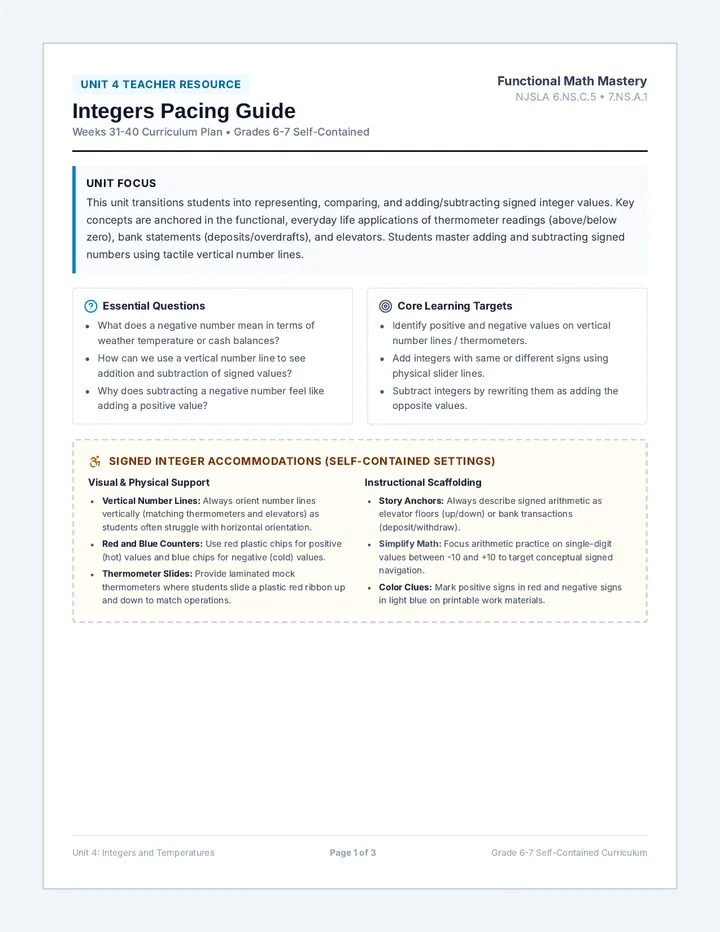
Unit 4 focuses on representing positive and negative integers in functional real-world contexts like thermometer readings and bank overdrafts, and adding/subtracting integers using vertical number lines. Aligned with NJSLA 6.NS.C.5 and 7.NS.A.1.
Integers Pacing Guide
A 3-page comprehensive pacing guide and accommodation manual for Weeks 31-40, focusing on representing and adding/subtracting integers in functional real-world contexts like thermometer readings and bank overdrafts.
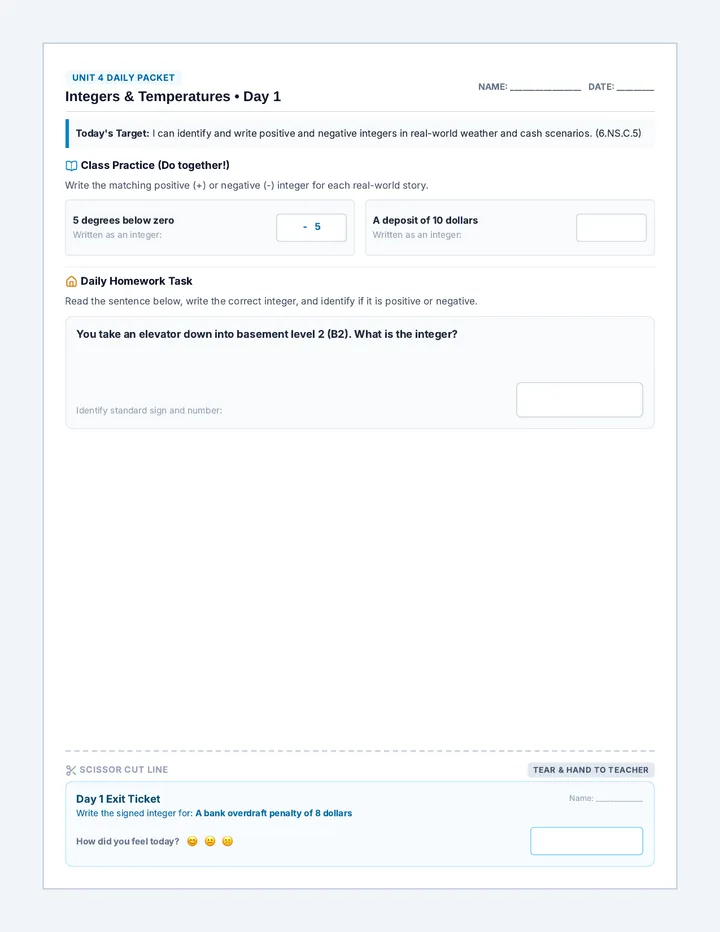
Integers Temperature Worksheet
A 5-page student daily workbook containing structured daily practice exercises, custom homework tasks, and tear-off style exit tickets for Days 1-5 of Unit 4.
Functional Math Mastery A comprehensive 30-week math curriculum sequence designed for self-contained 6th and 7th-grade classrooms. It bridges academic NJSLA standards with crucial functional life skills, featuring extensive accommodations, structured daily targets, and practical applications.
MS Michelle Sosnoff
Decimals Pacing Guide Unit 1 Teacher Resource
Decimals and Dollars Pacing Guide
Weeks 1-10 Curriculum Plan • Grades 6-7 Self-Contained
Functional Math Mastery NJSLA 6.NS.B.3 • 7.NS.A.3
Unit Focus
This unit bridges academic standards for decimal operations with essential life-skills of money management, budgeting, and transaction processing. Standard algorithms are scaffolded with tactile currency manipulatives, grid-aligned worksheets, and simplified vocabulary to maximize accessibility for diverse learners.
Essential Questions
Why does the placement of the decimal point change a number's value?
How does knowing how to add and subtract decimals protect my money?
How can I estimate totals to ensure I have enough cash before paying?
Core Learning Targets
Identify decimal place values to the hundredths using dollar bills/coins.
Align decimal points to add/subtract currency values up to $100.00.
Multiply and divide decimals in simple consumer-purchase scenarios.
Universal Accommodations Portfolio (Self-Contained Settings)
Visual & Physical Support
Visual Anchors: Color-code the decimal point (always green) and whole numbers/decimals with distinct shading.Concrete Manipulatives: Use play money ($1, $10 bills; quarters, dimes, pennies) for every worksheet problem.Grid Formats: Provide graph paper or heavy-lined grids to align place values vertically during addition/subtraction.
Instructional Scaffolding
Chunked Delivery: Limit instruction to one step at a time (e.g., Step 1: Write numbers; Step 2: Line up decimals; Step 3: Add).Prompting Hierarchy: Use verbal prompts → visual cues → hand-over-hand modeling of calculator/manipulative use.Functional Adaptations: Focus heavily on real dollar amounts ($1.50 instead of theoretical decimals like 1.5).
Unit 1: Decimals and Dollars Page 1 of 3 Grade 6-7 Self-Contained Curriculum
Weeks 1-5: Place Value & Adding/Subtracting Dollars
Daily Skill Targets, Functional Links, & Accommodations
Teacher Guide
WEEK 1: Introduction to Decimal Place Value NJSLA Standard: 6.NS.B.3
Day 1: Whole vs Part
Sort whole dollars vs. partial cents. Use sorting trays.
Day 2: Tenths Place
Introduce dimes ($0.10) as tenths of a dollar. Grid grids.
Day 3: Hundredths
Introduce pennies ($0.01) as hundredths of a dollar.
Day 4: Number Form
Write prices matching oral cues (e.g., "four dollars, fifty cents").
Day 5: Review & Quiz
Formative check matching actual coins to decimal text.
WEEK 2: Matching Values & Number Lines NJSLA Standard: 6.NS.C.6c
Day 1: Price Tags
Match price tags to actual play money piles.
Day 2: Number Lines
Place currency amounts on $0-$5 interval number lines.
Day 3: Ordering Decimals
Identify which of two items is more expensive ($3.50 vs $3.05).
Day 4: Ordering Sets
Sort 4 item price tags from cheapest to costliest.
Day 5: Grocery Sort
Sort real-world grocery boxes based on price points.
WEEK 3: Adding Decimals (No Regrouping) NJSLA Standard: 6.NS.B.3
Day 1: Grid Alignment
Write problems on grid templates; focus on decimal alignment.
Day 2: Sums < $10.00
Add bills & coins with play money. No regrouping.
Day 3: Combo Buying
Calculate cost of buying 2 small items (e.g., $1.20 + $2.50).
Day 4: Multi-Item Adds
Add 3 small items using column alignment grids.
Day 5: Store Activity
Simulate checkout with simplified non-regrouping items.
WEEK 4: Adding Decimals with Regrouping NJSLA Standard: 6.NS.B.3
Day 1: Exchange Rules
Practice exchanging 10 pennies for 1 dime, 10 dimes for $1.
Day 2: Carrying Over
Introduce "carrying" across decimal point onto grid sheet.
Day 3: Shopping math
Calculate totals for high-regroup items (e.g., $4.99 + $2.15).
Day 4: Estimation
Estimate sum of decimals to nearest whole dollar first.
Day 5: Partner Store
Check each other's addition using actual basic calculators.
WEEK 5: Subtracting Decimals (No Borrowing) NJSLA Standard: 7.NS.A.3
Day 1: Subtraction Grid
Align place values to subtract small decimals without borrowing.
Day 2: Change Back
Subtracting items from a single dollar bill or five-dollar bill.
Day 3: Price Differences
Determine how much more one product costs than another.
Day 4: Coupon Deduct
Apply visual coupons to lower the price tags of items.
Day 5: Halfway Check
Review placement, additions, and direct subtractions.
Unit 1: Decimals and Dollars Page 2 of 3 Grade 6-7 Self-Contained Curriculum
Weeks 6-10: Advanced Operations & Budgeting Applications
Daily Skill Targets, Multi-Step Problems, & Assessment Plan
Teacher Guide
WEEK 6: Subtracting with Borrowing (Making Change) NJSLA Standard: 7.NS.A.3
Day 1: Borrowing Intro
Practice borrowing 1 dollar to make 10 dimes on paper grids.
Day 2: Cashier Trick
Subtracting from even bills ($5.00, $10.00) using regrouping.
Day 3: Word Scenarios
Solve "How much change should you receive?" stories.
Day 4: Error Hunt
Identify wrong change amounts on mocked checkout receipts.
Day 5: Store Check
Live cashier simulation game using paper money sets.
WEEK 7: Multiplying Decimals (Quantities & Unit Pricing) NJSLA Standard: 6.NS.B.3
Day 1: Repeated Add
Build 3 copies of $1.50 with money, add them to show 3 x $1.50.
Day 2: Count Decimals
Learn to place decimal point by counting digits from right.
Day 3: Multiplying Whole
Multiply price by whole numbers (e.g., 4 shirts at $5.50 each).
Day 4: Real Receipt
Calculate item line totals on a receipt worksheet.
Day 5: Match & Paste
Match multiplication expressions to total amount models.
WEEK 8: Simple Division of Decimals (Sharing Costs) NJSLA Standard: 6.NS.B.3
Day 1: Splitting Cash
Split physical $10.00 or $5.00 bills between 2 peers.
Day 2: Direct Division
Divide even decimal numbers by whole number divisors.
Day 3: Cost Sharing
Find price of 1 item from a multi-pack price (e.g. 4 for $6.00).
Day 4: Unit Rates intro
Compare divide outcomes (which pack is cheaper per unit?).
Day 5: Pizza Sharing
Divide price of a class pizza party among 3-4 students.
WEEK 9: Multi-Step Budgeting Project
Objectives: Plan a simulated meal with a strict $20.00 budget limit.
Select items from catalog, add items, estimate tax, check budget ceiling, calculate remaining funds.
WEEK 10: Review and Unit Assessment
Assessment: Structured 1:1 or small-group standard evaluation.
Accommodated matching, alignment grids, simplified calculations, and optional read-aloud support.
Functional Assessment Strategies
Diagnostic Interview
Assess understanding verbally or via tactile placement. Ask: "Can you show me $1.35 with these coins?"
Portfolio Tracking
Save students' lined-grid addition/subtraction worksheets over weeks 3-6 to verify baseline-to-independent progress.
Alternative Scoring
Award partial credit for correct decimal alignment and cash setup even if arithmetic calculation contains a basic error.
Unit 1: Decimals and Dollars Page 3 of 3 Grade 6-7 Self-Contained Curriculum
Decimals Budgeting Worksheet Unit 1 Daily Packet
Decimals & Dollars • Day 1
Name: _________________ Date: _________
Today's Target: I can identify whole dollars and decimal parts using bills and dimes. (6.NS.B.3)
Class Practice (Do together!)
Identify the decimal values of the money blocks shown below.
3 Dollars & 4 Dimes Standard form price tag:
$3.40
5 Dollars & 8 Dimes Standard form price tag:
Daily Homework Task
Write down the total money amount. Draw play money bills or coins if you need help!
You have 1 five-dollar bill and 6 dimes. What is your decimal total?
Show your drawing or math notes below:
$
Scissor Cut Line Tear & Hand to Teacher
Day 1 Exit Ticket
Write the decimal number for: 7 Whole Dollars & 2 Dimes
Name: _____________
How did you feel today? 😊 😐 ☹️
Unit 1 Daily Packet
Decimals & Dollars • Day 2
Name: _________________ Date: _________
Today's Target: I can line up decimals vertically to add currency without regrouping. (6.NS.B.3)
Class Practice (Do together!)
Add the prices below. Keep your decimal points perfectly lined up!
Problem A: $1.35 + $4.20
$1.35
+$4.20
$5.55
Problem B: $3.50 + $2.14
$3.50
+$2.14
$.
Daily Homework Task
Solve this horizontal equation by lining them up vertically in the white box.
Question:
Find the total of: $6.02 + $1.75
Hint: Place values match up perfectly!
$6.02
+ $1.75
$ __.__
Scissor Cut Line Tear & Hand to Teacher
Day 2 Exit Ticket
Line up and add: $5.40 + $3.10
Name: _____________
Need help today? Yes Some No
Unit 1 Daily Packet
Decimals & Dollars • Day 3
Name: _________________ Date: _________
Today's Target: I can add decimal prices with regrouping/carrying values across columns. (6.NS.B.3)
Class Practice (Do together!)
Be careful: when you reach 10 cents, you must carry 1 over into the next column!
Problem A: $4.55 + $1.65 (Carry over)
Fractions Pacing Guide Unit 2 Teacher Resource
Fractions and Food Pacing Guide
Weeks 11-20 Curriculum Plan • Grades 6-7 Self-Contained
Functional Math Mastery NJSLA 6.NS.A.1 • 7.NS.A.1-2
Unit Focus
This unit introduces fraction concepts, equivalents, and operations through the hands-on kitchen skill of recipe scaling. Standard visual fraction models are reinforced using realistic physical measuring cups, tactile sensory bins (e.g., rice/water measuring), and scaffolded, visual recipe conversion tables.
Essential Questions
How do fractions help us measure food ingredients accurately?
What does it mean when two fractions "look different" but represent the same amount?
How can we double or halve a recipe to feed more or fewer people?
Core Learning Targets
Identify visual models of halves, thirds, and quarters.
Match equivalent fraction pairs (e.g., 2/4 is equivalent to 1/2).
Add fractions with like denominators in cup measurement contexts.
Culinary & Tactile Accommodations (Self-Contained Settings)
Visual & Physical Support
Tactile Cups: Provide measuring cups with bold, clear plastic-raised lettering for fraction labels.Pouring Practice: Use dry rice, beans, or colored water in sensory tables to physically build fraction equivalents.Fraction Tiles: Use circle "pizza" fractions to physically model addition and subtraction.
Instructional Scaffolding
Pictorial Support: Show fraction labels with companion circle-pie or cup drawings.Scaffolded Worksheets: Keep math simple by focusing strictly on common denominators (2, 3, 4, 8).Task Analysis: Split recipe scaling into discrete tasks: reading standard quantity, halving quantity, measuring.
Unit 2: Fractions and Food Page 1 of 3 Grade 6-7 Self-Contained Curriculum
Weeks 11-15: Visual Fractions & Equivalence
Daily Skill Targets, Functional Links, & Accommodations
Teacher Guide
WEEK 11: Introduction to Halves and Quarters NJSLA Standard: 6.NS.A.1
Day 1: Whole vs Half
Slice paper pizzas and real sandwiches in half. Identify 1/2.
Day 2: Quarters Intro
Slice halves again to introduce quarters (1/4). Draw shapes.
Day 3: Pizza Slices
Match fractional parts of circles to 1/2 and 1/4 labels.
Fractions Kitchen Worksheet Unit 2 Daily Packet
Fractions & Food • Day 1
Name: _________________ Date: _________
Today's Target: I can identify halves, thirds, and quarters using visual circle fraction models. (6.NS.A.1)
Class Practice (Do together!)
Identify the visual fractions representing slices of food.
Circle with 1 of 2 parts shaded Written standard fraction:
1 / 2
Circle with 3 of 4 parts shaded Written standard fraction:
Daily Homework Task
Draw a circle to represent a pizza, then shade exactly 1/4 of it!
Your Drawing Box:
Divide into 4 equal slices before shading.
Shaded: 1/4
Scissor Cut Line Tear & Hand to Teacher
Day 1 Exit Ticket
Write the written fraction for: Two slices of a three-slice pie
Name: _____________
How did you feel today? 😊 😐 ☹️
Unit 2 Daily Packet
Fractions & Food • Day 2
Name: _________________ Date: _________
Today's Target: I can identify equivalent fractions such as 1/2 and 2/4 using visual maps. (6.RP.A.3)
Class Practice (Do together!)
Check the visual fraction columns below to match equivalent quantities.
Model A: 1/2 of a standard bar
1/2
Model B: 2/4 of a standard bar
1/4
1/4
Daily Homework Task
If your 1/2 cup scoop is dirty, how many times do you need to scoop 1/4 cup ?
Question:
Write down the equivalent number of scoops needed to reach 1/2 cup.
Remember: 1/4 + 1/4 = 2/4.
_____ Scoops
of 1/4 cup
Scissor Cut Line Tear & Hand to Teacher
Day 2 Exit Ticket
Are 1/3 cup and 2/6 cup equivalent fractions?
Name: _____________
Need help today? Yes Some No
Unit 2 Daily Packet
Fractions & Food • Day 3
Name: _________________ Date: _________
Today's Target: I can identify and sequence physical measuring cups from smallest to largest volume. (7.NS.A.3)
Class Practice (Do together!)
Write down the fractions matching the raised print labels on our kitchen scoops.
Ratios Pacing Guide Unit 3 Teacher Resource
Rates and Shop Math Pacing Guide
Weeks 21-30 Curriculum Plan • Grades 6-7 Self-Contained
Functional Math Mastery NJSLA 6.RP.A.3 • 6.EE.B.7 • 7.RP.A.1
Unit Focus
This unit transitions students into rates, comparisons, and basic linear modeling. Key learning focuses on comparison shopping (best unit price), calculating store percentage discounts, and utilizing basic algebraic equations to model personal income, paychecks, and routine living expenses.
Essential Questions
How can I compare store prices to know which deal actually saves money?
What does "percentage discount" mean for my budget at checkout?
How do we use letter variables to figure out unknown shopping costs?
Core Learning Targets
Write basic ratios (e.g. 2 markers to 3 pencils) from visuals.
Determine unit price to make comparison store purchases.
Apply basic percents (10%, 20%, 50%) to calculate store discounts.
Rates & Algebraic Accommodations (Self-Contained Settings)
Visual & Physical Support
Visual Price Tags: Create double-sided product tags showing original price alongside pre-calculated discounted amounts.Algebra Balance: Use physical balance scale models to demonstrate "keeping equations balanced" on both sides.Unit Price Cards: Color code cost cards to make division ratios visually simple.
Instructional Scaffolding
Simplified Equations: Target whole numbers in equations first (e.g., \( x + 5 = 12 \)) before rational decimals.Calculator Integration: Teach students explicitly how to execute percentage operations on standard calculators.Graphic Organizers: Provide multi-column forms for comparison shopping columns (Pack A vs Pack B).
Unit 3: Rates and Shop Math Page 1 of 3 Grade 6-7 Self-Contained Curriculum
Weeks 21-25: Ratios & Unit Rates Comparison
Daily Skill Targets, Comparison Shopping, & Ratio Models
Teacher Guide
WEEK 21: Basic Ratio Concepts & Real Objects NJSLA Standard: 6.RP.A.1
Day 1: What is a Ratio?
Define ratio as a comparison. Use plastic shapes (3 blue to 2 red).
Day 2: Colons & Text
Write ratio expressions in 3 ways: "3 to 2", "3:2", and "3/2".
Day 3: Class Ratios
Count classmates (e.g. boys to girls ratio). Graph outcomes.
Ratios Sales Worksheet Unit 3 Daily Packet
Rates & Shop Math • Day 1
Name: _________________ Date: _________
Today's Target: I can write basic ratios using colons to compare classroom objects. (6.RP.A.1)
Class Practice (Do together!)
Count the items and write down the comparison ratio (e.g., 3:2).
🖍️ 3 Red Markers to ✏️ 2 Yellow Pencils Written colon ratio:
3 : 2
🎒 1 Blue Backpack to 📓 4 Notebooks Written colon ratio:
Daily Homework Task
Count items in your home or desk, then write down the ratio.
You have 5 forks and 3 spoons on the kitchen table. What is the ratio?
Ratio of forks to spoons:
____ : ____
Scissor Cut Line Tear & Hand to Teacher
Day 1 Exit Ticket
Write the ratio for: 2 green chairs and 5 blue tables
Name: _____________
How did you feel today? 😊 😐 ☹️
Unit 3 Daily Packet
Rates & Shop Math • Day 2
Name: _________________ Date: _________
Today's Target: I can calculate the unit price (cost of one single item) using division. (6.RP.A.2)
Class Practice (Do together!)
Divide total cost by quantity to find price for 1 item.
Problem A: Pack of 3 sodas for $6.00
$6.00 ÷ 3
Cost:$2.00
Problem B: Pack of 4 markers for $8.00
$8.00 ÷ 4
Cost:$.
Daily Homework Task
Solve this unit rate division. Show your work in the white box.
Question:
A box of 5 snack cupcakes costs $10.00 . What is the unit cost for 1 cupcake?
Divide $10.00 by 5 cupcakes.
$10.00 ÷ 5
$ __.__
Scissor Cut Line Tear & Hand to Teacher
Day 2 Exit Ticket
Find the unit price: Pack of 2 drinks for $4.00
Name: _____________
Need help today? Yes Some No
Unit 3 Daily Packet
Rates & Shop Math • Day 3
Name: _________________ Date: _________
Today's Target: I can compare two different pack deals to find the cheaper unit price. (7.RP.A.1)
Class Practice (Do together!)
Which deal is cheaper per soda bottle? Check the unit prices.
Deal A: 2 Pack of sodas for $6.00
Integers Pacing Guide Unit 4 Teacher Resource
Integers Pacing Guide
Weeks 31-40 Curriculum Plan • Grades 6-7 Self-Contained
Functional Math Mastery NJSLA 6.NS.C.5 • 7.NS.A.1
Unit Focus
This unit transitions students into representing, comparing, and adding/subtracting signed integer values. Key concepts are anchored in the functional, everyday life applications of thermometer readings (above/below zero), bank statements (deposits/overdrafts), and elevators. Students master adding and subtracting signed numbers using tactile vertical number lines.
Essential Questions
What does a negative number mean in terms of weather temperature or cash balances?
How can we use a vertical number line to see addition and subtraction of signed values?
Why does subtracting a negative number feel like adding a positive value?
Core Learning Targets
Identify positive and negative values on vertical number lines / thermometers.
Add integers with same or different signs using physical slider lines.
Subtract integers by rewriting them as adding the opposite values.
Signed Integer Accommodations (Self-Contained Settings)
Visual & Physical Support
Vertical Number Lines: Always orient number lines vertically (matching thermometers and elevators) as students often struggle with horizontal orientation.Red and Blue Counters: Use red plastic chips for positive (hot) values and blue chips for negative (cold) values.Thermometer Slides: Provide laminated mock thermometers where students slide a plastic red ribbon up and down to match operations.
Instructional Scaffolding
Story Anchors: Always describe signed arithmetic as elevator floors (up/down) or bank transactions (deposit/withdraw).Simplify Math: Focus arithmetic practice on single-digit values between -10 and +10 to target conceptual signed navigation.Color Clues: Mark positive signs in red and negative signs in light blue on printable work materials.
Unit 4: Integers and Temperatures Page 1 of 3 Grade 6-7 Self-Contained Curriculum
Weeks 31-35: Signed Values & Vertical Number Lines
Daily Skill Targets, Functional Links, & Accommodations
Teacher Guide
WEEK 31: Concept of Negative Values (Above/Below Zero) NJSLA Standard: 6.NS.C.5
Day 1: Chilly Temperatures
Introduce weather temperatures below 0 degrees. Sort cold vs hot.
Integers Temperature Worksheet Unit 4 Daily Packet
Integers & Temperatures • Day 1
Name: _________________ Date: _________
Today's Target: I can identify and write positive and negative integers in real-world weather and cash scenarios. (6.NS.C.5)
Class Practice (Do together!)
Write the matching positive (+) or negative (-) integer for each real-world story.
5 degrees below zero Written as an integer:
- 5
A deposit of 10 dollars Written as an integer:
Daily Homework Task
Read the sentence below, write the correct integer, and identify if it is positive or negative.
You take an elevator down into basement level 2 (B2). What is the integer?
Identify standard sign and number:
Scissor Cut Line Tear & Hand to Teacher
Day 1 Exit Ticket
Write the signed integer for: A bank overdraft penalty of 8 dollars
Name: _____________
How did you feel today? 😊 😐 ☹️
Unit 4 Daily Packet
Integers & Temperatures • Day 2
Name: _________________ Date: _________
Today's Target: I can calculate absolute value (the positive distance from zero) on vertical scales. (6.NS.C.7c)
Class Practice (Do together!)
Count how many steps away each number is from the center zero point. Absolute value is always positive!
Model A: Absolute Value of -4
Equation notation:
| -4 | = 4
(Distance steps to zero)
Model B: Absolute Value of +6
Equation notation:
| +6 | = _____
(Try counting the steps!)
Daily Homework Task
Compute absolute values. Remember: distance is always a positive number!
Question:
Find the absolute values:| -7 | and | +3 |
Drop the signs to find standard distances.
| -7 | =
| +3 | =
Scissor Cut Line Tear & Hand to Teacher
Day 2 Exit Ticket
Calculate the value: | -9 |
Name: _____________
Need help today? Yes Some No
Unit 4 Daily Packet
Integers & Temperatures • Day 3
Name: _________________ Date: _________
Today's Target: I can add integers with the same signs using vertical thermometer number lines. (7.NS.A.1)
Problem B: $2.48 + $3.85 (Try it!)
Daily Homework Task Practice carrying decimals vertically. Show all your steps in the grid!
Find the sum: $5.99 + $2.15
Hint: 9 + 5 = 14, carry the 1!
Scissor Cut Line Tear & Hand to Teacher
Day 3 Exit Ticket Line up and add: $6.75 + $1.45
Pacing speed today? Too Fast Perfect Too Slow
Decimals & Dollars • Day 4 Name: _________________ Date: _________
Today's Target: I can subtract decimal prices to calculate cashier change from a $5.00 bill. (7.NS.A.3)
Class Practice (Do together!) We buy a cookie for $1.50. We pay with a $5.00 bill. How much change do we get back?
Problem A: $5.00 - $1.50 (Borrowing steps)
Problem B: $5.00 - $2.25 (Try borrowing!)
Daily Homework Task Practice subtracting from whole bills. Write numbers vertically to subtract!
You pay with $10.00 . Your meal costs $6.50 . How much change is left?
Remember to drop the decimal point straight down!
Scissor Cut Line Tear & Hand to Teacher
Day 4 Exit Ticket Calculate change: pay with $5.00 , item costs $4.10 .
Use play money today? Yes No
Decimals and Dollars • Day 5 Check Name: _________________ Date: _________
Directions to Student: Read each question carefully. Use your vertical grids to show your math work. Ask your teacher if you need questions read aloud.
1. Place Value Matching Match the word description to the correct standard decimal price tag.
3 Whole Dollars & 2 Dimes $3.20
3 Whole Dollars & 2 Pennies $3.02
2. Vertical Decimal Addition Add the numbers vertically. Show any carrying values in the small slots.
3. Making Cashier Change You buy popcorn for $3.50 . You pay with a $5.00 bill . Subtract to find your change.
Line up decimals.
Borrow across zeros.
Write dollar sign.
Unit 1: Decimals and Dollars Page 5 of 5 Grade 6-7 Self-Contained Curriculum
Label numerator (top/parts) and denominator (bottom/whole).
Hands-on assessment sorting physical visual pieces.
WEEK 12: Equivalence Basics (1/2 = 2/4) NJSLA Standard: 6.RP.A.3
Lay two 1/4 tiles directly over one 1/2 tile to show equivalence.
Fill two 1/4 cups of water and pour into 1/2 cup to show same volume.
Color shapes representing 2/4 and 1/2 to verify visually.
Navigate printed fraction bar sheets to match basic pairs.
Group activity matching equivalent fraction cards.
WEEK 13: Measuring Cup Identification NJSLA Standard: 7.NS.A.3
Hold and label physical 1/4, 1/3, 1/2, and 1-cup measures.
Arrange cups in a line from smallest volume to largest volume.
Identify which physical cup is needed for a prompt on screen.
Practice pouring dry ingredients exactly to lines on measuring cups.
Match recipe card text to real cups (e.g. 1/3 cup of sugar).
WEEK 14: Thirds and Sixths (Diving Deeper) NJSLA Standard: 6.NS.A.1
Split a rectangle or square into 3 equal columns. Label 1/3.
Practice filling 1/3 cup to visual marks using sandbox sand.
Split thirds in half to show 1/6. Compare size: 1/3 vs 1/6.
Compare 2/6 to 1/3 using clear overlays and bar blocks.
Draw and cut circles representing thirds and sixths.
WEEK 15: Ordering and Comparing Fractions NJSLA Standard: 6.NS.C.7
Which is more: 3/4 or 1/4? Color shapes to confirm.
Which is more: 1/2 or 1/4? Discuss denominator sizes.
Line up fractions (1/4, 1/2, 3/4) from least to greatest.
Create an interactive classroom poster for ordering values.
Review equivalence and comparison through sorting tasks.
Unit 2: Fractions and Food Page 2 of 3 Grade 6-7 Self-Contained Curriculum
Weeks 16-20: Adding Fractions & Recipe Scaling Projects Daily Skill Targets, Functional Applications, & Assessments
WEEK 16: Adding Fractions (Like Denominators) NJSLA Standard: 7.NS.A.1
Color 1/4 of a circle, then 2/4. Count total shaded wedges (3/4).
Explain the rule: add numerators only, denominator stays same.
Add fractions of cups of ingredients (e.g. 1/3 cup + 1/3 cup).
Show mixed numbers: 2/3 + 2/3 = 4/3 or 1 and 1/3 cups.
Review like-denominator sums using visual recipe prompt cards.
WEEK 17: Halving Recipes (Dividing Fractions) NJSLA Standard: 6.NS.A.1
Halve whole numbers first (e.g., half of 4 cups is 2 cups).
Halve 1/2 of a cup using measuring cups to discover 1/4 cup.
Introduce division rules with visual fraction cards and recipes.
Given a 3-item recipe, rewrite the quantities halved.
Differentiate halving with simple cookie dough templates.
WEEK 18: Doubling Recipes (Multiplying Fractions) NJSLA Standard: 7.NS.A.2
Multiply cups of flour by 2 (e.g. 2 x 3 cups = 6 cups).
Double 1/2 to show 2/2 or 1 whole cup using sandbox measures.
Double 1/4 to get 2/4 (equivalent to 1/2 cup).
Day 4: Interactive Recipe
Scale up biscuit recipe measurements. Record on charts.
Peer challenge game scaling recipes under time limits.
WEEK 19: Culinary Math Lab
Hands-on: Run a no-bake oatmeal cookie recipe lab.
Measure, double or halve parts in team cooking groups, check outcomes, eat final results!
WEEK 20: Unit Assessment & Showcase
Assessment: Standard and performance fractions evaluation.
Demonstrate fraction concepts physically with measuring cups, followed by written review paper.
Culinary Math Lab Assessments
Physical Task Analysis Score accuracy on pouring and scoop selection independently vs needing assistance prompts.
Equivalent Matching Assess if students can pair different size templates on a magnetic fraction board without errors.
Recipe Translation Grade the written student worksheet for correct mathematical fractions before cookie making.
Unit 2: Fractions and Food Page 3 of 3 Grade 6-7 Self-Contained Curriculum
Problem A: One Quarter Scoop
(Smallest standard scoop)
Problem B: One Third Scoop
Daily Homework Task Which scoop is larger? Write the correct comparison sign (> or <) in the circle.
Compare: 1/2 cup versus 1/4 cup
Hint: Halves are bigger than quarters!
Scissor Cut Line Tear & Hand to Teacher
Day 3 Exit Ticket Sort from smallest to largest: 1/2 cup, 1/4 cup, 1 cup
Pacing speed today? Too Fast Perfect Too Slow
Fractions & Food • Day 4 Name: _________________ Date: _________
Today's Target: I can add recipe fractions with common denominators (like 1/4 + 2/4). (7.NS.A.1)
Class Practice (Do together!) Remember: add the top numbers (numerators) only. Bottom number stays same!
Problem A: 1/4 + 2/4 cup of sugar
Problem B: 1/3 + 1/3 cup of milk
Daily Homework Task Practice kitchen addition equations. Show your numerator additions!
Add: 1/8 + 4/8 cup of oats
Denominator rule: do not add the 8s!
Scissor Cut Line Tear & Hand to Teacher
Day 4 Exit Ticket Add fractions: 2/4 cup flour + 1/4 cup sugar
Use circle models today? Yes No
Fractions & Food • Day 5 Check Name: _________________ Date: _________
Directions to Student: Read each fraction question. Shade circles, write cup numbers, and add denominators carefully. Ask for a read-aloud if needed.
1. Circle Fraction Shading Shade exactly the written fraction below.
2. Match Equivalent Cup Sizes Connect the matching fraction pairs that equal the same amount.
1/2 Cup is equal to: _____ / 4 Cup
1/3 Cup is equal to: _____ / 6 Cup
2/2 Cup is equal to: _____ Whole Cup
Scooping a 1/4 cup two times gives you exactly 1/2 cup of chocolate chips!
3. Kitchen Fraction Additions Find the sum of recipe flour cup measurements.
Unit 2: Fractions and Food Page 5 of 5 Grade 6-7 Self-Contained Curriculum
Count pencil box ratios (pens vs highlighters) in journals.
Identify ratio matches from multiple-choice picture worksheets.
WEEK 22: Equivalent Ratios & Scaling Mixes NJSLA Standard: 6.RP.A.3a
Mix blue & yellow paint. Scale: 1 blue drop to 2 yellow drops.
Double ratio to 2:4 drops. Compare: shades are identical.
Scale lemonade ratios (1 cup powder to 4 cups water).
Fill in blank numbers on visual pattern scaling grids.
Group activity classifying card decks of equivalent ratios.
WEEK 23: Understanding Unit Rates (Price Per Item) NJSLA Standard: 6.RP.A.2
Introduce "for each" pricing (e.g. 3 apples for $3.00).
Day 2: Finding Unit Price
Divide total cost by quantity to find cost of 1 single item.
Practice with simple division numbers (e.g., 4 shirts for $20).
Calculate unit rates with simple decimals using calculator.
Calculate single-item costs for bulk items in school store.
WEEK 24: Comparison Shopping & Target Deals NJSLA Standard: 7.RP.A.1
Compare box packs (e.g., 2 sodas for $4 vs 1 soda for $3).
Divide store sizes (e.g., 10oz chips for $5 vs 5oz chips for $3).
Find comparison deals on actual local grocery flyers.
Complete multi-column sheet finding cheapest per-unit price.
Compare snack sizes in real checkout simulation activity.
WEEK 25: Percents as Parts of 100 NJSLA Standard: 6.RP.A.3c
Introduce percent using a visual 100-square grid block sheet.
Shade grid boxes to represent 50%, 25%, and 10% values.
Day 3: Percentages & money
Connect 50% to half-off and 100% to paying full price.
Align fractions to percents (1/2 is 50%, 1/4 is 25%).
Matching quiz linking fraction visual blocks to percents.
Unit 3: Rates and Shop Math Page 2 of 3 Grade 6-7 Self-Contained Curriculum
Weeks 26-30: Percent Discounts & One-Step Equations Daily Skill Targets, Basic Algebra, & Final Evaluation
WEEK 26: Calculating Store Discounts (50% & 10% Off) NJSLA Standard: 7.RP.A.3
Cut prices directly in half to find 50% discount savings.
Slide the decimal point one spot to the left to find 10%.
Find 20% or 30% by counting 10% increments repeatedly.
Subtract the discount from original price to find checkout cost.
Purchase catalog items applying 10% or 50% discount coupons.
WEEK 27: Calculating Simple Tax & Restaurant Tips NJSLA Standard: 7.RP.A.3
Day 1: What is Sales Tax?
Explain sales tax as an extra cost. Use receipt models.
Discuss tips for dining. Use standard 15% and 20% prompts.
Learn shortcut tip cards (15% is approx. $1.50 per $10).
Day 4: Restaurant Receipt
Add tips and taxes onto simulated dining checks.
Order from a café menu, calculate total including tax/tip.
WEEK 28: Writing Simple Algebraic Expressions NJSLA Standard: 6.EE.A.2
Introduce letter variables representing unknown values.
Write total cost formula for multiple items (e.g. $3 per ticket: 3t).
Evaluate 3t when t is 5 tickets ($15 total cost).
Translate: "five dollars plus the cost of food" → $5 + f.
Match scenario cards to their algebraic formulas.
WEEK 29: Solving One-Step Equations
Objectives: Solve simple add/subtract/multiply equations.
Solve \( x + 3 = 10 \) or \( 2x = 8 \) utilizing balance models and inverse check cards.
WEEK 30: Review and Curriculum Wrap
Assessment: Full 30-week math evaluation & celebration.
Review ratios, basic cooking fractions, vertical money calculations, and basic equations.
Shop Math Assessment Models
Comparison Shopping Score the student's ability to locate cheapest option on grocery shelves independently.
Calculator Percentages Assess correct step sequencing on standard calculator when finding 20% off.
Inverse Balance Check Grade the physical manipulative setup solving for the unknown variable \( x \).
Unit 3: Rates and Shop Math Page 3 of 3 Grade 6-7 Self-Contained Curriculum
Deal B: 6 Pack of sodas for $12.00
Daily Homework Task Compare store deals. Write which deal is cheaper in the drawing box.
Deal 1: 1 box for $4.00Deal 2: Pack of 2 for $6.00 ($3 each)
Scissor Cut Line Tear & Hand to Teacher
Day 3 Exit Ticket Which is cheaper: 1 burger for $3.00 or 2 burgers for $8.00 ?
Pacing speed today? Too Fast Perfect Too Slow
Rates & Shop Math • Day 4 Name: _________________ Date: _________
Today's Target: I can apply a 50% discount coupon to calculate half-off price tags. (7.RP.A.3)
Class Practice (Do together!) To find a 50% off price, divide the original price tag exactly by 2.
Problem A: Cool T-Shirt ($20.00 Original)
Problem B: Warm Jacket ($40.00 Original)
Daily Homework Task Practice finding 50% discount checkouts. Show your division!
Skate shoes cost $60.00 . Apply a 50% off discount coupon.
Scissor Cut Line Tear & Hand to Teacher
Day 4 Exit Ticket Calculate 50% discount: Cap costs $10.00 original
Use calculator today? Yes No
Rates & Shop Math • Day 5 Check Name: _________________ Date: _________
Directions to Student: Read each question carefully. Write colon ratios, compute division unit prices, and calculate discount tags. Ask for help if needed.
1. Writing Ratios Write down the colon ratios representing classroom objects.
🎒 2 Backpacks to 📓 5 Notebooks:
🖍️ 4 Markers to ✏️ 3 Pencils:
2. Computing Unit Prices Divide to find the single unit price matching the bulk box prices.
Problem A: 3 notebooks for $9.00
Finding unit price helps you discover which box has the better, cheaper checkout deal.
3. Coupon Discount Check Calculate the final price of the running shoes with 50% off.
Unit 3: Rates and Shop Math Page 5 of 5 Grade 6-7 Self-Contained Curriculum
Day 2: Elevation Sea Level
Model sea level as zero. Compare flying birds vs swimming fish.
Introduce overdraft debt as negative balance. Deposit is positive.
Explore elevator levels below ground lobby (e.g. basement B1).
Match daily scenario sentences to negative and positive integers.
WEEK 32: Reading and Marking Thermometers NJSLA Standard: 6.NS.C.6c
Identify zero point on a large vertical scale thermometer model.
Read and write temperatures above zero degrees. Color red bars.
Read and write temperatures below zero. Color blue ice bars.
Day 4: Temperature Changes
Describe rising and dropping mercury levels in weather stories.
Look at frozen landscapes, match with accurate sub-zero readings.
WEEK 33: Vertical Number Lines (-10 to +10) NJSLA Standard: 6.NS.C.6c
Draw vertical number lines with zero in the exact center.
Establish standard layout: higher tick marks are larger numbers.
Verify lower numbers are negative. Mark levels -1 through -10.
Physical task: slide plastic paperclips to targeted values.
Identify correct digit positions on vertically labeled charts.
WEEK 34: Absolute Value (Distance from Zero) NJSLA Standard: 6.NS.C.7c
Count steps back to zero from +3 and -3 on a classroom floor rug.
Day 2: Distance is Positive
Explain that distance is always a positive number (no negative steps).
Introduce absolute value notation bars (e.g. |-4| = 4).
Real-world: describe depth magnitude (swimming 5 feet deep is 5 steps).
Assess visual absolute values matching horizontal steps.
WEEK 35: Comparing & Ordering Signed Integers NJSLA Standard: 6.NS.C.7b
Identify which temperature is warmer (higher on thermometer).
Day 2: Below zero comparisons
Compare -5 degrees vs -1 degree. Which is colder?
Day 3: Signed inequalities
Write comparison statements using < and > for signed sets.
Arrange 4 signed numbers from coldest to warmest.
Review absolute values, visual locations, and comparisons.
Unit 4: Integers and Temperatures Page 2 of 3 Grade 6-7 Self-Contained Curriculum
Weeks 36-40: Adding & Subtracting Signed Numbers Daily Skill Targets, Arithmetic Scaffolds, & Final Evaluation
WEEK 36: Adding Integers (Same Signs) NJSLA Standard: 7.NS.A.1
Add whole positive values. Walk steps forward on number line.
Model negative addition: start below zero and go lower (-2 + -3).
Combine blue negative plastic counters to find negative totals.
Add magnitudes together, keep the common sign (e.g. -4 + -2 = -6).
Review same-sign operations using paired worksheet board games.
WEEK 37: Adding Integers (Different Signs) NJSLA Standard: 7.NS.A.1
Exchanging positive (+1) and negative (-1) counters to cancel out.
Start negative, walk positive (e.g. -3 + 5). Locate outcome.
Model temperature rise: starts at -4, rises 6 degrees.
Subtract absolute magnitudes, take the sign of the larger one.
Use water thermometers to demonstrate rising warmth arithmetic.
WEEK 38: Subtracting Integers (Subtract is Adding Opposites) NJSLA Standard: 7.NS.A.1c
Day 1: Keep Change Change
Introduce KCC formula: keep 1st, change sign, change 2nd number.
Practice: 3 - 5 is rewritten as 3 + (-5). Solve on number lines.
Practice: 2 - (-4) is rewritten as 2 + 4. Explain visual shift.
Solve multi-level elevator stories moving below parking garage.
Peer subtraction competition using laminated grid cards.
WEEK 39: Functional Weather Reporting Project
Real-World: Act as mock TV weather forecasters in Alaska.
Track high/low temperatures, subtract to find weekly drops, record and present sub-zero weather broadcasts.
WEEK 40: Review & Final Integers Assessment
Evaluation: Standard 1:1 or small-group integers check.
Solve signed arithmetic vertically using slider number lines, followed by comprehensive final scores.
Integers Assessment Models
Vertical Navigation Score accuracy on sliding paperclip up/down vertical lines to solve additions.
Keep-Change-Change Verify if student can correctly rewrite subtraction equations into equivalent additions.
Functional Scenarios Grade the written student worksheet matching freeze images to signed degrees.
Unit 4: Integers and Temperatures Page 3 of 3 Grade 6-7 Self-Contained Curriculum
Class Practice (Do together!) When signs are the same, combine their values and keep their common sign!
Problem A: -2 + -3 (Go lower!)
(Start at -2, go down 3 steps)
Problem B: -4 + -1 (Try it!)
(Start at -4, go down 1 step)
Daily Homework Task Find the negative sum. Draw helper counters if needed!
Hint: Keep the negative sign!
Scissor Cut Line Tear & Hand to Teacher
Day 3 Exit Ticket Pacing speed today? Too Fast Perfect Too Slow
Integers & Temperatures • Day 4 Name: _________________ Date: _________
Today's Target: I can add integers with different signs using zero pair counters. (7.NS.A.1)
Class Practice (Do together!) When signs are different, find their difference and keep the sign of the larger value.
Problem A: -4 + 6 (Temp rising!)
(Start at -4, go UP 6 steps)
Problem B: -3 + 2 (Try it!)
(Start at -3, go UP 2 steps)
Daily Homework Task Solve different-sign operations. Show your math on the vertical thermometer bar.
Start below zero and count upwards!
Scissor Cut Line Tear & Hand to Teacher
Day 4 Exit Ticket Add different signs: -5 + 7
Use zero counters today? Yes No
Integers & Temperatures • Day 5 Check Name: _________________ Date: _________
Directions to Student: Read each signed integer question. Use your vertical thermometer line sketches to solve vertical additions. Ask for help if needed.
1. Signed Integer Matching Match the real world story with the correct positive or negative standard integer.
A dive of 6 feet below sea level:
A deposit of 12 dollars in cash:
2. Distance Absolute Values Find the standard absolute positive steps from zero.
| -8 | is equal to: _________
| +4 | is equal to: _________
| -12 | is equal to: _________
Absolute value measures distance, which is always positive. You cannot take negative steps!
3. Vertical Thermometer Additions Compute the final temperatures using vertical number lines.
A) -4 + -3 = _________
(Use vertical slider lines)
Unit 4: Integers and Temperatures Page 5 of 5 Grade 6-7 Self-Contained Curriculum