Operation Blueprint Teacher Guide
REF: M.4.Q.OA.3 // DEEP COMPUTE
STANDARD M.4.Q.OA.3 PEDAGOGICAL MAP
OPERATION BLUEPRINT
A structured learning progression and scaffolding architecture for executing complex multi-step computations.
Standard Unpacked & Focus
M.4.Q.OA.3 Focus: Solving multi-step whole-number word problems using four operations. The pedagogical blueprint demands that students progress from parsing simple, disjointed steps to executing structured, unified operations nested inside custom-built algebraic equations.
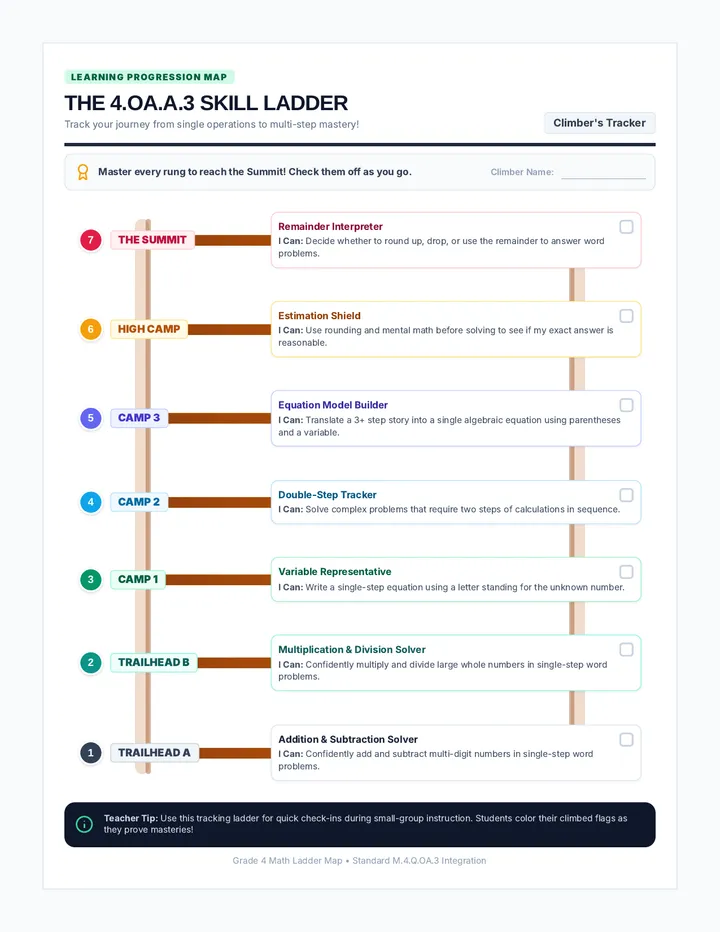
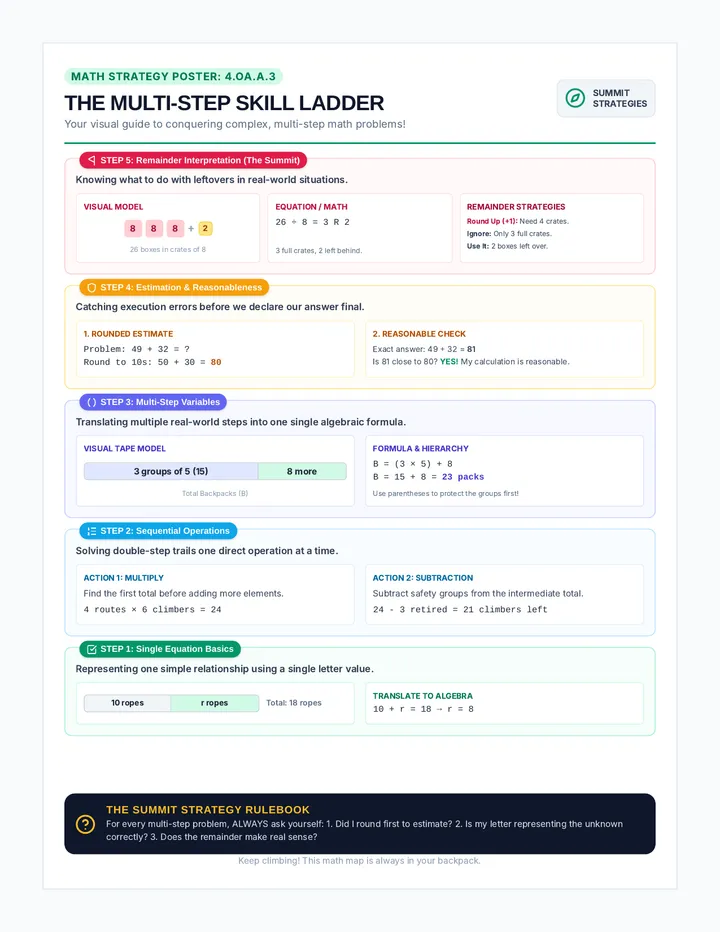
Learning Progression Roadmap
1
Single-Bridge Integration (Additive Focus)
Least Complex
Two discrete additive or subtractive relationships that build upon each other directly without operation priority shifts.
Example: 12 apples are picked, then 15 more. If 8 are eaten, how many are left?
Equation: \( (12 + 15) - 8 = 19 \)
2
Multi-Operational Splitting (Additive x Multiplicative)
Moderate
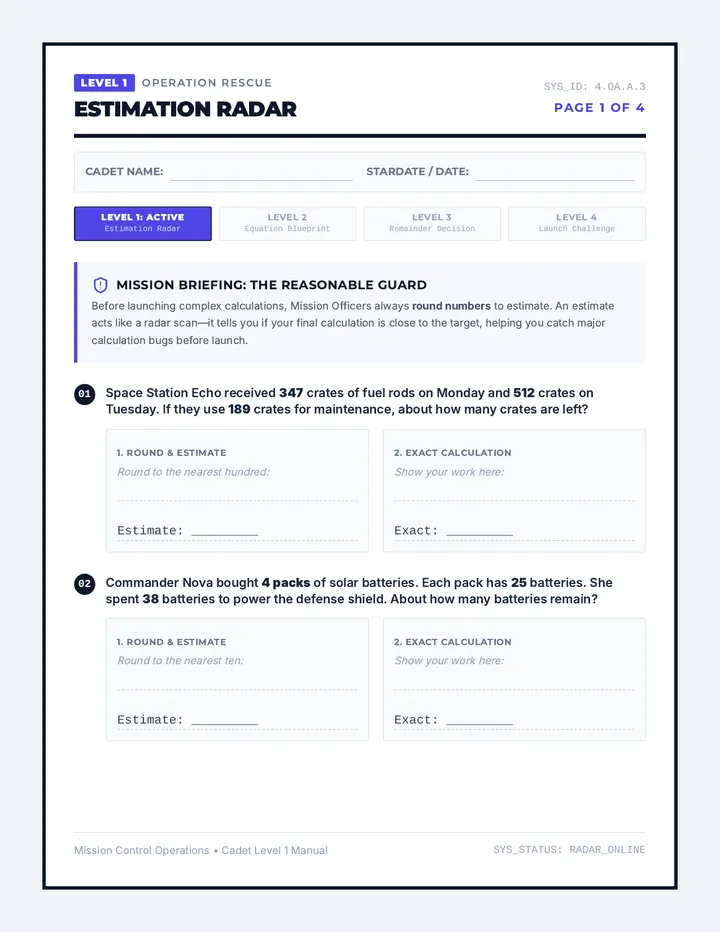
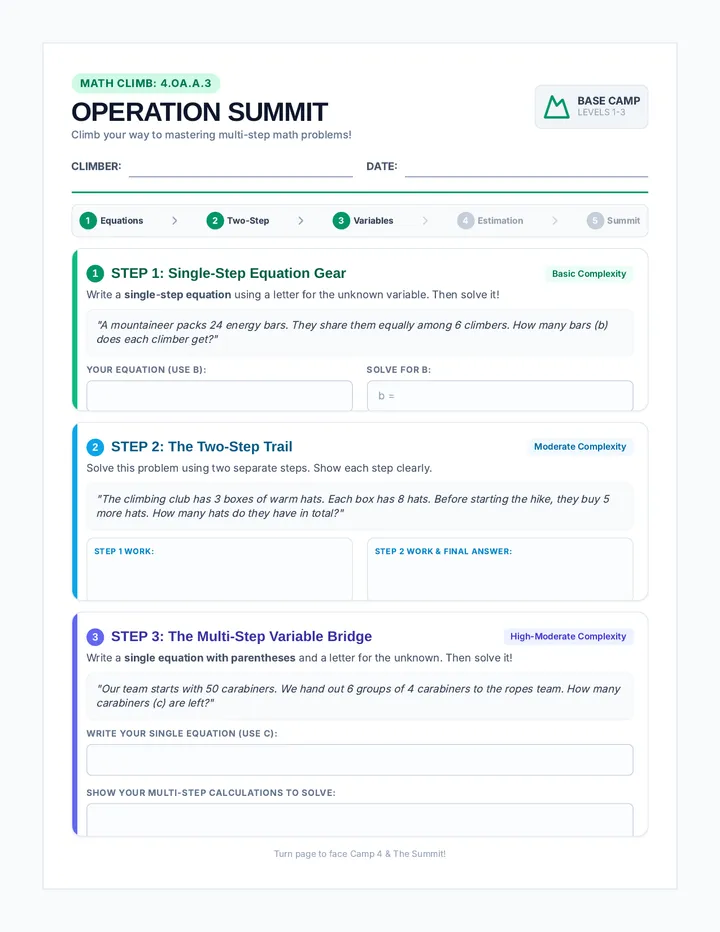
Introduction of distinct operations (multiplication/division alongside addition/subtraction) sequentially without parenthetical overrides.
Example: A baker makes 6 boxes of cupcakes, with 8 in each. She then sells 15.
Equation: \( (6 \times 8) - 15 = 33 \)
3
Nested Operational Grouping (Parentheses Priority)
High Complexity
Combining and comparing grouped totals where a lower precedence operation (addition/subtraction) must occur before multiplication/division.
Example: Total fruit from 3 boxes of 5 oranges and 4 boxes of 8 apples.
Equation: \( (3 \times 5) + (4 \times 8) = 47 \)
4
Unified Execution & Interpret-the-Remainder Bounds
Most Complex
Complex multi-operation loops where the final step includes division requiring students to interpret the remainder based on context.
Example: 80 total cookies minus 14 eaten. If packed into bags of 6, how many bags are needed?
Equation: \( (80 - 14) \div 6 = 11 \text{ R } 0 \) (exact)
M.4.Q.OA.3 • PROGRESSION WORKSPACE
PAGE 1 OF 3
SEC: 02 // MODELING DYNAMICS
Instructional Modeling
SCAFFOLDING MULTI-OPERATION COMPUTATION
Teaching kids how to construct operational pathways using tape models and Priority Trees.
Stage A: Concrete Tape Modeling
The Problem Context: A teacher buys 8 packs of whiteboard markers. There are 12 markers in each pack. She hands out 15 markers to Group A, and 23 markers to Group B. How many markers are remaining?
Total Markers Purchased: \( 8 \times 12 = 96 \)
Group A: 15
Group B: 23
Remaining: \( R \)
Formulaic Scaffold: \( R = (8 \times 12) - (15 + 23) \) Goal: Clear structural breakdown before computation.
Stage B: Order of Operations & The Priority Tree
Computational Priority Tree
\( (8 \times 12) - (15 + 23) \)
Step 1 (Left) Step 2 (Right)
96 Multiplication
-
38 Parentheses Add
⬇
Final Difference: 58
The 3 Rules of Multi-Execution:
- Group First: Force parentheses over variables that aggregate units (like Group A + Group B).
- Rank the Ops: Multiplications & divisions are computed prior to additions & subtractions unless grouped.
- Left-to-Right: If operations hold equal priority, solve sequentially from left to right.
Key Insight: 4th Graders fail when they perform basic left-to-right operations without analyzing precedence.
Teacher Intervention Pivot: Before calculating, require students to draw a "Strategy Path" by drawing thin, light arches underneath the equation to map the calculation order.
M.4.Q.OA.3 • PEDAGOGICAL TOOLKIT
PAGE 2 OF 3
SEC: 03 // DIAGNOSTIC & TRACKING
Diagnostic Suite
DIAGNOSTICS & LOOK-FOR EVIDENCE
Anticipating systematic errors and tracking student execution during active problem-solving.
Common Computational Misconceptions
| Error Pattern | The Student Misconception | Targeted Instructional Pivot |
|---|
| Left-to-Right Blindness | Student solves whatever calculation appears first from left to right, ignoring operations, groups, or bracket constraints. | Introduce "Operation Parking Lots". Students isolate addition components until they execute multiplications. |
| Parentheses Erasure | Student reads the word problem, isolates numbers, writes a flat equation without parentheses, and computes wrong totals. | Have students label groups in the physical story context first (e.g. [Box A + Box B]) before translating to symbols. |
| Remainder Amnesia | When division is needed, students drop the remainder or write a fraction that doesn't fit the real-world limit of the question. | Use the "Three-Box Reflection": Round-Up (needs extra), Drop (ignore), or Share (fractional share). |
Look-For Observational Checklist
CLIPBOARD READY TOOL
| Student Name | Correct Equation Structure | Multi-Op Priority Execution | Remainder Decision Point | Teacher Coaching Notes |
|---|
| 1. ___________________ | ⬜ Meets ⬜ Developing | ⬜ Meets ⬜ Developing | ⬜ Meets ⬜ Developing | |
| 2. ___________________ | ⬜ Meets ⬜ Developing | ⬜ Meets ⬜ Developing | ⬜ Meets ⬜ Developing | |
| 3. ___________________ | ⬜ Meets ⬜ Developing | ⬜ Meets ⬜ Developing | ⬜ Meets ⬜ Developing | |
| 4. ___________________ | ⬜ Meets ⬜ Developing | ⬜ Meets ⬜ Developing | ⬜ Meets ⬜ Developing | |
| 5. ___________________ | ⬜ Meets ⬜ Developing | ⬜ Meets ⬜ Developing | ⬜ Meets ⬜ Developing | |
Core Standard Look-For: Is the student evaluating numerical equations structurally, checking if the solution matches real-world limits through mental math or rounding estimation? Verify if the student labels the units to validate their computational route.
M.4.Q.OA.3 • EVALUATION MATRIX
PAGE 3 OF 3