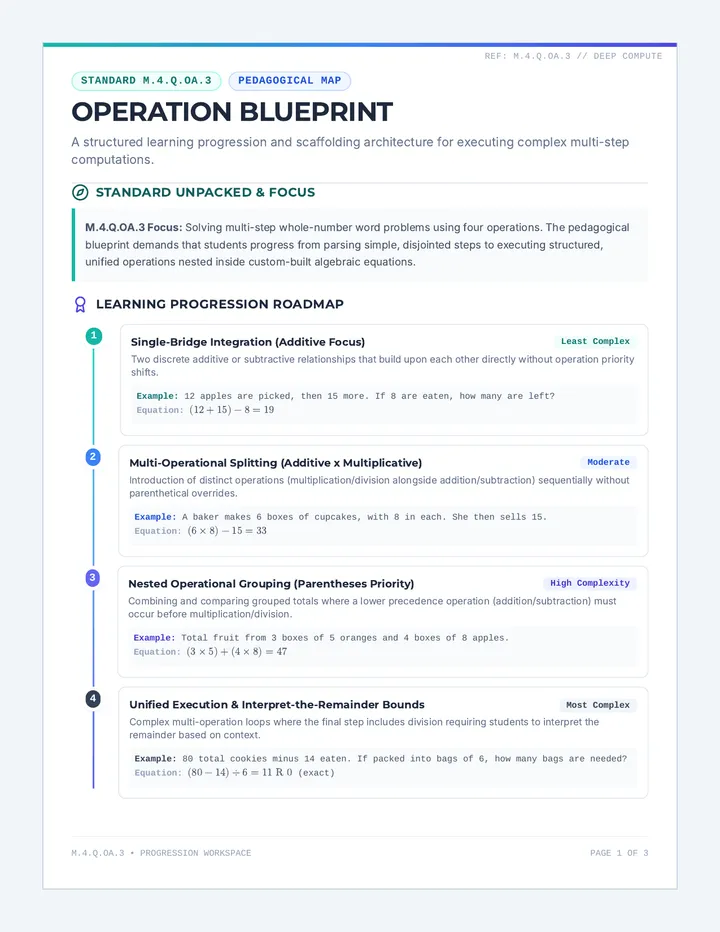
A lesson built around a five-step progression ladder for fourth-grade standard 4.OA.A.3. Students progress from single-step equation writing to multi-step problem solving with estimation and remainder interpretation, structured around an engaging mountain-climbing theme.
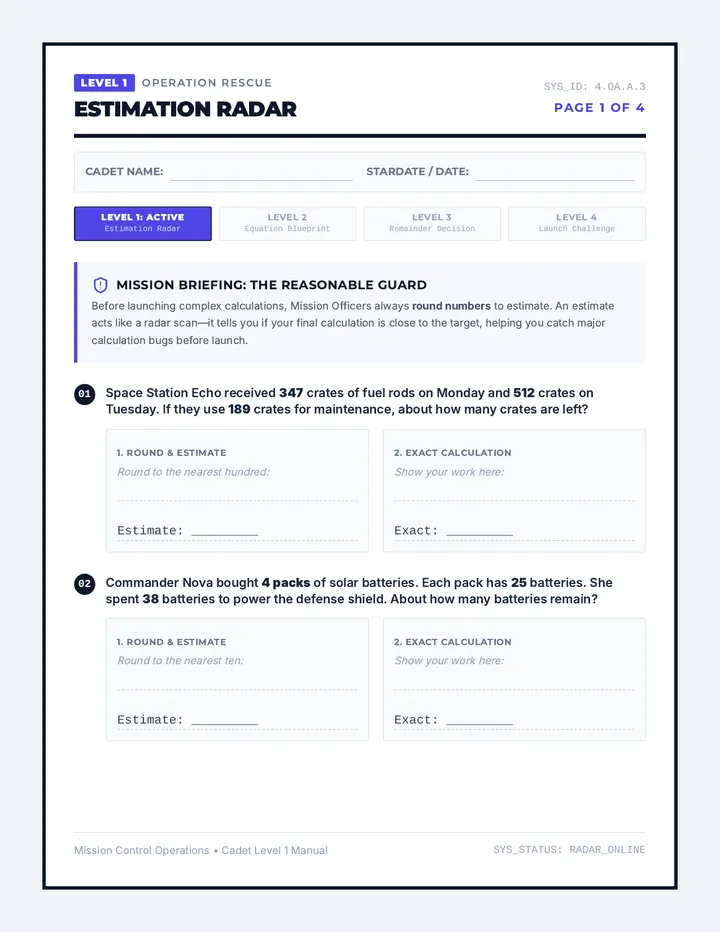
Trap: Student rounds exact answer instead of estimating beforehand. Or cannot explain why it's reasonable. Question: "Does rounding before or after calculating help you catch mistakes sooner?"
Step 5: The Summit Remainder Rock (Remainder Interpretation)
Highest Cognitive Complexity
Context: 57 boxes + 18 boxes = 75 total boxes. 8 boxes fit per crate. Find crates needed.
Correct Answers
Calculation: 57 + 18 = 75 total boxes.
75 ÷ 8 = 9 remainder 3. Strategy: Round Up (+1 to quotient).
9 full crates leaves 3 boxes behind. We need 1 more crate for those remaining 3 boxes. Final Answer: 10 crates.
Misconceptions & Probing
Trap: Writes 9 crates (ignores remainder), or says "9 R 3 crates" (non-real world answer). Question: "Can we leave those last 3 boxes of food on the mountain? What must we do to get them up?"
Crucial Concept: Teaching the 3 Remainder Pathways
Always guide students to identify which of the three paths the story context requires:
1. Round Up (+1) All items must be processed. e.g., Crates, buses, tables.
2. Ignore/Drop Only count completed items. e.g., full bags of cookies, whole shirts made.
3. Share/Slice The leftover is the answer or becomes a fraction. e.g., leftover money, leftover pizza.
Climbing Remediation Guide (Where to intervene)
Struggling at Step 1 or 2? Provide concrete counters. Have students circle groups of variables. Standardize writing "Start, Change, End" models.
Struggling at Step 3? Practice writing "word-only equations" first: Total Carabiners - (Groups × Carabiners/Group) = Leftover. Then substitute numbers and letter.
Struggling at Step 4? Ensure they estimate before calculating. Compare rounding effects (overestimation vs underestimation).
Struggling at Step 5? Use real objects or drawings. Draw 75 boxes and circle them in groups of 8. Highlight the leftover 3 boxes sitting on the ground!
Student Performance
Diagnostic Classification
Key Action Plan
Stops at Step 1 or 2
Developing Single/Double Steps
Focus on multi-action visual mapping and sequential operations.
Stops at Step 3
Algebraic Modeling Gap
Practice order of operations and placing parentheses to protect units.
Stops at Step 4
Calculation Focus (No Self-Check)
Reinforce estimation routines as an automatic first step, not final step.
Stops at Step 5
Conceptual Division Gap
Teach real-world scenarios requiring rounding up vs drop remainder.
Operation Summit Instructor Guide • Page 2 of 2 • Standard M.4.Q.OA.3 Focus