Family Math Quest Study Guide
4th Grade Math Companion
Family Math Quest Topic 2
School-to-Home Resource
Fluently Add & Subtract
Welcome to Topic 2 Math Support!
In this unit, our 4th graders are learning to flexibly and fluently add and subtract multi-digit whole numbers. Instead of just memorizing procedures, we focus on place value understanding, smart estimation, and mental math strategies that build true math power. Use this guide at home to speak the same math language we use in the classroom!
The Rules of the Game: Properties of Addition
Commutative Property
Order Doesn't Matter
You can add numbers in any order and the sum remains the exact same.
12 + 15 = 15 + 12
Associative Property
Grouping Doesn't Matter
Changing the grouping of addends does not change the total sum.
(3 + 4) + 6 = 3 + (4 + 6)
Identity Property
The Power of Zero
Adding zero to any number results in that same number.
2,450 + 0 = 2,450
The Terminology Toolkit
Compensation
Adjusting a number in a problem to make it easier to compute mentally, then adjusting the answer to correct the difference.
e.g., 98 + 45 is easier as 100 + 45 - 2
Algorithm
A step-by-step procedure or set of rules to solve a math calculation. The standard algorithm is what most adults learned as "stacking and carrying."
Our goal: fluent execution with actual place value understanding!
Variable
A letter or symbol (like x or n) used in math equations to represent an unknown quantity that we want to solve for.
e.g., 4,500 + x = 6,000 (x = 1,500)
Inverse Operations
Operations that undo each other. Addition and subtraction are inverse operations. Students use these to check their own calculations.
Check 400 - 150 = 250 with 250 + 150 = 400
Unit Topic 2: Fluency Study Guide Page 1 of 4 Interactive Family Resource
Part 1: Addition Expeditions (Lessons 2-1 to 2-4)
Mental Math & Algorithms
2-1: Sums & Differences with Mental Math
Core Concepts
Students use friendly numbers to calculate sums and differences without pencil and paper. We use three key mental tools:
1. Compensation
Change a number to a benchmark, then balance.
396 + 145 → 400 + 145 (-4) = 541
2. Counting Up
Find difference by starting low and leaping up.
320 - 295 → 295 (+5) + 20 → 25
3. Counting Down
Jump backward to solve easy differences.
450 - 60 → 450 - 50 - 10 → 390
2-2: Estimating Sums & Differences
Crucial Step
Before calculating, students must estimate to find an approximate answer. This acts as a safety check to ensure their calculated answers are reasonable.
Pro Tip: Nearest Benchmarks
Encourage rounding to the nearest ten, hundred, or thousand. Ask: "Is 4,582 closer to 4,000 or 5,000?" Use number lines visually.
4,582 → 5,000
+ 3,124 → 3,000
Estimate: ~ 8,000
2-3 & 2-4: Adding Whole & Greater Numbers
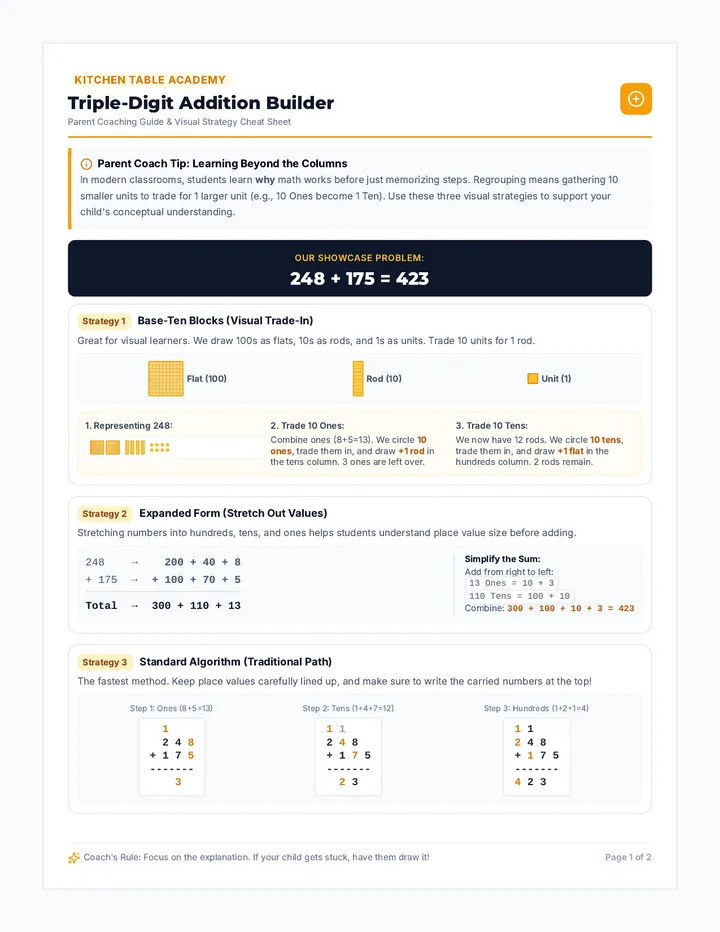
Standard Algorithm
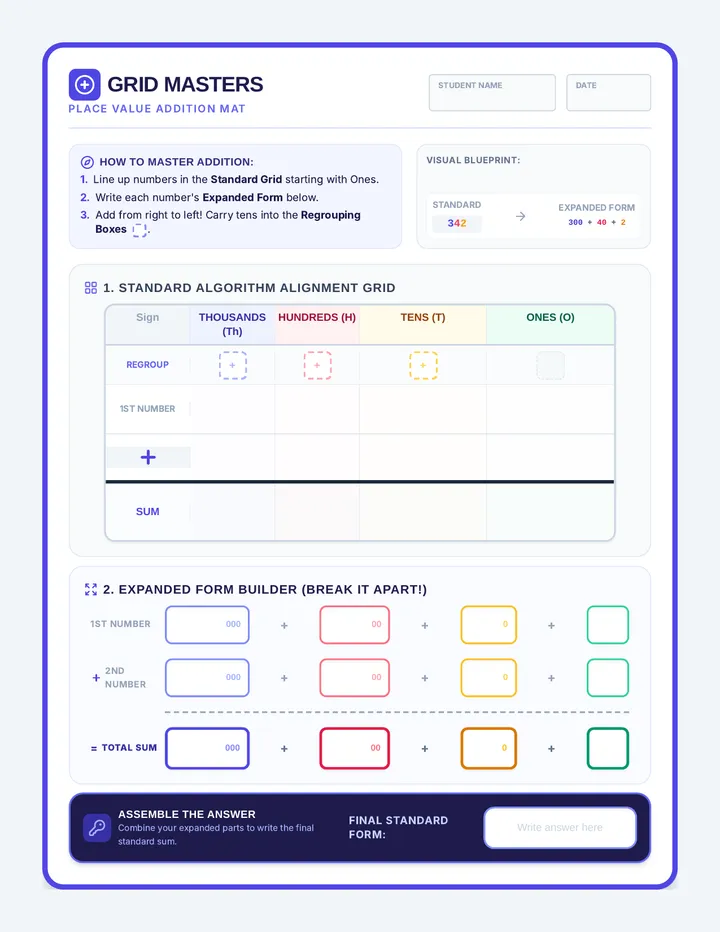
Students extend addition to larger numbers (up to 1,000,000) using the standard algorithm, lining up columns strictly by place value and tracking regrouping.
The Math Work
¹ ¹ ¹
4 5, 8 2 1
+ 2 7, 3 9 4
7 3, 2 1 5
Solving for Unknowns (Variables)
We replace blank boxes with variables (letters). This sets the stage for Algebra!
14,500 + p = 20,000 → p = 5,500
Kitchen Table Game: "AddIt! Challenge" 🃏
How to Play: Use a standard deck of cards (remove face cards, Aces = 1). Each player draws 6 cards and designs two 3-digit numbers. Try to create the combination that yields the highest sum! Solve on scrap paper, check each other's algorithm, and earn points for accurate work.
Unit Topic 2: Fluency Study Guide Page 2 of 4 Interactive Family Resource
Part 2: Subtraction Adventures (Lessons 2-5 to 2-8)
Subtraction & Problem Solving
2-5 & 2-6: Subtracting Greater Numbers & Checking Work
Self-Reliance
We teach students that they don't need a teacher (or key!) to know if their subtraction is correct. They use Inverse Operations to verify answers.
Step 1: Subtract
³ ¹¹
5, 4 2 5
- 1, 2 8 0
4, 1 4 5
Step 2: Check with Addition
¹
4, 1 4 5 (Diff)
+ 1, 2 8 0 (Sub)
5, 4 2 5 (Matches!)
2-7: Subtracting Across Zeros (The "Trading" Guide)
Common Misconception
Subtracting across zeros (like 4,000 - 1,235) is notoriously tricky! Instead of magic "cross-out" tricks, we teach place-value regrouping.
The "Why" Behind the Math:
We cannot trade from tens or hundreds if they are zero! We must go all the way to the thousands place. Trade 1 thousand for 10 hundreds. Then trade 1 hundred for 10 tens. Finally, trade 1 ten for 10 ones.
Thousands 4 → 3
Hundreds 10 → 9
Tens 10 → 9
Ones 10
2-8: Problem Solving & Reasoning
Visual Modeling
We use Bar Diagrams (Tape Models) to map out word problems visually so students know exactly which operation to choose.
Problem Blueprint:
"A national park has 5,000 trees. 1,450 are pines, the rest are oaks. How many are oaks?"
Total Trees: 5,000
Pine: 1,450
Oaks: ?
Kitchen Table Game: "The Zero-Out Challenge" 🎯
How to Play: Start each player at 1,000 points. Players take turns rolling a standard die three times to generate a 3-digit number (e.g., rolling a 4, 2, and 5 makes 425). Subtract that number from your points. The goal is to reach exactly 0. You must use addition checks along the way!
Unit Topic 2: Fluency Study Guide Page 3 of 4 Interactive Family Resource
Quest Tracker & Home Practice Lab
At-Home Checklist
Interactive Challenges
Challenge 2-1: Mental Math 197 + 54
Solve mentally using compensation. Explain how you did it below:
Challenge 2-2: Estimate 4,521 - 1,890
Round each to the nearest thousand and estimate the difference:
Challenge 2-7: Zeros 6,000 - 2,345
Practice your regrouping. Put your final answer in the box:
Challenge 2-8: Reasoning Algebra
A path is 3,500m. We walked 1,200m. Solve for m left:
Equation: 3,500 - 1,200 = m m = ______
Lesson & Skills Tracker
| Lesson | IXL Code | Status |
|---|
| 2-1 Mental Math | D7B, D9R | |
| 2-2 Estimation | DU5, 5F9 | |
| 2-3 Add Whole #s | DWQ | |
| 2-4 Greater Sums | 26W | |
| 2-5 Subtract Whole #s | 6SZ | |
| 2-6 Greater Diffs | TSJ | |
| 2-7 Across Zeros | LZZ | |
| 2-8 Reasoning | CZM, F5H | |
Homework & Practice Suite
Homework Videos
Another Look PDF
Savvy Practice
Quick Checks
Kitchen Conversations
Ditch the boring "How was school?" question! Try these powerful math conversational starters instead:
1. "When we regroup across a zero, why can't we borrow from the tens place immediately?"
2. "How does estimating our final answers help us prevent silly calculation errors?"
Unit Topic 2: Fluency Study Guide Page 4 of 4 Interactive Family Resource