Theorem Gatekeeper Worksheet
DC Calculus • Mean Value Theorem
Theorem Quick Check
#SlayerApproved
Name:
Date:
Directions: For each function \(f(x)\) and closed interval \([a, b]\), determine whether the Mean Value Theorem applies. Mark Yes or No.
MVT Conditions: 1. Continuous on \([a, b]\)
2. Differentiable on \((a, b)\)
| # |
Function \(f(x)\) |
Interval \([a, b]\) |
MVT Applies? |
| 1 |
\(f(x) = x^3 - 4x + 1\) |
\([-2, 2]\) |
|
| Yes No |
|
|
|
|
| 2 | \(f(x) = |x - 3|\) | \([0, 5]\) |
Yes No
|
| 3 | \(f(x) = \dfrac{1}{x - 2}\) | \([1, 4]\) |
Yes No
|
| 4 | \(f(x) = \sqrt{x}\) | \([0, 9]\) |
Yes No
|
| 5 | \(f(x) = x^{2/3}\) | \([-1, 8]\) |
Yes No
|
| 6 | \(y = \sin(x)\) | \([0, \pi]\) |
Yes No
|
| 7 | \(f(x) = \dfrac{x^2 - 9}{x - 3}\) | \([0, 5]\) |
Yes No
|
| 8 | \(f(x) = \ln(x + 1)\) | \([0, e - 1]\) |
Yes No
|
| 9 | \(f(x) = \begin{cases} x^2 + 1, & x < 1 \\ 3x - 1, & x \ge 1 \end{cases}\) | \([0, 3]\) |
Yes No
|
| 10 | \(f(x) = \sqrt[3]{x - 1}\) | \([0, 2]\) |
Yes No
|
Theorem Gatekeeper Answer Key
DC Calculus • Mean Value Theorem
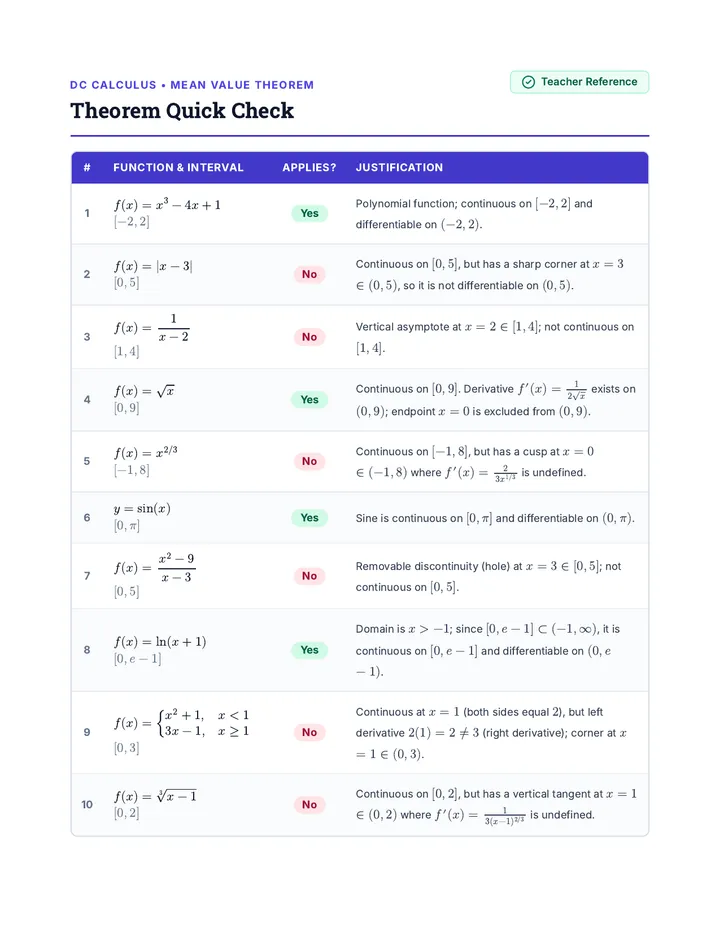
Theorem Quick Check
Teacher Reference
| # |
Function & Interval |
Applies? |
Justification |
| 1 |
|
|
|
| \(f(x) = x^3 - 4x + 1\) |
|
|
|
\([-2, 2]\)
| Yes | Polynomial function; continuous on \([-2, 2]\) and differentiable on \((-2, 2)\). |
| 2 |
\(f(x) = |x - 3|\)
\([0, 5]\)
| No | Continuous on \([0, 5]\), but has a sharp corner at \(x = 3 \in (0, 5)\), so it is not differentiable on \((0, 5)\). |
| 3 |
\(f(x) = \dfrac{1}{x - 2}\)
\([1, 4]\)
| No | Vertical asymptote at \(x = 2 \in [1, 4]\); not continuous on \([1, 4]\). |
| 4 |
\(f(x) = \sqrt{x}\)
\([0, 9]\)
| Yes | Continuous on \([0, 9]\). Derivative \(f'(x) = \frac{1}{2\sqrt{x}}\) exists on \((0, 9)\); endpoint \(x = 0\) is excluded from \((0, 9)\). |
| 5 |
\(f(x) = x^{2/3}\)
\([-1, 8]\)
| No | Continuous on \([-1, 8]\), but has a cusp at \(x = 0 \in (-1, 8)\) where \(f'(x) = \frac{2}{3x^{1/3}}\) is undefined. |
| 6 |
\(y = \sin(x)\)
\([0, \pi]\)
| Yes | Sine is continuous on \([0, \pi]\) and differentiable on \((0, \pi)\). |
| 7 |
\(f(x) = \dfrac{x^2 - 9}{x - 3}\)
\([0, 5]\)
| No | Removable discontinuity (hole) at \(x = 3 \in [0, 5]\); not continuous on \([0, 5]\). |
| 8 |
\(f(x) = \ln(x + 1)\)
\([0, e - 1]\)
| Yes | Domain is \(x > -1\); since \([0, e - 1] \subset (-1, \infty)\), it is continuous on \([0, e - 1]\) and differentiable on \((0, e - 1)\). |
| 9 |
\(f(x) = \begin{cases} x^2 + 1, & x < 1 \\ 3x - 1, & x \ge 1 \end{cases}\)
\([0, 3]\)
| No | Continuous at \(x = 1\) (both sides equal \(2\)), but left derivative \(2(1) = 2 \neq 3\) (right derivative); corner at \(x = 1 \in (0, 3)\). |
| 10 |
\(f(x) = \sqrt[3]{x - 1}\)
\([0, 2]\)
| No | Continuous on \([0, 2]\), but has a vertical tangent at \(x = 1 \in (0, 2)\) where \(f'(x) = \frac{1}{3(x-1)^{2/3}}\) is undefined. |