Derivative Duel Worksheet
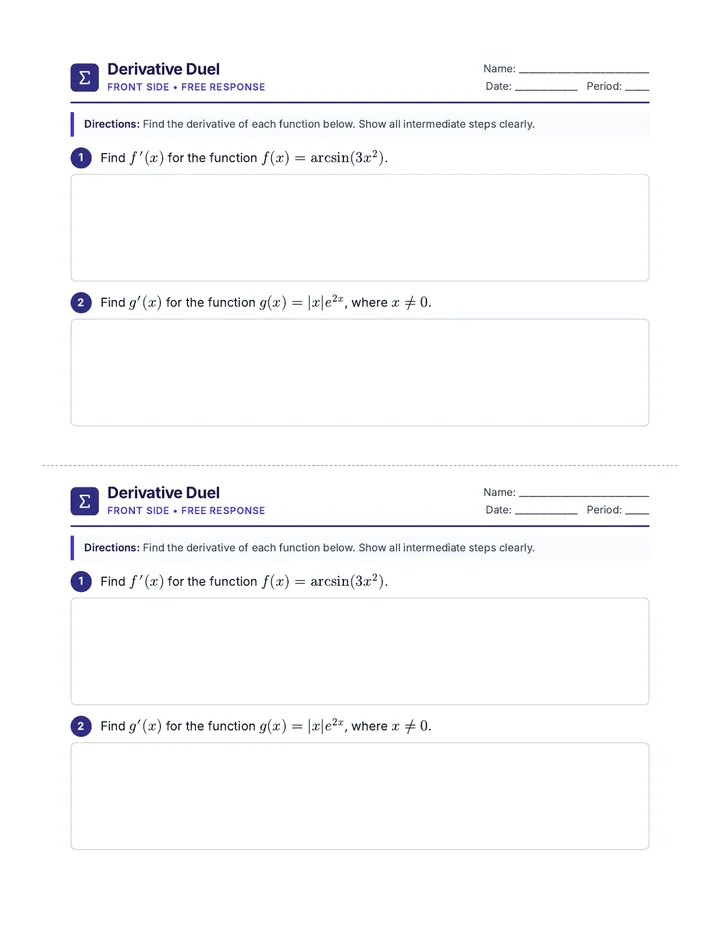
Derivative Duel
Front Side • Free Response
Name: ___________________________
Date: _____________ Period: _____
Directions: Find the derivative of each function below. Show all intermediate steps clearly.
1
Find \(f'(x)\) for the function \(f(x) = \arcsin(3x^2)\).
2
Find \(g'(x)\) for the function \(g(x) = |x|e^{2x}\), where \(x \neq 0\).
Derivative Duel
Back Side • Multiple Choice
Name: ___________________________
Directions: Show your work in each box, then circle the best answer choice.
3
Let \(f(x) = x^3 + 2x - 1\). If \(g(x) = f^{-1}(x)\), what is the value of \(g'(2)\)?
(A) \(\frac{1}{14}\)
(B) \(\frac{1}{5}\)
(C) \(5\)
(D) \(14\)
4
Given \(y^2 = x^3 + 3x\), what is the value of \(\frac{d^2y}{dx^2}\) at the point \((1, 2)\)?
(A) \(\frac{3}{8}\)
(B) \(\frac{3}{2}\)
(C) \(\frac{3}{4}\)
(D) \(-\frac{3}{8}\)
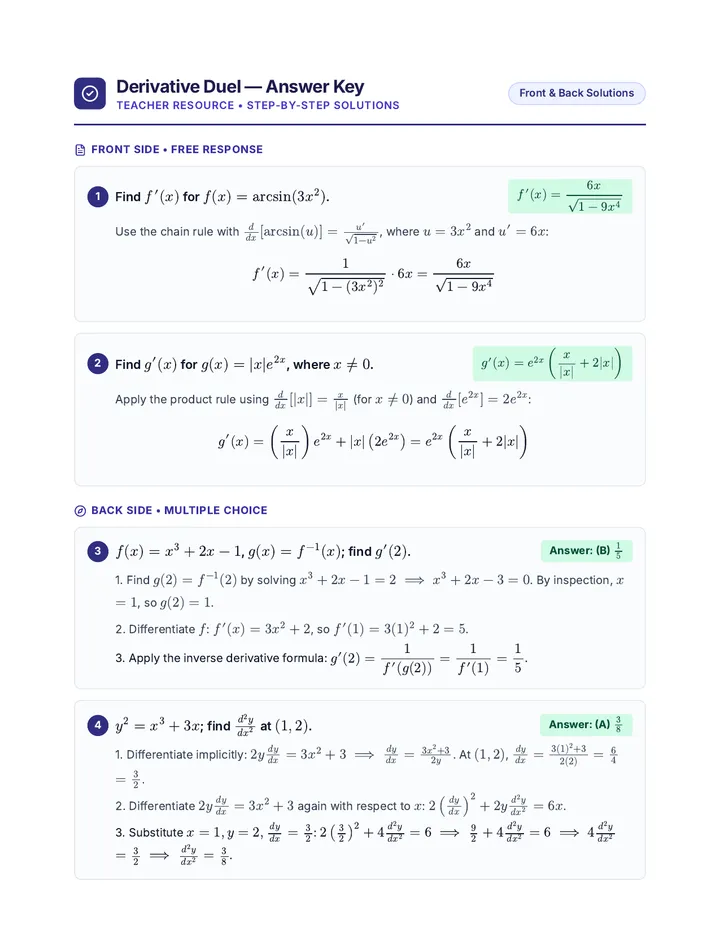
Derivative Duel Answer Key
Derivative Duel — Answer Key
Teacher Resource • Step-by-Step Solutions
Front & Back Solutions
Front Side • Free Response
1 Find \(f'(x)\) for \(f(x) = \arcsin(3x^2)\).
\(f'(x) = \dfrac{6x}{\sqrt{1 - 9x^4}}\)
Use the chain rule with \(\frac{d}{dx}[\arcsin(u)] = \frac{u'}{\sqrt{1 - u^2}}\), where \(u = 3x^2\) and \(u' = 6x\):
\[f'(x) = \frac{1}{\sqrt{1 - (3x^2)^2}} \cdot 6x = \frac{6x}{\sqrt{1 - 9x^4}}\]
2 Find \(g'(x)\) for \(g(x) = |x|e^{2x}\), where \(x \neq 0\).
\(g'(x) = e^{2x}\left(\dfrac{x}{|x|} + 2|x|\right)\)
Apply the product rule using \(\frac{d}{dx}[|x|] = \frac{x}{|x|}\) (for \(x \neq 0\)) and \(\frac{d}{dx}[e^{2x}] = 2e^{2x}\):
\[g'(x) = \left(\frac{x}{|x|}\right)e^{2x} + |x|\left(2e^{2x}\right) = e^{2x}\left(\frac{x}{|x|} + 2|x|\right)\]
Back Side • Multiple Choice
3 \(f(x) = x^3 + 2x - 1\), \(g(x) = f^{-1}(x)\); find \(g'(2)\).
Answer: (B) \(\frac{1}{5}\)
1. Find \(g(2) = f^{-1}(2)\) by solving \(x^3 + 2x - 1 = 2 \implies x^3 + 2x - 3 = 0\). By inspection, \(x = 1\), so \(g(2) = 1\).
2. Differentiate \(f\): \(f'(x) = 3x^2 + 2\), so \(f'(1) = 3(1)^2 + 2 = 5\).
3. Apply the inverse derivative formula: \(g'(2) = \dfrac{1}{f'(g(2))} = \dfrac{1}{f'(1)} = \dfrac{1}{5}\).
4 \(y^2 = x^3 + 3x\); find \(\frac{d^2y}{dx^2}\) at \((1, 2)\).
Answer: (A) \(\frac{3}{8}\)
1. Differentiate implicitly: \(2y\frac{dy}{dx} = 3x^2 + 3 \implies \frac{dy}{dx} = \frac{3x^2 + 3}{2y}\). At \((1, 2)\), \(\frac{dy}{dx} = \frac{3(1)^2 + 3}{2(2)} = \frac{6}{4} = \frac{3}{2}\).
2. Differentiate \(2y\frac{dy}{dx} = 3x^2 + 3\) again with respect to \(x\): \(2\left(\frac{dy}{dx}\right)^2 + 2y\frac{d^2y}{dx^2} = 6x\).
3. Substitute \(x = 1, y = 2, \frac{dy}{dx} = \frac{3}{2}\): \(2\left(\frac{3}{2}\right)^2 + 4\frac{d^2y}{dx^2} = 6 \implies \frac{9}{2} + 4\frac{d^2y}{dx^2} = 6 \implies 4\frac{d^2y}{dx^2} = \frac{3}{2} \implies \frac{d^2y}{dx^2} = \frac{3}{8}\).