Extrema Theorems Quick Check
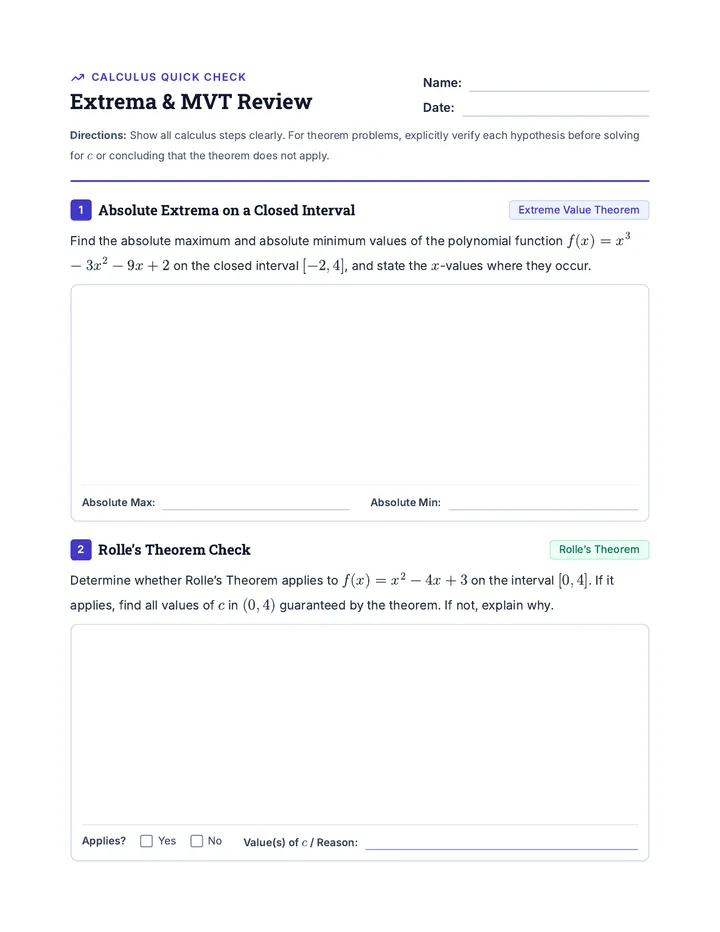
Calculus Quick Check
Extrema & MVT Review
Name:
Date:
Directions: Show all calculus steps clearly. For theorem problems, explicitly verify each hypothesis before solving for \(c\) or concluding that the theorem does not apply.
1
Absolute Extrema on a Closed Interval
Extreme Value Theorem
Find the absolute maximum and absolute minimum values of the polynomial function \( f(x) = x^3 - 3x^2 - 9x + 2 \) on the closed interval \( [-2, 4] \), and state the \(x\)-values where they occur.
Absolute Max:
Absolute Min:
2
Rolle’s Theorem Check
Rolle’s Theorem
Determine whether Rolle’s Theorem applies to \( f(x) = x^2 - 4x + 3 \) on the interval \( [0, 4] \). If it applies, find all values of \(c\) in \( (0, 4) \) guaranteed by the theorem. If not, explain why.
Applies? Yes No
Value(s) of \(c\) / Reason:
3
Rolle’s Theorem Check
Rolle’s Theorem
Determine whether Rolle’s Theorem applies to \( g(x) = |x - 2| \) on the interval \( [0, 4] \). If it applies, find all values of \(c\) in \( (0, 4) \) guaranteed by the theorem. If not, explain why.
Applies? Yes No
Value(s) of \(c\) / Reason:
4
Mean Value Theorem Check
Mean Value Theorem
Determine whether the Mean Value Theorem applies to \( f(x) = x^3 + 2x + 4 \) on the interval \( [-1, 0] \). If it applies, find all values of \(c\) in \( (-1, 0) \) guaranteed by the theorem. If not, explain why.
Applies? Yes No
Value(s) of \(c\) / Reason:
5
Mean Value Theorem Check
Mean Value Theorem
Determine whether the Mean Value Theorem applies to \( k(x) = \dfrac{1}{x - 1} \) on the interval \( [0, 3] \). If it applies, find all values of \(c\) in \( (0, 3) \) guaranteed by the theorem. If not, explain why.
Applies? Yes No
Value(s) of \(c\) / Reason:
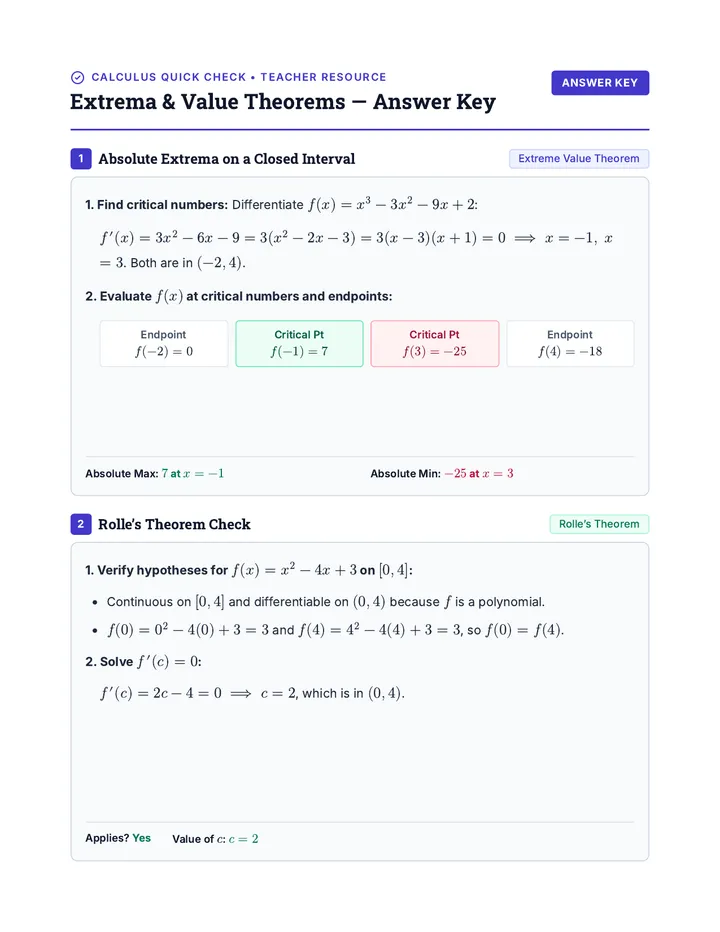
Extrema Theorems Answer Key
Calculus Quick Check • Teacher Resource
Extrema & Value Theorems — Answer Key
Answer Key
1
Absolute Extrema on a Closed Interval
Extreme Value Theorem
1. Find critical numbers: Differentiate \( f(x) = x^3 - 3x^2 - 9x + 2 \):
\( f'(x) = 3x^2 - 6x - 9 = 3(x^2 - 2x - 3) = 3(x - 3)(x + 1) = 0 \implies x = -1,\; x = 3 \). Both are in \( (-2, 4) \).
2. Evaluate \( f(x) \) at critical numbers and endpoints:
Endpoint
\( f(-2) = 0 \)
Critical Pt
\( f(-1) = 7 \)
Critical Pt
\( f(3) = -25 \)
Endpoint
\( f(4) = -18 \)
Absolute Max: \( 7 \) at \( x = -1 \)
Absolute Min: \( -25 \) at \( x = 3 \)
2
Rolle’s Theorem Check
Rolle’s Theorem
1. Verify hypotheses for \( f(x) = x^2 - 4x + 3 \) on \( [0, 4] \):
- Continuous on \( [0, 4] \) and differentiable on \( (0, 4) \) because \( f \) is a polynomial.
- \( f(0) = 0^2 - 4(0) + 3 = 3 \) and \( f(4) = 4^2 - 4(4) + 3 = 3 \), so \( f(0) = f(4) \).
2. Solve \( f'(c) = 0 \):
\( f'(c) = 2c - 4 = 0 \implies c = 2 \), which is in \( (0, 4) \).
Applies? Yes
Value of \(c\): \( c = 2 \)
3
Rolle’s Theorem Check
Rolle’s Theorem
Verify hypotheses for \( g(x) = |x - 2| \) on \( [0, 4] \):
- Continuous on \( [0, 4] \) and \( g(0) = 2 = g(4) \).
- Fails differentiability: \( g'(x) = -1 \) for \( x < 2 \) and \( g'(x) = 1 \) for \( x > 2 \). Because the left- and right-hand derivatives do not match at \( x = 2 \), \( g \) is not differentiable at \( x = 2 \in (0, 4) \) (sharp corner).
Applies? No
Reason: \( g(x) \) is not differentiable at \( x = 2 \in (0, 4) \).
4
Mean Value Theorem Check
Mean Value Theorem
1. Verify hypotheses for \( f(x) = x^3 + 2x + 4 \) on \( [-1, 0] \):
Continuous on \( [-1, 0] \) and differentiable on \( (-1, 0) \) because \( f \) is a polynomial.
2. Set \( f'(c) = \dfrac{f(0) - f(-1)}{0 - (-1)} \):
\( f(0) = 4 \) and \( f(-1) = (-1)^3 + 2(-1) + 4 = 1 \), so \( \dfrac{4 - 1}{0 - (-1)} = 3 \).
\( f'(c) = 3c^2 + 2 = 3 \implies 3c^2 = 1 \implies c^2 = \dfrac{1}{3} \implies c = \pm\dfrac{\sqrt{3}}{3} \). Since \( c \in (-1, 0) \), \( c = -\dfrac{\sqrt{3}}{3} \).
Applies? Yes
Value of \(c\): \( c = -\dfrac{\sqrt{3}}{3} \)
5
Mean Value Theorem Check
Mean Value Theorem
Verify hypotheses for \( k(x) = \dfrac{1}{x - 1} \) on \( [0, 3] \):
- Fails continuity: \( k(x) \) is undefined at \( x = 1 \in [0, 3] \) (infinite discontinuity / vertical asymptote).
- Because \( k \) is not continuous on \( [0, 3] \) (and not differentiable at \( x = 1 \in (0, 3) \)), the hypotheses are not satisfied.
Applies? No
Reason: \( k(x) \) is discontinuous at \( x = 1 \in [0, 3] \).