Lesson 3-5 Solve Systems Using Matrices Notes Finite Mathematics • Systems & Matrices
Lesson 3-5: Solve Systems Using Matrices
Guided Notes
Page 1 of 2
Name:
Date:
Period:
1
Core Concept: The Augmented Matrix
An augmented matrix represents the coefficients and constants of a linear system written in standard form. Dimensions are always stated as \(\text{rows} \times \text{columns}\) (\(m \times n\)), where \(\text{rows} = \text{number of equations}\) and \(\text{columns} = \text{variables} + 1\).
2 × 2 System
2 equations, 2 variables
Matrix: 2 × 3
3 × 3 System
3 equations, 3 variables
Matrix: 3 × 4
4 × 4 System
4 equations, 4 variables
Matrix: 4 × 5
⚠️ Crucial Rule: Align all variables in the same order across every row. When a variable is absent from an equation, enter 0 as its coefficient!
2
Guided Examples: Writing Systems as Augmented Matrices
Example A: 2 × 2 System
\(\begin{cases} 4x - 3y = 11 \\ x + 5y = -7 \end{cases}\)
Augmented Matrix (\(2 \times 3\)):
\(\left[\begin{array}{cc|c} \underline{\hspace{18px}} & \underline{\hspace{18px}} & \underline{\hspace{18px}} \\ \underline{\hspace{18px}} & \underline{\hspace{18px}} & \underline{\hspace{18px}} \end{array}\right]\)
Example B: 3 × 3 System Watch for Missing Terms!
\(\begin{cases} 2x + y - 3z = 4 \\ 3x - 5y = 14 \\ -x + 4y + 2z = -9 \end{cases}\)
Augmented Matrix (\(3 \times 4\)):
\(\left[\begin{array}{ccc|c} \underline{\hspace{14px}} & \underline{\hspace{14px}} & \underline{\hspace{14px}} & \underline{\hspace{14px}} \\ \underline{\hspace{14px}} & \underline{\hspace{14px}} & \underline{\hspace{14px}} & \underline{\hspace{14px}} \\ \underline{\hspace{14px}} & \underline{\hspace{14px}} & \underline{\hspace{14px}} & \underline{\hspace{14px}} \end{array}\right]\)
Example C: 4 × 4 System (\(w, x, y, z\))
\(\begin{cases} w + 2x - y + z = 8 \\ 2w - x + 3z = 3 \\ -w + 3x + 2y - z = 5 \\ 3w - x - 2y + 4z = 10 \end{cases}\)
Augmented Matrix (\(4 \times 5\)):
\(\left[\begin{array}{cccc|c} 1 & 2 & -1 & 1 & 8 \\ 2 & -1 & \mathbf{0} & 3 & 3 \\ -1 & 3 & 2 & -1 & 5 \\ 3 & -1 & -2 & 4 & 10 \end{array}\right]\)
3
Online Tool: Desmos Matrix Calculator (desmos.com/matrix)
Online Free Solver
1 Create Matrix
Click the blue New Matrix button. By default, this assigns name [A].
2 Set Size & Enter Values
Use the + / – buttons to set Rows & Columns (e.g., \(3 \times 4\)). Type all numbers, then press Enter .
3 Run RREF Command
Click rref on the keypad, then click matrix [A]. The solved matrix appears instantly!
Finite Mathematics • Systems & Matrices
Lesson 3-5: Solve Systems Using Matrices
Guided Notes
Page 2 of 2
4
How to Read Reduced Row Echelon Form (RREF)
Reduced Row Echelon Form isolates each variable by producing an identity matrix (a diagonal of 1s and 0s elsewhere) on the coefficient side. The final column reveals the unique value of each corresponding variable.
2 × 3 RREF Output
\(\left[\begin{array}{cc|c} 1 & 0 & 5 \\ 0 & 1 & -2 \end{array}\right]\)
Row 1: \(1x + 0y = 5 \implies \mathbf{x = 5}\)
Row 2: \(0x + 1y = -2 \implies \mathbf{y = -2}\)
Solution: \((5, -2)\)
3 × 4 RREF Output
\(\left[\begin{array}{ccc|c} 1 & 0 & 0 & 4 \\ 0 & 1 & 0 & -1 \\ 0 & 0 & 1 & 3 \end{array}\right]\)
Row 1: \(\implies \mathbf{x = 4}\)
Row 2: \(\implies \mathbf{y = -1}\)
Row 3: \(\implies \mathbf{z = 3}\)
Solution: \((4, -1, 3)\)
4 × 5 RREF Output
\(\left[\begin{array}{cccc|c} 1 & 0 & 0 & 0 & 2 \\ 0 & 1 & 0 & 0 & 0 \\ 0 & 0 & 1 & 0 & -3 \\ 0 & 0 & 0 & 1 & 7 \end{array}\right]\)
\(w = 2,\; x = 0\)
\(y = -3,\; z = 7\)
Solution: \((2, 0, -3, 7)\)
No Solution: Row with \(\left[\begin{array}{ccc|c} 0 & 0 & 0 & 1 \end{array}\right] \implies 0 = 1\) (Contradiction)
Infinitely Many: Row with \(\left[\begin{array}{ccc|c} 0 & 0 & 0 & 0 \end{array}\right] \implies 0 = 0\) (Dependent)
5
Putting It All Together: Write Matrix & Solve
Practice 1: 2 × 2 System Dimensions: 2 × 3
\(\begin{cases} 2x + 5y = 9 \\ 3x - y = 5 \end{cases}\)
Augmented Matrix:
Desmos RREF Output:
Solution \((x, y)\):
Practice 2: 3 × 3 System Dimensions: 3 × 4
\(\begin{cases} x + 2y + z = 0 \\ 2x - y = 8 \\ -x + y + 3z = -2 \end{cases}\)
Augmented Matrix:
Desmos RREF Output:
Solution \((x, y, z)\):
Practice 3: 4 × 4 System Dimensions: 4 × 5
\(\begin{cases} w + x + y + z = 6 \\ 2w - x + 3y - z = 5 \\ w + 3x - y + 2z = 4 \\ -w + 2x + y + z = 3 \end{cases}\)
Augmented Matrix:
Desmos RREF Output:
Solution \((w, x, y, z)\):
Lesson 3-5 Solve Systems Using Matrices Key Finite Mathematics • Teacher Resource
Lesson 3-5: Solve Systems Using Matrices
TEACHER KEY
Page 1 of 2
Unit: Linear Systems & Matrix Algebra
Topic: Augmented Matrices & Desmos RREF
STATUS: MASTER KEY
1
Core Concept: The Augmented Matrix
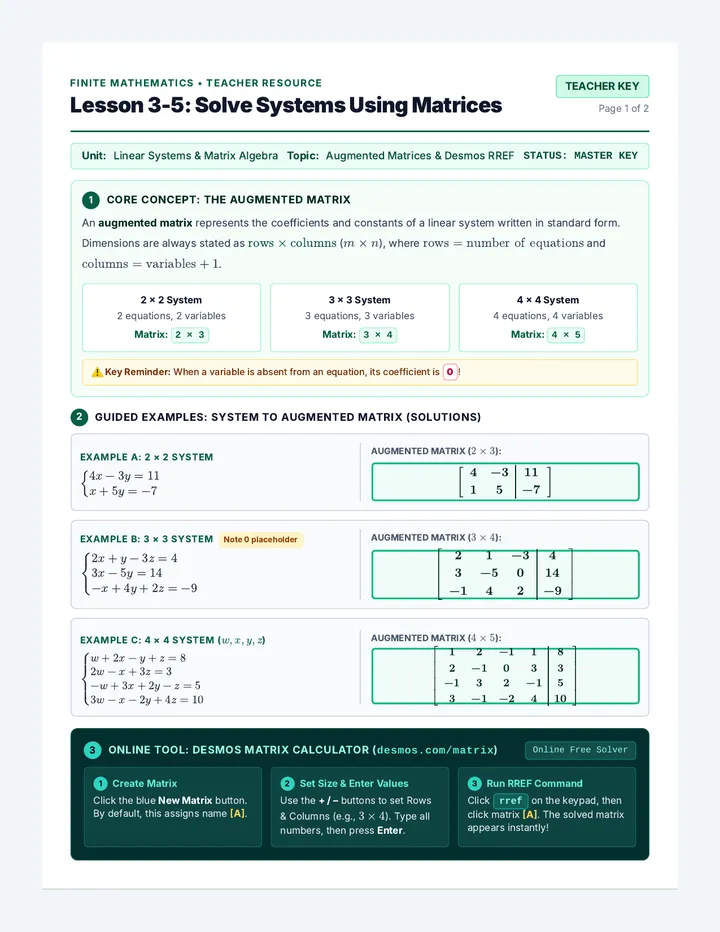
An augmented matrix represents the coefficients and constants of a linear system written in standard form. Dimensions are always stated as \(\text{rows} \times \text{columns}\) (\(m \times n\)), where \(\text{rows} = \text{number of equations}\) and \(\text{columns} = \text{variables} + 1\).
2 × 2 System
2 equations, 2 variables
Matrix: 2 × 3
3 × 3 System
3 equations, 3 variables
Matrix: 3 × 4
4 × 4 System
4 equations, 4 variables
Matrix: 4 × 5
⚠️ Key Reminder: When a variable is absent from an equation, its coefficient is 0!
2
Guided Examples: System to Augmented Matrix (Solutions)
Example A: 2 × 2 System
\(\begin{cases} 4x - 3y = 11 \\ x + 5y = -7 \end{cases}\)
Augmented Matrix (\(2 \times 3\)):
\(\left[\begin{array}{cc|c} \mathbf{4} & \mathbf{-3} & \mathbf{11} \\ \mathbf{1} & \mathbf{5} & \mathbf{-7} \end{array}\right]\)
Example B: 3 × 3 System Note 0 placeholder
\(\begin{cases} 2x + y - 3z = 4 \\ 3x - 5y = 14 \\ -x + 4y + 2z = -9 \end{cases}\)
Augmented Matrix (\(3 \times 4\)):
\(\left[\begin{array}{ccc|c} \mathbf{2} & \mathbf{1} & \mathbf{-3} & \mathbf{4} \\ \mathbf{3} & \mathbf{-5} & \mathbf{0} & \mathbf{14} \\ \mathbf{-1} & \mathbf{4} & \mathbf{2} & \mathbf{-9} \end{array}\right]\)
Example C: 4 × 4 System (\(w, x, y, z\))
\(\begin{cases} w + 2x - y + z = 8 \\ 2w - x + 3z = 3 \\ -w + 3x + 2y - z = 5 \\ 3w - x - 2y + 4z = 10 \end{cases}\)
Augmented Matrix (\(4 \times 5\)):
\(\left[\begin{array}{cccc|c} \mathbf{1} & \mathbf{2} & \mathbf{-1} & \mathbf{1} & \mathbf{8} \\ \mathbf{2} & \mathbf{-1} & \mathbf{0} & \mathbf{3} & \mathbf{3} \\ \mathbf{-1} & \mathbf{3} & \mathbf{2} & \mathbf{-1} & \mathbf{5} \\ \mathbf{3} & \mathbf{-1} & \mathbf{-2} & \mathbf{4} & \mathbf{10} \end{array}\right]\)
3
Online Tool: Desmos Matrix Calculator (desmos.com/matrix)
Online Free Solver
1 Create Matrix
Click the blue New Matrix button. By default, this assigns name [A].
2 Set Size & Enter Values
Lesson 3-5 Solve Systems Using Matrices Worksheet Finite Mathematics • Practice Assignment
Lesson 3-5: Solve Systems Using Matrices
Worksheet
Page 1 of 2
Name:
Date:
Period:
Score:
i
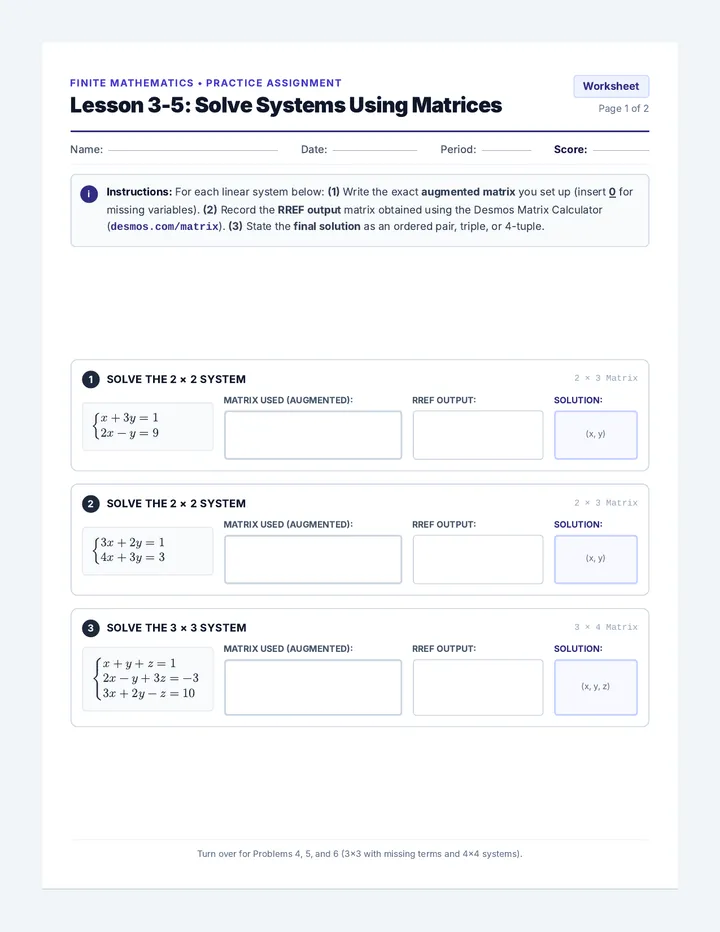
Instructions: For each linear system below: (1) Write the exact augmented matrix you set up (insert 0 for missing variables). (2) Record the RREF output matrix obtained using the Desmos Matrix Calculator (desmos.com/matrix). (3) State the final solution as an ordered pair, triple, or 4-tuple.
1 Solve the 2 × 2 System
2 × 3 Matrix
\(\begin{cases} x + 3y = 1 \\ 2x - y = 9 \end{cases}\)
Matrix Used (Augmented):
RREF Output:
Solution:
(x, y)
2 Solve the 2 × 2 System
2 × 3 Matrix
\(\begin{cases} 3x + 2y = 1 \\ 4x + 3y = 3 \end{cases}\)
Matrix Used (Augmented):
RREF Output:
Solution:
(x, y)
3 Solve the 3 × 3 System
3 × 4 Matrix
\(\begin{cases} x + y + z = 1 \\ 2x - y + 3z = -3 \\ 3x + 2y - z = 10 \end{cases}\)
Matrix Used (Augmented):
RREF Output:
Solution:
(x, y, z)
Turn over for Problems 4, 5, and 6 (3×3 with missing terms and 4×4 systems).
Finite Mathematics • Practice Assignment
Lesson 3-5: Solve Systems Using Matrices
Worksheet
Page 2 of 2
4 Solve the 3 × 3 System Watch for 0s
3 × 4 Matrix
\(\begin{cases} x + 2y = 7 \\ 3y - 2z = 8 \\ 2x - y + 5z = 4 \end{cases}\)
Matrix Used (Augmented):
RREF Output:
Solution:
(x, y, z)
5 Solve the 4 × 4 System (\(w, x, y, z\))
4 × 5 Matrix
\(\begin{cases} w + x + y + z = 5 \\ 2w + 3x - y + z = -1 \\ w - 2x + 2y - z = 9 \\ 3w + x + y - 2z = 6 \end{cases}\)
Matrix Used (Augmented):
RREF Output:
Solution:
(w, x, y, z)
6 Solve the 4 × 4 System (\(w, x, y, z\)) Missing Terms
4 × 5 Matrix
\(\begin{cases} 2w + x - y + z = 9 \\ w - 2x + 3z = 1 \\ 3x + 2y - z = 3 \\ w + x + y - z = 0 \end{cases}\)
Matrix Used (Augmented):
Lesson 3-5 Solve Systems Using Matrices Worksheet Key Finite Mathematics • Teacher Resource
Lesson 3-5: Solve Systems Using Matrices
TEACHER KEY
Page 1 of 2
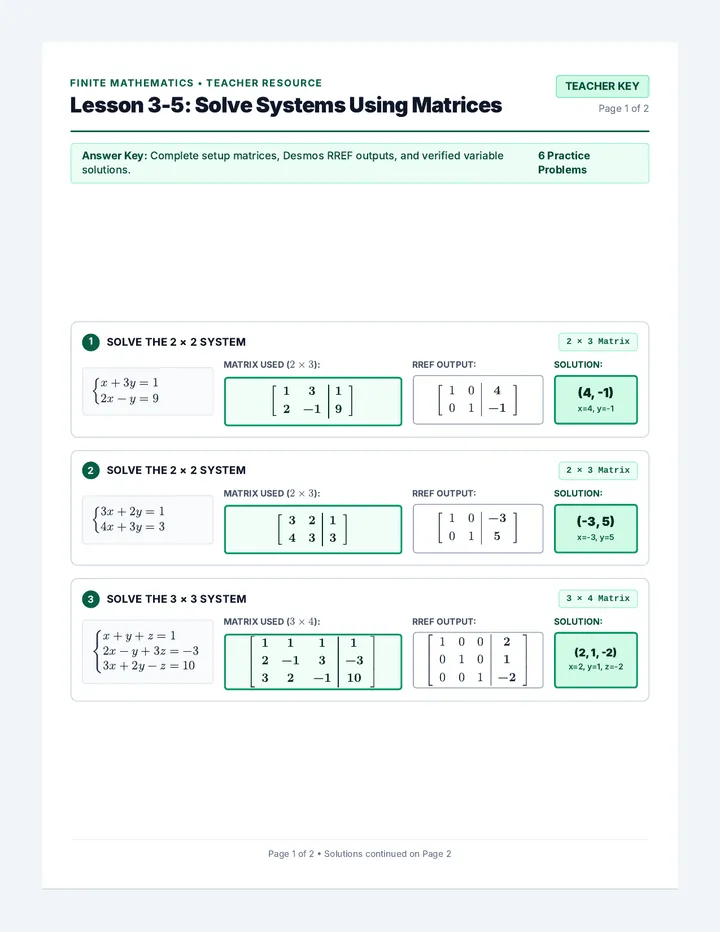
Answer Key: Complete setup matrices, Desmos RREF outputs, and verified variable solutions.
6 Practice Problems
1 Solve the 2 × 2 System
2 × 3 Matrix
\(\begin{cases} x + 3y = 1 \\ 2x - y = 9 \end{cases}\)
Matrix Used (\(2 \times 3\)):
\(\left[\begin{array}{cc|c} \mathbf{1} & \mathbf{3} & \mathbf{1} \\ \mathbf{2} & \mathbf{-1} & \mathbf{9} \end{array}\right]\)
RREF Output:
\(\left[\begin{array}{cc|c} 1 & 0 & \mathbf{4} \\ 0 & 1 & \mathbf{-1} \end{array}\right]\)
Solution:
(4, -1) x=4, y=-1
2 Solve the 2 × 2 System
2 × 3 Matrix
\(\begin{cases} 3x + 2y = 1 \\ 4x + 3y = 3 \end{cases}\)
Matrix Used (\(2 \times 3\)):
\(\left[\begin{array}{cc|c} \mathbf{3} & \mathbf{2} & \mathbf{1} \\ \mathbf{4} & \mathbf{3} & \mathbf{3} \end{array}\right]\)
RREF Output:
\(\left[\begin{array}{cc|c} 1 & 0 & \mathbf{-3} \\ 0 & 1 & \mathbf{5} \end{array}\right]\)
Solution:
(-3, 5) x=-3, y=5
3 Solve the 3 × 3 System
3 × 4 Matrix
\(\begin{cases} x + y + z = 1 \\ 2x - y + 3z = -3 \\ 3x + 2y - z = 10 \end{cases}\)
Matrix Used (\(3 \times 4\)):
\(\left[\begin{array}{ccc|c} \mathbf{1} & \mathbf{1} & \mathbf{1} & \mathbf{1} \\ \mathbf{2} & \mathbf{-1} & \mathbf{3} & \mathbf{-3} \\ \mathbf{3} & \mathbf{2} & \mathbf{-1} & \mathbf{10} \end{array}\right]\)
RREF Output:
\(\left[\begin{array}{ccc|c} 1 & 0 & 0 & \mathbf{2} \\ 0 & 1 & 0 & \mathbf{1} \\ 0 & 0 & 1 & \mathbf{-2} \end{array}\right]\)
Solution:
(2, 1, -2) x=2, y=1, z=-2
Page 1 of 2 • Solutions continued on Page 2
Finite Mathematics • Teacher Resource
Lesson 3-5: Solve Systems Using Matrices
TEACHER KEY
Page 2 of 2
4 Solve the 3 × 3 System 0 placeholders required
3 × 4 Matrix
\(\begin{cases} x + 2y = 7 \\ 3y - 2z = 8 \\ 2x - y + 5z = 4 \end{cases}\)
Matrix Used (\(3 \times 4\)):
\(\left[\begin{array}{ccc|c} \mathbf{1} & \mathbf{2} & \mathbf{0} & \mathbf{7} \\ \mathbf{0} & \mathbf{3} & \mathbf{-2} & \mathbf{8} \\ \mathbf{2} & \mathbf{-1} & \mathbf{5} & \mathbf{4} \end{array}\right]\)
RREF Output:
\(\left[\begin{array}{ccc|c} 1 & 0 & 0 & \mathbf{-1} \\ 0 & 1 & 0 & \mathbf{4} \\ 0 & 0 & 1 & \mathbf{2} \end{array}\right]\)