Lockbox Match Cards
Lockbox Math Match Cards
Set A: The Real Number System & Radicals (Cards 01–05)
Cut Along Dotted Lines
Page 1 of 3
Pair 01 • Lock Rational Decimals
Convert the rational number \(\frac{7}{12}\) into its equivalent decimal form using long division. State whether the decimal terminates or repeats, and explain why.
Target: \(\frac{7}{12}\) Standard: 8.NS.A.1
Pair 01 • Key Match Verification
\(0.58\overline{3}\) (repeating decimal).
Because the reduced denominator \(12 = 2^2 \cdot 3\) contains the prime factor \(3\) (not only \(2\) and \(5\)), it cannot terminate. The digit \(3\) repeats indefinitely.
Result: \(0.58333...\) Type: Repeating
Pair 02 • Lock Irrational Numbers
Classify \(\sqrt{28}\) as rational or irrational. Explain your reasoning and find two consecutive integers that \(\sqrt{28}\) falls between on a number line.
Target: \(\sqrt{28}\) Standard: 8.NS.A.1, 8.NS.A.2
Pair 02 • Key Match Verification
Irrational Number.
\(28\) is not a perfect square (\(5^2 = 25\) and \(6^2 = 36\)). Since \(\sqrt{25} < \sqrt{28} < \sqrt{36}\), it lies strictly between 5 and 6 (\(\approx 5.29\)). Decimal neither terminates nor repeats.
Between: \(5 < \sqrt{28} < 6\) Non-terminating
Pair 03 • Lock Ordering Real Numbers
Compare and order this set of real numbers from least to greatest: \(-\sqrt{17},\;\; -4.2,\;\; \pi,\;\; \sqrt{10},\;\; \frac{16}{5}\)
5 Real Values Standard: 8.NS.A.2
Pair 03 • Key Match Verification
\(-4.2 < -\sqrt{17} < \pi < \sqrt{10} < \frac{16}{5}\)
Approximate decimals:
\(-4.200 < -4.123 < 3.1416 < 3.162 < 3.200\)
Least: \(-4.2\) Greatest: \(\frac{16}{5} = 3.2\)
Pair 04 • Lock Square & Cube Roots
Evaluate the numerical expression completely: \(\sqrt{\frac{144}{49}} - \sqrt[3]{-216}\) Write your final answer as an exact improper fraction or mixed number.
Evaluate Expression Standard: 8.EE.A.2
Pair 04 • Key Match Verification
\(\sqrt{\frac{144}{49}} = \frac{12}{7}\) and \(\sqrt[3]{-216} = -6\).
Then: \(\frac{12}{7} - (-6) = \frac{12}{7} + \frac{42}{7} = \mathbf{\frac{54}{7}}\) or \(\mathbf{7\frac{5}{7}}\).
Result: \(\frac{54}{7}\) Note: \((-6)^3 = -216\)
Pair 05 • Lock Root Equations
Solve both equations for the variable: (A) \(2x^2 + 10 = 108\) (B) \(y^3 - 19 = 45\) State all real solutions and explain why (A) has two roots while (B) has one.
Equations with Powers Standard: 8.EE.A.2
Pair 05 • Key Match Verification
(A) \(2x^2 = 98 \implies x^2 = 49 \implies \mathbf{x = \pm 7}\) (both \(+7\) and \(-7\) square to \(49\)).
(B) \(y^3 = 64 \implies y = \sqrt[3]{64} \implies \mathbf{y = 4}\) (only \(+4\) cubes to \(+64\)).
Solutions: \(x = \pm 7,\; y = 4\) Square root \(\pm\)
Lockbox Math Challenge • Printable Station Cards Cards 01 to 05
Lockbox Math Match Cards
Set B: Expressions, Exponents & Linear Equations (Cards 06–10)
Cut Along Dotted Lines
Page 2 of 3
Pair 06 • Lock Exponent Laws
Simplify the expression completely using properties of integer exponents. Express with positive exponents only: \(\frac{(4x^3 y^{-2})^2 \cdot x^{-2} y^5}{2 x^4 y^3}\)
Simplify Expression Standard: 8.EE.A.1
Pair 06 • Key Match Verification
Numerator: \(16 x^6 y^{-4} \cdot x^{-2} y^5 = 16 x^4 y^1\).
Divide by denominator: \(\frac{16 x^4 y^1}{2 x^4 y^3} = 8 x^{4-4} y^{1-3} = 8 x^0 y^{-2} = \mathbf{\frac{8}{y^2}}\).
Result: \(\frac{8}{y^2}\) Rules: Power & Quotient
Pair 07 • Lock Combining Like Terms
Expand the parentheses and simplify the algebraic expression completely by combining all like terms: \(3(4a - 2b) - 5(a - 3b) - 2(a + 4)\)
Distribute & Group Standard: 8.EE.C.7b
Pair 07 • Key Match Verification
Distribute: \(12a - 6b - 5a + 15b - 2a - 8\).
Group terms:
\(a\): \((12 - 5 - 2)a = 5a\); \(b\): \((-6 + 15)b = 9b\); const: \(-8\).
Final: \(5a + 9b - 8\).
Result: \(5a + 9b - 8\) Check signs carefully
Pair 08 • Lock Variables on Both Sides
Solve the linear equation for \(x\): \(5(2x - 3) - 4x = 2(x + 6) + 1\) Show the step where variable terms are isolated on one side.
Linear Equation Standard: 8.EE.C.7b
Pair 08 • Key Match Verification
Left: \(10x - 15 - 4x = 6x - 15\).
Right: \(2x + 12 + 1 = 2x + 13\).
Subtract \(2x\): \(4x - 15 = 13 \implies 4x = 28 \implies \mathbf{x = 7}\).
Solution: \(x = 7\) Check: \(27 = 27\) \(\checkmark\)
Pair 09 • Lock Multi-Step Equations
Solve the rational multi-step equation by clearing fractions first: \(\frac{3x - 5}{4} + 2 = \frac{x + 7}{2}\)
Clear Denominator (LCD = 4) Standard: 8.EE.C.7b
Pair 09 • Key Match Verification
Multiply entire equation by LCD \(4\):
\((3x - 5) + 4(2) = 2(x + 7)\)
\(3x - 5 + 8 = 2x + 14 \implies 3x + 3 = 2x + 14 \implies \mathbf{x = 11}\).
Solution: \(x = 11\) Check: \(\frac{28}{4} + 2 = 9 = \frac{18}{2}\) \(\checkmark\)
Pair 10 • Lock Number of Solutions
Determine whether each has one, no, or infinitely many solutions: (A) \(4(2x - 3) = 8x - 15\) (B) \(2(5x + 3) - 4 = 10x + 2\)
Identity vs Contradiction Standard: 8.EE.C.7a
Pair 10 • Key Match Verification
(A) \(8x - 12 = 8x - 15 \implies -12 = -15\) (False contradiction) \(\implies\) No Solution (\(\emptyset\)).
(B) \(10x + 2 = 10x + 2 \implies 2 = 2\) (True identity) \(\implies\) Infinitely Many Solutions.
(A) No Solution (B) Infinite Solutions
Lockbox Math Challenge • Printable Station Cards Cards 06 to 10
Lockbox Math Match Cards
Set C: Proportionality, Slope & Linear Functions (Cards 11–15)
Cut Along Dotted Lines
Page 3 of 3
Pair 11 • Lock Proportionality
A bakery recipe requires \(15\) cups of flour to make \(6\) identical artisan loaves. Determine if the relationship between cups of flour (\(y\)) and loaves (\(x\)) is proportional. Write the equation and state the unit rate.
\(15\) cups per \(6\) loaves Standard: 8.EE.B.5
Pair 11 • Key Match Verification
Proportional because constant ratio \(k = \frac{y}{x} = \frac{15}{6} = 2.5\).
Unit rate: \(2.5\) cups per loaf.
Equation of proportionality: \(y = 2.5x\) (or \(y = \frac{5}{2}x\)).
\(k = 2.5\) Passes through \((0,0)\)
Pair 12 • Lock Slope as Unit Rate
Runner A's motion is modeled by \(y = 8.5x\) (\(y\) in meters, \(x\) in seconds). Runner B's proportional graph passes through \((0,0)\) and \((4, 38)\). Compare their slopes and determine who runs faster.
Compare 2 Rates Standard: 8.EE.B.5
Pair 12 • Key Match Verification
Runner A slope: \(m_A = 8.5\text{ m/s}\).
Runner B slope: \(m_B = \frac{38 - 0}{4 - 0} = \frac{38}{4} = 9.5\text{ m/s}\).
Runner B is faster by \(1.0\text{ m/s}\) because Runner B's line has a steeper slope.
\(m_B = 9.5 > m_A = 8.5\) Steeper = Faster
Pair 13 • Lock Direct Variation \(y=mx\)
Analyze the linear equation \(y = -\frac{3}{2}x\). Identify the slope, constant of proportionality, give the coordinates of at least two integer points on the graph, and explain why its y-intercept is \((0,0)\).
Equation: \(y = -\frac{3}{2}x\) Standard: 8.EE.B.5
Pair 13 • Key Match Verification
Slope \(m = -\frac{3}{2}\); constant \(k = -\frac{3}{2}\).
When \(x = 0\), \(y = -\frac{3}{2}(0) = 0\), so y-intercept is always \((0,0)\).
Integer coordinates: \((0, 0)\), \((2, -3)\), and \((-2, 3)\).
Origin: \((0,0)\) Direction: Downhill
Pair 14 • Lock y-Intercept Meaning
A research submarine starts at an elevation of \(45\) meters below sea level and ascends at a steady rate of \(3\) meters per minute. Write an equation for elevation \(y\) after \(x\) minutes, state the y-intercept, and interpret its real-world meaning.
Contextual y-Intercept Standard: 8.F.B.4
Pair 14 • Key Match Verification
Equation: \(y = 3x - 45\).
y-intercept: \((0, -45)\).
Real-world meaning: At time \(x = 0\) minutes (initial starting moment), the submarine is situated \(45\) meters below sea level.
Starting Value: \(-45\)m Ascent Rate: \(+3\)m/min
Pair 15 • Lock Slope-Intercept Form
A linear function has a slope of \(m = -\frac{4}{3}\) and passes through the point \((6, -1)\). Determine its y-intercept \(b\), write the equation in \(y = mx + b\) form, and calculate the x-intercept of the line.
Given: \(m = -\frac{4}{3}\), Point \((6,-1)\) Standard: 8.EE.B.6, 8.F.B.4
Pair 15 • Key Match Verification
Substitute: \(-1 = -\frac{4}{3}(6) + b \implies -1 = -8 + b \implies \mathbf{b = 7}\).
Equation: \(y = -\frac{4}{3}x + 7\).
x-intercept: \(0 = -\frac{4}{3}x + 7 \implies \frac{4}{3}x = 7 \implies \mathbf{x = \frac{21}{4} = 5.25}\) or \((5.25, 0)\).
\(y = -\frac{4}{3}x + 7\) Intercepts: \((0,7)\) & \((5.25, 0)\)
Lockbox Math Challenge • Printable Station Cards Cards 11 to 15
Lockbox Match Worksheet
8th Grade Math Review Puzzle Activity
Lockbox Match Tracker
Match each Lock problem card with its Key solution card. Show all mathematical work below to verify each unlock.
Name:
Date:
Period:
Score: ____ / 15 Unlocked Page 1 of 2
PAIR 01 Rational Decimals (\(\frac{7}{12}\)) Lock [ ]
Show long division proof. State repeating digit(s) & denominator prime factors:
Decimal Form: _______________ [ ] Term. [ ] Rep.
PAIR 02 Irrational Numbers (\(\sqrt{28}\)) Lock [ ]
Show consecutive perfect squares and estimate placement on number line:
Classification: ______________ Between: ___ and ___
PAIR 03 Ordering Real Numbers Lock [ ]
Convert each to decimal estimate: \(-\sqrt{17},\; -4.2,\; \pi,\; \sqrt{10},\; \frac{16}{5}\):
Ordered: _____ < _____ < _____ < _____ < _____
PAIR 04 Square & Cube Roots Lock [ ]
Evaluate \(\sqrt{\frac{144}{49}} - \sqrt[3]{-216}\) with common denominator steps:
Exact Fraction: ____________ Mixed Number: ____________
PAIR 05 Root Equations (\(x^2\) & \(y^3\)) Lock [ ]
Solve: (A) \(2x^2 + 10 = 108\) and (B) \(y^3 - 19 = 45\):
\(x = \) _______________ \(y = \) _______________
PAIR 06 Exponent Expressions Lock [ ]
Simplify: \(\frac{(4x^3 y^{-2})^2 \cdot x^{-2} y^5}{2 x^4 y^3}\) using power & quotient rules:
Simplified Expression: ____________________
PAIR 07 Combining Like Terms Lock [ ]
Expand & combine: \(3(4a - 2b) - 5(a - 3b) - 2(a + 4)\):
Standard Form: ________________________
PAIR 08 Variables on Both Sides Lock [ ]
Solve: \(5(2x - 3) - 4x = 2(x + 6) + 1\). Check your final answer:
Solution: \(x = \) __________ Check Value: _____ = _____
Lockbox Math Challenge • Student Recording Document Turn page for Stations 09–15 and Final Vault Challenge →
Lockbox Match Tracker (Continued)
Complete pairs 09–15, then solve the Vault Synthesis Challenge to crack the master code.
Stations 09–15
Page 2 of 2
PAIR 09 Multi-Step Equations Lock [ ]
Solve \(\frac{3x - 5}{4} + 2 = \frac{x + 7}{2}\) by clearing denominators (LCD):
Solution: \(x = \) __________ LCD Used: _____
PAIR 10 Number of Solutions Lock [ ]
Show simplified form for (A) \(4(2x-3)=8x-15\) & (B) \(2(5x+3)-4=10x+2\):
(A): ___________________ (B): ___________________
PAIR 11 Proportional Relationships Lock [ ]
Flour (\(y\)) to Loaves (\(x\)): \(15\) cups for \(6\) loaves. Calculate \(k = \frac{y}{x}\):
Unit Rate: _____ cups/loaf Equation: \(y = \) ________
PAIR 12 Slope as Unit Rate Lock [ ]
Compute slope \(m = \frac{\Delta y}{\Delta x}\) for Runner A and Runner B through \((4, 38)\):
Faster Runner: ___________ Difference: _____ m/s
PAIR 13 Analyze \(y = mx\) Lock [ ]
For \(y = -\frac{3}{2}x\), identify slope, constant, and calculate coordinates when \(x = 2\):
Slope \(m\): _____ Points: \((0,0)\), (___, ___)
PAIR 14 Understand y-Intercept Lock [ ]
Submarine depth: starts at \(-45\text{m}\), ascends \(+3\text{m/min}\). Formulate equation:
Equation: \(y = \) ____________ y-int: \((0, \_\_\_\_)\)
PAIR 15 Analyze \(y = mx + b\) Lock [ ]
Given slope \(m = -\frac{4}{3}\) through \((6, -1)\). Solve for \(b\) and x-intercept:
Equation: __________________ x-int: (____, 0)
Vault Final Code Master Synthesis
Error Analysis: Maya claims that because \(y = 4x + 6\) represents a straight line with constant rate of change, it must be a proportional relationship. Explain why Maya is incorrect using definitions of unit rate and y-intercept.
Must pass through: (____, ____) Unlocked!
Lockbox Math Challenge • Student Recording Document Verified by Instructor: ___________________________ Date: _________
Lockbox Solutions Guide
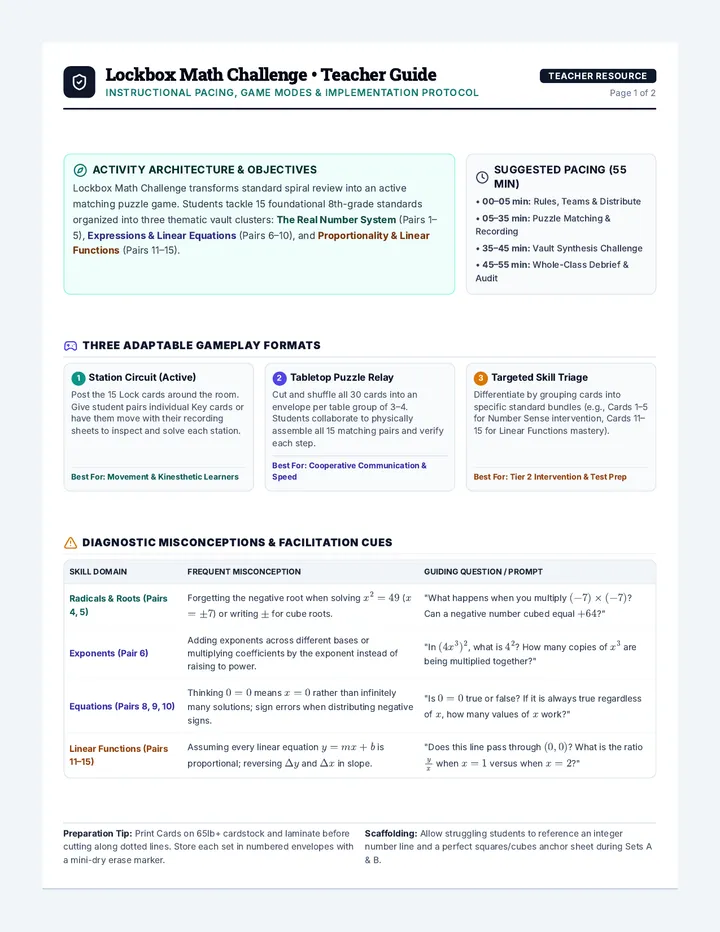
Lockbox Math Challenge • Teacher Guide
Instructional Pacing, Game Modes & Implementation Protocol
Teacher Resource
Page 1 of 2
Activity Architecture & Objectives
Lockbox Math Challenge transforms standard spiral review into an active matching puzzle game. Students tackle 15 foundational 8th-grade standards organized into three thematic vault clusters: The Real Number System (Pairs 1–5), Expressions & Linear Equations (Pairs 6–10), and Proportionality & Linear Functions (Pairs 11–15).
Suggested Pacing (55 Min)
- • 00–05 min: Rules, Teams & Distribute
- • 05–35 min: Puzzle Matching & Recording
- • 35–45 min: Vault Synthesis Challenge
- • 45–55 min: Whole-Class Debrief & Audit
Three Adaptable Gameplay Formats
1
Station Circuit (Active)
Post the 15 Lock cards around the room. Give student pairs individual Key cards or have them move with their recording sheets to inspect and solve each station.
Best For: Movement & Kinesthetic Learners
2
Tabletop Puzzle Relay
Cut and shuffle all 30 cards into an envelope per table group of 3–4. Students collaborate to physically assemble all 15 matching pairs and verify each step.
Best For: Cooperative Communication & Speed
3
Targeted Skill Triage
Differentiate by grouping cards into specific standard bundles (e.g., Cards 1–5 for Number Sense intervention, Cards 11–15 for Linear Functions mastery).
Best For: Tier 2 Intervention & Test Prep
Diagnostic Misconceptions & Facilitation Cues
| Skill Domain |
Frequent Misconception |
Guiding Question / Prompt |
| Radicals & Roots (Pairs 4, 5) |
Forgetting the negative root when solving \(x^2 = 49\) (\(x = \pm 7\)) or writing \(\pm\) for cube roots. |
"What happens when you multiply \((-7) \times (-7)\)? Can a negative number cubed equal \(+64\)?" |
| Exponents (Pair 6) |
Adding exponents across different bases or multiplying coefficients by the exponent instead of raising to power. |
"In \((4x^3)^2\), what is \(4^2\)? How many copies of \(x^3\) are being multiplied together?" |
| Equations (Pairs 8, 9, 10) |
Thinking \(0 = 0\) means \(x = 0\) rather than infinitely many solutions; sign errors when distributing negative signs. |
"Is \(0=0\) true or false? If it is always true regardless of \(x\), how many values of \(x\) work?" |
| Linear Functions (Pairs 11–15) |
Assuming every linear equation \(y = mx + b\) is proportional; reversing \(\Delta y\) and \(\Delta x\) in slope. |
"Does this line pass through \((0,0)\)? What is the ratio \(\frac{y}{x}\) when \(x=1\) versus when \(x=2\)?" |
Preparation Tip: Print Cards on 65lb+ cardstock and laminate before cutting along dotted lines. Store each set in numbered envelopes with a mini-dry erase marker.
Scaffolding: Allow struggling students to reference an integer number line and a perfect squares/cubes anchor sheet during Sets A & B.
Master Solution Matrix & Answer Key
Complete Worked Solutions & Verification Benchmarks
Quick-Check Key
Page 2 of 2
| Pair |
Skill Focus |
Key Mathematical Proof / Solution |
Final Verified Answer |
| 01 |
Rational Decimals |
Long division: \(7.000 \div 12 = 0.5833...\) Denominator \(12 = 2^2 \cdot 3\). Factor of 3 creates repeating remainder. |
\(0.58\overline{3}\) (Repeating) |
| 02 |
Irrational Numbers |
\(28\) is non-square. \(\sqrt{25} < \sqrt{28} < \sqrt{36}\) so \(5 < \sqrt{28} < 6\). Non-repeating decimal. |
Irrational; between 5 & 6 |
| 03 |
Ordering Real Numbers |
\(-4.200 < -4.123 (-\sqrt{17}) < 3.1416 (\pi) < 3.162 (\sqrt{10}) < 3.200 (\frac{16}{5})\). |
\(-4.2 < -\sqrt{17} < \pi < \sqrt{10} < \frac{16}{5}\) |
| 04 |
Square & Cube Roots |
\(\sqrt{\frac{144}{49}} = \frac{12}{7}\); \(\sqrt[3]{-216} = -6\). \(\frac{12}{7} - (-6) = \frac{12 + 42}{7} = \frac{54}{7}\). |
\(\frac{54}{7} = 7\frac{5}{7}\) |
| 05 |
Root Equations |
\(2x^2 = 98 \implies x^2 = 49 \implies x = \pm 7\); \(y^3 = 64 \implies y = \sqrt[3]{64} = 4\). |
\(x = \pm 7\), \(y = 4\) |
| 06 |
Exponential Expressions |
\((4x^3 y^{-2})^2 = 16 x^6 y^{-4}\); times \(x^{-2} y^5 = 16 x^4 y^1\). Divide by \(2 x^4 y^3 = 8 y^{-2} = \frac{8}{y^2}\). |
\(\frac{8}{y^2}\) |
| 07 |
Combining Like Terms |
Distribute: \(12a - 6b - 5a + 15b - 2a - 8 = (12 - 5 - 2)a + (-6 + 15)b - 8\). |
\(5a + 9b - 8\) |
| 08 |
Variables Both Sides |
\(10x - 15 - 4x = 6x - 15\); Right: \(2x + 13\). \(6x - 15 = 2x + 13 \implies 4x = 28\). |
\(x = 7\) |
| 09 |
Multi-Step Equations |
Multiply by LCD \(4\): \((3x - 5) + 8 = 2(x + 7) \implies 3x + 3 = 2x + 14 \implies x = 11\). |
\(x = 11\) |
| 10 |
Number of Solutions |
(A) \(8x - 12 = 8x - 15 \implies -12 = -15\) (False \(\implies\) No Sol). |
|
| (B) \(10x + 2 = 10x + 2 \implies 2 = 2\) (Identity \(\implies \infty\) Sol). |
(A) No Sol • (B) \(\infty\) Sol |
|
|
| 11 |
Proportionality |
Ratio \(k = \frac{15}{6} = 2.5\) is constant across all quantities. Linear through \((0,0)\). |
\(y = 2.5x\) (\(k = 2.5\)) |
| 12 |
Slope as Unit Rate |
Runner A: \(m_A = 8.5\text{ m/s}\). Runner B: \(m_B = \frac{38}{4} = 9.5\text{ m/s}\). Difference: \(1.0\text{ m/s}\). |
Runner B faster by \(1.0\) m/s |
| 13 |
Analyze \(y = mx\) |
Passes through origin because \(y = -\frac{3}{2}(0) = 0\). Points: \((0,0), (2, -3), (-2, 3)\). |
\(m = -\frac{3}{2}\); \((2,-3)\) |
| 14 |
Understand y-Intercept |
Initial depth is \(-45\)m at \(x=0\) min. Rate is \(+3\)m/min. \(y = 3x - 45\). |
\(y = 3x - 45\); \((0, -45)\) |
| 15 |
Analyze \(y = mx + b\) |
\(-1 = -\frac{4}{3}(6) + b \implies b = 7\). Equation: \(y = -\frac{4}{3}x + 7\). For x-int: \(0 = -\frac{4}{3}x + 7 \implies x = 5.25\). |
\(y = -\frac{4}{3}x + 7\); \((5.25, 0)\) |
Vault Synthesis Error Analysis • Exemplar Solution Key
Master Verification
Exemplar Student Justification: Maya is incorrect. While \(y = 4x + 6\) is a linear function with a constant slope of \(4\), a relationship is proportional if and only if the line passes through the origin \((0,0)\), which means the y-intercept must be \(0\) (\(b = 0\)). In Maya's equation, when \(x = 0\), \(y = 6\), not \(0\). Furthermore, the ratio \(\frac{y}{x}\) is not constant: at \(x = 1\), \(\frac{y}{x} = \frac{10}{1} = 10\), but at \(x = 2\), \(\frac{y}{x} = \frac{14}{2} = 7\). Because the ratio \(\frac{y}{x}\) changes depending on \(x\), there is no constant of proportionality.
Lockbox Math Challenge • Master Solution Key Standards: 8.NS.1-2, 8.EE.1-2, 8.EE.5-7, 8.F.4