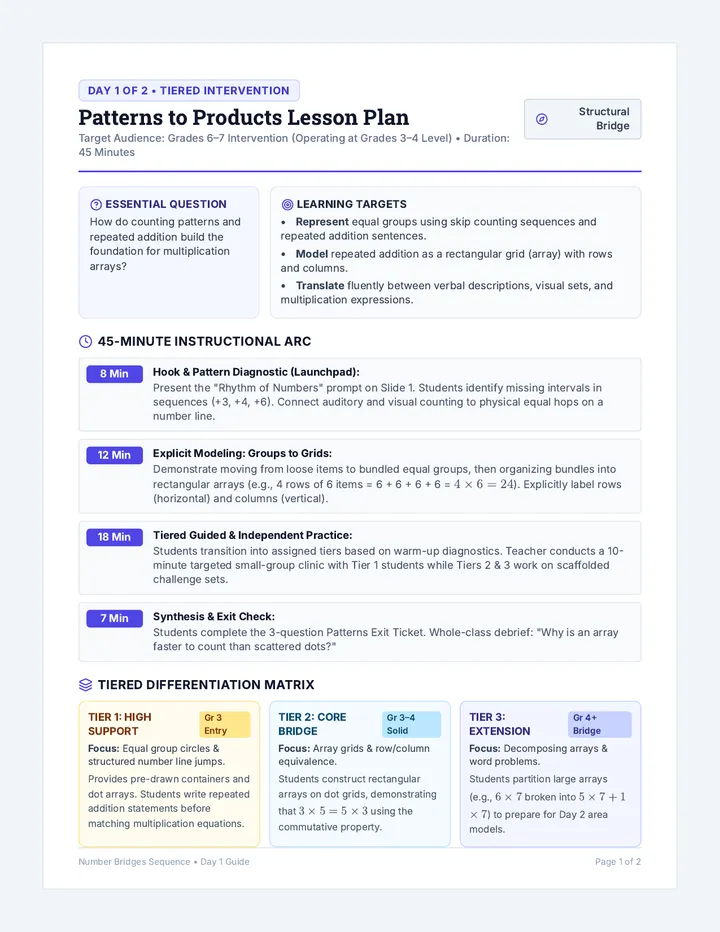
A comprehensive, visual foundational lesson introducing repeated addition through equal groups, arrays, and number line hops to build a solid bridge to multiplication.
Intervention: Use concrete manipulatives. Place 5 cubes in each of 3 cups. Ask: "What is inside the cup? We add what's inside (5), not the cups themselves!"
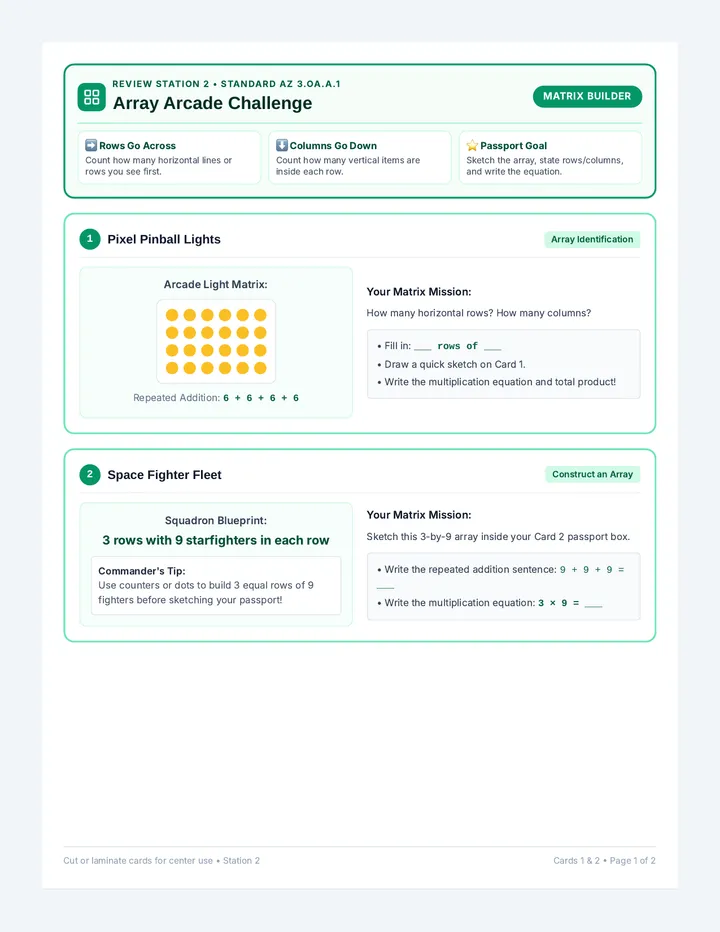
Misconception 2: Confusing Rows and Columns in Arrays
Example error: Counting vertical columns when asked for the number of rows.
Intervention: Physical gesture anchor: Have students sweep their arm horizontally for "Row like a boat across water" and point up/down for "Columns hold up Greek buildings."
Misconception 3: Unequal Groups as Repeated Addition
Example error: Writing a multiplication equation for sets like 4 + 3 + 4 = 11.
Intervention: Display non-examples prominently. Emphasize that multiplication only works when every single group is identical.
Tiered Differentiation Pathways
Tier 1: Scaffolding
Provide 2-color counters and sorting bowls.
Use pre-drawn sentence frames with color coding.
Focus on groups of 2, 5, and 10 first.
Tier 2: On-Grade
Complete Practice Pack Levels 1 & 2 independently.
Translate word stories into arrays and number lines.
Explain the connection between factor and addend.
Tier 3: Extension
Explore the Commutative Property (e.g., 3×4 vs 4×3).
Design original array word problems for classmates.
Solve two-step equal groups challenge scenarios.
Debrief & Check for Understanding Questions
Prompt 1: Visual Transfer
"If I have 5 jumps of 4 on a number line, what repeated addition sentence matches? How many total?"
Prompt 2: Conceptual Meaning
"Why is writing 4 × 6 faster than writing 6 + 6 + 6 + 6? What does the 4 tell us?"
Group Power • Teacher Facilitation Guide Page 2 of 2
=
Multiplication Equation:
×
=
Maya has stickers in all.
Group Power Practice Pack • Scaffolded Math Workshop Page 2 of 2