Lenny.com
Explore
Create
ActivitiesNewMathEnglish Language ArtsScience & EngineeringSocial StudiesGlobal LanguagesHealth & Physical EducationSpecial EducationCounseling & Life SkillsArts & CreativityESL
Lenny.com
Lenny.com
Explore
Create
ActivitiesNewMathEnglish Language ArtsScience & EngineeringSocial StudiesGlobal LanguagesHealth & Physical EducationSpecial EducationCounseling & Life SkillsArts & CreativityESL
Lenny.com
Lenny.com

Solutions

Lenny for EducatorsLenny for SchoolsLenny for Districts

Product

ExploreSign inCreateSupportAbout

Resources

Getting startedMTSS Acceleration Program

© 2026 Lenny Learning Inc.

TermsPrivacyAccessibility
LinkedInInstagramX
Lenny
MathNumbers & CountingCounting ObjectsNumber NamesComparing NumbersNumber OperationsCounting SequenceNumbers 0-10Place Value Understanding and SystemAdd and Subtract Within 20Addition and Subtraction ConceptsAddition and Subtraction EquationsAddition and Subtraction ProblemsFoundations for MultiplicationMultiplication and Division PropertiesMultiply and Divide Within 100Multiplication and Division ProblemsFactors and MultiplesProperties of OperationsPatterns and RelationshipsGenerate and Analyze PatternsMulti-Digit ArithmeticPlace Value OperationsMulti-Digit and Decimal OperationsNumerical ExpressionsFour Operations and PatternsFour Operations Problem SolvingMeasurement & DataMeasurable AttributesMeasuring LengthsMeasure and Estimate Lengths in Standard UnitsRelate Addition and Subtraction to LengthClassifying and Counting ObjectsTime and MoneyArea Concepts and MeasurementPerimeter and Area MeasuresAngle Concepts and MeasurementTime, Volume, and MassMeasurement Unit ConversionsGeometryIdentifying ShapesShapes and AttributesShape Attributes and ReasoningShapes and CompositionClassifying 2D FiguresGeometric Figures and RelationshipsLines, Angles, and ShapesAngle, Area, and VolumeGeometric MeasurementVolume of 3D ShapesCoordinate Plane ApplicationsTransformations in the PlaneCongruence and SimilarityUnderstand congruence in terms of rigid motionsSimilarity and TransformationsProve Theorems Involving SimilarityPythagorean TheoremTrigonometry for General TrianglesMake Geometric ConstructionsProve Geometric TheoremsTheorems About CirclesFind Arc Lengths And Areas of Sectors of CirclesVolume FormulasRelationships Between Two-Dimensional and Three-Dimensional ObjectsProve Simple Geometric Theorems AlgebraicallyTranslate Between Geometric Description and Equation for Conic SectionApply Geometric Concepts in Modeling SituationsFractions & DecimalsFractions as NumbersBuilding FractionsFraction Equivalence and OrderingAdding and Subtracting FractionsMultiplying and Dividing FractionsDividing FractionsDecimal FractionsMulti-Digit Computation and FactorsAdd, Subtract, Multiply, and Divide Rational NumbersRational Number SystemIrrational Numbers and ApproximationsRatiosRatios and ProportionsProportional RelationshipsUnit RateAlgebraAlgebraic ExpressionsGenerate Equivalent ExpressionsQuantitative RelationshipsProportional Relationships and Linear EquationsEquations and InequalitiesEquation Solving and ReasoningLinear Equations and SystemsGraph Equations and InequalitiesSystems of EquationsReal-World Algebraic ProblemsQuantitative Reasoning with UnitsExpression StructureEquivalent Expression FormsRadicals and Integer ExponentsRational ExponentsRational and Irrational NumbersPolynomial OperationsPolynomial IdentitiesPolynomial Zeros and FactorsRational ExpressionsComplex Number OperationsComplex Numbers in PolynomialsComplex Numbers on PlaneStatistics & ProbabilityRepresent and Interpret DataData DistributionsStatistical VariabilityProbability ModelsCompound Event ProbabilitiesStatistical SamplingInterpret Categorical and Quantitative DataBivariate Data PatternsInterpret Linear ModelsComparing Two PopulationsRandom Processes in StatisticsIndependence and Conditional ProbabilityExpected ValuesProbability-Based Decision MakingStatistical Inference and ConclusionsFunctionsFunction Concepts and NotationDefine and Compare FunctionsInterpret Functions in ContextAnalyze Function RepresentationsModel Relationships with FunctionsIdentify Linear vs Exponential GrowthDistinguish Between Function TypesCompare Growth RatesInterpret Function ExpressionsBuild Functions from RelationshipsConstruct and Model FunctionsTransform and Combine FunctionsModel Comparison and SelectionSolve Exponential EquationsTrigonometryTrigonometric Ratios Involving Right TrianglesTrigonometric Functions and Unit CircleModel with Trigonometric FunctionsTrigonometric IdentitiesVectors & MatricesIntroduction to Vectors and MatricesVector QuantitiesVector OperationsMatrix OperationsCalculusLimits and ContinuityDerivative Concepts and NotationDerivative Rules and TechniquesApplications of DerivativesOptimization ProblemsRelated RatesCurve Sketching and AnalysisIntegration Concepts and NotationAntiderivatives and Indefinite IntegralsDefinite Integrals and AreaFundamental Theorem of CalculusIntegration TechniquesApplications of IntegrationDifferential EquationsSequences and SeriesParametric and Polar FunctionsVector-Valued Functions

Garden Array Architects

Students explore multiplication, rectangular arrays, area, and perimeter by designing their own backyard vegetable gardens. Using grid models and real-world planting constraints, learners discover how array dimensions determine total planting area and perimeter determines fencing needs.

RCRoni Coleman

Veggie Arrays: Applied Challenges

Part 2: Real-World Garden Problems & Geometric Reasoning

Name: ____________________________

4

Farmer Maria's Crisp Radish Patch

Farmer Maria builds a rectangular radish bed that is 6 feet long and 4 feet wide.

Draw and label a sketch of Maria's bed:

Area Equation (Planting Space): ____ ft × ____ ft = _____ sq ft

Perimeter Equation (Fencing Needed): __ + __ + __ + __ = _____ feet

5

The Mystery Cucumber Bed (Finding Missing Width)

A gardener builds a rectangular cucumber patch with a total area of 28 square feet. The length of the bed is 7 feet.

Step 1: Find Width 7 × ____ = 28

Width = _____ ft

Step 2: Show Work for Perimeter

Step 3: Total Fence Fence needed:

P = _____ ft

6

Investigation: Same Area, Different Fence Length!

Critical Thinking

Two students both design an onion patch with an area of 12 square feet:

Bed A (Kai's Design) 1 foot wide by 12 feet long

Area: 1 × 12 = _____ sq ft

Perimeter: 1 + 12 + 1 + 12 = _____ ft

Bed B (Maya's Design) 3 feet wide by 4 feet long

Area: 3 × 4 = _____ sq ft

Perimeter: 3 + 4 + 3 + 4 = _____ ft

Which design requires less fencing to protect? Why does a long skinny bed require more fence than a square-like bed?

7

Gardener Error Analysis: Spot the Mistake!

Leo says: "My garden bed is 5 feet long and 3 feet wide, so its area is 16 feet because 5 + 3 + 5 + 3 = 16."

Explain Leo's mistake and state the correct area with proper units:

Mastery Objective: Solve area (L × W) and perimeter (2L + 2W) garden problems

Page 2 of 2

You might also like

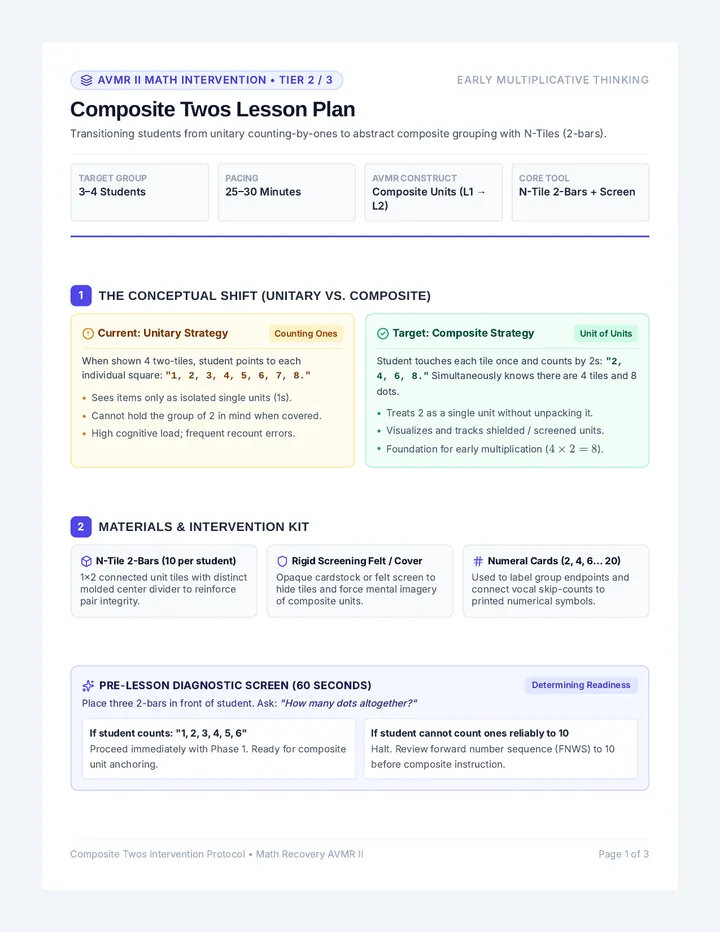
Composite Twos Lesson Plan

Math Intervention Suite

A comprehensive math intervention suite targeting foundational construct progressions from early multiplicative units to conceptual fraction schemes.

JW

Julie Whitehead

13
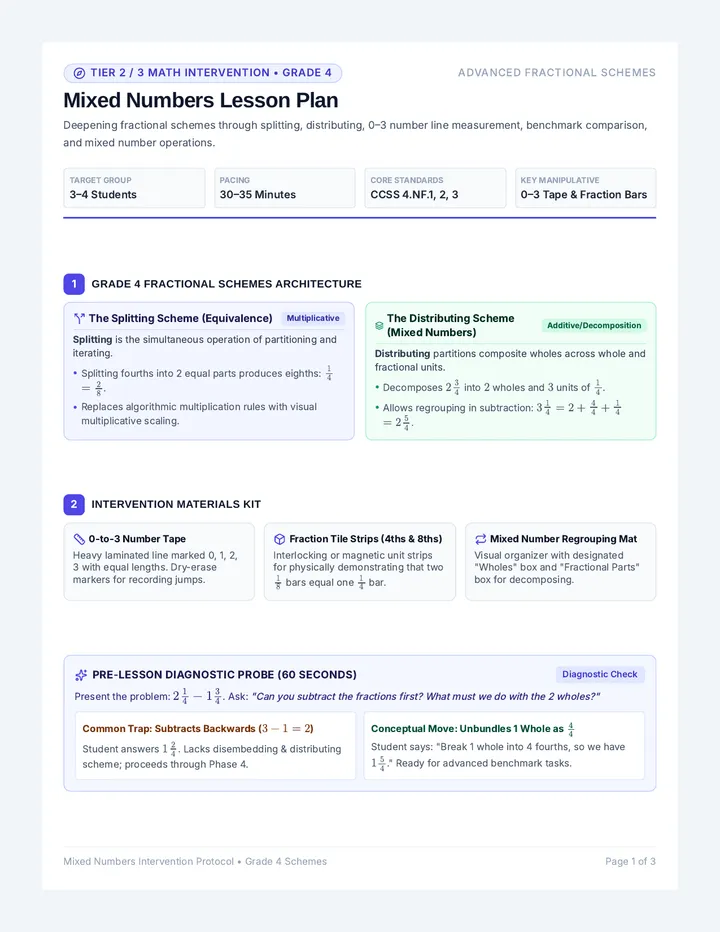
Mixed Numbers Lesson Plan

Fraction Navigators

A Grade 4 intervention lesson targeting advanced fractional schemes: disembedding, iterating, splitting, distributing, number lines, equivalence, benchmark comparison, and adding/subtracting mixed numbers.

JW

Julie Whitehead

4
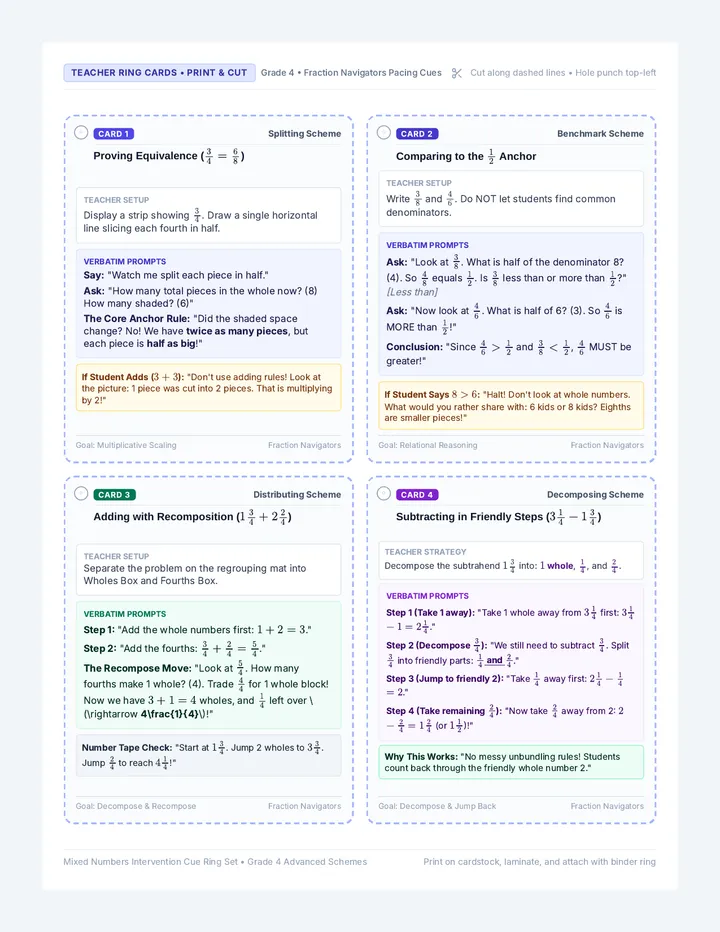
Mixed Numbers Cue Cards

Mixed Numbers Cue Cards

A print-and-cut 4-card teacher cue ring set for Grade 4: Card 4 has been updated to use the decomposing/chunking subtraction strategy (subtracting 1 whole first, then decomposing 3/4 into 1/4 and 2/4 and jumping back in two steps) instead of unbundling wholes.

JW

Julie Whitehead

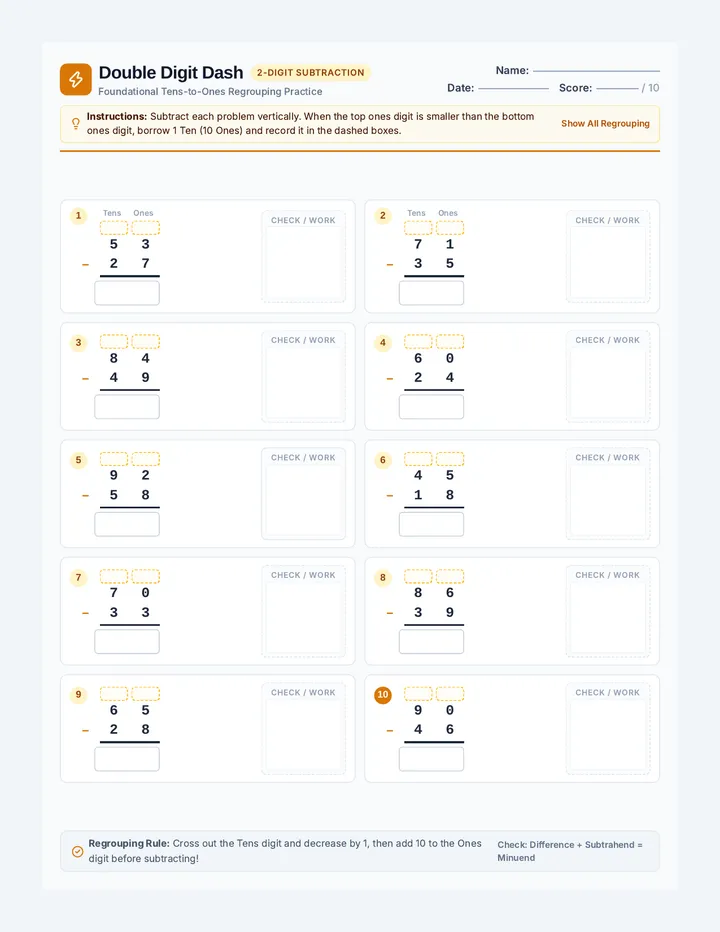
Double Digit Dash Worksheet

Elementary Skills Lab

A foundational elementary curriculum covering progressive multi-digit mathematics operations and early literacy grammar and phonics analysis.

JM

Jennifer Murphy

5
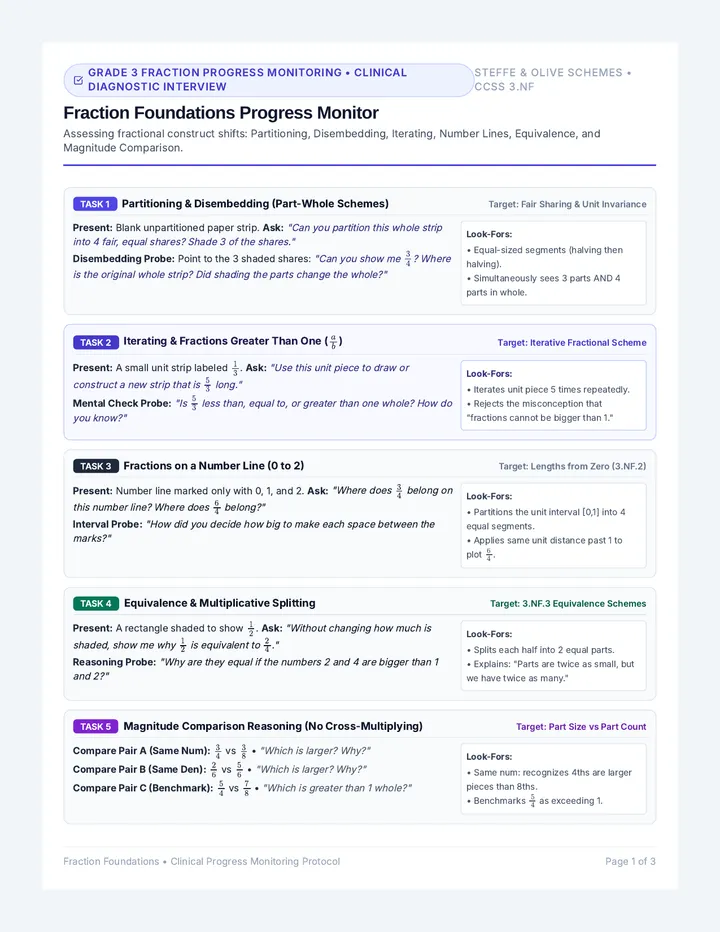
Fraction Foundations Progress Monitor

Fraction Foundations

An intervention unit targeting Grade 3 fraction foundations through partitioning wholes, disembedding, iterating unit fractions, number lines, equivalence, and magnitude comparison.

JW

Julie Whitehead

4
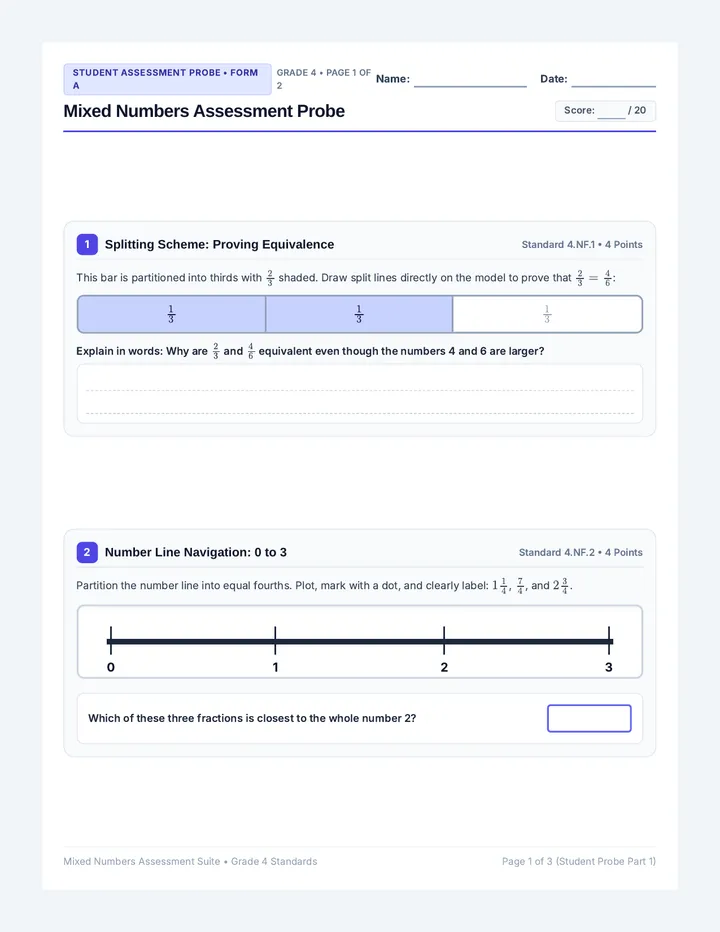
Mixed Numbers Progress Monitor

Mixed Numbers Progress Monitor

A 3-page clinical assessment probe and scoring guide for Grade 4: Pages 1 and 2 provide large, generously spaced student work areas for splitting, number lines, benchmark reasoning, and mixed number operations, while Page 3 provides the comprehensive examiner scoring guide and MTSS rubric. Fixed number line spacing and brought down the follow-up question box to resolve overlap.

JW

Julie Whitehead

Roll and Multiply Slides

Fact Master Quest

A comprehensive 3-day instructional sequence designed to build fluency in single-digit multiplication facts from 1 to 10. Students progress from experiential dice rolling and array modeling to systematic 10x10 chart mapping, culminating in flashcard fabrication and timed partner drills.

AA

alicia accapezzato

9
Composite Twos Lesson Plan

Two Tile Leap

An intervention lesson designed to transition early math learners from unitary counting by ones to composite counting by twos using N-tiles and AVMR II screening techniques.

JW

Julie Whitehead

5
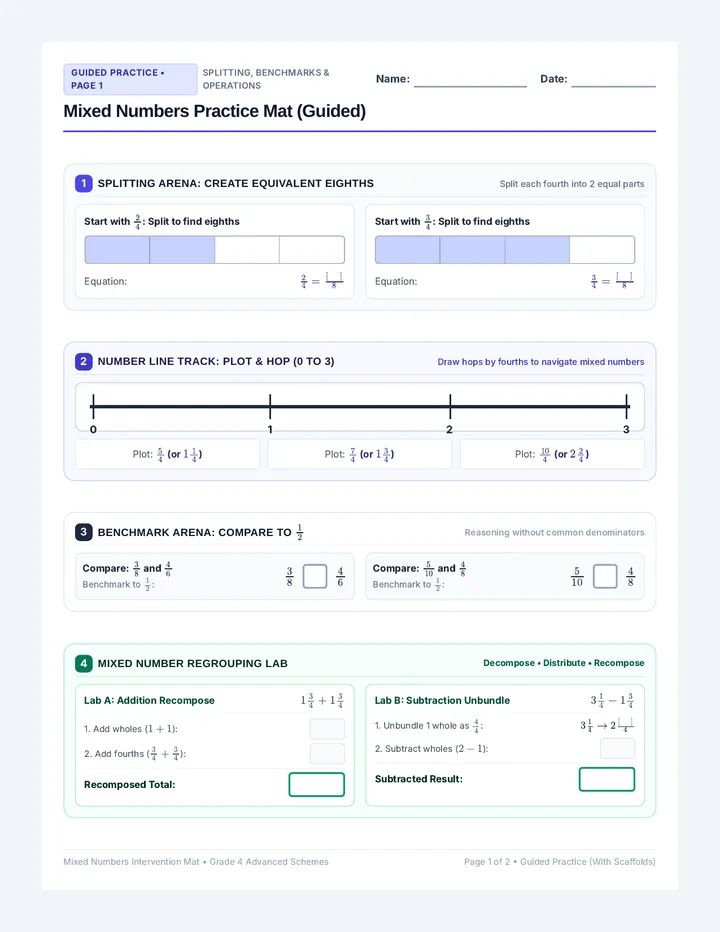
Mixed Numbers Practice Mat

Mixed Numbers Practice Mat

A 2-page student intervention practice mat for Grade 4: Page 1 includes guided instructional scaffolds and prompts, while Page 2 provides the exact same tasks without hints for independent practice and mastery verification.

JW

Julie Whitehead

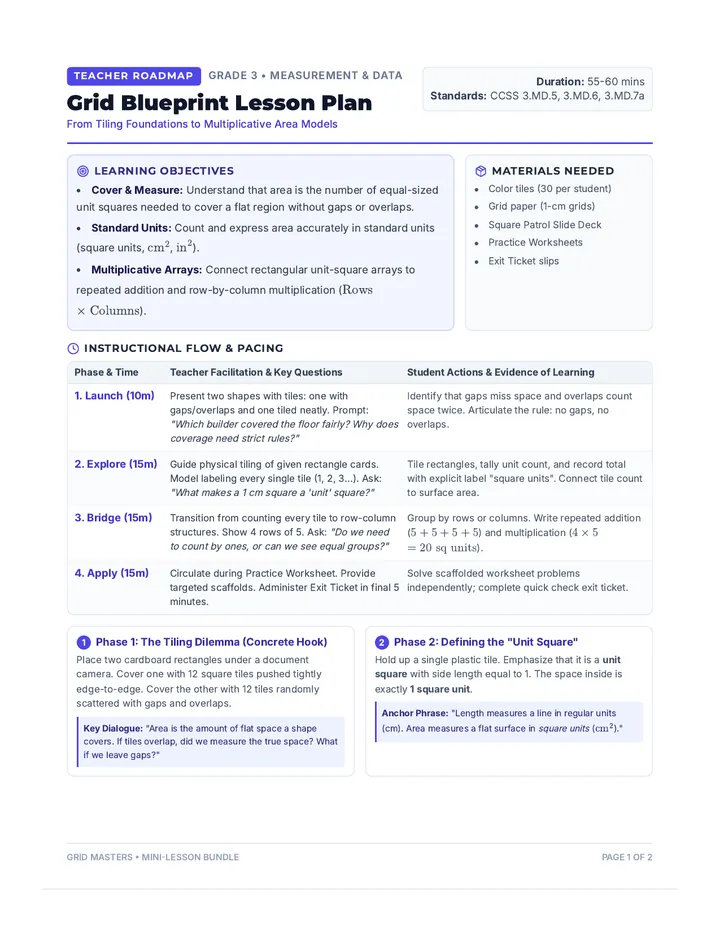
Grid Blueprint Lesson Plan

Dimension Architects

A coherent spatial measurement sequence bridging two-dimensional surface coverage to three-dimensional volume measurement. Students transition from tiling flat regions with unit squares to packing solid rectangular prisms with unit cubes, connecting spatial arrays to multiplicative formulas.

MJ

Meg Jones

8
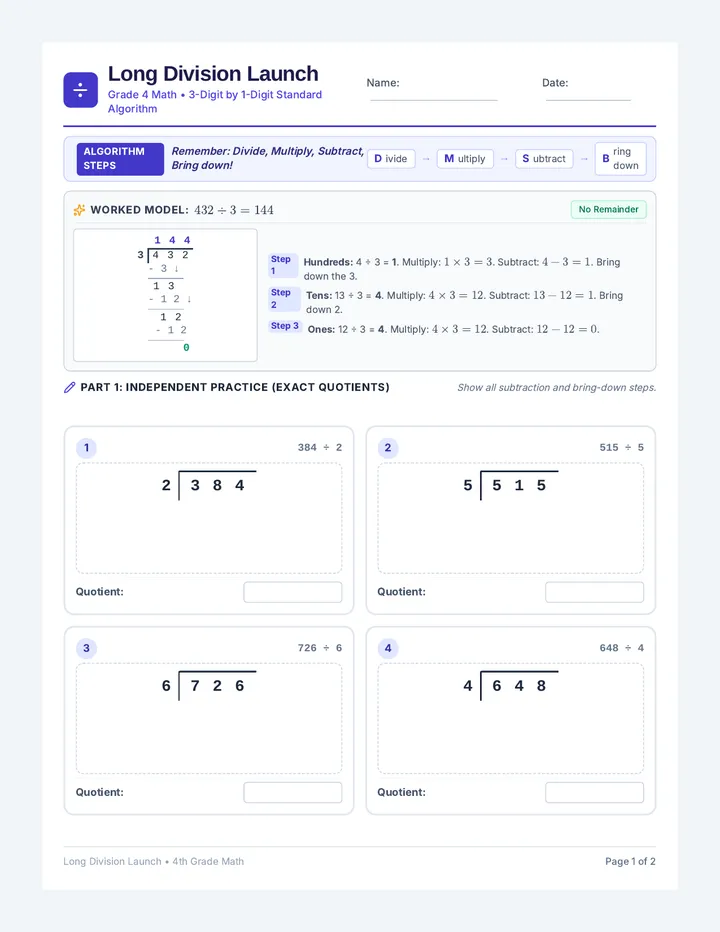
Long Division Launch Worksheet

Long Division Launch

A comprehensive foundational lesson on multi-digit division for fourth graders. Students master the standard algorithm dividing three-digit numbers by one-digit divisors, transitioning from clean divisions to problems with remainders.

MB

Marissa Britton

2
Mixed Numbers Lesson Plan

Mixed Numbers Lesson Plan

A comprehensive 3-page Grade 4 intervention lesson plan guiding teachers step-by-step through disembedding, iterating, splitting, distributing, number line navigation (0-3), benchmark comparison, and mixed number operations.

JW

Julie Whitehead