Function Frenzy Review Packet Function Frenzy Review Packet
Algebra 1 • Unit 03: Introduction to Functions
Calculators NOT Allowed
Name: _______________________________________
Date: ______________________
PART 1
Concept Reminders
1. Is It a Function?
Every input \(x\) has exactly one output \(y\) .
Ordered pairs: No repeated \(x\)-values with different \(y\)-values.Graphs: Passes the Vertical Line Test (hits at most once).
2. Graph Features
Domain: All \(x\)-values (left → right).Range: All \(y\)-values (bottom → top).Positive: Graph is above the \(x\)-axis (\(y > 0\)).Increasing: Graph goes up from left to right (use \(x\)-intervals).
3. Function Notation
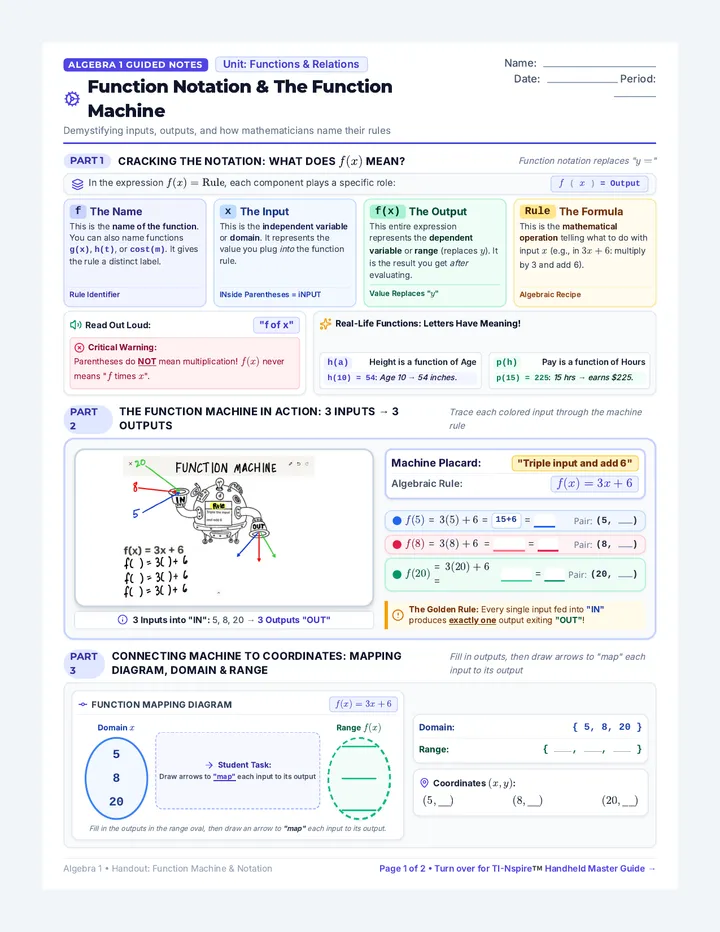
In \(f(x) = y\), \(x\) is the input and \(y\) is the output .
Evaluate \(f(3)\): Plug in \(x = 3\).Solve \(f(x) = 10\): Set output equal to \(10\) and find \(x\).Units: Check time/unit labels carefully!
PART 2
Guided Practice
1. Consider the relation \(\{(4, 9), (k, 7), (-2, 5), (6, 9)\}\). Give one value of \(k\) that makes this relation not a function, and explain why in one sentence.
2. Given \(h(x) = 3x - 11\), find the value of \(x\) that makes \(h(x) = 13\) true. Show your steps.
3. A linear function \(p(t) = 45 + 15t\) models the total cost in dollars to rent a kayak for \(t\) hours. Explain what the number \(45\) represents in this situation.
Unit 03 Review • Algebra 1 Page 1 of 3
4. Solve the literal equation \(4ab - 8 = c\) for \(b\) in terms of \(a\) and \(c\). Show your work.
PART 3
Test Spotlight: Direct from Unit 03 Test
Original Assessment Questions
Test Question 1 (Unit 03 Test #5)
Function \(d\) gives the distance of a boat from the dock \(t\) seconds after leaving the dock. Distance is measured in meters. Here is a graph that represents \(d\).
Which of the following statements is NOT true?
(A) \(d(30) = d(70)\)
(B) \(d(10) = 20\)
(C) \(d(90) < d(160)\)
(D) \(d(0) = 0\)
Show how you checked each choice:
Test Question 2 (Unit 03 Test #9)
In the function below, \(c\) is a constant. If \(g(4) = 5\), what is the value of \(g(-2)\)?
\[g(x) = 2x + c\]
(A) \(-7\)
(B) \(-1\)
(C) \(1\)
(D) \(5\)
Unit 03 Review • Algebra 1 Page 2 of 3
Test Question 3 (Unit 03 Test #13 • Open-Ended Response) 4 points
Function \(R\) gives the amount of rain measured by a rain gauge \(t\) hours since it started raining. The amount of rain is measured in millimeters.
For a and b , what does each expression or equation represent in this situation? Explain in one sentence.
a) \(R(3) = N\)
b) \(R(0.5) = 14\)
For c and d , write an expression or equation in function notation to represent each statement.
c) Six hours after it started raining, the amount of rain was 37 millimeters.
d) The amount of rain 90 minutes after it started raining was the same as the amount 120 minutes after it started raining.
Before the Test: Quick Readiness Check
☐ I can check functions using ordered pairs & VLT.
☐ I can find \(c\) in \(g(x) = mx + c\) from a given point.
☐ I can read values & inequalities from a graph.
☐ I convert minutes to hours before writing \(R(t)\).
Unit 03 Review • Algebra 1 Page 3 of 3
Function Frenzy Answer Key Function Frenzy Answer Key
Algebra 1 • Unit 03: Introduction to Functions
ANSWER KEY
PART 2
Guided Practice Solutions
Problem 1: Identifying Functions Answer: \(k = 4, -2,\) or \(6\)
Explanation: Any value of \(k\) that matches an existing \(x\)-coordinate (\(4\), \(-2\), or \(6\)) pairs the same input with two different outputs (since the \(y\)-value here is \(7\), which differs from \(9\), \(5\), and \(9\)). Having one input map to two different outputs violates the definition of a function.
Problem 2: Solving \(h(x) = 13\) Answer: \(x = 8\)
Set the function expression equal to \(13\) and solve for \(x\):
\(3x - 11 = 13 \implies 3x = 24 \implies x = 8\)
Common Error: Do not plug \(13\) in for \(x\)! \(h(x) = 13\) gives the output, not the input.
Problem 3: Interpreting Linear Models Initial Fee / \(y\)-intercept
Sample Explanation: The number \(45\) represents a flat base fee of \(\$45\) charged for \(0\) hours of kayak rental (before any hourly rate of \(\$15\)/hour is added).
Problem 4: Literal Equations Answer: \(b = \dfrac{c + 8}{4a}\)
Step 1: Add \(8\) to both sides: \(4ab = c + 8\)
Step 2: Divide both sides by \(4a\): \(b = \dfrac{c + 8}{4a}\)
Note: Both \(c\) and \(8\) must be divided by \(4a\).
Unit 03 Review Answer Key • Algebra 1 Page 1 of 2
PART 3
Test Spotlight Solutions (Direct from Unit 03 Test)
Test Question 1 (Unit 03 Test #5) Correct Choice: (C)
(A) \(d(30) = d(70)\): True. At \(t = 30\) and \(t = 70\), the boat is \(40\text{ m}\) from the dock.(B) \(d(10) = 20\): True. At \(t = 10\) seconds, the distance is \(20\text{ m}\).(C) \(d(90) < d(160)\): NOT TRUE. From the graph, \(d(90) = 50\) and \(d(160) = 40\), and \(50 < 40\) is false.(D) \(d(0) = 0\): True. At \(t = 0\), the boat is at the dock (\(0\text{ m}\)).
Test Question 2 (Unit 03 Test #9) Correct Choice: (A) \(-7\)
Step 1 — Find \(c\) using \(g(4) = 5\):
\(5 = 2(4) + c \implies 5 = 8 + c \implies c = -3\)
Step 2 — Evaluate \(g(-2)\) using \(g(x) = 2x - 3\):
\(g(-2) = 2(-2) - 3 = -4 - 3 = -7\)
Test Question 3 (Unit 03 Test #13 • 4 Points) 1 pt per part
a) \(R(3) = N\): Three hours after it started raining, the amount of rain measured by the rain gauge was \(N\) millimeters.
b) \(R(0.5) = 14\): Half an hour (\(0.5\) hours) after it started raining, the amount of rain was \(14\) millimeters.
c) \(R(6) = 37\)
d) \(R(1.5) = R(2)\) (Convert minutes to hours: \(90\text{ min} = 1.5\text{ hr}\) and \(120\text{ min} = 2\text{ hr}\).)
Unit 03 Review Answer Key • Algebra 1 Page 2 of 2
Function Frenzy Teacher Guide Function Frenzy Teacher Guide
Algebra 1 • Unit 03 Assessment Review (45-Minute Block)
No Calculators
Review Objectives
Determine whether a relation or graph represents a function using input-output rules and the Vertical Line Test.
Interpret domain, range, positive intervals, and increasing/decreasing intervals from graphs.
Evaluate functions, solve for unknown constants, and translate real-world statements into function notation.
45-Minute Pacing Plan
Time
Segment
Teacher Moves & Materials
0–10 min
Concept Blitz (Slides 1–4)
Walk through the 3 Concept Reminder cards on Packet Page 1 while students annotate key terms.
10–22 min
Guided Practice (Q1–Q4)
Model Q1 together, then have pairs complete Q2–Q4 without calculators. Circulate to check literal equation steps.
22–38 min
Test Spotlight (Slides 5–8)
Students tackle the 3 original Unit 03 Test questions independently (4 min each), followed by whole-class debrief.
38–45 min
Readiness Check & Wrap-Up
Students complete the Quick Readiness Check on Page 3 and identify one skill to review tonight.
High-Frequency Misconceptions to Watch For
Confusing \(f(x) = 10\) with \(f(10)\)
Students often substitute \(10\) for \(x\) instead of setting the equation equal to \(10\). Remind them: inside parentheses = input; after the equals sign = output.
Minutes vs. Hours in Test Q13
In Part d, students frequently write \(R(90) = R(120)\). Prompt them to re-read the problem stem: "\(t\) hours since it started raining."
Negative Sign Errors in \(g(-2)\)
Without calculators, students slip on \(2(-2) - 3\). Encourage writing parentheses around negative substitutions every time.
Positive vs. Increasing on Graphs
A graph can be below the \(x\)-axis (negative) while going up (increasing). Have students trace with a finger left-to-right.
Unit 03 Teacher Guide • Algebra 1 Page 1 of 2
Test Spotlight: Facilitation & Debrief Prompts
Test Question 1 (Original Test #5 — Boat Distance)
Target: 4–5 min
Key Question: "Why is it helpful to write down the exact \(y\)-value for each choice before deciding which one is NOT true?"
Facilitation Tip: Have students annotate the graph at \(t = 90\) (\(y = 50\)) and \(t = 160\) (\(y = 40\)). Emphasize that \(50 < 40\) is false, so (C) is the correct answer.
Test Question 2 (Original Test #9 — Constant \(c\))
Target: 4–5 min
Key Question: "What information does \(g(4) = 5\) give us, and why do we need it before finding \(g(-2)\)?"
Facilitation Tip: Ask students to label \(x = 4\) and \(g(x) = 5\) above the given equation. Once \(c = -3\) is found, have them rewrite the full rule \(g(x) = 2x - 3\) before substituting \(x = -2\).
Test Question 3 (Original Test #13 — Rain Gauge)
Target: 6–7 min
Key Question: "What units must go inside \(R(\underline{\hspace{0.5cm}})\), and what units come out?"
Facilitation Tip: Require complete sentences for parts (a) and (b) that include both quantities and units (hours and millimeters). For part (d), pause and ask: "Why would \(R(90) = R(120)\) lose a point?"
Differentiation & Support
Scaffolding: Provide sentence frames for Test Q13a–b: "____ hours after it started raining, the amount of rain was ____ millimeters." Extension: Challenge early finishers to sketch a possible graph for \(R(t)\) that satisfies \(R(0.5) = 14\) and \(R(1.5) = R(2)\), then identify where \(R(t)\) is increasing vs. constant.
Unit 03 Teacher Guide • Algebra 1 Page 2 of 2
Function Frenzy Review Slides Algebra 1 • Unit 03 Review
Calculators NOT Allowed
Function Frenzy
Mastering functions, graph features, and function notation before the Unit 03 Assessment.
1. Identifying Functions
2. Graph Features
3. Test Spotlight (3 Qs)
1. Is It a Function?
Concept Review
Golden Rule: Every input \(x\) has exactly one output \(y\) .
Ordered Pairs
Look at the \(x\)-values. If an \(x\)-value repeats with a different \(y\)-value, it is NOT a function.
\(\{(2, 5), (2, 8), (7, 10)\}\) → NOT a function!
Vertical Line Test
If any vertical line crosses the graph more than once , it fails and is NOT a function.
Each vertical line hits at most 1 point → Function!
2. Reading Graph Features
Concept Review
Domain & Range
Domain: All \(x\)-values (scan left → right ).Range: All \(y\)-values (scan bottom → top ).Use [ ] for closed dots, ( ) for \(\infty\) or open dots.
Positive vs. Increasing
Positive: Graph is above the \(x\)-axis (\(y > 0\)).Increasing: Graph goes up from left to right.Always write intervals using \(x\)-values !
Watch out: A graph can be below the \(x\)-axis (negative) while moving upward (increasing)!
3. Function Notation & Context
Concept Review
\(f(\text{input}) = \text{output}\)
Inside parentheses = \(x\) (input)
Equals sign result = \(y\) (output)
Evaluate \(f(3)\)
Plug \(3\) in for \(x\) and simplify.
Solve \(f(x) = 10\)
Set the rule equal to \(10\) and solve for \(x\).
Check Units!
Match the exact units (hours vs. minutes).
Test Spotlight #1: Boat Distance (Test #5)
Try It First!
Function \(d\) gives the distance of a boat from the dock \(t\) seconds after leaving the dock. Distance is measured in meters.
Which statement is NOT true?
(A) \(d(30) = d(70)\)
(B) \(d(10) = 20\)
(C) \(d(90) < d(160)\)
(D) \(d(0) = 0\)
Test Spotlight #1: Solution Breakdown
Answer: (C)
(A) \(d(30) = d(70)\)
At \(t = 30\) and \(t = 70\), distance is \(40\text{ m}\). True.
(B) \(d(10) = 20\)
At \(t = 10\text{ sec}\), distance is \(20\text{ m}\). True.
(C) \(d(90) < d(160)\)
\(d(90) = 50\) and \(d(160) = 40\). Since \(50 < 40\) is false, NOT TRUE!
(D) \(d(0) = 0\)
At \(t = 0\text{ sec}\), boat is at the dock (\(0\text{ m}\)). True.
Test Spotlight #2: Find the Constant (Test #9)
2-Step Solve
In the function below, \(c\) is a constant. If \(g(4) = 5\), what is the value of \(g(-2)\)? \(g(x) = 2x + c\)
Step 1: Find \(c\)
Use \(g(4) = 5\) (\(x = 4, y = 5\)):
\(5 = 2(4) + c\)
\(5 = 8 + c \implies c = -3\)
Step 2: Find \(g(-2)\)
Rewrite: \(g(x) = 2x - 3\)
\(g(-2) = 2(-2) - 3\)
\(g(-2) = -7\) (Choice A)
Test Spotlight #3: Rain Gauge (Test #13)
Open-Ended (4 pts)
Function \(R\) gives the amount of rain (in mm ) measured \(t\) hours since it started raining.
a) \(R(3) = N\)
3 hours after rain started, there were \(N\) mm of rain.
b) \(R(0.5) = 14\)
0.5 hours after rain started, there were 14 mm of rain.
c) 6 hours → 37 mm
\(R(6) = 37\)
d) 90 min same as 120 min
\(R(1.5) = R(2)\)