Function or Not Cards SET A
Function or Not?
Cut along dashed lines • Sort into Function vs. Not a Function (Page 1 of 2)
SET A • A1 Ordered Pairs
\(\{(-2, 5),\; (0, 1),\; (2, -3),\; (4, -7)\}\)
Function or Not a Function?
SET A • A2 Ordered Pairs
\(\{(1, 4),\; (3, 2),\; (1, -2),\; (5, 0)\}\)
Function or Not a Function?
SET A • A3 Table
\(x\)
\(y\)
\(-2\)
\(4\)
\(0\)
\(3\)
\(2\)
\(1\)
\(0\)
\(-3\)
Function or Not a Function?
SET A • A4 Table
\(x\)
\(y\)
\(-3\)
\(5\)
\(-1\)
\(5\)
\(1\)
\(2\)
\(3\)
\(2\)
Function or Not a Function?
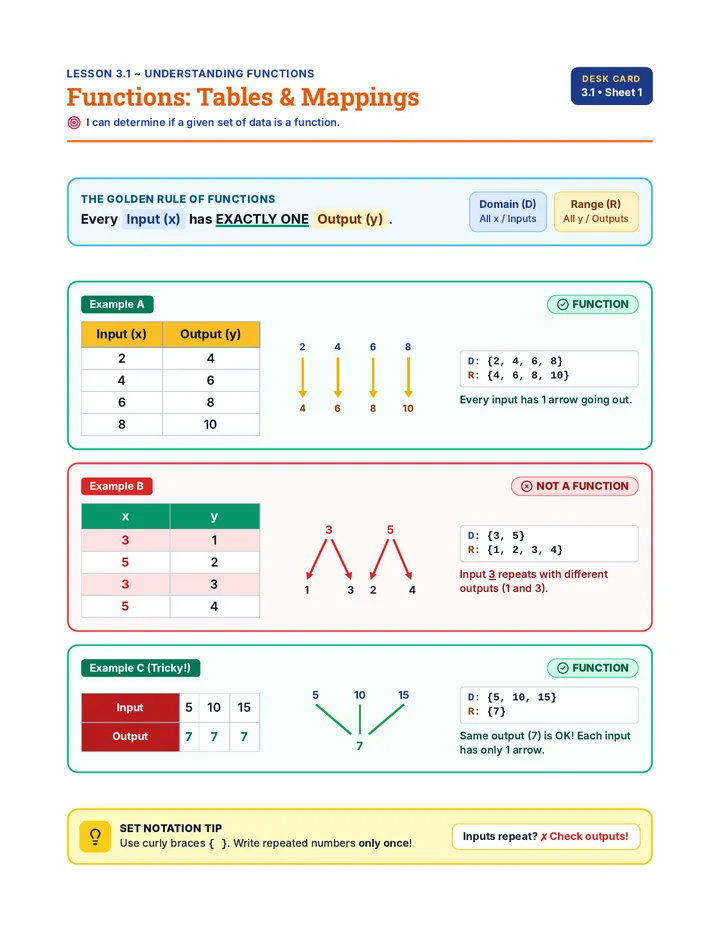
SET A • A5 Mapping Diagram
Input Output -1 0 2 4 3 7 11
Function or Not a Function?
SET A • A6 Mapping Diagram
Input Output 2 5 8 1 4 6 9
Function or Not a Function?
SET A
Function or Not?
Cut along dashed lines • Sort into Function vs. Not a Function (Page 2 of 2)
SET A • A7 Graph
x y
Function or Not a Function?
SET A • A8 Graph
x y
Function or Not a Function?
SET A • A9 Graph
x y
Function or Not a Function?
SET A • A10 Graph
x y
Function or Not a Function?
SET A • A11 Equation
\(y = 2x - 3\)
(\(x\) is the input, \(y\) is the output)
Function or Not a Function?
SET A • A12 Equation
\(y = -3x + 5\)
(\(x\) is the input, \(y\) is the output)
Function or Not a Function?
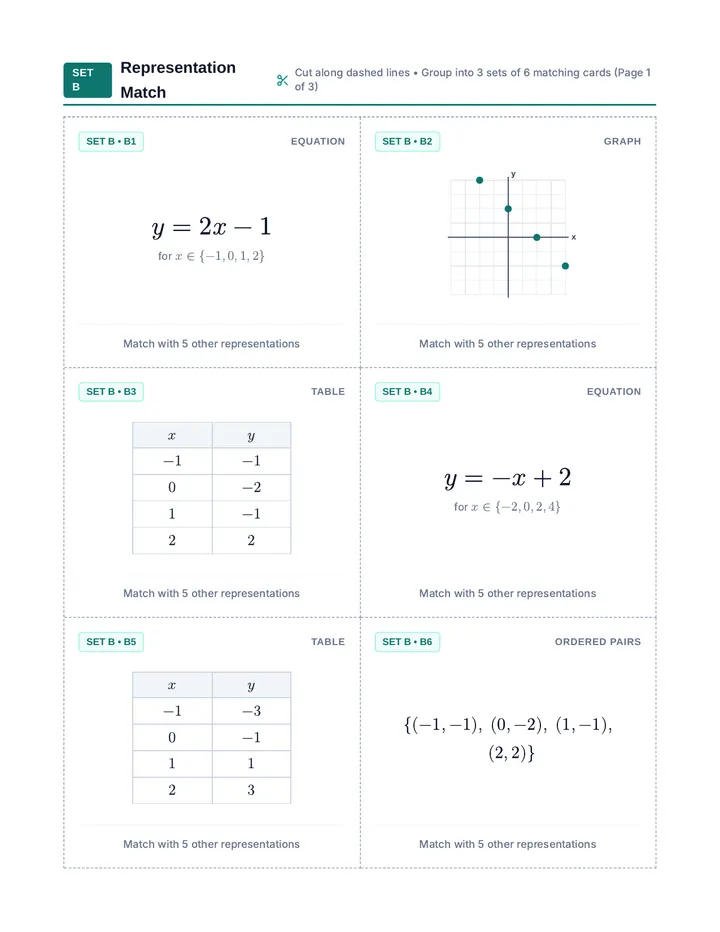
Representation Match Cards SET B
Representation Match
Cut along dashed lines • Group into 3 sets of 6 matching cards (Page 1 of 3)
SET B • B1 Equation
\(y = 2x - 1\)
for \(x \in \{-1, 0, 1, 2\}\)
Match with 5 other representations
SET B • B2 Graph
x y
Match with 5 other representations
SET B • B3 Table
\(x\)
\(y\)
\(-1\)
\(-1\)
\(0\)
\(-2\)
\(1\)
\(-1\)
\(2\)
\(2\)
Match with 5 other representations
SET B • B4 Equation
\(y = -x + 2\)
for \(x \in \{-2, 0, 2, 4\}\)
Match with 5 other representations
SET B • B5 Table
\(x\)
\(y\)
\(-1\)
\(-3\)
\(0\)
\(-1\)
\(1\)
\(1\)
\(2\)
\(3\)
Match with 5 other representations
SET B • B6 Ordered Pairs
\(\{(-1, -1),\; (0, -2),\; (1, -1),\; (2, 2)\}\)
Match with 5 other representations
SET B
Representation Match
Cut along dashed lines • Group into 3 sets of 6 matching cards (Page 2 of 3)
SET B • B7 Key Features
Domain: \(\{-1, 0, 1, 2\}\)
Range: \(\{-2, -1, 2\}\)
Both \(x = -1\) and \(x = 1\) produce the same output, \(y = -1\).
Match with 5 other representations
SET B • B8 Mapping Diagram
Input Output -1 0 1 2 -3 -1 1 3
Match with 5 other representations
SET B • B9 Ordered Pairs
\(\{(-2, 4),\; (0, 2),\; (2, 0),\; (4, -2)\}\)
Match with 5 other representations
SET B • B10 Graph
x y
Match with 5 other representations
SET B • B11 Table
\(x\)
\(y\)
\(-2\)
\(4\)
\(0\)
\(2\)
\(2\)
\(0\)
\(4\)
\(-2\)
Match with 5 other representations
SET B • B12 Equation
\(y = x^2 - 2\)
for \(x \in \{-1, 0, 1, 2\}\)
Match with 5 other representations
SET B
Representation Match
Cut along dashed lines • Group into 3 sets of 6 matching cards (Page 3 of 3)
SET B • B13 Key Features
Domain: \(\{-2, 0, 2, 4\}\)
Range: \(\{-2, 0, 2, 4\}\)
When the output is \(y = 0\), the input is \(x = 2\).
Match with 5 other representations
SET B • B14 Ordered Pairs
\(\{(-1, -3),\; (0, -1),\; (1, 1),\; (2, 3)\}\)
Match with 5 other representations
SET B • B15 Graph
x y
Match with 5 other representations
SET B • B16 Mapping Diagram
Input Output -2 0 2 4 -2 0 2 4
Match with 5 other representations
SET B • B17 Key Features
Domain: \(\{-1, 0, 1, 2\}\)
Range: \(\{-3, -1, 1, 3\}\)
When the input is \(x = 2\), the output is \(y = 3\).
Match with 5 other representations
SET B • B18 Mapping Diagram
Input Output -1 0 1 2 -2 -1 2
Match with 5 other representations
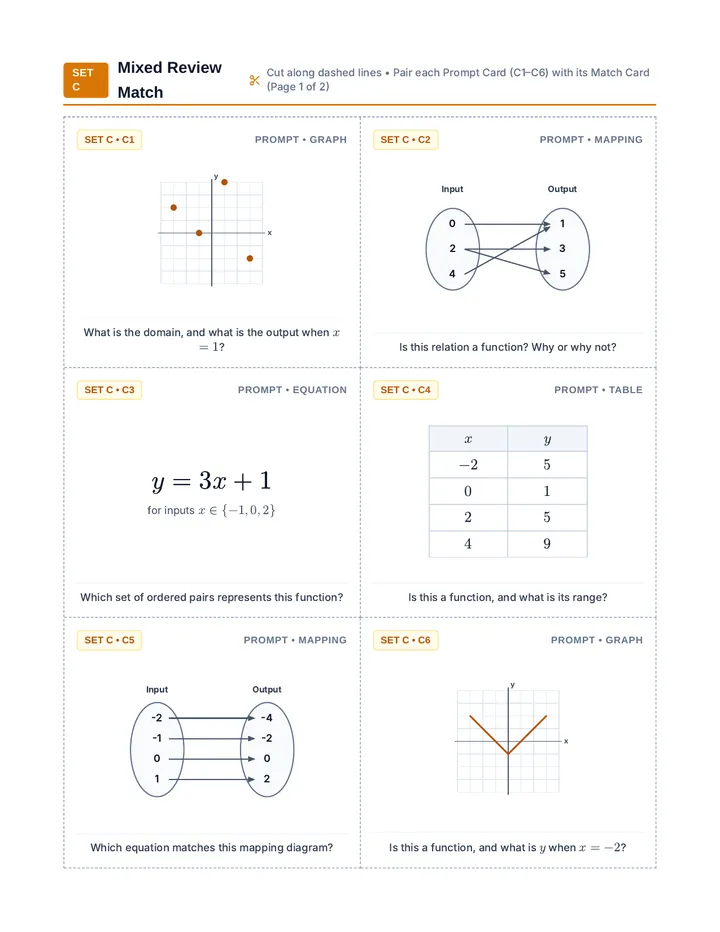
Mixed Review Match Cards SET C
Mixed Review Match
Cut along dashed lines • Pair each Prompt Card (C1–C6) with its Match Card (Page 1 of 2)
SET C • C1 Prompt • Graph
x y
What is the domain, and what is the output when \(x = 1\)?
SET C • C2 Prompt • Mapping
Input Output 0 2 4 1 3 5
Is this relation a function? Why or why not?
SET C • C3 Prompt • Equation
\(y = 3x + 1\)
for inputs \(x \in \{-1, 0, 2\}\)
Which set of ordered pairs represents this function?
SET C • C4 Prompt • Table
\(x\)
\(y\)
\(-2\)
\(5\)
\(0\)
\(1\)
\(2\)
\(5\)
\(4\)
\(9\)
Is this a function, and what is its range?
SET C • C5 Prompt • Mapping
Input Output -2 -1 0 1 -4 -2 0 2
Which equation matches this mapping diagram?
SET C • C6 Prompt • Graph
x y
Is this a function, and what is \(y\) when \(x = -2\)?
SET C
Mixed Review Match
Cut along dashed lines • Match Cards C7–C12 (Shuffled • Page 2 of 2)
SET C • C7 Match Card
Yes, it is a function.
Each input \(x\) has only one output \(y\).
Range: \(\{1, 5, 9\}\)
Pair with a Prompt Card
SET C • C8 Match Card
Domain: \(\{-3, -1, 1, 3\}\)
When input \(x = 1\), the output is \(y = 4\).
Pair with a Prompt Card
SET C • C9 Match Card
\(y = 2x\)
with domain \(\{-2, -1, 0, 1\}\)
Pair with a Prompt Card
SET C • C10 Match Card
Not a function.
The input \(2\) maps to two different outputs (\(3\) and \(5\)).
Pair with a Prompt Card
SET C • C11 Match Card
Yes, it is a function.
It passes the Vertical Line Test. When \(x = -2\), \(y = 1\).
Pair with a Prompt Card
SET C • C12 Match Card
\(\{(-1, -2),\; (0, 1),\; (2, 7)\}\)
Pair with a Prompt Card
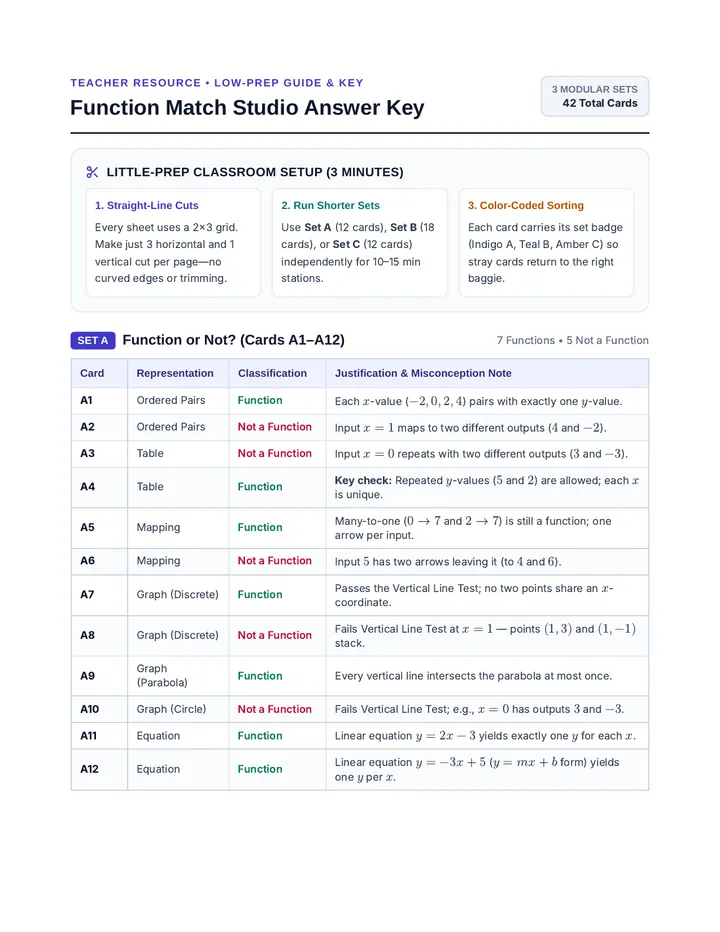
Function Cards Answer Key Teacher Resource • Low-Prep Guide & Key
Function Match Studio Answer Key
3 Modular Sets
42 Total Cards
Little-Prep Classroom Setup (3 Minutes)
1. Straight-Line Cuts
Every sheet uses a 2×3 grid. Make just 3 horizontal and 1 vertical cut per page—no curved edges or trimming.
2. Run Shorter Sets
Use Set A (12 cards), Set B (18 cards), or Set C (12 cards) independently for 10–15 min stations.
3. Color-Coded Sorting
Each card carries its set badge (Indigo A, Teal B, Amber C) so stray cards return to the right baggie.
SET A
Function or Not? (Cards A1–A12)
7 Functions • 5 Not a Function
Card
Representation
Classification
Justification & Misconception Note
A1
Ordered Pairs
Function
Each \(x\)-value (\(-2, 0, 2, 4\)) pairs with exactly one \(y\)-value.
A2
Ordered Pairs
Not a Function
Input \(x = 1\) maps to two different outputs (\(4\) and \(-2\)).
A3
Table
Not a Function
Input \(x = 0\) repeats with two different outputs (\(3\) and \(-3\)).
A4
Table
Function
Key check: Repeated \(y\)-values (\(5\) and \(2\)) are allowed; each \(x\) is unique.
A5
Mapping
Function
Many-to-one (\(0 \to 7\) and \(2 \to 7\)) is still a function; one arrow per input.
A6
Mapping
Not a Function
Input \(5\) has two arrows leaving it (to \(4\) and \(6\)).
A7
Graph (Discrete)
Function
Passes the Vertical Line Test; no two points share an \(x\)-coordinate.
A8
Graph (Discrete)
Not a Function
Fails Vertical Line Test at \(x = 1\) — points \((1, 3)\) and \((1, -1)\) stack.
A9
Graph (Parabola)
Function
Every vertical line intersects the parabola at most once.
A10
Graph (Circle)
Not a Function
Fails Vertical Line Test; e.g., \(x = 0\) has outputs \(3\) and \(-3\).
A11
Equation
Function
Linear equation \(y = 2x - 3\) yields exactly one \(y\) for each \(x\).
A12
Equation
Function
Linear equation \(y = -3x + 5\) (\(y = mx + b\) form) yields one \(y\) per \(x\).
Teacher Resource • Page 2 of 2
Sets B & C Answer Key
SET B
Representation Match (Cards B1–B18)
3 Functions × 6 Representations
Function
Equation
Table
Graph
Ordered Pairs
Mapping
Key Features
\(y = 2x - 1\)
D: \(\{-1,0,1,2\}\)
B1
B5
B10
B14
B8
B17
\(y = -x + 2\)
D: \(\{-2,0,2,4\}\)
B4
B11
B2
B9
B16
B13
\(y = x^2 - 2\)
D: \(\{-1,0,1,2\}\)
B12
B3
B15
B6
B18
B7
Differentiation Tip: For a shorter 12-card warm-up, remove the Key Features cards (B7, B13, B17) or use only two of the three functions.
SET C
Mixed Review Match (Cards C1–C12)
6 Prompt–Match Pairs
Pair
Skill Focus
Answer Summary & Teacher Note
C1 ↔ C8
Read Key Features (Graph)
Domain: \(\{-3, -1, 1, 3\}\). Point \((1, 4)\) shows output \(y = 4\) when \(x = 1\).
C2 ↔ C10
Function or Not (Mapping)
Not a function; input \(2\) maps to two outputs (\(3\) and \(5\)).
C3 ↔ C12
Match Representations
Substitute \(x \in \{-1, 0, 2\}\) into \(y = 3x + 1\) to get \(\{(-1, -2), (0, 1), (2, 7)\}\).
C4 ↔ C7
Function + Range (Table)
Yes, a function; Range is \(\{1, 5, 9\}\) (note: \(5\) is listed only once in the set).
C5 ↔ C9
Match Representations
Each output is double the input, matching \(y = 2x\) on \(\{-2, -1, 0, 1\}\).
C6 ↔ C11
VLT + Input/Output
Passes Vertical Line Test (function); reading \((-2, 1)\) on the graph gives \(y = 1\).