Slope Formula Anchor Chart
Algebra 1 Anchor Chart • Side 1
Finding Slope from Two Points
Key Symbol
\(m\)
Concept
What is Slope?
Slope = Rate of Change
Slope tells us how much the \(y\)-value changes for every change in \(x\).
In Words
\(\text{Slope} = \dfrac{\text{change in } y}{\text{change in } x}\)
Slope Formula
\(m = \dfrac{y_2 - y_1}{x_2 - x_1}\)
\(y\)-values = Vertical Change (Rise)
\(x\)-values = Horizontal Change (Run)
Step-by-Step Example
Find the slope through \((-1, -3)\) and \((4, 4)\)
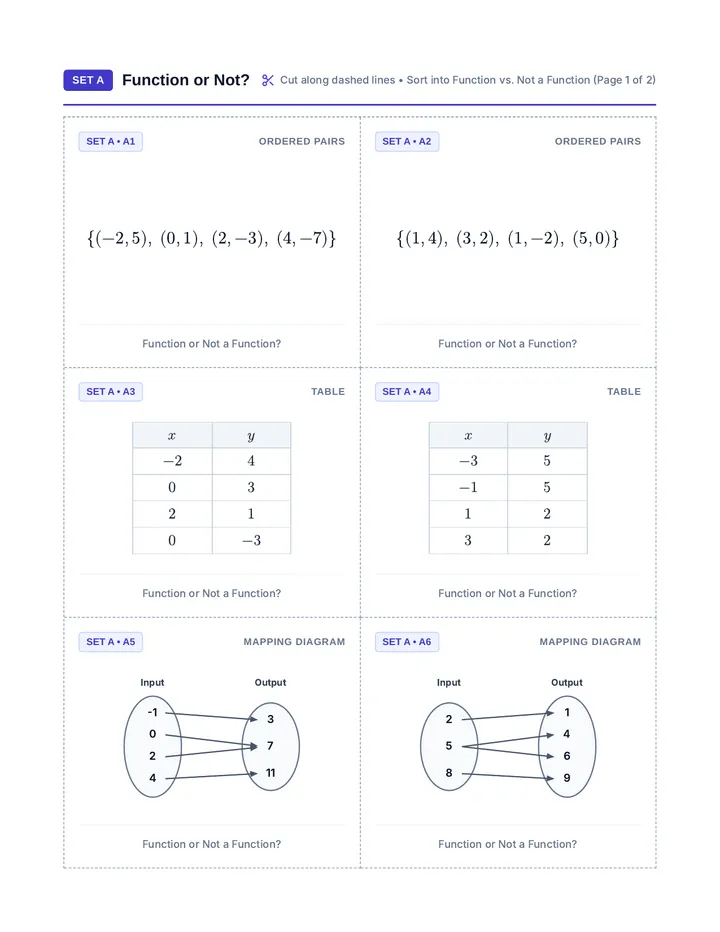
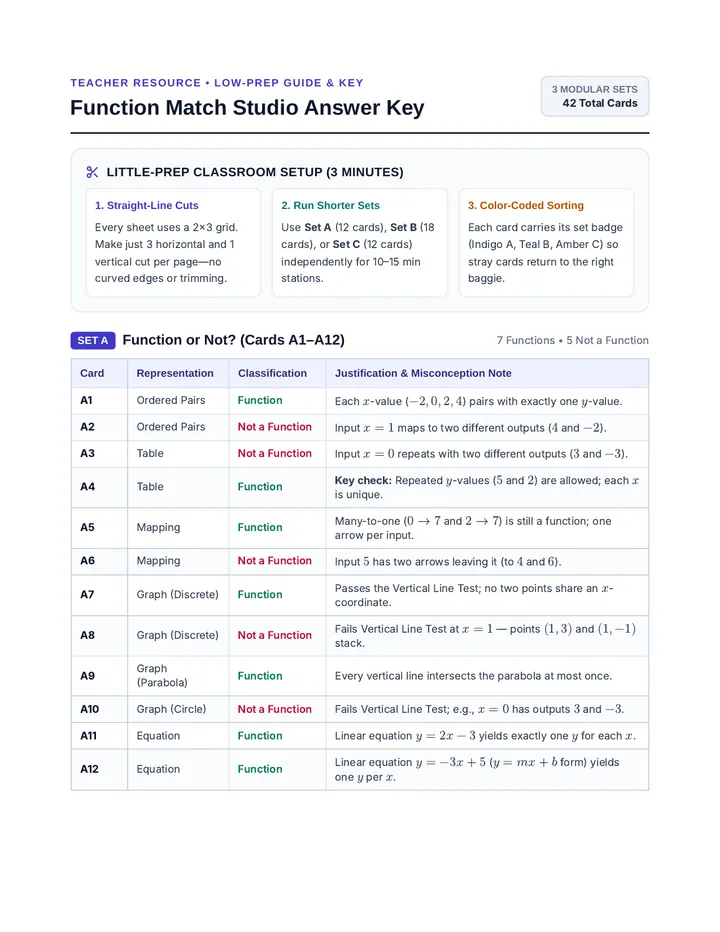
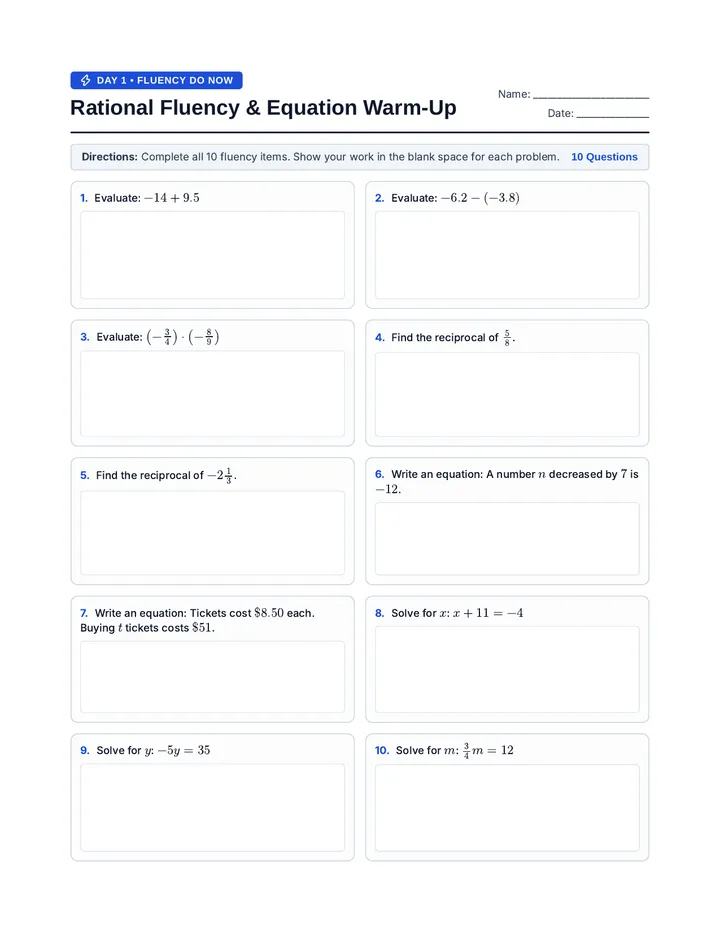
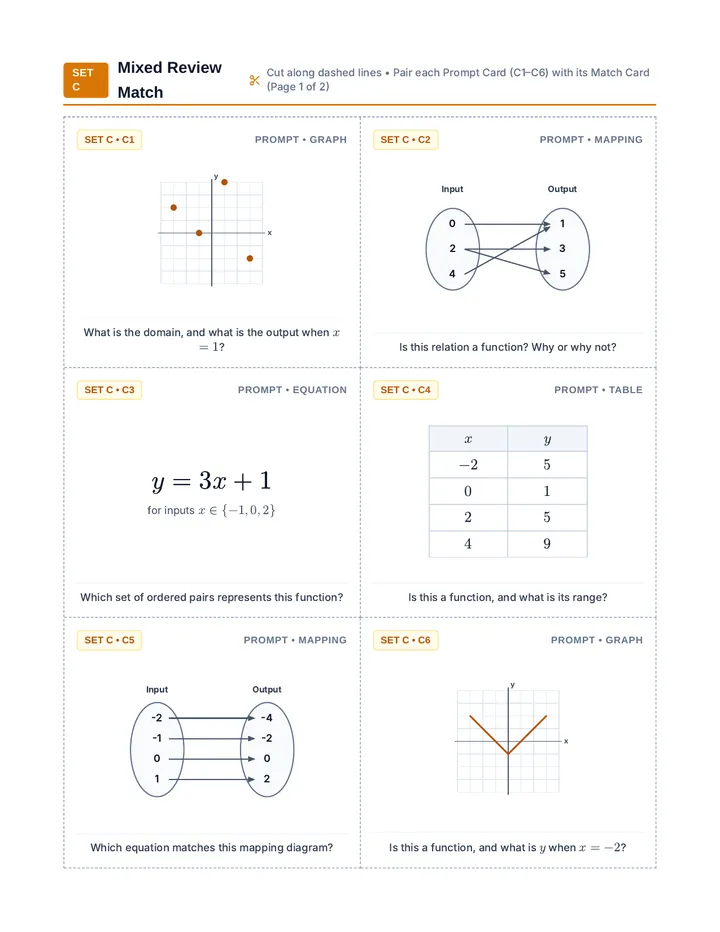
1
Label the Points
Assign \((x_1, y_1)\) and \((x_2, y_2)\):
\((-1, -3)\) and \((4, 4)\)
|
\(x\) |
\(y\) |
| Point 1 |
\(-1\) |
\(-3\) |
| Point 2 |
\(4\) |
\(4\) |
2
Find the Change in \(y\)
Subtract the \(y\)-values \((y_2 - y_1)\)
\(4 - (-3) = 7\)
Numerator = 7
3
Find the Change in \(x\)
Subtract the \(x\)-values \((x_2 - x_1)\)
\(4 - (-1) = 5\)
Denominator = 5
4
Divide (Write as a Fraction)
Put the change in \(y\) over the change in \(x\). Simplify if possible.
\(m = \dfrac{7}{5}\)
Algebra 1 Anchor Chart • Side 2
Slope Rules & Graph Connection
\(m = \dfrac{\text{rise}}{\text{run}} = \dfrac{y_2 - y_1}{x_2 - x_1}\)
Important Rule
Same Order on Top and Bottom
Don't mix the order!
Correct
\(\dfrac{4 - (-3)}{4 - (-1)}\)
Point 2 first on top & bottom
Also Correct
\(\dfrac{-3 - 4}{-1 - 4}\)
Point 1 first on top & bottom
Not Correct
\(\dfrac{4 - (-3)}{-1 - 4}\)
Switched order on bottom!
Visual Link
Connect It to the Graph
x y Rise = +7 Run = +5 (-1, -3) (4, 4)
Vertical
Rise = +7
Horizontal
Run = +5
\(m = \dfrac{\text{rise}}{\text{run}} = \dfrac{7}{5} = \dfrac{y_2 - y_1}{x_2 - x_1}\)
Big Idea: The formula is not a new skill—it is just a shortcut for counting rise and run!
Watch Out
Common Mistakes
\(x\) on top, \(y\) on bottom
\(\dfrac{x_2 - x_1}{y_2 - y_1}\)
\(y\) always goes on top!
Mixing subtraction order
\(\dfrac{y_2 - y_1}{x_1 - x_2}\)
Keep Point 2 & Point 1 aligned!
Forgetting negatives
\(4 - (-3) \neq 1\)
Minus a negative = plus!
Use parentheses around every coordinate value! \(4 - (-3) = 7\)
Pendiente con Dos Puntos Cartel
Cartel de Álgebra 1 • Lado 1
Cómo hallar la pendiente con dos puntos
Símbolo clave
\(m\)
Concepto
¿Qué es la pendiente?
Pendiente = Tasa de cambio
La pendiente nos indica cuánto cambia el valor de \(y\) por cada cambio en \(x\).
En palabras
\(\text{Pendiente} = \dfrac{\text{cambio en } y}{\text{cambio en } x}\)
Fórmula de la pendiente
\(m = \dfrac{y_2 - y_1}{x_2 - x_1}\)
Valores de \(y\) = Cambio vertical (Elevación)
Valores de \(x\) = Cambio horizontal (Avance)
Ejemplo paso a paso
Halla la pendiente entre \((-1, -3)\) y \((4, 4)\)
1
Etiqueta los puntos
Asigna \((x_1, y_1)\) y \((x_2, y_2)\):
\((-1, -3)\) y \((4, 4)\)
|
\(x\) |
\(y\) |
| Punto 1 |
\(-1\) |
\(-3\) |
| Punto 2 |
\(4\) |
\(4\) |
2
Halla el cambio en \(y\)
Resta los valores de \(y\) \((y_2 - y_1)\)
\(4 - (-3) = 7\)
Numerador = 7
3
Halla el cambio en \(x\)
Resta los valores de \(x\) \((x_2 - x_1)\)
\(4 - (-1) = 5\)
Denominador = 5
4
Divide (Escribe como fracción)
Pon el cambio en \(y\) sobre el cambio en \(x\). Simplifica si es posible.
\(m = \dfrac{7}{5}\)
Cartel de Álgebra 1 • Lado 2
Reglas y conexión con la gráfica
\(m = \dfrac{\text{elevación}}{\text{avance}} = \dfrac{y_2 - y_1}{x_2 - x_1}\)
Regla importante
Mismo orden arriba y abajo
¡No mezcles el orden!
Correcto
\(\dfrac{4 - (-3)}{4 - (-1)}\)
Punto 2 primero arriba y abajo
También correcto
\(\dfrac{-3 - 4}{-1 - 4}\)
Punto 1 primero arriba y abajo
Incorrecto
\(\dfrac{4 - (-3)}{-1 - 4}\)
¡Se cambió el orden abajo!
Conexión visual
Conéctalo con la gráfica
x y Elevación = +7 Avance = +5 (-1, -3) (4, 4)
Vertical
Elevación = +7
Horizontal
Avance = +5
\(m = \dfrac{\text{elevación}}{\text{avance}} = \dfrac{7}{5} = \dfrac{y_2 - y_1}{x_2 - x_1}\)
Idea clave: La fórmula no es una habilidad nueva; ¡es solo un atajo para contar la elevación y el avance!
¡Cuidado!
Errores comunes
\(x\) arriba, \(y\) abajo
\(\dfrac{x_2 - x_1}{y_2 - y_1}\)
¡\(y\) siempre va arriba!
Mezclar el orden al restar
\(\dfrac{y_2 - y_1}{x_1 - x_2}\)
¡Mantén Punto 2 y Punto 1 alineados!
Olvidar los negativos
\(4 - (-3) \neq 1\)
¡Restar un negativo = sumar!
¡Usa paréntesis alrededor de cada coordenada! \(4 - (-3) = 7\)