Lenny.com
Explore
Create
ActivitiesNewMathEnglish Language ArtsScience & EngineeringSocial StudiesGlobal LanguagesHealth & Physical EducationSpecial EducationCounseling & Life SkillsArts & CreativityESL
Lenny.com
Lenny.com
Explore
Create
ActivitiesNewMathEnglish Language ArtsScience & EngineeringSocial StudiesGlobal LanguagesHealth & Physical EducationSpecial EducationCounseling & Life SkillsArts & CreativityESL
Lenny.com
Lenny.com

Solutions

Lenny for EducatorsLenny for SchoolsLenny for Districts

Product

ExploreSign inCreateSupportAbout

Resources

Getting startedMTSS Acceleration Program

Newsletters

School Funding Newsletter

© 2026 Lenny Learning Inc.

TermsPrivacyAccessibility
LinkedInInstagramX
Lenny
MathNumbers & CountingCounting ObjectsNumber NamesComparing NumbersNumber OperationsCounting SequenceNumbers 0-10Place Value Understanding and SystemAdd and Subtract Within 20Addition and Subtraction ConceptsAddition and Subtraction EquationsAddition and Subtraction ProblemsFoundations for MultiplicationMultiplication and Division PropertiesMultiply and Divide Within 100Multiplication and Division ProblemsFactors and MultiplesProperties of OperationsPatterns and RelationshipsGenerate and Analyze PatternsMulti-Digit ArithmeticPlace Value OperationsMulti-Digit and Decimal OperationsNumerical ExpressionsFour Operations and PatternsFour Operations Problem SolvingMeasurement & DataMeasurable AttributesMeasuring LengthsMeasure and Estimate Lengths in Standard UnitsRelate Addition and Subtraction to LengthClassifying and Counting ObjectsTime and MoneyArea Concepts and MeasurementPerimeter and Area MeasuresAngle Concepts and MeasurementTime, Volume, and MassMeasurement Unit ConversionsGeometryIdentifying ShapesShapes and AttributesShape Attributes and ReasoningShapes and CompositionClassifying 2D FiguresGeometric Figures and RelationshipsLines, Angles, and ShapesAngle, Area, and VolumeGeometric MeasurementVolume of 3D ShapesCoordinate Plane ApplicationsTransformations in the PlaneCongruence and SimilarityUnderstand congruence in terms of rigid motionsSimilarity and TransformationsProve Theorems Involving SimilarityPythagorean TheoremTrigonometry for General TrianglesMake Geometric ConstructionsProve Geometric TheoremsTheorems About CirclesFind Arc Lengths And Areas of Sectors of CirclesVolume FormulasRelationships Between Two-Dimensional and Three-Dimensional ObjectsProve Simple Geometric Theorems AlgebraicallyTranslate Between Geometric Description and Equation for Conic SectionApply Geometric Concepts in Modeling SituationsFractions & DecimalsFractions as NumbersBuilding FractionsFraction Equivalence and OrderingAdding and Subtracting FractionsMultiplying and Dividing FractionsDividing FractionsDecimal FractionsMulti-Digit Computation and FactorsAdd, Subtract, Multiply, and Divide Rational NumbersRational Number SystemIrrational Numbers and ApproximationsRatiosRatios and ProportionsProportional RelationshipsUnit RateAlgebraAlgebraic ExpressionsGenerate Equivalent ExpressionsQuantitative RelationshipsProportional Relationships and Linear EquationsEquations and InequalitiesEquation Solving and ReasoningLinear Equations and SystemsGraph Equations and InequalitiesSystems of EquationsReal-World Algebraic ProblemsQuantitative Reasoning with UnitsExpression StructureEquivalent Expression FormsRadicals and Integer ExponentsRational ExponentsRational and Irrational NumbersPolynomial OperationsPolynomial IdentitiesPolynomial Zeros and FactorsRational ExpressionsComplex Number OperationsComplex Numbers in PolynomialsComplex Numbers on PlaneStatistics & ProbabilityRepresent and Interpret DataData DistributionsStatistical VariabilityProbability ModelsCompound Event ProbabilitiesStatistical SamplingInterpret Categorical and Quantitative DataBivariate Data PatternsInterpret Linear ModelsComparing Two PopulationsRandom Processes in StatisticsIndependence and Conditional ProbabilityExpected ValuesProbability-Based Decision MakingStatistical Inference and ConclusionsFunctionsFunction Concepts and NotationDefine and Compare FunctionsInterpret Functions in ContextAnalyze Function RepresentationsModel Relationships with FunctionsIdentify Linear vs Exponential GrowthDistinguish Between Function TypesCompare Growth RatesInterpret Function ExpressionsBuild Functions from RelationshipsConstruct and Model FunctionsTransform and Combine FunctionsModel Comparison and SelectionSolve Exponential EquationsTrigonometryTrigonometric Ratios Involving Right TrianglesTrigonometric Functions and Unit CircleModel with Trigonometric FunctionsTrigonometric IdentitiesVectors & MatricesIntroduction to Vectors and MatricesVector QuantitiesVector OperationsMatrix OperationsCalculusLimits and ContinuityDerivative Concepts and NotationDerivative Rules and TechniquesApplications of DerivativesOptimization ProblemsRelated RatesCurve Sketching and AnalysisIntegration Concepts and NotationAntiderivatives and Indefinite IntegralsDefinite Integrals and AreaFundamental Theorem of CalculusIntegration TechniquesApplications of IntegrationDifferential EquationsSequences and SeriesParametric and Polar FunctionsVector-Valued Functions

Function Foundry

A comprehensive 8th-grade mathematics lesson introducing function concepts, representations, and real-world modeling. Students progress from distinguishing functions to evaluating equations, discovering patterns in tables, and analyzing real-world systems.

CJChristy Jones

Function Foundry

A comprehensive 8th-grade mathematics lesson introducing function concepts, representations, and real-world modeling. Students progress from distinguishing functions to evaluating equations, discovering patterns in tables, and analyzing real-world systems.

CJChristy Jones
21

Rate of change (\(m\)):

Initial value (\(b\)):

Rule (\(y = mx + b\)):

Predict \(y\) when \(x = 10\):

Problem 12: Linear Function B (Work Backwards)

\(x\)\(y\)
215
421
627
833

Rate of change (\(m\)):

Initial value (\(b\)):

Rule (\(y = mx + b\)):

Predict \(y\) when \(x = 15\):

4 Part 4: Interpreting Graphs & Rate of Change

Hiking Elevation vs. Time Time (min) Elevation (ft) 1 2 3 4

13. Describe the behavior in Segment 1:

Is the hiker ascending, resting, or descending? Explain the rate:

14. What occurs during Segment 2?

Why does the elevation line remain completely flat?

15. Compare Segment 1 and Segment 3:

How do their rates of change (slopes) differ in sign and steepness?

5 Part 5: Mathematical Error Analysis

Misconception

Leo's Claim: "The relation \(\{ (3, 4), (5, 4), (8, 4) \}\) cannot be a function because the number \(4\) repeats three times!"

Is Leo correct?

Yes No

Explain Leo's error:

Page 2 of 2 • Function Power Practice Great work building your mathematical stamina!

$20 base monthly access + $5 per GB used.

Rule: \(y = 5x + 20\)

Plan B: Summit Wireless

$40 base monthly access + $2.50 per GB used.

Rule: \(y = 2.5x + 40\)

Complete the Comparison Table

Data Used (\(x\) GB)Plan A: \(y = 5x + 20\)Plan B: \(y = 2.5x + 40\)Cheaper Option?
0 GB$20$40Plan A ($20 cheaper)
4 GB$40
8 GB$60$60TIE ($60 each)
12 GB

Break-Even Point:

At what point on a coordinate graph would these two lines intersect? Write as an ordered pair \((x, y)\):

Intersection:

Consumer Recommendation:

If a student uses 15 GB each month, which plan should they purchase? Justify:

4

Quest 4: The Runner's Journey Analysis

Distance vs. Time Time (min) Distance (mi) I II III IV

Match each segment to the runner's action:

The runner jogged at a steady warm-up pace of 6 mph.

The runner stopped at a red crosswalk light for 2 minutes.

The runner sprinted uphill at their fastest forward speed.

The runner turned around and sprinted directly back home.

Page 2 of 2 • Function Quests Application Congratulations! Mathematical Model Complete.

4 Part 5: Mathematical Error Analysis (Leo's Misconception)

Leo is INCORRECT. The definition of a function specifies that each input can only have one output. It is completely valid for different inputs (\(3, 5, 8\)) to yield the exact same output (\(4\)). A repeated output represents a horizontal line, which easily passes the Vertical Line Test!

Page 1 of 2 • Teacher Answer Key Page 2: Real World Quests Solutions & Scoring Rubric

Teacher Resource • Applications Key

Real World Quests Solutions

Performance Task Solutions
Grading & Modeling Standards

1 Quest 1: The Rolling Taco Truck Solutions

Table Values:

  • 0 plates \(\to\) $60
  • 10 plates \(\to\) $90
  • 20 plates \(\to\) $120
  • 30 plates \(\to\) $150
  • 40 plates \(\to\) $180

Function Rule:

\(C(x) = 3x + 60\)

Slope Context:

Each additional combo plate costs exactly $3 to make.

\(y\)-Intercept Context:

The initial fixed fee of $60 to enter the festival, paid even if 0 plates are prepared.

2 Quest 2: Search Drone Altitude Descent

A. Function Rule:

\(A(t) = 320 - 40t\)

or \(A(t) = -40t + 320\)

B. At \(t = 5\) Seconds:

\(320 - 40(5) = 320 - 200\)

\(\mathbf{120}\) feet altitude

C. Landing Time (\(A = 0\)):

\(0 = 320 - 40t \implies 40t = 320\)

\(t = \mathbf{8}\) seconds

3 Quest 3: Mobile Data Plan Showdown

Table Completions: At 4 GB: Plan A = $40, Plan B = $50 (Plan A cheaper by $10). At 8 GB: Both plans = $60 (Tie). At 12 GB: Plan A = $80, Plan B = $70 (Plan B cheaper by $10).

Intersection Point:

\((8, 60)\)

At 8 GB of data, both providers charge exactly $60.

Recommendation for 15 GB:

Choose Plan B! Plan A costs \(5(15) + 20 = \mathbf{\$95}\). Plan B costs \(2.5(15) + 40 = \mathbf{\$77.50}\). Plan B saves $17.50!

4 Quest 4: Mystery Runner Segment Match

Segment I: Steady warm-up pace

Segment II: Stopped at light (flat line)

Segment III: Sprinting uphill (steepest)

Segment IV: Returning home (negative slope)

Teacher Diagnostic Guide & Key Common Errors:

  • Notation Confusion: Watch for students reading \(f(5)\) as \(f \times 5\). Remind them: \(f\) is the machine name, and \(5\) is the fuel going into it.
  • Rate vs. Intercept: On Table B (Problem 12), students often mistakenly take the first \(y\)-value (\(15\)) as the initial value \(b\). Highlight that \(x\) must be \(0\).
  • Decreasing vs. Negative Distance: Clarify that in Quest 4 Segment IV, a downward slope on a distance-from-home graph means traveling back home, not negative speed.

Page 2 of 2 • Teacher Answer Key & Guide Function Foundry Resource Suite
You might also like

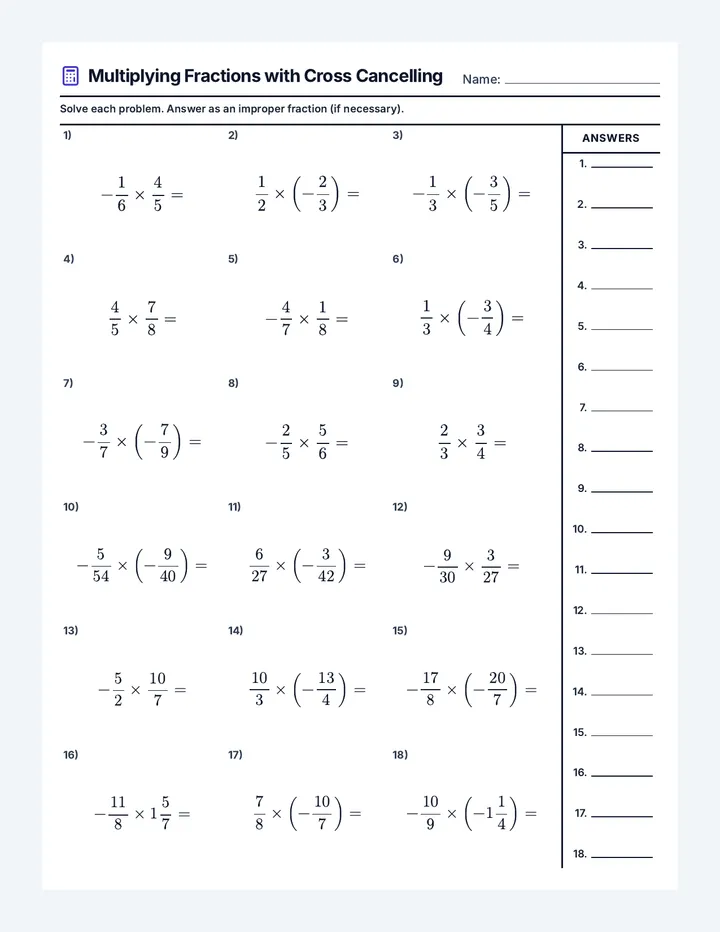
Cross Cancelling Fractions Worksheet

Fraction Operations

A comprehensive sequence covering fraction multiplication with cross-cancelling techniques and fraction division using reciprocals.

T

tsthibeault

11
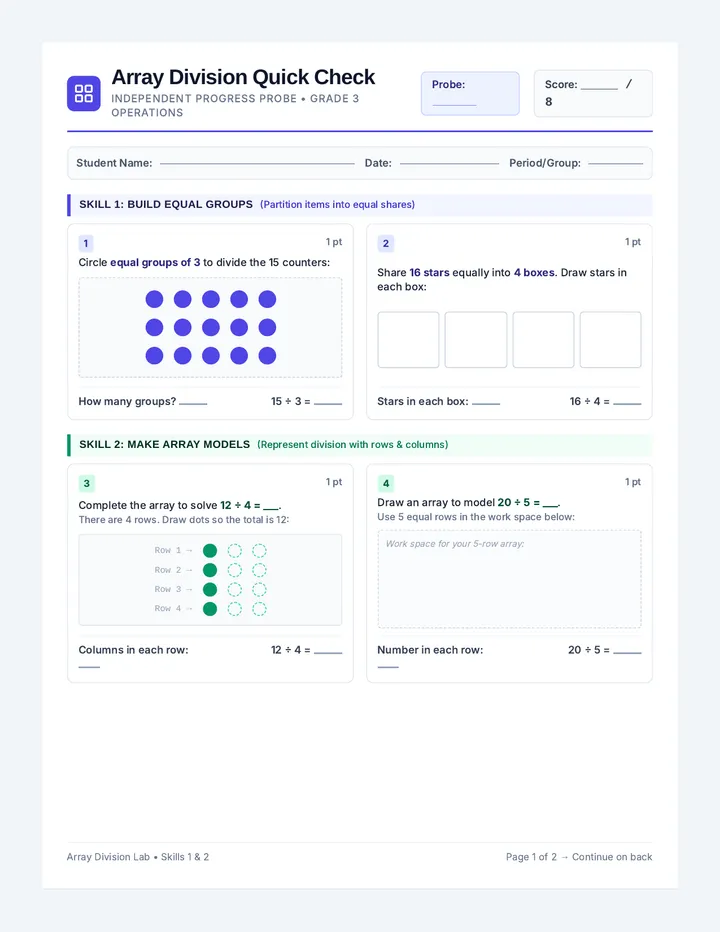
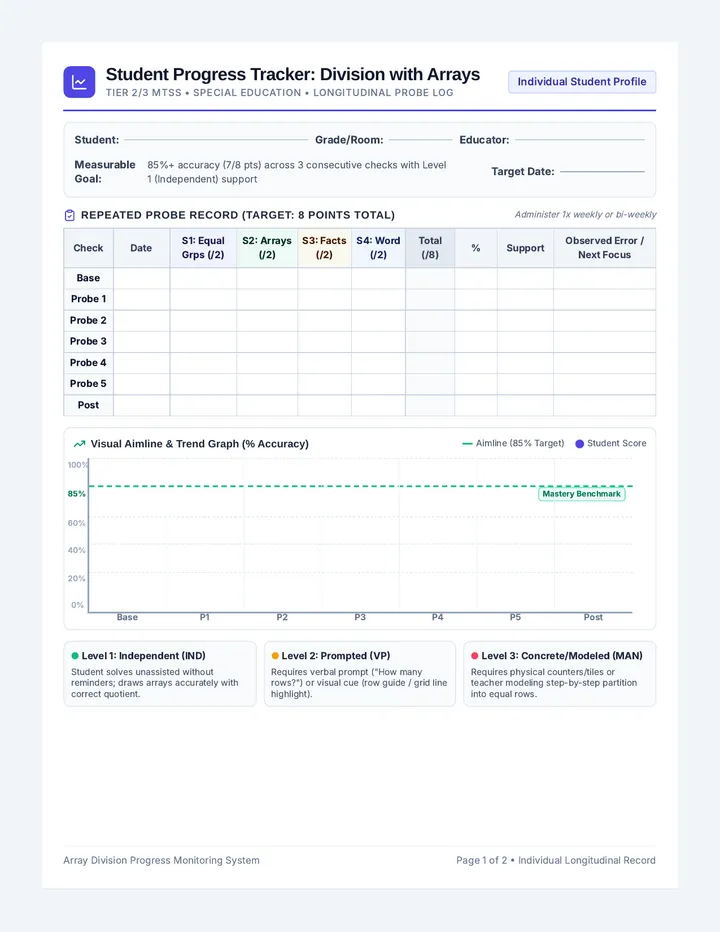
Array Division Probe Worksheet

Array Division Lab

A progress-monitoring toolkit for tracking division mastery with arrays across four targeted skills: equal groups, array models, connected facts, and word problems. Includes an independent student probe worksheet and a teacher longitudinal tracking sheet.

JW

Jorlian Wynes

2
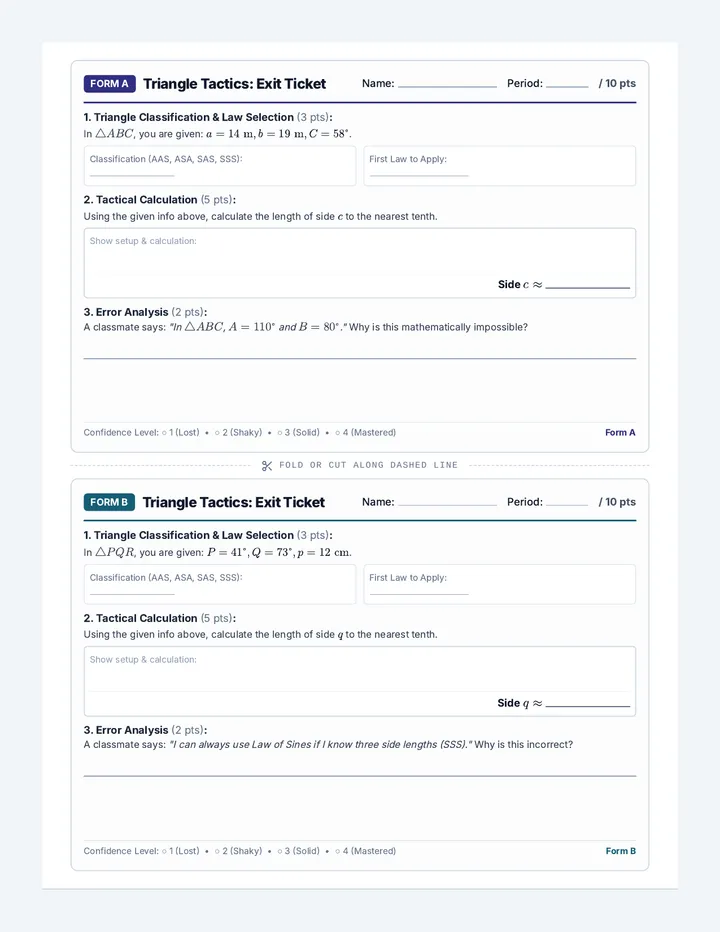
Triangle Tactics Exit Ticket

Triangle Tactics Exit Ticket

A printable two-up exit ticket featuring parallel Form A and Form B slips with classification decisions, oblique triangle calculations, and conceptual error analysis.

PV

Pamela Vessel

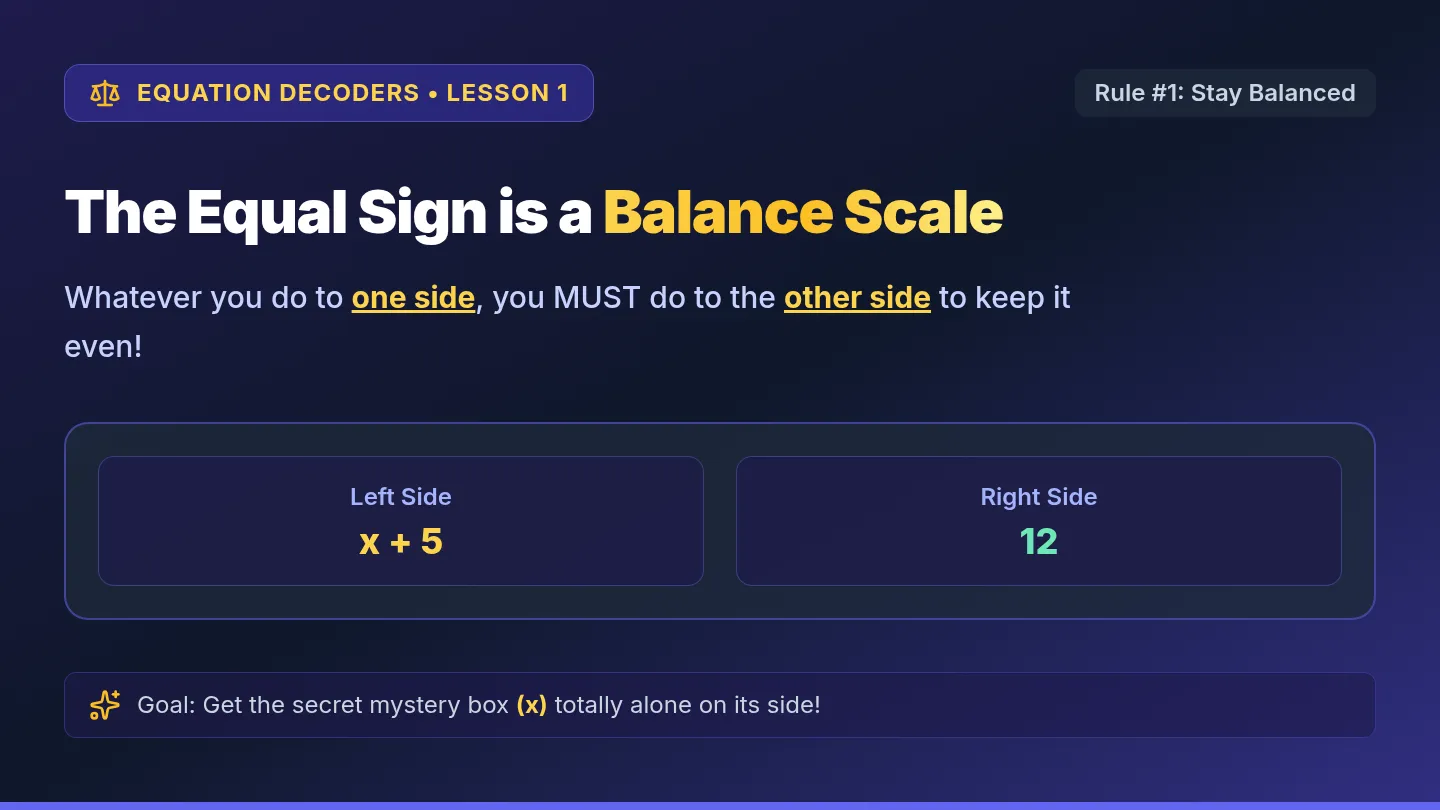
Balance Scale Slides

Equation Decoders

A scaffolded multi-day sequence engineered for 8th grade students with IEPs and math anxiety, demystifying linear equations through concrete balance models, visual inverse flowcharts, and structured routines.

DD

Darryl Davis

7
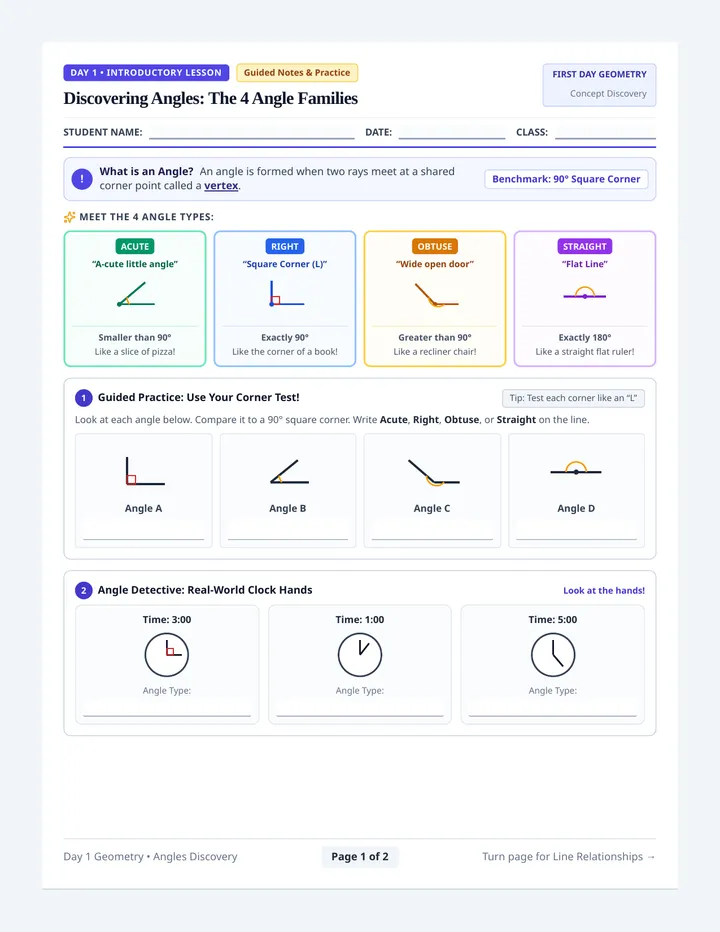
Lines and Angles Practice Worksheet

Lines and Angles Launch

An engaging, accessible Day 1 introductory lesson on the four types of angles and three line relationships. Designed for initial direct instruction, guided practice, and foundational mastery with zero high-stakes test jargon.

G

gonzalezs

3
Array Division Progress Tracker

Array Division Progress Tracker

A comprehensive two-page teacher progress-monitoring tracking system featuring an individual student longitudinal probe log, a visual aimline progress chart, support-level rubrics, and a small-group multi-probe mastery roster with diagnostic error analysis.

JW

Jorlian Wynes

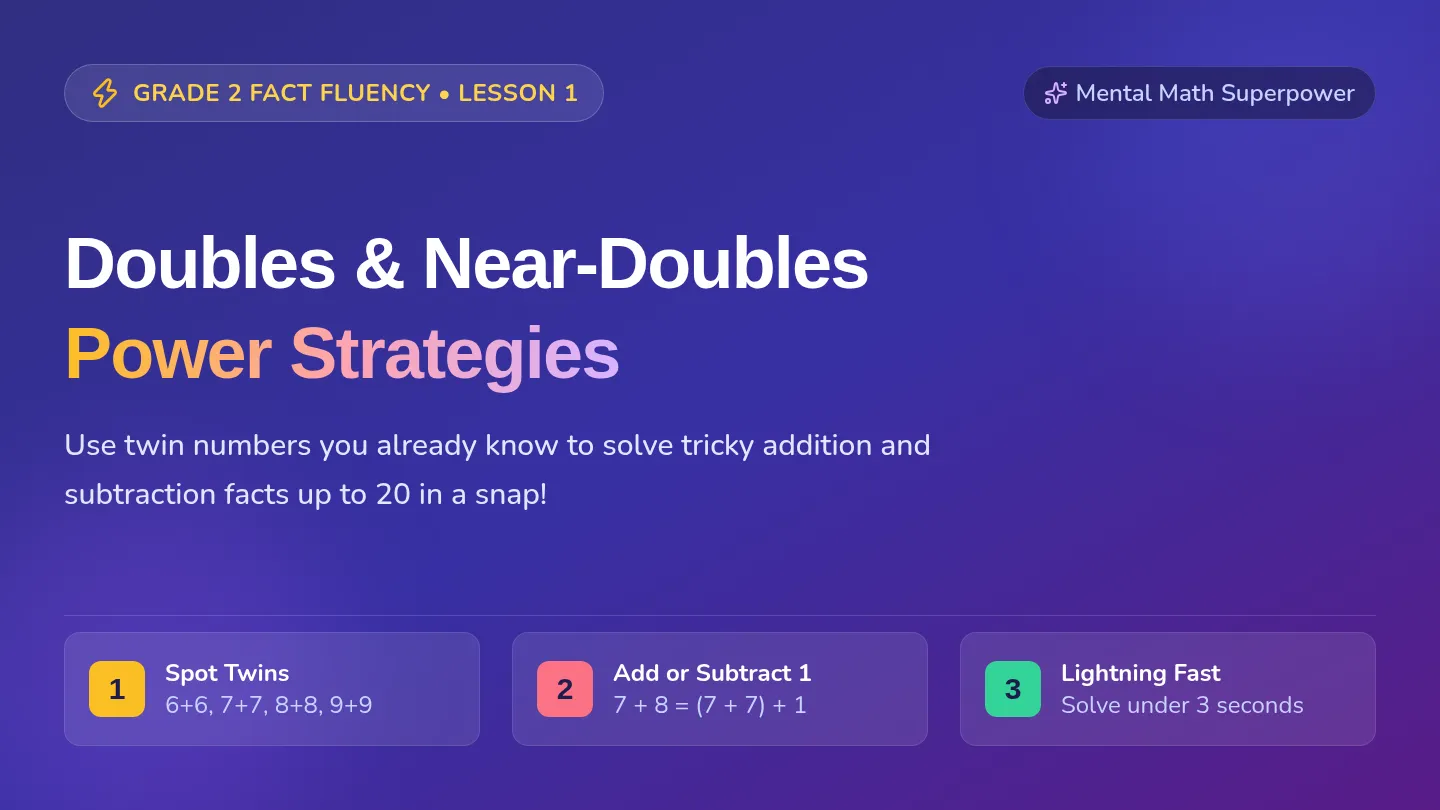
Doubles Power Slides

Fact Fluency Sprint

A three-day scaffolded math sequence designed for second-grade fact fluency within 20, moving systematically through doubles and near-doubles, bridge-through-ten strategies, and mixed fluency consolidation.

M

mgamache

6
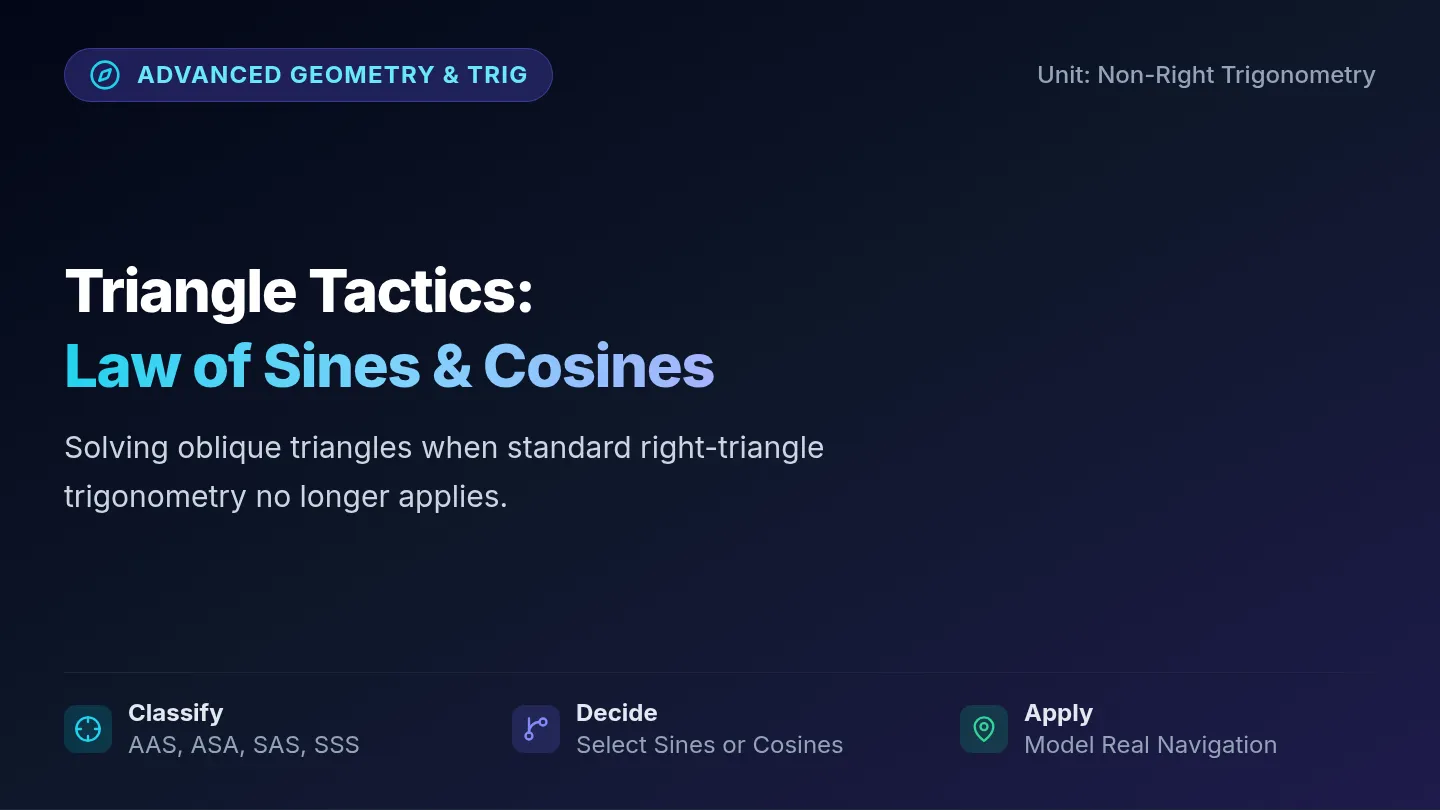
Triangle Tactics Slides

Triangle Tactics

A comprehensive trigonometry lesson equipping students to master the Law of Sines and the Law of Cosines through decision-making frameworks, oblique triangle calculations, and real-world modeling.

PV

Pamela Vessel

6
Array Division Probe Worksheet

Array Division Probe Worksheet

A two-page independent student progress-monitoring probe assessing four key division skills using array models, equal grouping, related multiplication facts, and word problems. Includes clear handwriting lines, structured array drawing spaces, and a brief self-reflection check.

JW

Jorlian Wynes

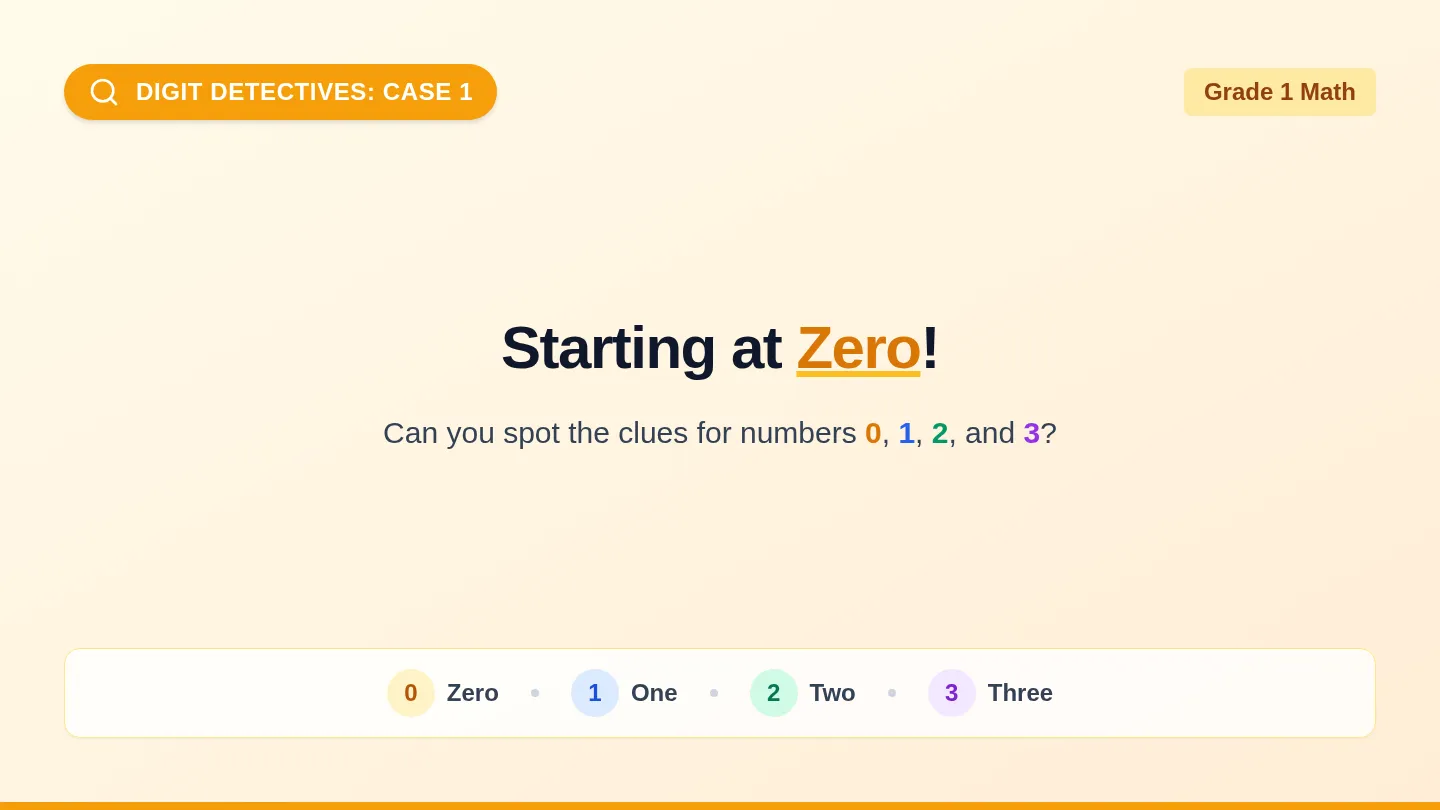
Starting Clues Slides

Digit Detectives

A foundational three-part sequence for first-grade learners to develop instant numeral identification and quantity matching for numbers 0 through 10. Through detective-themed visual slides, print-ready practice sheets, and guided teaching routines, students master numeral recognition and sequential order.

MS

Melissa Saunders

9
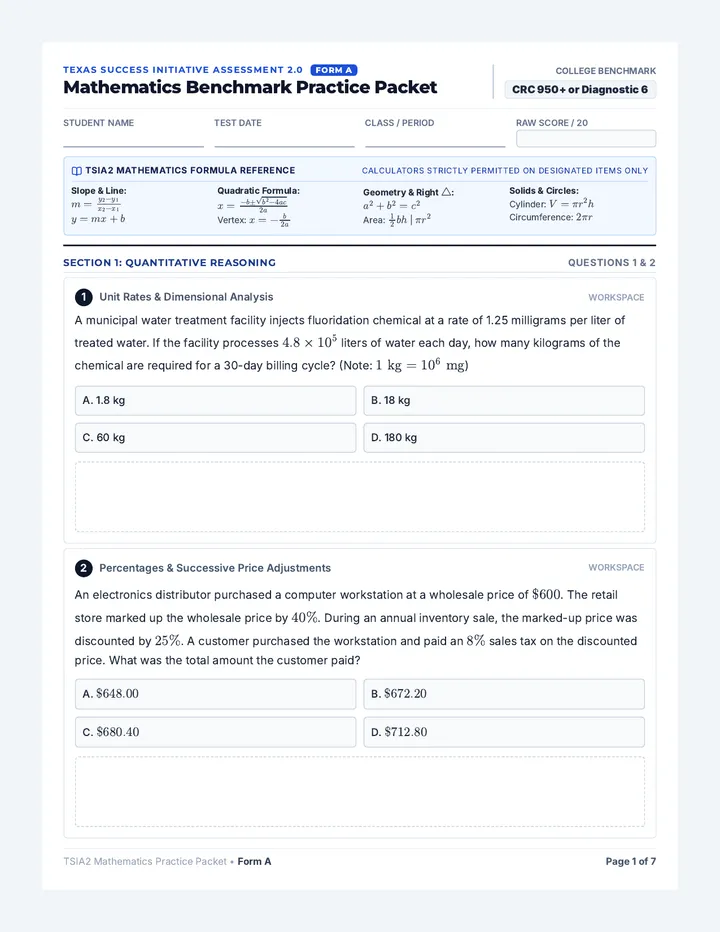
TSIA2 Mastery Practice Packet

TSIA2 Benchmark Prep

A complete college-readiness assessment module for the Texas Success Initiative Assessment 2.0 (Mathematics), featuring a full 20-question benchmark practice packet and an exhaustive teacher solutions and diagnostic guide.

PV

Pamela Vessel

10
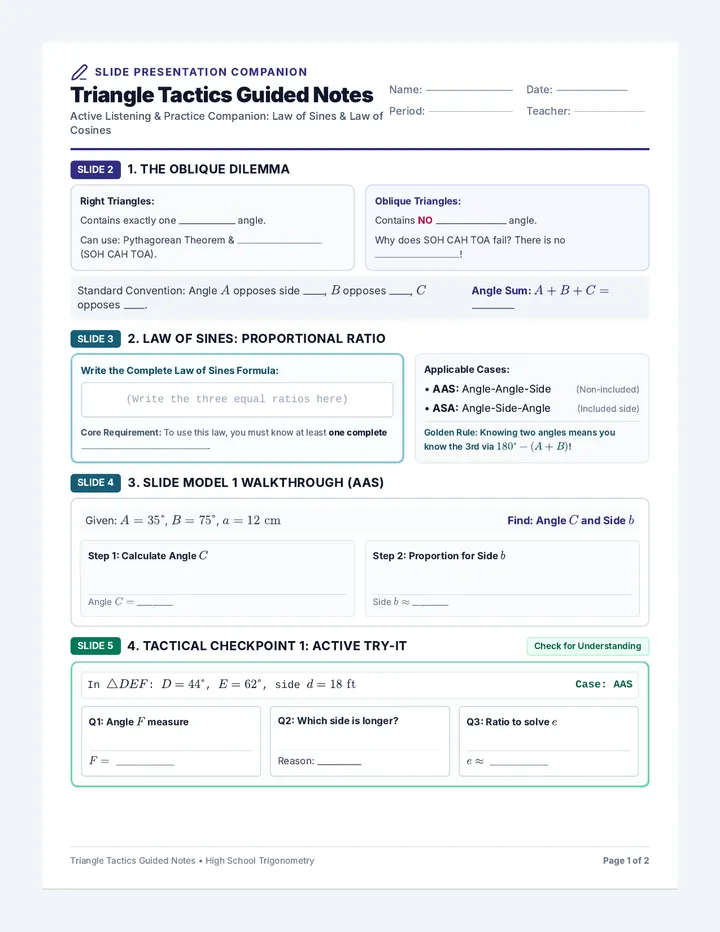
Triangle Tactics Guided Notes

Triangle Tactics Guided Notes

A two-page printable guided notes handout aligned directly with the slide presentation, featuring fill-in-the-blank definitions, formula anchor boxes, slide model tracking, and checkpoint reflection prompts.

PV

Pamela Vessel