Lenny.com
Explore
Create
ActivitiesNewMathEnglish Language ArtsScience & EngineeringSocial StudiesGlobal LanguagesHealth & Physical EducationSpecial EducationCounseling & Life SkillsArts & CreativityESL
Lenny.com
Lenny.com
Explore
Create
ActivitiesNewMathEnglish Language ArtsScience & EngineeringSocial StudiesGlobal LanguagesHealth & Physical EducationSpecial EducationCounseling & Life SkillsArts & CreativityESL
Lenny.com
Lenny.com

Solutions

Lenny for EducatorsLenny for SchoolsLenny for Districts

Product

ExploreSign inCreateSupportAbout

Resources

Getting startedMTSS Acceleration Program

Newsletters

School Funding Newsletter

© 2026 Lenny Learning Inc.

TermsPrivacyAccessibility
LinkedInInstagramX
Lenny
MathNumbers & CountingCounting ObjectsNumber NamesComparing NumbersNumber OperationsCounting SequenceNumbers 0-10Place Value Understanding and SystemAdd and Subtract Within 20Addition and Subtraction ConceptsAddition and Subtraction EquationsAddition and Subtraction ProblemsFoundations for MultiplicationMultiplication and Division PropertiesMultiply and Divide Within 100Multiplication and Division ProblemsFactors and MultiplesProperties of OperationsPatterns and RelationshipsGenerate and Analyze PatternsMulti-Digit ArithmeticPlace Value OperationsMulti-Digit and Decimal OperationsNumerical ExpressionsFour Operations and PatternsFour Operations Problem SolvingMeasurement & DataMeasurable AttributesMeasuring LengthsMeasure and Estimate Lengths in Standard UnitsRelate Addition and Subtraction to LengthClassifying and Counting ObjectsTime and MoneyArea Concepts and MeasurementPerimeter and Area MeasuresAngle Concepts and MeasurementTime, Volume, and MassMeasurement Unit ConversionsGeometryIdentifying ShapesShapes and AttributesShape Attributes and ReasoningShapes and CompositionClassifying 2D FiguresGeometric Figures and RelationshipsLines, Angles, and ShapesAngle, Area, and VolumeGeometric MeasurementVolume of 3D ShapesCoordinate Plane ApplicationsTransformations in the PlaneCongruence and SimilarityUnderstand congruence in terms of rigid motionsSimilarity and TransformationsProve Theorems Involving SimilarityPythagorean TheoremTrigonometry for General TrianglesMake Geometric ConstructionsProve Geometric TheoremsTheorems About CirclesFind Arc Lengths And Areas of Sectors of CirclesVolume FormulasRelationships Between Two-Dimensional and Three-Dimensional ObjectsProve Simple Geometric Theorems AlgebraicallyTranslate Between Geometric Description and Equation for Conic SectionApply Geometric Concepts in Modeling SituationsFractions & DecimalsFractions as NumbersBuilding FractionsFraction Equivalence and OrderingAdding and Subtracting FractionsMultiplying and Dividing FractionsDividing FractionsDecimal FractionsMulti-Digit Computation and FactorsAdd, Subtract, Multiply, and Divide Rational NumbersRational Number SystemIrrational Numbers and ApproximationsRatiosRatios and ProportionsProportional RelationshipsUnit RateAlgebraAlgebraic ExpressionsGenerate Equivalent ExpressionsQuantitative RelationshipsProportional Relationships and Linear EquationsEquations and InequalitiesEquation Solving and ReasoningLinear Equations and SystemsGraph Equations and InequalitiesSystems of EquationsReal-World Algebraic ProblemsQuantitative Reasoning with UnitsExpression StructureEquivalent Expression FormsRadicals and Integer ExponentsRational ExponentsRational and Irrational NumbersPolynomial OperationsPolynomial IdentitiesPolynomial Zeros and FactorsRational ExpressionsComplex Number OperationsComplex Numbers in PolynomialsComplex Numbers on PlaneStatistics & ProbabilityRepresent and Interpret DataData DistributionsStatistical VariabilityProbability ModelsCompound Event ProbabilitiesStatistical SamplingInterpret Categorical and Quantitative DataBivariate Data PatternsInterpret Linear ModelsComparing Two PopulationsRandom Processes in StatisticsIndependence and Conditional ProbabilityExpected ValuesProbability-Based Decision MakingStatistical Inference and ConclusionsFunctionsFunction Concepts and NotationDefine and Compare FunctionsInterpret Functions in ContextAnalyze Function RepresentationsModel Relationships with FunctionsIdentify Linear vs Exponential GrowthDistinguish Between Function TypesCompare Growth RatesInterpret Function ExpressionsBuild Functions from RelationshipsConstruct and Model FunctionsTransform and Combine FunctionsModel Comparison and SelectionSolve Exponential EquationsTrigonometryTrigonometric Ratios Involving Right TrianglesTrigonometric Functions and Unit CircleModel with Trigonometric FunctionsTrigonometric IdentitiesVectors & MatricesIntroduction to Vectors and MatricesVector QuantitiesVector OperationsMatrix OperationsCalculusLimits and ContinuityDerivative Concepts and NotationDerivative Rules and TechniquesApplications of DerivativesOptimization ProblemsRelated RatesCurve Sketching and AnalysisIntegration Concepts and NotationAntiderivatives and Indefinite IntegralsDefinite Integrals and AreaFundamental Theorem of CalculusIntegration TechniquesApplications of IntegrationDifferential EquationsSequences and SeriesParametric and Polar FunctionsVector-Valued Functions

Fraction Fusion

A comprehensive Grade 4–5 introductory lesson on adding fractions with like denominators, featuring rich visual models, multilingual ELL scaffolds, sentence frames, and structured cooperative learning.

Fraction Fusion

A comprehensive Grade 4–5 introductory lesson on adding fractions with like denominators, featuring rich visual models, multilingual ELL scaffolds, sentence frames, and structured cooperative learning.

Sofia 1

Sofia 2

Sofia 3

Sofia 4

Left

Left

Left

They ate 5 slices out of 8 total slices.

Sentence Frame: "Together they ate 5 out of 8 equal slices."


Math Detective: Trap Alert!

¡Cuidado con la Trampa!

Look at Carlos's work:

\(\frac{2}{7} + \frac{3}{7} = \frac{5}{14}\)

Is Carlos correct or incorrect? Thumbs Up or Thumbs Down?

What went wrong?

Carlos added denominators: \(7 + 7 = 14\). Fourteenths are tiny pieces! The pieces did not shrink!

The Correct Fix!

Keep the denominator as 7.

\(\frac{2}{7} + \frac{3}{7} = \frac{5}{7}\)

Never add denominators when combining parts of the same whole!


Partner Talk: Speak Like a Mathematician

Habla con tu Compañero

Structured Sentence Frames

“I am adding ___ and ___.”

“The denominator is ___, so the size of each piece stays the same.”

“When I add the numerators, the total sum is ___.”

En Español: “El denominador es el mismo, así que solo sumo los numeradores.”

Turn to your elbow partner and share your thinking!


Your Mission: Practice & Conquer

¡A Trabajar!

1

Look & Color

Shade the fraction bars to represent both addends.

2

Add & Keep

Add the numerators together and keep the denominator.

3

Explain

Use your sentence frames to tell why your sum makes sense.

You are a Fraction Master! • ¡Eres un Maestro de Fracciones!

Vocabulary: mile = milla

Step 1: Shade Mateo's miles below (10 equal parts):

1/10

1/10

1/10

1/10

1/10

1/10

1/10

1/10

1/10

1/10

Step 2: Write Equation

Step 3: Complete the Sentence

Mateo ran _______ of a mile altogether.

Part 4: Math Detective (Find and Fix the Mistake!)

¡Detective de Errores!

Diego wrote this addition on his test:   \(\frac{2}{7} + \frac{3}{7} = \frac{5}{14}\)

1. Is Diego correct? Yes No Correct Sum:

2. Explain why Diego's answer is wrong. Use the word denominator:

Self-Check & Reflection

How confident do you feel adding fractions with like denominators?

😁 Got it! 🤔 Need practice 🙋 Need help

Fraction Fusion • Student Practice Sheet Page 2 of 2

1/10

1/10

1/10

1/10

Equation:

\(\frac{3}{10} + \frac{4}{10} = \frac{7}{10}\) of a mile

Complete Sentence:

Mateo ran \(\frac{7}{10}\) of a mile altogether.

Part 4: Detective Fix Solution

Exemplar Explanation

1. Is Diego correct? [ ] Yes [X] No (Incorrect) Correct Sum: \(\frac{5}{7}\)

Exemplar Student Response: “Diego is wrong because he added the bottom numbers (7 + 7 = 14). When adding fractions, we keep the denominator the same because the size of each piece did not change. The correct answer is \(\frac{5}{7}\).”

ELL Formative Diagnostic Checklist

Visual Modeling (30%)

Shaded parts accurately represent both addends without skipping parts.

Conceptual Rule (40%)

Numerators added correctly; denominator strictly remains the same across all items.

Language Expression (30%)

Accurately uses target terms (numerator, denominator) in sentence frames.
Fraction Fusion • Teacher Answer Key Page 2 of 2

You might also like

Safari Sums Slides

Creature Fraction Quest

A two-day virtual math sequence exploring fraction addition, decomposition, and subtraction through vibrant wildlife expeditions and visual animal models.

LB

Lara Becker

4
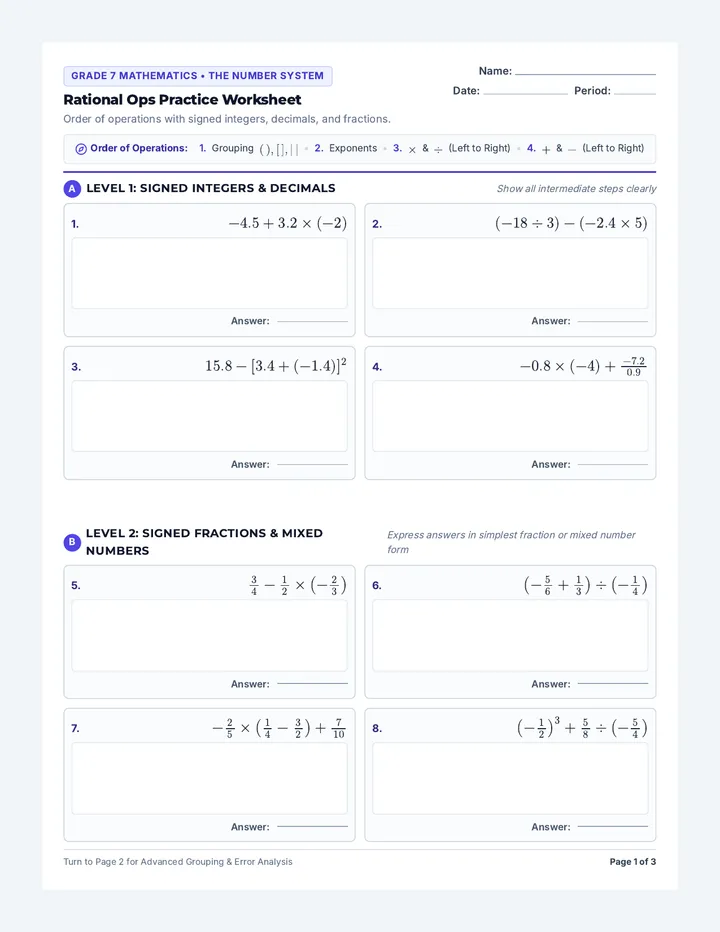
Rational Ops Practice Worksheet

Rational Order Operations

A 7th-grade mathematics lesson covering the order of operations with signed integers, decimals, and fractions. Students master multi-step arithmetic, nested grouping symbols, error analysis, and authentic real-world modeling.

CW

Coreen Williams

2
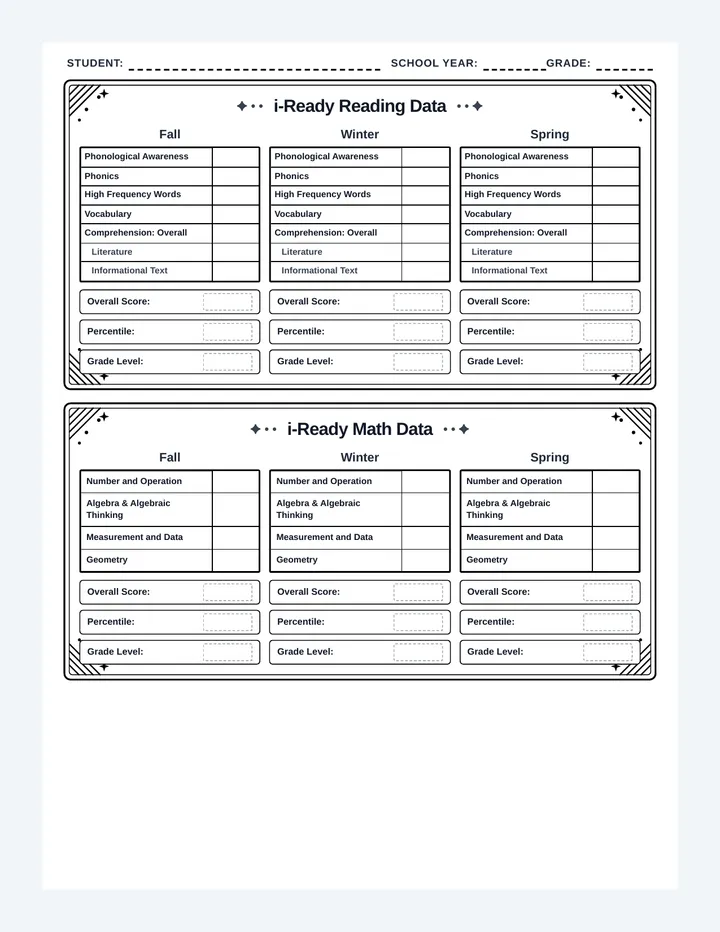
iReady Test Tracker Document

iReady Test Tracker Document

A printable i-Ready diagnostic test tracker for reading and math featuring Fall, Winter, and Spring columns with tightened header spacing and aligned student information fields.

H

hounshell

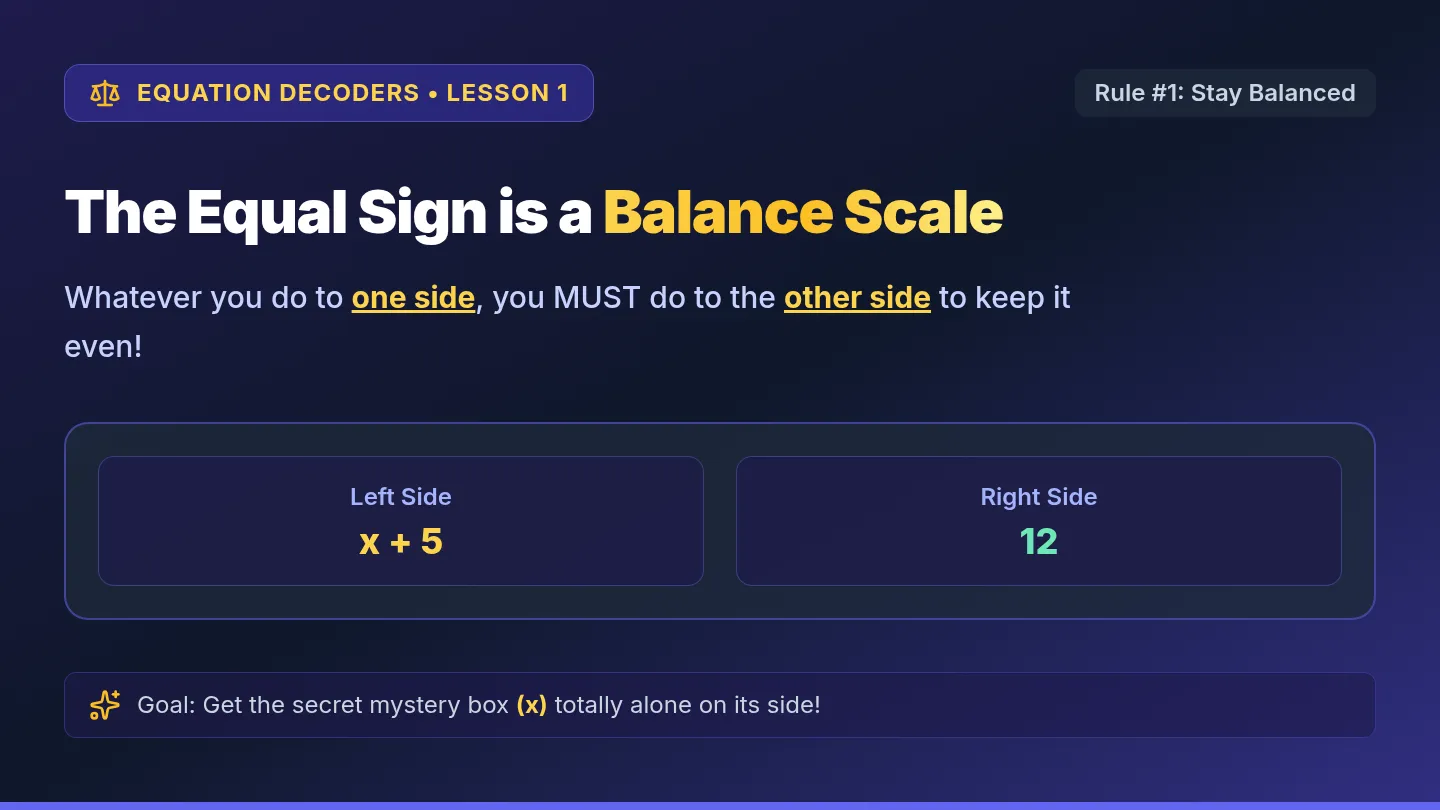
Balance Scale Slides

Equation Decoders

A scaffolded multi-day sequence engineered for 8th grade students with IEPs and math anxiety, demystifying linear equations through concrete balance models, visual inverse flowcharts, and structured routines.

DD

Darryl Davis

7
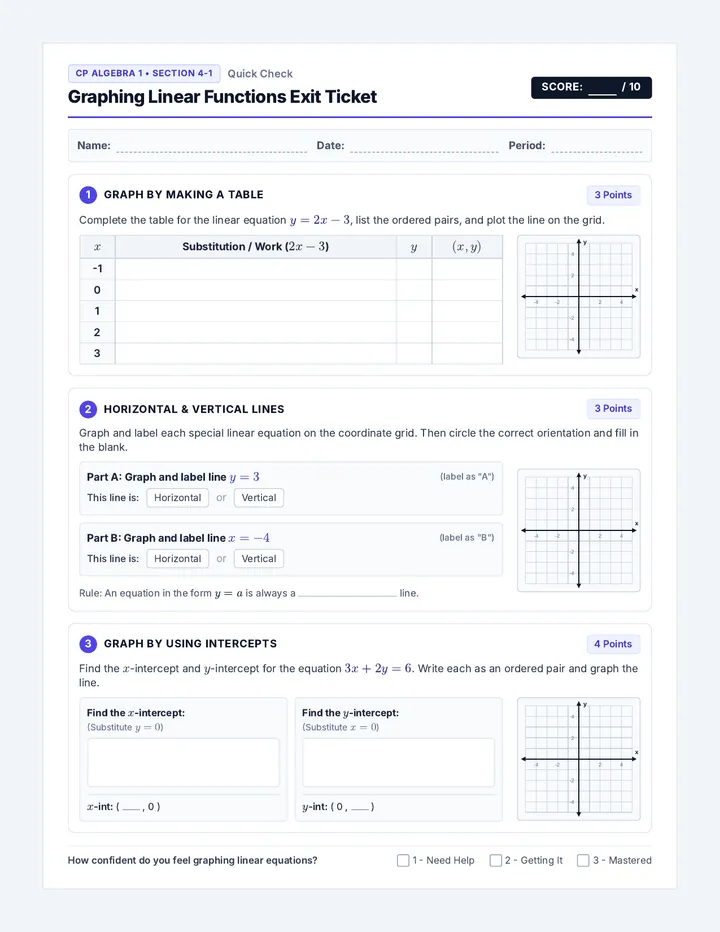
Linear Functions Exit Ticket

Graphing Linear Functions

A high school Algebra 1 lesson on graphing linear equations using tables of values, identifying horizontal and vertical special lines, and calculating x- and y-intercepts.

K

kgreene

2
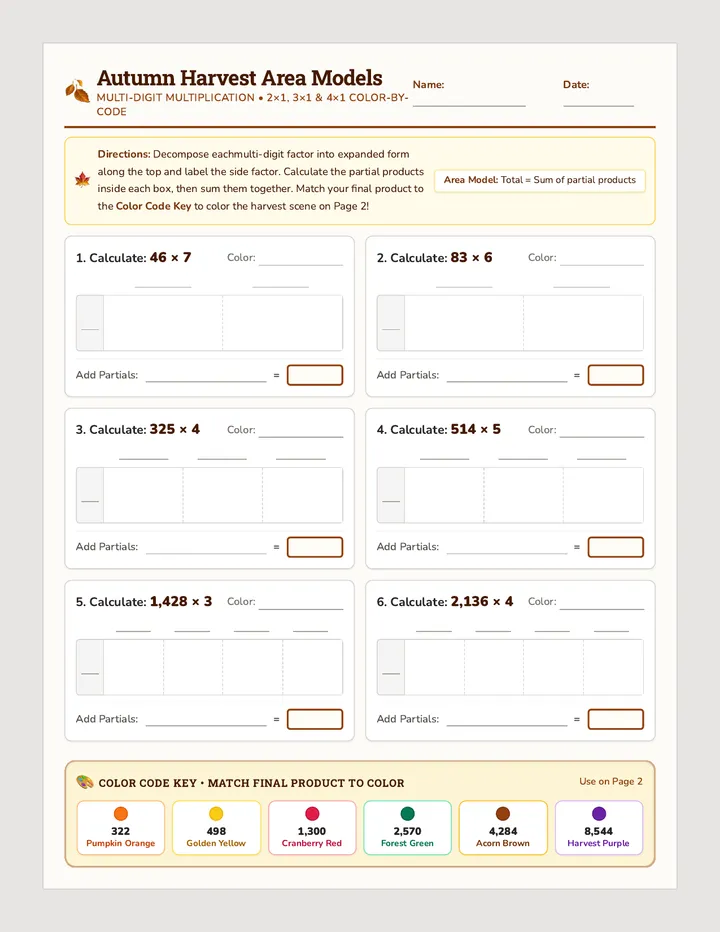
Autumn Harvest Area Model Worksheet

Autumn Harvest Area Model Worksheet

A 2-page autumn-themed mathematics worksheet combining independent 2x1, 3x1, and 4x1 area model multiplication with an autumn harvest color-by-number landscape illustration.

A

aasaltzman

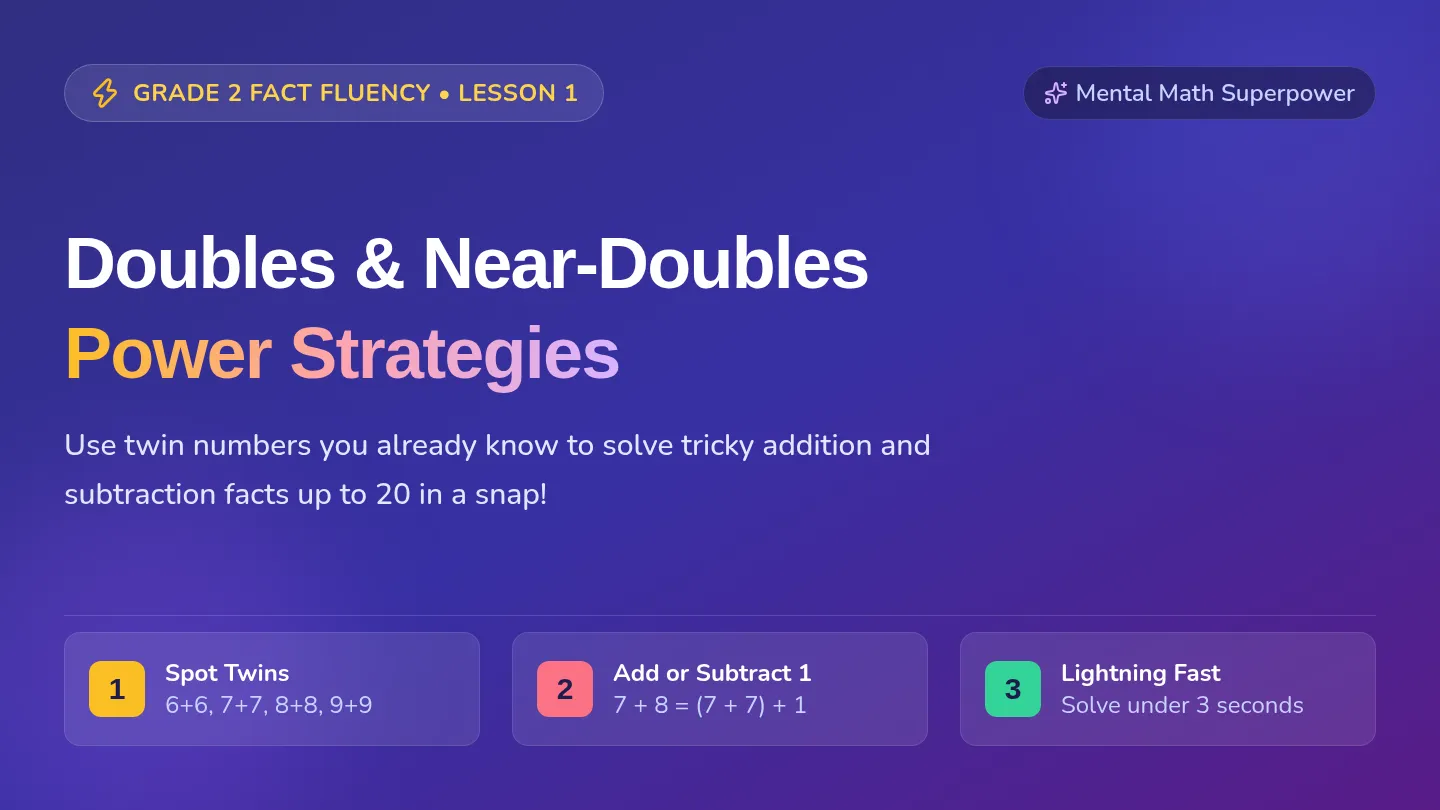
Doubles Power Slides

Fact Fluency Sprint

A three-day scaffolded math sequence designed for second-grade fact fluency within 20, moving systematically through doubles and near-doubles, bridge-through-ten strategies, and mixed fluency consolidation.

M

mgamache

6
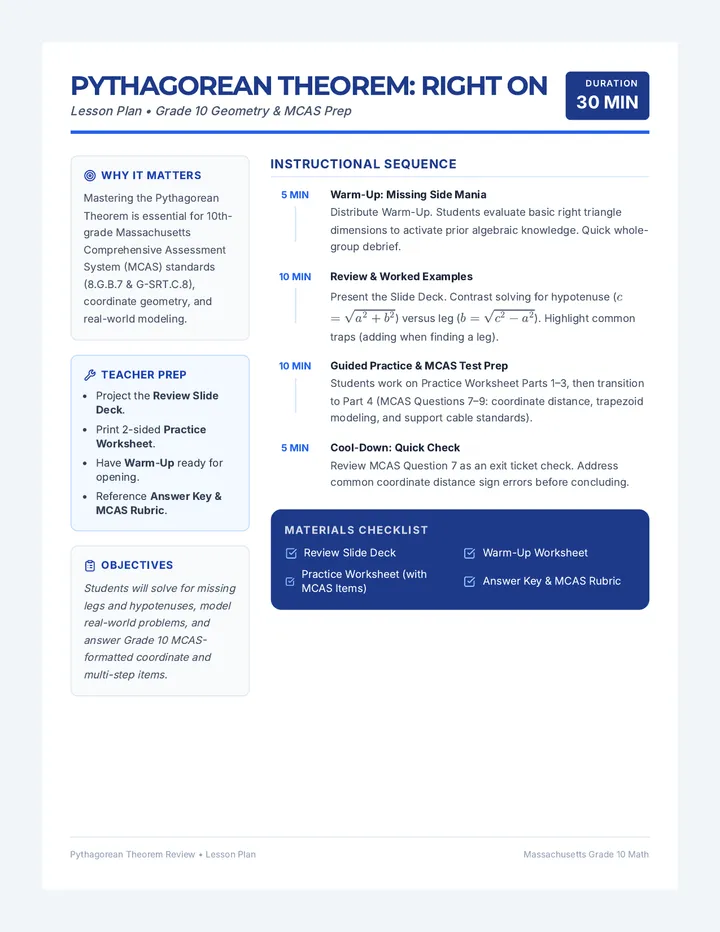
Pythagorean Lesson Plan

Pythagorean Theorem Right On

A 30-minute review lesson for 10th-grade students focusing on the Pythagorean Theorem, its formula, and real-world applications. Students will practice solving for both the hypotenuse and legs of right triangles.

MA

Meaghan Allen

5
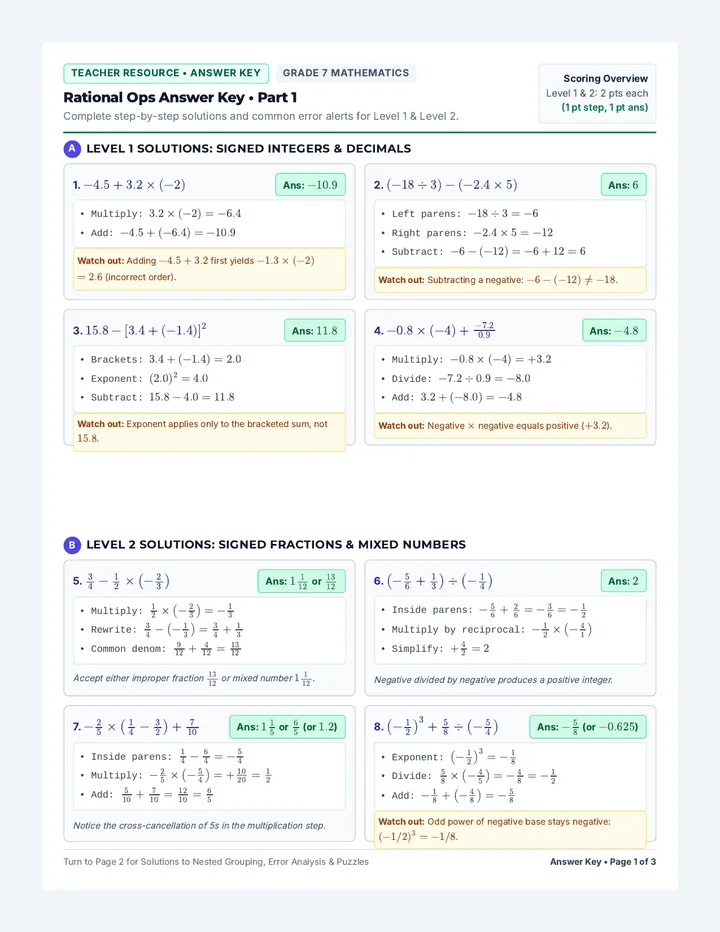
Rational Ops Answer Key

Rational Ops Answer Key

A comprehensive three-page teacher answer key for the Rational Ops Practice Worksheet, featuring step-by-step worked solutions, intermediate arithmetic checks, common misconceptions, and grading rubrics for all 18 problems.

CW

Coreen Williams

Starting Clues Slides

Digit Detectives

A foundational three-part sequence for first-grade learners to develop instant numeral identification and quantity matching for numbers 0 through 10. Through detective-themed visual slides, print-ready practice sheets, and guided teaching routines, students master numeral recognition and sequential order.

MS

Melissa Saunders

9
Reflections Coordinate Quiz

Reflections Mastery

A Grade 8 math lesson covering reflections across horizontal and vertical lines on the coordinate plane, complete with accessible quizzes in English and Spanish.

JD

Jenna Dzioba

3
Rational Ops Practice Worksheet

Rational Ops Practice Worksheet

A comprehensive three-page practice worksheet for 7th grade students on order of operations with rational numbers. Pages 1 and 2 cover integer and decimal operations, fractions, nested grouping symbols, error analysis, and parentheses puzzles, while Page 3 is exclusively dedicated to four authentic, multi-step real-world word problems.

CW

Coreen Williams