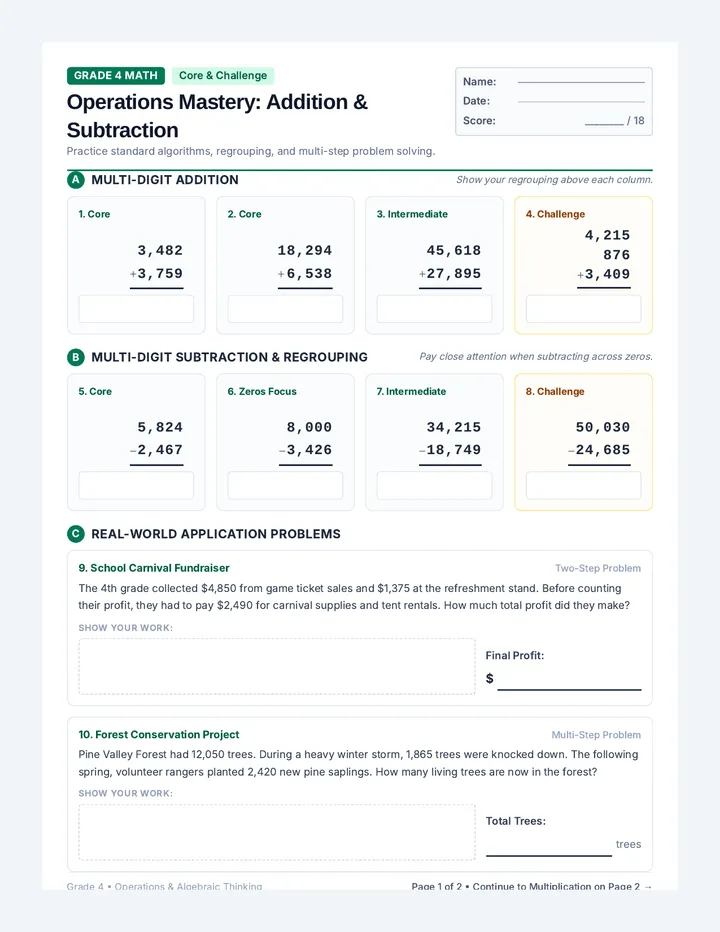
Visual Additions Worksheet 01
Fraction Architects • Practice Series
Visual Additions Worksheet
Name:
Date: Score:
Blueprint Rule: You cannot combine pieces of different sizes directly. Slice each model so both have pieces of the same equal size (the common denominator), then count the total shaded pieces!
A Bar Models: Partition into Equal Slices & Add
4 Points
1. \( \frac{1}{2} + \frac{1}{4} \) Common Size: Fourths
Half (split into 4ths): \( \frac{1}{2} = \frac{2}{4} \)
Fourth: \( \frac{1}{4} \)
Sum:
\( \frac{2}{4} + \frac{1}{4} = \)
2. \( \frac{1}{3} + \frac{1}{6} \) Common Size: Sixths
Third (split into 6ths): \( \frac{1}{3} = \frac{2}{6} \)
Sixth: \( \frac{1}{6} \)
Sum:
\( \frac{2}{6} + \frac{1}{6} = \)
3. \( \frac{2}{5} + \frac{3}{10} \) Common Size: Tenths
Fifths to tenths: \( \frac{2}{5} = \frac{4}{10} \)
Three tenths: \( \frac{3}{10} \)
Sum:
\( \frac{4}{10} + \frac{3}{10} = \)
4. \( \frac{3}{8} + \frac{1}{4} \) Common Size: Eighths
Three eighths: \( \frac{3}{8} \)
Fourth (split into 8ths): \( \frac{1}{4} = \frac{2}{8} \)
Sum:
\( \frac{3}{8} + \frac{2}{8} = \)
B Area Models: Draw & Compute Equivalent Fractions
4 Points
5. \( \frac{1}{2} + \frac{1}{3} \) (Grid of \( 2 \times 3 = 6 \))
Shade \( \frac{1}{2} \) (3 sixths) in blue, shade \( \frac{1}{3} \) (2 sixths) in orange.
\( \frac{1}{2} = \frac{\text{?}}{6} \rightarrow \) \( \frac{3}{6} \)
\( \frac{1}{3} = \frac{\text{?}}{6} \rightarrow \) \( \frac{2}{6} \)
Total:
6. \( \frac{1}{4} + \frac{2}{3} \) (Grid of \( 4 \times 3 = 12 \))
Convert each fraction into twelfths to find the total sum.
\( \frac{1}{4} = \frac{\text{?}}{12} \rightarrow \) \( \frac{3}{12} \)
\( \frac{2}{3} = \frac{\text{?}}{12} \rightarrow \) \( \frac{8}{12} \)
Total:
C Architect's Reasoning
2 Points
A student claimed: "\( \frac{1}{3} + \frac{1}{6} = \frac{2}{9} \) because \( 1+1=2 \) and \( 3+6=9 \)." Explain using the bar models above why this is incorrect.
Fraction Architects • Level 1: Concrete & Visual Addition Target Standard: 5.NF.A.1
Visual Subtractions Worksheet 02
Fraction Architects • Practice Series
Visual Subtractions Worksheet
Name:
Date: Score:
Take-Away Rule: You cannot remove different-sized pieces directly! Convert the minuend and subtrahend into equal unit fractions, shade the starting amount, and cross out the amount being subtracted.
A Bar Models: Cross Out Subtracted Parts
4 Points
1. \( \frac{3}{4} - \frac{1}{2} \) LCD: 4
Start: \( \frac{3}{4} \) Take away: \( \frac{1}{2} = \frac{2}{4} \)
✕
✕
2 fourths are crossed out from 3 fourths.
Difference:
\( \frac{3}{4} - \frac{2}{4} = \)
2. \( \frac{5}{6} - \frac{1}{3} \) LCD: 6
Start: \( \frac{5}{6} \) Take away: \( \frac{1}{3} = \frac{2}{6} \)
✕
✕
Cross out 2 sixths. What remains?
Difference:
\( \frac{5}{6} - \frac{2}{6} = \)
3. \( \frac{7}{10} - \frac{2}{5} \) LCD: 10
Start: \( \frac{7}{10} \) Take away: \( \frac{2}{5} = \frac{4}{10} \)
✕
✕
✕
✕
4 tenths crossed out from 7 tenths.
Difference:
\( \frac{7}{10} - \frac{4}{10} = \)
4. \( \frac{7}{8} - \frac{3}{4} \) LCD: 8
Start: \( \frac{7}{8} \) Take away: \( \frac{3}{4} = \frac{6}{8} \)
✕
✕
✕
✕
✕
✕
6 eighths crossed out from 7 eighths.
Difference:
\( \frac{7}{8} - \frac{6}{8} = \)
B Grid Models: Find Common Units & Subtract
4 Points
5. \( \frac{2}{3} - \frac{1}{2} \) (LCD = 6)
Convert both to 6ths. Shade 4 sixths, cross out 3 sixths.
\( \frac{2}{3} = \frac{\text{?}}{6} \rightarrow \) \( \frac{4}{6} \)
\( \frac{1}{2} = \frac{\text{?}}{6} \rightarrow \) \( \frac{3}{6} \)
Result:
6. \( \frac{3}{4} - \frac{1}{3} \) (LCD = 12)
Convert both to 12ths. Shade 9 twelfths, cross out 4 twelfths.
\( \frac{3}{4} = \frac{\text{?}}{12} \rightarrow \) \( \frac{9}{12} \)
\( \frac{1}{3} = \frac{\text{?}}{12} \rightarrow \) \( \frac{4}{12} \)
Result:
C Visual Problem Solving
2 Points
Maya had \( \frac{5}{6} \) of a board of cedar wood. She sawed off \( \frac{1}{2} \) of the board for a shelf. What fraction of the original board is left? Show work and write the final simplified fraction.
Common Ground Worksheet 03
Fraction Architects • Practice Series
Common Ground Worksheet
Name:
Date: Score:
The Golden Multiplier: List multiples of each denominator until you spot the smallest matching number (the LCD). Multiply numerator and denominator by the factor needed to reach that LCD!
A Find the Least Common Denominator (LCD)
4 Points
1. Denominators: \( 4 \) and \( 6 \)
Multiples of 4: 4, 8, 12, 16, 20...
Multiples of 6: 6, 12, 18, 24...
LCD:
12
2. Denominators: \( 3 \) and \( 5 \)
Multiples of 3: 3, 6, 9, 12, 15, 18...
Multiples of 5: 5, 10, 15, 20, 25...
LCD:
3. Denominators: \( 6 \) and \( 8 \)
Multiples of 6: ________________________
Multiples of 8: ________________________
LCD:
4. Denominators: \( 4 \) and \( 10 \)
Multiples of 4: ________________________
Multiples of 10: _______________________
LCD:
B Rename Fractions with the Target LCD
4 Points
5. Target LCD = 12
\( \frac{1}{4} \times \frac{3}{3} = \)
\( \frac{1}{6} \times \frac{2}{2} = \)
6. Target LCD = 15
\( \frac{2}{3} \times \frac{?}{?} = \)
\( \frac{3}{5} \times \frac{?}{?} = \)
7. Target LCD = 24
\( \frac{5}{8} = \frac{\text{?}}{24} \)
\( \frac{1}{6} = \frac{\text{?}}{24} \)
8. Target LCD = 20
\( \frac{3}{4} = \frac{\text{?}}{20} \)
\( \frac{7}{10} = \frac{\text{?}}{20} \)
C Full Transformation & Setup
2 Points
Rewrite \( \frac{3}{8} \) and \( \frac{5}{12} \) with a common denominator. State the LCD and write the two new equivalent fractions ready to add.
LCD of 8 and 12:
\( \frac{3}{8} \rightarrow \)
\( \frac{5}{12} \rightarrow \)
Fraction Architects • Level 3: Finding LCD & Generating Equivalents Target Standard: 5.NF.A.1
Friendly Additions Worksheet 04
Fraction Architects • Practice Series
Friendly Additions Worksheet
Name:
Date: Score:
Shortcut Alert: When the larger denominator is a multiple of the smaller one, you only need to change ONE fraction! Keep the larger denominator as your LCD. Simplify answers when possible.
A Guided Practice: Convert One Fraction & Add
4 Points
1. \( \frac{1}{2} + \frac{3}{8} \) LCD = 8
Change \( \frac{1}{2} \rightarrow \frac{1 \times 4}{2 \times 4} = \frac{4}{8} \)
Add: \( \frac{4}{8} + \frac{3}{8} = \)
Final Sum:
2. \( \frac{1}{3} + \frac{4}{9} \) LCD = 9
Change \( \frac{1}{3} \rightarrow \frac{1 \times 3}{3 \times 3} = \frac{\text{?}}{9} \)
Add: \( \frac{\text{?}}{9} + \frac{4}{9} = \)
Final Sum:
3. \( \frac{3}{10} + \frac{2}{5} \) LCD = 10
Change \( \frac{2}{5} \rightarrow \frac{2 \times 2}{5 \times 2} = \frac{\text{?}}{10} \)
Add: \( \frac{3}{10} + \frac{\text{?}}{10} = \)
Final Sum:
4. \( \frac{5}{12} + \frac{1}{4} \) LCD = 12
Change \( \frac{1}{4} \rightarrow \frac{1 \times 3}{4 \times 3} = \frac{\text{?}}{12} \)
Add: \( \frac{5}{12} + \frac{\text{?}}{12} = \quad \) (Simplify!)
Simplified Sum:
B Independent Computations (Show Work & Simplify)
4 Points
5. \( \frac{1}{6} + \frac{1}{2} \)
Work space:
Answer:
6. \( \frac{3}{14} + \frac{2}{7} \)
Work space:
Answer:
7. \( \frac{3}{16} + \frac{5}{8} \)
Work space:
Answer:
8. \( \frac{7}{20} + \frac{3}{5} \)
Work space:
Answer:
C Blueprint Application
2 Points
An electrician installs \( \frac{3}{16} \) mile of copper wiring in the morning and \( \frac{1}{4} \) mile in the afternoon. What is the total length of copper wiring installed today?
Show addition:
Total:
Fraction Architects • Level 4: One-Fraction Conversion Addition Target Standard: 5.NF.A.1
Friendly Subtractions Worksheet 05
Fraction Architects • Practice Series
Friendly Subtractions Worksheet
Name:
Date: Score:
Precision Focus: Identify whether the minuend or subtrahend has the smaller denominator. Convert only that fraction so denominators match, subtract numerators, and always check if you can simplify to lowest terms!
A Guided Steps: Match Denominators & Subtract
4 Points
1. \( \frac{7}{8} - \frac{1}{4} \) LCD = 8
Convert \( \frac{1}{4} \rightarrow \frac{1 \times 2}{4 \times 2} = \frac{2}{8} \)
Subtract: \( \frac{7}{8} - \frac{2}{8} = \)
Difference:
2. \( \frac{2}{3} - \frac{5}{12} \) LCD = 12
Convert \( \frac{2}{3} \rightarrow \frac{2 \times 4}{3 \times 4} = \frac{\text{?}}{12} \)
Subtract: \( \frac{\text{?}}{12} - \frac{5}{12} = \quad \) (Simplify!)
Simplified:
3. \( \frac{9}{10} - \frac{1}{2} \) LCD = 10
Convert \( \frac{1}{2} \rightarrow \frac{1 \times 5}{2 \times 5} = \frac{\text{?}}{10} \)
Subtract: \( \frac{9}{10} - \frac{\text{?}}{10} = \quad \) (Simplify!)
Simplified:
4. \( \frac{11}{16} - \frac{3}{8} \) LCD = 16
Convert \( \frac{3}{8} \rightarrow \frac{3 \times 2}{8 \times 2} = \frac{\text{?}}{16} \)
Subtract: \( \frac{11}{16} - \frac{\text{?}}{16} = \)
Difference:
B Independent Subtraction & Simplification
4 Points
5. \( \frac{5}{6} - \frac{1}{3} \)
Work space:
Answer:
6. \( \frac{4}{5} - \frac{3}{15} \)
Work space:
Answer:
7. \( \frac{13}{18} - \frac{1}{6} \)
Work space:
Answer:
8. \( \frac{7}{8} - \frac{1}{2} \)
Work space:
Answer:
C Tank Reservoir Analysis
2 Points
A water cistern holds \( \frac{7}{10} \) of its capacity. During testing, \( \frac{2}{5} \) of the tank's capacity was drained. What fraction of the cistern's capacity is still full?
Show subtraction equation:
Remaining:
Fraction Architects • Level 5: One-Fraction Conversion Subtraction Target Standard: 5.NF.A.1
Prime Denominators Worksheet 06
Fraction Architects • Practice Series
Prime Denominators Worksheet
Name:
Date: Score:
Two-Way Conversion: When denominators have no common factors (like 3 and 5, or 4 and 7), multiply them together to find the LCD: \( \text{LCD} = a \times b \). Multiply each fraction by the other denominator!
A Convert Both Fractions & Add
4 Points
1. \( \frac{1}{3} + \frac{2}{5} \) LCD: \( 3 \times 5 = 15 \)
\( \frac{1}{3} \times \frac{5}{5} = \frac{5}{15} \quad \) and \( \quad \frac{2}{5} \times \frac{3}{3} = \frac{6}{15} \)
Sum: \( \frac{5}{15} + \frac{6}{15} = \)
Result:
2. \( \frac{1}{4} + \frac{2}{7} \) LCD: \( 4 \times 7 = 28 \)
\( \frac{1}{4} \times \frac{7}{7} = \frac{\text{?}}{28} \quad \) and \( \quad \frac{2}{7} \times \frac{4}{4} = \frac{\text{?}}{28} \)
Sum: \( \frac{\text{?}}{28} + \frac{\text{?}}{28} = \)
Result:
3. \( \frac{1}{2} + \frac{2}{3} \) LCD: \( 2 \times 3 = 6 \)
\( \frac{1}{2} = \frac{\text{?}}{6} \quad \) and \( \quad \frac{2}{3} = \frac{\text{?}}{6} \)
Sum (Improper / Mixed Number):
Result:
4. \( \frac{3}{5} + \frac{1}{4} \) LCD: \( 5 \times 4 = 20 \)
\( \frac{3}{5} = \frac{\text{?}}{20} \quad \) and \( \quad \frac{1}{4} = \frac{\text{?}}{20} \)
Sum:
Result:
B Independent Practice (Write Common Denominators First)
4 Points
5. \( \frac{2}{5} + \frac{1}{3} \)
LCD = ____ • Equivalent addition:
Answer:
6. \( \frac{3}{7} + \frac{1}{2} \)
LCD = ____ • Equivalent addition:
Answer:
7. \( \frac{2}{3} + \frac{3}{8} \)
LCD = ____ • Equivalent addition:
Answer:
8. \( \frac{4}{9} + \frac{1}{2} \)
LCD = ____ • Equivalent addition:
Answer:
C Culinary Lab Problem
2 Points
A pastry chef combines \( \frac{2}{3} \) cup of almond flour with \( \frac{3}{5} \) cup of oat flour. Express the total amount of flour as an improper fraction and as a mixed number.
Work: LCD = 15
Mixed Number:
Fraction Architects • Level 6: Coprime & Prime Denominator Addition Target Standard: 5.NF.A.1
Cross Paths Worksheet 07
Fraction Architects • Practice Series
Cross Paths Worksheet
Name:
Date: Score:
Dual-Conversion Subtraction: Always find the common multiple first! Convert both fractions to matching denominators, subtract the numerators (\( N_1 - N_2 \)), keep the common denominator, and reduce if possible.
A Convert Both Fractions & Subtract
4 Points
1. \( \frac{2}{3} - \frac{1}{4} \) LCD: \( 3 \times 4 = 12 \)
\( \frac{2}{3} \times \frac{4}{4} = \frac{8}{12} \quad \) and \( \quad \frac{1}{4} \times \frac{3}{3} = \frac{3}{12} \)
Subtract: \( \frac{8}{12} - \frac{3}{12} = \)
Difference:
2. \( \frac{3}{4} - \frac{2}{5} \) LCD: \( 4 \times 5 = 20 \)
\( \frac{3}{4} \times \frac{5}{5} = \frac{\text{?}}{20} \quad \) and \( \quad \frac{2}{5} \times \frac{4}{4} = \frac{\text{?}}{20} \)
Subtract: \( \frac{\text{?}}{20} - \frac{\text{?}}{20} = \)
Difference:
3. \( \frac{4}{5} - \frac{1}{2} \) LCD: \( 5 \times 2 = 10 \)
\( \frac{4}{5} = \frac{\text{?}}{10} \quad \) and \( \quad \frac{1}{2} = \frac{\text{?}}{10} \)
Subtract:
Difference:
4. \( \frac{5}{6} - \frac{3}{8} \) LCD: 24 (not 48!)
\( \frac{5}{6} \times \frac{4}{4} = \frac{20}{24} \quad \) and \( \quad \frac{3}{8} \times \frac{3}{3} = \frac{9}{24} \)
Subtract: \( \frac{20}{24} - \frac{9}{24} = \)
Difference:
B Independent Computations & Lowest Terms
4 Points
5. \( \frac{5}{7} - \frac{1}{3} \)
LCD = ____ • Equivalent subtraction:
Answer:
6. \( \frac{7}{9} - \frac{1}{2} \)
LCD = ____ • Equivalent subtraction:
Answer:
7. \( \frac{5}{8} - \frac{1}{6} \)
LCD = ____ • Equivalent subtraction:
Answer:
8. \( \frac{3}{4} - \frac{2}{7} \)
LCD = ____ • Equivalent subtraction:
Answer:
C Fabricator's Tolerance Check
2 Points
A metal bracket measures \( \frac{7}{8} \) inch wide. The mounting gap is \( \frac{2}{3} \) inch wide. How much wider is the bracket than the mounting gap?
Work: LCD = 24
Difference:
Fraction Architects • Level 7: Dual-Conversion Subtraction Target Standard: 5.NF.A.1
Fraction Fusion Worksheet 08
Fraction Architects • Practice Series
Fraction Fusion Worksheet
Name:
Date: Score:
Sign Check Protocol: Look closely at the operation sign! Are you finding a sum (\( + \)) or a difference (\( - \))? Find the best LCD, compute, and simplify every answer into lowest terms or a mixed number.
A Mixed Operations Fluency (Circle the sign first!)
6 Points
1. \( \frac{1}{2} + \frac{2}{5} \) +
Work space:
Answer:
2. \( \frac{5}{6} - \frac{1}{4} \) −
Work space:
Answer:
3. \( \frac{3}{8} + \frac{5}{12} \) +
Work space:
Answer:
4. \( \frac{7}{10} - \frac{1}{3} \) −
Work space:
Answer:
5. \( \frac{2}{3} + \frac{3}{5} \) +
Work space:
Answer:
6. \( \frac{11}{12} - \frac{3}{4} \) −
Work space:
Answer:
B Multi-Step & Three-Fraction Operations
2 Points
7. \( \frac{1}{2} + \frac{1}{3} + \frac{1}{6} \)
Find a single common denominator for 2, 3, and 6.
Work:
Simplified Sum:
8. \( \left(\frac{3}{4} + \frac{1}{8}\right) - \frac{1}{2} \)
Add inside parentheses first, then subtract.
Work:
Final Result:
C Truth Testing
2 Points
\( \frac{2}{3} + \frac{1}{4} = \frac{11}{12} \)
T F
\( \frac{7}{8} - \frac{3}{4} = \frac{4}{4} = 1 \)
T F
Fraction Architects • Level 8: Mixed Operations & Fluency Target Standard: 5.NF.A.1
Real World Worksheet 09
Fraction Architects • Practice Series
Real World Worksheet
Name:
Date: Score:
4-Step Protocol: 1. Identify key numbers. 2. Choose operation (\( + \) for total, \( - \) for difference/leftover). 3. Convert to common denominators. 4. Label with units!
1 Trail Hiking Challenge Addition
Jordan hiked \( \frac{3}{5} \) of a mile before lunch and another \( \frac{3}{10} \) of a mile after lunch to reach Summit Peak. How many total miles did Jordan hike today?
Work space (LCD = 10):
Answer:
2 Woodshop Framing Subtraction
A carpenter has an oak board that is \( \frac{7}{8} \) meter long. He cuts off a piece measuring \( \frac{1}{3} \) meter for a drawer handle. What is the length of the remaining board?
Work space (LCD = 24):
Answer:
3 Chemistry Lab Solutions Addition
Elena mixes \( \frac{2}{3} \) liter of distilled water with \( \frac{1}{4} \) liter of saline solution in a beaker. How many liters of liquid are in the beaker altogether?
Work space (LCD = 12):
Answer:
4 Bakery Flour Inventory Subtraction
A bakery container began with \( \frac{5}{6} \) sack of whole wheat flour. After baking sourdough loaves, \( \frac{3}{8} \) sack was used. How much flour is left in the container?
Work space (LCD = 24):
Answer:
5 Grand Master 2-Step Challenge
2 Points
Liam needs \( 1 \) whole yard of fabric for a school banner. He has \( \frac{1}{4} \) yard of blue fabric and \( \frac{2}{5} \) yard of gold fabric. How much more fabric does he need to buy?
Step 1: \( \frac{1}{4} + \frac{2}{5} = \) ____ • Step 2: \( 1 - \text{sum} = \)
Needs to buy:
Fraction Architects • Level 9: Real-World Applications & Units Target Standard: 5.NF.A.2
Error Detective Worksheet 10
Fraction Architects • Practice Series
Error Detective Worksheet
Name:
Date: Score:
Detective Mission: Each case below shows a piece of student work containing a critical mathematical flaw. Spot the mistake, describe why it happens, and calculate the true correct solution!
1 Case #101: The "Add Everything" Trap FLAWED WORK
Student Work:
\( \frac{2}{5} + \frac{1}{3} = \frac{2+1}{5+3} = \frac{3}{8} \)
What went wrong?
(Explain why you cannot add denominators directly)
Correct Answer:
2 Case #102: The Halfway Multiplier FLAWED WORK
Student Work:
\( \frac{3}{4} - \frac{1}{2} = \frac{3}{4} - \frac{1}{4} = \frac{2}{4} = \frac{1}{2} \)
What went wrong?
(Explain what happened to the numerator of 1/2)
Correct Answer:
3 Case #103: The Zero Denominator FLAWED WORK
Student Work:
\( \frac{5}{6} - \frac{1}{6} = \frac{5-1}{6-6} = \frac{4}{0} \)
What went wrong?
(Explain what denominator must do during subtraction)
Correct Simplified Answer:
★ Grand Architect Capstone Challenge
4 Points
Find the missing fraction \( \Box \) that makes each mathematical equation true:
A. \( \frac{1}{4} + \Box = \frac{7}{12} \)
\( \Box = \)
B. \( \frac{9}{10} - \Box = \frac{1}{2} \)
\( \Box = \)
Fraction Architects • Level 10: Error Analysis & Capstone Mastery Target Standard: 5.NF.A.1 & 5.NF.A.2