Flash and Build Lesson Plan
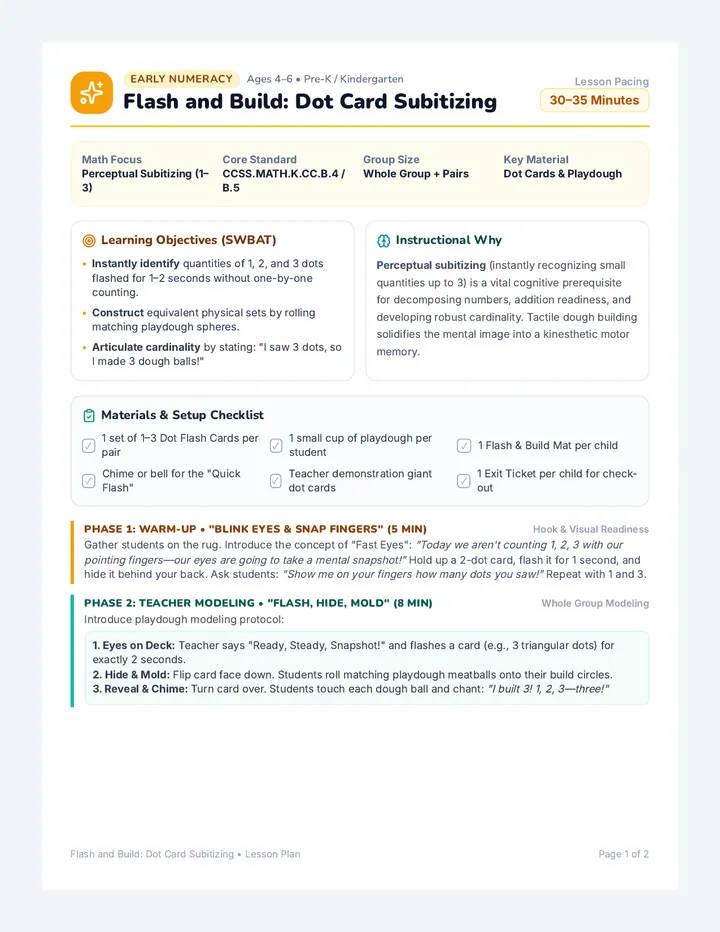
Early Numeracy Ages 4–6 • Pre-K / Kindergarten
Flash and Build: Dot Card Subitizing
Lesson Pacing 30–35 Minutes
Math Focus Perceptual Subitizing (1–3)
Core Standard CCSS.MATH.K.CC.B.4 / B.5
Group Size Whole Group + Pairs
Key Material Dot Cards & Playdough
Learning Objectives (SWBAT)
- • Instantly identify quantities of 1, 2, and 3 dots flashed for 1–2 seconds without one-by-one counting.
- • Construct equivalent physical sets by rolling matching playdough spheres.
- • Articulate cardinality by stating: "I saw 3 dots, so I made 3 dough balls!"
Instructional Why
Perceptual subitizing (instantly recognizing small quantities up to 3) is a vital cognitive prerequisite for decomposing numbers, addition readiness, and developing robust cardinality. Tactile dough building solidifies the mental image into a kinesthetic motor memory.
Materials & Setup Checklist
✓
1 set of 1–3 Dot Flash Cards per pair
✓
1 small cup of playdough per student
✓
1 Flash & Build Mat per child
✓
Chime or bell for the "Quick Flash"
✓
Teacher demonstration giant dot cards
✓
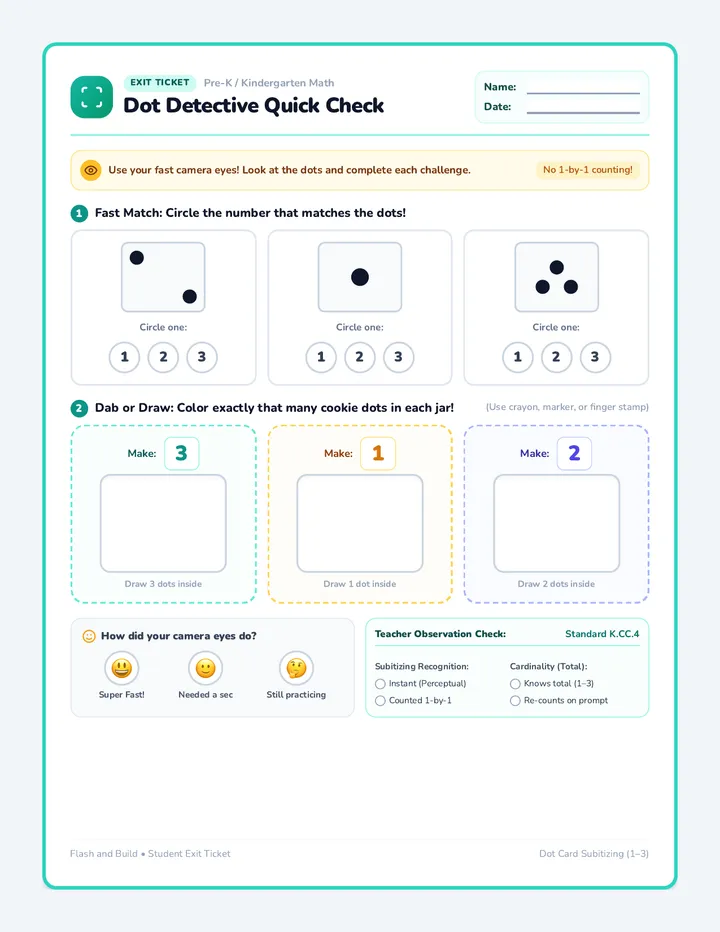
1 Exit Ticket per child for check-out
Phase 1: Warm-Up • "Blink Eyes & Snap Fingers" (5 Min) Hook & Visual Readiness
Gather students on the rug. Introduce the concept of "Fast Eyes": "Today we aren't counting 1, 2, 3 with our pointing fingers—our eyes are going to take a mental snapshot!" Hold up a 2-dot card, flash it for 1 second, and hide it behind your back. Ask students: "Show me on your fingers how many dots you saw!" Repeat with 1 and 3.
Phase 2: Teacher Modeling • "Flash, Hide, Mold" (8 Min) Whole Group Modeling
Introduce playdough modeling protocol: 1. Eyes on Deck: Teacher says "Ready, Steady, Snapshot!" and flashes a card (e.g., 3 triangular dots) for exactly 2 seconds.
2. Hide & Mold: Flip card face down. Students roll matching playdough meatballs onto their build circles.
3. Reveal & Chime: Turn card over. Students touch each dough ball and chant: "I built 3! 1, 2, 3—three!"
Flash and Build: Dot Card Subitizing • Lesson Plan Page 1 of 2
Guided Practice, Facilitation & Differentiation
Phase 3 Small Groups & Targeted Teacher Interventions
Execution Guide
Phase 3: Partner "Flash & Build" Game Stations (12–15 Min)
Tiered Progression
A Round 1: Canonical
Standard dice patterns. Flash cards with centered dot (1), diagonal pair (2), and diagonal trio (3). Builds confidence through familiar shapes.
B Round 2: Linear & Triangle
Non-standard layouts: 2 vertical dots, 3 in a horizontal row, or 3 forming a triangle. Prompts visual grouping without relying on dice memory.
C Round 3: Quick Swap
Partner A flashes, Partner B builds. Then Partner A checks Partner B's mat. After 3 turns, partners switch roles smoothly.
Teacher Questioning Framework & Verbal Cues
Promoting Subitizing: "How did you know there were 3 so fast? Did you have to count 1-2-3, or did your eyes snap a picture of the triangle?"
Reinforcing Cardinality: "You rolled 1, 2, 3 dough balls. So how many dough balls do you have all together in your group?"
Exploring Invariance: "If I spread your 3 dough balls far apart, are there still 3? What if I push them close together?"
Common Misconceptions & In-The-Moment Moves
Misconception: Reverting to Counting
Child touches the card and counts "one, two, three" rather than trusting immediate visual recognition.
Move: Decrease flash time to 1 second. Encourage: "Trust your fast camera eyes! Tell me right away before the card vanishes!"
Misconception: Size vs Quantity Bias
Child believes rolling one big dough ball is "more" than three small dough balls.
Move: Have the child line up the 3 balls next to the 1 big ball. Count items: "Size is how big, but quantity is how many items!"
Differentiation Strategies
Support: Provide dot cards with textured/raised tactile dots; keep flash cards visible for 3 seconds if needed before fading.
Extension: Flash two cards sequentially (e.g., 1 dot, then 2 dots) and challenge the learner to mold the combined total (3).
Phase 4: Debrief & Exit Ticket (5 Min)
Have children squish their playdough back into containers. Distribute the Dot Detective Exit Ticket. Students complete the quick 1–3 perceptual dot matching independently to document individual mastery.
Flash and Build: Dot Card Subitizing • Lesson Plan Page 2 of 2
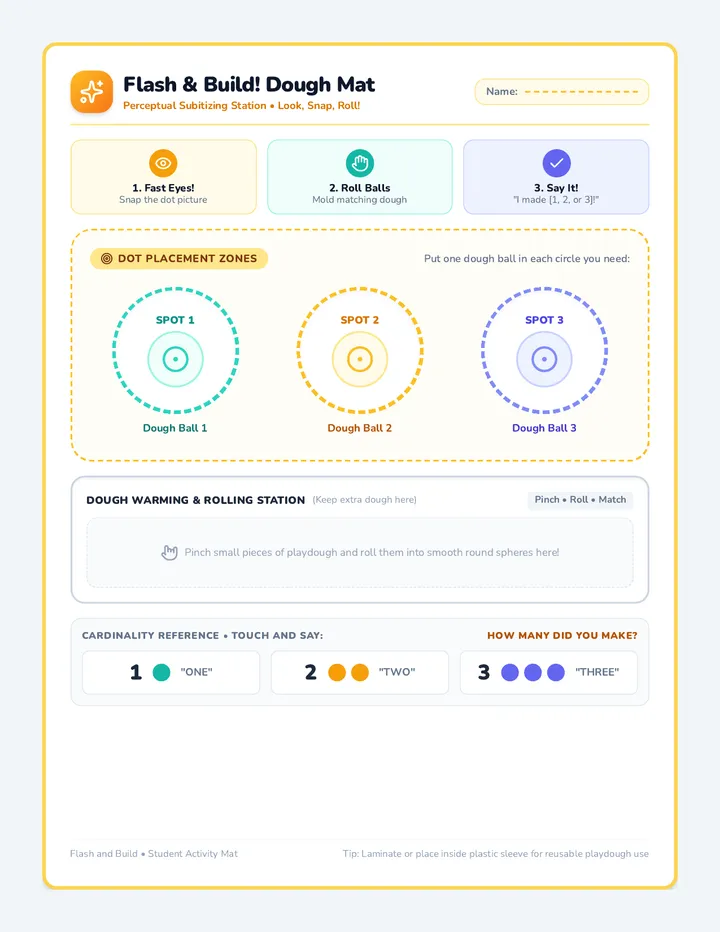
Playdough Dot Game Mats
Flash & Build! Dough Mat
Perceptual Subitizing Station • Look, Snap, Roll!
Name:
1. Fast Eyes! Snap the dot picture
2. Roll Balls Mold matching dough
3. Say It! "I made [1, 2, or 3]!"
Dot Placement Zones Put one dough ball in each circle you need:
Spot 1
Dough Ball 1
Spot 2
Dough Ball 2
Spot 3
Dough Ball 3
Dough Warming & Rolling Station (Keep extra dough here)
Pinch • Roll • Match
Pinch small pieces of playdough and roll them into smooth round spheres here!
Cardinality Reference • Touch and Say: How many did you make?
1
"ONE"
2
"TWO"
3
"THREE"
Flash and Build • Student Activity Mat Tip: Laminate or place inside plastic sleeve for reusable playdough use
Print & Cut Dot Cards (1–3)
9 High-Contrast Cards • Canonical, Linear & Geometric Arrangements
Cut Along Dashed Lines
Card 1 Qty: 1
Single Center Dot
Card 2 Qty: 2
Diagonal Pair (Dice)
Card 3 Qty: 2
Horizontal Row Pair
Card 4 Qty: 2
Vertical Column Pair
Card 5 Qty: 3
Triangle Cluster
Card 6 Qty: 3
Diagonal Trio (Dice 3)
Card 7 Qty: 3
Horizontal Row of 3
Card 8 Qty: 3
Inverted Triangle Cluster
Card 9 Qty: 3
Vertical Column of 3
Flash and Build • Dot Card Flash Deck Print on heavy cardstock & cut cards for partner or teacher flashing