Expression Mastery Assessment Indiana 6.NS.5 (E) ILEARN Proficiency Check
Expression Mastery Assessment
Grade 6 Mathematics
Name:
Date:
Period:
Directions: Solve each problem completely. Show every step of your work and write clear explanations using math vocabulary. Calculators are not permitted.
1
Order of Operations: Exponents & Grouping Symbols
Proficiency: ☐ Below ☐ Approaching ☐ At ☐ Above
Evaluate the expression below, showing every step:
\( 48 \div (2^3 - 4) + 3 \times 2^2 \)
Then, explain why \( 2^3 \) is evaluated before subtracting \( 4 \), and determine what the value of the expression would be if the parentheses were removed.
2
Order of Operations: Nonnegative Rational Numbers
Proficiency: ☐ Below ☐ Approaching ☐ At ☐ Above
Evaluate the expression below using either fraction form or decimal form for all steps:
\( \left(\frac{3}{4} + 0.5\right)^2 - \frac{1}{8} \times 4 \)
Show all work clearly, and explain how you converted between fractions and decimals.
Expression Mastery Assessment — Indiana 6.NS.5 (E) Name: ____________________________
3
Identity & Inverse Properties
Proficiency: ☐ Below ☐ Approaching ☐ At ☐ Above
Consider the expression: \( (6.4 + 0) + \left(\frac{5}{3} \times \frac{3}{5}\right) + (9 - 9) \)
(a) Evaluate the expression. (b) Name the specific identity or inverse property shown in each of the three groups, and explain the difference between an identity property and an inverse property.
4
Commutative & Associative Properties
Proficiency: ☐ Below ☐ Approaching ☐ At ☐ Above
Use properties of operations to evaluate efficiently: \( 0.25 \times 17 \times 4 + \left(2\frac{1}{3} + 5\frac{3}{4} + 1\frac{2}{3}\right) \)
Show how you reordered and regrouped the numbers, label where you used the Commutative and Associative properties, and explain why these properties do not work for subtraction or division.
5
Distributive Property
Proficiency: ☐ Below ☐ Approaching ☐ At ☐ Above
Evaluate \( 8 \times \left(3\frac{1}{4} + 1.5\right) \) by applying the Distributive Property first. Show the distributed expression and final value.
Then, show how the Distributive Property can also be used to evaluate \( 7 \times 99 \) mentally.
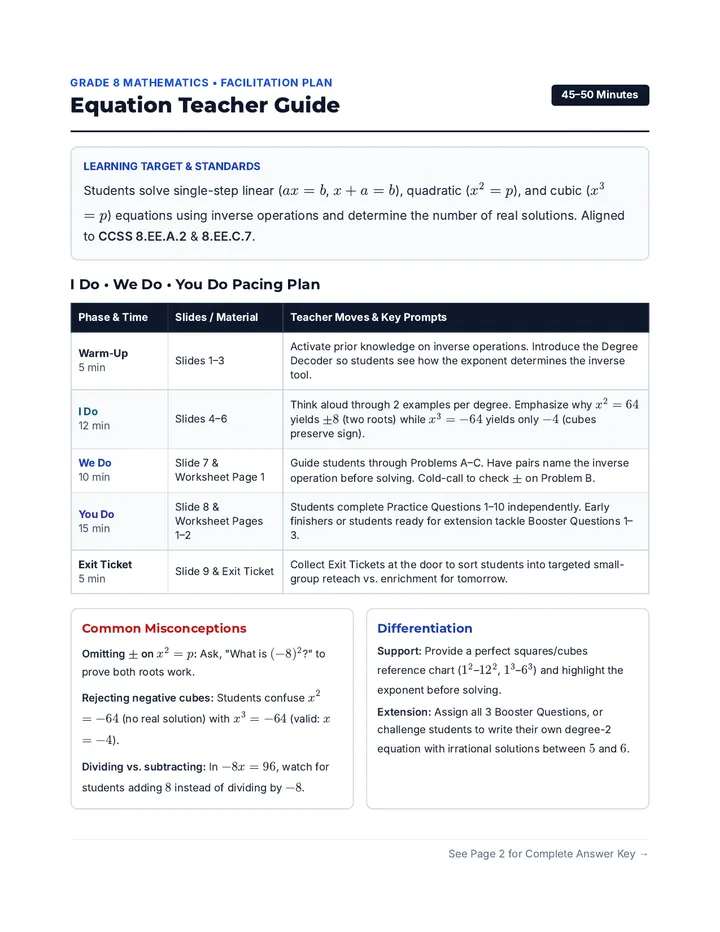
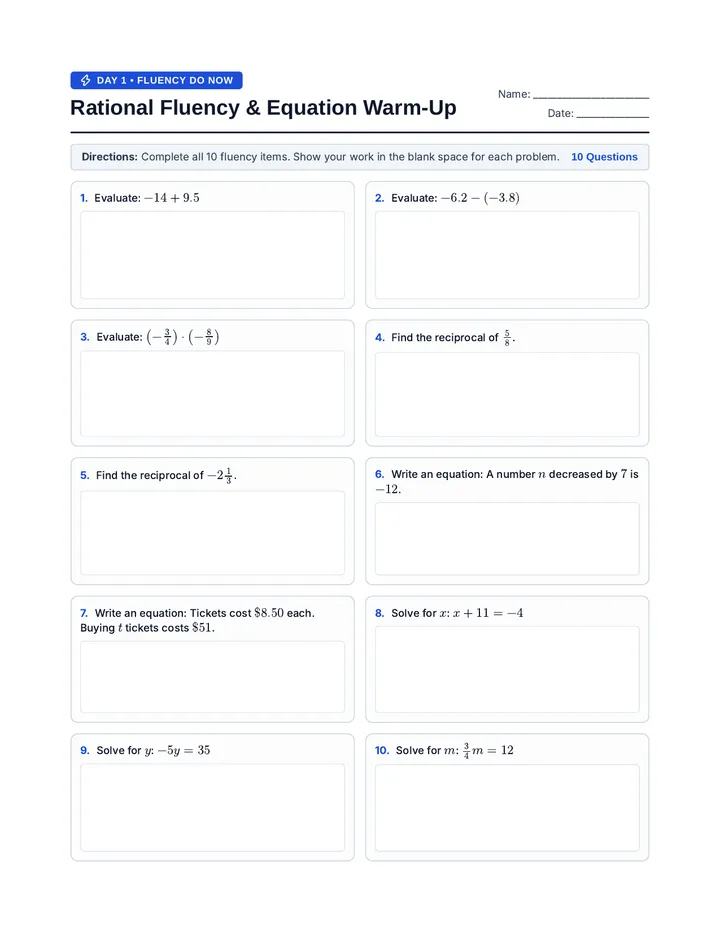
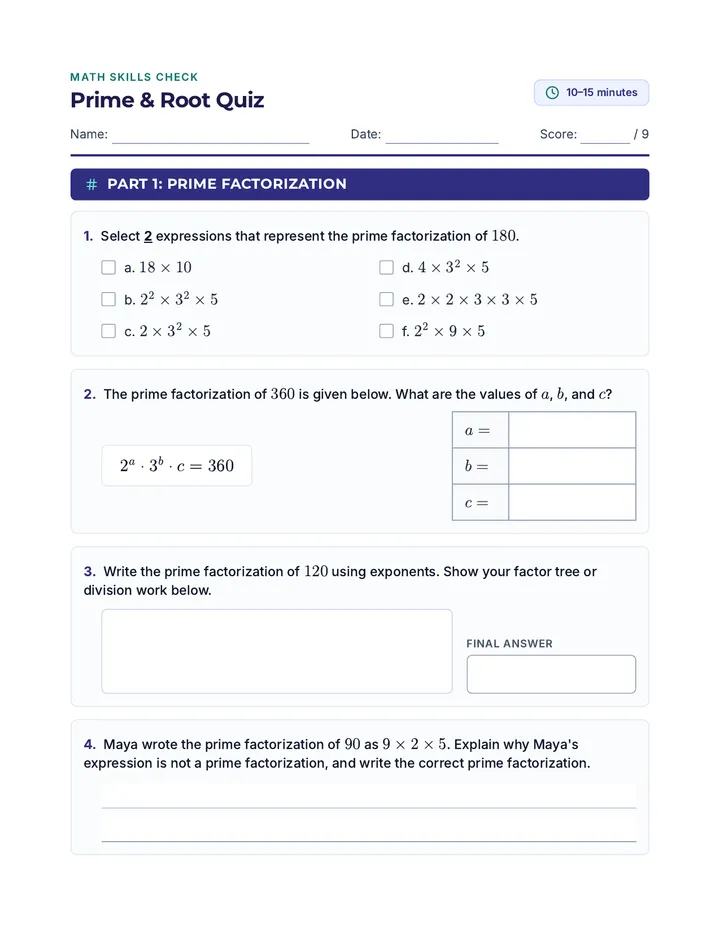
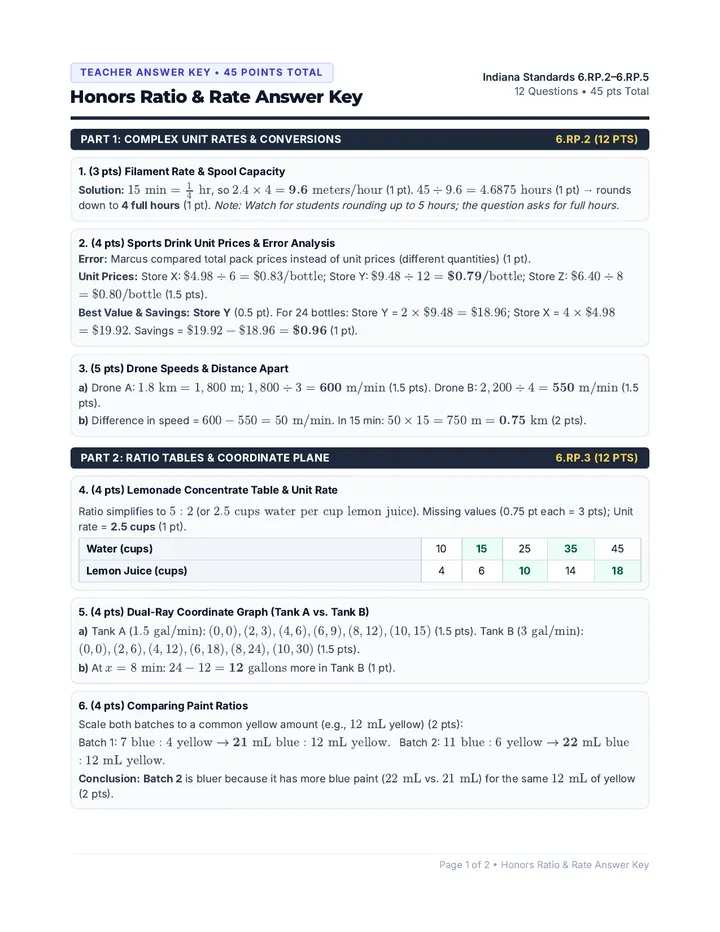
ILEARN 6.NS.5 Proficiency Rubric Teacher Guide & Answer Key Indiana 6.NS.5 (E)
ILEARN 6.NS.5 Proficiency Rubric
Grade 6 Mathematics
Below Proficiency
Limited understanding; frequent order, property, or rational number errors.
Approaching
Applies basic rules in simple cases; struggles with exponents, fractions, or justification.
At Proficiency
Accurately evaluates expressions with rational numbers & applies properties.
Above Proficiency
Evaluates efficiently, justifies reasoning, and extends to non-routine cases.
Q1 • Order of Operations: Exponents & Grouping Symbols
Answer: 24 (without parentheses: 14)
Worked Solution: \( 48 \div (2^3 - 4) + 3 \times 2^2 = 48 \div (8 - 4) + 3 \times 4 = 48 \div 4 + 12 = 12 + 12 = \mathbf{24} \). Evaluate \( 2^3 \) first because it is inside parentheses and exponents precede subtraction. Without parentheses: \( 48 \div 8 - 4 + 12 = 6 - 4 + 12 = \mathbf{14} \).
Below
Approaching
At
Above
Evaluates left-to-right or computes \( 2^3 = 6 \); cannot reach 24.
Correctly evaluates exponents or parentheses partially, but makes a minor order/arithmetic error.
Accurately finds 24 with clear steps and explains why \( 2^3 \) precedes subtraction.
Finds 24 , gives a complete explanation, AND correctly determines 14 without parentheses.
Q2 • Order of Operations: Nonnegative Rational Numbers
Answer: \( 1.0625 \) or \( 1\frac{1}{16} \)
Worked Solution: Decimal form: \( (0.75 + 0.5)^2 - 0.125 \times 4 = (1.25)^2 - 0.5 = 1.5625 - 0.5 = \mathbf{1.0625} \). Fraction form: \( \left(\frac{3}{4} + \frac{2}{4}\right)^2 - \frac{4}{8} = \left(\frac{5}{4}\right)^2 - \frac{1}{2} = \frac{25}{16} - \frac{8}{16} = \mathbf{\frac{17}{16} = 1\frac{1}{16}} \).
Below
Approaching
At
Above
Unable to convert between fractions and decimals or adds unlike fractions incorrectly.
Converts correctly to \( 1.25 \) or \( \frac{5}{4} \), but errs when squaring or subtracting \( \frac{1}{2} \).
Accurately evaluates to \( 1.0625 \) or \( 1\frac{1}{16} \) with clear conversion steps.
Accurately solves and explains conversion clearly, showing precision across both forms or verifying reasonableness.
ILEARN 6.NS.5 Proficiency Rubric — Page 2 Indiana Grade 6 Mathematics
Q3 • Identity & Inverse Properties
Answer: \( 7.4 \)
Worked Solution: (a) \( 6.4 + 1 + 0 = \mathbf{7.4} \). (b) \( 6.4 + 0 = 6.4 \) uses the Additive Identity ; \( \frac{5}{3} \times \frac{3}{5} = 1 \) uses the Multiplicative Inverse ; \( 9 - 9 = 0 \) uses the Additive Inverse . Identity keeps a value unchanged; inverse combines numbers to produce the identity (0 or 1).
Q4 • Commutative & Associative Properties
Answer: \( 26\frac{3}{4} \) or \( 26.75 \)
Worked Solution: Reorder (Commutative ): \( (0.25 \times 4) \times 17 + (2\frac{1}{3} + 1\frac{2}{3}) + 5\frac{3}{4} \). Regroup (Associative ): \( 1 \times 17 + 4 + 5\frac{3}{4} = 17 + 9\frac{3}{4} = \mathbf{26\frac{3}{4}} \). Subtraction and division are not commutative or associative because changing order or grouping changes the result (e.g., \( 8 - 2 \neq 2 - 8 \)).
Q5 • Distributive Property
Answer: \( 38 \) & \( 693 \)
Worked Solution: \( 8 \times (3\frac{1}{4} + 1.5) = (8 \times 3\frac{1}{4}) + (8 \times 1.5) = 26 + 12 = \mathbf{38} \). For \( 7 \times 99 \): rewrite as \( 7 \times (100 - 1) = (7 \times 100) - (7 \times 1) = 700 - 7 = \mathbf{693} \) (or \( 7 \times (90 + 9) = 630 + 63 = 693 \)).
Instructional Next Steps by ILEARN Proficiency Tier
Below / Approaching: Reteach exponent notation (\( 2^3 = 2 \times 2 \times 2 \)) and use color-coded grouping brackets before introducing mixed fractions/decimals. At / Above: Challenge students to create their own multi-step expressions that target a specific value using at least two properties.
Expression Mastery Slides Indiana 6.NS.5 (E) Grade 6 Math
Expression Mastery
Order of Operations, Exponents, Rational Numbers, and Properties of Operations.
“I Can” Roadmap: Order of Operations
Parts 1 & 2
Topic
Below
Approaching
At
Above
1. Exponents & Grouping
I can add & multiply left to right.
I can solve simple parentheses.
I can evaluate with exponents & grouping.
I can explain & compare grouping shifts.
2. Rational Numbers
I can solve with whole numbers.
I can convert fractions & decimals.
I can evaluate mixed rational forms.
I can verify across both number forms.
“I Can” Roadmap: Properties
Parts 3 & 4
Topic
Below
Approaching
At
Above
3. Identity & Inverse
I can compute with 0 and 1.
I can spot +0 or ×1 patterns.
I can name all identity & inverse rules.
I can contrast identity vs. inverse.
4. Commutative & Associative
I can add & multiply in order.
I can regroup friendly numbers.
I can label order & grouping steps.
I can prove why − and ÷ fail.
“I Can” Roadmap: Distributive Property
Part 5
Below Proficiency
I can multiply one term at a time.
Approaching Proficiency
I can set up distributed parts.
At Proficiency
I can distribute to solve expressions.
Above Proficiency
I can use distribution for mental math.
Today's Learning Targets
1
Order of Operations
Evaluate expressions with grouping symbols, exponents, fractions, and decimals.
2
Properties of Operations
Use Identity, Inverse, Commutative, Associative, and Distributive properties.
Order of Operations
Part 1
Grouping Symbols — \( ( \ ) , [ \ ] \)
Exponents — \( 2^3 = 2 \times 2 \times 2 \)
Multiply / Divide (Left to Right)
Add / Subtract (Left to Right)
Worked Example: Exponents & Grouping
Part 1
\( 36 \div (3^2 - 3) + 2 \times 5 \)
\( = 36 \div (\mathbf{9} - 3) + 2 \times 5 \) (Exponent inside grouping)
\( = 36 \div \mathbf{6} + 2 \times 5 \) (Finish parentheses)
\( = \mathbf{6} + \mathbf{10} = \mathbf{16} \) (Multiply/Divide, then Add)
Your Turn: Exponents & Grouping
Part 1
Example A
\( 30 \div (2^2 + 1) + 4^2 \)
Show every step!
Example B
\( 5 \times (3^2 - 4) - 2^3 \)
Show every step!
Rational Numbers: Decimal Path
Part 2
Convert all numbers to decimals first:
\( \left(\frac{1}{2} + 0.25\right)^2 \)
\( = (\mathbf{0.5} + 0.25)^2 \)
\( = (\mathbf{0.75})^2 = \mathbf{0.5625} \)
Rational Numbers: Fraction Path
Part 2
Or convert all numbers to fractions first:
\( \left(\frac{1}{2} + 0.25\right)^2 \)
\( = \left(\frac{2}{4} + \mathbf{\frac{1}{4}}\right)^2 \)
\( = \left(\mathbf{\frac{3}{4}}\right)^2 = \mathbf{\frac{9}{16}} \)
Your Turn: Rational Numbers
Part 2
Example A
\( \left(\frac{1}{4} + 0.75\right)^2 - 0.5 \)
Convert to one form and solve!
Example B
\( 1.5 \times \left(\frac{2}{3} + \frac{1}{3}\right) + \left(\frac{1}{2}\right)^2 \)
Convert to one form and solve!
Identity = Stays the Same
Part 3
Additive Identity (+ 0)
\( 7.5 + 0 = 7.5 \)
Adding 0 keeps the value unchanged.
Multiplicative Identity (× 1)
\( \frac{3}{4} \times 1 = \frac{3}{4} \)
Multiplying by 1 keeps the value unchanged.
Inverse = Undoes to Identity
Part 3
Additive Inverse (to 0)
\( 9 + (-9) = 0 \)
Opposites add to 0 (the additive identity).
Multiplicative Inverse (to 1)
\( \frac{5}{3} \times \frac{3}{5} = 1 \)
Reciprocals multiply to 1 (the mult. identity).
Your Turn: Identity & Inverse
Part 3
Example A
\( (4.8 + 0) + \left(\frac{7}{2} \times \frac{2}{7}\right) \)
Evaluate & name both properties!
Example B
\( (12 - 12) + (9.3 \times 1) \)
Evaluate & name both properties!
Commutative & Associative
Part 4
Commutative = Order
Swap the order :
\( 0.25 \times 17 \times 4 \)
\( = 0.25 \times 4 \times 17 \)
Associative = Grouping
Move the parentheses :
\( (0.25 \times 4) \times 17 \)
\( = 1 \times 17 = 17 \)
Watch Out! Only + and ×
Part 4
Commutative and Associative properties DO NOT work for subtraction or division!
Subtraction Fails
\( 8 - 2 \neq 2 - 8 \)
Division Fails
\( 12 \div 3 \neq 3 \div 12 \)
Your Turn: Commutative & Associative
Part 4
Example A
\( 0.5 \times 19 \times 2 \)
Reorder & regroup to solve mentally!
Example B
\( \left(3\frac{1}{4} + 8\right) + 2\frac{3}{4} \)
Reorder & regroup to solve mentally!
Distributive Property: Fractions
Part 5
Multiply the outside factor by every term inside: \( a(b + c) = ab + ac \)
\( 6 \times \left(2\frac{1}{3} + 0.5\right) \)
\( = \left(6 \times 2\frac{1}{3}\right) + (6 \times 0.5) \)
\( = 14 + 3 = \mathbf{17} \)
Distributive Property: Mental Math
Part 5
Break apart a tricky number into friendly parts!
\( 7 \times 99 \)
\( = 7 \times (100 - 1) \)
\( = 700 - 7 = \mathbf{693} \)
Your Turn: Distributive Property
Part 5
Example A
\( 4 \times \left(2\frac{1}{2} + 1.25\right) \)
Distribute first, then solve!
Example B
\( 6 \times 98 \)
Use \( (100 - 2) \) mentally!
Quick Partner Check
Challenge 1
\( 20 - 2^3 \times 2 + (3 + 1) \)
Which step comes first?
Challenge 2
\( 4 \times \left(5 + \frac{1}{4}\right) \)
Solve using Distribution!
Expression Mastery Guided Notes Indiana 6.NS.5 (E) Guided Notes
Expression Mastery Guided Notes
Grade 6 Mathematics
Name:
Date:
Period:
Part 1 • Order of Operations (Exponents & Grouping)
Slides 6–8
1. _____________________ Symbols \( ( \ ) , [ \ ] \)
2. _____________________ \( (2^3 = 2 \times 2 \times 2) \)
3. _____________ / _____________ (Left to Right)
4. _____________ / _____________ (Left to Right)
Worked Example: \( 36 \div (3^2 - 3) + 2 \times 5 \)
Your Turn A: \( 30 \div (2^2 + 1) + 4^2 \)
Your Turn B: \( 5 \times (3^2 - 4) - 2^3 \)
Part 2 • Mixing Fractions & Decimals
Slides 9–11
Strategy: Convert all numbers into the _____________________ form before calculating.
Decimal Path: \( \left(\frac{1}{2} + 0.25\right)^2 \)
Fraction Path: \( \left(\frac{1}{2} + 0.25\right)^2 \)
Your Turn A: \( \left(\frac{1}{4} + 0.75\right)^2 - 0.5 \)
Your Turn B: \( 1.5 \times \left(\frac{2}{3} + \frac{1}{3}\right) + \left(\frac{1}{2}\right)^2 \)
Expression Mastery Guided Notes — Page 2 Name: ____________________________
Part 3 • Identity & Inverse Properties
Slides 12–14
Identity = Stays the _____________
Additive Identity: \( 7.5 + \) ______ \( = 7.5 \)
Multiplicative Identity: \( \frac{3}{4} \times \) ______ \( = \frac{3}{4} \)
Inverse = Undoes to _____________
Additive Inverse: \( 9 + (-9) = \) ______
Multiplicative Inverse: \( \frac{5}{3} \times \frac{3}{5} = \) ______
Your Turn A: \( (4.8 + 0) + \left(\frac{7}{2} \times \frac{2}{7}\right) \)
Your Turn B: \( (12 - 12) + (9.3 \times 1) \)
Part 4 • Commutative & Associative Properties
Slides 15–17
Commutative = Swap _____________
\( 0.25 \times 17 \times 4 = \) ________________________
Associative = Move _____________
\( (0.25 \times 4) \times 17 = \) ___________________
Watch Out! Works ONLY for _______________ and _______________ — never _______________ or _______________.
Your Turn A: \( 0.5 \times 19 \times 2 \)
Your Turn B: \( \left(3\frac{1}{4} + 8\right) + 2\frac{3}{4} \)
Expression Mastery Guided Notes — Page 3 Name: ____________________________
Part 5 • The Distributive Property
Slides 18–20
Rule: Multiply the outside factor by every term inside: \( a(b + c) = \) _____________________
Example 1: \( 6 \times \left(2\frac{1}{3} + 0.5\right) \)
Example 2 (Mental Math): \( 7 \times 99 \)
Your Turn A: \( 4 \times \left(2\frac{1}{2} + 1.25\right) \)
Your Turn B: \( 6 \times 98 \)
Quick Partner Check — Wrap-Up
Slide 21
Challenge 1: \( 20 - 2^3 \times 2 + (3 + 1) \)
Challenge 2: \( 4 \times \left(5 + \frac{1}{4}\right) \)
Order of Operations Practice Worksheet Indiana 6.NS.5 (E) ILEARN Practice • Set 1
Order of Operations Practice Worksheet
Grade 6 Mathematics
Name:
Date:
Period:
Directions: Solve each problem using the order of operations. Show your work in the blank boxes.
1. Evaluating with Exponents & Grouping ILEARN Selected Response
What is the value of the expression \( 54 \div (3^2 - 3) + 2^3 \)?
A. \( 11 \)
B. \( 17 \)
C. \( 21 \)
D. \( 23 \)
2. Step-by-Step Evaluation Show All Steps
Evaluate \( 6 \times (4^2 - 10) \div 3 + 5^2 \).
3. Rational Numbers in Mixed Form Show All Steps
Evaluate \( \left(1.2 + \frac{3}{5}\right)^2 - \frac{1}{4} \times 8 \). Write your final answer as a decimal or fraction.
Order of Operations Practice Worksheet — Page 2 Name: ____________________________
4. Equivalent Expressions ILEARN Multi-Select
Select all expressions that have a value of \( 12 \).
☐ A. \( 2^3 + 8 \div 2 \)
☐ B. \( (2 + 4)^2 \div 3 \)
☐ C. \( 20 - 2^2 \times 2 \)
☐ D. \( 4.5 \times 2 + 1.5 \times 2 \)
5. Error Analysis (ILEARN Reasoning) Explain & Correct
Maya evaluated \( 18 - 2^3 + 4 \) and wrote: “\( 18 - 6 + 4 = 12 + 4 = 16 \).”
Identify Maya’s mistake, explain why it is incorrect, and find the correct value.
6. Real-World Expression Constructed Response
A baker makes \( 2 \) trays of \( 12 \) muffins and \( 3 \) trays of \( 8 \) muffins, then packs them equally into \( 2^2 \) boxes. Write and evaluate a single numerical expression to find how many muffins go in each box.
Properties of Operations Practice Worksheet Indiana 6.NS.5 (E) ILEARN Practice • Set 2
Properties of Operations Practice Worksheet
Grade 6 Mathematics
Name:
Date:
Period:
Directions: Apply the properties of operations to identify equivalent expressions and evaluate efficiently.
1. Identifying Properties ILEARN Selected Response
Which property justifies rewriting \( 6 \times (3.5 + 1.5) \) as \( (6 \times 3.5) + (6 \times 1.5) \)?
A. Associative Property of Multiplication
B. Commutative Property of Addition
C. Distributive Property
D. Multiplicative Identity Property
2. Name the Property Fill in the Blank
Mathematical Statement
Property Name
\( \frac{4}{9} \times \frac{9}{4} = 1 \)
\( 14.2 + 0 = 14.2 \)
\( (2.5 + 7) + 3 = 2.5 + (7 + 3) \)
\( 8 \times \frac{1}{2} = \frac{1}{2} \times 8 \)
3. Smart Regrouping Show All Steps
Use the Commutative and Associative Properties to evaluate \( 0.2 \times 13 \times 5 + \left(4\frac{1}{5} + 7 + 2\frac{4}{5}\right) \) efficiently. Label each property you use.
Properties of Operations Practice Worksheet — Page 2 Name: ____________________________
4. Equivalent Expressions ILEARN Multi-Select
Select all expressions that are equivalent to \( 9 \times (4 + 2.5) \).
☐ A. \( 9 \times 4 + 2.5 \)
☐ B. \( (9 \times 4) + (9 \times 2.5) \)
☐ C. \( 36 + 22.5 \)
☐ D. \( (4 + 2.5) \times 9 \)
5. Distributive Property & Mental Math Constructed Response
(a) Evaluate \( 12 \times \left(2\frac{1}{4} + 0.5\right) \) by distributing first.
(b) Show how to use the Distributive Property to evaluate \( 8 \times 103 \) mentally.
6. Why Properties Have Limits (ILEARN Reasoning) Explain & Prove
Jordan says: “Since \( 4 + 12 = 12 + 4 \), it must also be true that \( 24 \div 6 = 6 \div 24 \).”
Is Jordan correct? Explain using the Commutative Property and compute both values to prove your answer.
Practice Worksheets Answer Key Teacher Answer Key Indiana 6.NS.5 (E)
Practice Worksheets Answer Key
Grade 6 Mathematics
Set 1 • Order of Operations Practice Worksheet
1. B (17) — \( 54 \div (9 - 3) + 8 = 54 \div 6 + 8 = 9 + 8 = 17 \).
2. 37 — \( 6 \times (16 - 10) \div 3 + 25 = 6 \times 6 \div 3 + 25 = 36 \div 3 + 25 = 12 + 25 = 37 \).
3. \( 1.24 \) (or \( 1\frac{6}{25} \)) — \( (1.2 + 0.6)^2 - \frac{1}{4} \times 8 = (1.8)^2 - 2 = 3.24 - 2 = 1.24 \).
4. A, B, C, D — All four expressions evaluate to \( 12 \) (\( 8 + 4 \), \( 36 \div 3 \), \( 20 - 8 \), and \( 9 + 3 \)).
5. Maya evaluated \( 2^3 \) as \( 2 \times 3 = 6 \) instead of \( 2 \times 2 \times 2 = 8 \). Correct value: \( 18 - 8 + 4 = 10 + 4 = \mathbf{14} \).
6. Expression: \( (2 \times 12 + 3 \times 8) \div 2^2 = (24 + 24) \div 4 = 48 \div 4 = \mathbf{12} \) muffins per box.
Set 2 • Properties of Operations Practice Worksheet
1. C — Distributive Property.
2. Row 1: Multiplicative Inverse Property ; Row 2: Additive Identity Property ; Row 3: Associative Property of Addition ; Row 4: Commutative Property of Multiplication .
3. 27 — Reorder (Commutative) & regroup (Associative): \( (0.2 \times 5) \times 13 + \left(4\frac{1}{5} + 2\frac{4}{5}\right) + 7 = 1 \times 13 + 7 + 7 = 13 + 14 = 27 \).
4. B, C, D — Option A is incorrect because \( 9 \) was not distributed to \( 2.5 \).
5. (a) \( \left(12 \times 2\frac{1}{4}\right) + (12 \times 0.5) = 27 + 6 = \mathbf{33} \). (b) \( 8 \times (100 + 3) = 800 + 24 = \mathbf{824} \).
6. Jordan is incorrect . Division is not commutative: \( 24 \div 6 = \mathbf{4} \), while \( 6 \div 24 = \mathbf{\frac{1}{4}} \) (or \( 0.25 \)), and \( 4 \neq 0.25 \).
Nested Expressions Challenge Worksheet Indiana 6.NS.5 (E) At / Above Proficiency • Set 1
Nested Expressions Challenge Worksheet
Accelerated Grade 6 Math
Name:
Date:
Period:
1. Nested Grouping & Multiple Exponents At Proficiency
Evaluate \( 72 \div \left[2^3 + (5 - 2)^2 - 5\right] + 3 \times \left(\frac{1}{2}\right)^2 \). Show every intermediate step and express your final answer as both a mixed number and a decimal.
2. Target-Value Grouping Challenge Above Proficiency
Consider the ungrouped expression: \( 24 \div 2^2 + 2 \times 3^2 - 4 \)
(a) Insert one pair of parentheses so the expression equals \( 32 \). (b) Insert one pair of parentheses differently so the expression equals \( 16 \). Verify both with step-by-step work.
3. Rational Number Equivalence ILEARN Multi-Select
Select all expressions that are equal to \( 2.25 \).
☐ A. \( \left(\frac{3}{2}\right)^2 \)
☐ B. \( \left(0.5 + \frac{1}{4}\right) \times 3 \)
☐ C. \( 5 - (1.5)^2 - 0.5 \)
☐ D. \( \left(2^2 - \frac{1}{4}\right) \div 2 \)
Nested Expressions Challenge Worksheet — Page 2 Name: ____________________________
4. Precision with Repeating vs. Terminating Forms Above Proficiency
Evaluate \( \left(\frac{1}{3} + 0.5\right)^2 \times 18 - \frac{1}{2} \).
Explain why converting \( 0.5 \) to a fraction is more accurate than converting \( \frac{1}{3} \) to a decimal before squaring.
5. Multi-Step Real-World Synthesis Above Proficiency
A robotics club has a $150 budget. They buy \( 2^2 \) motors at $18.50 each and \( 2 \) sensor kits at \( \$12\frac{1}{4} \) each. They split the remaining money equally between \( 2 \) competition entry fees.
Write one numerical expression using grouping symbols and an exponent to represent the amount spent per entry fee, then evaluate it.
Property Proofs Challenge Worksheet Indiana 6.NS.5 (E) At / Above Proficiency • Set 2
Property Proofs Challenge Worksheet
Accelerated Grade 6 Math
Name:
Date:
Period:
1. Strategic Multi-Property Simplification At Proficiency
Evaluate \( \left(\frac{7}{4} \times 19 \times \frac{4}{7}\right) + (3.6 + 9.8 + 6.4) + (15 - 15) \) without a calculator. Rewrite the expression step-by-step and label every property used (Commutative, Associative, Identity, Inverse).
2. Reverse Distribution (Factoring for Mental Math) Above Proficiency
Use the Distributive Property in reverse (\( ab + ac = a(b + c) \)) to evaluate both expressions mentally:
(a) \( 18 \times 4.25 + 18 \times 5.75 \) (b) \( 15 \times 7\frac{2}{3} - 15 \times 1\frac{2}{3} \)
3. Equivalent Expressions Justification ILEARN Multi-Select
Select all expressions equivalent to \( 12 \times \left(3.5 + \frac{1}{4}\right) \).
☐ A. \( 42 + 3 \)
☐ B. \( (3.5 + 0.25) \times 12 \)
☐ C. \( 12 \times 3.5 + \frac{1}{4} \)
☐ D. \( 6 \times (7 + 0.5) \)
Property Proofs Challenge Worksheet — Page 2 Name: ____________________________
4. Always, Sometimes, or Never True? Above Proficiency
Determine whether each statement is Always True , Sometimes True , or Never True for nonnegative rational numbers. Give a numerical example or counterexample for each.
(a) \( a \div (b + c) = (a \div b) + (a \div c) \) (b) \( a \times (b - c) = (a \times b) - (a \times c) \)
5. Expression Architect Above Proficiency
Design your own numerical expression that:
• Uses at least four nonnegative rational numbers (including at least one fraction and one decimal),three different properties of operations to simplify efficiently, and\( 10 \) . Show the step-by-step simplification and label each property.
Advanced Worksheets Answer Key Teacher Answer Key At / Above Proficiency
Advanced Worksheets Answer Key
Accelerated Grade 6 Math
Set 1 • Nested Expressions Challenge Worksheet
1. \( 6\frac{3}{4} \) or \( 6.75 \) — \( 72 \div [8 + 9 - 5] + 3 \times \frac{1}{4} = 72 \div 12 + \frac{3}{4} = 6 + \frac{3}{4} = 6\frac{3}{4} \).
2. (a) \( 24 \div (2^2 + 2) \times 3^2 - 4 = 24 \div 6 \times 9 - 4 = 36 - 4 = \mathbf{32} \). (b) \( 24 \div 2^2 + 2 \times (3^2 - 4) = 6 + 2 \times 5 = \mathbf{16} \).
3. A, B, C — \( (3/2)^2 = 2.25 \), \( 0.75 \times 3 = 2.25 \), \( 5 - 2.25 - 0.5 = 2.25 \) (D evaluates to \( 1.875 \)).
4. 12 — \( \left(\frac{1}{3} + \frac{1}{2}\right)^2 \times 18 - \frac{1}{2} = \left(\frac{5}{6}\right)^2 \times 18 - \frac{1}{2} = \frac{25}{36} \times 18 - \frac{1}{2} = 12\frac{1}{2} - \frac{1}{2} = \mathbf{12} \). Using fractions avoids rounding the repeating decimal \( 0.\overline{3} \), preserving exactness.
5. Expression: \( \left[150 - \left(2^2 \times 18.50 + 2 \times 12\frac{1}{4}\right)\right] \div 2 = [150 - (74 + 24.50)] \div 2 = 51.50 \div 2 = \mathbf{\$25.75} \) per entry fee.
Set 2 • Property Proofs Challenge Worksheet
1. 38.8 — Commutative & Associative: \( \left(\frac{7}{4} \times \frac{4}{7}\right) \times 19 + (3.6 + 6.4) + 9.8 + (15 - 15) \). Inverse & Identity: \( (1 \times 19) + 10 + 9.8 + 0 = 19 + 19.8 = \mathbf{38.8} \).
2. (a) \( 18 \times (4.25 + 5.75) = 18 \times 10 = \mathbf{180} \). (b) \( 15 \times \left(7\frac{2}{3} - 1\frac{2}{3}\right) = 15 \times 6 = \mathbf{90} \).
3. A, B, D — All equal \( 45 \) (C equals \( 42.25 \) because \( 12 \) was not distributed to \( \frac{1}{4} \)).
4. (a) Sometimes True (true only when \( a = 0 \), e.g., \( 0 \div (2 + 2) = 0 = 0 + 0 \); false for \( a = 12, b = 2, c = 4 \): \( 12 \div 6 = 2 \neq 6 + 3 = 9 \)). (b) Always True (Distributive Property of Multiplication over Subtraction, for \( b \ge c \)).
5. Sample rubric check: Expression contains 4+ nonnegative rational numbers (with at least 1 fraction & 1 decimal), uses 3+ named properties accurately, and simplifies to \( 10 \).
Accelerated Expression Mastery Assessment Indiana 6.NS.5 (E) Accelerated • At / Above Proficiency
Accelerated Expression Mastery Assessment
Accelerated Grade 6 Math
Name:
Date:
Period:
Directions: Show all intermediate steps and justify your reasoning with precise mathematical vocabulary. Calculators are not permitted.
1
Nested Grouping & Exponents
Proficiency: ☐ Below ☐ Approaching ☐ At ☐ Above
Evaluate the nested expression below, showing every step:
\( 96 \div \left[2^3 + (5 - 2)^2 - 5\right] + 3 \times 2^2 \)
Then, determine what the value would be if the outer brackets \( [\ ] \) were removed (while keeping the parentheses), and explain why the value changes.
2
Rational Numbers & Exact Precision
Proficiency: ☐ Below ☐ Approaching ☐ At ☐ Above
Evaluate the expression below in exact form:
\( \left(\frac{2}{3} + 0.25\right)^2 \times 144 - \left(1\frac{1}{2}\right)^2 \)
Explain why converting \( 0.25 \) to a fraction is necessary for an exact answer rather than converting \( \frac{2}{3} \) to a decimal.
Accelerated Expression Mastery Assessment — Indiana 6.NS.5 (E) Name: ____________________________
3
Identity & Inverse Properties
Proficiency: ☐ Below ☐ Approaching ☐ At ☐ Above
Evaluate: \( \left(\frac{8}{5} \times \frac{5}{8}\right) \times 14.75 + (19.2 - 19.2) + \left(0 + 3\frac{1}{4}\right) \)
Name every identity and inverse property used to simplify the expression, and explain why \( 0 \) does not have a multiplicative inverse.
4
Commutative & Associative Proofs
Proficiency: ☐ Below ☐ Approaching ☐ At ☐ Above
Evaluate mentally using properties: \( 0.125 \times 37 \times 8 + \left(6\frac{2}{5} + 4.75 + 3\frac{3}{5}\right) \)
Label where you used the Commutative and Associative properties. Then, provide a numerical counterexample proving that division is neither commutative nor associative.
5
Reverse Distribution & Mental Math
Proficiency: ☐ Below ☐ Approaching ☐ At ☐ Above
(a) Use the Distributive Property in reverse to evaluate \( 24 \times 3.65 + 24 \times 6.35 - 24 \times 2.5 \).
(b) Show how to use the Distributive Property to evaluate \( 12 \times 99\frac{3}{4} \) mentally.
Accelerated 6.NS.5 Proficiency Rubric Teacher Guide & Answer Key Accelerated • 6.NS.5 (E)
Accelerated 6.NS.5 Proficiency Rubric
Accelerated Grade 6 Math
Q1 • Nested Grouping & Exponents
Answer: 20 (without brackets: 28)
Worked Solution: \( 96 \div [8 + 3^2 - 5] + 3 \times 4 = 96 \div [8 + 9 - 5] + 12 = 96 \div 12 + 12 = 8 + 12 = \mathbf{20} \). Without outer brackets: \( 96 \div 8 + 9 - 5 + 12 = 12 + 9 - 5 + 12 = \mathbf{28} \). Removing brackets causes division (\( 96 \div 2^3 \)) to happen before adding \( (5-2)^2 \) and subtracting \( 5 \).
Below
Approaching
At
Above
Misapplies order of operations or exponents inside brackets.
Evaluates \( 20 \) correctly, but errs on the unbracketed expression.
Accurately finds 20 and 28 with clear step-by-step work.
Finds 20 and 28 and precisely explains how bracket removal shifts division priority.
Q2 • Rational Numbers & Exact Precision
Answer: \( 118\frac{3}{4} \) or \( 118.75 \)
Worked Solution: \( \left(\frac{2}{3} + \frac{1}{4}\right)^2 \times 144 - \left(\frac{3}{2}\right)^2 = \left(\frac{11}{12}\right)^2 \times 144 - \frac{9}{4} = \frac{121}{144} \times 144 - 2.25 = 121 - 2.25 = \mathbf{118.75} \) (or \( \mathbf{118\frac{3}{4}} \)). Converting \( \frac{2}{3} \) to \( 0.\overline{6} \) requires rounding, which introduces error when squared.
Below
Approaching
At
Above
Rounds \( \frac{2}{3} \) early or makes fraction/exponent errors.
Reaches \( \frac{11}{12} \) or \( 121 \), but errs on \( (1\frac{1}{2})^2 \) or final subtraction.
Accurately finds \( 118.75 \) or \( 118\frac{3}{4} \) using exact fraction form.
Finds exact value and clearly explains why repeating decimals lose precision when squared.
Accelerated 6.NS.5 Proficiency Rubric — Page 2 Accelerated Grade 6 Math
Q3 • Identity & Inverse Properties
Answer: \( 18 \)
Worked Solution: \( 1 \times 14.75 + 0 + 3\frac{1}{4} = 14.75 + 3.25 = \mathbf{18} \). Properties: Multiplicative Inverse (\( \frac{8}{5} \times \frac{5}{8} = 1 \)), Multiplicative Identity (\( 1 \times 14.75 \)), Additive Inverse (\( 19.2 - 19.2 = 0 \)), Additive Identity (\( + 0 \) and \( 0 + 3\frac{1}{4} \)). Zero has no multiplicative inverse because no number multiplied by \( 0 \) equals \( 1 \).
Q4 • Commutative & Associative Proofs
Answer: \( 51.75 \) or \( 51\frac{3}{4} \)
Worked Solution: Commutative & Associative: \( (0.125 \times 8) \times 37 + \left(6\frac{2}{5} + 3\frac{3}{5}\right) + 4.75 = 1 \times 37 + 10 + 4.75 = \mathbf{51.75} \). Counterexamples: \( 12 \div 3 = 4 \neq 3 \div 12 = 0.25 \) (not commutative); \( (24 \div 6) \div 2 = 2 \neq 24 \div (6 \div 2) = 8 \) (not associative).
Q5 • Reverse Distribution & Mental Math
Answer: (a) \( 180 \) • (b) \( 1197 \)
Worked Solution: (a) Factor out \( 24 \): \( 24 \times (3.65 + 6.35 - 2.5) = 24 \times (10 - 2.5) = 24 \times 7.5 = \mathbf{180} \). (b) Rewrite \( 99\frac{3}{4} \) as \( (100 - \frac{1}{4}) \): \( 12 \times 100 - 12 \times \frac{1}{4} = 1200 - 3 = \mathbf{1197} \).