Equation Power Slides Grade 8 Mathematics I Do • We Do • You Do
Blueprint Unit
Equation Power Lab
Solving Single-Step Equations of Varying Degree
Degree 1: \(ax = b\)
Degree 2: \(x^2 = p\)
Degree 3: \(x^3 = p\)
Mission Briefing
Warm-Up & Target
Learning Target
I can solve single-step equations of degree 1, 2, and 3 by applying the correct inverse operation and checking the number of real solutions.
Quick Warm-Up
Discuss with a partner: What undoes each operation?
Adding \(7\) → ?
Multiplying by \(-3\) → ?
Squaring a number → ?
Key Idea: Every equation is a balance—whatever you do to one side, do to the other.
The Degree Decoder
Core Concept
Degree 1 • Linear
\(x^1\) (written as \(x\))
Undo \(+\) with \(-\), and \(\times\) with \(\div\).
\(x + 5 = 12\)
Degree 2 • Quadratic
\(x^2\) (squared)
Undo squaring with \(\pm\sqrt{\phantom{x}}\) (two roots when \(p > 0\)).
\(x^2 = 49\)
Degree 3 • Cubic
\(x^3\) (cubed)
Undo cubing with \(\sqrt[3]{\phantom{x}}\) (keeps the original sign).
\(x^3 = -27\)
Check the exponent on \(x\) first—it tells you which inverse tool to grab!
I Do
Degree 1: Linear Equations
Watch & Listen
Example 1: Subtraction
\(x - 14 = -9\)
Step 1: Inverse of \(-14\) is \(+14\).
\(x - 14 + 14 = -9 + 14\)
Solution: \(x = 5\)
Example 2: Multiplication
\(-6x = 42\)
Step 1: Inverse of \(\times(-6)\) is \(\div(-6)\).
\(\dfrac{-6x}{-6} = \dfrac{42}{-6}\)
Solution: \(x = -7\)
Pro Tip: Always check your sign when adding negatives or dividing by a negative!
I Do
Degree 2: Quadratic Equations
Watch & Listen
Example 3: Integer Square
\(x^2 = 64\)
Step 1: Take the square root of both sides.
\(x = \pm\sqrt{64}\)
Solution: \(x = 8\) or \(x = -8\)
Example 4: Fraction Square
\(x^2 = \dfrac{9}{25}\)
Step 1: Square root top & bottom.
\(x = \pm\dfrac{\sqrt{9}}{\sqrt{25}}\)
Solution: \(x = \pm\dfrac{3}{5}\)
Why \(\pm\)? Because both \(8^2 = 64\) and \((-8)^2 = 64\)!
I Do
Degree 3: Cubic Equations
Watch & Listen
Example 5: Positive Cube
\(x^3 = 27\)
Step 1: Take the cube root of both sides.
\(x = \sqrt[3]{27}\)
Solution: \(x = 3\) (only positive!)
Example 6: Negative Cube
\(x^3 = -64\)
Step 1: Cube root of a negative is negative.
\(x = \sqrt[3]{-64}\)
Solution: \(x = -4\)
Check: \((-4) \times (-4) \times (-4) = 16 \times (-4) = -64\). Cubes keep their sign!
We Do
Guided Practice Together
Solve on Your Sheet
Problem A • Degree 1
\(\dfrac{x}{4} = -11\)
What is the inverse of dividing by \(4\)?
Problem B • Degree 2
\(x^2 = 121\)
How many solutions should we write?
Problem C • Degree 3
\(x^3 = -125\)
Will \(x\) be positive, negative, or both?
Turn & Talk: Share your inverse step with a partner before we reveal each answer!
You Do
Independent Lab & Boosters
Solo Work
Practice Questions
• Complete Parts A, B, and C on your worksheet.
• Show the inverse operation on every problem.
• Check \(\pm\) on all degree 2 equations.
Booster Questions
• Tackle non-perfect squares (exact roots like \(\pm\sqrt{20}\)).
• Spot the error in a worked student solution.
• Explain when \(x^2 = p\) has zero real solutions!
Goal: Finish Parts A–C cleanly, then level up with the Booster Questions on Page 2.
Exit Ticket & Wrap-Up
Final Check
Before You Pack Up:
1. Complete all 4 questions on your Equation Exit Ticket.
2. Double-check your signs and \(\pm\) symbols.
3. Circle your confidence level at the bottom of the ticket.
Degree 1 → \(+, -, \times, \div\) Degree 2 → \(\pm\sqrt{\phantom{x}}\) Degree 3 → \(\sqrt[3]{\phantom{x}}\)
Equation Practice Worksheet Grade 8 Math • Equation Power Lab
Equation Practice Worksheet
Name: _______________________________
Date: _________________
Degree 1 (Linear)
\(x^1\): Undo \(+, -\) or \(\times, \div\)
Degree 2 (Quadratic)
\(x^2 = p\): Use \(\pm\sqrt{p}\) (2 roots if \(p > 0\))
Degree 3 (Cubic)
\(x^3 = p\): Use \(\sqrt[3]{p}\) (keeps sign)
We Do
Guided Practice (Solve Together)
A. \(\dfrac{x}{4} = -11\)
B. \(x^2 = 121\)
C. \(x^3 = -125\)
You Do
Practice Questions: Parts A & B
Show the inverse operation for every problem.
1. \(x + 18 = -7\) Degree 1
2. \(-8x = 96\) Degree 1
3. \(x - \dfrac{3}{4} = \dfrac{5}{4}\) Degree 1
4. \(x^2 = 81\) Degree 2
5. \(x^3 = 64\) Degree 3
6. \(x^2 = \dfrac{16}{49}\) Degree 2
Continue to Page 2 for Part C and Booster Questions →
Part C: Mixed Degree Practice
You Do • Continued
7. \(0.5x = -14\) Degree 1
8. \(x^3 = -216\) Degree 3
9. \(x^2 = 0.36\) Degree 2
10. \(\dfrac{x}{-9} = 6\) Degree 1
Booster Questions
Level-Up Challenge
Booster 1 (Exact Roots & Estimation):
Solve \(x^2 = 20\). Leave your solutions in exact radical form, then state which two consecutive whole numbers the positive solution falls between.
Booster 2 (Error Analysis):
Maya solved \(x^2 = 100\) and wrote \(x = 10\). Marcus solved \(x^3 = -8\) and wrote "No real solution." Explain the mistake in each student's work and give the correct answers.
Booster 3 (Conceptual Reasoning):
Why does \(x^2 = -25\) have no real solution, while \(x^3 = -27\) has a real solution? Use multiplication in your explanation.
Equation Exit Ticket Equation Power Lab • Formative Check
Equation Exit Ticket
Name: _______________________________
Date: _________________
Solve each equation. Show the inverse operation you used on both sides and write your final answer clearly.
1. \(x - 19 = -5\) Degree 1
2. \(-7x = 56\) Degree 1
3. \(x^2 = 144\) Degree 2
4. \(x^3 = -27\) Degree 3
Confidence Check — Circle the option that fits best today:
1 — Need more practice
2 — Getting there
3 — Ready for more!
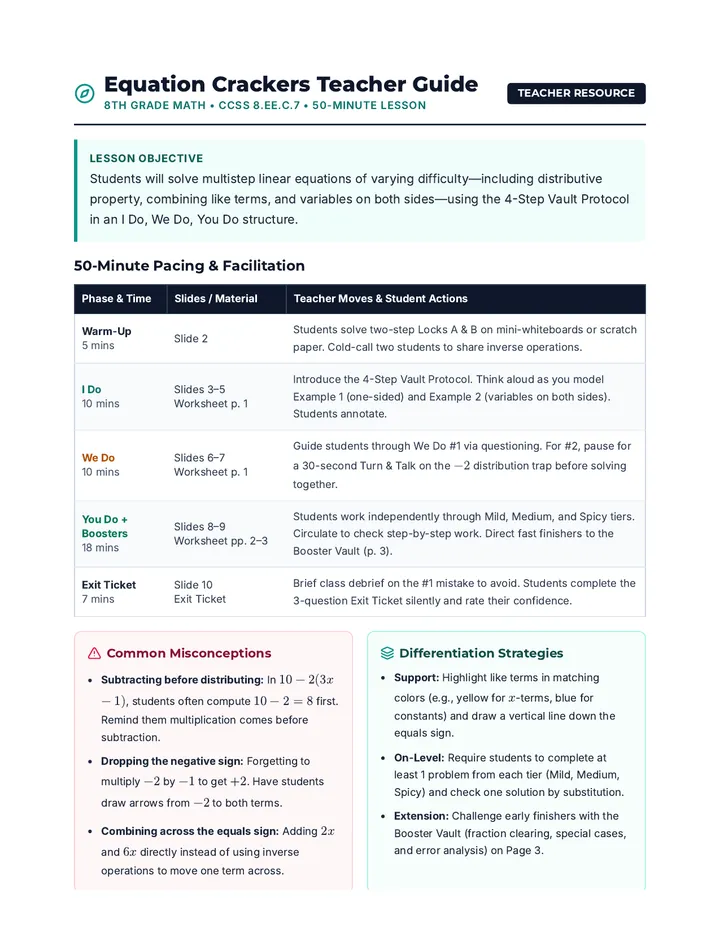
Equation Teacher Guide Grade 8 Mathematics • Facilitation Plan
Equation Teacher Guide
45–50 Minutes
Learning Target & Standards
Students solve single-step linear (\(ax = b\), \(x + a = b\)), quadratic (\(x^2 = p\)), and cubic (\(x^3 = p\)) equations using inverse operations and determine the number of real solutions. Aligned to CCSS 8.EE.A.2 & 8.EE.C.7.
I Do • We Do • You Do Pacing Plan
Phase & Time
Slides / Material
Teacher Moves & Key Prompts
Warm-Up
5 min
Slides 1–3
Activate prior knowledge on inverse operations. Introduce the Degree Decoder so students see how the exponent determines the inverse tool.
I Do
12 min
Slides 4–6
Think aloud through 2 examples per degree. Emphasize why \(x^2 = 64\) yields \(\pm 8\) (two roots) while \(x^3 = -64\) yields only \(-4\) (cubes preserve sign).
We Do
10 min
Slide 7 & Worksheet Page 1
Guide students through Problems A–C. Have pairs name the inverse operation before solving. Cold-call to check \(\pm\) on Problem B.
You Do
15 min
Slide 8 & Worksheet Pages 1–2
Students complete Practice Questions 1–10 independently. Early finishers or students ready for extension tackle Booster Questions 1–3.
Exit Ticket
5 min
Slide 9 & Exit Ticket
Collect Exit Tickets at the door to sort students into targeted small-group reteach vs. enrichment for tomorrow.
Common Misconceptions
Omitting \(\pm\) on \(x^2 = p\): Ask, "What is \((-8)^2\)?" to prove both roots work.
Rejecting negative cubes: Students confuse \(x^2 = -64\) (no real solution) with \(x^3 = -64\) (valid: \(x = -4\)).
Dividing vs. subtracting: In \(-8x = 96\), watch for students adding \(8\) instead of dividing by \(-8\).
Differentiation
Support: Provide a perfect squares/cubes reference chart (\(1^2\)–\(12^2\), \(1^3\)–\(6^3\)) and highlight the exponent before solving.
Extension: Assign all 3 Booster Questions, or challenge students to write their own degree-2 equation with irrational solutions between \(5\) and \(6\).
See Page 2 for Complete Answer Key →
Complete Answer Key
Equation Power Lab
We Do: Guided Practice
A. \(\frac{x}{4} = -11 \Rightarrow \mathbf{x = -44}\)
B. \(x^2 = 121 \Rightarrow \mathbf{x = \pm 11}\)
C. \(x^3 = -125 \Rightarrow \mathbf{x = -5}\)
You Do: Practice Questions (1–10)
Subtract \(18\): \(\mathbf{x = -25}\)
Square root: \(\mathbf{x = \pm\frac{4}{7}}\)
Divide by \(-8\): \(\mathbf{x = -12}\)
Divide by \(0.5\): \(\mathbf{x = -28}\)
Add \(\frac{3}{4}\): \(x = \frac{8}{4} \Rightarrow \mathbf{x = 2}\)
Cube root: \(\mathbf{x = -6}\)
Square root: \(\mathbf{x = \pm 9}\)
Square root: \(\mathbf{x = \pm 0.6}\)
Cube root: \(\mathbf{x = 4}\)
Multiply by \(-9\): \(\mathbf{x = -54}\)
Booster Questions (1–3)
Booster 1: Exact solutions: \(\mathbf{x = \pm\sqrt{20}}\) (or \(\pm 2\sqrt{5}\)). Since \(4^2 = 16\) and \(5^2 = 25\), \(\sqrt{20}\) lies between 4 and 5.
Booster 2: Maya forgot the negative root; the full solution is \(\mathbf{x = \pm 10}\) because \((-10)^2 = 100\). Marcus confused cube roots with square roots; \(\mathbf{x = -2}\) is valid because \((-2)^3 = -8\).
Booster 3: Squaring any real number (positive or negative) produces a non-negative result (\((+5)^2 = 25\) and \((-5)^2 = 25\)), so \(x^2 = -25\) has no real solution. Cubing a negative number multiplies three negatives, yielding a negative (\((-3)(-3)(-3) = -27\)), so \(x^3 = -27\) has the solution \(x = -3\).
Equation Exit Ticket (1–4)
\(x - 19 = -5 \Rightarrow \mathbf{x = 14}\) (add \(19\))
\(-7x = 56 \Rightarrow \mathbf{x = -8}\) (divide by \(-7\))
\(x^2 = 144 \Rightarrow \mathbf{x = \pm 12}\) (square root)
\(x^3 = -27 \Rightarrow \mathbf{x = -3}\) (cube root)