Lenny.com
Explore
Create
ActivitiesNewMathEnglish Language ArtsScience & EngineeringSocial StudiesGlobal LanguagesHealth & Physical EducationSpecial EducationCounseling & Life SkillsArts & CreativityESL
Lenny.com
Lenny.com
Explore
Create
ActivitiesNewMathEnglish Language ArtsScience & EngineeringSocial StudiesGlobal LanguagesHealth & Physical EducationSpecial EducationCounseling & Life SkillsArts & CreativityESL
Lenny.com
Lenny.com

Solutions

Lenny for EducatorsLenny for SchoolsLenny for Districts

Product

ExploreSign inCreateSupportAbout

Resources

Getting startedMTSS Acceleration Program

Newsletters

School Funding Newsletter

© 2026 Lenny Learning Inc.

TermsPrivacyAccessibility
LinkedInInstagramX
Lenny
MathNumbers & CountingCounting ObjectsNumber NamesComparing NumbersNumber OperationsCounting SequenceNumbers 0-10Place Value Understanding and SystemAdd and Subtract Within 20Addition and Subtraction ConceptsAddition and Subtraction EquationsAddition and Subtraction ProblemsFoundations for MultiplicationMultiplication and Division PropertiesMultiply and Divide Within 100Multiplication and Division ProblemsFactors and MultiplesProperties of OperationsPatterns and RelationshipsGenerate and Analyze PatternsMulti-Digit ArithmeticPlace Value OperationsMulti-Digit and Decimal OperationsNumerical ExpressionsFour Operations and PatternsFour Operations Problem SolvingMeasurement & DataMeasurable AttributesMeasuring LengthsMeasure and Estimate Lengths in Standard UnitsRelate Addition and Subtraction to LengthClassifying and Counting ObjectsTime and MoneyArea Concepts and MeasurementPerimeter and Area MeasuresAngle Concepts and MeasurementTime, Volume, and MassMeasurement Unit ConversionsGeometryIdentifying ShapesShapes and AttributesShape Attributes and ReasoningShapes and CompositionClassifying 2D FiguresGeometric Figures and RelationshipsLines, Angles, and ShapesAngle, Area, and VolumeGeometric MeasurementVolume of 3D ShapesCoordinate Plane ApplicationsTransformations in the PlaneCongruence and SimilarityUnderstand congruence in terms of rigid motionsSimilarity and TransformationsProve Theorems Involving SimilarityPythagorean TheoremTrigonometry for General TrianglesMake Geometric ConstructionsProve Geometric TheoremsTheorems About CirclesFind Arc Lengths And Areas of Sectors of CirclesVolume FormulasRelationships Between Two-Dimensional and Three-Dimensional ObjectsProve Simple Geometric Theorems AlgebraicallyTranslate Between Geometric Description and Equation for Conic SectionApply Geometric Concepts in Modeling SituationsFractions & DecimalsFractions as NumbersBuilding FractionsFraction Equivalence and OrderingAdding and Subtracting FractionsMultiplying and Dividing FractionsDividing FractionsDecimal FractionsMulti-Digit Computation and FactorsAdd, Subtract, Multiply, and Divide Rational NumbersRational Number SystemIrrational Numbers and ApproximationsRatiosRatios and ProportionsProportional RelationshipsUnit RateAlgebraAlgebraic ExpressionsGenerate Equivalent ExpressionsQuantitative RelationshipsProportional Relationships and Linear EquationsEquations and InequalitiesEquation Solving and ReasoningLinear Equations and SystemsGraph Equations and InequalitiesSystems of EquationsReal-World Algebraic ProblemsQuantitative Reasoning with UnitsExpression StructureEquivalent Expression FormsRadicals and Integer ExponentsRational ExponentsRational and Irrational NumbersPolynomial OperationsPolynomial IdentitiesPolynomial Zeros and FactorsRational ExpressionsComplex Number OperationsComplex Numbers in PolynomialsComplex Numbers on PlaneStatistics & ProbabilityRepresent and Interpret DataData DistributionsStatistical VariabilityProbability ModelsCompound Event ProbabilitiesStatistical SamplingInterpret Categorical and Quantitative DataBivariate Data PatternsInterpret Linear ModelsComparing Two PopulationsRandom Processes in StatisticsIndependence and Conditional ProbabilityExpected ValuesProbability-Based Decision MakingStatistical Inference and ConclusionsFunctionsFunction Concepts and NotationDefine and Compare FunctionsInterpret Functions in ContextAnalyze Function RepresentationsModel Relationships with FunctionsIdentify Linear vs Exponential GrowthDistinguish Between Function TypesCompare Growth RatesInterpret Function ExpressionsBuild Functions from RelationshipsConstruct and Model FunctionsTransform and Combine FunctionsModel Comparison and SelectionSolve Exponential EquationsTrigonometryTrigonometric Ratios Involving Right TrianglesTrigonometric Functions and Unit CircleModel with Trigonometric FunctionsTrigonometric IdentitiesVectors & MatricesIntroduction to Vectors and MatricesVector QuantitiesVector OperationsMatrix OperationsCalculusLimits and ContinuityDerivative Concepts and NotationDerivative Rules and TechniquesApplications of DerivativesOptimization ProblemsRelated RatesCurve Sketching and AnalysisIntegration Concepts and NotationAntiderivatives and Indefinite IntegralsDefinite Integrals and AreaFundamental Theorem of CalculusIntegration TechniquesApplications of IntegrationDifferential EquationsSequences and SeriesParametric and Polar FunctionsVector-Valued Functions

Property Patrol Hunt

An active, movement-based scavenger hunt where students apply the commutative, associative, distributive, identity, and inverse properties to generate and justify equivalent linear expressions. Students rotate through self-checking loop stations, evaluate equivalence through algebraic proof and numerical substitution, and crack the mystery codeword.

RRRachel Ramey

1. Algebraic Steps (Distributive / Combining):

Properties: Distributive Commutative Associative Identity

2. Solve with PEMDAS Test: \(x = \text{___}\)

( ) Grouping:

× Multiply:

+ Final Sum:

Matches simplified expression value

STOP #7 Station Letter: Codeword Letter:

Next Station Answer:

1. Algebraic Steps (Distributive / Combining):

Properties: Distributive Commutative Associative Identity

2. Solve with PEMDAS Test: \(x = \text{___}\)

( ) Grouping:

× Multiply:

+ Final Sum:

Matches simplified expression value

STOP #8 Station Letter: Codeword Letter:

Next Station Answer:

1. Algebraic Steps (Distributive / Combining):

Properties: Distributive Commutative Associative Identity

2. Solve with PEMDAS Test: \(x = \text{___}\)

( ) Grouping:

× Multiply:

+ Final Sum:

Matches simplified expression value

STOP #9 Station Letter: Codeword Letter:

Next Station Answer:

1. Algebraic Steps (Distributive / Combining):

Properties: Distributive Commutative Associative Identity

2. Solve with PEMDAS Test: \(x = \text{___}\)

( ) Grouping:

× Multiply:

+ Final Sum:

Matches simplified expression value

STOP #10 Station Letter: Codeword Letter:

Next Station Answer:

1. Algebraic Steps (Distributive / Combining):

Properties: Distributive Commutative Associative Identity

2. Solve with PEMDAS Test: \(x = \text{___}\)

( ) Grouping:

× Multiply:

+ Final Sum:

Matches simplified expression value

Secret Codeword Decoder:

Record all 10 letters collected in your journey:

#1

#2

#3

#4

#5

#6

#7

#8

#9

#10

Order of Operations Reflection: Why must you multiply \(3 \times (2x + 4)\) in Station A before adding the 5?

Page 2 of 2 • Property Patrol Scavenger Hunt Equivalence Verified: Both expressions name the same value for any variable input!

| • Repeated like terms
• GCF Factoring: \(6(x+2)\) | \(x = 4\)
PEMDAS: \(12+8+6+4+6\)
\(= \mathbf{36}\) | Station F
\(6x + 12\) |

Setup & Dispersal

Post cards across the room perimeter. Assign student pairs to different starting stations (A, G, C, J, B, etc.) so students circulate evenly without crowding.

PEMDAS Verification Check

Ensure students calculate the Order of Operations column step-by-step: evaluate inside parentheses first, perform multiplications, then complete additions.

Page 1 of 2 • Property Patrol Facilitator Guide See Page 2 for Stations F, I, D, H, E & Misconception Protocols

Master Solutions (Continued) • Stations F, I, D, H, E & Instructional Notes

Standards: Indiana 6.NS.7 • Expressions & Data Analysis

StationBanner (Prev)Expression & Algebraic Property StepsILEARN 6.NS.7 ModelPEMDAS SolveNext (Letter)
F

Letter: A

| \(6x + 12\) |

\(\frac{1}{2}(4x + 16) + 3x + 1\)

\(= 2x + 8 + 3x + 1 = (2x + 3x) + (8 + 1) = \mathbf{5x + 9}\)

| • Fraction coefficient (half)
• Combining like terms | \(x = 3\)
PEMDAS: \(\frac{1}{2}(28) + 9 + 1\)
\(= 14 + 10 = \mathbf{24}\) | Station I
\(5x + 9\) | |

I

Letter: L

| \(5x + 9\) |

\(4(x + 2x + 1) + 7\)

\(= 4(3x + 1) + 7 = 12x + 4 + 7 = \mathbf{12x + 11}\)

| • Order of Operations in ( )
• \(3(2m+m+3m)\) spec model | \(x = 2\)
PEMDAS: \(4(7) + 7\)
\(= 28 + 7 = \mathbf{35}\) | Station D
\(12x + 11\) | |

D

Letter: E

| \(12x + 11\) |

\(2(5x + 6) + x + 4\)

\(= 10x + 12 + 1x + 4 = (10x + 1x) + (12 + 4) = \mathbf{11x + 16}\)

| • Distributive without GCF
• \(6y + 18 = 2(3y + 9)\) spec | \(x = 2\)
PEMDAS: \(2(16) + 2 + 4\)
\(= 32 + 6 = \mathbf{38}\) | Station H
\(11x + 16\) | |

H

Letter: N

| \(11x + 16\) |

\(3(2x + 1) + 2(2x + 5)\)

\(= 6x + 3 + 4x + 10 = (6x + 4x) + (3 + 10) = \mathbf{10x + 13}\)

| • Double distribution
• Multi-term regrouping | \(x = 2\)
PEMDAS: \(3(5) + 2(9)\)
\(= 15 + 18 = \mathbf{33}\) | Station E
\(10x + 13\) | |

E

Letter: T

| \(10x + 13\) |

\(1(2x + 6) + 2(x + 4)\)

\(= 2x + 6 + 2x + 8 = (2x + 2x) + (6 + 8) = \mathbf{4x + 14}\)

| • Mult. Identity (\(1 \cdot a = a\))
• Distributive Property | \(x = 3\)
PEMDAS: \(1(12) + 2(7)\)
\(= 12 + 14 = \mathbf{26}\) | Station A
\(4x + 14\) |

Common Order of Operations & Distributive Misconceptions

Misconception 1: Adding Before Multiplying

In Station A (\(5 + 3(2x + 4)\)), students add \(5 + 3 = 8\) first.

Prompt: "What does PEMDAS say about multiplication vs addition? The 3 is multiplying the parentheses!"

Misconception 2: Skipping Grouping Combining

In Station G (\(2(3x + x + 4)\)), students distribute without simplifying inside grouping first.

Prompt: "Can you combine \(3x + x\) inside the parentheses before multiplying? Both methods yield \(8x + 8\)."

Misconception 3: Factoring vs Expanding

In Station B, students fail to see that \(6x + 12\) can be factored as \(6(x + 2)\).

Prompt: "What greatest common factor divides both 6 and 12? Factoring is the distributive property in reverse!"

Whole-Class Debrief Prompts (5–10 Minutes)

1. The Power of PEMDAS in Algebra: "Why did evaluating the original expression and the simplified expression at \(x = 3\) produce the exact same number? How does this justify equivalence?"

2. Factoring & Expanding Connection: "Look at Station B: why are \(6x + 12\) and \(6(x + 2)\) equivalent? How do both expressions model the distributive property?"

Page 2 of 2 • Property Patrol Facilitator Guide Fully Aligned to Indiana 6.NS.7 Specifications • Classroom-Ready

You might also like

Tens Takeover Slides

Math Mayhem Bootcamp

A 3-day high-energy, humor-packed math bootcamp bridging place value regrouping within 100, expansion to 1000 and repeated addition models, and multi-digit multiplication and division strategies. Every day features scaffolded models, spiral warm-ups, funny storylines, practice problems, and exit tickets.

LB

Lara Becker

10
Integration Intro Test Form B

Integration Intro

Introductory unit covering definite and indefinite integrals, basic antiderivative rules, Riemann sums, properties of definite integrals, and accumulation functions.

MP

Michael Paglieroni

2
Integration Intro Answer Key

Integration Intro Answer Key

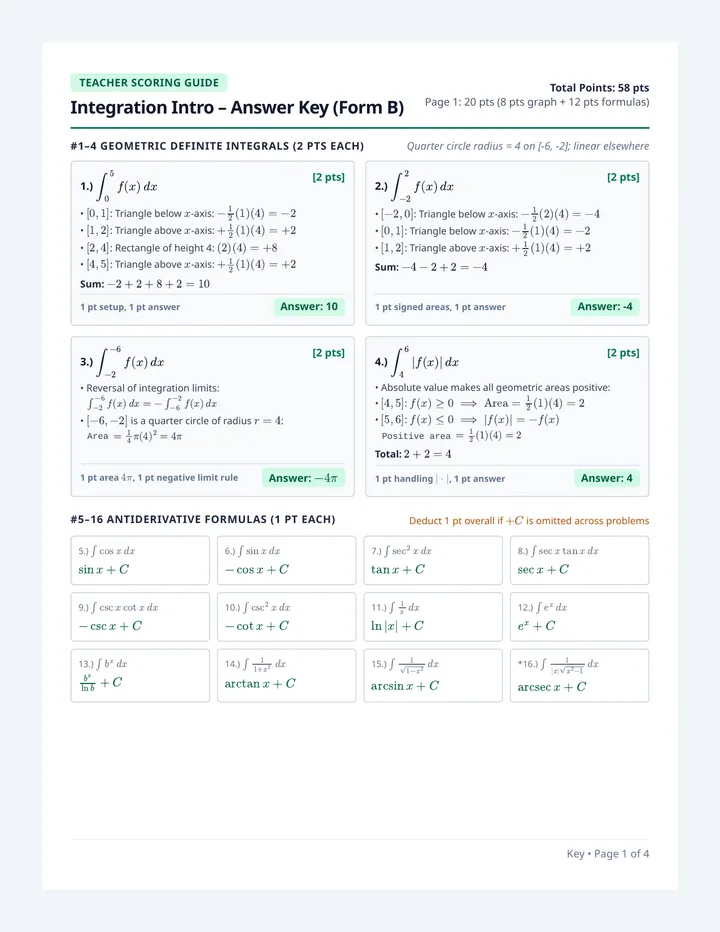
Comprehensive 4-page answer key and grading guide for the Form B Integration Intro exam, featuring step-by-step geometric breakdown, antiderivative formula checks, detailed multiple-choice rationales, and an AP-style 9-point FRQ scoring rubric with common student error notes.

MP

Michael Paglieroni

Critter Vision Lesson Plan

Animal Eyes Algebra

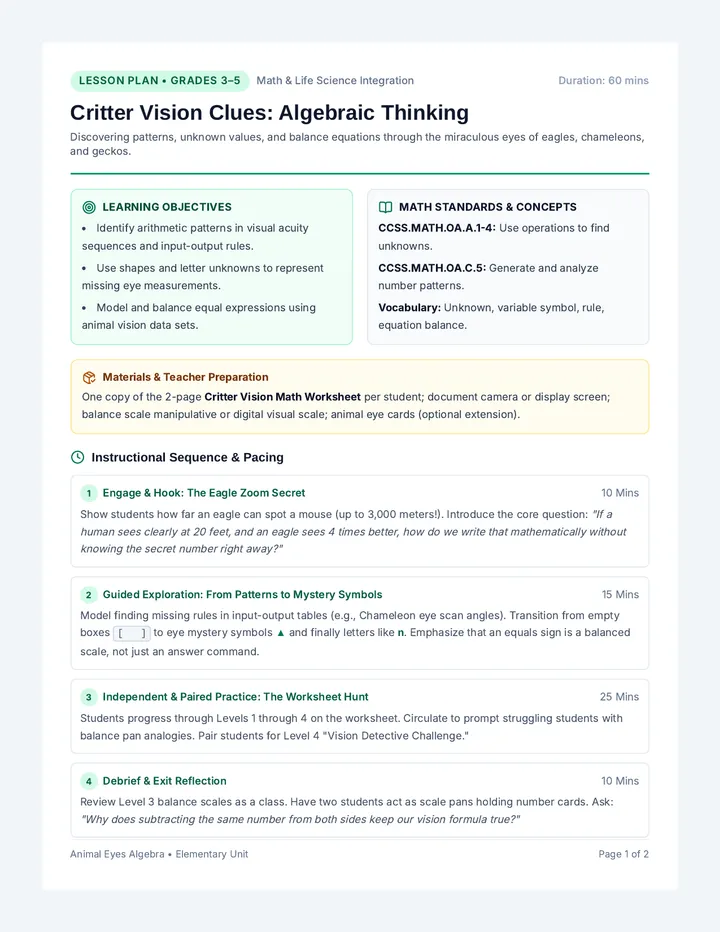
A two-part mathematics sequence exploring algebraic thinking through comparative animal vision. Students in elementary and middle school analyze fields of view, visual acuity, photoreceptor counts, and stereoscopic sight through graduated algebraic models.

Lenny Avatar
Lenny
6
Check One Addition Worksheet

Stack Addition Checks

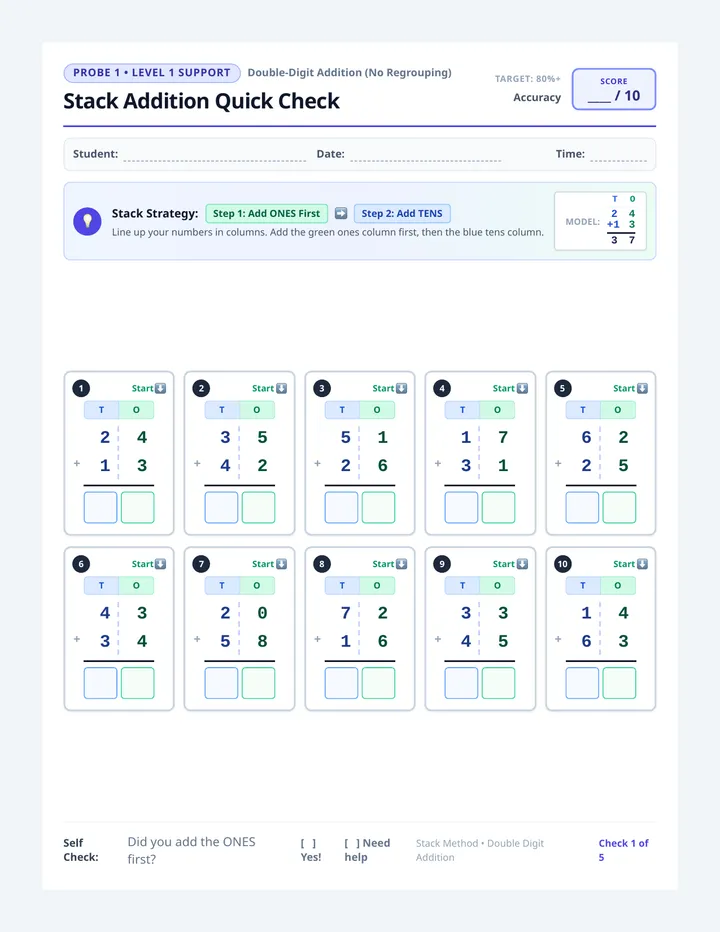
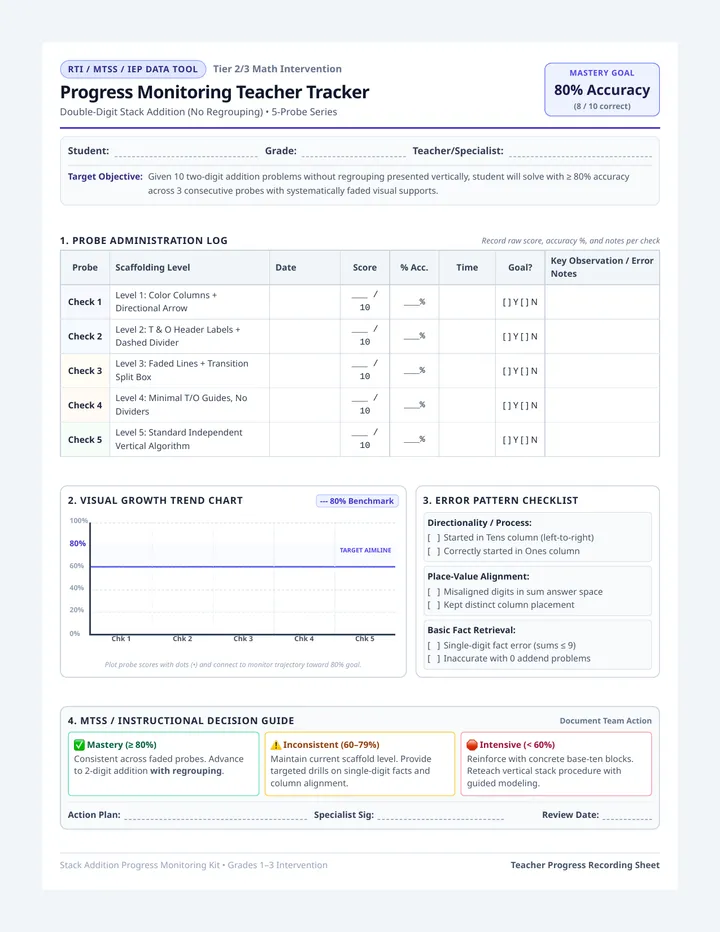
A targeted five-probe progress monitoring series for two-digit addition without regrouping using the vertical stack method. Features systematic scaffolding reduction from full place-value columns to independent mastery, accompanied by a comprehensive teacher recording tracker.

ML

Michelle Low

6
Integration Intro Test Form B

Integration Intro Test Form B

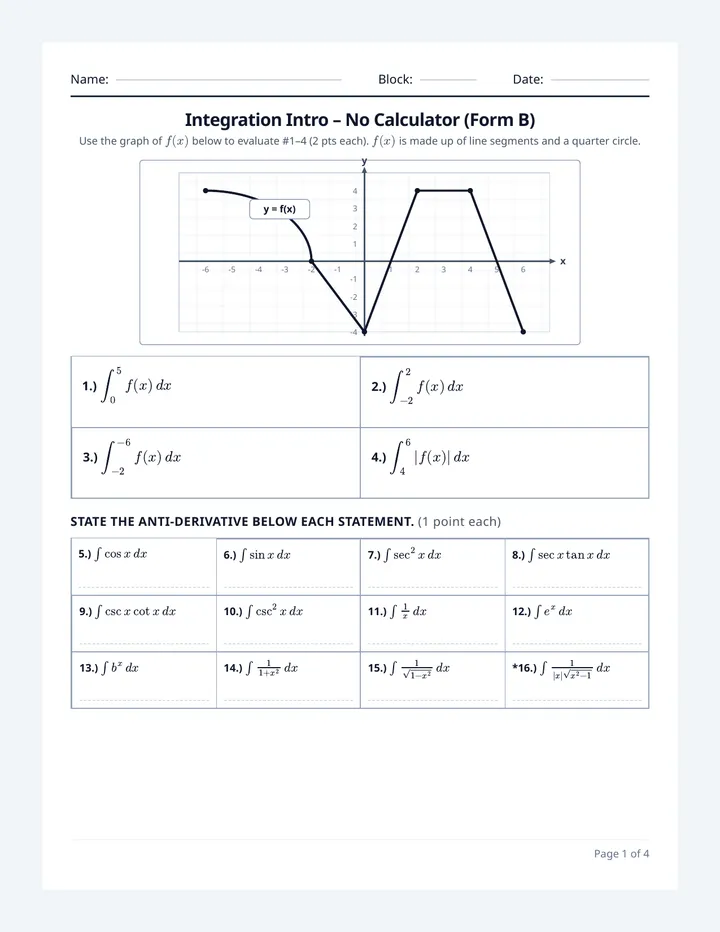
Form B version of the Integration Intro exam, featuring an equivalent difficulty no-calculator section with piecewise and circular geometric integration, an antiderivative formula recall grid, ten multiple-choice conceptual and computational problems, and a calculator-active contextual free-response problem.

MP

Michael Paglieroni

Treasure Trove Addition Worksheet

Regrouping Quest

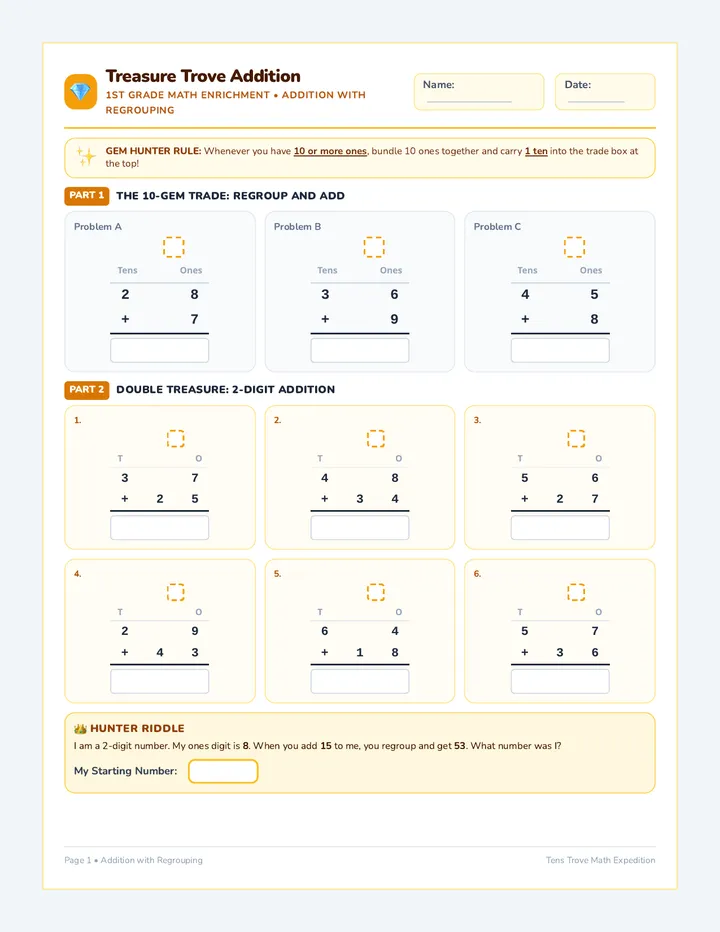
A two-part 1st grade math enrichment sequence exploring addition and subtraction with regrouping through interactive partner card games and detective puzzle challenges.

KE

Kathy Ellis

6
Midterm Quest Station Cards

Algebra Midterm Quest

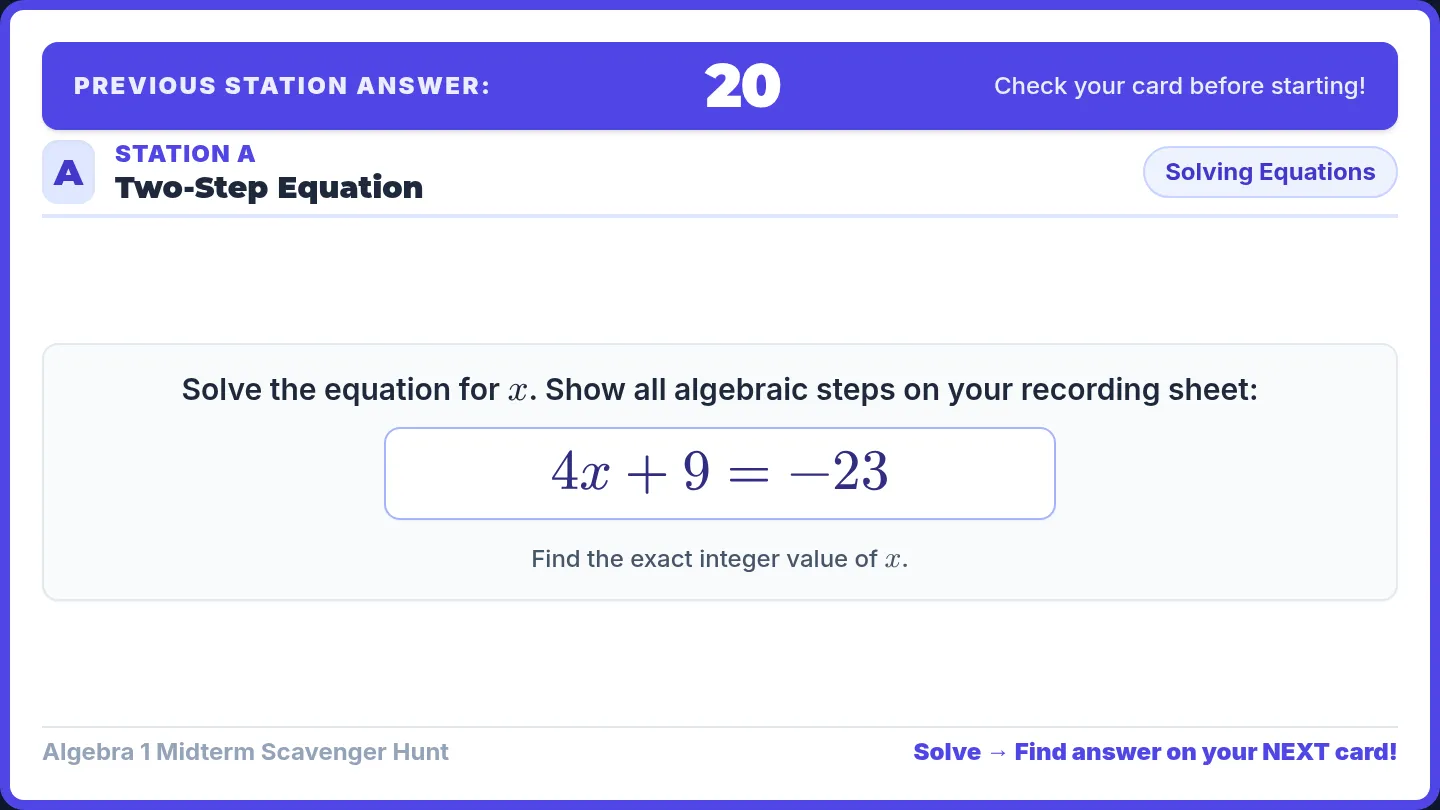
A comprehensive midsemester review featuring a 15-station self-checking scavenger hunt for Grade 9 Algebra 1. Students move through stations covering linear equations, sequences, expressions, inequalities, and proportional reasoning.

EW

Elizabeth Webber

3
Addition Progress Teacher Tracker

Addition Progress Teacher Tracker

A comprehensive teacher progress-recording sheet and RTI/IEP tracker for two-digit addition without regrouping. Includes a multi-probe data log, visual trend graphing grid, diagnostic error analysis rubric, and instructional decision guide.

ML

Michelle Low

Error Detective Activity

Digit Dynamics

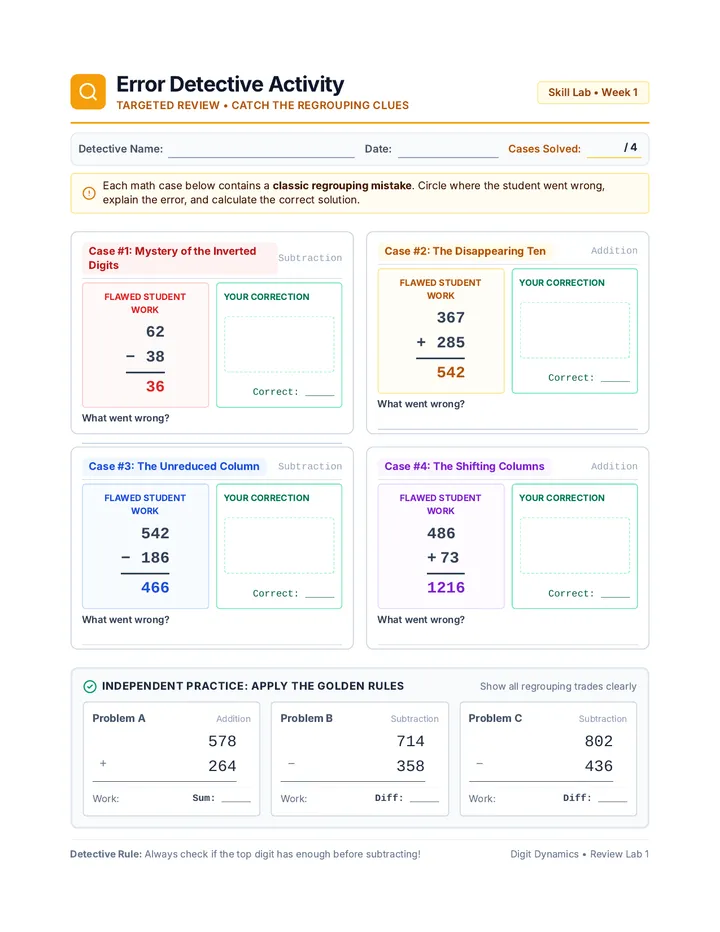
A multi-week progress monitoring sequence targeting multi-digit addition and subtraction with regrouping. Features recurring standardized probes, diagnostic error-analysis review sheets, and a longitudinal student progress tracker.

Lenny Avatar
Lenny
14
Data Shape Detectives Slides

Data Shape Detectives

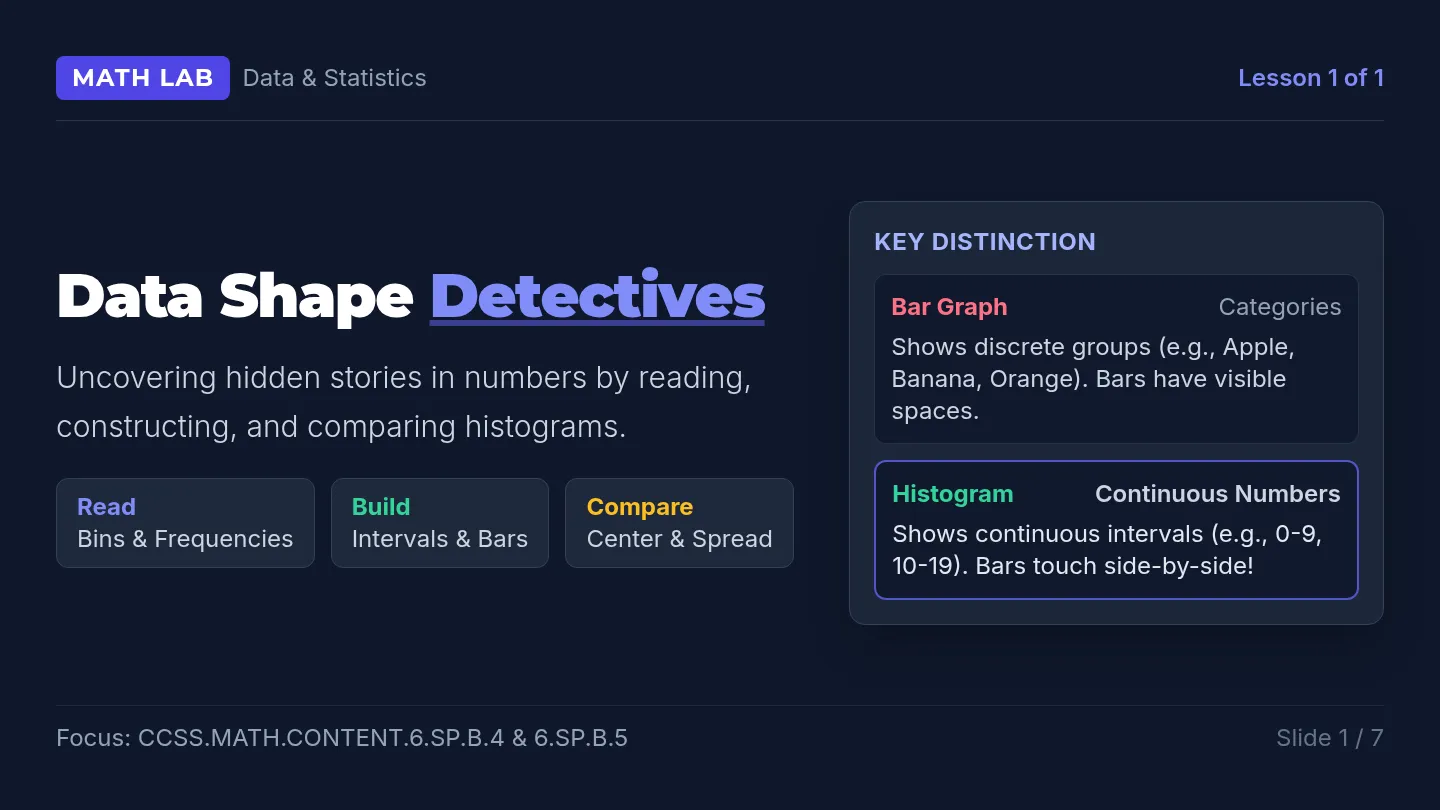
A comprehensive middle school mathematics lesson focused on interpreting histograms, constructing frequency tables and graphs from raw data, and comparing distributions by shape, center, and spread.

LL

Logan Lloyd

5
Check Five Addition Worksheet

Check Five Addition Worksheet

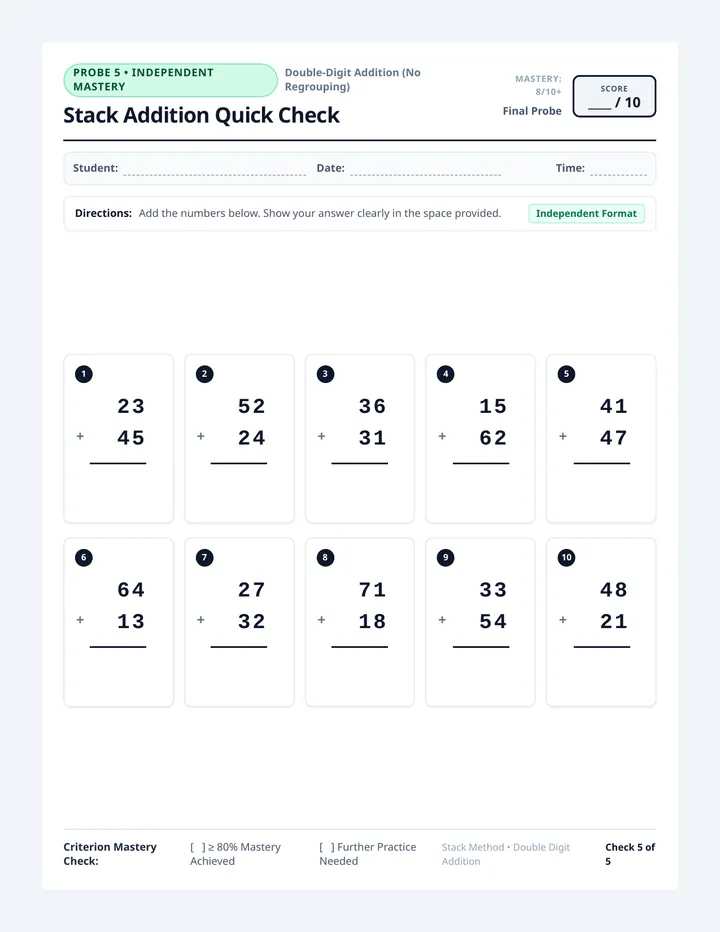
Level 5 progress monitoring check for two-digit addition without regrouping. Features full independent mastery format with standard vertical stack presentation, zero scaffolds, and mastery outcome criteria.

ML

Michelle Low