Lenny.com
Explore
Create
ActivitiesNewMathEnglish Language ArtsScience & EngineeringSocial StudiesGlobal LanguagesHealth & Physical EducationSpecial EducationCounseling & Life SkillsArts & CreativityESL
Lenny.com
Lenny.com
Explore
Create
ActivitiesNewMathEnglish Language ArtsScience & EngineeringSocial StudiesGlobal LanguagesHealth & Physical EducationSpecial EducationCounseling & Life SkillsArts & CreativityESL
Lenny.com
Lenny.com

Solutions

Lenny for EducatorsLenny for SchoolsLenny for Districts

Product

ExploreSign inCreateSupportAbout

Resources

Getting startedMTSS Acceleration Program

© 2026 Lenny Learning Inc.

TermsPrivacyAccessibility
LinkedInInstagramX
Lenny
MathNumbers & CountingCounting ObjectsNumber NamesComparing NumbersNumber OperationsCounting SequenceNumbers 0-10Place Value Understanding and SystemAdd and Subtract Within 20Addition and Subtraction ConceptsAddition and Subtraction EquationsAddition and Subtraction ProblemsFoundations for MultiplicationMultiplication and Division PropertiesMultiply and Divide Within 100Multiplication and Division ProblemsFactors and MultiplesProperties of OperationsPatterns and RelationshipsGenerate and Analyze PatternsMulti-Digit ArithmeticPlace Value OperationsMulti-Digit and Decimal OperationsNumerical ExpressionsFour Operations and PatternsFour Operations Problem SolvingMeasurement & DataMeasurable AttributesMeasuring LengthsMeasure and Estimate Lengths in Standard UnitsRelate Addition and Subtraction to LengthClassifying and Counting ObjectsTime and MoneyArea Concepts and MeasurementPerimeter and Area MeasuresAngle Concepts and MeasurementTime, Volume, and MassMeasurement Unit ConversionsGeometryIdentifying ShapesShapes and AttributesShape Attributes and ReasoningShapes and CompositionClassifying 2D FiguresGeometric Figures and RelationshipsLines, Angles, and ShapesAngle, Area, and VolumeGeometric MeasurementVolume of 3D ShapesCoordinate Plane ApplicationsTransformations in the PlaneCongruence and SimilarityUnderstand congruence in terms of rigid motionsSimilarity and TransformationsProve Theorems Involving SimilarityPythagorean TheoremTrigonometry for General TrianglesMake Geometric ConstructionsProve Geometric TheoremsTheorems About CirclesFind Arc Lengths And Areas of Sectors of CirclesVolume FormulasRelationships Between Two-Dimensional and Three-Dimensional ObjectsProve Simple Geometric Theorems AlgebraicallyTranslate Between Geometric Description and Equation for Conic SectionApply Geometric Concepts in Modeling SituationsFractions & DecimalsFractions as NumbersBuilding FractionsFraction Equivalence and OrderingAdding and Subtracting FractionsMultiplying and Dividing FractionsDividing FractionsDecimal FractionsMulti-Digit Computation and FactorsAdd, Subtract, Multiply, and Divide Rational NumbersRational Number SystemIrrational Numbers and ApproximationsRatiosRatios and ProportionsProportional RelationshipsUnit RateAlgebraAlgebraic ExpressionsGenerate Equivalent ExpressionsQuantitative RelationshipsProportional Relationships and Linear EquationsEquations and InequalitiesEquation Solving and ReasoningLinear Equations and SystemsGraph Equations and InequalitiesSystems of EquationsReal-World Algebraic ProblemsQuantitative Reasoning with UnitsExpression StructureEquivalent Expression FormsRadicals and Integer ExponentsRational ExponentsRational and Irrational NumbersPolynomial OperationsPolynomial IdentitiesPolynomial Zeros and FactorsRational ExpressionsComplex Number OperationsComplex Numbers in PolynomialsComplex Numbers on PlaneStatistics & ProbabilityRepresent and Interpret DataData DistributionsStatistical VariabilityProbability ModelsCompound Event ProbabilitiesStatistical SamplingInterpret Categorical and Quantitative DataBivariate Data PatternsInterpret Linear ModelsComparing Two PopulationsRandom Processes in StatisticsIndependence and Conditional ProbabilityExpected ValuesProbability-Based Decision MakingStatistical Inference and ConclusionsFunctionsFunction Concepts and NotationDefine and Compare FunctionsInterpret Functions in ContextAnalyze Function RepresentationsModel Relationships with FunctionsIdentify Linear vs Exponential GrowthDistinguish Between Function TypesCompare Growth RatesInterpret Function ExpressionsBuild Functions from RelationshipsConstruct and Model FunctionsTransform and Combine FunctionsModel Comparison and SelectionSolve Exponential EquationsTrigonometryTrigonometric Ratios Involving Right TrianglesTrigonometric Functions and Unit CircleModel with Trigonometric FunctionsTrigonometric IdentitiesVectors & MatricesIntroduction to Vectors and MatricesVector QuantitiesVector OperationsMatrix OperationsCalculusLimits and ContinuityDerivative Concepts and NotationDerivative Rules and TechniquesApplications of DerivativesOptimization ProblemsRelated RatesCurve Sketching and AnalysisIntegration Concepts and NotationAntiderivatives and Indefinite IntegralsDefinite Integrals and AreaFundamental Theorem of CalculusIntegration TechniquesApplications of IntegrationDifferential EquationsSequences and SeriesParametric and Polar FunctionsVector-Valued Functions

Equation Elements

A comprehensive Algebra 1 vocabulary review featuring 30 single-word terms (15 starting with D and 15 starting with E) aligned to linear equations, domain, range, and proportional reasoning.

Rrubaiya.ahmed

Equation Elements

A comprehensive Algebra 1 vocabulary review featuring 30 single-word terms (15 starting with D and 15 starting with E) aligned to linear equations, domain, range, and proportional reasoning.

Rrubaiya.ahmed
C.

D. The quantity by which another number is divided; must never equal zero.

E. A plotted symbol (solid or open circle) showing whether an endpoint is included.

F. To eliminate or clear a denominator after multiplying both sides by the LCM.

G. The measurable length of elapsed time in hours or minutes in a rate problem.

Section B: IA Exam Connections

1. In Round 3 #2, "The money spent at a parking meter varies directly with time parked." What type of equation model (\(y = kx\)) represents this relationship?

Answer:

2. In Round 2 #1, multiplying \(\frac{2}{3}(12 - 3x) = 5 - \frac{1}{4}x\) by the LCM allows you to do what to all fractional denominators?

Answer:

Algebra 1 • Interim Assessment Review Turn page for "E" Vocabulary (Part 1) →

Name: Seat #:

Date:

Algebra 1 • Interim Assessment Review

Term Matchup: "E" Vocabulary (Part 1)

Page 3 of 4

Section A: Match Terms 1–8 to Definitions A–H

Write letter in brackets

1. Equation [     ]

2. Evaluate [     ]

3. Expression [     ]

4. Equal [     ]

5. Equivalent [     ]

6. Endpoint [     ]

7. Eliminate [     ]

8. Exponent [     ]

A. A mathematical sentence with an equal sign showing two expressions are equal.

B. To substitute known numbers for variables and simplify to a single value.

C. A mathematical phrase with numbers and operations, but NO equal sign.

D. Having the exact same numerical quantity, size, or algebraic value (\(=\)).

E. Equations or expressions that share the identical value or solution set.

F. The boundary value marking the beginning or end of an interval.

G. To clear or cancel out variables or denominators using inverse operations.

H. A superscript showing repeated multiplication of a base (\(x^1, x^2\)).

Section B: IA Exam Connections

1. Do Now #2 asks: "Part A: If \(6x - 12 = -30\), find \(x\). Part B: What is the value of \(2x - 4\)?" What math action is required in Part B?

Answer:

2. In Round 1 #2, \(\frac{4}{5}(x - 7) = 8\) is transformed into \(4(x - 7) = 40\). What term describes these two equations?

Answer:

Algebra 1 • Interim Assessment Review Turn page for "E" Vocabulary (Part 2) →

Name: Seat #:

Date:

Algebra 1 • Interim Assessment Review

Term Matchup: "E" Vocabulary (Part 2)

Page 4 of 4

Section A: Match Terms 9–15 to Definitions A–G

Write letter in brackets

9. Expand [     ]

10. Estimate [     ]

11. Element [     ]

12. Even [     ]

13. Extraneous [     ]

14. Exact [     ]

15. Equality [     ]

A. To remove parentheses by multiplying out terms using distribution.

B. To calculate an approximate value to verify if a computed answer makes sense.

C. An individual value or member that belongs to a specific mathematical set.

D. An integer completely divisible by 2 without any remainder (\(\dots -2, 0, 2, 4 \dots\)).

E. A false algebraic solution that makes a denominator zero in the original equation.

F. A precise, unrounded numerical answer left as a simplified fraction.

G. The fundamental principle stating that balance is preserved under identical operations.

Section B: IA Exam Connections

1. In Do Now #1, \(\frac{5}{x+4} = \frac{3}{x-2}\). Why must we verify that solutions do not equal \(-4\) or \(2\)? What type of false root are we guarding against?

Answer:

2. In Round 1 #4, the solution is written as \(x = \frac{7}{2}\) rather than \(3.5\). What term describes keeping an unrounded, completely accurate fraction?

Answer:

Algebra 1 • Interim Assessment Review Term Matchup Complete • Turn In for Grading

Anchor: Direct variation has constant ratio \(\frac{y}{x} = k\).

Discrete D11 • Data

Data made of distinct, individual isolated points rather than a continuous curve.

Set of coordinates \(\{(1, 16), (2, 64)\}\)

Anchor: Discrete points are counted; continuous is measured.

Divisor D12 • Division

The quantity by which another number is divided; must never equal zero.

Round 1 #2: Simplifying \(-\frac{68}{4} = -17\) (divisor is 4)

Anchor: Divisor sits on the bottom in a fraction.

Dot D13 • Graphs

A solid circle (includes point, \(\le\)) or open circle (excludes point, \(<\)).

Drill #2: Solid dot at \(x = 12 \implies x \le 12\)

Anchor: Solid dot uses brackets \([ \; ]\); open dot uses \(( \; )\).

Drop D14 • Method

To eliminate denominators or cancelled common factors across an equation.

Round 2: Multiply by 12 drops fractions instantly.

Anchor: Multiplying by LCM drops all fraction bars.

Duration D15 • Rates

The length of elapsed time in minutes or hours during a rate problem.

Round 3 #1: Roasting duration: \(20\text{ min} \times 20 = 400\text{ min}\)

Anchor: Check units (convert minutes to hours by \(\div 60\)).

"D" Mastery Check 15 Terms

Review all 15 "D" terms before moving to the "E" deck:

▢ Domain▢ Decimal ▢ Denominator▢ Degree ▢ Distribute▢ Direct ▢ Difference▢ Discrete ▢ Division▢ Divisor ▢ Decrease▢ Dot ▢ Dependent▢ Drop / Duration

Mastered 15 D terms!

Page 2 of 4 • Set 2 ("D" Words 9–15 & Mastery) Next page begins "E" Words →

Cut along dashed lines • Set 3: "E" Flashcards (1–8)

Algebra 1 • Equations Review

Equation E1 • Balance

A mathematical sentence with an equal sign (\(=\)) stating two expressions are equal.

\(3x + 2 = 5(x - 1)\) (has solution \(x = \frac{7}{2}\))

Anchor: An equation has an equal sign and can be solved.

Evaluate E2 • Compute

To replace variables with numbers and calculate the resulting simplified value.

Round 1 #5: If \(x = -5\), evaluate \(6(-5) - 7 = -37\).

Trap: Don't stop at finding \(x\); plug it in!

Expression E3 • Phrase

A mathematical phrase made of numbers, variables, and operations, with no equal sign.

\(2x - 4\) (cannot solve for \(x\); only evaluate)

Anchor: Expressions never contain an equal sign!

Equal E4 • Equality

Having the exact same numerical quantity, size, or algebraic value (\(=\)).

Left side value \(=\) Right side value

Anchor: Whatever is done to one side must be done to other.

Equivalent E5 • Same Roots

Equations that share the exact same solution set after valid transformations.

\(\frac{4}{5}(x-7) = 8 \iff 4(x-7) = 40\)

Anchor: Valid operations produce equivalent equations.

Endpoint E6 • Boundary

The extreme boundary value at the start or end of a domain or range interval.

Drill #1: Endpoints at \(t = 0\) and \(t = 4\).

Anchor: Look at dots to see if endpoints are included.

Eliminate E7 • Simplify

To remove fractions or variable terms by applying legal inverse operations.

Round 2: Multiply by LCM 12 to eliminate fractions.

Anchor: Eliminating fractions avoids tricky arithmetic.

Exponent E8 • Power

A superscript showing repeated multiplication of a base term (\(x^1, x^2\)).

In linear equations, variable exponent is 1.

Anchor: An exponent of 1 is usually unwritten: \(x = x^1\).

Page 3 of 4 • Set 3 ("E" Words 1–8) Turn over for "E" Words 9–15

Cut along dashed lines • Set 4: "E" Flashcards (9–15 & Mastery)

Algebra 1 • Equations Review

Expand E9 • Algebra

To remove parentheses by multiplying out factors using the distributive property.

Round 1 #6: Expand \(-3(x - 7)\) into \(-3x + 21\).

Anchor: Expanding is the reverse of factoring.

Estimate E10 • Check

To calculate an approximate value to verify if a computed answer is reasonable.

Round 3 #3: \(1,800 \approx 3.6 \times 500 \implies > 10\text{ hours}\).

Anchor: Use estimation to rule out crazy answer choices!

Element E11 • Set Member

An individual member or value belonging to a defined mathematical set.

\(x = 2\) is an element of the domain \([0, 4]\).

Anchor: Each \(x\)-input is an element of the domain.

Even E12 • Integers

An integer cleanly divisible by 2 with zero remainder (\(\dots -2, 0, 2, 4 \dots\)).

Round 1 #3: Solution \(m = 56\) is an even integer.

Anchor: Even numbers end in 0, 2, 4, 6, or 8.

Extraneous E13 • False Root

A false solution from solving steps that makes a denominator zero.

Do Now #1: In \(\frac{5}{x+4} = \frac{3}{x-2}\), \(x \ne -4, 2\).

Anchor: Always check roots in rational equations!

Exact E14 • Precision

A completely precise solution left as a simplified fraction, never rounded.

Round 1 #4: Exact answer is \(\frac{7}{2}\) (not 3.5).

Anchor: Standardized exams favor exact improper fractions.

Equality E15 • Balance

The fundamental law stating balance is preserved under identical operations.

Addition, Subtraction, Multiplication Properties of Equality.

Anchor: Keep the scale balanced at all times.

"E" Mastery Check 15 Terms

Review all 15 "E" terms in your study card deck:

▢ Equation▢ Expand ▢ Evaluate▢ Estimate ▢ Expression▢ Element ▢ Equal▢ Even ▢ Equivalent▢ Extraneous ▢ Endpoint▢ Exact ▢ Eliminate▢ Equality

Mastered 15 E terms!

Page 4 of 4 • Set 4 ("E" Words 9–15 & Mastery) Complete 30-Card Algebra Review Deck
You might also like

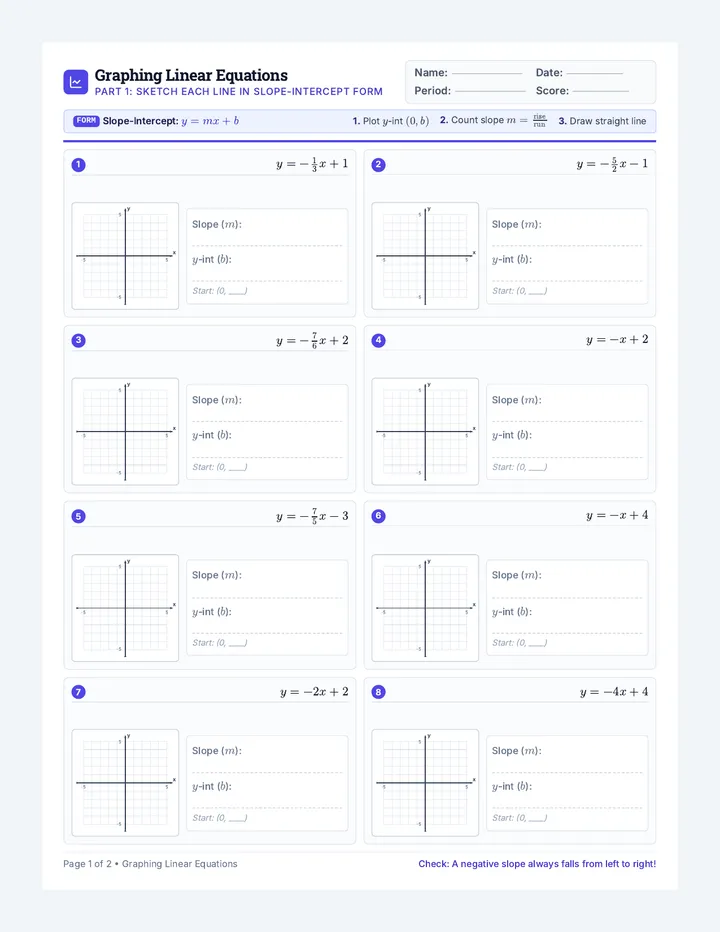
Linear Equations Practice Worksheet

Coordinate Geometry Mastery

A secondary mathematics curriculum sequence exploring linear functions and geometric transformations on the Cartesian coordinate plane, featuring print-ready guided practice and teacher keys.

FM

Fernando Mancini

4
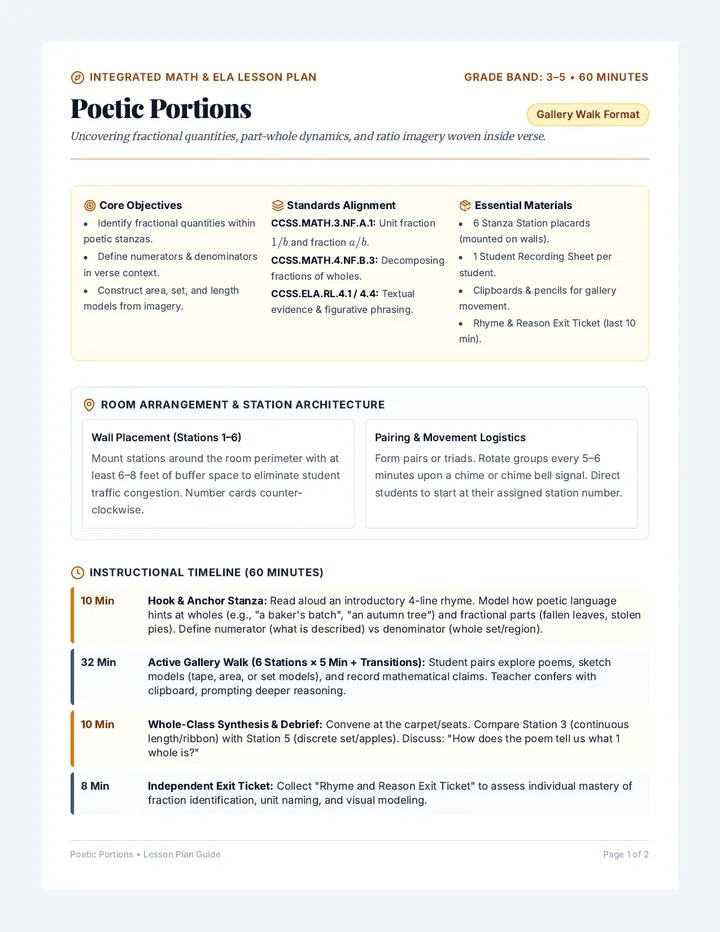
Poetic Portions Lesson Plan

Poetic Portions

A cross-curricular mathematics and language arts lesson where students participate in a gallery walk to analyze, interpret, and model fractional values embedded within poetic stanzas. Students decode fractional relationships of sets, lengths, and regions described in verse while building conceptual understanding.

NS

Naomi Seifert

5
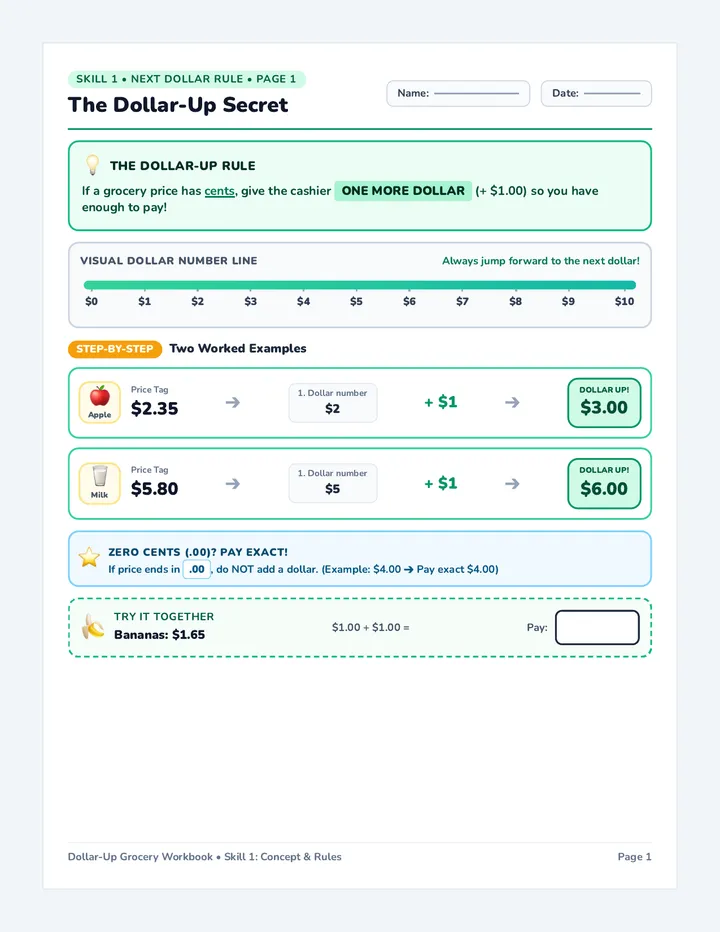
Dollar Up Grocery Workbook

Dollar Up Grocery Workbook

An expanded 8-page large-print student workbook with two full pages per skill covering the dollar-up method for grocery shopping under $10. Includes number line jumps, produce and bakery aisle picture price lists, dollar bill counting arrays, itemized checkout receipts, and exact-dollar discrimination.

Lenny Avatar
Lenny
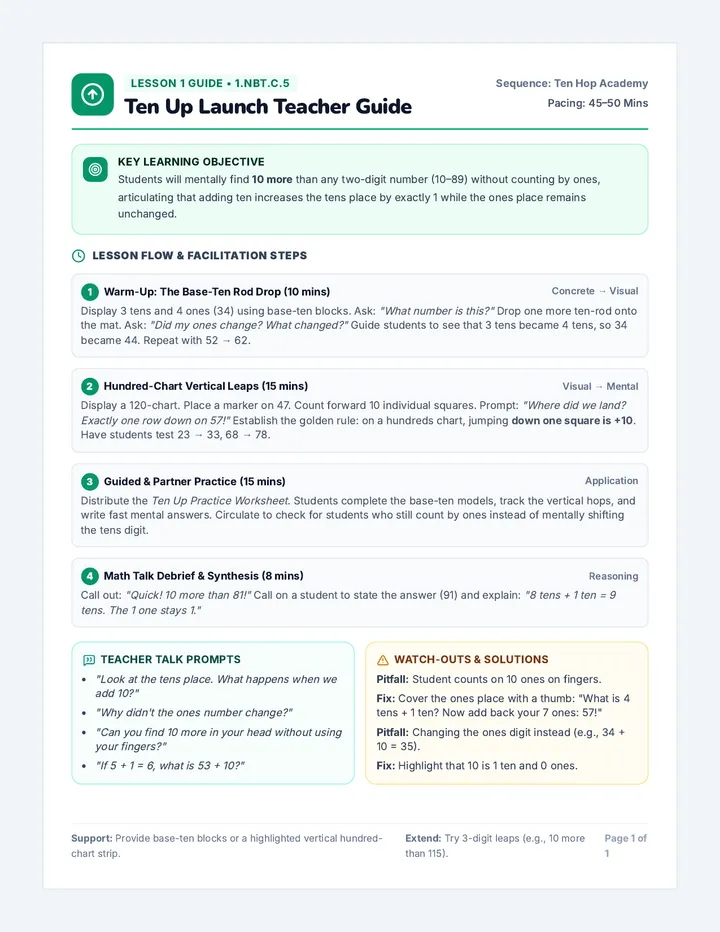
Ten Up Teacher Guide

Ten Hop Academy

A comprehensive 3-lesson primary math sequence designed to develop first graders' mental fluency with finding 10 more and 10 less than any two-digit number. Students transition from concrete base-ten models and hundreds-chart leap patterns to rapid mental calculations and clear verbal explanations.

K

kkipperman

9
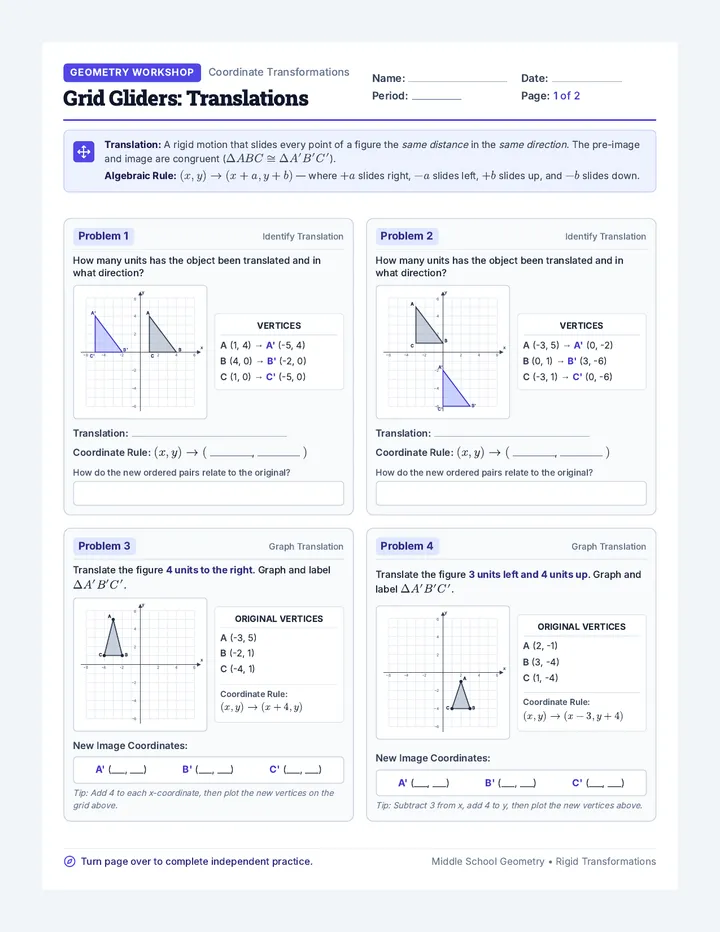
Grid Gliders Worksheet

Grid Gliders

A focused middle school geometry lesson on translations in the coordinate plane. Students discover rigid transformations, determine translation direction and distance, formulate coordinate rules, and graph translated figures.

FM

Fernando Mancini

2
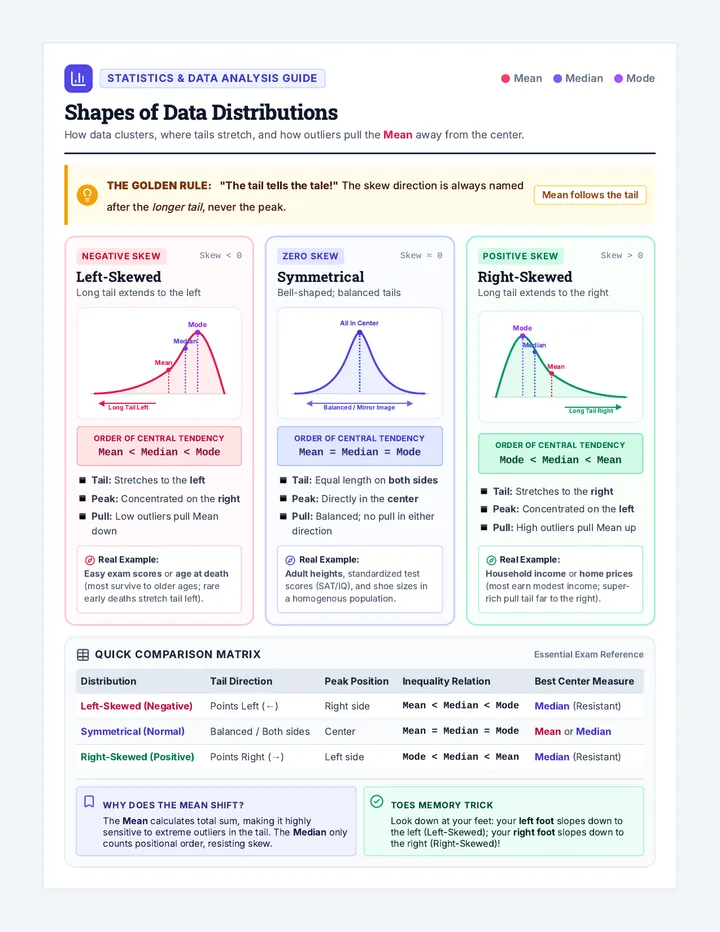
Distribution Shapes Anchor Chart

Distribution Shapes Anchor Chart

A comprehensive visual reference anchor chart illustrating symmetrical, left-skewed, and right-skewed distributions. Features clear curve diagrams with exact mean, median, and mode placements, memory mnemonics, and real-world examples.

CF

Chad Forde

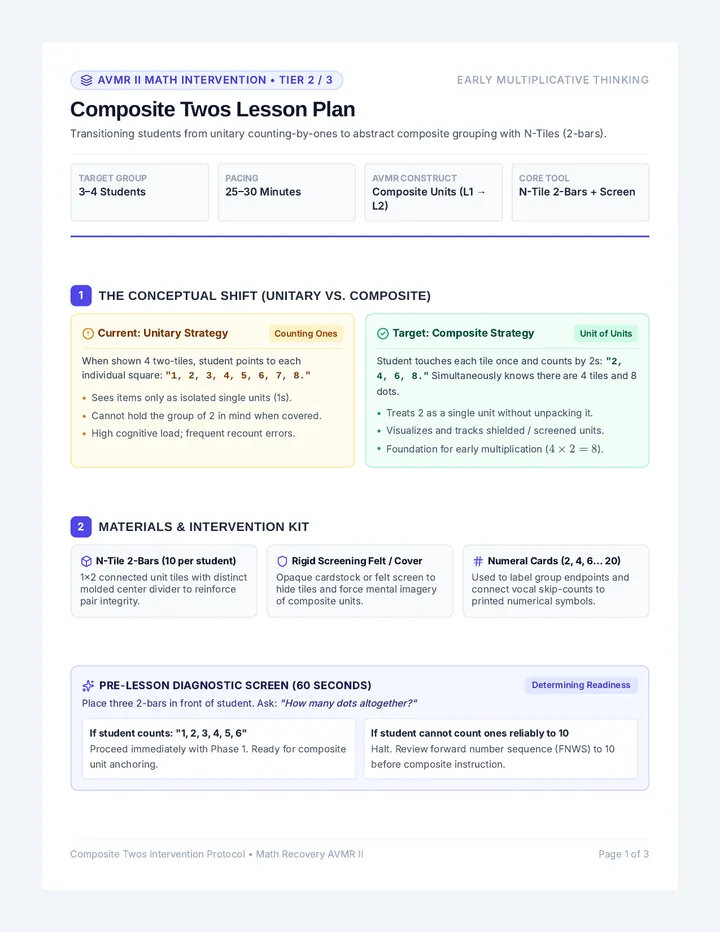
Composite Twos Lesson Plan

Math Intervention Suite

A comprehensive math intervention suite targeting foundational construct progressions from early multiplicative units to conceptual fraction schemes.

JW

Julie Whitehead

13
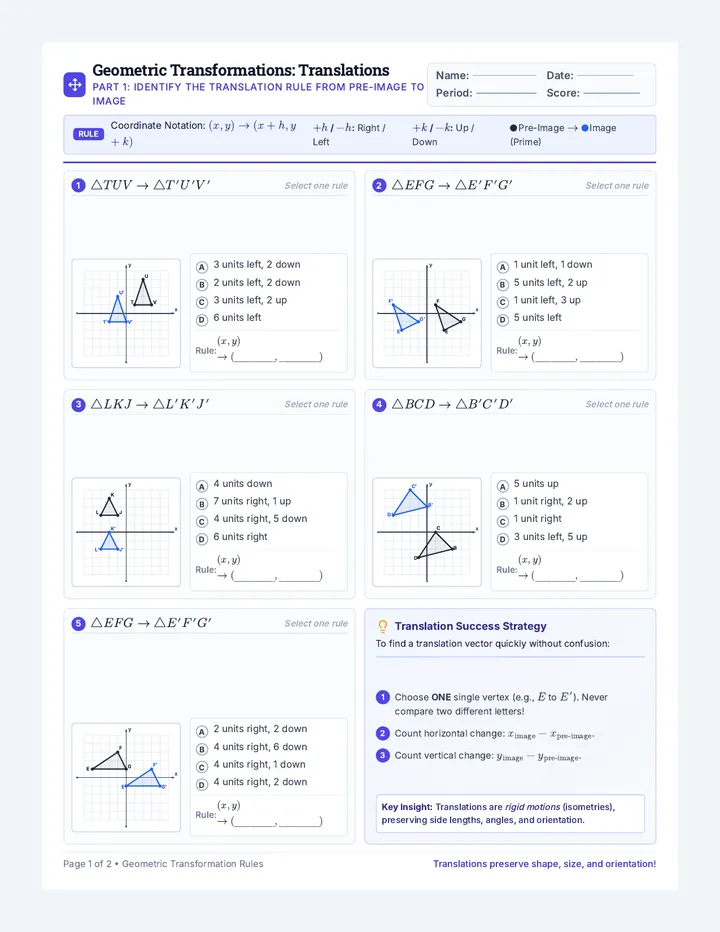
Translation Rules Worksheet

Geometric Translations

A targeted secondary geometry lesson on identifying, describing, and writing coordinate rules for translations on the Cartesian plane. Features vector coordinate diagrams and algebraic mapping notation.

FM

Fernando Mancini

2
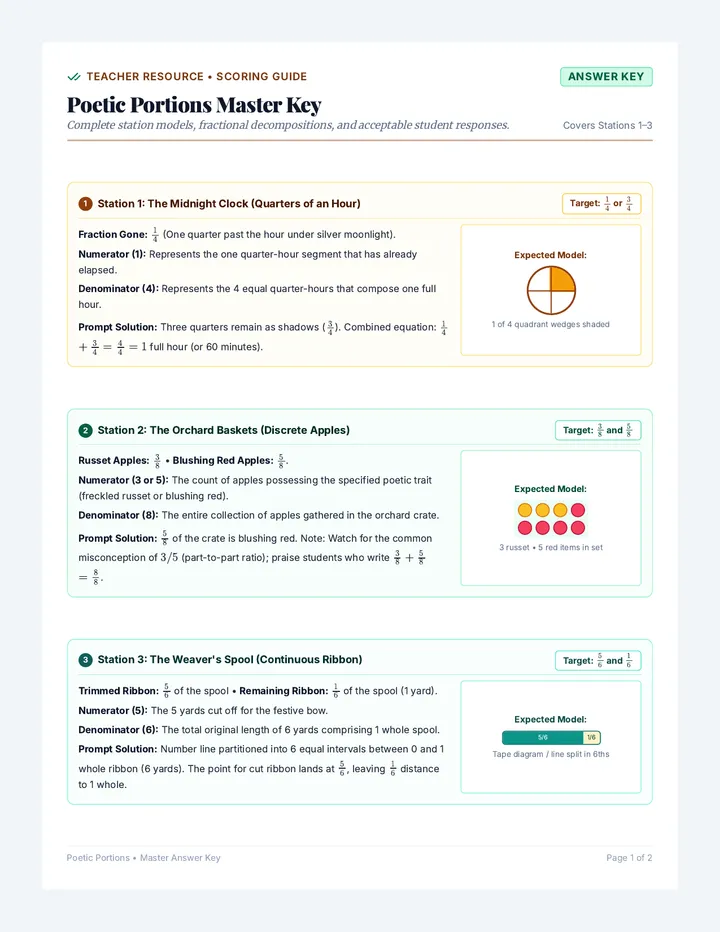
Poetic Portions Answer Key

Poetic Portions Answer Key

A 2-page teacher answer key and scoring guide providing full solutions, diagram exemplars, textual justifications, and exit ticket response criteria for the Poetic Portions lesson bundle.

NS

Naomi Seifert

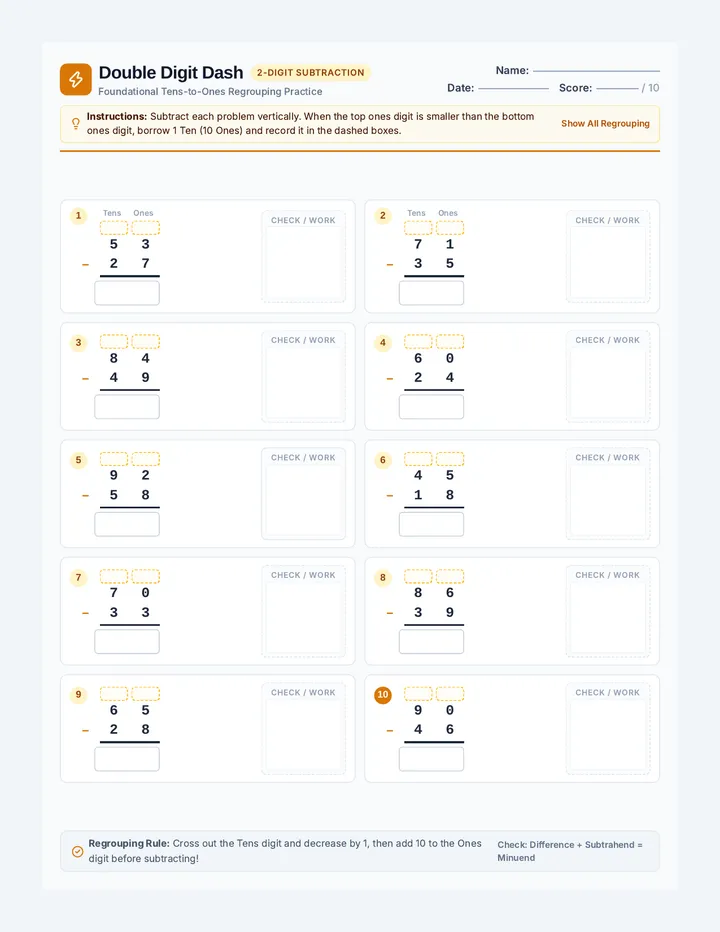
Double Digit Dash Worksheet

Elementary Skills Lab

A foundational elementary curriculum covering progressive multi-digit mathematics operations and early literacy grammar and phonics analysis.

JM

Jennifer Murphy

5
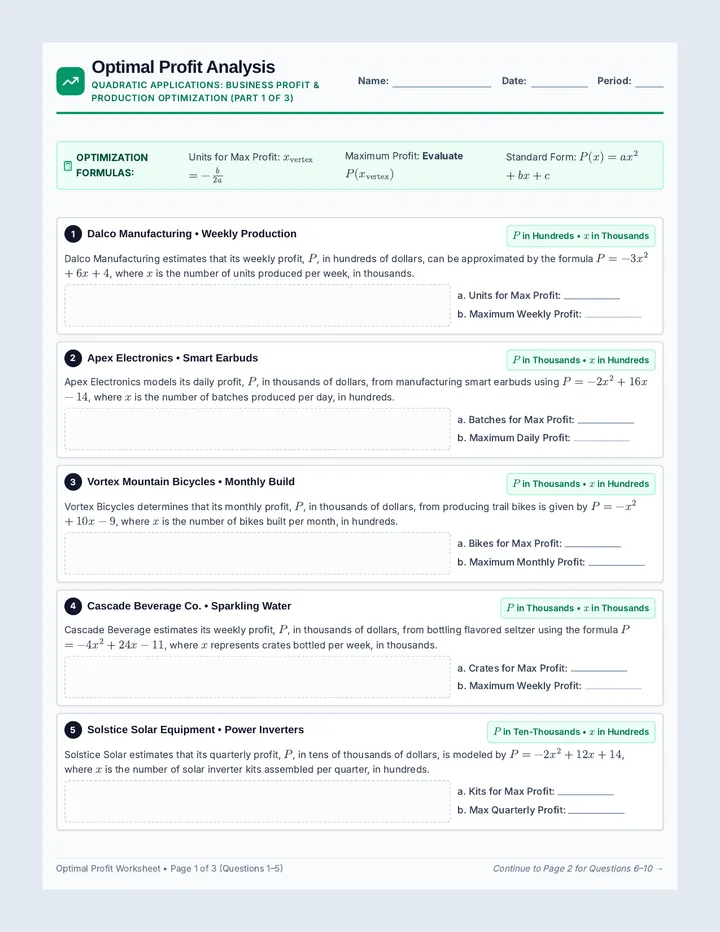
Optimal Profit Worksheet

Profit Optimization

An instructional lesson on quadratic business applications where students model revenue, cost, and profit to find vertex optima, maximum earnings, and strategic production levels.

CK

Cheydon Krysl

2
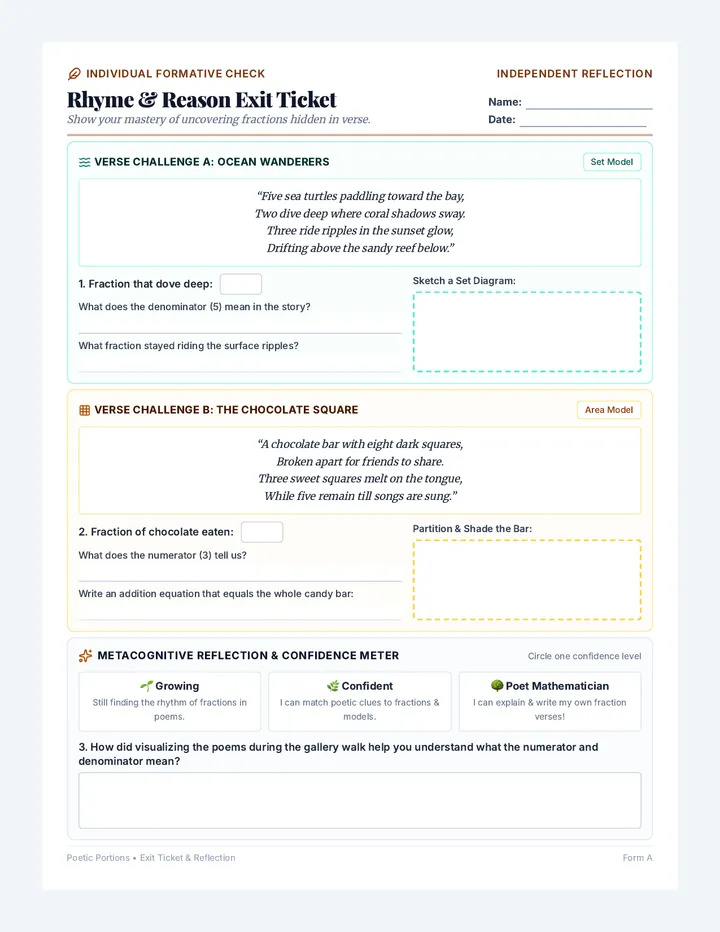
Rhyme and Reason Exit Ticket

Rhyme and Reason Exit Ticket

An individual formative assessment featuring two original verse-fraction challenges, visual modeling areas, and a metacognitive reflection on connecting literary imagery to fractional quantities.

NS

Naomi Seifert