A two-day science lab-themed review lesson focused on rounding decimals to the nearest whole number and tenth. Students analyze laboratory specimen data using the lab rounding rhyme to master precision, analyze measurement errors, and complete an assessment quiz.
Flask Weight: \( 12.\underline{7}2 \) g
Target: tenths (\( 7 \)). Tester: 2.
2 is "4 or less," so let it rest!
\( 12.72 \) rounds to 12.7 g
Independent Practice: Round each sensor reading to the nearest tenth.
1. Enzyme Sol.: \( 8.26 \) mL
Rounds:
2. Catalyst Mass: \( 15.34 \) g
Rounds:
3. Glass Tube: \( 6.09 \) cm
Rounds:
4. Reaction Time: \( 2.75 \) s
Rounds:
5. Thermal Probe: \( 31.98 \) °C
Rounds:
6. pH Level: \( 4.41 \)
Rounds:
Part 4: Lab Experiment Word Problems
Scenario A: Dr. Ellis measures \( 17.65 \) grams of copper sulfate crystal on an analytical balance. Record the mass rounded to:
Nearest whole gram:
Nearest tenth gram:
Scenario B: Centrifuge Trial 1 took \( 14.38 \) seconds and Trial 2 took \( 14.44 \) seconds. When rounded to the nearest tenth, do they round to the same value? Show work and explain below.
Part 5: Scientist Inquiry — Why Do We Round?
Question 1: A beaker only has lines every whole milliliter. Why is it misleading for a scientist to report a measurement as \( 15.682 \) mL from that beaker?
Question 2: In a safety protocol, a vessel holds at most \( 50 \) grams. Why might a lab team prefer rounding numbers to help make quick, safe decisions?
Laboratory Calibration Record • Form 5-A Page 2 of 2
nearest tenth of a Joule
Part 5: Lab Quality Control Clinic (2 Pts)
20. A lab intern writes in their notebook: "The test tube contained \( 13.98 \) mL. Rounded to the nearest tenth, it is \( 13.10 \) mL."
Explain the intern's misconception:
Correct rounded measurement:
Part 6: Scientific Reasoning — Why Do We Round? (3 Pts)
21. Instrument Precision: A graduated cylinder is graduated only by single milliliters (\( 1 \) mL markings). Why should a scientist round a calculated volume to the nearest whole milliliter instead of reporting \( 28.4619 \) mL?
22. Safety & Estimation: Why is rounding essential in real-world science applications when estimating supplies, reaction containers, or dangerous thresholds?
Calibration Assessment Quiz • Section B Page 2 of 2
let it rest!
Computation Checks:
\( 28.7 \) g \( \rightarrow \) 29 g
\( 14.2 \) mL \( \rightarrow \) 14 mL
\( 6.38 \) s \( \rightarrow \) 6.4 s
\( 9.04 \) °C \( \rightarrow \) 9.0 °C
Lab Analysis Prompt:
The zero in 20.0 g is required because it signals precision to the nearest tenth rather than the ones place.
Teacher Master Answer Keys • Form TK-1 Page 1 of 2
Evaluations & Assessments
Homework & Quiz Master Keys
Form TK-2
Field Research Homework Key (Night 1) Assignment Key
Part 1: Whole Numbers
1. \( 43.6 \) mL \( \rightarrow \) 44 mL
2. \( 8.2 \) kg \( \rightarrow \) 8 kg
3. \( 99.5 \) cm \( \rightarrow \) 100 cm
4. \( 6.49 \) pH \( \rightarrow \) 6 pH
Part 1: Tenths (\( 0.1 \))
5. \( 1.08 \) \( \rightarrow \) 1.1 g/mL
6. \( 15.73 \) \( \rightarrow \) 15.7 s
7. \( 3.96 \) \( \rightarrow \) 4.0 kPa
8. \( 24.01 \) \( \rightarrow \) 24.0 cm²
Part 2: Error Clinic
Error: Looked at hundredths place (\( 8 \)) instead of the immediate neighbor (tenths digit \( 3 \)). Correct: 3 is 4 or less, let it rest \( \rightarrow \) 7 grams.
Part 3 Word Problem: Alpha whole: 85 °C • Beta whole: 85 °C • Alpha tenth: 84.7 °C. Part 4 Reflection: Infinite or excessive decimal places overwhelm readers and give a false sense of precision; rounded data is easier to compare and understand.
Data Calibration Assessment Quiz Key (Day 2) 35 Pts Total
Part 1 & 2: Protocols & Whole Numbers
1. "raise the score!" / "let it rest!" (2 pts)
2. Testing digit: Tenths digit (1 pt)
3. Testing digit: Hundredths digit (1 pt)
4. \( 16.7 \) mL \( \rightarrow \) 17 mL
5. \( 8.29 \) g \( \rightarrow \) 8 g
6. \( 42.5 \) °C \( \rightarrow \) 43 °C
7. \( 0.83 \) m \( \rightarrow \) 1 m
8. \( 79.18 \) s \( \rightarrow \) 79 s
9. \( 105.62 \) mg \( \rightarrow \) 106 mg
10. Multiple Choice: C) 24.61 g (rounds to 25)
Part 3 & 4: Tenths & Problems
11. \( 5.37 \) mL \( \rightarrow \) 5.4 mL
12. \( 18.62 \) g \( \rightarrow \) 18.6 g
13. \( 7.05 \) cm \( \rightarrow \) 7.1 cm
14. \( 23.419 \) s \( \rightarrow \) 23.4 s
15. \( 8.96 \) g \( \rightarrow \) 9.0 g
16. \( 0.44 \) mL \( \rightarrow \) 0.4 mL
17. Multiple Choice: B) 12.1 V
18. a) 3.8 g • b) 48 mL
19. Both round to 92.5 J (Yes, same value).
Part 5 & 6: Quality Control & Scientific Reasoning
20. Quality Control Clinic: Intern treated the .9 as 9 and added 1 to make "10" after the decimal rather than regrouping \( 9 + 1 = 10 \) tenths into 1 whole. Correct answer is 14.0 mL. 21. Instrument Precision: The cylinder can only resolve to 1 mL. Recording \( 28.4619 \) mL implies precision the instrument physically cannot detect (false precision). 22. Safety & Estimation: Rounding numbers gives quick, reliable estimates of capacity, prevents hazardous overfilling, and makes calculations rapid during urgent lab protocols.
Teacher Master Answer Keys • Form TK-2 Page 2 of 2
Rounded:
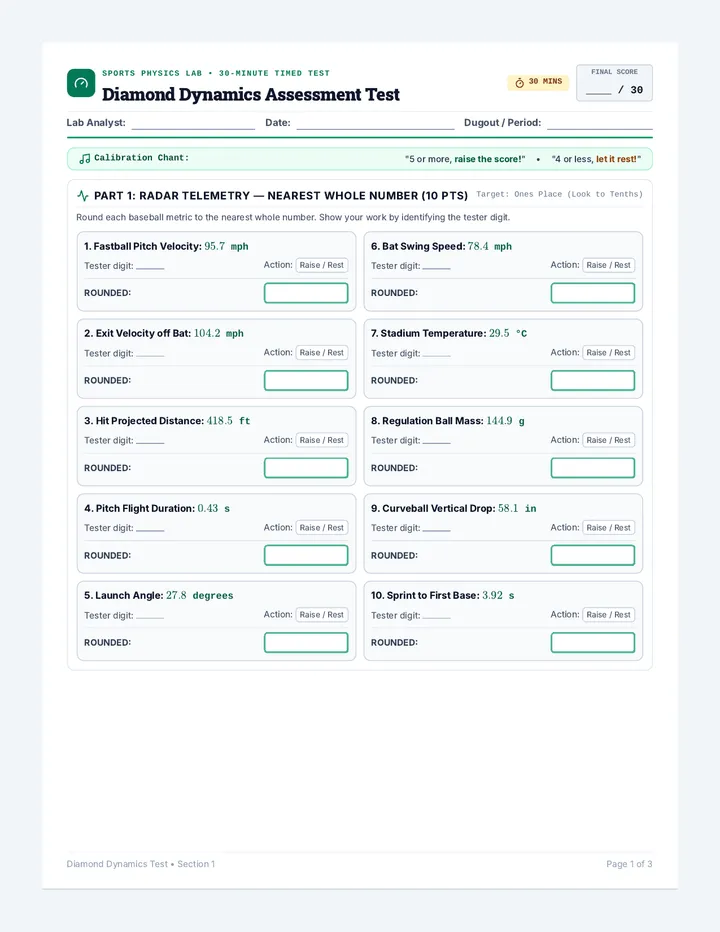
17. Wood Bat Barrel Diam.: \( 6.64 \) cm
Tester digit: Action: Raise / Rest
Rounded:
13. Slider Horizontal Break: \( 13.48 \) in
Tester digit: Action: Raise / Rest
Rounded:
18. Wind Gust at Plate: \( 9.97 \) mph
Tester digit: Action: Raise / Rest
Rounded:
14. Drag Coefficient: \( 0.324 \)
Tester digit: Action: Raise / Rest
Rounded:
19. Ball Seam Height: \( 0.75 \) mm
Tester digit: Action: Raise / Rest
Rounded:
15. Air Density in Dome: \( 1.218 \) kg/m³
Tester digit: Action: Raise / Rest
Rounded:
20. Pitch Release Height: \( 5.85 \) ft
Tester digit: Action: Raise / Rest
Rounded:
Diamond Dynamics Test • Section 2 Page 2 of 3
Diamond Dynamics Test • Section 3
Word Problems & Scientific Inquiry
10 Points Total
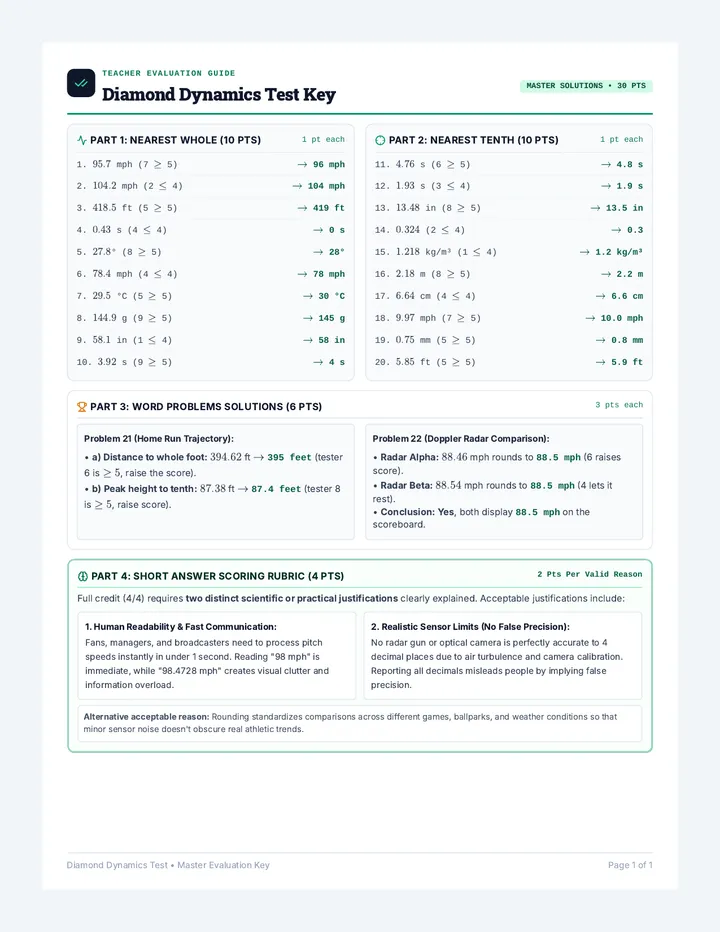
Part 3: Sports Science Word Problems (6 Pts)
Problem 21: Statcast Trajectory Analysis 3 Points
During a laboratory wind-tunnel experiment, sports physicists test how air pressure affects a baseball hit. Optical sensors measure the simulated home run distance as \( 394.62 \) feet and the ball's peak height at the apex of its trajectory as \( 87.38 \) feet.
a) Round distance (\( 394.62 \) ft) to the nearest whole foot:
Show work / rule:
Answer:
b) Round peak height (\( 87.38 \) ft) to the nearest tenth of a foot:
Show work / rule:
Answer:
Problem 22: Doppler Radar Calibration 3 Points
Two Doppler radar units measure the release speed of a closer's slider. Radar Unit Alpha registers \( 88.46 \) mph and Radar Unit Beta registers \( 88.54 \) mph.
If the broadcast graphics system rounds all pitch speeds to the nearest tenth, will both radar units display the exact same number on the stadium scoreboard? Round both values, compare them, and explain below.
Alpha (\( 88.46 \)) to tenth:
Beta (\( 88.54 \)) to tenth:
Written explanation & comparison:
Part 4: Scientific Inquiry — Why Do We Round? (4 Pts)
2 Pts Per Reason
High-tech tracking sensors calculate speeds with 4 to 6 decimal places (e.g., \( 98.4728 \) mph). Explain two distinct reasons why sports scientists, coaches, and broadcasters round data to the nearest whole number or tenth instead of reporting all decimals.
Diamond Dynamics Test • Section 3 Page 3 of 3
88.5 mph
Radar Beta:
88.5 mph
Conclusion:
Yes
88.5 mph
Part 4: Short Answer Scoring Rubric (4 Pts) 2 Pts Per Valid Reason
Full credit (4/4) requires two distinct scientific or practical justifications clearly explained. Acceptable justifications include:
1. Human Readability & Fast Communication: Fans, managers, and broadcasters need to process pitch speeds instantly in under 1 second. Reading "98 mph" is immediate, while "98.4728 mph" creates visual clutter and information overload.
2. Realistic Sensor Limits (No False Precision): No radar gun or optical camera is perfectly accurate to 4 decimal places due to air turbulence and camera calibration. Reporting all decimals misleads people by implying false precision.
Alternative acceptable reason: Rounding standardizes comparisons across different games, ballparks, and weather conditions so that minor sensor noise doesn't obscure real athletic trends.
Diamond Dynamics Test • Master Evaluation Key Page 1 of 1