Circle Circuit Station Cards 01
Station One
Angle Navigation & Quadrants
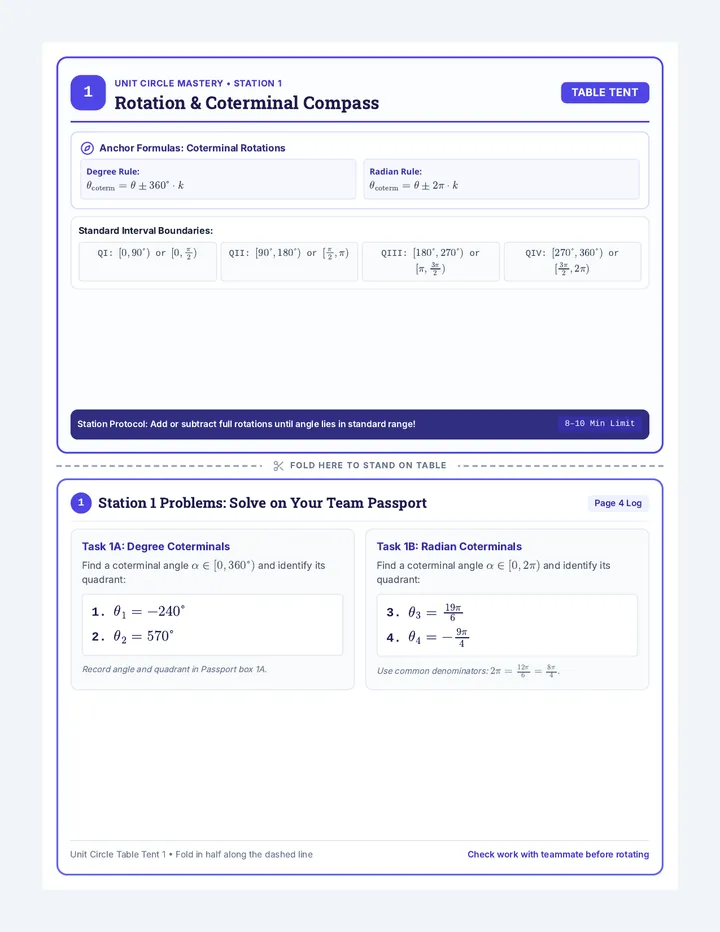
Coterminal Angles
Core Anchor
Coterminal angles share the exact initial side (positive \(x\)-axis) and terminal ray, differing by integer multiples of full rotations: \(\theta \pm 360^\circ k\) or \(\theta \pm 2\pi k\).
A Degree Rotation Protocol Fundamental
Given the standard position angle \(\theta = 570^\circ\):
Part 1 Find one positive coterminal angle \(\alpha\) such that \(0^\circ \le \alpha < 360^\circ\).
Part 2 Find one negative coterminal angle \(\beta\) such that \(-360^\circ \le \beta < 0^\circ\).
Part 3 Identify the quadrant where the terminal ray terminates (QI, QII, QIII, or QIV).
B Radian Orbit Analysis Standard
A satellite antenna rotates to an angle of \(\theta = -\frac{13\pi}{4}\) radians.
Add positive periods of \(2\pi\) to determine the coterminal angle in \([0, 2\pi)\).
Determine which quadrant contains this terminal ray.
How many complete full clockwise revolutions occurred prior to stopping?
C Dual Condition Quadrant Detective Mastery Challenge
Determine the unique quadrant where the terminal ray of \(\theta\) must terminate to satisfy both conditions simultaneously:
Condition Set 1
\(\sin\theta > 0\) and \(\cot\theta < 0\)
Analyze signs of \(y\) and \(x/y\).
Condition Set 2
\(\cos\theta < 0\) and \(\csc\theta < 0\)
Analyze signs of \(x\) and \(1/y\).
Show all addition/subtraction steps on your recording sheet.
STATION 1 OF 6
02
Station Two
Bowtie Symmetry & Reference Angles
Reference Angle \(\theta'\)
Core Rule
A reference angle \(\theta'\) is always the positive acute angle (\(0^\circ < \theta' \le 90^\circ\) or \(0 < \theta' \le \frac{\pi}{2}\)) formed between the terminal side of \(\theta\) and the horizontal \(x\)-axis .
A Rapid Reference Calculator Degree & Radian Drills
Calculate the exact reference angle \(\theta'\) for each given standard angle:
1. \(\theta = 225^\circ\) Quadrant III
\(\theta' = \theta - 180^\circ\)
2. \(\theta = \frac{5\pi}{3}\) Quadrant IV
\(\theta' = 2\pi - \theta\)
3. \(\theta = 300^\circ\) Quadrant IV
\(\theta' = 360^\circ - \theta\)
4. \(\theta = -\frac{7\pi}{6}\) Negative Angle
Coterminal first
B The "Bowtie" Symmetry Family Visual Geometry
When all reference triangles with reference angle \(\theta' = \frac{\pi}{4}\) are drawn across all 4 quadrants, their hypotenuses and horizontal legs form a geometric "bowtie" .
Your Tasks:
List the 4 angles in \([0, 2\pi)\) having \(\theta' = \frac{\pi}{4}\).
Draw the bowtie sketch inside the circle template on your recording sheet.
Label the coordinates of all 4 terminal intersection points.
Bowtie Family
C Reverse Reference Reconstruction Mastery Challenge
An unknown angle \(\theta\) lies in Quadrant IV and possesses a reference angle of \(\theta' = \frac{\pi}{6}\).
Standard Interval \([0, 2\pi)\) Determine the exact value of \(\theta\).
Extended Interval \([2\pi, 4\pi)\) Determine the coterminal value of \(\theta\) in this second rotation.
Reference angles are ALWAYS positive and acute (\(0 < \theta' \le 90^\circ\)).
STATION 2 OF 6
03
Station Three
Coordinate Geometry & Terminal Points
\(x^2 + y^2 = 1\)
Coordinate Equivalence
Every point on the unit circle satisfies \(x^2 + y^2 = 1\). By definition, terminal coordinates are \((x, y) = (\cos\theta, \sin\theta)\) , and \(\tan\theta = \frac{y}{x}\) (\(x \ne 0\)).
A Missing Coordinate Solver Algebraic Equation
The point \(P\left(-\frac{\sqrt{5}}{3}, y\right)\) lies on the unit circle in Quadrant III .
Substitute into \(x^2 + y^2 = 1\) to find the exact value of \(y\). Remember QIII signs!
2. State the Primary Ratios:
\(\cos\theta = ?\) \(\sin\theta = ?\) \(\tan\theta = ?\)
B Exact Terminal Coordinate Identification Unit Circle Matching
Determine the exact terminal coordinates \((x, y)\) for each standard angle:
Angle 1 \(\theta = \frac{5\pi}{6}\) Terminal \((x, y)\) = ?
Angle 2 \(\theta = \frac{4\pi}{3}\) Terminal \((x, y)\) = ?
Angle 3 \(\theta = \frac{7\pi}{4}\) Terminal \((x, y)\) = ?
C Geometric Boundary Verification Mastery Challenge
A radar system reports a point \(Q\left(\frac{3}{5}, -\frac{4}{5}\right)\).
Algebraic Proof Prove whether \(Q\) lies on the unit circle by calculating \(x^2 + y^2\).
Trigonometric Link If \(Q\) is on the circle, write \(\cos\theta\) and \(\sin\theta\) for its angle \(\theta\).
Remember: \(x = \cos\theta\), \(y = \sin\theta\), and \(\tan\theta = y/x\).
STATION 3 OF 6
04
Station Four
Exact Values of Primary Ratios
No Decimals
Evaluation Strategy
To evaluate without a calculator: (1) Find the reference angle \(\theta'\), (2) Recall the exact first-quadrant ratio, and (3) Apply the sign from the CAST / ASTC quadrant rule.
A Special Radian Angles Exact Ratios
Find the exact simplified value (rationalize all denominators):
Problem 1 \(\sin\left(\frac{7\pi}{6}\right)\) Show \(\theta'\) & Sign
Problem 2 \(\cos\left(\frac{3\pi}{4}\right)\) Show \(\theta'\) & Sign
Problem 3 \(\tan\left(\frac{5\pi}{3}\right)\) Show \(\theta'\) & Sign
B Quadrantal & Axis-Lying Angles Axes Navigation
Angles along coordinate axes do not form triangles. Use coordinates \((1,0), (0,1), (-1,0), (0,-1)\):
Axis 1 \(\cos\left(-\frac{\pi}{2}\right)\)
Axis 2 \(\sin(3\pi)\)
Axis 3 \(\tan(\pi)\)
Axis 4 \(\tan\left(\frac{3\pi}{2}\right)\)
C Degree Precision Challenges Mastery Challenge
Find the exact simplified value for each expression:
\(\sin(-240^\circ)\) Hint: negative angle
\(\cos(315^\circ)\) Hint: Quadrant IV
\(\tan(210^\circ)\) Hint: Quadrant III
Exact radical form required! Write \(\frac{\sqrt{3}}{2}\), NOT 0.866.
STATION 4 OF 6
05
Station Five
Reciprocal Functions & Undefined Values
\(\sec, \csc, \cot\)
Reciprocal Identities
\(\sec\theta = \frac{1}{\cos\theta} = \frac{1}{x}\) • \(\csc\theta = \frac{1}{\sin\theta} = \frac{1}{y}\) • \(\cot\theta = \frac{1}{\tan\theta} = \frac{x}{y}\). Whenever the denominator is zero, the value is Undefined !
A Reciprocal Exact Evaluations Exact Form
First evaluate the primary function, then take the reciprocal and rationalize:
Problem 1 \(\sec\left(\frac{2\pi}{3}\right)\) Find \(\cos\) first
Problem 2 \(\csc\left(\frac{5\pi}{4}\right)\) Find \(\sin\) first
Problem 3 \(\cot\left(\frac{11\pi}{6}\right)\) Calculate \(\frac{x}{y}\)
B Singularity Analysis (Defined vs. Undefined) Division by Zero
State whether each is DEFINED (with exact value) or UNDEFINED (state why: \(x = 0\) or \(y = 0\)):
1. \(\sec\left(\frac{\pi}{2}\right)\) Point: \((0, 1)\)
2. \(\csc(\pi)\) Point: \((-1, 0)\)
3. \(\cot\left(\frac{\pi}{2}\right)\) Point: \((0, 1)\)
4. \(\cot(0)\) Point: \((1, 0)\)
C Reciprocal Clue Detective Mastery Challenge
You are given that \(\csc\theta = -\frac{2\sqrt{3}}{3}\) and \(\theta\) terminates in Quadrant IV .
Step 1 Find \(\sin\theta\)
Step 2 Find \(\theta \in [0, 2\pi)\)
Step 3 Find \(\sec\theta\) & \(\cot\theta\)
Watch out: \(\cot(\pi/2) = 0/1 = 0\) (defined), but \(\tan(\pi/2) = 1/0\) is undefined.
STATION 5 OF 6
06
Station Six
Expression Engine & Identities
Combined Operations
Circuit Grand Master
Evaluate each trigonometric factor individually to exact radical values before applying algebraic order of operations. Note: \(\sin^2\theta = (\sin\theta)^2\).
A Multi-Term Operations Exact Simplification
Evaluate each expression to an exact integer or simplified rational number:
Operation 1 (Pythagorean Test) \(\sin^2\left(\frac{5\pi}{4}\right) + \cos^2\left(\frac{5\pi}{4}\right)\)
Square each term
Operation 2 (Mixed Product & Difference) \(\sec\left(\frac{\pi}{3}\right) \cdot \tan\left(\frac{7\pi}{4}\right) - 3\csc\left(\frac{7\pi}{6}\right)\)
Follow PEMDAS
B Rational Fractional Quotient Fraction Reduction
Simplify the following nested fraction to a single rational number or integer:
\(\frac{\sin\left(\frac{\pi}{3}\right) + \cos\left(\frac{\pi}{6}\right)}{\tan\left(\frac{2\pi}{3}\right)}\)
1. Simplify Numerator • 2. Evaluate Denominator • 3. Divide & Cancel
C The Pythagorean Identity Verification Mastery Challenge
Evaluate the expression for \(\theta = \frac{3\pi}{4}\):
\(4\sec^2\left(\frac{3\pi}{4}\right) - 4\tan^2\left(\frac{3\pi}{4}\right)\)
1. Compute using exact substituted values.
2. Explain how this verifies \(1 + \tan^2\theta = \sec^2\theta\).
Circuit Complete! Verify all 6 station responses before turning in.
STATION 6 OF 6
Circle Circuit Student Packet Precalculus • Trigonometry
Circle Circuit Student Packet
Stations 1 – 3
Name:
Date:
Period:
1 Station 1: Angle Navigation & Quadrants
Coterminal Formulas
A. \(\theta = 570^\circ\)
Positive Coterminal \([0, 360^\circ)\):
Negative Coterminal \([-360^\circ, 0^\circ)\):
Terminal Quadrant:
B. \(\theta = -\frac{13\pi}{4}\)
Coterminal \(\phi \in [0, 2\pi)\):
Terminal Quadrant:
Full Clockwise Revolutions:
C. Quadrant Clues
\(\sin\theta > 0\) & \(\cot\theta < 0 \implies\) Quad:
\(\cos\theta < 0\) & \(\csc\theta < 0 \implies\) Quad:
2 Station 2: Bowtie Symmetry & Reference Angles
\(\theta'\) Always Positive & Acute
A. Find Reference Angle \(\theta'\)
1. \(225^\circ \rightarrow \theta' =\)
2. \(\frac{5\pi}{3} \rightarrow \theta' =\)
3. \(300^\circ \rightarrow \theta' =\)
4. \(-\frac{7\pi}{6} \rightarrow \theta' =\)
B. Bowtie Family for \(\theta' = \frac{\pi}{4}\)
List 4 standard angles:
Terminal coordinates:
C. QIV with \(\theta' = \frac{\pi}{6}\)
\(\theta \in [0, 2\pi)\):
\(\theta \in [2\pi, 4\pi)\):
3 Station 3: Coordinate Geometry & Terminal Points
\(x^2 + y^2 = 1 \iff (\cos\theta)^2 + (\sin\theta)^2 = 1\)
A. Point \(P\left(-\frac{\sqrt{5}}{3}, y\right)\) in QIII
Show work solving for \(y\):
\(\cos\theta\)
\(\sin\theta\)
\(\tan\theta\)
B. Terminal Points \((x, y)\)
1. \(\theta = \frac{5\pi}{6} \rightarrow\)
2. \(\theta = \frac{4\pi}{3} \rightarrow\)
3. \(\theta = \frac{7\pi}{4} \rightarrow\)
C. Verify \(Q\left(\frac{3}{5}, -\frac{4}{5}\right)\)
Check \(x^2 + y^2\):
\(\cos\theta =\) \(\sin\theta =\)
Turn page over to record Stations 4 – 6. PAGE 1 OF 2
Precalculus • Trigonometry
Circle Circuit Student Packet
Stations 4 – 6
4 Station 4: Exact Values of Primary Ratios
ASTC Quadrant Rule • Exact Radicals
A. Special Radian Angles
1. \(\sin\left(\frac{7\pi}{6}\right) =\)
2. \(\cos\left(\frac{3\pi}{4}\right) =\)
3. \(\tan\left(\frac{5\pi}{3}\right) =\)
B. Axis Angles
1. \(\cos\left(-\frac{\pi}{2}\right) =\)
2. \(\sin(3\pi) =\)
3. \(\tan(\pi) =\)
4. \(\tan\left(\frac{3\pi}{2}\right) =\)
C. Degree Challenges
1. \(\sin(-240^\circ) =\)
2. \(\cos(315^\circ) =\)
3. \(\tan(210^\circ) =\)
5 Station 5: Reciprocal Functions & Singularity Zones
\(\sec = 1/x\), \(\csc = 1/y\), \(\cot = x/y\)
A. Reciprocal Ratios
1. \(\sec\left(\frac{2\pi}{3}\right) =\)
2. \(\csc\left(\frac{5\pi}{4}\right) =\)
3. \(\cot\left(\frac{11\pi}{6}\right) =\)
B. Defined vs. Undefined
1. \(\sec\left(\frac{\pi}{2}\right) \rightarrow\)
2. \(\csc(\pi) \rightarrow\)
3. \(\cot\left(\frac{\pi}{2}\right) \rightarrow\)
4. \(\cot(0) \rightarrow\)
C. Clue Detective (\(\csc\theta = -\frac{2\sqrt{3}}{3}\), QIV)
\(\sin\theta =\)
\(\theta \in [0, 2\pi) =\)
\(\sec\theta =\)
\(\cot\theta =\)
6 Station 6: Expression Engine & Identities
Circuit Grand Master • Order of Operations
A. Multi-Term Operations
1. \(\sin^2(5\pi/4) + \cos^2(5\pi/4)\):
2. \(\sec(\pi/3)\tan(7\pi/4) - 3\csc(7\pi/6)\):
B. Fractional Quotient
\(\frac{\sin(\pi/3) + \cos(\pi/6)}{\tan(2\pi/3)}\):
C. Pythagorean Check
\(4\sec^2(3\pi/4) - 4\tan^2(3\pi/4)\):
Final Value:
Circuit Debrief & Reflection Circle your confidence level: 1 (Developing) • 2 (Proficient) • 3 (Mastery)
What is the most helpful rule or pattern you used today (e.g. CAST, bowtie, reference angles)?
Which station was most challenging and why?
Unit Circle Stations Activity Complete. Submit to teacher. PAGE 2 OF 2
Circle Circuit Launch Slides Stations Rotation Activity
Precalculus • Trigonometry
Circle Circuit
Navigate the unit circle across 6 collaborative stations. Connect coordinate geometry, coterminal rays, reference triangles, exact ratios, and reciprocal functions.
7–8 Minutes Per Station
Collaborate in Teams
Exact Radical Values Only
The Six Circuit Stations
Stations Map
1 Navigation
Coterminal angles, rotations, and quadrant location rules.
2 Bowtie Symmetry
Reference angles \(\theta'\), acute triangles, and quadrant formulas.
3 Coordinates
\(x^2 + y^2 = 1\), boundary tests, and terminal points \((x,y)\).
4 Exact Ratios
\(\sin\), \(\cos\), and \(\tan\) precision without decimal approximations.
5 Reciprocals
\(\sec\), \(\csc\), \(\cot\), and identifying undefined singularity values.
6 Circuit Master
Composite expressions, nested quotients, and Pythagorean checks.
Record complete solutions on your student packet at every stop!
Quadrant Navigation & Reference Rules
Core Reference
ASTC Sign Quadrants
QII Sine & Csc (+) \(\theta' = \pi - \theta\)
QI ALL Positive (+) \(\theta' = \theta\)
QIII Tangent & Cot (+) \(\theta' = \theta - \pi\)
QIV Cosine & Sec (+) \(\theta' = 2\pi - \theta\)
Golden Angle Principles
Reference angle \(\theta'\) is always positive and acute (\(\le 90^\circ\) or \(\frac{\pi}{2}\)).
Always measure to the \(x\)-axis , never the \(y\)-axis.
For negative or large angles, find coterminal angle in \([0, 2\pi)\) first!
Memory Aid: "All Students Take Calculus" gives positive functions in Q1, Q2, Q3, Q4.
Coordinates & Reciprocal Functions
Foundations
Unit Circle Equation: \(x^2 + y^2 = 1\)
\(x = \cos\theta \quad\text{and}\quad y = \sin\theta\)
\(\tan\theta = \frac{y}{x} = \frac{\sin\theta}{\cos\theta} \quad (x \ne 0)\)
Terminal coordinates directly reveal all trigonometric ratios without drawing right triangles.
Reciprocals & Singularities
\(\sec\theta = \frac{1}{\cos\theta} = \frac{1}{x}\) Undefined when \(x = 0\)
\(\csc\theta = \frac{1}{\sin\theta} = \frac{1}{y}\) Undefined when \(y = 0\)
\(\cot\theta = \frac{1}{\tan\theta} = \frac{x}{y}\) Undefined when \(y = 0\)
Notice: \(\cot(\pi/2) = \frac{0}{1} = 0\) is defined, but \(\tan(\pi/2) = \frac{1}{0}\) is undefined. Denominator Check!
Rotation Rules & Team Norms
Team Playbook
1
Engage Together
Discuss steps out loud. Every team member must understand and record the exact algebraic solution.
2
Radicals Only
No decimals from calculators! Write values like \(\frac{\sqrt{3}}{2}\), \(\frac{\sqrt{2}}{2}\), and \(-\sqrt{3}\).
3
Rotate on Chime
When the timer chimes, smoothly rotate clockwise to the next station: \(1 \rightarrow 2 \rightarrow \dots \rightarrow 6 \rightarrow 1\).
Ready? Move to your starting station and begin Mission A!
Circuit Synthesis & Class Debrief
Wrap-Up
Whole-Class Reflection Question
How did finding the reference angle \(\theta'\) allow you to evaluate angles of any size, whether positive, negative, or multiple rotations?
Key Realization 1: Symmetry reduces all infinite angles across the plane down to three acute reference triangles (\(30^\circ, 45^\circ, 60^\circ\)).
Key Realization 2: Every trigonometric function is simply the ratio of unit coordinates \((x, y)\) along the circle \(x^2 + y^2 = 1\).
Submit your completed Student Packet to the assignment inbox. Great work today!
Circle Circuit Teacher Guide Teacher Facilitation Guide
Circle Circuit: Stations Blueprint
60-Min Lesson
Instructional Objectives
Students calculate positive/negative coterminal angles, determine reference angles and quadrant signs, link coordinates on \(x^2 + y^2 = 1\) to trigonometric ratios, evaluate reciprocal and primary functions exactly without decimals, and simplify composite trigonometric expressions.
Rotation Schedule
Launch & Rules: 5 min
Stations (6 × 7.5 min): 45 min
Synthesis & Debrief: 10 min
Station Setup & Group Logistics
Physical Stations Place Station Posters 1–6 around the perimeter with clipboards or designated cluster desks. Keep order sequential (\(1 \rightarrow 2 \dots \rightarrow 6\)).
Team Structures Groups of 3–4 students. Assign rotating roles: Navigator (leads strategy), Verifier (checks exact radicals), and Scribe (monitors time).
Calculator Policy Strictly no graphing/scientific decimals. Scratch paper permitted for fraction arithmetic and radical rationalization.
Common Misconceptions & Teacher Prompts
Station 2: Vertical Axis Trap
Symptom: Students measure reference angle to the vertical \(y\)-axis (e.g., calling \(\theta'\) for \(120^\circ\) as \(30^\circ\) instead of \(60^\circ\)).Intervention: "Anchor your angle ray to the horizon (\(x\)-axis) like a bowtie ribbon!"
Station 5: Cotangent Singularity Confusion
Symptom: Claiming \(\cot(\pi/2)\) is undefined because \(\tan(\pi/2)\) is undefined.Intervention: "Write \(\cot\theta\) as \(\frac{x}{y}\). At \((0, 1)\), \(x=0\) and \(y=1\), so \(\frac{0}{1} = 0\), which is completely valid!"
Differentiation Strategies
Scaffolding / Intervention Provide struggling students with a blank laminated quadrant compass showing the bowtie reference triangles (\(30^\circ, 45^\circ, 60^\circ\)) and ASTC sign quadrants.
Extension / Acceleration Have early finishers at Station 6 prove that \(\frac{\sin\theta}{1+\cos\theta} = \frac{1-\cos\theta}{\sin\theta}\) by evaluating both sides at \(\theta = \frac{2\pi}{3}\).
Turn to Page 2 for the Complete Master Answer Key & Solutions. PAGE 1 OF 2
Precalculus Answer Key
Master Solutions: Stations 1 – 6
Complete Key
Station 1: Coterminal & Quadrants STATION 1
A. \(570^\circ\): Pos: \(570^\circ - 360^\circ = \mathbf{210^\circ}\). Neg: \(210^\circ - 360^\circ = \mathbf{-150^\circ}\). Terminal: Quadrant III .
B. \(-\frac{13\pi}{4}\): \(-\frac{13\pi}{4} + 4\pi = \mathbf{\frac{3\pi}{4}}\). Terminal: Quadrant II . Rotations: 1 full clockwise (and \(\frac{5}{8}\) rev).
C. Quadrant Clues: Case 1 (\(\sin > 0, \cot < 0\)) \(\implies \mathbf{Quadrant\ II}\). Case 2 (\(\cos < 0, \csc < 0\)) \(\implies \mathbf{Quadrant\ III}\).
Station 2: Bowtie & Reference \(\theta'\) STATION 2
A. \(\theta'\): (1) \(225^\circ - 180^\circ = \mathbf{45^\circ}\). (2) \(2\pi - \frac{5\pi}{3} = \mathbf{\frac{\pi}{3}}\). (3) \(360^\circ - 300^\circ = \mathbf{60^\circ}\). (4) \(-\frac{7\pi}{6} \equiv \frac{5\pi}{6} \implies \pi - \frac{5\pi}{6} = \mathbf{\frac{\pi}{6}}\).
B. Bowtie \(\frac{\pi}{4}\): Angles: \(\mathbf{\frac{\pi}{4}, \frac{3\pi}{4}, \frac{5\pi}{4}, \frac{7\pi}{4}}\). Coordinates: \((\pm\frac{\sqrt{2}}{2}, \pm\frac{\sqrt{2}}{2})\) in all 4 quadrants.
C. Reverse: In \([0, 2\pi)\): \(2\pi - \frac{\pi}{6} = \mathbf{\frac{11\pi}{6}}\). In \([2\pi, 4\pi)\): \(\frac{11\pi}{6} + 2\pi = \mathbf{\frac{23\pi}{6}}\).
Station 3: Coordinate Geometry STATION 3
A. Point \(P\) in QIII: \((-\frac{\sqrt{5}}{3})^2 + y^2 = 1 \implies \frac{5}{9} + y^2 = 1 \implies y^2 = \frac{4}{9} \implies \mathbf{y = -\frac{2}{3}}\). Ratios: \(\cos\theta = \mathbf{-\frac{\sqrt{5}}{3}}\), \(\sin\theta = \mathbf{-\frac{2}{3}}\), \(\tan\theta = \frac{-2/3}{-\sqrt{5}/3} = \mathbf{\frac{2\sqrt{5}}{5}}\).
B. Terminal \((x,y)\): (1) \(\frac{5\pi}{6} \rightarrow \mathbf{(-\frac{\sqrt{3}}{2}, \frac{1}{2})}\). (2) \(\frac{4\pi}{3} \rightarrow \mathbf{(-\frac{1}{2}, -\frac{\sqrt{3}}{2})}\). (3) \(\frac{7\pi}{4} \rightarrow \mathbf{(\frac{\sqrt{2}}{2}, -\frac{\sqrt{2}}{2})}\).
C. Verify \(Q\): \((\frac{3}{5})^2 + (-\frac{4}{5})^2 = \frac{9+16}{25} = \mathbf{1}\) (Yes!). \(\cos\theta = \mathbf{\frac{3}{5}}\), \(\sin\theta = \mathbf{-\frac{4}{5}}\).
Station 4: Exact Primary Ratios STATION 4
A. Radian Values: (1) \(\sin(\frac{7\pi}{6}) = \mathbf{-\frac{1}{2}}\). (2) \(\cos(\frac{3\pi}{4}) = \mathbf{-\frac{\sqrt{2}}{2}}\). (3) \(\tan(\frac{5\pi}{3}) = \mathbf{-\sqrt{3}}\).
B. Axis Angles: (1) \(\cos(-\frac{\pi}{2}) = \mathbf{0}\). (2) \(\sin(3\pi) = \mathbf{0}\). (3) \(\tan(\pi) = \mathbf{0}\). (4) \(\tan(\frac{3\pi}{2}) = \mathbf{Undefined}\) (\(\frac{-1}{0}\)).
C. Degree Challenges: (1) \(\sin(-240^\circ) = \sin(120^\circ) = \mathbf{\frac{\sqrt{3}}{2}}\). (2) \(\cos(315^\circ) = \mathbf{\frac{\sqrt{2}}{2}}\). (3) \(\tan(210^\circ) = \mathbf{\frac{\sqrt{3}}{3}}\).
Station 5: Reciprocals & Undefined STATION 5
A. Reciprocals: (1) \(\sec(\frac{2\pi}{3}) = \frac{1}{-1/2} = \mathbf{-2}\). (2) \(\csc(\frac{5\pi}{4}) = \frac{1}{-\sqrt{2}/2} = \mathbf{-\sqrt{2}}\). (3) \(\cot(\frac{11\pi}{6}) = \frac{\sqrt{3}/2}{-1/2} = \mathbf{-\sqrt{3}}\).
B. Singularities: (1) \(\sec(\frac{\pi}{2}) \rightarrow \mathbf{Undefined}\) (\(x=0\)). (2) \(\csc(\pi) \rightarrow \mathbf{Undefined}\) (\(y=0\)). (3) \(\cot(\frac{\pi}{2}) = \frac{0}{1} = \mathbf{0}\) (Defined!). (4) \(\cot(0) = \frac{1}{0} \rightarrow \mathbf{Undefined}\) (\(y=0\)).
C. Detective: \(\csc\theta = -\frac{2\sqrt{3}}{3} \implies \sin\theta = \mathbf{-\frac{\sqrt{3}}{2}}\). In QIV \(\implies \mathbf{\theta = \frac{5\pi}{3}}\). Then \(\sec\theta = \mathbf{2}\), \(\cot\theta = \mathbf{-\frac{\sqrt{3}}{3}}\).
Station 6: Expression Engine STATION 6
A. Multi-Term: (1) \((-\frac{\sqrt{2}}{2})^2 + (-\frac{\sqrt{2}}{2})^2 = \frac{2}{4} + \frac{2}{4} = \mathbf{1}\). (2) \((2)(-1) - 3(-2) = -2 + 6 = \mathbf{4}\).
B. Fractional Quotient: Numerator: \(\frac{\sqrt{3}}{2} + \frac{\sqrt{3}}{2} = \sqrt{3}\). Denominator: \(-\sqrt{3}\). Quotient: \(\frac{\sqrt{3}}{-\sqrt{3}} = \mathbf{-1}\).
C. Pythagorean Identity: \(\sec(\frac{3\pi}{4}) = -\sqrt{2} \implies \sec^2 = 2\); \(\tan(\frac{3\pi}{4}) = -1 \implies \tan^2 = 1\). Expression: \(4(2) - 4(1) = 8 - 4 = \mathbf{4}\). Confirms \(4(\sec^2\theta - \tan^2\theta) = 4(1) = 4\).
Circle Circuit Complete Instructional Resource Set. PAGE 2 OF 2