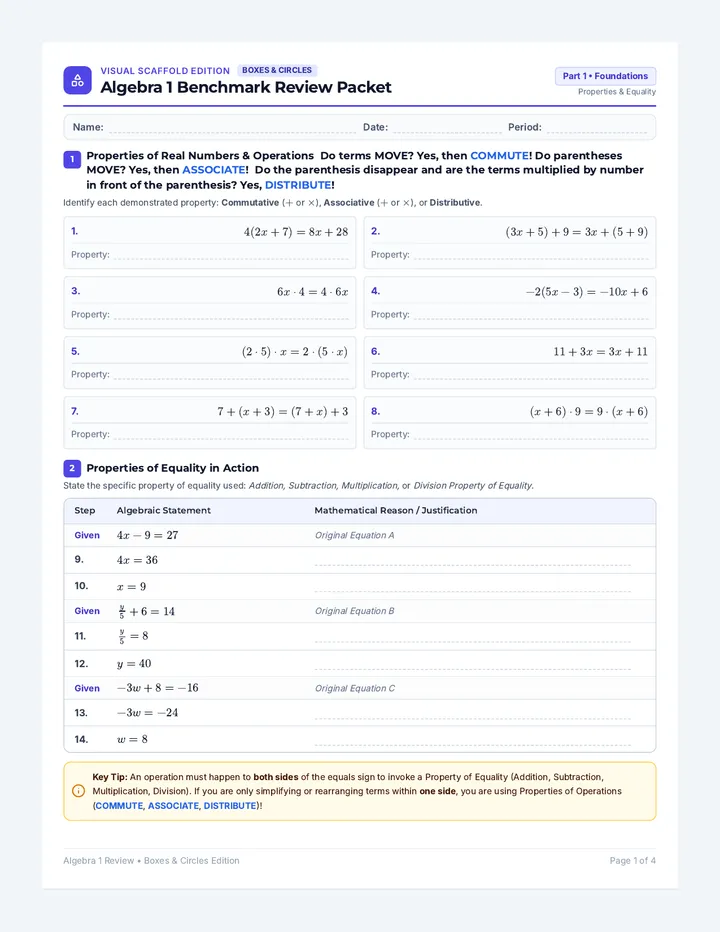
Algebra 1 Benchmark Blitz • Teacher Solutions Page 1 of 4
3
Answer Key & Question 20 Analysis
A. Completed Polynomial Identification Table:
| Given Expression | # of Terms | Standard Form | Degree | Leading Coeff. | Constant |
|---|---|---|---|---|---|
| 15. \(5x - 7 + 3x^2\) | 3 | \(3x^2 + 5x - 7\) | 2 | 3 | -7 |
| 16. \(9 - 4x^3\) | 2 | \(-4x^3 + 9\) | 3 | -4 | 9 |
| 17. \(8x + 15x^4 - 2x^2 + 1\) | 4 | \(15x^4 - 2x^2 + 8x + 1\) | 4 | 15 | 1 |
| 18. \(-6x + 19\) | 2 | \(-6x + 19\) | 1 | -6 | 19 |
| 19. \(-x^3 + 5x^5 - 12\) | 3 | \(5x^5 - x^3 - 12\) | 5 | 5 | -12 |
20. Benchmark Question Solution & Trap Rationale Correct Answer: B (\(3x^4 - 2x^2 + 5x - 7\))
Condition Check: Degree = 4 (highest power is \(x^4\)), Leading Coefficient = 3 (coefficient of \(x^4\)), Constant = \(-7\).
21. Error Analysis Solution:
Correction: Expression must be arranged in standard form first: \(10 - 3x + 8x^3 \implies 8x^3 - 3x + 10\). Therefore, Degree = 3 (from \(8x^3\)), Leading Coeff. = 8, and Constant = 10.
22. Trinomial of Degree 3 Key:
Degree 3, 3 terms, leading coeff \(-4\), constant \(9\).
Sample Answers:
\(-4x^3 + 2x + 9\) or \(-4x^3 - 5x^2 + 9\)
23. Simplification & TI-Nspire:
\(3(2x-4)-5(x^2-2x+1)\)
\(=\mathbf{-5x^2 + 16x - 17}\)
TI-Nspire: Store \(x:=3\) → both evaluate to \(-14\). True!
Algebra 1 Benchmark Blitz • Teacher Solutions Page 2 of 4
4
Problems 24 – 31 Solutions
24. \(5(2x - 3) - 7x = 12\) \(x = 9\)
\(10x - 15 - 7x = 12 \implies 3x - 15 = 12\)
\(3x = 27 \implies \mathbf{x = 9}\)
Check: \(5(18-3)-63 = 75-63 = 12 \checkmark\)
25. \(8 - 3(x + 4) = 2x - 19\) \(x = 3\)
\(8 - 3x - 12 = 2x - 19 \implies -3x - 4 = 2x - 19\)
\(-5x = -15 \implies \mathbf{x = 3}\)
Check: \(8-3(7) = -13\); \(2(3)-19 = -13 \checkmark\)
26. \(0.6(2x - 4) - 0.2(3x + 1) = 1.6\) \(x = 7\)
\(1.2x - 2.4 - 0.6x - 0.2 = 1.6\)
\(0.6x - 2.6 = 1.6 \implies 0.6x = 4.2 \implies \mathbf{x = 7}\)
Check: \(0.6(10) - 0.2(22) = 6 - 4.4 = 1.6 \checkmark\)
27. \(4(2x - 1) - 3(x + 5) = 2(x - 3) + 5\) \(x = 6\)
\(8x - 4 - 3x - 15 = 2x - 6 + 5\)
\(5x - 19 = 2x - 1 \implies 3x = 18 \implies \mathbf{x = 6}\)
Check: \(4(11)-3(11)=11\); \(2(3)+5=11 \checkmark\)
28. \(\frac{3x - 5}{4} = \frac{x + 7}{2}\) \(x = 19\)
\(2(3x - 5) = 4(x + 7) \implies 6x - 10 = 4x + 28\)
\(2x = 38 \implies \mathbf{x = 19}\)
Check: \(\frac{52}{4} = 13\); \(\frac{26}{2} = 13 \checkmark\)
29. \(\frac{2}{3}(6x - 9) = 3(x + 1) - 8\) \(x = 1\)
\(4x - 6 = 3x + 3 - 8 \implies 4x - 6 = 3x - 5\)
\(4x - 3x = -5 + 6 \implies \mathbf{x = 1}\)
Check: \(\frac{2}{3}(-3) = -2\); \(3(2)-8 = -2 \checkmark\)
30. \(4(3x - 2) = 2(6x + 5)\) No Solution (\(\emptyset\))
\(12x - 8 = 12x + 10 \implies 12x - 12x = 10 + 8\)
\(-8 = 10\) (Contradiction/False)
No value of \(x\) makes this true → \(\mathbf{No\ Solution}\)
31. \(6x - 2(x - 5) = 4(x + 2) + 2\) Infinitely Many
\(6x - 2x + 10 = 4x + 8 + 2 \implies 4x + 10 = 4x + 10\)
\(10 = 10\) (Identity/Always True)
All real numbers are solutions → \(\mathbf{Infinitely\ Many}\)
Algebra 1 Benchmark Blitz • Teacher Solutions Page 3 of 4
5
Problems 32 – 38 Solutions
Golden Rule: When you divide both sides by a negative number, you MUST reverse (flip) the inequality symbol!
32. \(-2(3x - 5) + 4 < 26\) Solution: \(x > -2\)
\(-6x + 10 + 4 < 26 \implies -6x + 14 < 26\)
\(-6x < 12 \implies \mathbf{x > -2}\) (FLIP < to > when dividing by -6!)
Graph Solution:
-5-4-3-2-101
33. \(4(2x - 3) - 5x \ge 6\) Solution: \(x \ge 6\)
\(8x - 12 - 5x \ge 6 \implies 3x - 12 \ge 6\)
\(3x \ge 18 \implies \mathbf{x \ge 6}\) (Dividing by positive 3: do NOT flip)
Graph Solution:
3456789
34. \(\frac{5 - 2x}{3} \ge 7\) Solution: \(x \le -8\)
\(5 - 2x \ge 21 \implies -2x \ge 16\)
\(\mathbf{x \le -8}\) (FLIP ≥ to ≤ when dividing by -2!)
Graph Solution:
-11-10-9-8-7-6-5
35. \(-0.4(5x - 10) - 3 \ge 9\) Solution: \(x \le -4\)
\(-2x + 4 - 3 \ge 9 \implies -2x + 1 \ge 9\)
\(-2x \ge 8 \implies \mathbf{x \le -4}\) (FLIP ≥ to ≤ when dividing by -2!)
Graph Solution:
-7-6-5-4-3-2-1
36. \(5x - 7 < 2(x + 4) + 3\) Solution: \(x < 6\)
\(5x - 7 < 2x + 8 + 3 \implies 5x - 7 < 2x + 11\)
\(3x < 18 \implies \mathbf{x < 6}\) (Dividing by positive 3: do NOT flip)
Graph Solution:
3456789
37. Solution & Trap Rationale Answer: D (\(k=5\))
\(-5(k - 2) + 4 < -6 \implies -5k + 14 < -6\)
\(-5k < -20 \implies k > 4\) (flipped symbol!)
Choice C (\(k=4\)) is a boundary trap. Only D (\(k=5\)) satisfies \(k > 4\).
38. Solution & Trap Rationale Answer: D (\(m \ge 10\))
\(4(2 - 3m) \le -2(5m + 6) \implies 8 - 12m \le -10m - 12\)
\(-2m \le -20 \implies m \ge 10\) (flip symbol!)
Forgetting to reverse \(\le\) to \(\ge\) leads to incorrect Choice C (\(m \le 10\)).
Algebra 1 Benchmark begins on Wednesday, November 4th and ends on Monday, November 9th!
Algebra 1 Benchmark Blitz • Teacher Solutions Page 4 of 4
Repaso para Examen de Referencia • Álgebra 1 Página 1 de 4
3
Exponentes, Términos y Grado
Forma Estándar Exponentes decrecen de izq. a der.
Grado Exponente más alto de la variable
Coef. Principal Coeficiente de mayor potencia
Constante Término sin variable
A. Cuenta los términos, reescribe en forma estándar e identifica los componentes clave:
| Expresión Dada | # de Términos | Forma Estándar | Grado | Coef. Princ. | Constante |
|---|---|---|---|---|---|
| 15. \(5x - 7 + 3x^2\) | |||||
| 16. \(9 - 4x^3\) | |||||
| 17. \(8x + 15x^4 - 2x^2 + 1\) | |||||
| 18. \(-6x + 19\) | |||||
| 19. \(-x^3 + 5x^5 - 12\) |
20 Pregunta de Forma Estándar para Examen
Opción Múltiple
¿Qué polinomio tiene grado 4, un coeficiente principal de 3 y un término constante de \(-7\)?
A \(3x^2 - 2x^4 + 5x - 7\)
B \(3x^4 - 2x^2 + 5x - 7\)
C \(-7x^4 + 3x^2 - 2x + 5\)
D \(3x^4 - 2x^2 + 5x + 7\)
21. Análisis de Error: Encuentra y Corrige el Error
Afirmación del Estudiante: "Para la expresión \(10 - 3x + 8x^3\), el coeficiente principal es 10 porque es el primer número escrito, y el grado es 1 porque \(x\) viene después."
Explica por qué el estudiante está equivocado e indica el grado y el coeficiente principal correctos:
22. Construye un Polinomio:
Escribe un trinomio de grado 3 en forma estándar con un coeficiente principal de \(-4\) y una constante de \(9\).
Tu Polinomio:
23. Simplifica y Verifica: TI-Nspire
Simplifica: \(3(2x - 4) - 5(x^2 - 2x + 1)\)
TI-Nspire: ¡Evalúa un valor (ej. \(x=3\)) para comprobar equivalencia!
Repaso para Examen de Referencia • Álgebra 1 Página 2 de 4
4
Muestra todos los pasos algebraicos abajo
Solución: \(x =\)
Solución: \(x =\)
Solución: \(x =\)
Solución: \(x =\)
Solución: \(x =\)
Solución: \(x =\)
Solución: 𝑥 =
Solución: 𝑥 =
Repaso para Examen de Referencia • Álgebra 1 Página 3 de 4
5
Área de Resolución Optimizada
Regla de Oro: Cuando divides ambos lados entre un número negativo, ¡DEBES invertir (cambiar de sentido) el símbolo de la desigualdad!
Solución:
Gráfica:
-5-4-3-2-101
Solución:
Gráfica:
3456789
Solución:
Gráfica:
-11-10-9-8-7-6-5
Solución:
Gráfica:
-7-6-5-4-3-2-1
Solución:
Gráfica:
3456789
37. Preparación de Examen Ítem 1
¿Qué valor de \(k\) hace que
\(-5(k - 2) + 4 < -6\) sea VERDADERO?
A \(k = 2\)
B \(k = 3\)
C \(k = 4\)
D \(k = 5\)
Justifica:
38. Preparación de Examen Ítem 2
¿Qué desigualdad representa todas las soluciones de:
\(4(2 - 3m) \le -2(5m + 6)\)?
A \(m \le -10\)
B \(m \ge -10\)
C \(m \le 10\)
D \(m \ge 10\)
Justifica:
¡El Examen de Referencia de Álgebra 1 comienza el miércoles 4 de noviembre y termina el lunes 9 de noviembre!
Repaso para Examen de Referencia • Álgebra 1 Página 4 de 4
Repaso de Álgebra 1 • Soluciones para el Docente Página 1 de 4
3
Soluciones y Análisis
A. Tabla de Identificación de Polinomios Completa:
| Expresión Dada | # de Términos | Forma Estándar | Grado | Coef. Princ. | Constante |
|---|---|---|---|---|---|
| 15. \(5x - 7 + 3x^2\) | 3 | \(3x^2 + 5x - 7\) | 2 | 3 | -7 |
| 16. \(9 - 4x^3\) | 2 | \(-4x^3 + 9\) | 3 | -4 | 9 |
| 17. \(8x + 15x^4 - 2x^2 + 1\) | 4 | \(15x^4 - 2x^2 + 8x + 1\) | 4 | 15 | 1 |
| 18. \(-6x + 19\) | 2 | \(-6x + 19\) | 1 | -6 | 19 |
| 19. \(-x^3 + 5x^5 - 12\) | 3 | \(5x^5 - x^3 - 12\) | 5 | 5 | -12 |
20. Solución de Examen y Trampas Comunes Respuesta Correcta: B (\(3x^4 - 2x^2 + 5x - 7\))
Verificación de Condiciones: Grado = 4, Coeficiente Principal = 3, Constante = \(-7\).
21. Solución de Análisis de Error:
Corrección: Se debe ordenar en forma estándar primero: \(10 - 3x + 8x^3 \implies 8x^3 - 3x + 10\). Por lo tanto, Grado = 3, Coeficiente Principal = 8 y Constante = 10.
22. Trinomio de Grado 3: Clave
Grado 3, 3 términos, coef. principal \(-4\), constante \(9\).
Respuestas Muestra:
\(-4x^3 + 2x + 9\) o \(-4x^3 - 5x^2 + 9\)
23. Simplificación y TI-Nspire:
\(3(2x-4)-5(x^2-2x+1)\)
\(=\mathbf{-5x^2 + 16x - 17}\)
TI-Nspire: Al guardar \(x:=3\) ambos evalúan a \(-14\). ¡Verificado!
Repaso de Álgebra 1 • Soluciones para el Docente Página 2 of 4
4
Soluciones de Problemas 24 – 31
24. \(5(2x - 3) - 7x = 12\) \(x = 9\)
\(10x - 15 - 7x = 12 \implies 3x - 15 = 12\)
\(3x = 27 \implies \mathbf{x = 9}\)
Comprobación: \(5(15)-63 = 12 \checkmark\)
25. \(8 - 3(x + 4) = 2x - 19\) \(x = 3\)
\(8 - 3x - 12 = 2x - 19 \implies -3x - 4 = 2x - 19\)
\(-5x = -15 \implies \mathbf{x = 3}\)
Comprobación: \(8-21 = -13\); \(6-19 = -13 \checkmark\)
26. \(0.6(2x - 4) - 0.2(3x + 1) = 1.6\) \(x = 7\)
\(1.2x - 2.4 - 0.6x - 0.2 = 1.6\)
\(0.6x - 2.6 = 1.6 \implies 0.6x = 4.2 \implies \mathbf{x = 7}\)
Comprobación: \(6 - 4.4 = 1.6 \checkmark\)
27. \(4(2x - 1) - 3(x + 5) = 2(x - 3) + 5\) \(x = 6\)
\(8x - 4 - 3x - 15 = 2x - 6 + 5\)
\(5x - 19 = 2x - 1 \implies 3x = 18 \implies \mathbf{x = 6}\)
Comprobación: \(44-33 = 11\); \(6+5 = 11 \checkmark\)
28. \(\frac{3x - 5}{4} = \frac{x + 7}{2}\) \(x = 19\)
\(2(3x - 5) = 4(x + 7) \implies 6x - 10 = 4x + 28\)
\(2x = 38 \implies \mathbf{x = 19}\)
Comprobación: \(\frac{52}{4}=13\); \(\frac{26}{2}=13 \checkmark\)
29. \(\frac{2}{3}(6x - 9) = 3(x + 1) - 8\) \(x = 1\)
\(4x - 6 = 3x + 3 - 8 \implies 4x - 6 = 3x - 5\)
\(4x - 3x = -5 + 6 \implies \mathbf{x = 1}\)
Comprobación: \(\frac{2}{3}(-3) = -2\); \(6-8 = -2 \checkmark\)
30. \(4(3x - 2) = 2(6x + 5)\) Sin Solución (\(\emptyset\))
\(12x - 8 = 12x + 10 \implies 12x - 12x = 10 + 8\)
\(-8 = 10\) (Contradicción/Falso)
Ningún valor de \(x\) hace esto verdadero → \(\mathbf{Sin\ Solución}\)
31. \(6x - 2(x - 5) = 4(x + 2) + 2\) Infinitas Soluciones
\(6x - 2x + 10 = 4x + 8 + 2 \implies 4x + 10 = 4x + 10\)
\(10 = 10\) (Identidad/Siempre Verdadero)
Todos los números reales son soluciones → \(\mathbf{Infinitas}\)
Repaso de Álgebra 1 • Soluciones para el Docente Página 3 de 4
5
Soluciones de Problemas 32 – 38
Regla de Oro: Cuando divides ambos lados entre un número negativo, ¡DEBES invertir (cambiar de sentido) el símbolo de la desigualdad!
32. \(-2(3x - 5) + 4 < 26\) Solución: \(x > -2\)
\(-6x + 10 + 4 < 26 \implies -6x + 14 < 26\)
\(-6x < 12 \implies \mathbf{x > -2}\) (¡INVIERTE < a > al dividir entre -6!)
Gráfica:
-5-4-3-2-101
33. \(4(2x - 3) - 5x \ge 6\) Solución: \(x \ge 6\)
\(8x - 12 - 5x \ge 6 \implies 3x - 12 \ge 6\)
\(3x \ge 18 \implies \mathbf{x \ge 6}\) (División positiva: no se invierte)
Gráfica:
3456789
34. \(\frac{5 - 2x}{3} \ge 7\) Solución: \(x \le -8\)
\(5 - 2x \ge 21 \implies -2x \ge 16\)
\(\mathbf{x \le -8}\) (¡INVIERTE ≥ a ≤ al dividir entre -2!)
Gráfica:
-11-10-9-8-7-6-5
35. \(-0.4(5x - 10) - 3 \ge 9\) Solución: \(x \le -4\)
\(-2x + 4 - 3 \ge 9 \implies -2x + 1 \ge 9\)
\(-2x \ge 8 \implies \mathbf{x \le -4}\) (¡INVIERTE ≥ a ≤ al dividir entre -2!)
Gráfica:
-7-6-5-4-3-2-1
36. \(5x - 7 < 2(x + 4) + 3\) Solución: \(x < 6\)
\(5x - 7 < 2x + 8 + 3 \implies 5x - 7 < 2x + 11\)
\(3x < 18 \implies \mathbf{x < 6}\) (División positiva: no se invierte)
Gráfica:
3456789
37. Solución y Análisis Respuesta: D (\(k=5\))
\(-5(k - 2) + 4 < -6 \implies -5k + 14 < -6\)
\(-5k < -20 \implies k > 4\) (¡símbolo invertido!)
La opción C (\(k=4\)) es el límite no incluido. Solo D (\(k=5\)) es verdadera.
38. Solución y Análisis Respuesta: D (\(m \ge 10\))
\(4(2 - 3m) \le -2(5m + 6) \implies 8 - 12m \le -10m - 12\)
\(-2m \le -20 \implies m \ge 10\) (¡símbolo invertido!)
Olvidar invertir el signo lleva al error en la opción C (\(m \le 10\)).
¡El Examen de Referencia de Álgebra 1 comienza el miércoles 4 de noviembre y termina el lunes 9 de noviembre!
Repaso de Álgebra 1 • Soluciones para el Docente Página 4 of 4
Algebra 1 Review • Boxes & Circles Edition Page 1 of 4
3
Exponents, Terms & Degree
[ BOX ] Variable Terms: Find highest exponent & leading coeff.!
( O ) Circle Constants: Terms with no variable attached!
A. Count terms, re-write in standard form, and identify key components:
| Given Expression | # of Terms | Standard Form | Degree | Leading Coeff. | Constant |
|---|---|---|---|---|---|
| 15. \(5x - 7 + 3x^2\) | |||||
| 16. \(9 - 4x^3\) | |||||
| 17. \(8x + 15x^4 - 2x^2 + 1\) | |||||
| 18. \(-6x + 19\) | |||||
| 19. \(-x^3 + 5x^5 - 12\) |
20 Benchmark Standard Form Question
Multiple Choice
Which polynomial has degree 4, a leading coefficient of 3, and a constant term of \(-7\)?
A \(3x^2 - 2x^4 + 5x - 7\)
B \(3x^4 - 2x^2 + 5x - 7\)
C \(-7x^4 + 3x^2 - 2x + 5\)
D \(3x^4 - 2x^2 + 5x + 7\)
21. Error Analysis: Spot and Correct the Mistake
Student Claim: "For the expression \(10 - 3x + 8x^3\), the leading coefficient is 10 because it is the first number written, and the degree is 1 because \(x\) comes next."
Explain why the student is incorrect and state the actual degree and leading coefficient:
22. Build a Polynomial:
Write a trinomial of degree 3 in standard form with a leading coefficient of \(-4\) and a constant of \(9\).
Your Polynomial:
23. Simplify & TI-Nspire Check: TI-Nspire
Simplify: \(3(2x - 4) - 5(x^2 - 2x + 1)\)
TI-Nspire: Test a value (e.g. \(x=3\)) to verify equivalence!
Algebra 1 Review • Boxes & Circles Edition Page 2 of 4
4
Maximized Solving Space
= Combined Variable Term = Combined Constant Term Dashed line = Balance Wall
Solution: \(x =\)
Solution: \(x =\)
Solution: \(x =\)
Solution: \(x =\)
Solution: \(x =\)
Solution: \(x =\)
Conclusion:
Conclusion:
Algebra 1 Review • Boxes & Circles Edition Page 3 of 4
5
Maximized Solving Area
Golden Rule: When you divide both sides by a negative number, you MUST reverse (flip) the inequality symbol!
Graph Solution:
-5-4-3-2-101
Solution:
Graph Solution:
3456789
Solution:
Graph Solution:
-11-10-9-8-7-6-5
Solution:
Graph Solution:
-7-6-5-4-3-2-1
Solution:
Graph Solution:
3456789
Solution:
37. Benchmark Test Prep Item 1
Which value of \(k\) makes
\(-5(k - 2) + 4 < -6\) TRUE?
A \(k = 2\)
B \(k = 3\)
C \(k = 4\)
D \(k = 5\)
Justify:
38. Benchmark Test Prep Item 2
Which inequality represents all solutions to:
\(4(2 - 3m) \le -2(5m + 6)\)?
A \(m \le -10\)
B \(m \ge -10\)
C \(m \le 10\)
D \(m \ge 10\)
Justify:
Algebra 1 Benchmark begins on Wednesday, November 4th and ends on Monday, November 9th!
Algebra 1 Review • Boxes & Circles Edition Page 4 of 4