Compound Shapes Area Worksheet
Name:
CCSS 7.G.B.4 & 7.G.B.6
Date:
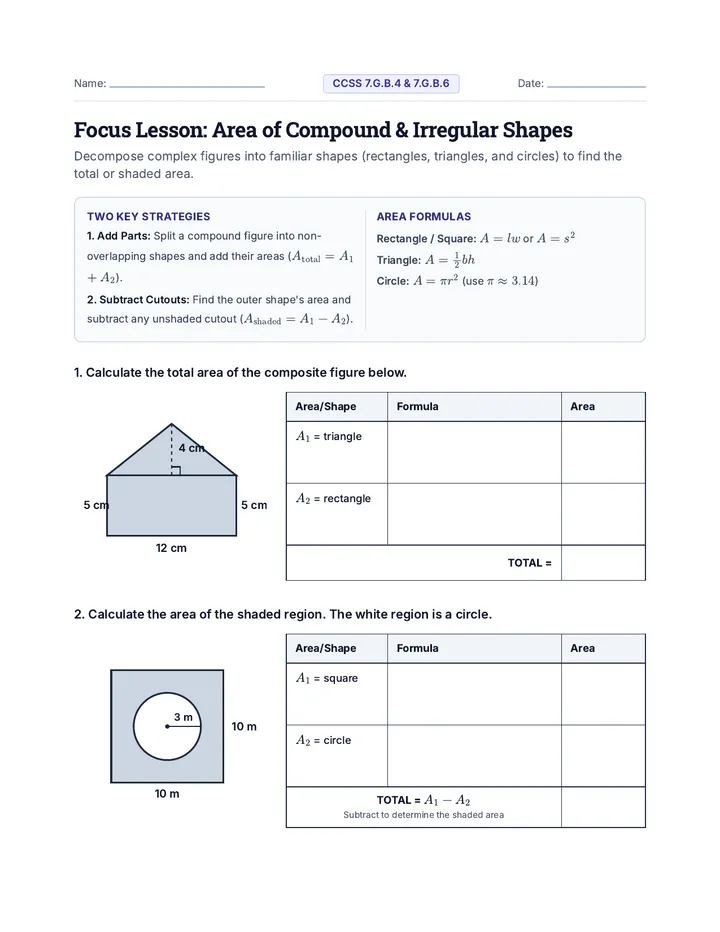
Focus Lesson: Area of Compound & Irregular Shapes
Break complex shapes into rectangles, triangles, and circles to find the area.
2 Easy Steps
• Add Parts: Find each shape's area, then add them together.
• Subtract Cutouts: Find the big shape's area, then subtract the white cutout.
Formulas
Rectangle / Square: \(A = l \times w\)
Triangle: \(A = \frac{1}{2} \times b \times h\)
Circle: \(A = \pi r^2\) (\(\pi \approx 3.14\))
1. Find the total area of the shape below.
4 cm 4 cm 10 cm
| Area/Shape |
Formula |
Area |
| \(A_1\) = triangle |
|
|
| \(A_2\) = rectangle |
|
|
| TOTAL = |
|
|
2. Find the area of the shaded region.
4 m 3 m 10 m 10 m
| Area/Shape |
Formula |
Area |
| \(A_1\) = square |
|
|
| \(A_2\) = rectangle |
|
|
| TOTAL = \(A_1 - A_2\) Subtract to find the shaded area |
|
|
Guided Practice: Composite Figures
CCSS 7.G.B.6
Calculate the area of each figure below.

| Area/Shape |
Formula |
Area |
| \(A_1\) = triangle |
|
|
| \(A_2\) = square |
|
|
| TOTAL = |
|
|
| Area/Shape |
Formula |
Area |
|
|
|
|
|
|
| TOTAL = |
|
|
Guided Practice (continued)
CCSS 7.G.B.4 & 7.G.B.6

| Area/Shape |
Formula |
Area |
| \(A_1\) = circle |
|
|
| \(A_2\) = circle |
|
|
| TOTAL = |
|
|
| Area/Shape |
Formula |
Area |
|
|
|
|
|
|
| TOTAL = |
|
|
Guided Practice: Shaded Regions
CCSS 7.G.B.4 & 7.G.B.6
Calculate the area of the shaded region.

| Area/Shape |
Formula |
Area |
| \(A_1\) = rectangle |
|
|
| \(A_2\) = rectangle |
|
|
| TOTAL = \(A_1 - A_2\) Subtract to determine the shaded area |
|
|
| Area/Shape |
Formula |
Area |
|
|
|
|
|
|
| TOTAL = |
|
|
Guided Practice: Shaded Regions (continued)
CCSS 7.G.B.4 & 7.G.B.6

| Area/Shape |
Formula |
Area |
|
|
|
|
|
|
| TOTAL = |
|
|
| Area/Shape |
Formula |
Area |
|
|
|
|
|
|
| TOTAL = |
|
|
Independent Practice: Composite Figures
CCSS 7.G.B.4 & 7.G.B.6
Calculate the area of each figure below.
1. Determine the area of the gray region.

| Area/Shape |
Formula |
Area |
|
|
|
|
|
|
| TOTAL = |
|
|
2. Determine the area of the blue region. The white region is a square.

| Area/Shape |
Formula |
Area |
|
|
|
|
|
|
| TOTAL = |
|
|
Independent Practice (continued)
CCSS 7.G.B.4 & 7.G.B.6
3. Determine the area of both shapes combined.

| Area/Shape |
Formula |
Area |
|
|
|
|
|
|
| TOTAL = |
|
|
Strategy Check (CCSS 7.G.B.6)
In your own words, how do you decide whether to add areas together or subtract one area from another when solving a compound shape problem?
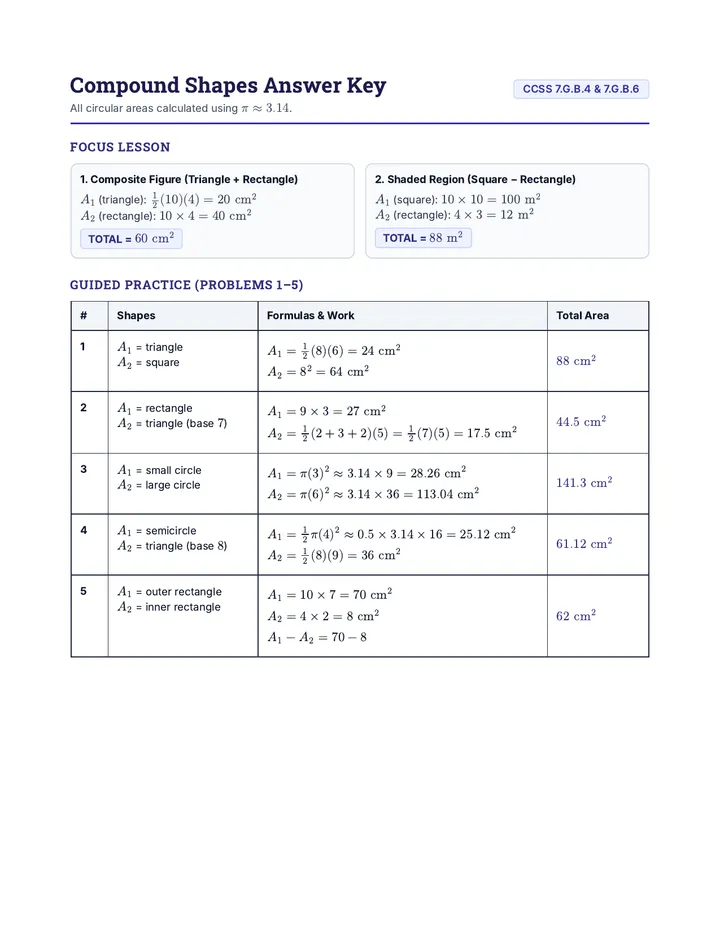
Compound Shapes Answer Key
Compound Shapes Answer Key
All circular areas calculated using \(\pi \approx 3.14\).
CCSS 7.G.B.4 & 7.G.B.6
Focus Lesson
1. Composite Figure (Triangle + Rectangle)
\(A_1\) (triangle): \(\frac{1}{2}(10)(4) = 20\text{ cm}^2\)
\(A_2\) (rectangle): \(10 \times 4 = 40\text{ cm}^2\)
TOTAL = \(60\text{ cm}^2\)
2. Shaded Region (Square − Rectangle)
\(A_1\) (square): \(10 \times 10 = 100\text{ m}^2\)
\(A_2\) (rectangle): \(4 \times 3 = 12\text{ m}^2\)
TOTAL = \(88\text{ m}^2\)
Guided Practice (Problems 1–5)
| # |
Shapes |
Formulas & Work |
Total Area |
| 1 |
\(A_1\) = triangle |
|
|
| \(A_2\) = square |
\(A_1 = \frac{1}{2}(8)(6) = 24\text{ cm}^2\) |
|
|
| \(A_2 = 8^2 = 64\text{ cm}^2\) |
\(88\text{ cm}^2\) |
|
|
| 2 |
\(A_1\) = rectangle |
|
|
| \(A_2\) = triangle (base \(7\)) |
\(A_1 = 9 \times 3 = 27\text{ cm}^2\) |
|
|
| \(A_2 = \frac{1}{2}(2+3+2)(5) = \frac{1}{2}(7)(5) = 17.5\text{ cm}^2\) |
\(44.5\text{ cm}^2\) |
|
|
| 3 |
\(A_1\) = small circle |
|
|
| \(A_2\) = large circle |
\(A_1 = \pi(3)^2 \approx 3.14 \times 9 = 28.26\text{ cm}^2\) |
|
|
| \(A_2 = \pi(6)^2 \approx 3.14 \times 36 = 113.04\text{ cm}^2\) |
\(141.3\text{ cm}^2\) |
|
|
| 4 |
\(A_1\) = semicircle |
|
|
| \(A_2\) = triangle (base \(8\)) |
\(A_1 = \frac{1}{2}\pi(4)^2 \approx 0.5 \times 3.14 \times 16 = 25.12\text{ cm}^2\) |
|
|
| \(A_2 = \frac{1}{2}(8)(9) = 36\text{ cm}^2\) |
\(61.12\text{ cm}^2\) |
|
|
| 5 |
\(A_1\) = outer rectangle |
|
|
| \(A_2\) = inner rectangle |
\(A_1 = 10 \times 7 = 70\text{ cm}^2\) |
|
|
| \(A_2 = 4 \times 2 = 8\text{ cm}^2\) |
|
|
|
| \(A_1 - A_2 = 70 - 8\) |
\(62\text{ cm}^2\) |
|
|
Compound Shapes Answer Key (continued)
CCSS 7.G.B.4 & 7.G.B.6
Guided Practice (Problems 6–8)
| # |
Shapes |
Formulas & Work |
Total Area |
| 6 |
\(A_1\) = outer circle |
|
|
| \(A_2\) = inner circle |
\(A_1 = \pi(4)^2 \approx 3.14 \times 16 = 50.24\text{ cm}^2\) |
|
|
| \(A_2 = \pi(2)^2 \approx 3.14 \times 4 = 12.56\text{ cm}^2\) |
|
|
|
| \(A_1 - A_2 = 50.24 - 12.56\) |
\(37.68\text{ cm}^2\) |
|
|
| 7 |
\(A_1\) = rectangle |
|
|
| \(A_2\) = right triangle |
\(A_1 = 15 \times 10 = 150\text{ cm}^2\) |
|
|
| \(A_2 = \frac{1}{2}(8)(6) = 24\text{ cm}^2\) |
|
|
|
| \(A_1 - A_2 = 150 - 24\) |
\(126\text{ cm}^2\) |
|
|
| 8 |
\(A_1\) = square |
|
|
| \(A_2\) = semicircle (\(r=2\)) |
\(A_1 = 4 \times 4 = 16\text{ ft}^2\) |
|
|
| \(A_2 = \frac{1}{2}\pi(2)^2 \approx 0.5 \times 3.14 \times 4 = 6.28\text{ ft}^2\) |
|
|
|
| \(A_1 - A_2 = 16 - 6.28\) |
\(9.72\text{ ft}^2\) |
|
|
Independent Practice (Problems 1–3)
| # |
Shapes |
Formulas & Work |
Total Area |
| 1 |
\(A_1\) = rectangle |
|
|
| \(A_2\) = \(\frac{3}{4}\) circle (\(r=9\)) |
\(A_1 = 20 \times 18 = 360\text{ in}^2\) |
|
|
| \(A_2 = \frac{3}{4}\pi(9)^2 \approx 0.75 \times 3.14 \times 81 = 190.755\text{ in}^2\) |
|
|
|
| \(A_1 - A_2 = 360 - 190.755 = 169.245\text{ in}^2\) |
\(169.25\text{ in}^2\) |
|
|
| 2 |
\(A_1\) = right triangle |
|
|
| \(A_2\) = square |
\(A_1 = \frac{1}{2}(20)(8.5) = 85\text{ cm}^2\) |
|
|
| \(A_2 = 4 \times 4 = 16\text{ cm}^2\) |
|
|
|
| \(A_1 - A_2 = 85 - 16\) |
\(69\text{ cm}^2\) |
|
|
| 3 |
\(A_1\) = rectangle |
|
|
| \(A_2\) = circle (\(d=10, r=5\)) |
\(A_1 = 15 \times 10 = 150\text{ cm}^2\) |
|
|
| \(A_2 = \pi(5)^2 \approx 3.14 \times 25 = 78.5\text{ cm}^2\) |
|
|
|
| \(A_1 + A_2 = 150 + 78.5\) |
\(228.5\text{ cm}^2\) |
|
|
Strategy Check — Sample Student Response (CCSS 7.G.B.6)
Add areas together when a compound figure is formed by joining two or more non-overlapping shapes side-by-side or on top of each other. Subtract an area when an unshaded shape is cut out from inside a larger shaded shape.