Integer Strings Slides
Number Talk & Problem String
Integer Sign Strings
What happens to multiplication when we walk past zero?
Look for patterns
Explain your reasoning
Use what you know
String 1: Walking Past Zero
Part 1 of 3
\( 4 \times 3 = \)
\( 4 \times 2 = \)
\( 4 \times 1 = \)
\( 4 \times 0 = \)
Notice & Wonder
How does the product change each time the second factor decreases by \( 1 \)?
Solve mentally first. Share your pattern before we cross zero!
String 1: Crossing Zero
Part 2 of 3
\( 4 \times (-1) = \)
\( 4 \times (-3) = \)
\( (-3) \times 4 = \)
If the pattern continues, what must \( 4 \times (-1) \) equal?
How does \( 4 \times (-3) \) help us know \( (-3) \times 4 \)?
Think: groups of negatives AND the commutative property.
String 1: Negative × Negative
Part 3 of 3
\( (-3) \times 2 = \)
\( (-3) \times 1 = \)
\( (-3) \times 0 = \)
\( (-3) \times (-1) = \)
\( (-3) \times (-4) = \)
Track the Direction
As the second factor goes down by \( 1 \), what happens to the product this time?
What does that tell us about \( (-3) \times (-1) \)?
Be ready to justify why the sign flips!
Pause & Synthesize
\( (+) \times (-) \)
Groups of a negative amount move further below zero.
Product: Negative
\( (-) \times (+) \)
Same as \( (+) \times (-) \) by the commutative property.
Product: Negative
\( (-) \times (-) \)
The opposite of a negative product—the pattern keeps climbing!
Product: Positive
Now let’s use relationships—not just rules—to multiply bigger integers!
String 2: Smart Strategies
Part 1 of 2
\( (-5) \times 12 = \)
\( (-5) \times (-12) = \)
\( (-15) \times (-4) = \)
Think Strategically
How can you use \( 10 \)s, or doubling & halving, to solve these without stacking?
Hint: Compare \( (-5) \times (-12) \) with \( (-15) \times (-4) \).
Share at least two different ways to find \( (-15) \times (-4) \).
String 2: Scaling & Over-Under
Part 2 of 2
\( (-25) \times 16 = \)
\( (-19) \times (-4) = \)
Doubling & Halving
Can you double \(-25\) and halve \(16\)? Does the sign stay the same?
Over & Under
How can \( (-20) \times (-4) \) help you find \( (-19) \times (-4) \)?
Determine the sign first, or carry the sign through your strategy!
Exit Challenge
\( (-12) \times (-25) = \)
Solve this problem in two different ways on your recording sheet, and explain how you know the sign of the product.
Strategies to try: Doubling & Halving, Partial Products, or Over & Under Show your thinking!
Integer Strings Teacher Guide
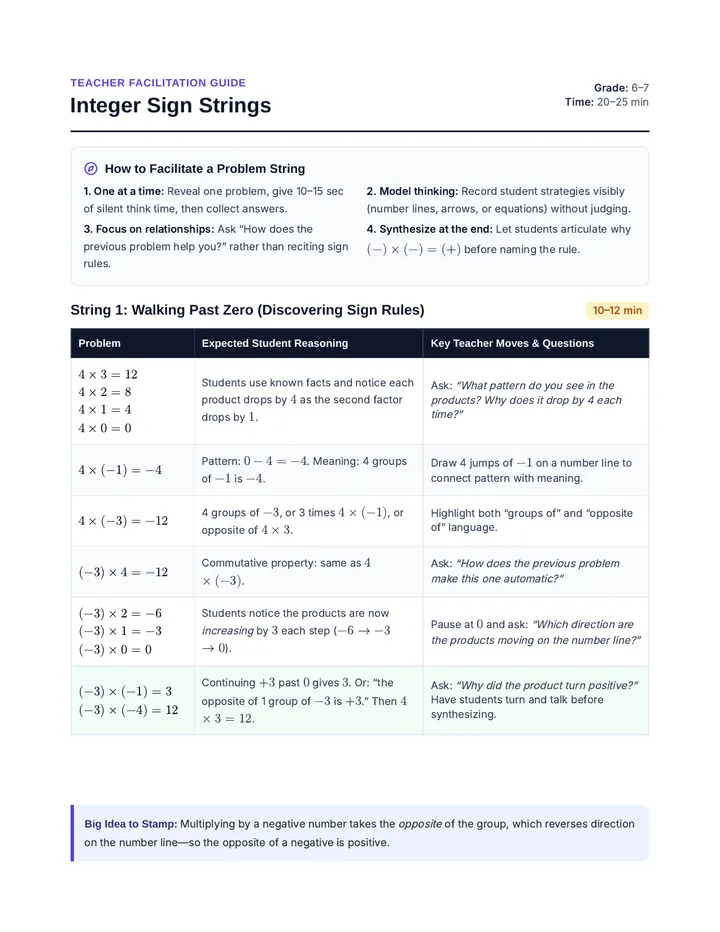
Teacher Facilitation Guide
Integer Sign Strings
Grade: 6–7
Time: 20–25 min
How to Facilitate a Problem String
1. One at a time: Reveal one problem, give 10–15 sec of silent think time, then collect answers.
2. Model thinking: Record student strategies visibly (number lines, arrows, or equations) without judging.
3. Focus on relationships: Ask “How does the previous problem help you?” rather than reciting sign rules.
4. Synthesize at the end: Let students articulate why \( (-) \times (-) = (+) \) before naming the rule.
String 1: Walking Past Zero (Discovering Sign Rules)
10–12 min
| Problem |
Expected Student Reasoning |
Key Teacher Moves & Questions |
| \( 4 \times 3 = 12 \) |
|
|
| \( 4 \times 2 = 8 \) |
|
|
| \( 4 \times 1 = 4 \) |
|
|
| \( 4 \times 0 = 0 \) |
Students use known facts and notice each product drops by \( 4 \) as the second factor drops by \( 1 \). |
Ask: “What pattern do you see in the products? Why does it drop by 4 each time?” |
| \( 4 \times (-1) = -4 \) |
Pattern: \( 0 - 4 = -4 \). Meaning: 4 groups of \(-1\) is \(-4\). |
Draw 4 jumps of \(-1\) on a number line to connect pattern with meaning. |
| \( 4 \times (-3) = -12 \) |
4 groups of \(-3\), or 3 times \( 4 \times (-1) \), or opposite of \( 4 \times 3 \). |
Highlight both “groups of” and “opposite of” language. |
| \( (-3) \times 4 = -12 \) |
Commutative property: same as \( 4 \times (-3) \). |
Ask: “How does the previous problem make this one automatic?” |
| \( (-3) \times 2 = -6 \) |
|
|
| \( (-3) \times 1 = -3 \) |
|
|
| \( (-3) \times 0 = 0 \) |
Students notice the products are now increasing by \( 3 \) each step (\(-6 \to -3 \to 0\)). |
Pause at \( 0 \) and ask: “Which direction are the products moving on the number line?” |
| \( (-3) \times (-1) = 3 \) |
|
|
| \( (-3) \times (-4) = 12 \) |
Continuing \( +3 \) past \( 0 \) gives \( 3 \). Or: “the opposite of 1 group of \(-3\) is \(+3\).” Then \( 4 \times 3 = 12 \). |
Ask: “Why did the product turn positive?” Have students turn and talk before synthesizing. |
Big Idea to Stamp: Multiplying by a negative number takes the opposite of the group, which reverses direction on the number line—so the opposite of a negative is positive.
String 2: Strategic Integer Multiplication
10–12 min
| Problem |
Expected Student Strategies |
Key Teacher Moves & Questions |
| \( (-5) \times 12 = -60 \) |
Use \( (-5) \times 10 + (-5) \times 2 = -50 + (-10) = -60 \), or halve/double to \( (-10) \times 6 = -60 \). |
Model doubling & halving: “Does doubling \(-5\) to \(-10\) and halving \(12\) to \(6\) keep the product equal?” |
| \( (-5) \times (-12) = 60 \) |
Opposite of \( (-5) \times 12 \), so \( +60 \). |
Ask: “How fast can you solve this using the problem right above it?” |
| \( (-15) \times (-4) = 60 \) |
Double & halve: \( (-30) \times (-2) = 60 \). Or triple \(-5\) and divide \(-12\) by \(3\)! |
Point out that \( (-5) \times (-12) \) and \( (-15) \times (-4) \) are equivalent by scaling by \( 3 \) and \( \frac{1}{3} \). |
| \( (-25) \times 16 = -400 \) |
Double & halve twice: \( (-50) \times 8 = (-100) \times 4 = -400 \). Or \( (-25) \times 4 \times 4 \). |
Ask: “Why is \(-25\) a great number to double?” |
| \( (-19) \times (-4) = 76 \) |
Over & Under: \( (-20) \times (-4) = 80 \), then subtract one group of \(-4\)? Care needed: \( 19 \times 4 = 80 - 4 = 76 \), and \( (-) \times (-) = (+) \). |
Encourage determining the sign first (\( + \)), then using \( 20 \times 4 - 1 \times 4 = 76 \), OR \( (-20 + 1) \times (-4) = 80 - 4 = 76 \). |
Common Misconceptions
- Confusing addition & multiplication rules: Students may think \( (-3) \times (-4) = -12 \) because “negative plus negative is negative.” Re-anchor to the pattern \( -6, -3, 0, +3 \).
- Over/Under sign slip: On \( (-19) \times (-4) \), students may add \( 4 \) to \( 80 \) instead of subtracting \( 4 \). Have them estimate \( 19 \times 4 < 80 \) first.
Differentiation & Extensions
- Support: Keep a vertical number line visible during String 1 so students physically track jumps past \( 0 \).
- Extend: Ask students to predict \( (-2) \times (-2) \times (-2) \) and explain why three negatives multiply to a negative.
- Language Support: Pair “opposite of” with arrow flips on the number line.
Exit Challenge Answer Key: \( (-12) \times (-25) = 300 \) 2+ valid strategies
Strategy 1 (Double & Halve): Halve \(-12\) to \(-6\) and double \(-25\) to \(-50\) → \( (-6) \times (-50) = 300 \) (or \( (-3) \times (-100) = 300 \)). Strategy 2 (Partial Products): \( (-10) \times (-25) + (-2) \times (-25) = 250 + 50 = 300 \). Sign: \( (-) \times (-) = (+) \).
Integer Strings Recording Sheet
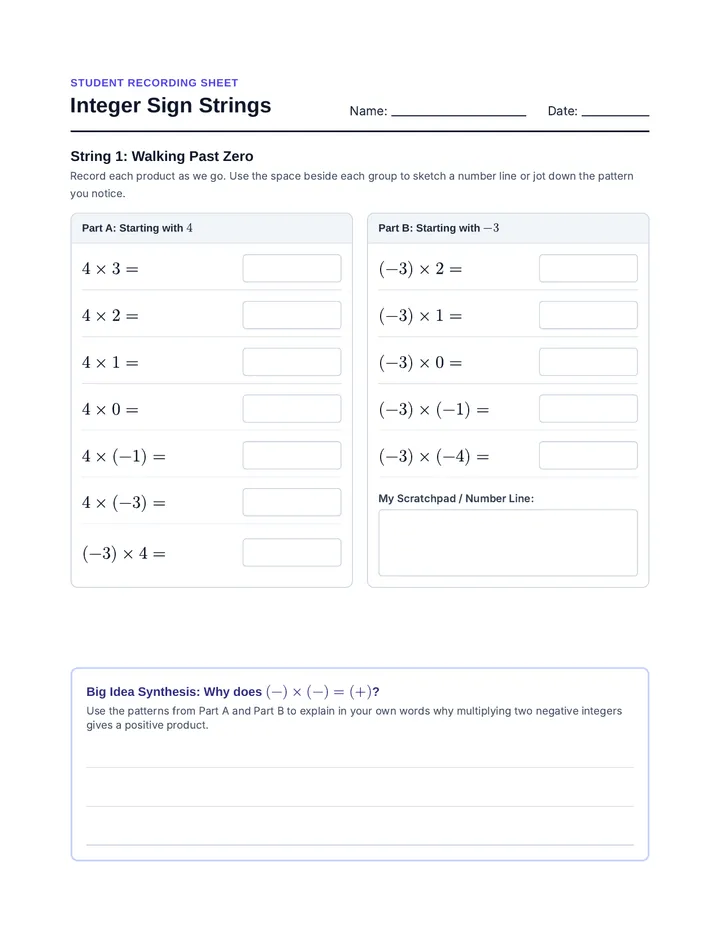
Student Recording Sheet
Integer Sign Strings
Name: ________________________
Date: ____________
String 1: Walking Past Zero
Record each product as we go. Use the space beside each group to sketch a number line or jot down the pattern you notice.
Part A: Starting with \( 4 \)
\( 4 \times 3 = \)
\( 4 \times 2 = \)
\( 4 \times 1 = \)
\( 4 \times 0 = \)
\( 4 \times (-1) = \)
\( 4 \times (-3) = \)
\( (-3) \times 4 = \)
Part B: Starting with \( -3 \)
\( (-3) \times 2 = \)
\( (-3) \times 1 = \)
\( (-3) \times 0 = \)
\( (-3) \times (-1) = \)
\( (-3) \times (-4) = \)
My Scratchpad / Number Line:
Big Idea Synthesis: Why does \( (-) \times (-) = (+) \)?
Use the patterns from Part A and Part B to explain in your own words why multiplying two negative integers gives a positive product.
String 2: Smart Strategies
Show how you used relationships to solve mentally.
1. \( (-5) \times 12 = \) ________
2. \( (-5) \times (-12) = \) ________
3. \( (-15) \times (-4) = \) ________
4. \( (-25) \times 16 = \) ________
5. \( (-19) \times (-4) = \) ________
Exit Challenge: \( (-12) \times (-25) \)
Solve Two Ways
Solve \( (-12) \times (-25) \) using two different strategies (e.g., Doubling & Halving, Partial Products, or Over & Under).
Strategy 1:
Strategy 2:
How do you know the sign of your final product?