Area Architect Slides
Middle School Math
AREA ARCHITECT
Designing the world using quadrilaterals and geometry.
WARM-UP
Quick-Fire Area Check
5 Minutes
1
What is the area formula for a Rectangle?
2
What is the area formula for a Triangle?
3
What is the area formula for a Trapezoid?
Draw them on your worksheet!
RECAP: TRAPEZOIDS & KITES
Watch the focus sections for the special shapes.
Embedded media
Kites (10:40)
Area = \(\frac{1}{2} d_1 d_2\)
Trapezoids (19:20)
Area = \(\frac{1}{2}(b_1 + b_2)h\)
Pay attention to how the diagonals and bases are measured.
AREA ARCHITECT
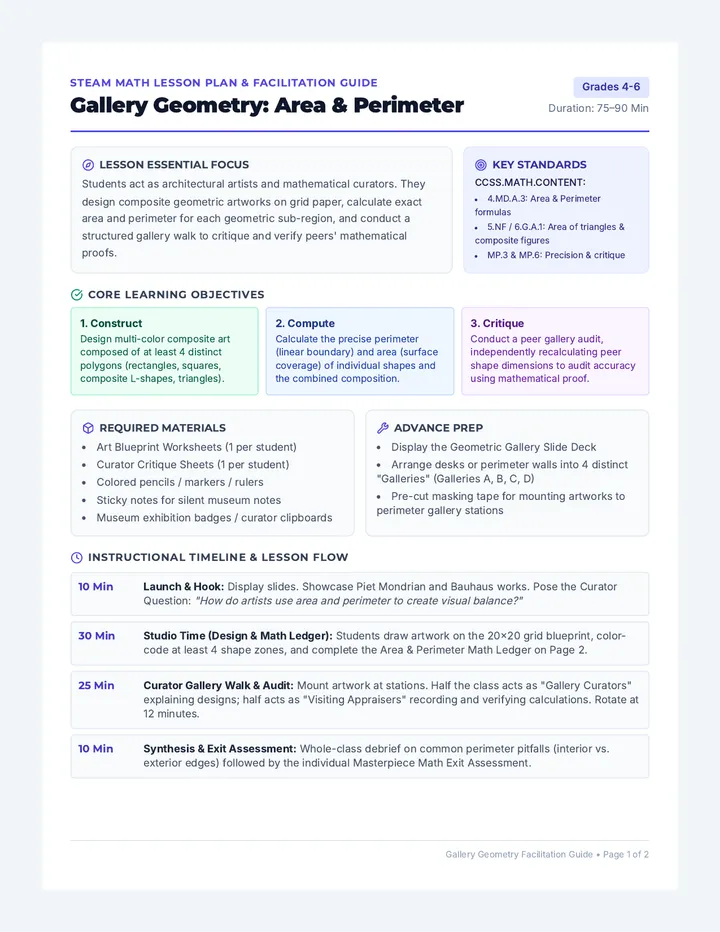
The Design Challenge
25 Minutes
The Mission
Design a Geometry Robot or a Floor Plan. Your creation MUST contain at least one of each:
- Square
- Rectangle
- Parallelogram
- Trapezoid
- Kite
Steps to Success
- Sketch your design on the grid.
- Label dimensions for EVERY shape.
- Calculate the area of each shape.
- Sum them up for the Total Composite Area.
Tip: Use 1 grid square = 1 unit or 1 cm.
Peer Inspection
Trade your design with a neighboring architect.
Verify ONE calculation on their sheet.
Do you get the same area? Sign off if it matches!
Area Architect Worksheet
AREA ARCHITECT
Design Portfolio & Worksheet
Name:
Date:
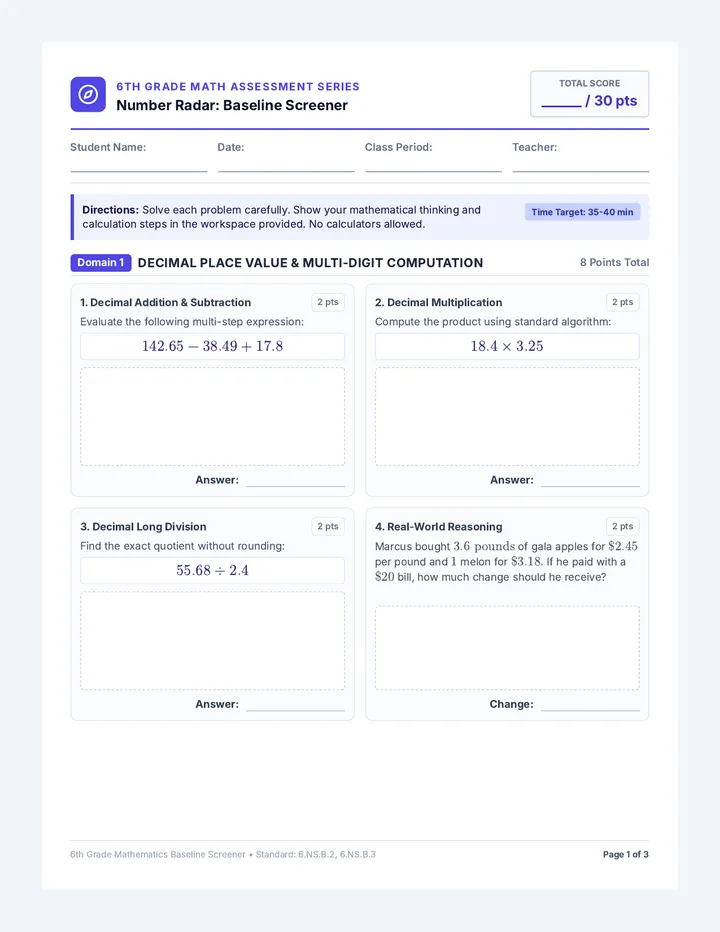
Part 1: Quick-Fire Formula Check
1. Rectangle
2. Triangle
3. Trapezoid
Part 2: The Blueprint
Requirement: 1 Square, 1 Rectangle, 1 Parallelogram, 1 Trapezoid, 1 Kite.
Scale: 1 unit = 1 grid square
Part 3: Area Calculations
| Shape Type | Dimensions (Labels) | Area Calculation | Area (sq units) |
|---|
| | | |
| | | |
| | | |
| | | |
| | | |
| | | |
| Total Composite Area: | | | |
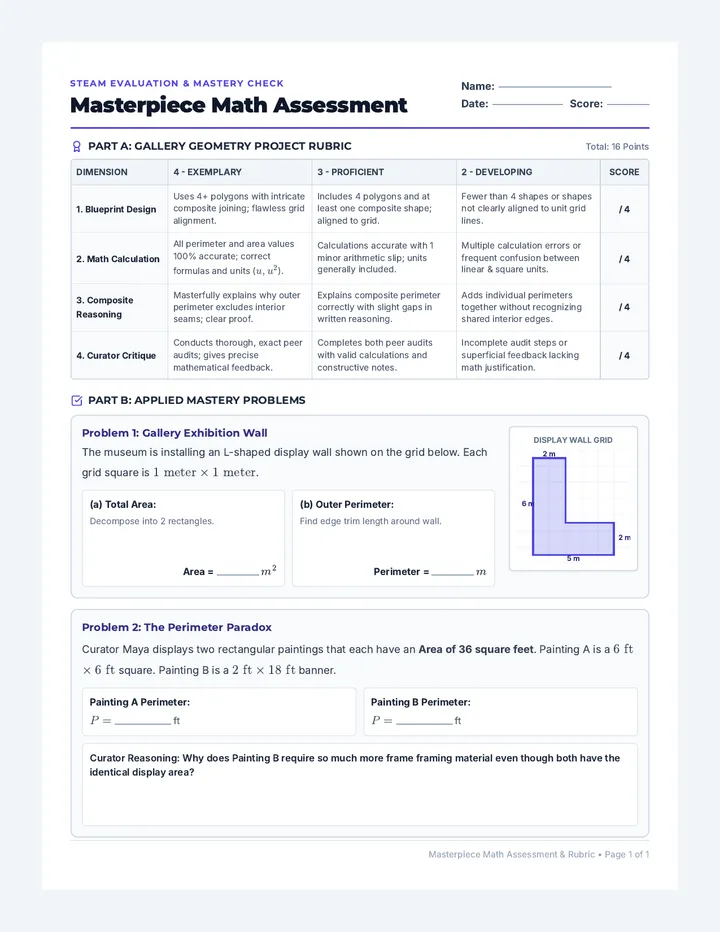
Architect Peer Review
Trade papers. Verify one calculation above and circle it. If correct, sign below.
Verified By:
Area Architect Teacher Guide
Teacher Guide
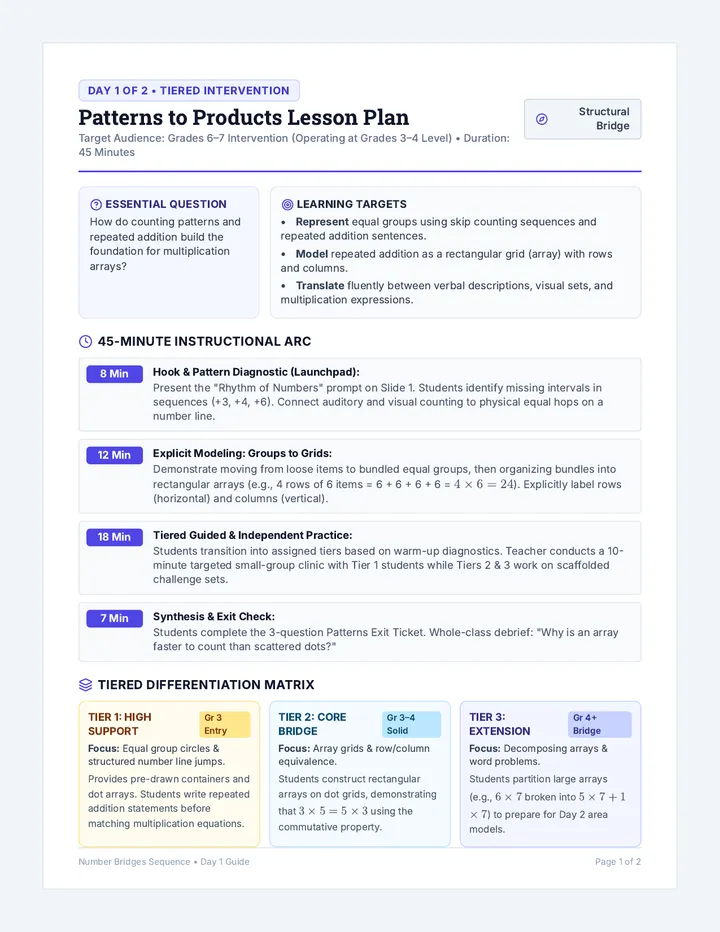
Lesson: Area Architect
Grade Level: 6-8
Duration: 50 Minutes
Objective
Students will apply area formulas for various quadrilaterals (square, rectangle, parallelogram, trapezoid, and kite) to design a complex composite shape, calculate its total area, and perform peer verification.
Key Concepts
- Composite Area
- Quadrilateral Properties
- Formula Application
- Measurement & Scale
Materials Needed
- Rulers / Straightedges
- Student Worksheet
- Colored Pencils (Optional)
- Slide Deck (Presentation)
Lesson Pacing
05 min
Warm-up: Quick-Fire Area Check
Students recall formulas for Rectangle, Triangle, and Trapezoid. Key: Rect: \(L \times W\), Tri: \(\frac{1}{2}bh\), Trap: \(\frac{1}{2}(b_1+b_2)h\).
10 min
Video Recap: Kite & Trapezoid
Watch focal segments. Emphasize that a Kite uses the same area formula as a Rhombus: \(\frac{1}{2} d_1 d_2\). Note that diagonals in a kite are perpendicular.
25 min
Main Activity: Area Architect
Students design their "Geometry Robot" or "Floor Plan". Monitor for: Correct use of grid units, labeling all necessary dimensions (e.g., both bases and height for trapezoids), and logical decomposition.
05 min
Closure: Peer Check
Swap designs. Partners check exactly one shape's area calculation for accuracy. Sign off on the sheet if it's correct.
Differentiation
Support: Provide a checklist of formulas on the board. Suggest specific grid-aligned dimensions (e.g., "Make your trapezoid base 4 and 6, height 2").
Challenge: Require students to include a subtractive area (e.g., a "hole" or "window") where they must subtract one shape from another.
Common Pitfalls
- Confusing height with slant height in parallelograms/trapezoids.
- Forgetting to multiply by 1/2 in triangles, kites, and trapezoids.
- Misidentifying the bases of a trapezoid (the parallel sides).