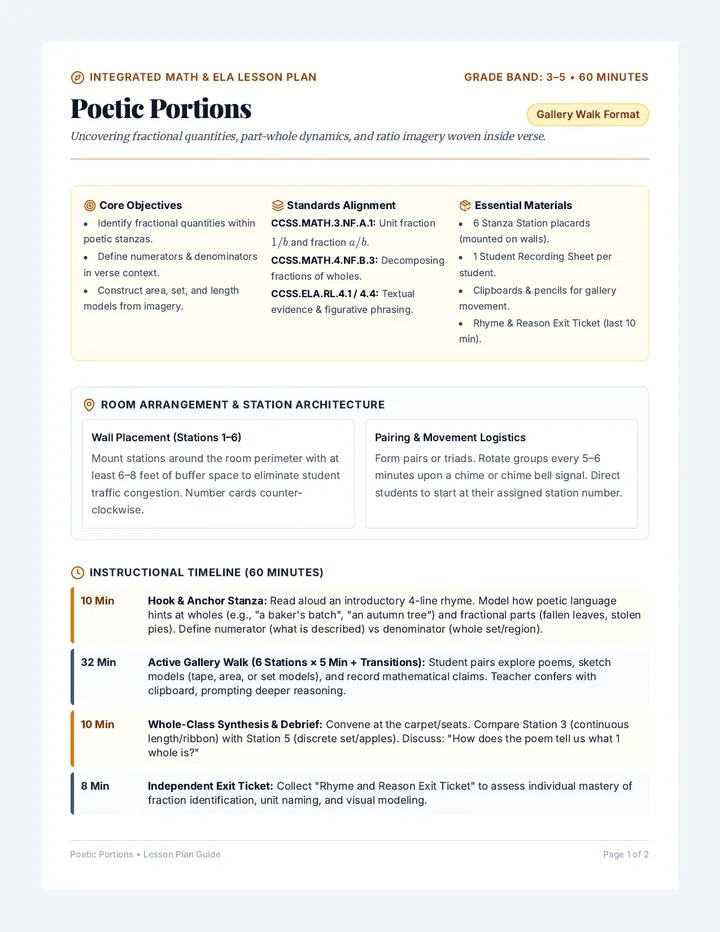
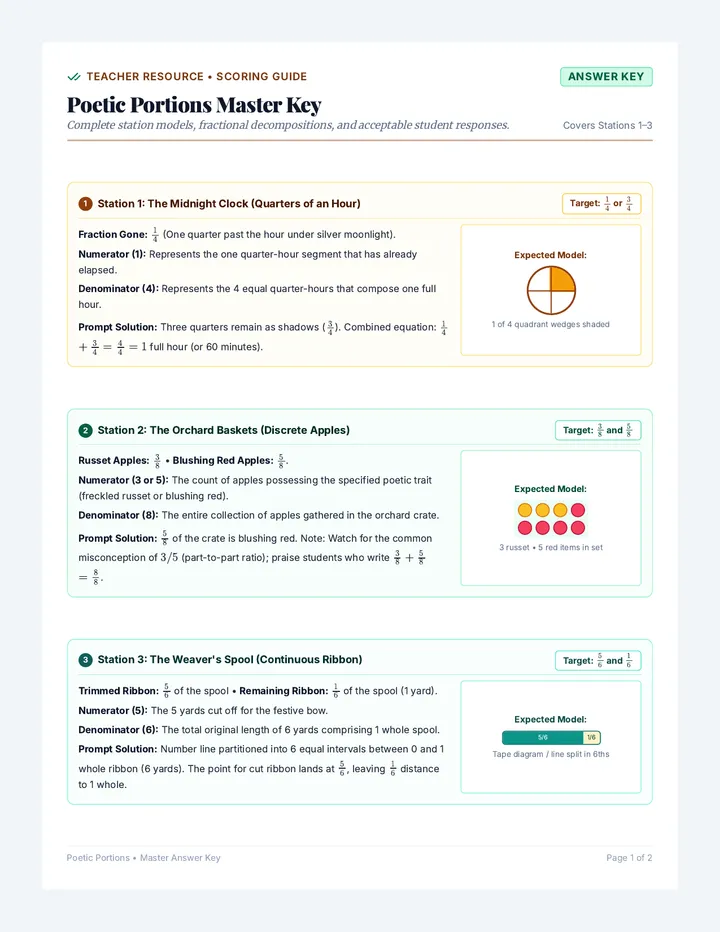
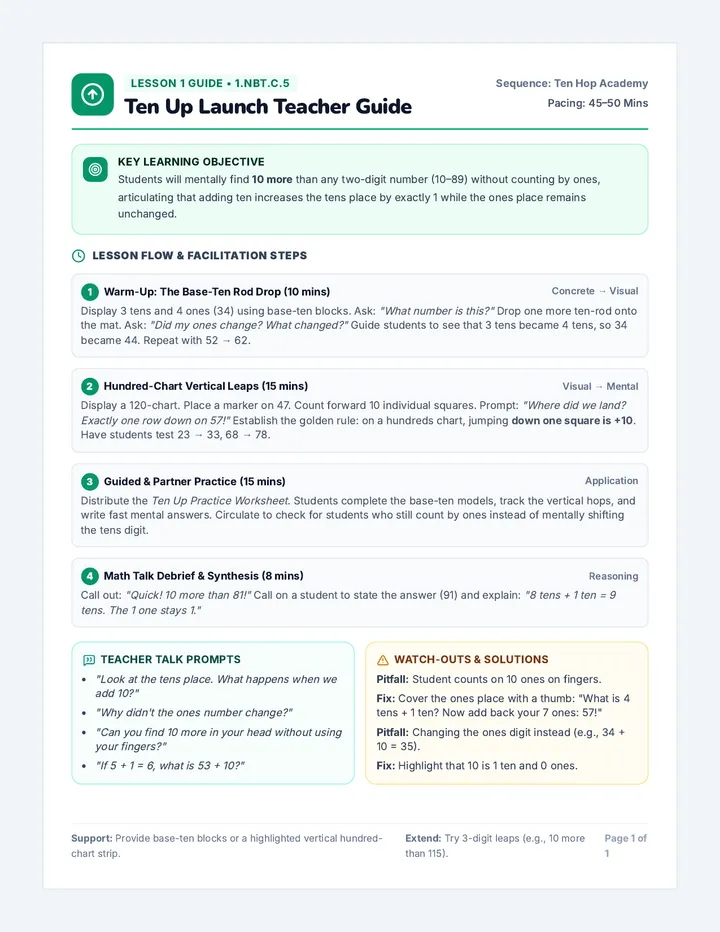
Angle Radar Slides Grade 8 Geometry | Angle Pair Detection
Angle Radar
Detecting and classifying angle relationships: Adjacent, Vertical, Complementary, and Supplementary.
4 Target Relationships Mastery Goal: 80%+ Accuracy
Slide 1 of 7
Framework
The Core Four Angle Relationships
Slide 2 of 7
1. Adjacent Side-by-Side
Share a common vertex and a common ray (arm), but have no overlapping interior points.
"Neighbors sharing a fence"
2. Vertical Opposite
Opposite angles formed by two intersecting straight lines. They are always congruent (equal) !
\( \angle 1 = \angle 3 \) | \( \angle 2 = \angle 4 \)
3. Complementary Sum = 90°
Two angles whose measures add up to exactly 90 degrees (a right angle).
\( \angle A + \angle B = 90^\circ \)
4. Supplementary Sum = 180°
Two angles whose measures add up to exactly 180 degrees (a straight line / linear pair).
\( \angle A + \angle B = 180^\circ \)
Focus: Inspect whether angle pairs are linked by position or by sum.
Positional Relationships
Adjacent vs. Vertical Angles
Slide 3 of 7
A
Adjacent Angles
Vertex V \( \angle 1 \) \( \angle 2 \) Shared Ray
Must share a common vertex.
Must share a common ray (side).
Cannot overlap each other.
V
Vertical Angles
\( \angle 1 \) \( \angle 3 \) \( \angle 4 \) \( \angle 2 \)
Formed by two intersecting straight lines.
Sit across the vertex like an "X".
Always Congruent: \( \angle 1 = \angle 3 \) and \( \angle 2 = \angle 4 \)
Key Rule: Vertical angles are never adjacent because they don't share a side!
Sum-Based Relationships
Complementary vs. Supplementary
Slide 4 of 7
Complementary
Sum = 90°
50° 40°
Memory Radar:
C stands for Corner (a \(90^\circ\) square corner) or Alphabetical order: C comes before S, so \(90^\circ\) comes before \(180^\circ\).
Supplementary
Sum = 180°
125° 55°
Memory Radar:
S stands for Straight line (\(180^\circ\)). Adjacent supplementary angles make a Linear Pair .
Note: Angles do NOT have to touch to be complementary or supplementary!
Class Radar Check
Spot the Angle Relationship
Slide 5 of 7
Diagram A
\( \angle 1 \) \( \angle 3 \)
What is the relationship between \( \angle 1 \) and \( \angle 3 \)?
➜ Vertical Angles (Equal!)
Diagram B
\( \angle a \) \( \angle b \)
What is the relationship between \( \angle a \) and \( \angle b \)?
➜ Adjacent & Complementary
Diagram C
\( 115^\circ \) \( 65^\circ \)
What relationship describes this pair of angles?
➜ Supplementary (Linear Pair)
Pro Tip: Angle pairs can be both adjacent and supplementary or complementary!
Algebraic Applications
Setting Up and Solving for \( x \)
Slide 6 of 7
Case 1: Vertical Angles Equal
Two intersecting lines form opposite angles labeled \( (3x + 10)^\circ \) and \( 70^\circ \).
1. Set them equal:
\( 3x + 10 = 70 \)
2. Subtract 10 from both sides:
\( 3x = 60 \)
3. Divide by 3:
\( x = 20 \)
Case 2: Supplementary Angles Sum = 180°
Two adjacent angles form a straight line and are labeled \( (4x)^\circ \) and \( 60^\circ \).
1. Add and set to 180:
\( 4x + 60 = 180 \)
2. Subtract 60 from both sides:
\( 4x = 120 \)
3. Divide by 4:
\( x = 30 \)
Remember: First identify the relationship, then choose between \( = \) , \( + = 90^\circ \) , or \( + = 180^\circ \) .
Mastery Checkpoint
Your Turn: Angle Radar Worksheet
Slide 7 of 7
1. Classify
Examine the diagram. Identify whether angles share a ray, cross in an X, or form right/straight angles.
2. Calculate
Use known angle sums (\(90^\circ\), \(180^\circ\)) or angle congruence to find the unknown values.
3. Reach 80%+
Complete the 5-part mastery assessment checkpoint with at least 4 of 5 (80%) correct.
Ready for independent practice! Grab your Angle Radar Worksheet.
Goal: 80% (4/5) Mastery
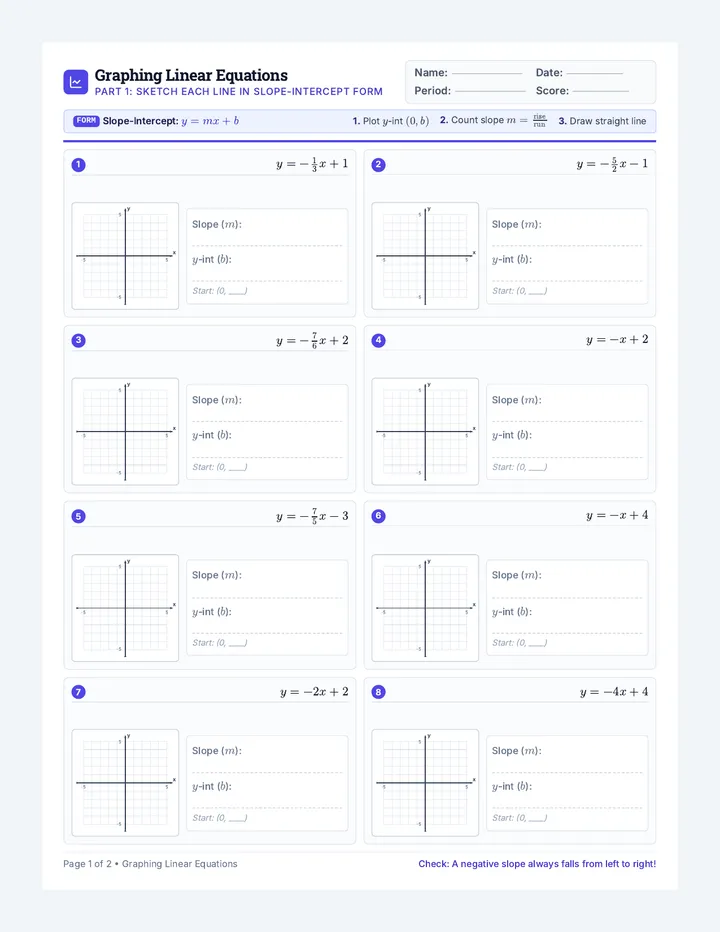
Angle Radar Worksheet Grade 8 Geometry • Standard 8.G.B
Angle Radar Worksheet
Detecting Adjacent, Vertical, Complementary, & Supplementary Angles
Name:
Date: Period:
Adjacent
Share vertex & ray; no overlap.
Vertical
Opposite in straight lines; congruent .
Complementary
Sum equals 90° (right angle).
Supplementary
Sum equals 180° (straight line).
1 Part 1: Diagram Classification
List all relationships that apply (Adjacent, Vertical, Complementary, Supplementary)
Problem 1 Pair: \(\angle 1\) and \(\angle 3\)
∠1 ∠2 ∠3 ∠4
Relationship(s):
Problem 2 Pair: \(\angle AOB\) and \(\angle BOC\)
∠AOB ∠BOC O
Relationship(s):
Problem 3 Pair: \(\angle 1\) and \(\angle 2\)
∠1 ∠2
Relationship(s):
Problem 4 Pair: \(35^\circ\) and \(55^\circ\) (Separate)
35° 55°
Relationship(s):
2 Part 2: Angle Radar True / False Analysis
Read each statement. Circle T (True) or F (False), then write a 1-sentence justification.
1. Two vertical angles can also be adjacent to each other.
T / F
2. Two angles can be supplementary even if they are completely separated and do not touch.
T / F
Angle Radar • 8th Grade Math Page 1 of 2 • Turn over for Part 3 & Mastery Checkpoint
Angle Radar • Solving & Mastery Checkpoint
Apply geometric equations and verify standard mastery
Target Goal 80% Accuracy (4 of 5)
3 Part 3: Find the Missing Measure
Identify the relationship, then write and solve an equation.
Problem 5 Intersection
(2x + 10)° 74°
Relationship:
Equation & Solution:
Value of \(x =\)
Problem 6 Straight Line
132° y°
Relationship:
Equation & Solution:
Value of \(y =\)
4 Part 4: Mastery Checkpoint (Identify the Relationship)
Mastery Target: 4 of 5 (80%)
Select the single best term describing the relationship between the two described angles.
1. Two straight roads intersect forming angles opposite each other across the center. Which relationship correctly defines them?
Angle Radar Answer Key Teacher Guide • Solutions • Grade 8
Angle Radar Answer Key
Annotated Solutions • Page 1 Worksheet Key • Diagnostic Guide
Classroom Answer Key
1 Part 1: Diagram Classification Solutions
Problem 1: \(\angle 1\) and \(\angle 3\) Vertical
Correct Answer: Vertical Angles (also Congruent)
Teacher Insight: Angles 1 and 3 are formed by two intersecting lines and sit directly across the vertex. They share only a vertex, not a common ray, so they are not adjacent.
Problem 2: \(\angle AOB\) and \(\angle BOC\) Adjacent & Comp.
Correct Answer: Adjacent & Complementary
Teacher Insight: They share ray \(OB\) and vertex \(O\). The right angle marker at \(\angle AOC\) confirms their sum is \(90^\circ\). Accept either or both terms.
Problem 3: \(\angle 1\) and \(\angle 2\) Adjacent & Supp.
Correct Answer: Adjacent & Supplementary (Linear Pair)
Teacher Insight: Angles share a ray and together form a straight line (\(180^\circ\)). Emphasize that "linear pair" implies both adjacent and supplementary.
Problem 4: \(35^\circ\) and \(55^\circ\) Complementary
Correct Answer: Complementary (Non-Adjacent)
Teacher Insight: \(35^\circ + 55^\circ = 90^\circ\). Highlight that angles do not need to share a vertex or ray to be complementary; only their sum matters!
2 Part 2: True / False Analysis & Common Misconceptions
Statement 1: Two vertical angles can also be adjacent to each other. FALSE
Model Justification: Vertical angles are formed by opposite rays across a vertex; adjacent angles must share a common side (ray). Because vertical angles never share a ray, they cannot be adjacent.
Statement 2: Two angles can be supplementary even if completely separated. TRUE
Model Justification: The definition of supplementary angles is based solely on their measures adding up to \(180^\circ\). They do not need to share a vertex or form a linear pair to be supplementary.
Instructional Radar Cues
The "Alphabet" Rule
C comes before S in the alphabet, just as 90° comes before 180° on the number line. Complementary = 90°, Supplementary = 180°.
The "Letter Shape" Visual
Turn the C in Complementary into a 9 (add a vertical line → 90). Turn the S in Supplementary into an