Addition Lab Slides Math Lab Review
Addition
Power Up
Adding Two-Digit Numbers with Base Ten Blocks & Place Value
Warm Up
Let's wake up our math brains!
30 + 20 = ?
4 + 5 = ?
Think-Pair-Share
How do the "tens" help us solve 34 + 25 quickly?
1 Build and Combine
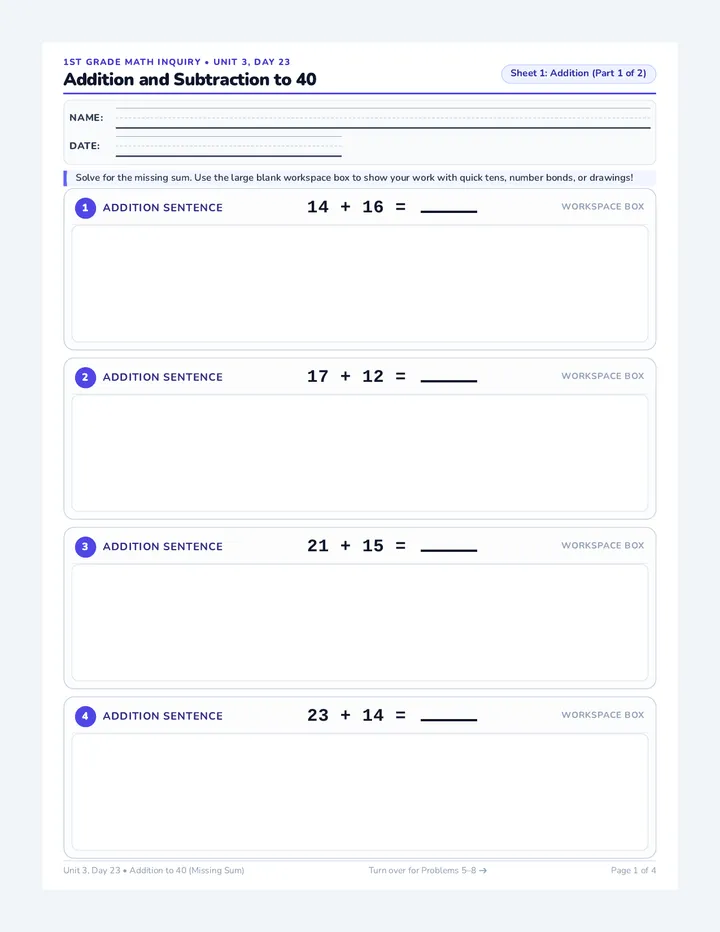
23 + 14 = 37
23
14
Step 1: Add Ones
Combine all units. 3 ones + 4 ones = 7 ones.
Step 2: Add Tens
Combine all rods. 2 tens + 1 ten = 3 tens.
2 The Big Trade (Regrouping)
25 + 18 = ?
13 ones? Too many for the ones place!
TRADE 10 ONES FOR
1. Add the ones: 5 + 8 = 13
2. Regroup: Keep 3 ones, trade 10 ones for a TEN.
3. Add tens: 1 (new) + 2 + 1 = 4
Total: 43
Lab Practice
Time: 2 Minutes
Grab your boards! Use base ten blocks or drawings to solve:
46 + 27 = ?
Build It
4 tens, 6 ones & 2 tens, 7 ones
Trade It
10 ones for 1 ten rod
Solve It
Combine for the final total
Lab Complete
Great work, mathematicians! You mastered the trade. Ready for the Quick Check?
10 Ones
1 Ten Rod
Addition Lab Practice Worksheet Addition Lab Practice
Topic: Two-Digit Addition & Regrouping
Name:
Date:
Researcher Instructions
Show your work by drawing base ten blocks for each problem. Remember: if you have 10 or more ones, you must circle them and trade them for a new tens rod!
Equation 01
32 + 25
Workspace: Draw Base Ten Blocks
Final Solution
Equation 02
46 + 18
Workspace: Draw Base Ten Blocks
Final Solution
Equation 03
27 + 39
Workspace: Draw Base Ten Blocks
Final Solution
Lab Analysis Challenge
Scientist Sam has 54 blue test tubes and 38 green test tubes. How many test tubes does Sam have in total?
Show Work Here
Total Test Tubes:
Double check your regrouping!
Addition Lab Answer Key Addition Lab Answer Key
Teacher Resource • Internal Use Only
Answer Key
Scoring Guidance
Check that students are accurately drawing rods (|) for tens and units (.) for ones. For problems 2 and 3, look for evidence of regrouping (circling 10 ones and showing an arrow to a new ten rod).
Equation 01
32 + 25
MODEL EXAMPLE
Correct Model Drawing
||| ..
|| .....
Correct Sum
57
Equation 02
46 + 18
Correct Model Drawing (Regrouped)
|||| ...... + | ........
Trade 10 ones for 1 ten rod.
Correct Sum
64
Equation 03
27 + 39
Correct Model Drawing (Regrouped)
|| ....... + ||| .........
Trade 10 ones for 1 ten rod.
Correct Sum
66
Challenge Answer
Logic Breakdown
54 + 38 = 92
4 ones + 8 ones = 12 ones (1 ten, 2 ones)
Final Answer
92 Tubes
Addition Lab Teacher Guide Teacher Guide 15-Minute Sprint
Addition Lab
Review
Place Value Focus
Objective
Students will add two-digit numbers using base ten blocks, focusing on regrouping (trading 10 ones for 1 ten rod).
Materials
Addition Lab Slides
Practice Worksheet
Mini-whiteboards
Base Ten Blocks
Total Time
15 MIN
Rapid Review Cycle
Lab Pacing & Flow
2 min
Launch: Warm Up
Use Slide 2 to activate prior knowledge. Ask students to solve the mental math problems on their boards. Focus on the connection between adding pure tens and adding ones.
5 min
Modeling: The Big Trade
Walk through Slides 3 & 4. Emphasize the "Trading" vocabulary.
3 min
Guided Drill
Use Slide 5. Students solve 46 + 27 on their whiteboards. Walk the room to check for the regrouping mark (the new ten rod being added to the tens column).
5 min
Quick Check: Practice Sheet
Distribute the Practice Worksheet. Students work independently. The "Lab Analysis Challenge" at the bottom serves as an extension for fast finishers.
Common Misconceptions
Ignoring the Trade
Students might write "413" for 25 + 18. Remind them that the ones place can only hold a single digit (0-9).
The Phantom Ten
Students trade the ones but forget to add the new ten rod to the tens column total. Have them circle the new rod in a different color.