Lenny.com
Explore
Create
ActivitiesNewMathEnglish Language ArtsScience & EngineeringSocial StudiesGlobal LanguagesHealth & Physical EducationSpecial EducationCounseling & Life SkillsArts & CreativityESL
Lenny.com
Lenny.com
Explore
Create
ActivitiesNewMathEnglish Language ArtsScience & EngineeringSocial StudiesGlobal LanguagesHealth & Physical EducationSpecial EducationCounseling & Life SkillsArts & CreativityESL
Lenny.com
Lenny.com

Solutions

Lenny for EducatorsLenny for SchoolsLenny for Districts

Product

ExploreSign inCreateSupportAbout

Resources

Getting startedMTSS Acceleration Program

© 2026 Lenny Learning Inc.

TermsPrivacyAccessibility
LinkedInInstagramX
Lenny
MathNumbers & CountingCounting ObjectsNumber NamesComparing NumbersNumber OperationsCounting SequenceNumbers 0-10Place Value Understanding and SystemAdd and Subtract Within 20Addition and Subtraction ConceptsAddition and Subtraction EquationsAddition and Subtraction ProblemsFoundations for MultiplicationMultiplication and Division PropertiesMultiply and Divide Within 100Multiplication and Division ProblemsFactors and MultiplesProperties of OperationsPatterns and RelationshipsGenerate and Analyze PatternsMulti-Digit ArithmeticPlace Value OperationsMulti-Digit and Decimal OperationsNumerical ExpressionsFour Operations and PatternsFour Operations Problem SolvingMeasurement & DataMeasurable AttributesMeasuring LengthsMeasure and Estimate Lengths in Standard UnitsRelate Addition and Subtraction to LengthClassifying and Counting ObjectsTime and MoneyArea Concepts and MeasurementPerimeter and Area MeasuresAngle Concepts and MeasurementTime, Volume, and MassMeasurement Unit ConversionsGeometryIdentifying ShapesShapes and AttributesShape Attributes and ReasoningShapes and CompositionClassifying 2D FiguresGeometric Figures and RelationshipsLines, Angles, and ShapesAngle, Area, and VolumeGeometric MeasurementVolume of 3D ShapesCoordinate Plane ApplicationsTransformations in the PlaneCongruence and SimilarityUnderstand congruence in terms of rigid motionsSimilarity and TransformationsProve Theorems Involving SimilarityPythagorean TheoremTrigonometry for General TrianglesMake Geometric ConstructionsProve Geometric TheoremsTheorems About CirclesFind Arc Lengths And Areas of Sectors of CirclesVolume FormulasRelationships Between Two-Dimensional and Three-Dimensional ObjectsProve Simple Geometric Theorems AlgebraicallyTranslate Between Geometric Description and Equation for Conic SectionApply Geometric Concepts in Modeling SituationsFractions & DecimalsFractions as NumbersBuilding FractionsFraction Equivalence and OrderingAdding and Subtracting FractionsMultiplying and Dividing FractionsDividing FractionsDecimal FractionsMulti-Digit Computation and FactorsAdd, Subtract, Multiply, and Divide Rational NumbersRational Number SystemIrrational Numbers and ApproximationsRatiosRatios and ProportionsProportional RelationshipsUnit RateAlgebraAlgebraic ExpressionsGenerate Equivalent ExpressionsQuantitative RelationshipsProportional Relationships and Linear EquationsEquations and InequalitiesEquation Solving and ReasoningLinear Equations and SystemsGraph Equations and InequalitiesSystems of EquationsReal-World Algebraic ProblemsQuantitative Reasoning with UnitsExpression StructureEquivalent Expression FormsRadicals and Integer ExponentsRational ExponentsRational and Irrational NumbersPolynomial OperationsPolynomial IdentitiesPolynomial Zeros and FactorsRational ExpressionsComplex Number OperationsComplex Numbers in PolynomialsComplex Numbers on PlaneStatistics & ProbabilityRepresent and Interpret DataData DistributionsStatistical VariabilityProbability ModelsCompound Event ProbabilitiesStatistical SamplingInterpret Categorical and Quantitative DataBivariate Data PatternsInterpret Linear ModelsComparing Two PopulationsRandom Processes in StatisticsIndependence and Conditional ProbabilityExpected ValuesProbability-Based Decision MakingStatistical Inference and ConclusionsFunctionsFunction Concepts and NotationDefine and Compare FunctionsInterpret Functions in ContextAnalyze Function RepresentationsModel Relationships with FunctionsIdentify Linear vs Exponential GrowthDistinguish Between Function TypesCompare Growth RatesInterpret Function ExpressionsBuild Functions from RelationshipsConstruct and Model FunctionsTransform and Combine FunctionsModel Comparison and SelectionSolve Exponential EquationsTrigonometryTrigonometric Ratios Involving Right TrianglesTrigonometric Functions and Unit CircleModel with Trigonometric FunctionsTrigonometric IdentitiesVectors & MatricesIntroduction to Vectors and MatricesVector QuantitiesVector OperationsMatrix OperationsCalculusLimits and ContinuityDerivative Concepts and NotationDerivative Rules and TechniquesApplications of DerivativesOptimization ProblemsRelated RatesCurve Sketching and AnalysisIntegration Concepts and NotationAntiderivatives and Indefinite IntegralsDefinite Integrals and AreaFundamental Theorem of CalculusIntegration TechniquesApplications of IntegrationDifferential EquationsSequences and SeriesParametric and Polar FunctionsVector-Valued Functions

Math Interim Masters

A focused kindergarten mathematics intervention lesson providing structured interim assessment practice packets with gradual release routines and full-page workspaces for word problems.

Vvictoria.lesniak

Math Interim Masters

A focused kindergarten mathematics intervention lesson providing structured interim assessment practice packets with gradual release routines and full-page workspaces for word problems.

Vvictoria.lesniak

How many baseballs?

Question 1 • Counting Objects to 10 Page 2

2

Find 1 More Than in the Box

Count the objects in the box. Find the group that has 1 MORE than the box.

MAT.KG.CC.B.4c

I Do (Teacher Model) Model: Count the box (2), then find 1 MORE: 2 and 1 more is 3!

Box:

(2 apples)

• 2 in box + 1 more = 3 apples

✓ Bubble the row with 3 apples (1 more than 2!)

We Do (Guided Practice) Count 4 in the box. What is 1 more than 4? (5!) Bubble 5!

Box:

(3 oranges)

(4 oranges - same)

(5 oranges - 1 more!)

You Do (Independent Practice) Which group has 1 MORE than the box?

•

•

•

Fill in the circle next to the group that has 1 MORE strawberry than the box.

Question 2 • One More Than a Set Page 3

3

Equal Sets (Different Objects)

Count the group in the box. Find the set below with the SAME number.

MAT.KG.CC.C.6

I Do (Teacher Model) Count 4 fish in box → Match with 4 shells!

Box (4):

3 starfish

✓ 4 shells (Same!)

We Do (Guided Practice) Count 5 flowers in the box, then find the matching row

4 leaves

5 bees

You Do (Independent Practice) Find the equal set!

rocket

rocket

rocket

rocket

rocket

rocket

Question 3 • Equivalent Sets (Different Objects) Page 4

4

Count & Write Numeral (Grouped Items)

Count items organized in clusters or rows, then write the total numeral.

MAT.KG.CC.B.5

I Do (Teacher Model) Model counting 6 crayons in 3 rows

1

2

3

4

5

6

How many?

6

We Do (Guided Practice) Count 2 on top, 1 in middle, 2 on bottom

How many?

You Do (Independent Practice) Count carefully!

How many blocks?

Question 4 • Counting Grouped Items to 10 Page 5

5

I Do • Teacher Model Word Problem (Addition Result Unknown)

Read • Draw First Group • Draw More • Count All • Circle Answer

Model Strategy

There were 3 frogs sitting on a lily pad.

Then, 3 more frogs hopped onto the lily pad.

How many frogs are on the lily pad now?

Modeled Thinking & Drawing: Step-by-Step Strategy

1. Draw first 3 frogs:

1

2

3

2. Draw 3 more frogs:

4

5

6

3. Count all together and write the number sentence:

3 + 3 = 6

Key Habit: Always circle your final answer so your teacher knows your answer!

Final Answer:

6

Question 5 • I Do (Teacher Model) Page 6

5

We Do • Guided Practice Word Problem (Guided Workspace)

Let's solve together: Draw first group, draw more, circle total!

Guided Practice

There were 5 bunnies hopping in the garden.

Then, 2 more bunnies hopped into the garden.

How many bunnies are in the garden now?

Show your work and circle your answer.

Step 1: Draw 5 • Step 2: Draw 2 more • Step 3: Count all

Draw circles or pictures here...

Teacher Initial:

Concrete Representation Code:

C X

Question 5 • We Do (Guided Practice) Page 7

5

You Do • Independent Practice Word Problem Practice

Word Problem • Addition Result Unknown (6 + 2)

MAT.KG.OA.A.2

There were 6 cats napping in the sunny room.

Then, a friend brought 2 more cats into the room.

How many cats are in the room now?

Show your work and circle your answer.

Teacher Initial:

Concrete Representation Code:

C X

Question 5 • You Do (Independent Practice) Page 8

6

Counting Forward (Multiple Choice)

Say the numbers in order. What number comes next in the counting sequence?

MAT.KG.CC.A.2

I Do (Teacher Model) Model: Say "6, 7...", the next number is 8!

6, 7,

8

6

7

8✓

9

We Do (Guided Practice) Say aloud together: 1, 2... what comes next?

1, 2,

1

2

3

4

You Do (Independent Practice) Fill in the bubble!

7, 8,

6

7

8

9

Question 6 • Counting Forward Sequence Page 9

7

Draw Equivalent Set & Write Number

Count the concrete counters, draw the same number, then write the numeral.

MAT.KG.CC.B.4

I Do (Teacher Model) Model: 3 counters pulled → draw 3 circles → write 3

Bag has 3 counters:

Drawn set: 3 circles • Written:

3

We Do (Guided Practice) Count 7 counters together, draw them, and write 7

Counters:

Draw & write:

You Do (Independent Practice) Count, draw, and write!

Count the number of star counters in your cup. Draw an equivalent set to the number of star counters on the page below. Then, write the number below.

Draw your counters here...

Write the number:

Question 7 • Draw Equivalent Set & Write Numeral Page 10

8

Count Forward & Write Numerals

Count on from the given numbers. Write the next numbers in order on the lines.

MAT.KG.CC.A.2

I Do (Teacher Model) Model: Start at 2, 3... count on: 4, 5, 6, 7

2, 3,

4

5

6

7

We Do (Guided Practice) Say them together: 5, 6, ___, ___, ___, ___

5, 6,

You Do (Independent Practice) Write each number carefully!

3, 4,

Question 8 • Write Consecutive Numbers Page 11

9

Count Both Sets & Circle the Object with More

Count set 1 • Write number • Count set 2 • Write number • Circle object with MORE

MAT.KG.CC.C.6

I Do (Teacher Model) Model: 3 apples vs. 6 bananas → 6 is more than 3, circle bananas!

3

MORE ✓

6

We Do (Guided Practice) Count each row, write numbers, circle the row with MORE!

You Do (Independent Practice) Count, write, & circle more!

1. Count set 1 and write the number. • 2. Count set 2 and write the number. • 3. Circle the object that has MORE.

M

M

M

M

M

Question 9 • Count Both Sets & Circle More Page 12

10

I Do • Teacher Model Word Problem (Addition Result Unknown to 10)

Read • Draw First Group • Draw More • Count All • Circle Answer

Model Strategy

There were 4 apples in a fruit bowl.

Then Liam put 6 more apples into the bowl.

How many apples are in the bowl now?

Modeled Thinking & Drawing: Organized 5-Group Strategy

1. Draw first 4 apples:

1

2

3

4

2. Draw 6 more apples:

5

6

7

8

9

10

3. Write the number sentence:

4 + 6 = 10

Check: 4 and 6 make 10!

Final Answer:

10

Question 10 • I Do (Teacher Model) Page 13

10

We Do • Guided Practice Word Problem (Guided Workspace)

Solve together: Draw first group, draw more, count and circle!

Guided Practice

There were 5 toy cars on a rug.

Then Ava put 4 more toy cars on the rug.

How many toy cars are on the rug now?

Show your work and circle your answer.

Step 1: Draw 5 • Step 2: Draw 4 more • Step 3: Count total

Draw circles or pictures here...

Teacher Initial:

Concrete Representation Code:

C X

Question 10 • We Do (Guided Practice) Page 14

10

You Do • Independent Practice Word Problem Practice

Word Problem • Addition Result Unknown (3 + 7)

MAT.KG.OA.A.2

There were 3 shells in a bucket.

Then Noah put 7 more shells into the bucket.

How many shells are in the bucket now?

Show your work and circle your answer.

Teacher Initial:

Concrete Representation Code:

C X

Question 10 • You Do (Independent Practice) Page 15
You might also like

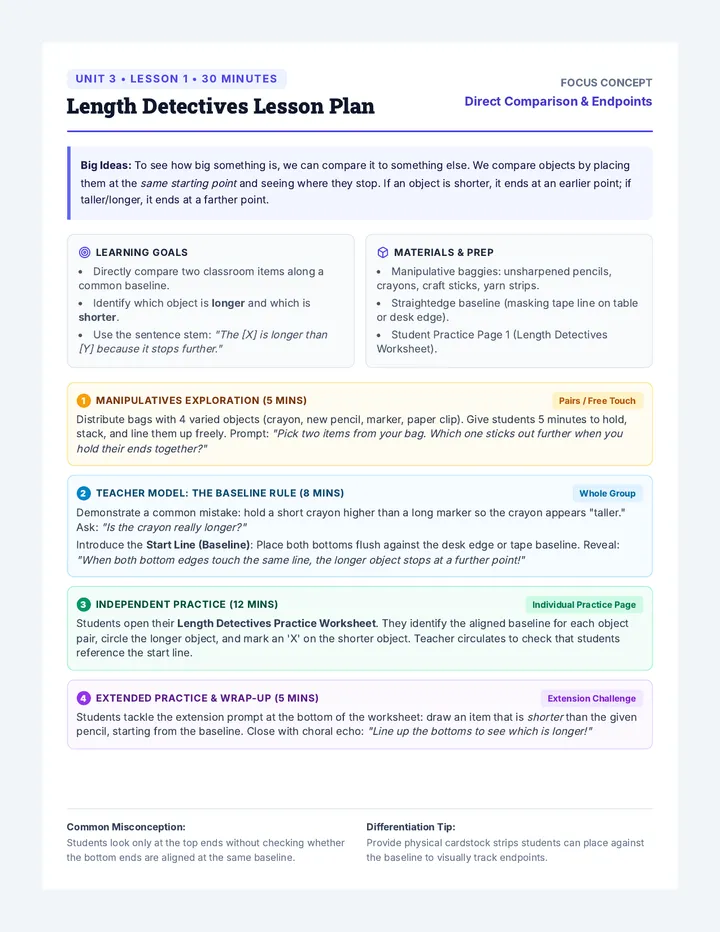
Length Detectives Lesson Plan

Measure and Count Quest

An 8-lesson kindergarten mathematics unit developing foundational concepts of direct length comparison, conservation of number, keeping track to 20, and ordering quantities. Students progress from physical alignment and sorting to abstract numerical comparison and sequence ordering.

V

victoria.lesniak

16
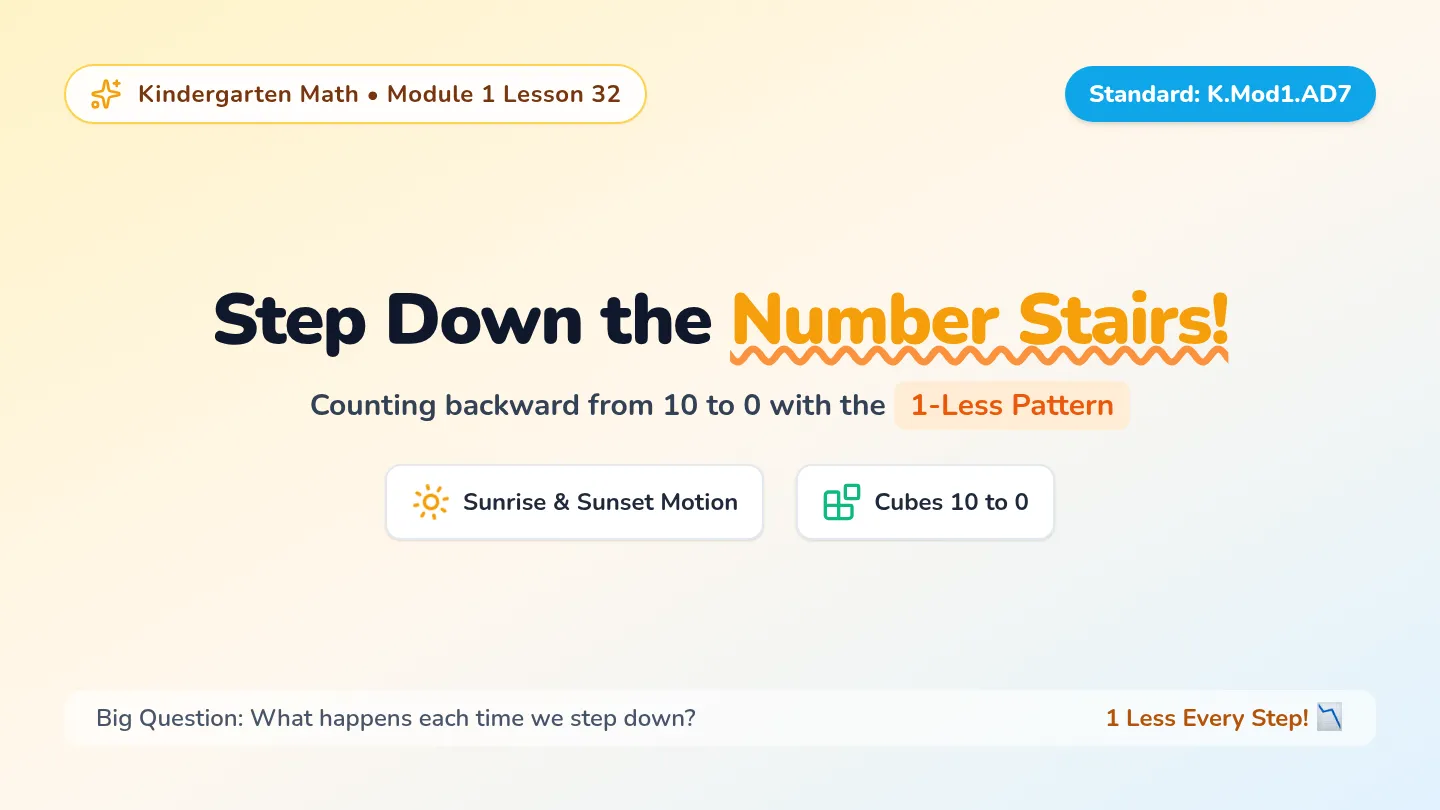
Number Stairs Slides

Number Stairs Countdown

A Kindergarten Eureka Math Lesson 32 resource pack focused on building number stairs to demonstrate the 1-less pattern and backward counting sequence from 10 to 0.

NS

Neelab Sayah

3
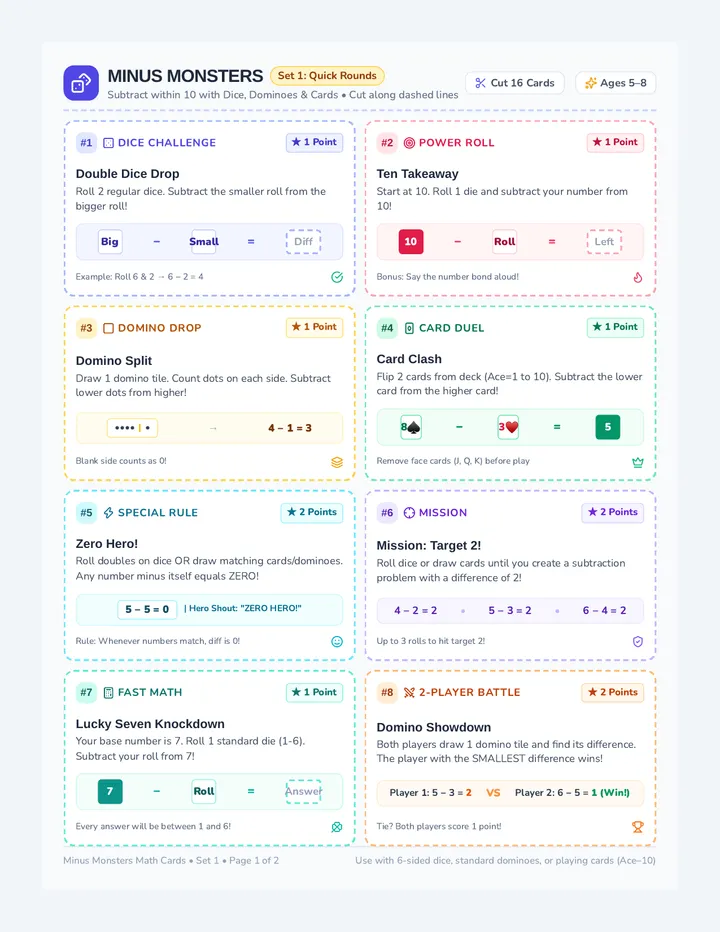
Minus Monsters Challenge Cards

Minus Monsters Challenge Cards

Printable challenge cards for a fast-paced subtraction game within ten using dice, dominoes, and playing cards. Features 16 action-packed game cards covering roll-and-subtract, domino differences, target matches, and bonus challenges.

EB

Evelyn Bibilashvili

Ten Frame Slides

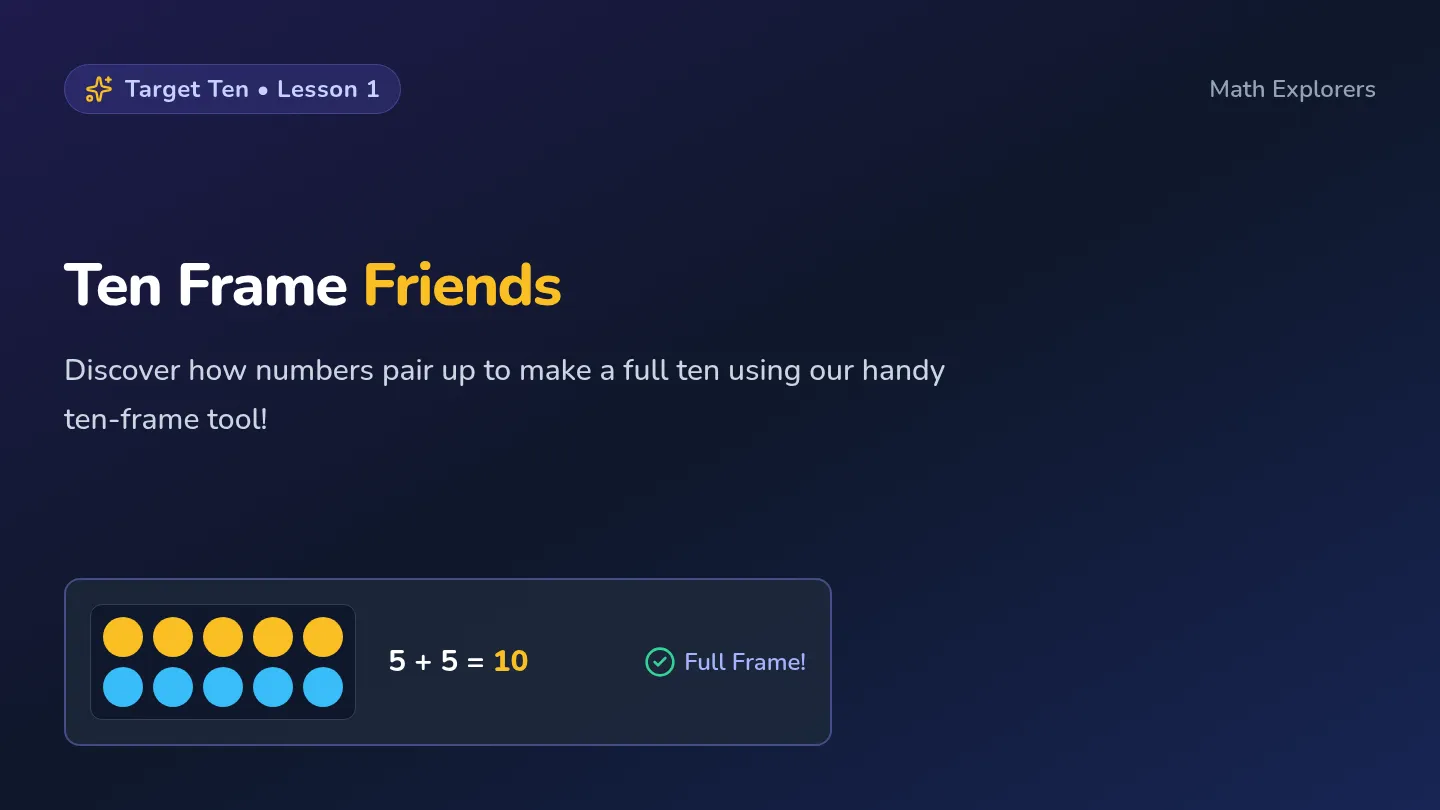
Target Ten

A foundational math sequence engineered to build addition fluency to 10 through concrete ten-frame modeling, number path navigation, and missing addend investigations. Designed with visual scaffolds and structured repetition for students needing extra support.

Lenny Avatar
Lenny
9
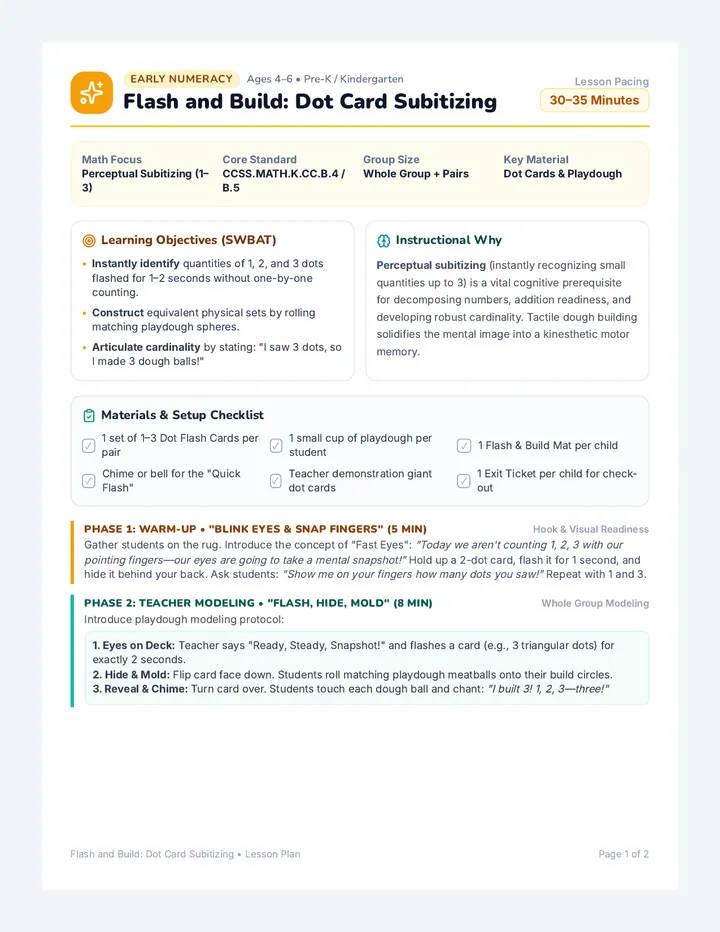
Flash and Build Lesson Plan

Flash and Build

A high-energy foundational early math lesson where preschool and kindergarten students master perceptual subitizing for quantities 1 through 3. Students view rapid visual flashes of dot cards in diverse configurations and immediately replicate the quantities using hands-on playdough spheres.

JW

J Watson

3
Number Stairs Activity Sheet

Number Stairs Activity Sheet

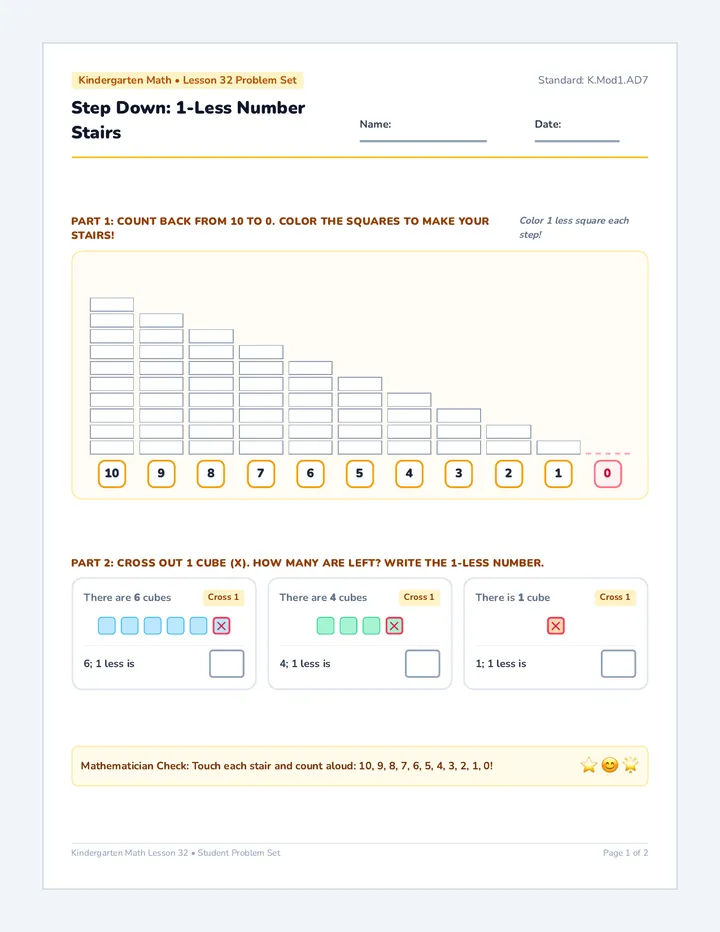
Printable Kindergarten student problem set and hands-on math center mat for coloring, building, and ordering number stairs showing the 1-less pattern from 10 down to 0.

NS

Neelab Sayah

Count Connect Slides

Number Builders

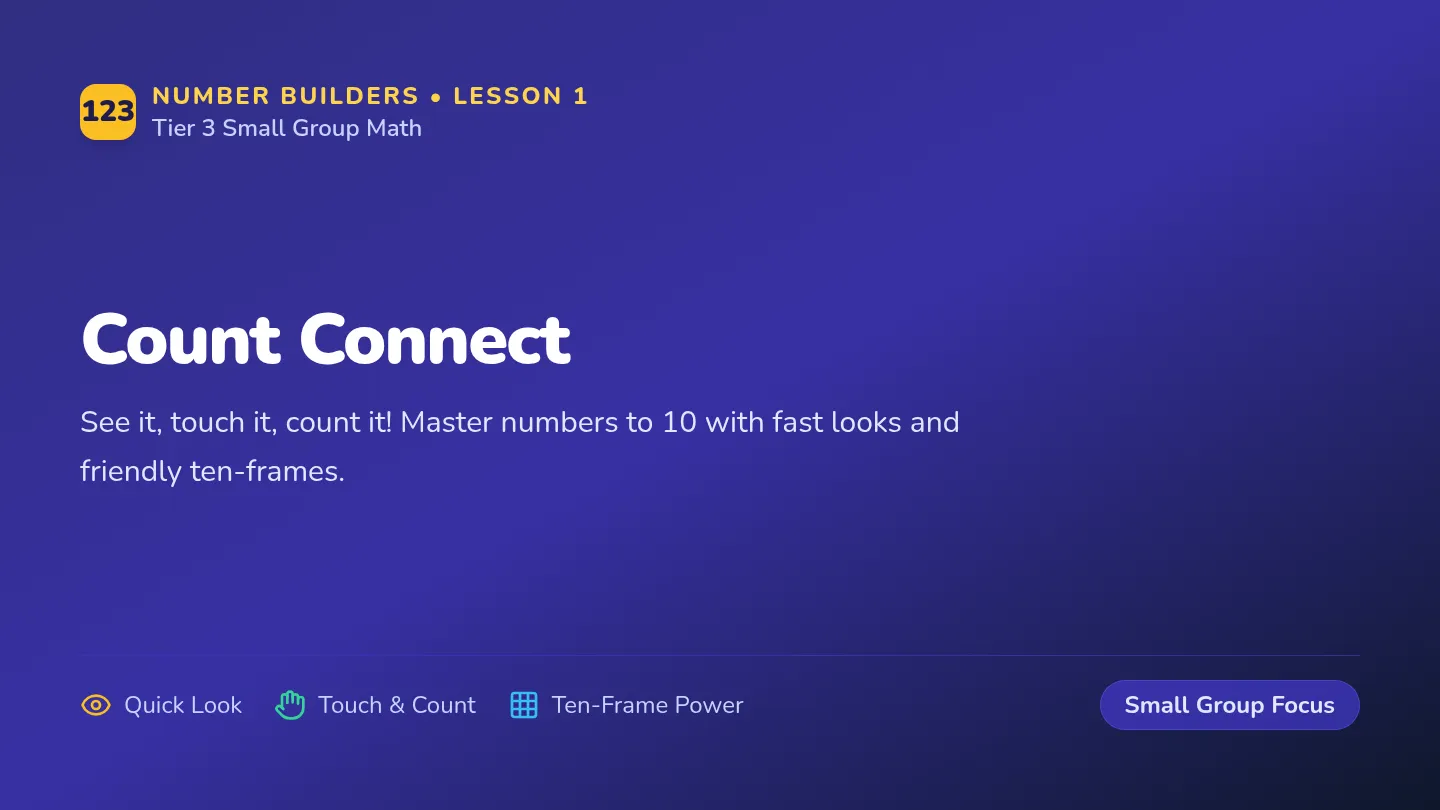
A targeted Tier 3 small-group intervention sequence focused on foundational number sense. Students build core counting, cardinality, and early place-value understanding through structured visual models and explicit multi-sensory routines.

K

knnatale

6
Spooky Tens Slides

Spooky Ten Frames

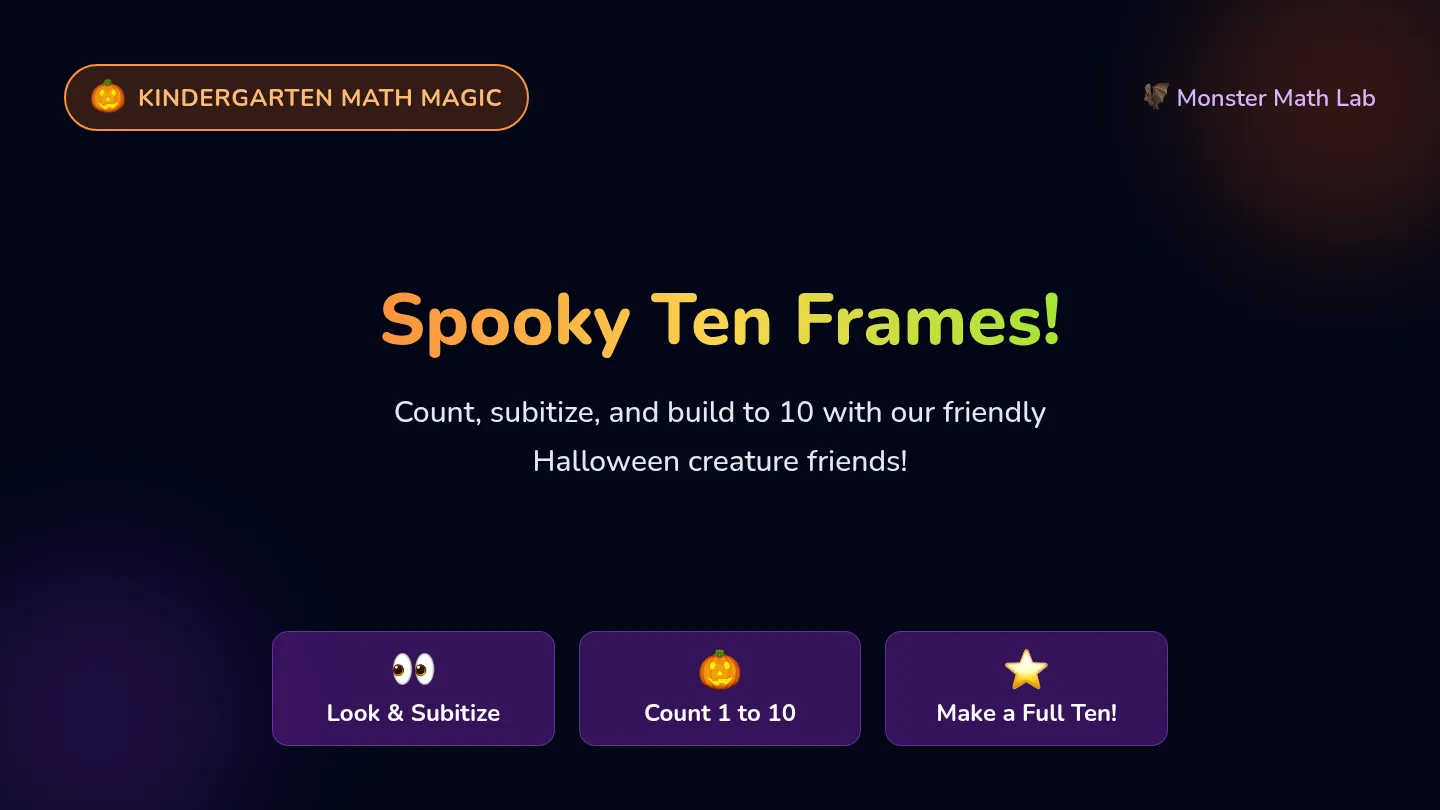
A high-spirited kindergarten Halloween math lesson exploring numbers 1 to 10 with ten frames, subitizing, and making ten through playful pumpkin, bat, and potion counters.

CV

Cecilia Velasquez

4
Number Stairs Lesson Plan

Number Stairs Lesson Plan

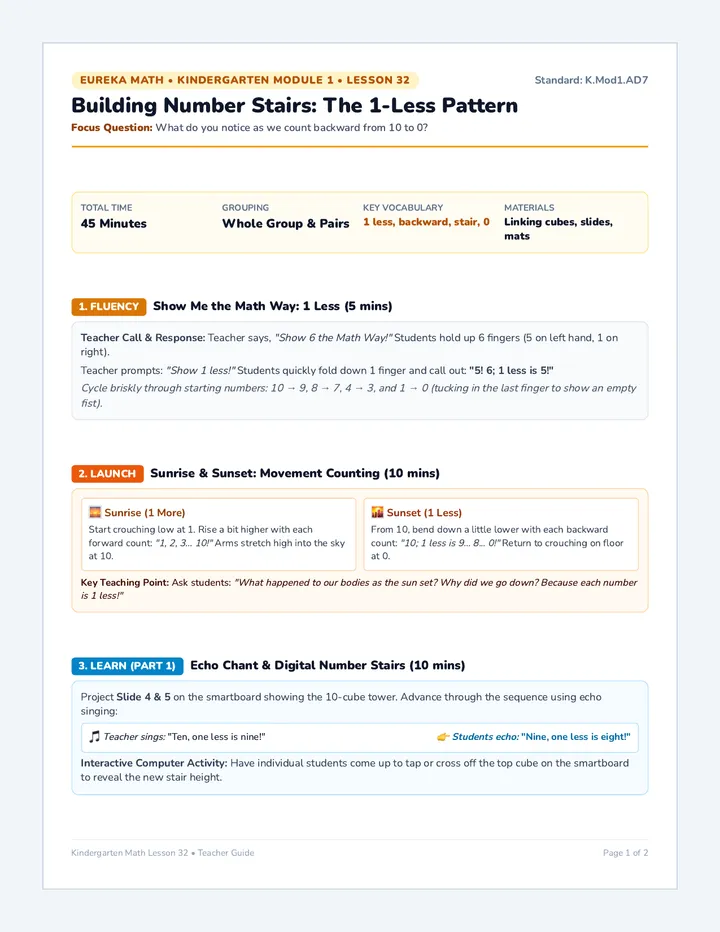
A comprehensive, interactive Kindergarten Lesson 32 guide with clear pacing, movement routines, questioning frameworks, Smartboard prompts, and math center rotation ideas.

NS

Neelab Sayah