Lenny.com
Explore
Create
ActivitiesNewMathEnglish Language ArtsScience & EngineeringSocial StudiesGlobal LanguagesHealth & Physical EducationSpecial EducationCounseling & Life SkillsArts & CreativityESL
Lenny.com
Lenny.com
Explore
Create
ActivitiesNewMathEnglish Language ArtsScience & EngineeringSocial StudiesGlobal LanguagesHealth & Physical EducationSpecial EducationCounseling & Life SkillsArts & CreativityESL
Lenny.com
Lenny.com

Solutions

Lenny for EducatorsLenny for SchoolsLenny for Districts

Product

ExploreSign inCreateSupportAbout

Resources

Getting startedMTSS Acceleration Program

© 2026 Lenny Learning Inc.

TermsPrivacyAccessibility
LinkedInInstagramX
Lenny

Matrix Operations

Addition, subtraction, and multiplication of matrices alongside techniques for calculating determinants and inverses. Supports solving systems of linear equations and modeling multi-dimensional data transformations.

MathNumbers & CountingCounting ObjectsNumber NamesComparing NumbersNumber OperationsCounting SequenceNumbers 0-10Place Value Understanding and SystemAdd and Subtract Within 20Addition and Subtraction ConceptsAddition and Subtraction EquationsAddition and Subtraction ProblemsFoundations for MultiplicationMultiplication and Division PropertiesMultiply and Divide Within 100Multiplication and Division ProblemsFactors and MultiplesProperties of OperationsPatterns and RelationshipsGenerate and Analyze PatternsMulti-Digit ArithmeticPlace Value OperationsMulti-Digit and Decimal OperationsNumerical ExpressionsFour Operations and PatternsFour Operations Problem SolvingMeasurement & DataMeasurable AttributesMeasuring LengthsMeasure and Estimate Lengths in Standard UnitsRelate Addition and Subtraction to LengthClassifying and Counting ObjectsTime and MoneyArea Concepts and MeasurementPerimeter and Area MeasuresAngle Concepts and MeasurementTime, Volume, and MassMeasurement Unit ConversionsGeometryIdentifying ShapesShapes and AttributesShape Attributes and ReasoningShapes and CompositionClassifying 2D FiguresGeometric Figures and RelationshipsLines, Angles, and ShapesAngle, Area, and VolumeGeometric MeasurementVolume of 3D ShapesCoordinate Plane ApplicationsTransformations in the PlaneCongruence and SimilarityUnderstand congruence in terms of rigid motionsSimilarity and TransformationsProve Theorems Involving SimilarityPythagorean TheoremTrigonometry for General TrianglesMake Geometric ConstructionsProve Geometric TheoremsTheorems About CirclesFind Arc Lengths And Areas of Sectors of CirclesVolume FormulasRelationships Between Two-Dimensional and Three-Dimensional ObjectsProve Simple Geometric Theorems AlgebraicallyTranslate Between Geometric Description and Equation for Conic SectionApply Geometric Concepts in Modeling SituationsFractions & DecimalsFractions as NumbersBuilding FractionsFraction Equivalence and OrderingAdding and Subtracting FractionsMultiplying and Dividing FractionsDividing FractionsDecimal FractionsMulti-Digit Computation and FactorsAdd, Subtract, Multiply, and Divide Rational NumbersRational Number SystemIrrational Numbers and ApproximationsRatiosRatios and ProportionsProportional RelationshipsUnit RateAlgebraAlgebraic ExpressionsGenerate Equivalent ExpressionsQuantitative RelationshipsProportional Relationships and Linear EquationsEquations and InequalitiesEquation Solving and ReasoningLinear Equations and SystemsGraph Equations and InequalitiesSystems of EquationsReal-World Algebraic ProblemsQuantitative Reasoning with UnitsExpression StructureEquivalent Expression FormsRadicals and Integer ExponentsRational ExponentsRational and Irrational NumbersPolynomial OperationsPolynomial IdentitiesPolynomial Zeros and FactorsRational ExpressionsComplex Number OperationsComplex Numbers in PolynomialsComplex Numbers on PlaneStatistics & ProbabilityRepresent and Interpret DataData DistributionsStatistical VariabilityProbability ModelsCompound Event ProbabilitiesStatistical SamplingInterpret Categorical and Quantitative DataBivariate Data PatternsInterpret Linear ModelsComparing Two PopulationsRandom Processes in StatisticsIndependence and Conditional ProbabilityExpected ValuesProbability-Based Decision MakingStatistical Inference and ConclusionsFunctionsFunction Concepts and NotationDefine and Compare FunctionsInterpret Functions in ContextAnalyze Function RepresentationsModel Relationships with FunctionsIdentify Linear vs Exponential GrowthDistinguish Between Function TypesCompare Growth RatesInterpret Function ExpressionsBuild Functions from RelationshipsConstruct and Model FunctionsTransform and Combine FunctionsModel Comparison and SelectionSolve Exponential EquationsTrigonometryTrigonometric Ratios Involving Right TrianglesTrigonometric Functions and Unit CircleModel with Trigonometric FunctionsTrigonometric IdentitiesVectors & MatricesIntroduction to Vectors and MatricesVector QuantitiesVector OperationsMatrix OperationsCalculusLimits and ContinuityDerivative Concepts and NotationDerivative Rules and TechniquesApplications of DerivativesOptimization ProblemsRelated RatesCurve Sketching and AnalysisIntegration Concepts and NotationAntiderivatives and Indefinite IntegralsDefinite Integrals and AreaFundamental Theorem of CalculusIntegration TechniquesApplications of IntegrationDifferential EquationsSequences and SeriesParametric and Polar FunctionsVector-Valued Functions

Videos

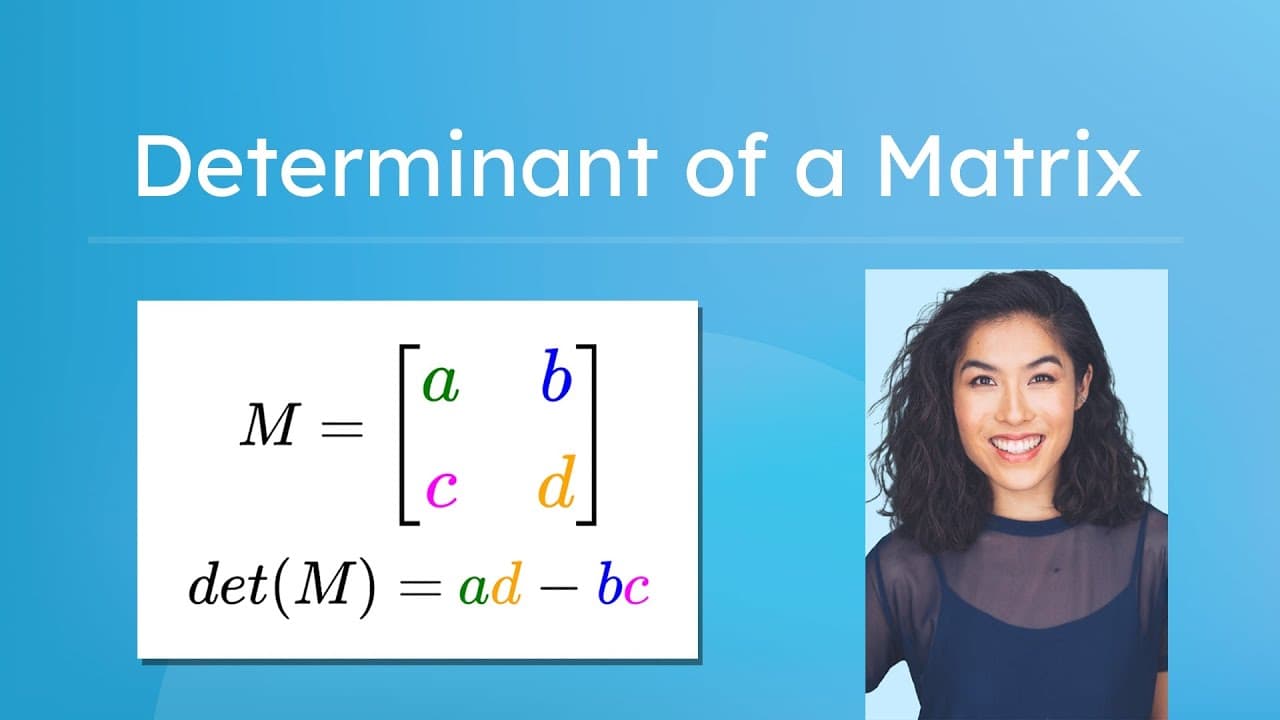
How to Calculate Matrix Determinants and Find Area

How to Calculate Matrix Determinants and Find Area

This comprehensive math lesson introduces students to the concept of the determinant of a matrix, a fundamental tool in linear algebra and precalculus. The video begins by defining what a determinant is—a scalar value calculated from a square matrix—and explains its significance in understanding matrix properties like invertibility and spatial transformations. It progresses step-by-step through the calculation methods for 2x2 matrices using the standard "ad-bc" formula, ensuring students grasp the basics before moving to more complex concepts. The lesson then advances to 3x3 matrices, demonstrating two distinct methods for calculation: the formal Cofactor Expansion method (using minor matrices and checkerboard signs) and the visual "Shortcut" method (often known as the Rule of Sarrus) involving diagonal multiplication. Clear, color-coded animations help visualize these algorithmic processes, making abstract calculations accessible and easier to memorize. Detailed examples are worked through for each method to reinforce understanding. Finally, the video bridges abstract algebra with geometry by applying determinants to find the area of polygons in the coordinate plane. It demonstrates how to interpret vectors from vertices and use the determinant to calculate the area of parallelograms and triangles. This application connects algebraic computation with geometric properties, providing a practical context for why determinants are a powerful mathematical tool.
Miacademy & MiaPrep Learning ChannelMiacademy & MiaPrep Learning Channel

21mins 51s

Sequences

Strategy Blueprint Slides

ACT Math Mastery

A comprehensive ACT Math preparation program focusing on essential strategies, high-yield Algebra and Geometry concepts, and realistic practice to boost scores.

AL

ava larumbe

26
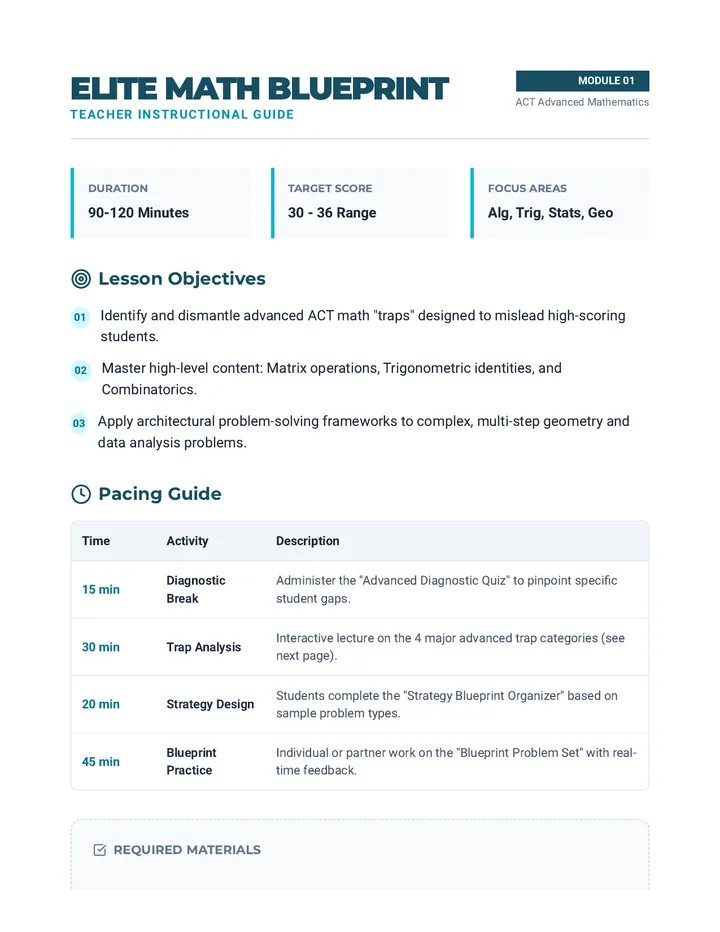
Elite Math Teacher Guide

Advanced ACT Mastery

A comprehensive prep sequence for the most challenging questions on the ACT Math and Science sections. It focuses on high-level conceptual blueprints for math topics like complex numbers and matrices, alongside speed-reading and data-interpretation strategies for the Science section.

AL

ava larumbe

29
Matrix Blueprint Basics Teacher Guide

Matrix Mastery and Linear Systems

A comprehensive 12th-grade mathematics sequence on matrix algebra, covering dimensions, arithmetic operations, determinants, inverses, and solving linear systems. Students progress from basic organization to using matrices as powerful tools for solving complex equations.

15
Curvilinear Blueprint Slides

Curvilinear Coordinates and Vector Analysis

This mathematical physics sequence explores the coordinate systems necessary for solving problems involving complex shapes, moving beyond Cartesian coordinates to General Curvilinear systems. Students derive scale factors, volume elements, and differential operators, culminating in solving Laplace's equation and understanding metric tensors.

15
Hyperplane Geometry Slides

Algorithmic Linear Algebra and System Solvers

This advanced sequence explores systems of linear equations through the lens of computational linear algebra. Graduate students will move from theoretical existence and uniqueness in vector spaces to matrix factorizations, algorithmic complexity, numerical stability, and iterative methods for large-scale systems.

11
Vertex Vault Slides

Modeling Geometric Transformations with Matrices

This sequence explores the geometric interpretation of matrices, treating them as operators that transform space. Students move from calculation to visual application, using matrices to represent coordinates, perform translations/dilations, and apply rotations/reflections via matrix multiplication.

12

Lessons

Circle Clusters Slides

Circle Clusters

Students will solve systems of linear equations derived from the geometric properties of mutually tangent circles, connecting spatial relationships to algebraic solutions.

3
Model Mechanics Lesson Plan

Model Mechanics

A Pre-Calculus lesson on solving 3x3 systems of equations to find quadratic models, featuring a manual elimination method and a matrix inverse method using graphing calculators.

4
Sarrus Showdown Worksheet

Determinant Duel

This lesson introduces the Rule of Sarrus as a shortcut for finding 3x3 determinants, comparing its efficiency against the standard cofactor expansion method through a competitive 'Method Battle'.

4
Matrix Masters Slides

Matrix Masters

Students learn to calculate 3x3 determinants using the Cofactor Expansion method, focusing on minor matrices and the checkerboard sign pattern through video analysis and collaborative problem-solving.

4
Terraform Slides

Terraform Mapping by Matrix

A high-school geometry and linear algebra lesson where students use 3x3 matrix determinants to calculate the area of complex, irregular polygons by triangulating coordinate data.

3
Matrix Decoder Worksheet

Matrix Mastermind Introduction to Determinants

This lesson introduces students to the determinant of 2x2 matrices. Students will learn the calculation formula, practice with various examples, explore matrices with a determinant of zero, and understand the geometric interpretation of a determinant as the area of a parallelogram.

3