Matrix Blueprint Basics Teacher Guide Matrix Blueprint Basics
Lesson 1: Introduction to Dimensions and Elements
Architectural Logistics
Grade 12 Mathematics
Topic
Matrix Organization & Addition
Duration
60 Minutes
Skill Focus
Dimensions, Elements, Basic Ops
Objectives
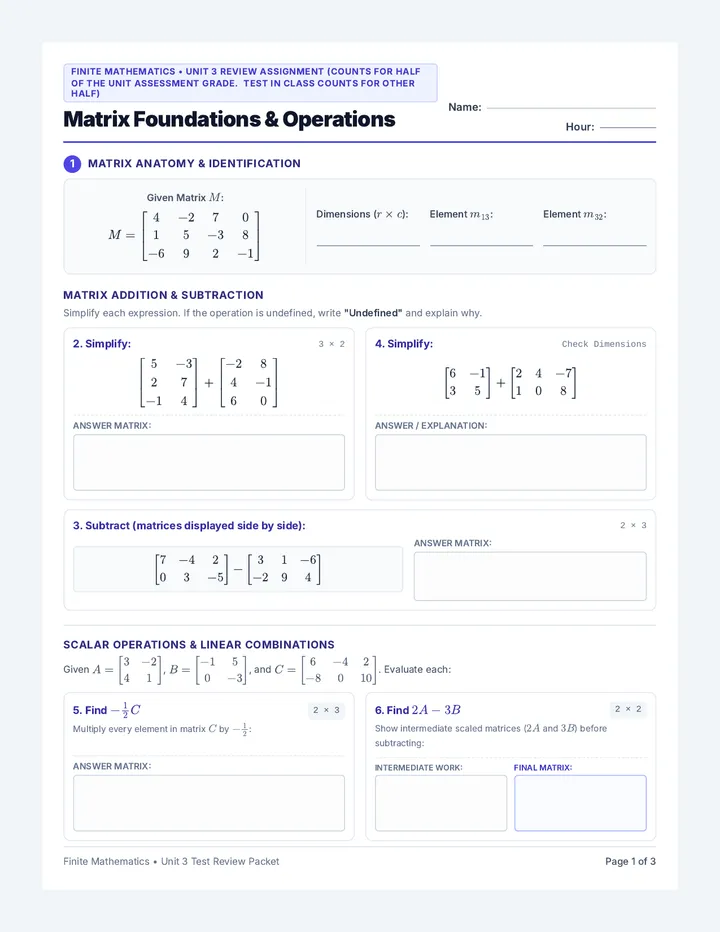
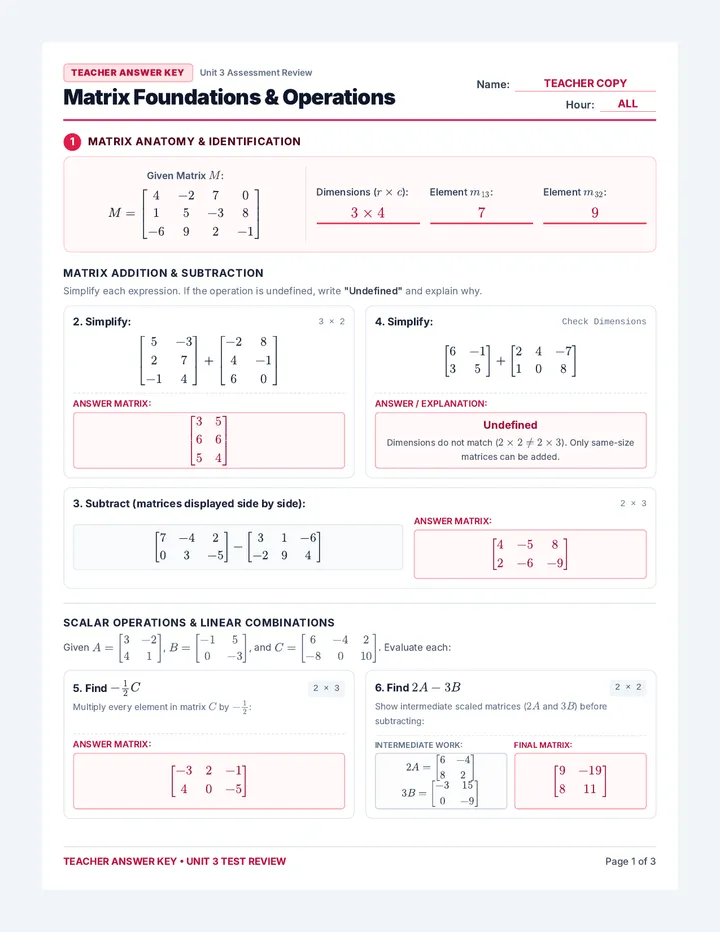
Identify the dimensions (rows × columns) of a given matrix.
Use standard notation to locate specific elements within a matrix.
Determine if two matrices are equal based on dimensions and elements.
Add and subtract matrices by matching corresponding elements.
Key Vocabulary
Matrix: A rectangular array of numbers.
Element: An individual entry in a matrix.
Dimensions: The number of rows and columns (R × C).
Scalar: A single real number.
Teaching Procedure
10
The Hook: Sports Data
Present a chaotic tournament bracket or season statistics. Ask students to organize this into a "Blueprint" (grid). Discuss why rows and columns are the most efficient way to store this data.
15
Direct Instruction: Anatomy of a Matrix
Define rows vs. columns. Introduce element notation \(a_{ij}\) where \(i\) is the row and \(j\) is the column. Pro-Tip: Remind students that "Row" comes before "Column" (RC cola or "Roman Catholics").
20
Workshop: Grid Arithmetic
Model addition and subtraction. Emphasize that dimensions MUST be identical. If dimensions differ, the operation is "undefined." Use the analogy of building a wall—bricks must line up perfectly.
15
Independent Practice & Exit Ticket
Students complete the "Blueprint Basics" worksheet. The exit ticket asks them to identify an element from a 3x3 matrix and perform one subtraction.
Anticipated Misconceptions
Row/Column Reversal
Students often confuse the order of dimensions (Columns × Rows instead of Rows × Columns). Correction: Always point to horizontal lines first, then vertical.
Mismatched Dimensions
Students may try to add matrices of different sizes by padding with zeros. Correction: Stress that the operation is impossible/undefined unless the grids are congruent.
Differentiation Strategies
Support
Use color-coded matrices where corresponding elements share the same color. Provide a "Cheat Sheet" showing a generic matrix with labeled elements \(a_{11}, a_{12}\), etc.
Extension
Introduce the concept of a Transpose matrix (\(A^T\)) and ask students to determine if \((A+B)^T = A^T + B^T\).
Matrix Blueprint Slides Matrix Blueprint Basics
Mastering the Architecture of Data
Unit: Linear Systems
01 The Hook: Organizing Chaos
Imagine you are managing a 16-team tournament. You need to track:
Points Scored
Fouls Committed
Turnovers
Minutes Played
How do we organize 64 data points so we can calculate totals instantly?
Blueprint.sys initializing...
Anatomy of a Matrix
A Matrix is a rectangular array of numbers enclosed in brackets.
\( A = \begin{bmatrix} a_{11} & a_{12} & a_{13} \\ a_{21} & a_{22} & a_{23} \end{bmatrix} \)
Element (\(a_{ij}\))
A specific entry in the matrix. \(i\) = Row, \(j\) = Column.
Scalar
A single real number outside the matrix.
Defining Dimensions
Rows \(\times\) Columns
Always name the number of horizontal rows first, then the number of vertical columns.
Examples:
\(\begin{bmatrix} 1 & 2 \\ 3 & 4 \end{bmatrix}\)
2 \(\times\) 2
\(\begin{bmatrix} 5 & 6 & 7 \end{bmatrix}\)
1 \(\times\) 3
\(\begin{bmatrix} 8 \\ 9 \end{bmatrix}\)
2 \(\times\) 1
Memory Hack
Think RC Cola
Rows then Columns.
Matrix Equality
Two matrices are EQUAL if and only if:
1. Same Dimensions
They must have the exact same number of rows and columns.
2. Matching Elements
Every corresponding entry must be identical.
\(\begin{bmatrix} x & 2 \\ 3 & 4 \end{bmatrix} = \begin{bmatrix} 5 & 2 \\ 3 & y \end{bmatrix} \implies x=5, y=4\)
Arithmetic Operations
The Golden Rule
You can ONLY add or subtract matrices if they have the same dimensions.
If they don't match, the operation is UNDEFINED .
How to do it:
Simply add or subtract the corresponding elements (the numbers in the same positions).
\(\begin{bmatrix} 1 & 2 \\ 3 & 4 \end{bmatrix} + \begin{bmatrix} 5 & 6 \\ 7 & 8 \end{bmatrix} = \begin{bmatrix} 1+5 & 2+6 \\ 3+7 & 4+8 \end{bmatrix}\)
System Check
Is the following operation defined? If so, what is the result?
\(\begin{bmatrix} 10 & 2 \\ -1 & 5 \end{bmatrix} - \begin{bmatrix} 4 & 0 \\ 7 & -3 \end{bmatrix}\)
Take 30 seconds to calculate in your head.
Matrix Blueprint Worksheet Matrix Blueprint: Data Log
Lesson 1: Introduction to Dimensions & Basic Operations
Architect:
Date:
01
Structural Analysis (Dimensions)
Determine the dimensions (Rows × Columns) for each matrix below.
\[ \begin{bmatrix} 4 & -1 \\ 0 & 3 \\ 12 & 7 \end{bmatrix} \]
Dimensions
\[ \begin{bmatrix} 1 & 5 & 9 & -2 \end{bmatrix} \]
Dimensions
\[ \begin{bmatrix} 8 \\ -4 \\ 0 \end{bmatrix} \]
Dimensions
02
Element Retrieval
\[ M = \begin{bmatrix} 10 & 4 & -2 \\ 0 & 7 & 13 \\ -5 & 1 & 8 \end{bmatrix} \]
m12 =
m31 =
m23 =
m33 =
03
System Synchronization (Equality)
Solve for the unknown variables to make the matrices equal.
\[ \begin{bmatrix} 2x & 5 \\ 0 & y-3 \end{bmatrix} = \begin{bmatrix} 12 & 5 \\ 0 & 10 \end{bmatrix} \]
x =
y =
\[ \begin{bmatrix} a+b & 4 \\ -1 & a-b \end{bmatrix} = \begin{bmatrix} 8 & 4 \\ -1 & 2 \end{bmatrix} \]
a =
b =
04
Arithmetic Logistics
Perform the indicated operations. If the operation is not possible, write "UNDEFINED".
1. \( \begin{bmatrix} 5 & 2 \\ -1 & 0 \end{bmatrix} + \begin{bmatrix} -3 & 4 \\ 7 & 1 \end{bmatrix} = \)
2. \( \begin{bmatrix} 8 & 12 \\ 4 & 5 \end{bmatrix} - \begin{bmatrix} 3 & 0 \\ 2 \end{bmatrix} = \)
3. \( \begin{bmatrix} 10 & -4 & 5 \\ 2 & 1 & 0 \end{bmatrix} - \begin{bmatrix} 8 & 2 & -3 \\ 0 & 4 & 5 \end{bmatrix} = \)
4. \( \begin{bmatrix} 3 \\ 1 \end{bmatrix} + \begin{bmatrix} 0 \\ -5 \end{bmatrix} - \begin{bmatrix} 2 \\ 2 \end{bmatrix} = \)
Multiplication Mastery Teacher Guide Multiplication Mastery
Lesson 2: Scalar and Matrix Multiplication
Architectural Logistics
Grade 12 Mathematics
Topic
Multiplication Algorithms
Duration
75 Minutes
Skill Focus
Row-by-Column Computation
Objectives
Multiply a matrix by a scalar.
Determine if the product of two matrices is defined based on dimensions.
Predict the dimensions of a resulting product matrix.
Perform matrix multiplication using the row-by-column algorithm.
Identify that matrix multiplication is non-commutative (\(AB \neq BA\)).
Key Concepts
"Inner dimensions match to define; outer dimensions define the result."
"Rows of the first, Columns of the second."
Teaching Procedure
10
The Hook: Store Revenue
Give students an Inventory Matrix (Rows: Stores, Cols: Items) and a Price Matrix (Rows: Items, Cols: Unit Price). Ask: "How do we find the total revenue for each store?" This naturally introduces the row-by-column logic.
15
Direct Instruction: Scalar & Compatibility
Quickly cover scalar multiplication (distributive). Spend more time on compatibility: If \(A\) is \(m \times n\) and \(B\) is \(p \times q\), then \(n\) must equal \(p\) for \(AB\) to exist. Resulting matrix is \(m \times q\).
25
Modeling the Algorithm
Use "The L-Motion" (Left-to-Right on Row 1, Top-to-Bottom on Column 1). Model a \(2 \times 2\) times a \(2 \times 2\). Show every step of the addition: \((a_{11}b_{11} + a_{12}b_{21})\).
25
Investigation: Commutativity
Have half the class calculate \(AB\) and the other half \(BA\) for two specific square matrices. Students will be surprised when the results are totally different. Discuss why this breaks the "rules" of normal arithmetic.
Anticipated Misconceptions
Element-Wise Multiplication
Students will naturally want to multiply matching entries like they did for addition. Correction: Call this the "Beginner Trap." Emphasize that matrix multiplication is a transformation, not just a simple list operation.
Order Doesn't Matter
Students assume \(AB = BA\). Correction: Emphasize that the columns of the first must match the rows of the second. If you flip them, they might not even be defined anymore!
Differentiation Strategies
Support
Provide a physical "L-shape" cutout that students can place over their matrices to isolate the row and column being multiplied. Focus on \(2 \times 2\) matrices only.
Multiplication Mastery Slides Multiplication Mastery
Scaling and Intersecting Data Systems
Architectural Log // Matrix.Arithmetic.v2
Scalar Multiplication
To multiply a matrix by a Scalar (a single number), simply multiply every element in the matrix by that number.
"Scaling is like zooming in or out on your blueprint."
\( 3 \cdot \begin{bmatrix} 2 & -1 \\ 4 & 0 \end{bmatrix} = \begin{bmatrix} 6 & -3 \\ 12 & 0 \end{bmatrix} \)
The Compatibility Check
Matrix multiplication is NOT always defined. Check your dimensions first!
Matrix A
m \(\times\) n
Matrix B
n \(\times\) p
INNER NUMBERS MUST MATCH
Resulting dimensions will be:
m \(\times\) p (Outer numbers)
The Row-by-Column Algorithm
Rows of the First
Follow the Path:
Select Row 1 from Matrix A.
Select Column 1 from Matrix B.
Multiply corresponding elements.
Sum the products. This is element \(c_{11}\).
Repeat for all row/column combinations.
(Row 1 \(\cdot\) Col 1) = \(a_{11}b_{11} + a_{12}b_{21}\)
CRITICAL RULE
AB \(\neq\) BA
In normal math, \(5 \times 2 = 2 \times 5\). In matrix math, changing the order of matrices creates a totally different result, or may even make the operation impossible!
Order 1
A \(\cdot\) B
Order 2
B \(\cdot\) A
Blueprint Challenge
Calculate the resulting product matrix:
\[ \begin{bmatrix} 1 & 2 \\ 3 & 4 \end{bmatrix} \cdot \begin{bmatrix} 5 \\ 6 \end{bmatrix} = \]
Result
Hint: Result dimensions will be \(2 \times 1\).
Multiplication Algorithm Worksheet Algorithm Drill: Multiplication
Lesson 2: Scalar Scaling & Row-by-Column Operations
Architect:
Date:
Phase 1
System Compatibility Test
Determine if the product \(AB\) is defined. If so, state the resulting dimensions.
Dimensions of A Dimensions of B Defined? Resulting Dimensions \(3 \times 2\) \(2 \times 5\) [ Yes / No ] \(4 \times 1\) \(4 \times 1\) [ Yes / No ] \(2 \times 2\) \(2 \times 2\) [ Yes / No ] \(1 \times 3\) \(3 \times 1\) [ Yes / No ]
Phase 2
Scalar Scaling
\( 5 \cdot \begin{bmatrix} 2 & -1 \\ 0 & 4 \\ -3 & 7 \end{bmatrix} = \)
\( -2 \cdot \begin{bmatrix} 1 & 8 & 3 \\ -4 & 5 & 0 \end{bmatrix} = \)
Phase 3
The Row-by-Column Algorithm
Execute the multiplication process. Show your entry-by-entry calculations in the workspace provided.
1. \( \begin{bmatrix} 1 & 3 \\ 2 & 4 \end{bmatrix} \cdot \begin{bmatrix} 5 \\ 0 \end{bmatrix} = \)
Workspace (Sum of Products)
2. \( \begin{bmatrix} 2 & -1 \\ 3 & 1 \end{bmatrix} \cdot \begin{bmatrix} 4 & 0 \\ -2 & 5 \end{bmatrix} = \)
Workspace (Sum of Products)
The Commutativity Challenge
Let \( A = \begin{bmatrix} 1 & 0 \\ 2 & 1 \end{bmatrix} \) and \( B = \begin{bmatrix} 1 & 2 \\ 0 & 1 \end{bmatrix} \).
Calculate AB:
Calculate BA:
Observation: Does \(AB = BA\)? _______________________
Determinant Dynamics Teacher Guide Determinant Dynamics
Lesson 3: Calculating Scalar Values of Matrices
Architectural Logistics
Grade 12 Mathematics
Topic
Determinants & Singularities
Duration
60 Minutes
Skill Focus
Expansion by Minors
Objectives
Calculate the determinant of a \(2 \times 2\) matrix using the formula \(ad-bc\).
Calculate the determinant of a \(3 \times 3\) matrix using expansion by minors.
Define and identify "singular" matrices.
Understand the relationship between the determinant and the existence of an inverse.
Key Concepts
"The determinant is the DNA of the matrix—it tells us if it's invertible."
"Expansion by Minors: Divide and Conquer."
Teaching Procedure
10
The Hook: The Cipher Key
Present a simple Caesar cipher that has been "matrix scrambled." Explain that to unscramble it, we need a single number—the determinant. This creates immediate buy-in for a seemingly abstract calculation.
10
Direct Instruction: \(2 \times 2\) Dynamics
Introduce notation \(det(A)\) or \(|A|\). Teach the diagonal subtraction: \(ad - bc\). Emphasize the importance of signs (especially when \(bc\) is negative).
20
Modeling: \(3 \times 3\) Expansion
Teach expansion along the first row. Show how to cross out a row and column to find the "minor" \(2 \times 2\) matrix. Crucial Point: Emphasize the checkerboard pattern of signs (\(+ - +\)).
20
The "Singularity" Search
Challenge students to create a matrix where the determinant is exactly 0. Ask: "What happens when you scale a system by 0?" Lead them to the conclusion that a 0 determinant means the matrix is a "dead end"—it cannot be reversed.
Anticipated Misconceptions
The Middle Sign Sign
In \(3 \times 3\) expansion, students almost always forget to subtract the second term. Correction: Write the sign pattern \(+ - +\) clearly above the matrix before starting any expansion.
Absolute Value Confusion
Students see the bars \(|A|\) and think the determinant must be positive. Correction: Explain that in matrix algebra, these bars mean "determinant," not "absolute value." Determinants can absolutely be negative!
Differentiation Strategies
Support
Use the "Sarrus' Rule" (copying the first two columns to the right) as an alternative for \(3 \times 3\) determinants for students who struggle with expansion by minors.
Determinant Dynamics Slides Determinant Dynamics
Unlocking the Singular Value of Systems
Operation: Scalar Analysis
The Matrix DNA
The Determinant is a single real number calculated from a Square Matrix.
It provides crucial info about the system, like whether the matrix has an Inverse .
Notation: \(det(A)\) or \(|A|\)
The Key to the System
"If the determinant is zero, the system is locked."
The 2 \(\times\) 2 Formula
\( A = \begin{bmatrix} a & b \\ c & d \end{bmatrix} \)
\( ad - bc \)
Main Diagonal
\( a \times d \)
\(-\)
Off Diagonal
\( b \times c \)
Expansion by Minors (\(3 \times 3\))
To find the determinant of a \(3 \times 3\) matrix, we "break it down" into smaller \(2 \times 2\) determinants.
The Step Process:
Pick a row (usually Row 1).
For each element, cross out its row/column.
Multiply the element by the determinant of the remaining \(2 \times 2\) (the Minor).
Apply the sign pattern!
Sign Pattern
\( \begin{bmatrix} + & - & + \\ - & + & - \\ + & - & + \end{bmatrix} \)
Always remember the middle negative sign!
The 3 \(\times\) 3 Layout
\( \begin{vmatrix} a & b & c \\ d & e & f \\ g & h & i \end{vmatrix} = a \begin{vmatrix} e & f \\ h & i \end{vmatrix} - b \begin{vmatrix} d & f \\ g & i \end{vmatrix} + c \begin{vmatrix} d & e \\ g & h \end{vmatrix} \)
TERM 1
Positive
TERM 2
Negative / Reversed
TERM 3
Positive
Singular Matrices
What if the Determinant is ZERO?
A matrix with a determinant of 0 is called Singular .
It has no Inverse . The system has "collapsed" and the original values cannot be recovered.
System Check
Find the determinant. Is this matrix singular?
\( \begin{bmatrix} 6 & 3 \\ 4 & 2 \end{bmatrix} \)
det = ?
Singular: [ Yes / No ]
Determinant Decipher Activity The Cipher Matrix
Lesson 3: Determinants and Singularities
Agent:
Date:
Mission Briefing
Intelligence has intercepted a set of "Cipher Keys" in matrix form. To decrypt the final message, you must calculate the determinant of each key. Warning: Some keys are "singular"—they have collapsed data and will not reveal any information. Identify these immediately.
Phase 1
2 × 2 Calibration
\( K_1 = \begin{bmatrix} 4 & 5 \\ 2 & 3 \end{bmatrix} \)
det(\(K_1\))
\( K_2 = \begin{bmatrix} -2 & 8 \\ 1 & -4 \end{bmatrix} \)
det(\(K_2\))
Is either of the keys above SINGULAR ? If so, which one? _____________________________
Phase 2
3 × 3 Master Key
Key M = \(\begin{bmatrix} 1 & 2 & 3 \\ 0 & 4 & -1 \\ 2 & 1 & 5 \end{bmatrix}\) Expansion by Minors required
Step 1: Write out the expansion formula
(1) \(\cdot\) det(____) - (2) \(\cdot\) det(____) + (3) \(\cdot\) det(____)
Step 2: Calculate 2 × 2 Minors
Step 3: Combine and Sum
Final det(M) =
Phase 3
The Decryption Table
Each determinant you calculated corresponds to a word in the secret transmission.
DET = 2
SYSTEM
DET = 0
NULL
DET = 21
LOCKED
DET = 25
ONLINE
Final Transmission
\(K_1\)
[Decoded Word 1]
\(K_2\)
[Decoded Word 2]
\(M\)
[Decoded Word 3]
Final Conclusion
Is the transmission successful? Explain what the "singular" key did to the message.
Inverse Insights Teacher Guide Identity & Inverse
Lesson 4: The Mathematical Undo Button
Architectural Logistics
Grade 12 Mathematics
Topic
Identity and Inverse Matrices
Duration
60 Minutes
Skill Focus
2x2 Inversion Formula
Objectives
Identify and construct Identity Matrices (\(I\)) of various dimensions.
Understand the property \(AI = IA = A\).
Calculate the inverse of a \(2 \times 2\) matrix using the determinant and adjacency matrix.
Verify inverse relationships through matrix multiplication.
Determine if an inverse exists based on the determinant.
Key Concepts
"The Identity Matrix is the '1' of the matrix world."
"The Inverse Matrix is the 'Reciprocal'—it resets the system to the identity."
Teaching Procedure
10
The Hook: The Undo Button
Ask: "If I multiply a number by 5, how do I undo it?" (Multiply by 1/5). "If I multiply a vector by a matrix, how do I get the original vector back?" Introduce the Inverse as the "Undo" matrix.
10
Identity Matrices
Define the Identity Matrix \(I\) (ones on the main diagonal, zeros elsewhere). Demonstrate that \(A \times I = A\). This establishes the "neutral" state of the system.
25
The \(2 \times 2\) Inverse Formula
Teach the recipe: 1. Find det(\(A\)). 2. Swap \(a\) and \(d\). 3. Change signs of \(b\) and \(c\). 4. Multiply by \(1/det(A)\). **Crucial Check:** If \(det(A) = 0\), you can't divide by it—so no inverse exists!
15
Verification Mastery
Practice multiplying a matrix by its inverse. If they don't get the identity matrix \(I\), they know they made an error. This "self-checking" nature of inverses is great for student independence.
Anticipated Misconceptions
Sign Confusion
Students often swap \(b\) and \(c\) instead of just changing their signs. Correction: Emphasize "Swap the first diagonal, Negate the second."
Determinant at the End
Students sometimes try to calculate the inverse but forget the \(1/det(A)\) scalar at the end. Correction: Remind them that without the determinant, the "scaling" of the undo-button is wrong.
Differentiation Strategies
Support
Provide a step-by-step checklist or graphic organizer for the inversion process. Use matrices with determinants of 1 or -1 to simplify the arithmetic during initial practice.
Inverse Insights Slides Inverse Insights
Mastering the Mathematical Undo Button
Operation: System Recovery // Matrix.Inversion
The Concept of "Undo"
In arithmetic, every operation has an opposite:
\(\times 5\) undone by \(\div 5\) (or \(\times \frac{1}{5}\))
Matrices also have "reciprocals" called Inverses.
Matrix \(A^{-1}\)
The matrix that reverses the effect of Matrix A.
The Identity Matrix (\(I\))
The Identity Matrix is the matrix equivalent of the number 1.
Rule:
"Ones on the main diagonal, Zeros everywhere else."
2 \(\times\) 2 Identity
\( I_2 = \begin{bmatrix} 1 & 0 \\ 0 & 1 \end{bmatrix} \)
3 \(\times\) 3 Identity
\( I_3 = \begin{bmatrix} 1 & 0 & 0 \\ 0 & 1 & 0 \\ 0 & 0 & 1 \end{bmatrix} \)
Defining the Inverse
Matrix \(B\) is the Inverse of Matrix \(A\) if and only if multiplying them together results in the Identity Matrix .
\( A \cdot A^{-1} = I \)
*Note: Not all matrices have an inverse. (Singular matrices!)*
The 2 \(\times\) 2 Inverse Recipe
If \( A = \begin{bmatrix} a & b \\ c & d \end{bmatrix} \)
\( A^{-1} = \frac{1}{det(A)} \begin{bmatrix} d & -b \\ -c & a \end{bmatrix} \)
1
Calculate det(\(A\))
2
Swap a and d
3
Negate b and c
4
Scale by \(1/det\)
System Verification
How do you know if your inverse is correct?
Multiply your original matrix by your answer.
If the result isn't I, there's a glitch in the calculation.
Quick Inverse
\( A = \begin{bmatrix} 3 & 1 \\ 5 & 2 \end{bmatrix} \)
Determinant
?
Inverse Matrix
?
Inverse Undo Worksheet Inverse Protocol: System Reset
Lesson 4: Identity Matrices & The Inversion Algorithm
Architect:
Date:
Phase 1
Identity Calibration
Construct the following identity matrices.
\( I_2 \)
\( I_3 \)
Is \(I\) Singular?
Justify using determinant
Phase 2
The 2 × 2 Inversion Formula
Calculate the inverse for each matrix. If the inverse does not exist, explain why.
1. \( A = \begin{bmatrix} 5 & 2 \\ 2 & 1 \end{bmatrix} \) Status: Invertible?
det(A)
Adjugate Matrix
Final \( A^{-1} \)
2. \( B = \begin{bmatrix} 6 & 3 \\ 4 & 2 \end{bmatrix} \) Status: Invertible?
det(B)
Inversion Analysis
Phase 3
Verification Proof
Verify that the matrix \( C^{-1} \) is correct by performing the multiplication \( C \cdot C^{-1} \).
Original Matrix \( C \):
\[ \begin{bmatrix} 3 & 1 \\ 4 & 2 \end{bmatrix} \]
Calculated Inverse \( C^{-1} \):
\[ \begin{bmatrix} 1 & -0.5 \\ -2 & 1.5 \end{bmatrix} \]
The Proof: \( C \times C^{-1} \)
\(\begin{bmatrix} 3 & 1 \\ 4 & 2 \end{bmatrix}\) \(\begin{bmatrix} 1 & -0.5 \\ -2 & 1.5 \end{bmatrix}\)
Show Row-by-Column Steps:
System Solutions Teacher Guide Solving Systems
Lesson 5: Matrix Equations & Solution Algorithms
Architectural Logistics
Grade 12 Mathematics
Topic
Matrix Equation \(AX = B\)
Duration
75 Minutes
Skill Focus
Applying Inverses to Solutions
Objectives
Convert a system of linear equations into a matrix equation of the form \(AX = B\).
Solve for the variable matrix \(X\) using the inverse of the coefficient matrix \(A\).
Recognize the importance of multiplication order (\(A^{-1}B\) vs. \(BA^{-1}\)).
Understand why matrix methods are the standard for computational linear algebra.
Key Concepts
"Isolation of variables through matrix inversion."
"Left-multiplying to maintain dimension compatibility."
Teaching Procedure
10
The Hook: Speed Trial
Give a messy \(2 \times 2\) system. Have one student solve by substitution while you solve using a pre-calculated inverse. The matrix method is consistently faster for complex systems.
15
The Anatomy of \(AX = B\)
Show how to "peel off" the coefficients into Matrix \(A\). The variables (\(x, y\)) go into a column vector \(X\). The constants go into Matrix \(B\). Prove that \(A \cdot X\) actually results in the original equations using row-by-column multiplication.
25
The Solution: \(X = A^{-1}B\)
Model the derivation: \(AX = B \implies A^{-1}(AX) = A^{-1}B \implies IX = A^{-1}B \implies X = A^{-1}B\). Stress the Order: \(A^{-1}\) must come first because multiplication is not commutative!
25
Mastery Workshop
Students solve three \(2 \times 2\) systems. For the final challenge, provide a \(3 \times 3\) system and its inverse, asking them to find the solution vector \(X\) using only matrix multiplication.
Anticipated Misconceptions
Multiplication Order
Students will often calculate \(B \cdot A^{-1}\) because they are used to dividing by the coefficient at the end of an equation. Correction: Remind them that for the dimensions to match (\(2 \times 2\) times \(2 \times 1\)), the inverse MUST be on the left.
Missing Variables
If a variable is missing (e.g., \(2x + 4 = 10\)), students might skip it. Correction: Explicitly show how to use 0 as a placeholder in Matrix \(A\).
Differentiation Strategies
Support
Allow students to use a graphing calculator for the matrix multiplication step (\(A^{-1} \cdot B\)) once they have demonstrated they can set up the equation \(AX = B\) correctly.
System Solutions Slides System Solutions
Integrating the Blueprint for Final Solutions
Final Protocol // Matrix.Systems.Final
The Ultimate Goal
Throughout this unit, we have learned to organize, multiply, and invert matrices.
Why?
Because these skills allow us to solve Systems of Equations with hundreds of variables at lightning speed using a single matrix operation.
2x + 3y = 8
x - y = 1
[ SOLUTION VECTOR ]
Translating to AX = B
A
Coefficients
X
Variables
=
B
Constants
\(\begin{bmatrix} a & b \\ c & d \end{bmatrix} \begin{bmatrix} x \\ y \end{bmatrix} = \begin{bmatrix} e \\ f \end{bmatrix}\)
How to Solve
1. AX = B
2. A-1(AX) = A-1B
3. IX = A-1B
4. X = A-1B
ORDER MATTERS: Left-Multiply by the Inverse!
Why A-1 first?
Defined Operation
\( A^{-1} \cdot B \)
(2 \(\times\) 2) \(\cdot\) (2 \(\times\) 1) = 2 \(\times\) 1
Undefined Operation
\( B \cdot A^{-1} \)
(2 \(\times\) 1) \(\cdot\) (2 \(\times\) 2) = ERROR
Worked Example
Solve the system:
4x + y = 14
2x - y = 4
"First, build the blueprint (Matrices A and B)."
The Setup
\( A = \begin{bmatrix} 4 & 1 \\ 2 & -1 \end{bmatrix} \), \( B = \begin{bmatrix} 14 \\ 4 \end{bmatrix} \)
\( det(A) = -4 - 2 = -6 \)
\( A^{-1} = -\frac{1}{6} \begin{bmatrix} -1 & -1 \\ -2 & 4 \end{bmatrix} \)
The Final Calculation
\( X = -\frac{1}{6} \begin{bmatrix} -1 & -1 \\ -2 & 4 \end{bmatrix} \begin{bmatrix} 14 \\ 4 \end{bmatrix} = \begin{bmatrix} 3 \\ 2 \end{bmatrix} \)
x = 3
y = 2
Plug them back into the original equations to verify. 4(3)+2=14. Check!
System Solutions Lab Report System Solutions Lab Report
Lesson 5: Solving Linear Systems via Matrix Algebra
Chief Architect:
Date:
Task 01
Translation Protocol
Convert the following systems of equations into matrix equations of the form \(AX = B\).
System 1:
Matrix Setup [A][X] = [B]
System 2:
Matrix Setup [A][X] = [B]
Task 02
Solution Algorithm
Select System 1 from above and solve for \(x\) and \(y\) using the inverse matrix method: \(X = A^{-1}B\).
1. Find det(A)
2. Construct \(A^{-1}\)
3. Perform Multiplication: \(X = A^{-1} \cdot B\)
[\(A^{-1}\)]
[B]
[X]
Final x
Final y
Task 03
Singularity Analysis
Consider the system below:
4x + 2y = 10
1. Calculate the determinant of the coefficient matrix:
2. Based on the determinant, can this system be solved using matrix inversion?
Yes
No
Explain why:
Unit Conclusion: Efficiency Analysis
Modern computers use matrices to solve systems with millions of variables in fields like weather prediction and 3D graphics. Why is the matrix method (\(X = A^{-1}B\)) superior to the substitution or elimination methods you learned in Algebra 1?
System Solution Protocol Complete Unit: Matrices & Vectors v1.0