Lenny.com
Explore
Create
ActivitiesNewMathEnglish Language ArtsScience & EngineeringSocial StudiesGlobal LanguagesHealth & Physical EducationSpecial EducationCounseling & Life SkillsArts & CreativityESL
Lenny.com
Lenny.com
Explore
Create
ActivitiesNewMathEnglish Language ArtsScience & EngineeringSocial StudiesGlobal LanguagesHealth & Physical EducationSpecial EducationCounseling & Life SkillsArts & CreativityESL
Lenny.com
Lenny.com

Solutions

Lenny for EducatorsLenny for SchoolsLenny for Districts

Product

ExploreSign inCreateSupportAbout

Resources

Getting startedMTSS Acceleration Program

© 2026 Lenny Learning Inc.

TermsPrivacyAccessibility
LinkedInInstagramX
Lenny

Counting Sequence

Sequential number naming and cardinal counting principles for early learners. Develops fluency in forward and backward sequences while introducing skip-counting patterns.

MathNumbers & CountingCounting ObjectsNumber NamesComparing NumbersNumber OperationsCounting SequenceNumbers 0-10Place Value Understanding and SystemAdd and Subtract Within 20Addition and Subtraction ConceptsAddition and Subtraction EquationsAddition and Subtraction ProblemsFoundations for MultiplicationMultiplication and Division PropertiesMultiply and Divide Within 100Multiplication and Division ProblemsFactors and MultiplesProperties of OperationsPatterns and RelationshipsGenerate and Analyze PatternsMulti-Digit ArithmeticPlace Value OperationsMulti-Digit and Decimal OperationsNumerical ExpressionsFour Operations and PatternsFour Operations Problem SolvingMeasurement & DataMeasurable AttributesMeasuring LengthsMeasure and Estimate Lengths in Standard UnitsRelate Addition and Subtraction to LengthClassifying and Counting ObjectsTime and MoneyArea Concepts and MeasurementPerimeter and Area MeasuresAngle Concepts and MeasurementTime, Volume, and MassMeasurement Unit ConversionsGeometryIdentifying ShapesShapes and AttributesShape Attributes and ReasoningShapes and CompositionClassifying 2D FiguresGeometric Figures and RelationshipsLines, Angles, and ShapesAngle, Area, and VolumeGeometric MeasurementVolume of 3D ShapesCoordinate Plane ApplicationsTransformations in the PlaneCongruence and SimilarityUnderstand congruence in terms of rigid motionsSimilarity and TransformationsProve Theorems Involving SimilarityPythagorean TheoremTrigonometry for General TrianglesMake Geometric ConstructionsProve Geometric TheoremsTheorems About CirclesFind Arc Lengths And Areas of Sectors of CirclesVolume FormulasRelationships Between Two-Dimensional and Three-Dimensional ObjectsProve Simple Geometric Theorems AlgebraicallyTranslate Between Geometric Description and Equation for Conic SectionApply Geometric Concepts in Modeling SituationsFractions & DecimalsFractions as NumbersBuilding FractionsFraction Equivalence and OrderingAdding and Subtracting FractionsMultiplying and Dividing FractionsDividing FractionsDecimal FractionsMulti-Digit Computation and FactorsAdd, Subtract, Multiply, and Divide Rational NumbersRational Number SystemIrrational Numbers and ApproximationsRatiosRatios and ProportionsProportional RelationshipsUnit RateAlgebraAlgebraic ExpressionsGenerate Equivalent ExpressionsQuantitative RelationshipsProportional Relationships and Linear EquationsEquations and InequalitiesEquation Solving and ReasoningLinear Equations and SystemsGraph Equations and InequalitiesSystems of EquationsReal-World Algebraic ProblemsQuantitative Reasoning with UnitsExpression StructureEquivalent Expression FormsRadicals and Integer ExponentsRational ExponentsRational and Irrational NumbersPolynomial OperationsPolynomial IdentitiesPolynomial Zeros and FactorsRational ExpressionsComplex Number OperationsComplex Numbers in PolynomialsComplex Numbers on PlaneStatistics & ProbabilityRepresent and Interpret DataData DistributionsStatistical VariabilityProbability ModelsCompound Event ProbabilitiesStatistical SamplingInterpret Categorical and Quantitative DataBivariate Data PatternsInterpret Linear ModelsComparing Two PopulationsRandom Processes in StatisticsIndependence and Conditional ProbabilityExpected ValuesProbability-Based Decision MakingStatistical Inference and ConclusionsFunctionsFunction Concepts and NotationDefine and Compare FunctionsInterpret Functions in ContextAnalyze Function RepresentationsModel Relationships with FunctionsIdentify Linear vs Exponential GrowthDistinguish Between Function TypesCompare Growth RatesInterpret Function ExpressionsBuild Functions from RelationshipsConstruct and Model FunctionsTransform and Combine FunctionsModel Comparison and SelectionSolve Exponential EquationsTrigonometryTrigonometric Ratios Involving Right TrianglesTrigonometric Functions and Unit CircleModel with Trigonometric FunctionsTrigonometric IdentitiesVectors & MatricesIntroduction to Vectors and MatricesVector QuantitiesVector OperationsMatrix OperationsCalculusLimits and ContinuityDerivative Concepts and NotationDerivative Rules and TechniquesApplications of DerivativesOptimization ProblemsRelated RatesCurve Sketching and AnalysisIntegration Concepts and NotationAntiderivatives and Indefinite IntegralsDefinite Integrals and AreaFundamental Theorem of CalculusIntegration TechniquesApplications of IntegrationDifferential EquationsSequences and SeriesParametric and Polar FunctionsVector-Valued Functions

Videos

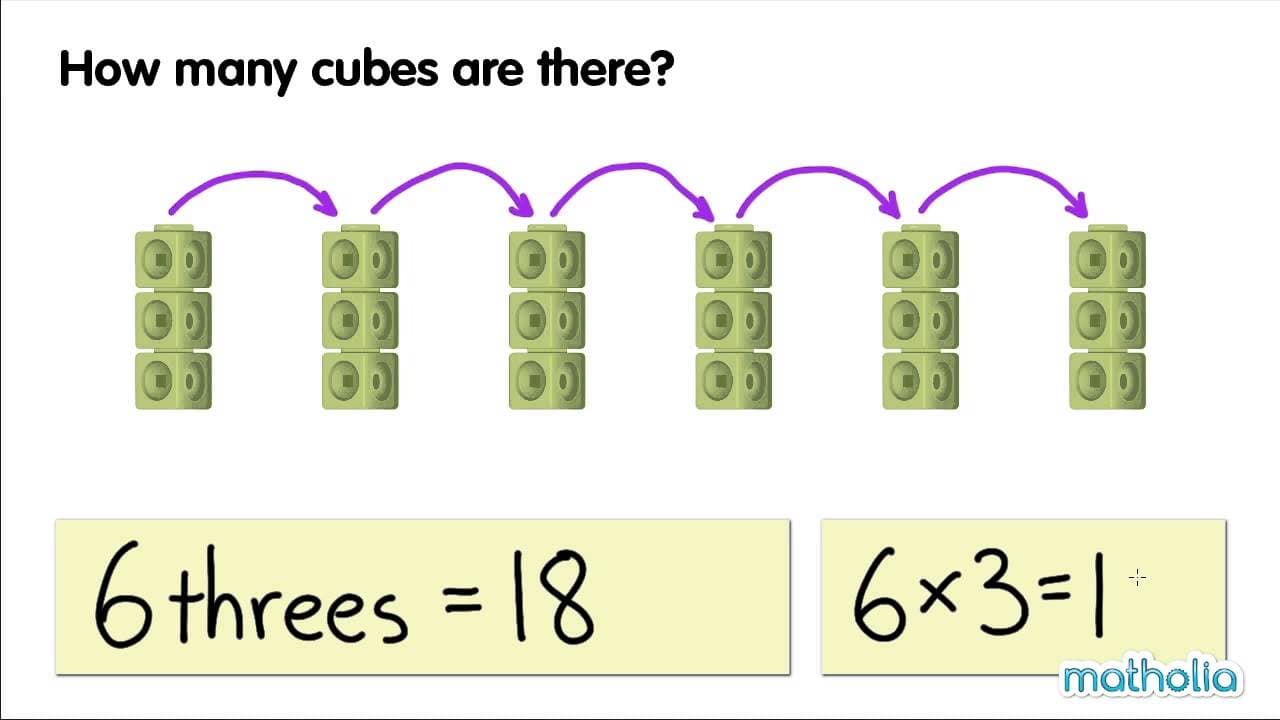
Learning to Multiply by 3 with Groups and Skip Counting

Learning to Multiply by 3 with Groups and Skip Counting

This instructional video provides a clear, step-by-step introduction to multiplying by 3, designed specifically for early elementary students. It begins by using concrete visual aids—groups of balloons and connecting cubes—to demonstrate the concept of multiplication as repeated addition. The narrator guides viewers through the process of counting groups, identifying how many items are in each group, and then skip-counting by threes to find the total sum. The video progresses from concrete examples to abstract representation. It explicitly links the language of "groups of" to the multiplication symbol, showing how "4 threes" translates mathematically to "4 x 3". Following the object-based examples, the video features a number line segment where numbers appear sequentially to practice skip-counting from 3 to 30. This visual reinforces the number pattern associated with the 3 times table. Finally, the video presents the complete multiplication table of 3, reading through each equation from 1 x 3 to 10 x 3. This structure makes the video an excellent resource for introducing the concept of multiplication, reinforcing skip-counting skills, and aiding in the memorization of multiplication facts. Teachers can use it to visualize the transition from addition to multiplication or as a review tool for times table fluency.

MatholiaChannelMatholiaChannel

3mins 1s

Counting Strategies for Circles and Rows

Counting Strategies for Circles and Rows

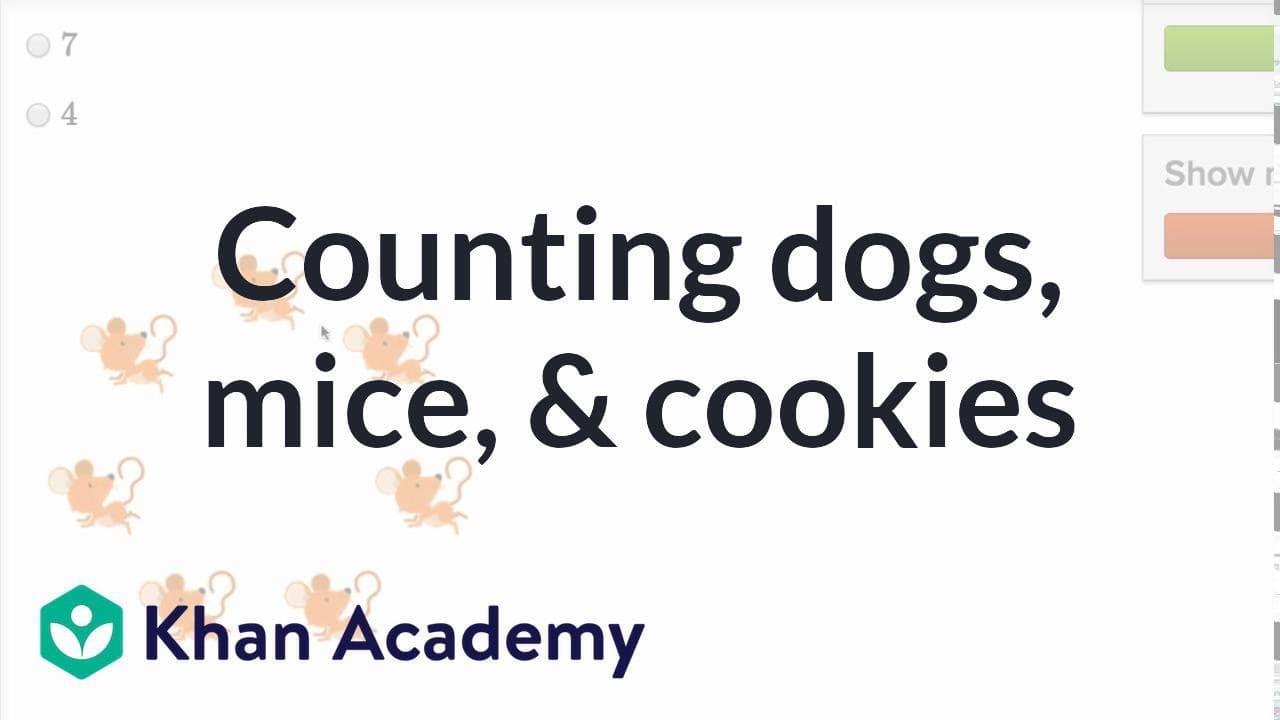
A focused mathematics tutorial that demonstrates strategies for counting objects arranged in different patterns, specifically circles, scattered groups, and arrays. The narrator guides viewers through four distinct counting exercises involving animated dogs, mice, and cookies, modeling the thought process required to count accurately without making common errors. The video specifically emphasizes the concept of "one-to-one correspondence" and strategies to avoid double-counting, particularly when objects are arranged in a continuous circle. By explicitly marking a starting point mentally and stopping before overlapping, the narrator models critical metacognitive strategies for early learners. This resource is highly valuable for early childhood classrooms as a direct instruction tool or intervention for students struggling with counting accuracy. It moves from simple circular arrangements (numbers 5-10) to more complex arrays involving teen numbers (up to 19), providing a scaffolded approach to learning cardinality.

Khan AcademyKhan Academy

1min 44s

Fast-Paced Counting by Ones: 1 to 50

Fast-Paced Counting by Ones: 1 to 50

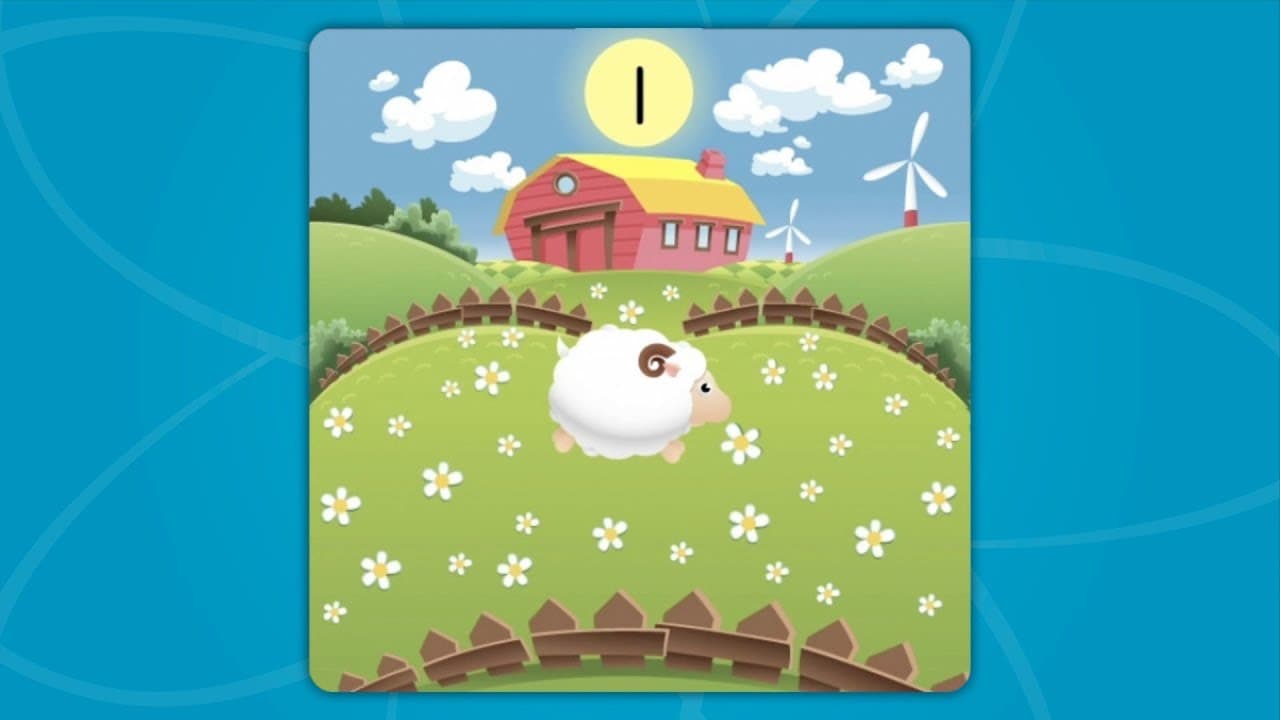
This high-energy animated video challenges early learners to practice counting by ones from 1 to 50 at a brisk pace. Labeled as an "Expert" level song, it features a fast, electronic beat designed to build fluency and automaticity in number sequencing. The video engages students visually and auditorily, moving beyond simple slow enumeration to rapid number recall. The visual theme is set on a bright, sunny farm. The video alternates between two main animated sequences: a boy performing jumping jacks during the musical interludes, and a sheep jumping over a fence as the counting occurs. Numbers from 1 through 50 appear clearly inside the sun at the top of the screen, synchronizing with the spoken count to reinforce number recognition alongside the auditory cues. Teachers can use this video as an effective "brain break" or warm-up activity in Math class. The rhythmic nature invites physical participation, allowing students to jump or clap along with the beat while practicing their numbers. It is particularly useful for assessing student fluency and helping them transition from counting slowly on fingers to reciting number sequences confidently and quickly.

Have Fun TeachingHave Fun Teaching

2mins 30s

Learning to Skip Count by Tens to 100

Learning to Skip Count by Tens to 100

This energetic animated math video teaches early learners how to skip count by tens up to 100. Set to an upbeat rhythm, the video uses bright visuals and a clear numerical display to guide students through the sequence 10, 20, 30, and so on. A friendly character stands alongside a digital display that flashes each number as it is sung, reinforcing the connection between the spoken word and the written numeral. Themes in this video center on foundational number sense, specifically the base-ten number system and pattern recognition. By isolating the multiples of ten, students can focus on the rhythmic pattern of counting (

Have Fun TeachingHave Fun Teaching

2mins 56s

Mastering Skip Counting by 10s, 100s, and 1,000s

Mastering Skip Counting by 10s, 100s, and 1,000s

This video serves as a clear, step-by-step instructional guide on the mathematical concept of 'Counting On' using place value strategies. It transitions from concrete visual aids using Base-10 blocks to abstract number sequences, demonstrating how to skip count by 10s, 100s, and 1,000s with 3-digit and 4-digit numbers. The core themes explore number sense, pattern recognition within the decimal system, and the specific mechanics of 'bridging' or crossing place value thresholds (e.g., transitioning from 190 to 200). The video systematically isolates changing digits to help students visualize how adding specific quantities affects only certain place values, except when a regrouping occurs. For educators, this video is an excellent tool for visual learners who struggle to understand how place value works with larger numbers. It effectively scaffolds learning by starting with physical representations before moving to symbolic numbers, making it perfect for introducing skip counting, reinforcing mental math strategies, or supporting remediation for students struggling with multi-digit addition.
MatholiaChannelMatholiaChannel

2mins 52s

How to Skip Count by Tens to 100

How to Skip Count by Tens to 100

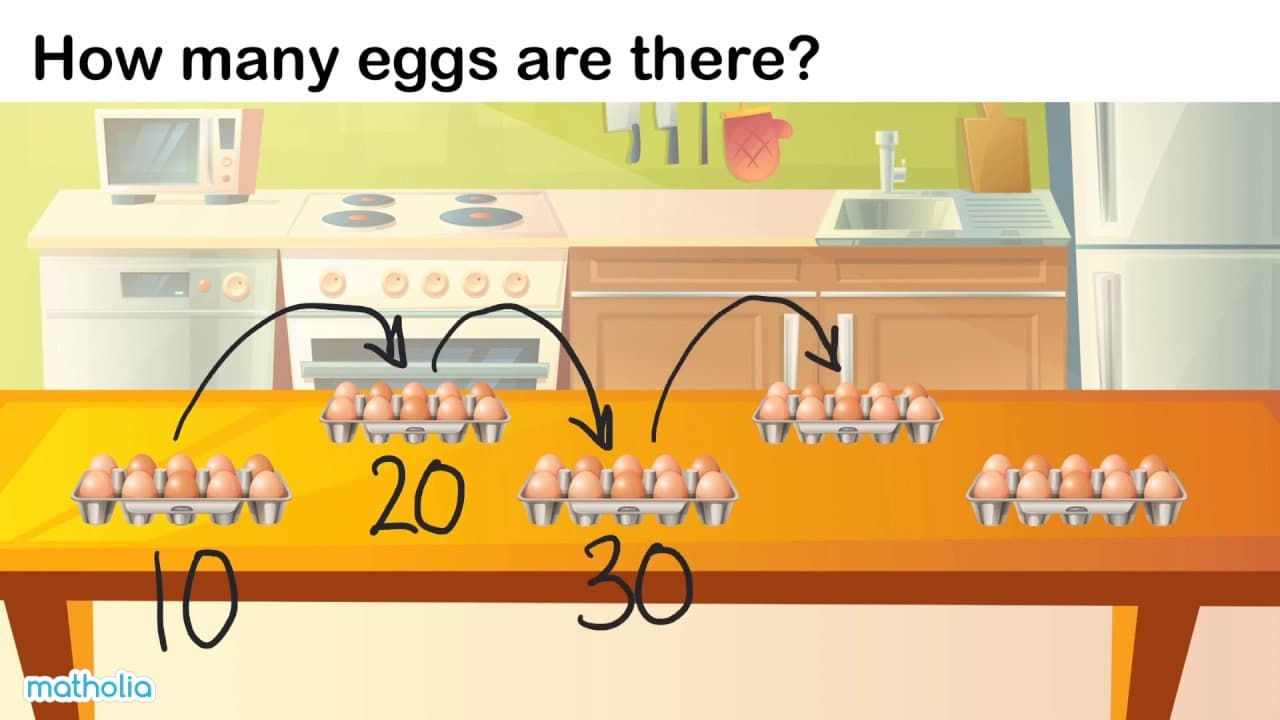
This animated math video introduces young learners to the concept of skip counting by tens through three distinct visual models: real-world grouping, a number line, and a hundred chart. The video begins by using cartons of eggs to demonstrate how grouping items into sets of ten allows for faster counting than counting by ones. It then transitions to abstract representations, showing how to jump by tens on a number line and identifying the vertical pattern created when counting by tens on a 1-100 number grid. Key themes include number sense, recognizing patterns in the base-ten number system, and efficient counting strategies. The video explicitly connects visual quantities (groups of eggs) to linear measurement (number line) and symbolic patterns (hundred chart), helping students bridge concrete and abstract mathematical understanding. For educators, this video serves as an excellent introduction or review of skip counting. The clear visuals support diverse learning styles, and the concluding question—asking students to predict the pattern if starting from the number 2—provides a natural springboard for critical thinking and extending the lesson into off-decade skip counting (e.g., 12, 22, 32).

MatholiaChannelMatholiaChannel

2mins

Materials

Short I Spelling Worksheet

Short I Spelling Worksheet

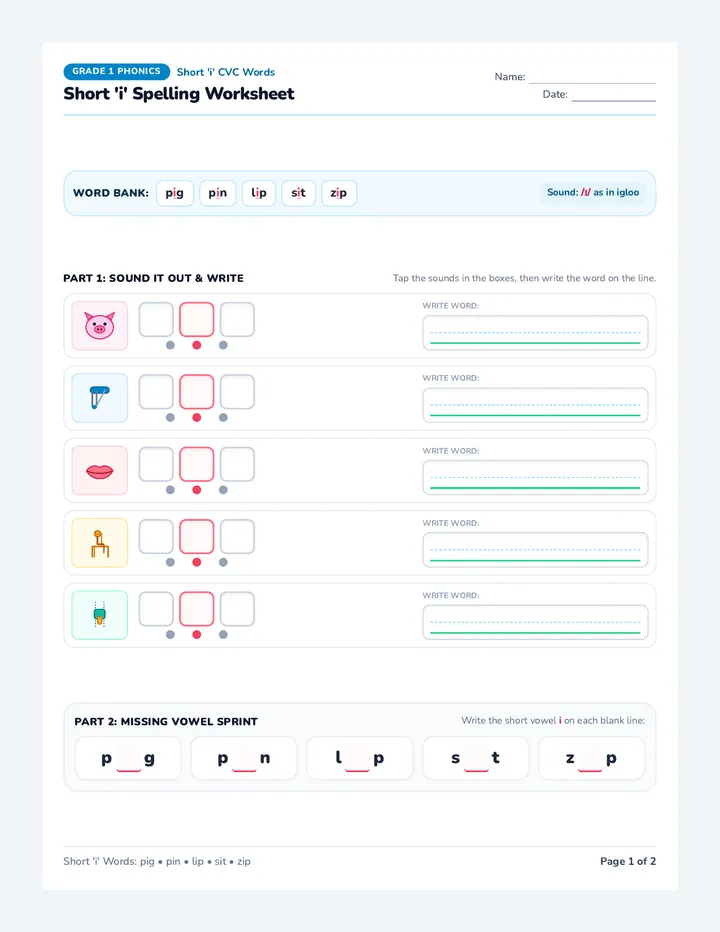
A two-page Grade 1 phonics and spelling worksheet focusing on 5 short I CVC words: pig, pin, lip, sit, and zip. Includes sound boxes, handwriting lines, word family sorting, cloze sentences, and a sentence writing challenge.

EA

Edith Asante

Everyday Math Workout Packet

Everyday Math Workout Packet

A comprehensive 20-day mixed review packet aligned with first-grade Everyday Math skills. Each daily page provides structured practice in counting on, turn-around facts, number line addition and subtraction up to 20, tally marks with data charts, decomposing numbers with parts-and-total frames, and story problems up to 12.

T

Terece.Williams

Word Spelling Practice Worksheet

Word Spelling Practice Worksheet

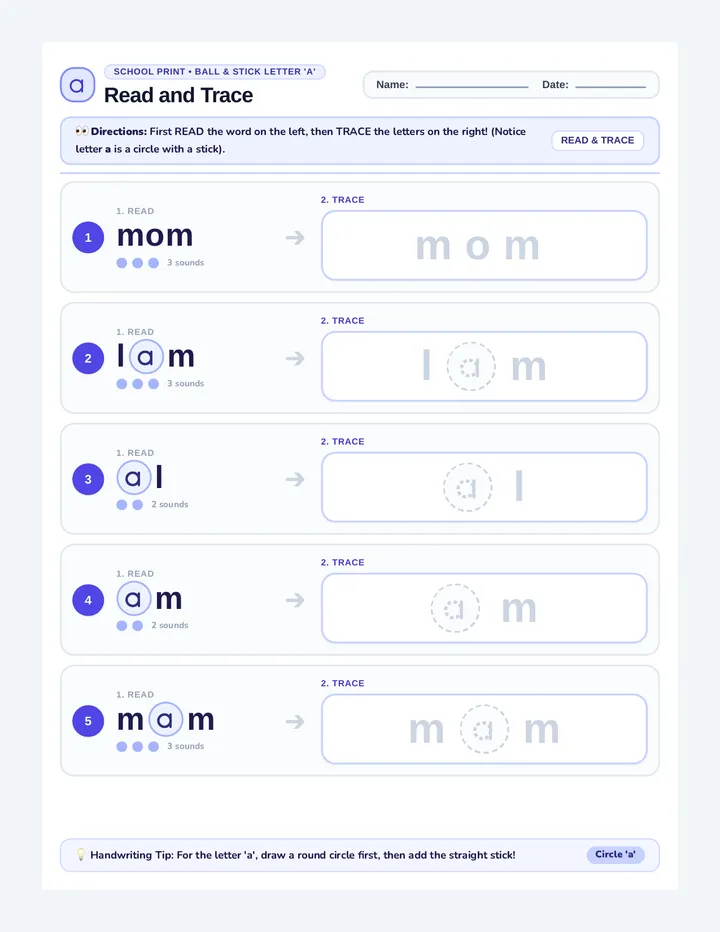
A large-print special education phonics worksheet for reading and tracing mom, lam, al, am, and mam with clean open tracing boxes (no triple lines), school circle-style letter a, and uniform sound dots with no yellow dots.

M

michelle.bernius

Number Safari Tracing Packet

Number Safari Tracing Packet

A comprehensive 1-20 number tracing and writing packet with a safari theme. Each number includes a visual counting aid (emojis), three dashed tracing examples, and two blank spaces for independent writing.

V

victoria.lesniak

Crayon Counter Worksheet

Crayon Counter Worksheet

A two-page printable 1st-grade math worksheet for counting on up to 12. Page 1 contains instructions, an example, and 8 problems. Page 2 contains a continuation banner and 8 more practice problems, all in high-contrast printer-friendly grayscale. Crayon boxes show the exact number of crayons sticking out of the top.

JB

Julia Butz

Rocket Count Lesson Plan

Rocket Count Lesson Plan

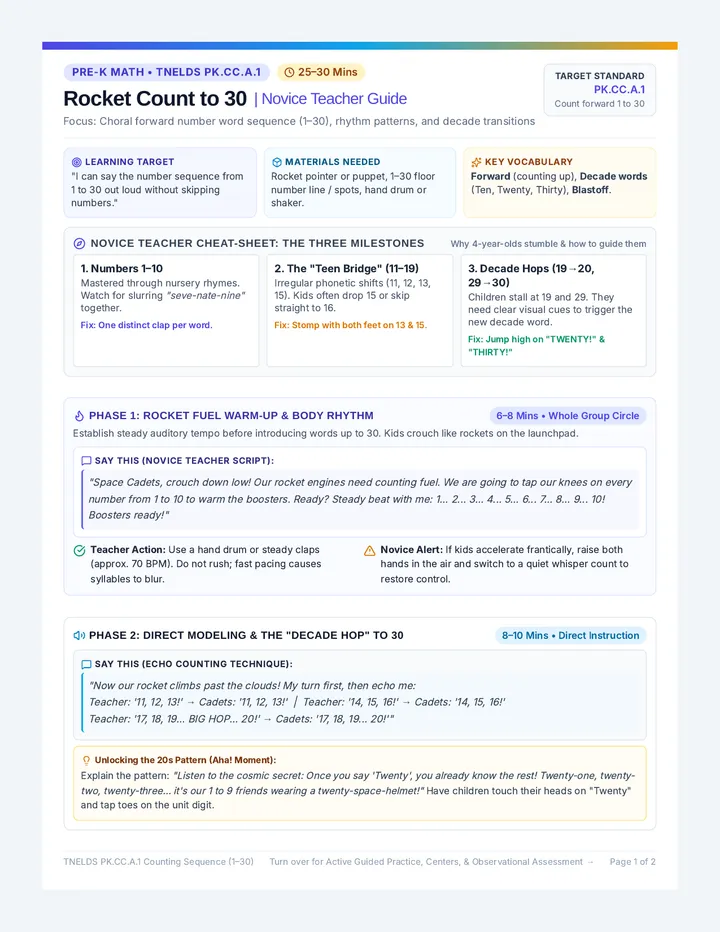
A comprehensive, step-by-step 2-page instructional lesson plan tailored for novice pre-K teachers to teach TNELDS standard PK.CC.A.1 (counting forward 1 to 30). Features verbatim teacher scripts, kinesthetic movement routines, decade transition strategies, differentiation tiers, and an observational assessment rubric.

JR

janiyah rankin

Sequences

Packet Master TOC document

Unit 6 Equal Groups and Multiplication

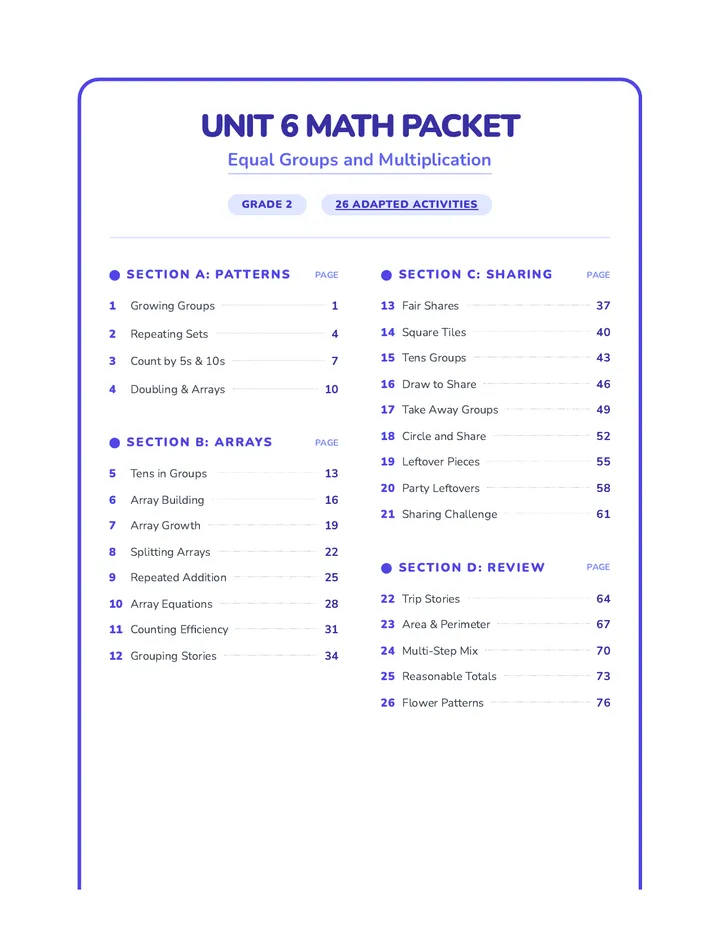
A comprehensive Grade 2 math packet focused on skip counting, repeated addition, arrays, and equal groups.

N

nmack

39
Number Gym Slides

Number Gym Circuit

A four-week intensive math intervention sequence for Tier 3 students. Each day features a 3-part drill targeting number identification, formation, and sequential counting. Weeks 1-2 focus on numbers 0-30; Weeks 3-4 expand to numbers 0-40.

NT

Nicole Thomson

22
Academy Final Mission Assessment

Pond Patrol Academy

A comprehensive math sequence designed for early learners to master counting from 1 to 20. Using a engaging pond theme, students progress from single-digit counting to understanding teen numbers and representing larger quantities.

CN

Coleman Newell

27
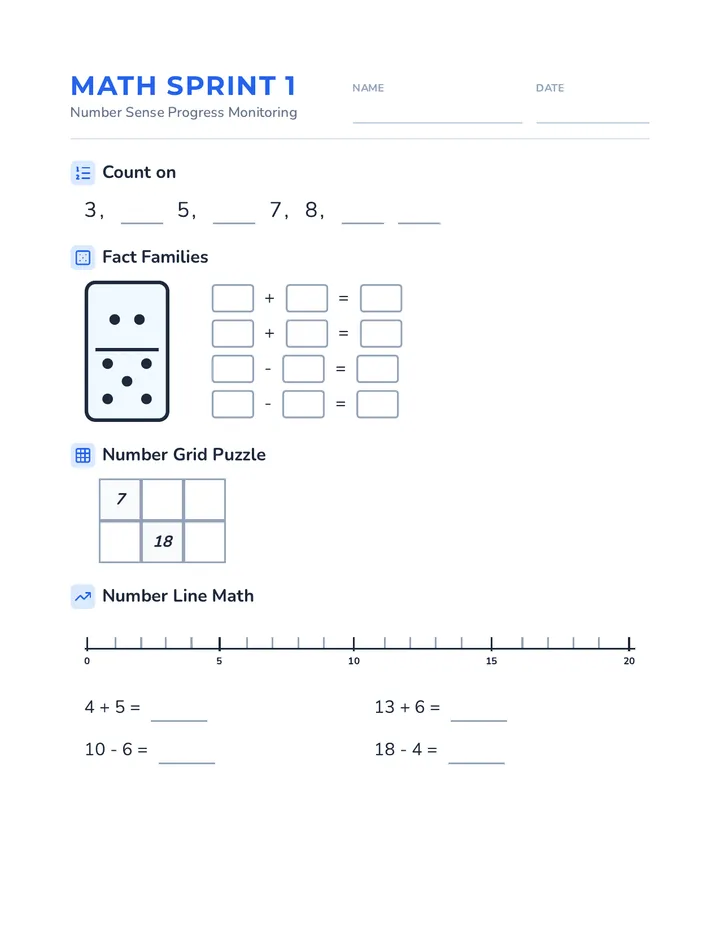
Math Sprint 1 Worksheet

Foundational Math Tracking

A comprehensive series of elementary math progress monitoring resources designed to track student growth in foundational arithmetic and number sense.

T

torrie.smith

24
Downhill Differences Slides

Podium Power Subtraction Strategy Unit

A 20-lesson subtraction fluency unit for primary students, explicitly organized by mental math strategies: Counting Up, Number Lines, Making 10, Pretend 10, and Close to Doubles, all with Winter Olympic themes.

T

tmatthews

63
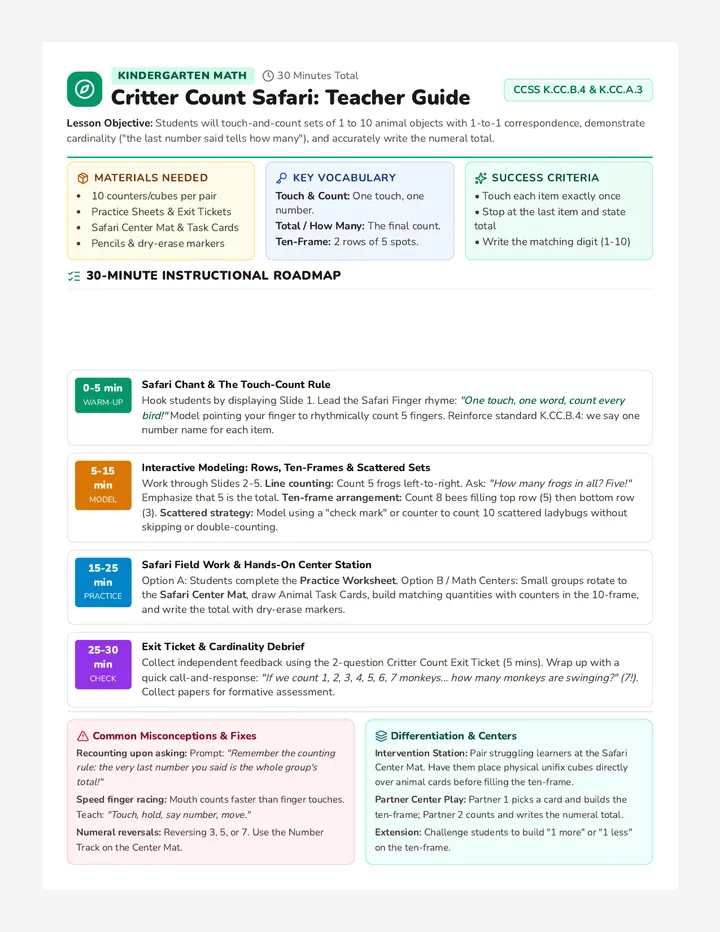
Critter Count Teacher Guide

Safari Math Explorers

A hands-on Kindergarten mathematics sequence covering one-to-one counting, cardinality, numeral handwriting 1 to 10, and representing quantities with concrete circle sets and ten-frames.

V

victoria.lesniak

21

Lessons

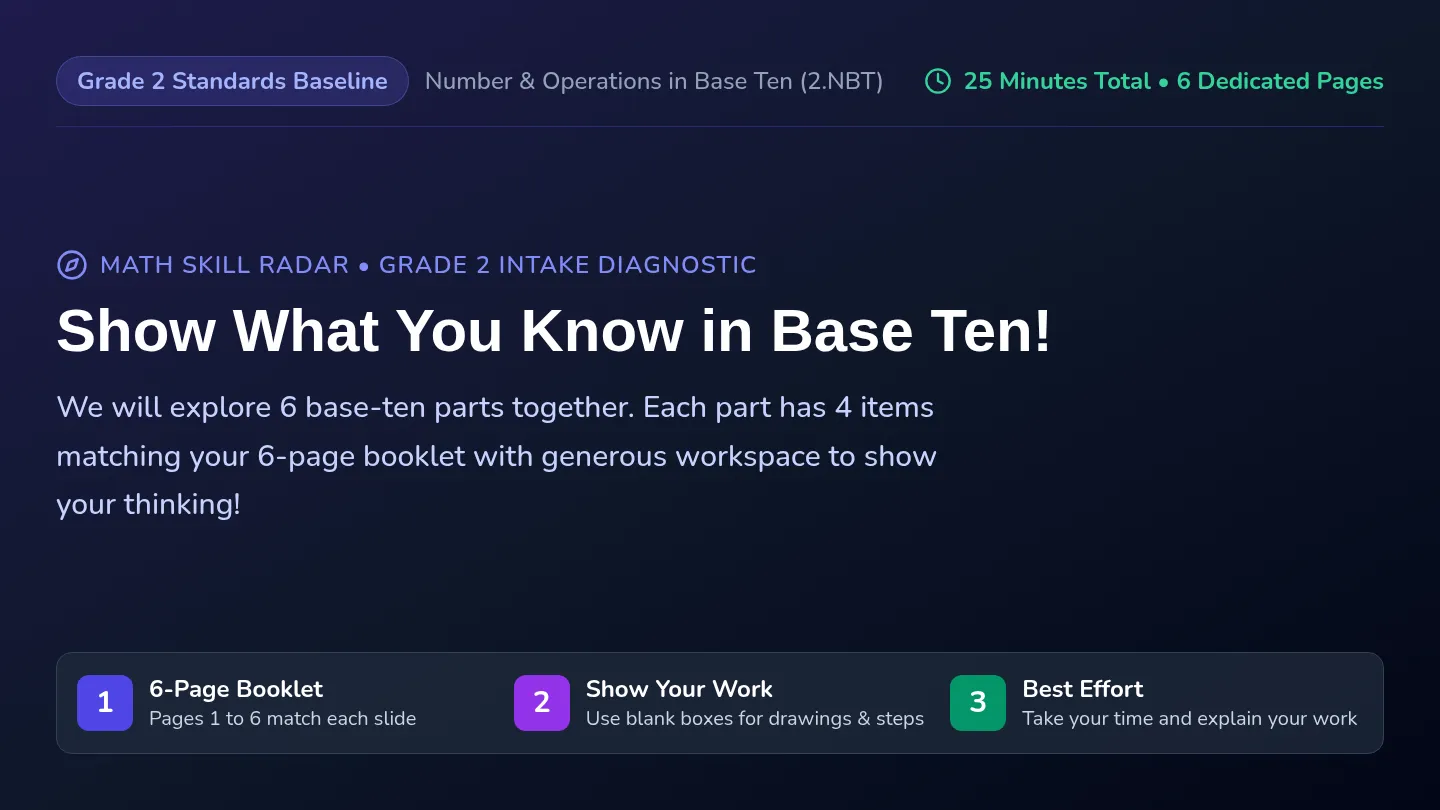
Math Radar Intake Slides

Math Skill Radar

A comprehensive baseline math diagnostic and intervention suite for special education spanning early numeracy through Grade 4. Features complete tiered intake assessments, practice packets, manipulative work mats, and master scoring keys for both 1st Grade Base Ten (1.NBT) and 2nd Grade Base Ten (2.NBT), alongside K-1 early number sense tools.

S

Sara

20
Cash Calculators Slides

Cash Calculators

A comprehensive lesson on mastering currency, from basic coin identification and skip counting to calculating mixed bills and making change in real-world market scenarios. Includes visual slides, scaffolded worksheets, and an interactive matching game.

DP

Deana Padgett

4
Pond Animals Worksheet

Counting Quest

A foundational math lesson focused on one-to-one correspondence for numbers 1-10, using visual number lines, physical counting, and finger representation.

CN

Coleman Newell

23
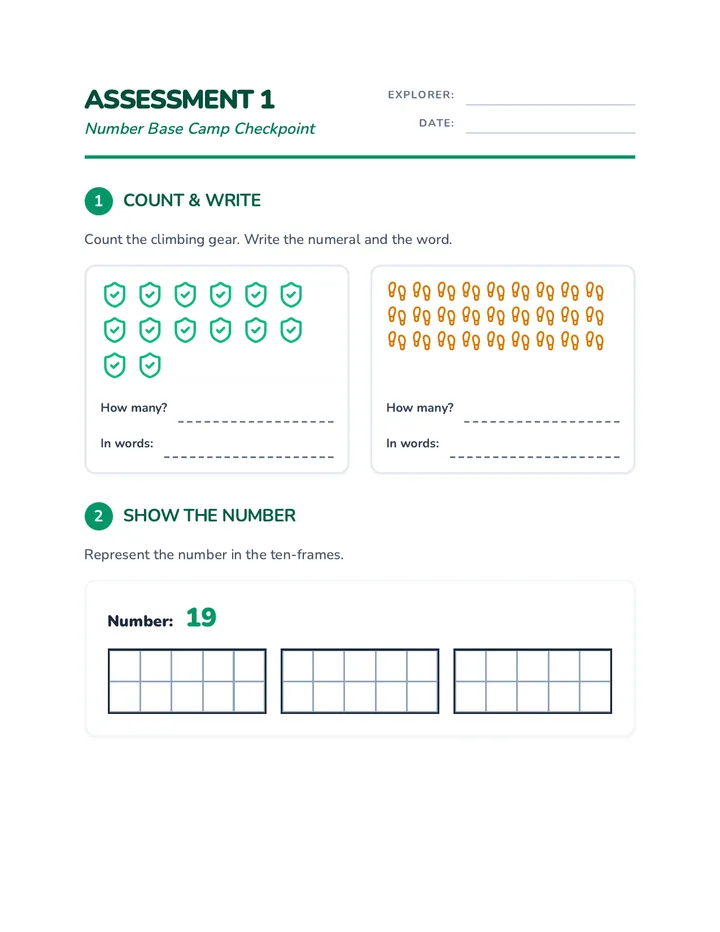
Assessment 1 Worksheet

Number Base Camp

A comprehensive lesson focused on mastering numbers up to 30, covering counting, recognizing, representing, naming, and ordering quantities through hands-on practice and assessment.

CN

Coleman Newell

16
Strategy Detective Case 1 Worksheet

Math Mastery Review

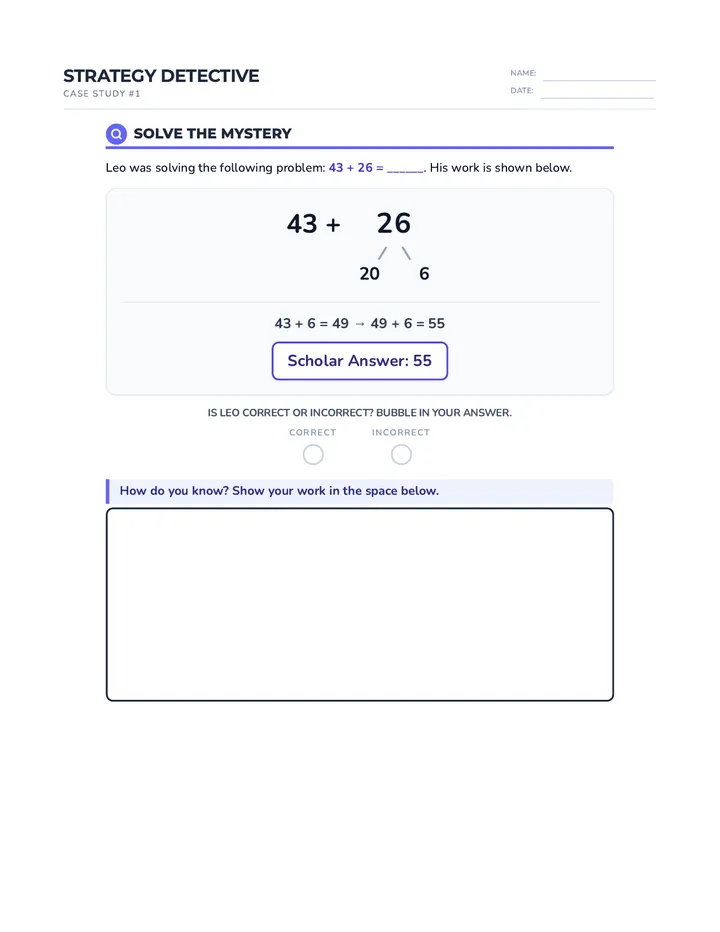
A comprehensive review packet covering counting sequences, place value, double-digit addition/subtraction with multiples of ten, and error analysis of addition strategies. Each core question type is practiced three times to ensure mastery.

DB

Daimyn Badzic

14
Number Fluency Practice Pack

Number Fluency Foundations

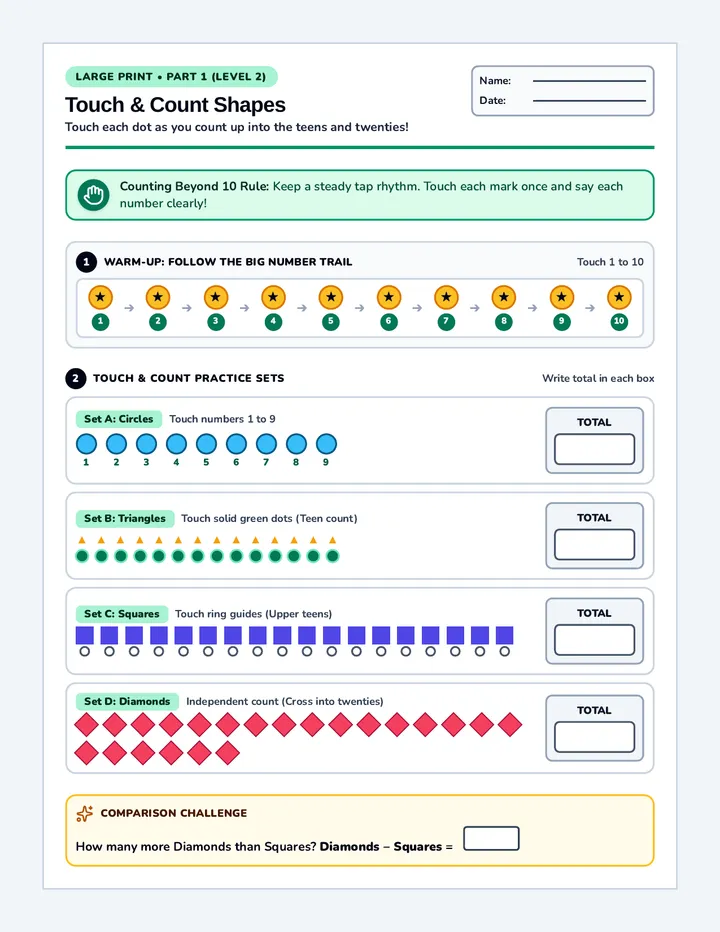
An advanced number fluency lesson combining higher-range shape tracking up to 24, tens-and-ones place value grouping up to 30, multi-interval skip counting (3s, 4s, 6s, off-decade 10s, reverse 5s), bridging-10 visual fast facts up to 20, and applied real-world word problem story worksheets with complete teacher keys.

S

Sara

10