Lenny.com
Explore
Create
ActivitiesNewMathEnglish Language ArtsScience & EngineeringSocial StudiesGlobal LanguagesHealth & Physical EducationSpecial EducationCounseling & Life SkillsArts & CreativityESL
Lenny.com
Lenny.com
Explore
Create
ActivitiesNewMathEnglish Language ArtsScience & EngineeringSocial StudiesGlobal LanguagesHealth & Physical EducationSpecial EducationCounseling & Life SkillsArts & CreativityESL
Lenny.com
Lenny.com

Solutions

Lenny for EducatorsLenny for SchoolsLenny for Districts

Product

ExploreSign inCreateSupportAbout

Resources

Getting startedMTSS Acceleration Program

© 2026 Lenny Learning Inc.

TermsPrivacyAccessibility
LinkedInInstagramX
Lenny

Addition and Subtraction Concepts

Mental math strategies, regrouping techniques, and the inverse relationship between operations. Builds computational fluency through visual models, number lines, and real-world word problems.

MathNumbers & CountingCounting ObjectsNumber NamesComparing NumbersNumber OperationsCounting SequenceNumbers 0-10Place Value Understanding and SystemAdd and Subtract Within 20Addition and Subtraction ConceptsAddition and Subtraction EquationsAddition and Subtraction ProblemsFoundations for MultiplicationMultiplication and Division PropertiesMultiply and Divide Within 100Multiplication and Division ProblemsFactors and MultiplesProperties of OperationsPatterns and RelationshipsGenerate and Analyze PatternsMulti-Digit ArithmeticPlace Value OperationsMulti-Digit and Decimal OperationsNumerical ExpressionsFour Operations and PatternsFour Operations Problem SolvingMeasurement & DataMeasurable AttributesMeasuring LengthsMeasure and Estimate Lengths in Standard UnitsRelate Addition and Subtraction to LengthClassifying and Counting ObjectsTime and MoneyArea Concepts and MeasurementPerimeter and Area MeasuresAngle Concepts and MeasurementTime, Volume, and MassMeasurement Unit ConversionsGeometryIdentifying ShapesShapes and AttributesShape Attributes and ReasoningShapes and CompositionClassifying 2D FiguresGeometric Figures and RelationshipsLines, Angles, and ShapesAngle, Area, and VolumeGeometric MeasurementVolume of 3D ShapesCoordinate Plane ApplicationsTransformations in the PlaneCongruence and SimilarityUnderstand congruence in terms of rigid motionsSimilarity and TransformationsProve Theorems Involving SimilarityPythagorean TheoremTrigonometry for General TrianglesMake Geometric ConstructionsProve Geometric TheoremsTheorems About CirclesFind Arc Lengths And Areas of Sectors of CirclesVolume FormulasRelationships Between Two-Dimensional and Three-Dimensional ObjectsProve Simple Geometric Theorems AlgebraicallyTranslate Between Geometric Description and Equation for Conic SectionApply Geometric Concepts in Modeling SituationsFractions & DecimalsFractions as NumbersBuilding FractionsFraction Equivalence and OrderingAdding and Subtracting FractionsMultiplying and Dividing FractionsDividing FractionsDecimal FractionsMulti-Digit Computation and FactorsAdd, Subtract, Multiply, and Divide Rational NumbersRational Number SystemIrrational Numbers and ApproximationsRatiosRatios and ProportionsProportional RelationshipsUnit RateAlgebraAlgebraic ExpressionsGenerate Equivalent ExpressionsQuantitative RelationshipsProportional Relationships and Linear EquationsEquations and InequalitiesEquation Solving and ReasoningLinear Equations and SystemsGraph Equations and InequalitiesSystems of EquationsReal-World Algebraic ProblemsQuantitative Reasoning with UnitsExpression StructureEquivalent Expression FormsRadicals and Integer ExponentsRational ExponentsRational and Irrational NumbersPolynomial OperationsPolynomial IdentitiesPolynomial Zeros and FactorsRational ExpressionsComplex Number OperationsComplex Numbers in PolynomialsComplex Numbers on PlaneStatistics & ProbabilityRepresent and Interpret DataData DistributionsStatistical VariabilityProbability ModelsCompound Event ProbabilitiesStatistical SamplingInterpret Categorical and Quantitative DataBivariate Data PatternsInterpret Linear ModelsComparing Two PopulationsRandom Processes in StatisticsIndependence and Conditional ProbabilityExpected ValuesProbability-Based Decision MakingStatistical Inference and ConclusionsFunctionsFunction Concepts and NotationDefine and Compare FunctionsInterpret Functions in ContextAnalyze Function RepresentationsModel Relationships with FunctionsIdentify Linear vs Exponential GrowthDistinguish Between Function TypesCompare Growth RatesInterpret Function ExpressionsBuild Functions from RelationshipsConstruct and Model FunctionsTransform and Combine FunctionsModel Comparison and SelectionSolve Exponential EquationsTrigonometryTrigonometric Ratios Involving Right TrianglesTrigonometric Functions and Unit CircleModel with Trigonometric FunctionsTrigonometric IdentitiesVectors & MatricesIntroduction to Vectors and MatricesVector QuantitiesVector OperationsMatrix OperationsCalculusLimits and ContinuityDerivative Concepts and NotationDerivative Rules and TechniquesApplications of DerivativesOptimization ProblemsRelated RatesCurve Sketching and AnalysisIntegration Concepts and NotationAntiderivatives and Indefinite IntegralsDefinite Integrals and AreaFundamental Theorem of CalculusIntegration TechniquesApplications of IntegrationDifferential EquationsSequences and SeriesParametric and Polar FunctionsVector-Valued Functions

Videos

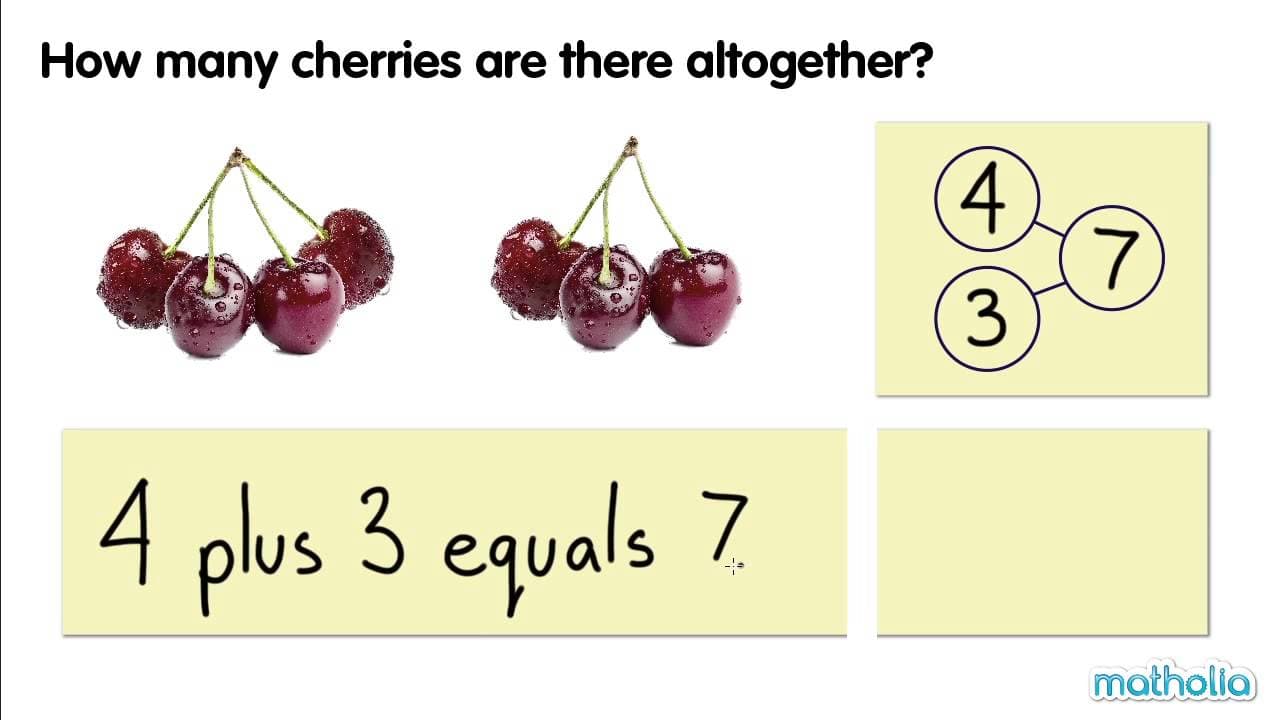
Writing Addition Equations with Pictures

Writing Addition Equations with Pictures

This educational video introduces young learners to the concept of addition through visual examples and step-by-step equation writing. Using concrete objects like kittens, cherries, and eggs, the video demonstrates how to combine two groups to find a total. It explicitly connects visual counting to the abstract representation of mathematics by showing how to translate physical quantities into both written sentences and numerical equations. The content focuses on three key themes: identifying parts of a whole, understanding number bonds (part-part-whole relationships), and learning mathematical vocabulary. It guides students through the process of recognizing distinct groups, counting them, and then expressing that relationship using the terms "plus" and "equals," as well as the symbols "+" and "=". This progression helps bridge the gap between counting and formal arithmetic. For educators, this video serves as an excellent instructional tool for modeling how to write addition equations. It reinforces the "part-part-whole" model using clear number bond diagrams alongside the equations. Teachers can use this video to scaffold lessons on addition, helping students move from counting physical manipulatives to writing their own number sentences. The repetitive structure allows for predictable learning, making it ideal for pause-and-discuss sessions where students predict the answers before they appear on screen.

MatholiaChannelMatholiaChannel

2mins 18s

Using Bar Graphs to Compare Quantities

Using Bar Graphs to Compare Quantities

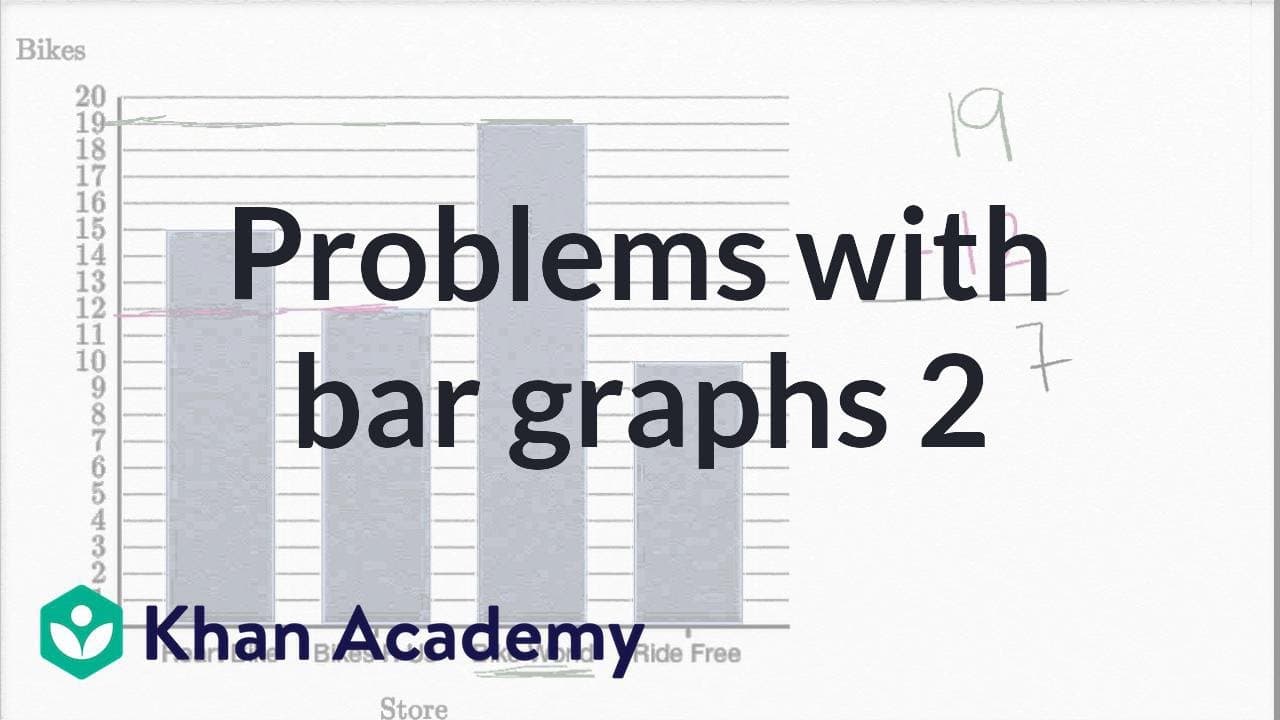
This video provides a clear, step-by-step tutorial on how to interpret data from a vertical bar graph to solve a comparison problem. The narrator demonstrates how to identify specific data points corresponding to different categories ('Bike World' and 'Bikes R Us') and determines the numerical value for each by reading the vertical axis. The content focuses on the key mathematical concept of finding the difference between two quantities. It explicitly models two distinct methods for solving the problem: first, by setting up a subtraction equation (19 - 12), and second, by visually counting the grid units on the graph to determine the 'gap' between the two bar heights. This dual approach reinforces the connection between arithmetic operations and visual data representation. This resource is excellent for early elementary classrooms introducing data analysis and graphing. It helps students transition from simply reading a graph to using the data to answer 'how many more' questions—a common hurdle for young learners. The video serves as a strong model for verifying answers, as it uses the visual counting method to check the arithmetic result.

Khan AcademyKhan Academy

1min 42s

Mastering Addition by Adding 11

Mastering Addition by Adding 11

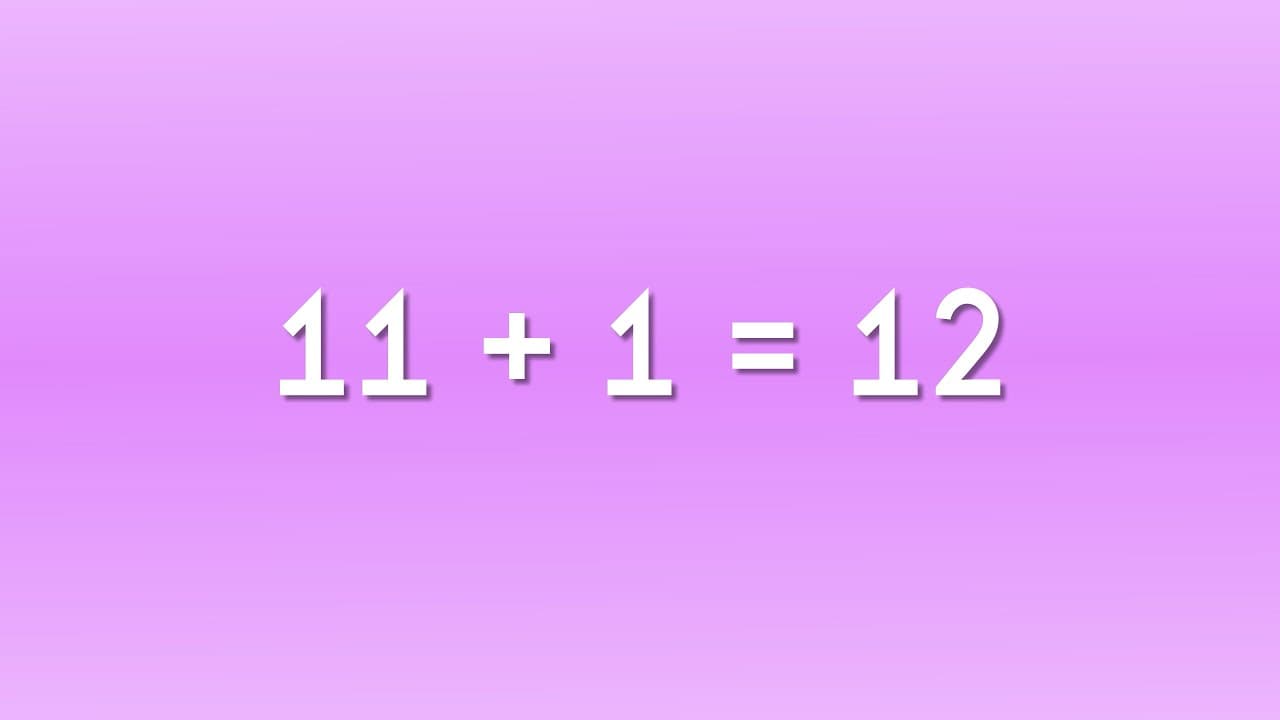
This educational music video features a catchy, rhythmic song designed to help students memorize addition facts involving the number 11. Through a repetitive and engaging pop-style melody, the video guides learners through equations ranging from 11 + 1 up to 11 + 15. The visual presentation is simple and focused, displaying clear white text against a purple gradient background to minimize distractions and keep attention on the mathematical concepts.

Have Fun TeachingHave Fun Teaching

2mins 26s

Mastering Addition Facts: The Adding 13 Song

Mastering Addition Facts: The Adding 13 Song

A high-energy educational song designed to help students master addition facts involving the number 13. Through a catchy pop-rock melody, the video guides learners through a sequence of addition equations starting from 13 + 1 and extending up to 13 + 15. The repetitive chorus and rhythmic delivery serve as mnemonic devices, aiding in the retention of these specific math facts. Key mathematical themes include basic arithmetic, sum calculation, and mental math fluency. The song breaks the addition facts into three distinct sets (1-5, 6-10, and 11-15), allowing for chunked learning. This structure helps students recognize patterns in addition and builds confidence in handling double-digit numbers. This resource is an excellent classroom tool for auditory learners and can be effectively used during transitions, as a warm-up activity, or as part of a math fluency rotation. Because the video features a static visual, it functions best as an audio accompaniment to physical manipulatives, whiteboard work, or movement-based learning activities where students can solve the equations along with the music.
Have Fun TeachingHave Fun Teaching

2mins 19s

Visualizing Addition to 20 Using Base-10 Blocks

Visualizing Addition to 20 Using Base-10 Blocks

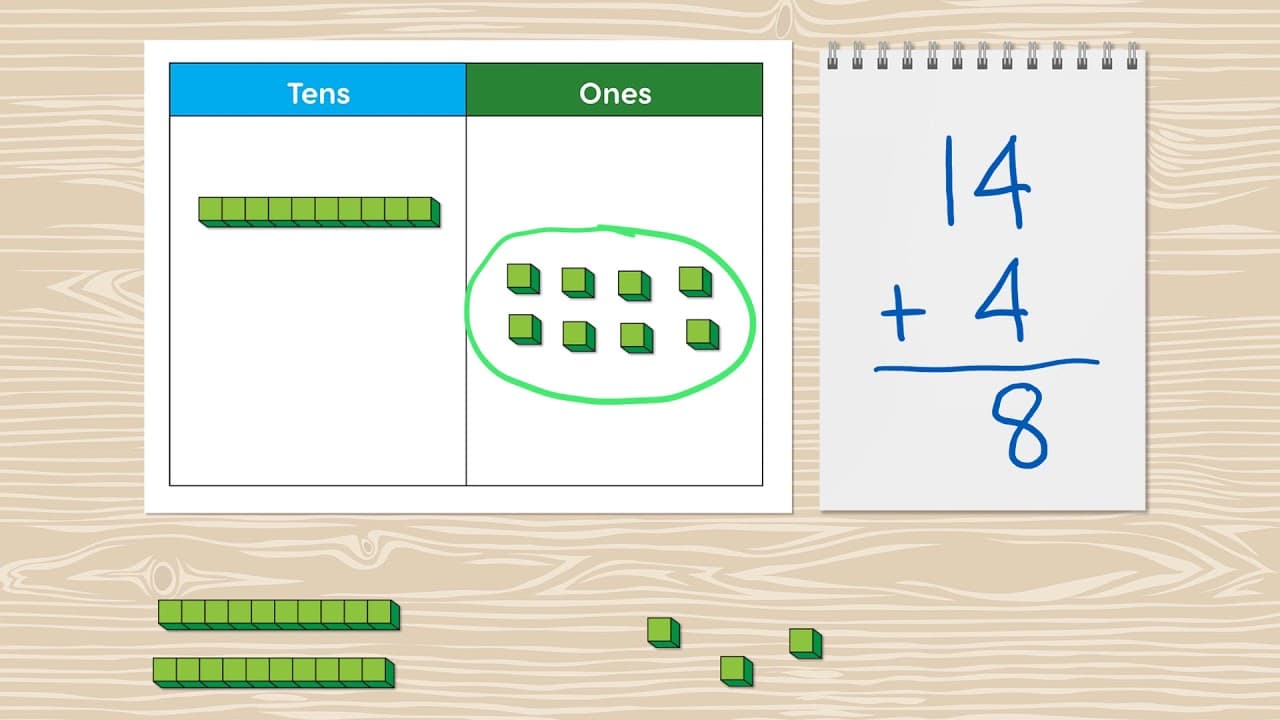
This educational video demonstrates the process of adding numbers up to 20 without regrouping using the Concrete-Pictorial-Abstract (CPA) framework. Through clear animations, it guides students on how to solve the equation 14 + 4 by using virtual base-10 blocks placed on a place value chart alongside standard vertical written notation. The video explores key mathematical themes including place value (distinguishing between tens and ones), modeling numbers with manipulatives, and the step-by-step algorithm for column addition. It explicitly connects the physical act of combining 'ones' blocks to the abstract action of writing the sum in the ones column of an equation. For educators, this resource is an excellent visual aid for introducing or reinforcing early addition strategies. It supports visual learners by clearly separating the tens and ones columns and provides a model for how students can use physical manipulatives at their desks to solve similar problems. It serves as a perfect bridge between counting individual items and understanding the structure of two-digit addition.

MatholiaChannelMatholiaChannel

1min 21s

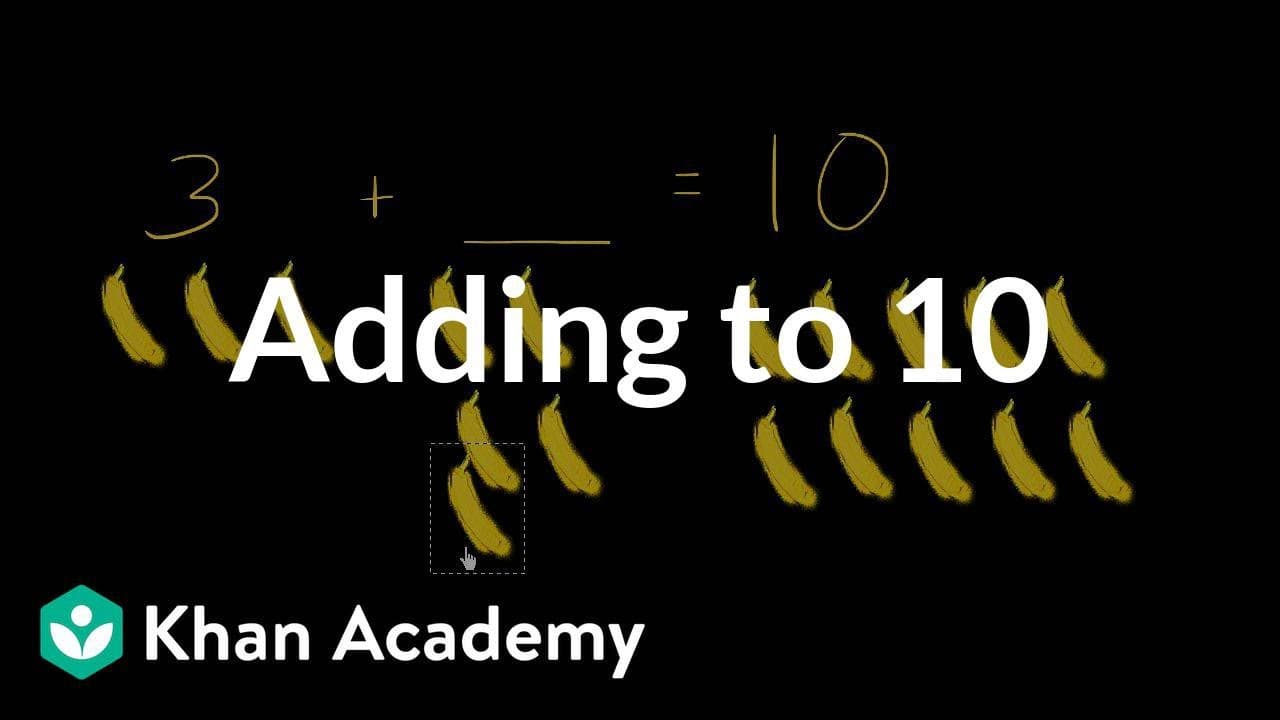
Finding the Missing Number to Make 10 with Bananas

Finding the Missing Number to Make 10 with Bananas

This educational math video demonstrates how to solve a missing addend problem using concrete visual aids. Specifically, it tackles the equation "3 + _ = 10" by using drawings of bananas to represent the numbers. The narrator guides viewers through a "counting on" strategy, starting with the initial three bananas and drawing additional ones one-by-one until the total reaches ten. The video explores key themes of addition, equality, and the relationship between numbers that sum to ten (often called "friends of ten"). It visually distinguishes between the starting quantity and the added quantity, helping students understand that the missing number represents only the items added to reach the total, not the total itself. For educators, this video is an excellent tool for introducing or reinforcing algebraic thinking in early elementary grades. It bridges the gap between concrete counting and abstract equations. Teachers can use it to model how to use manipulatives to solve for unknown numbers, validating strategies like counting on or using drawing to solve math problems.

Khan AcademyKhan Academy

2mins

Materials

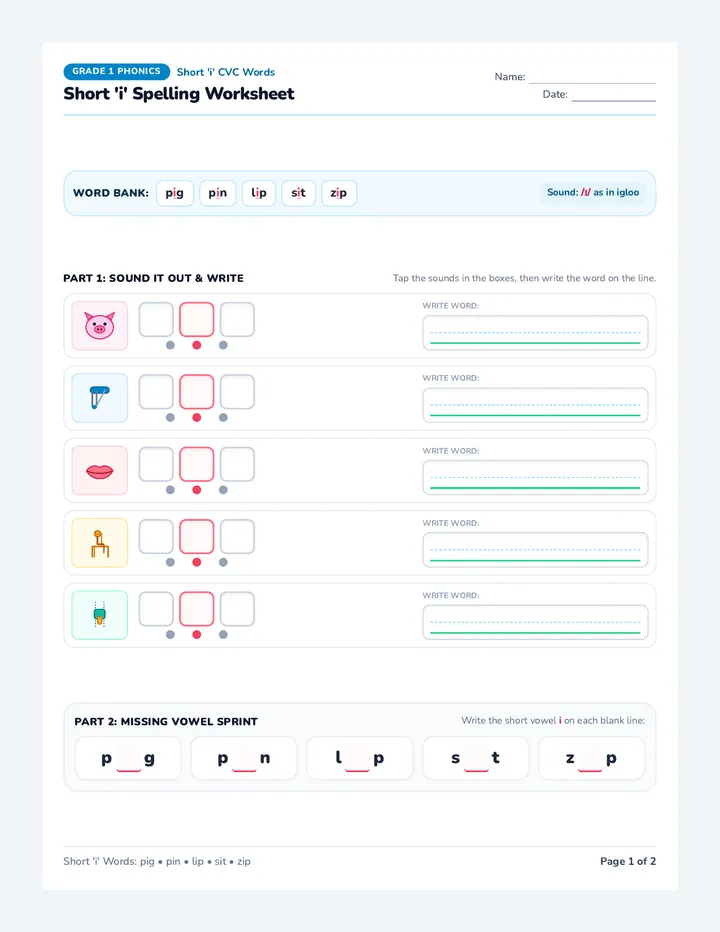
Short I Spelling Worksheet

Short I Spelling Worksheet

A two-page Grade 1 phonics and spelling worksheet focusing on 5 short I CVC words: pig, pin, lip, sit, and zip. Includes sound boxes, handwriting lines, word family sorting, cloze sentences, and a sentence writing challenge.

EA

Edith Asante

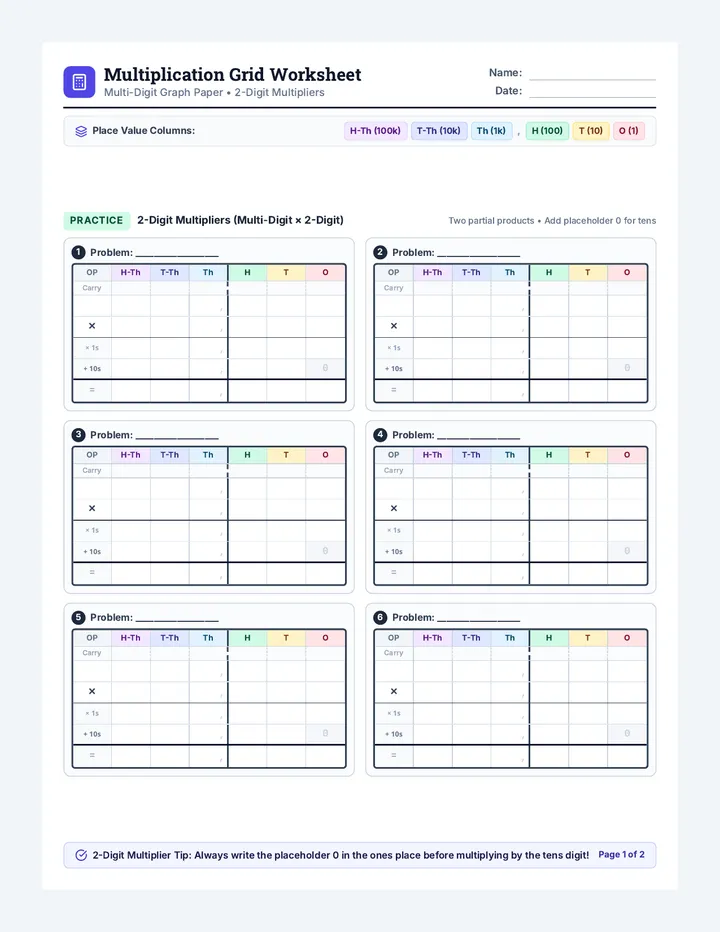
Multiplication Grid Worksheet

Multiplication Grid Worksheet

A 2-page multi-digit multiplication graph paper worksheet featuring structured place value calculation grids for 2-digit and 3-digit multiplier problems. Includes carry rows, aligned partial product spaces with placeholder zero guides, and place value reminders.

C

Carla

Everyday Math Workout Packet

Everyday Math Workout Packet

A comprehensive 20-day mixed review packet aligned with first-grade Everyday Math skills. Each daily page provides structured practice in counting on, turn-around facts, number line addition and subtraction up to 20, tally marks with data charts, decomposing numbers with parts-and-total frames, and story problems up to 12.

T

Terece.Williams

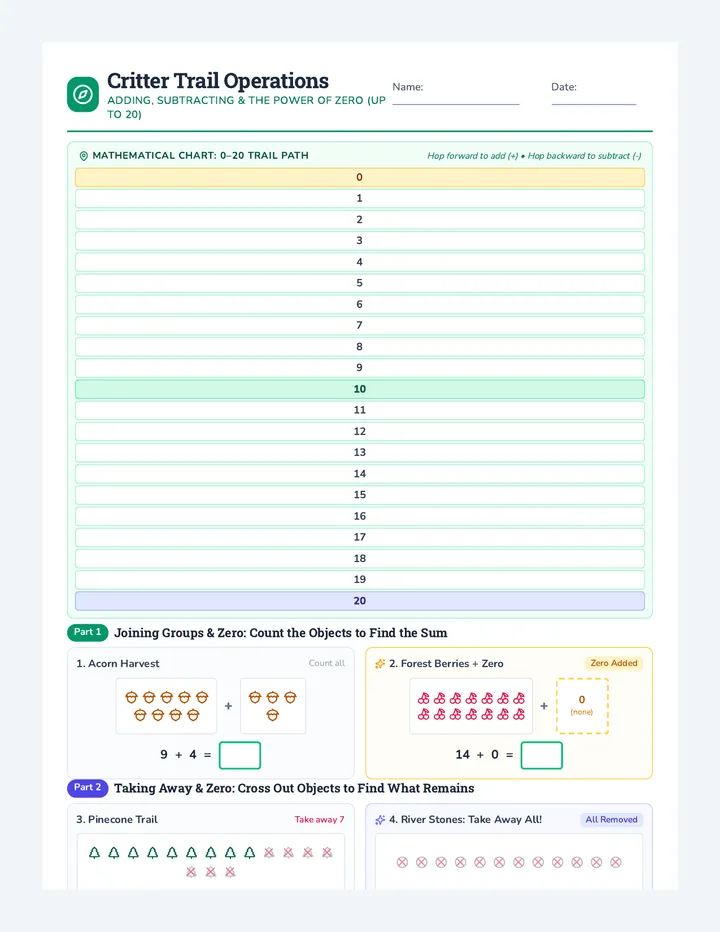
Critter Trail Operations Worksheet

Critter Trail Operations Worksheet

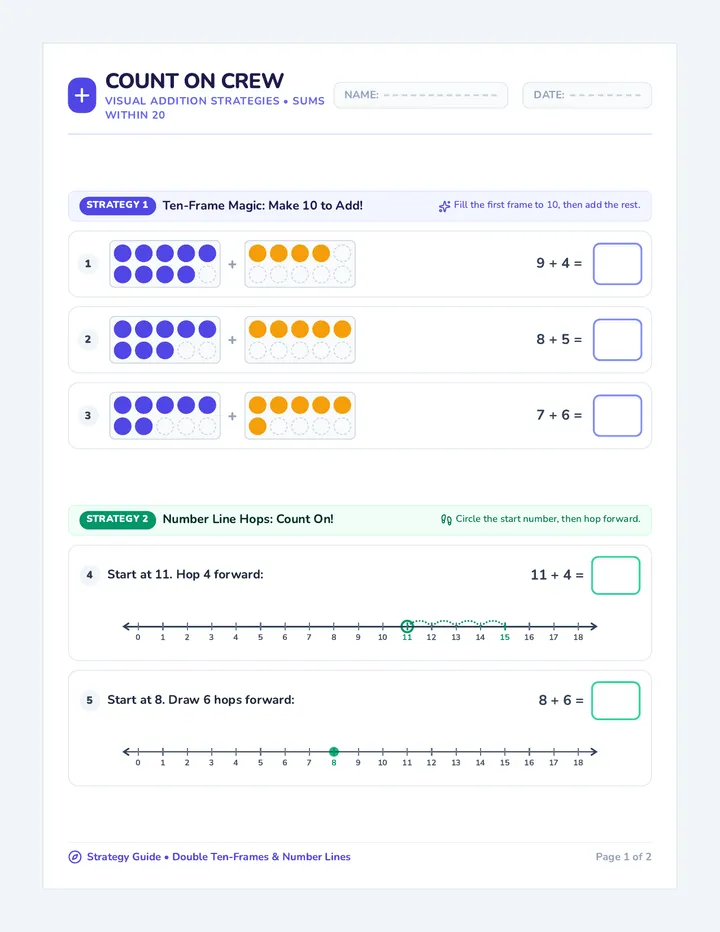
A 2-page print-ready mathematics worksheet for practicing addition and subtraction up to 20 with concrete object visuals, double ten-frames, a 0-20 number path chart, and focused practice with zero ('none') and missing parts.

RL

Rosa Langenstein

CVCC Words Sheet

CVCC Words Sheet

A clean, printable single-page Grade 1 phonics sheet featuring 24 decodable CVCC words with ending consonant blends, arranged in a clear 4x6 reading grid with tracking checkboxes.

EA

Edith Asante

Three-Digit Addition Packet

Three-Digit Addition Packet

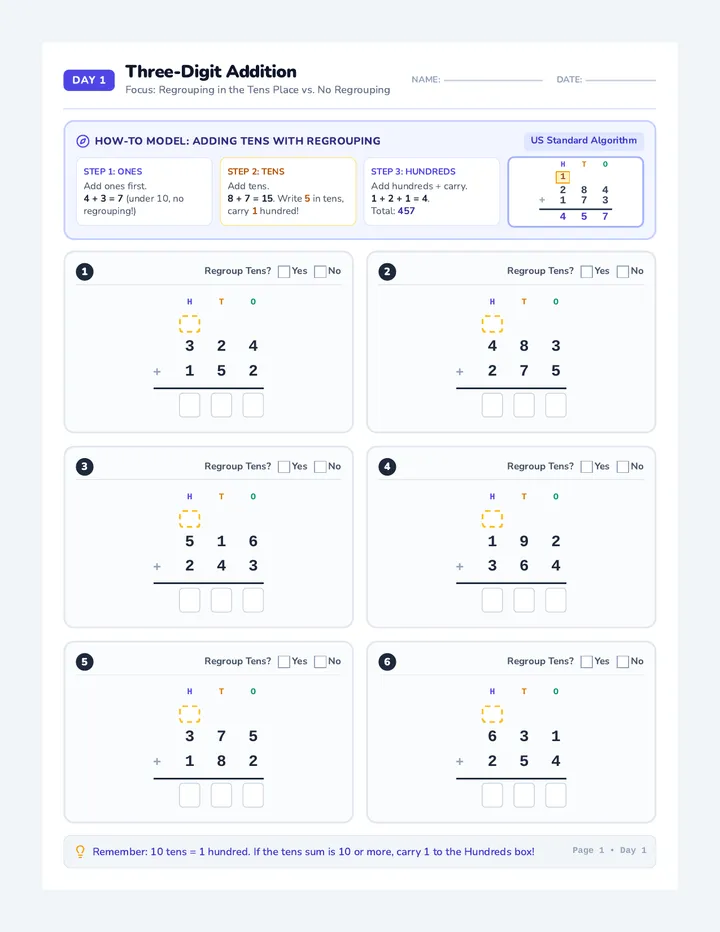
A comprehensive 5-day modified worksheet packet for three-digit addition using the US Standard Algorithm, designed for special education and math intervention. Features structured place-value columns, designated regrouping boxes, consistent daily practice with an intentional mixture of no-regrouping and tens-place regrouping problems, and supportive self-monitoring checklists.

EB

Emily Brown

Sequences

Packet Master TOC document

Unit 6 Equal Groups and Multiplication

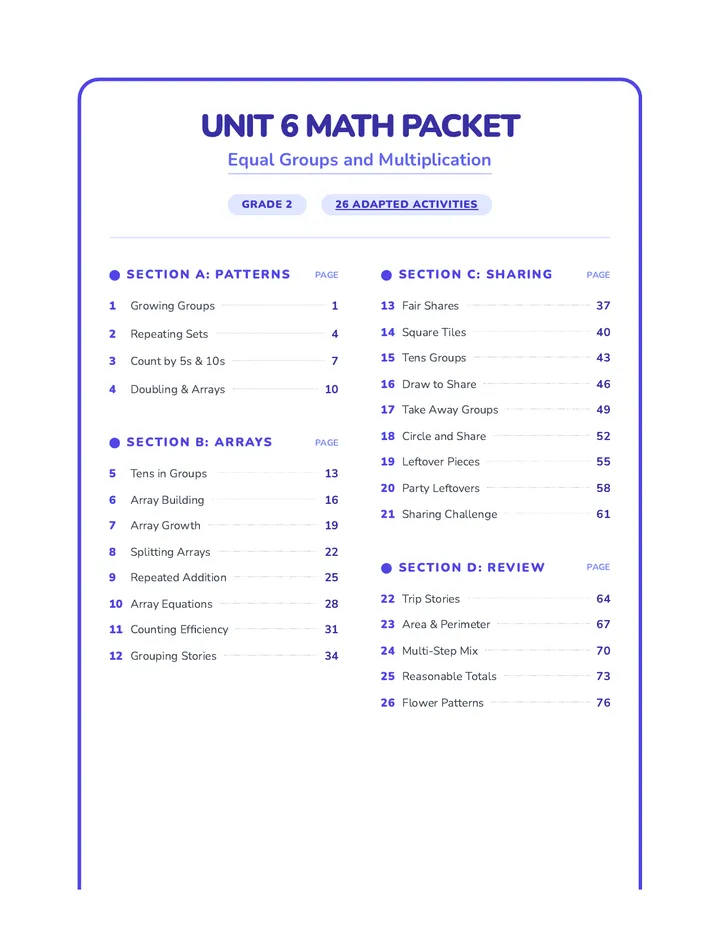
A comprehensive Grade 2 math packet focused on skip counting, repeated addition, arrays, and equal groups.

N

nmack

39
Addition Powerhouse Worksheet

Condensed Calculation

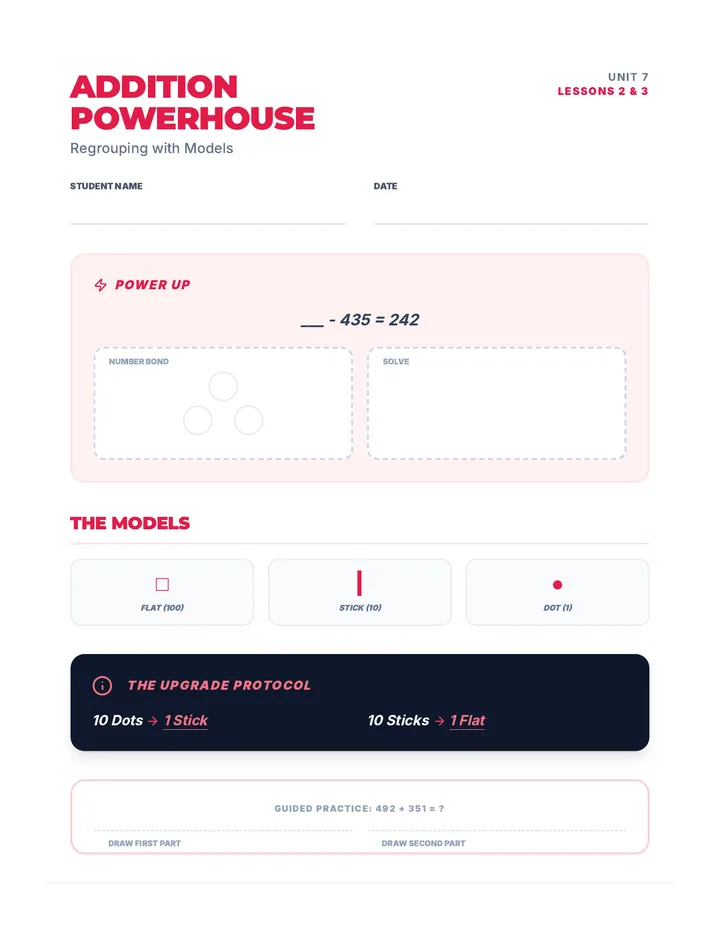
A condensed version of the LEAP Grade 2 Unit 7 curriculum, focusing on addition and subtraction to 1,000 with regrouping across multiple strategies.

MW

Melissa Wienke

34
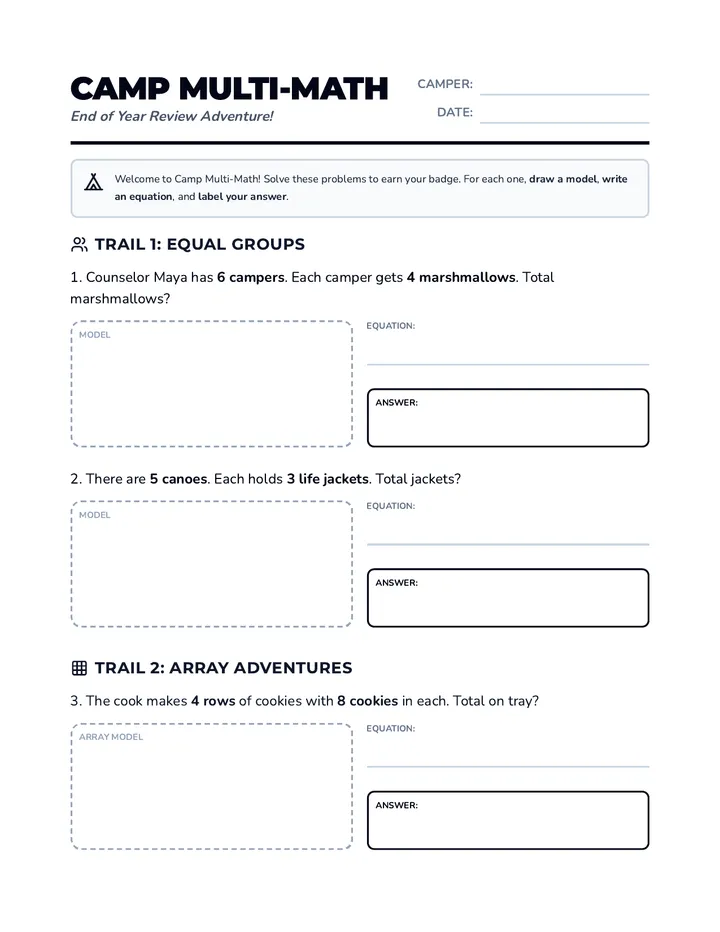
Camp Multi-Math Worksheet

Math Review Adventures

A collection of themed end-of-year math review adventures for different grade levels, focusing on spiraling key standards and problem-solving.

DB

Deborah Burton

21
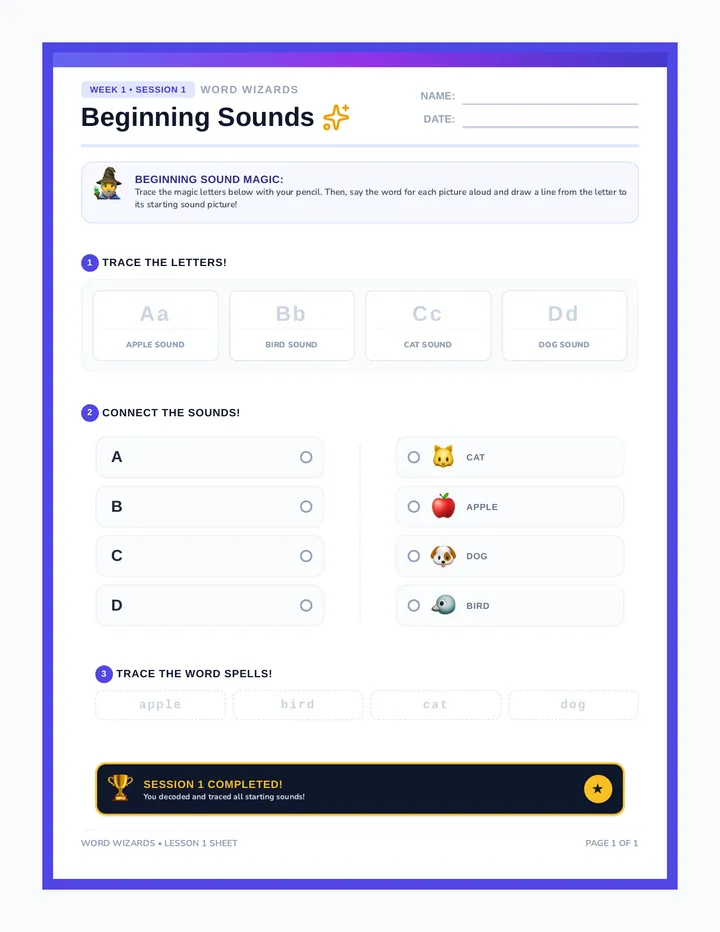
Beginning Sounds Worksheet

Word Wizards

An engaging, high-impact 4-week literacy skills program for young learners. Features highly visual, fun printable worksheets focusing on beginning letter sounds, CVC phonics blending, sight word reading, and short stories.

Z

ziad

18
Fraction Fundamentals Slides

Fraction Factory

A comprehensive 3-week unit covering the full spectrum of fraction operations, from basic identification and equivalence to multiplication and division, themed as a precision engineering factory.

C

corteza

15
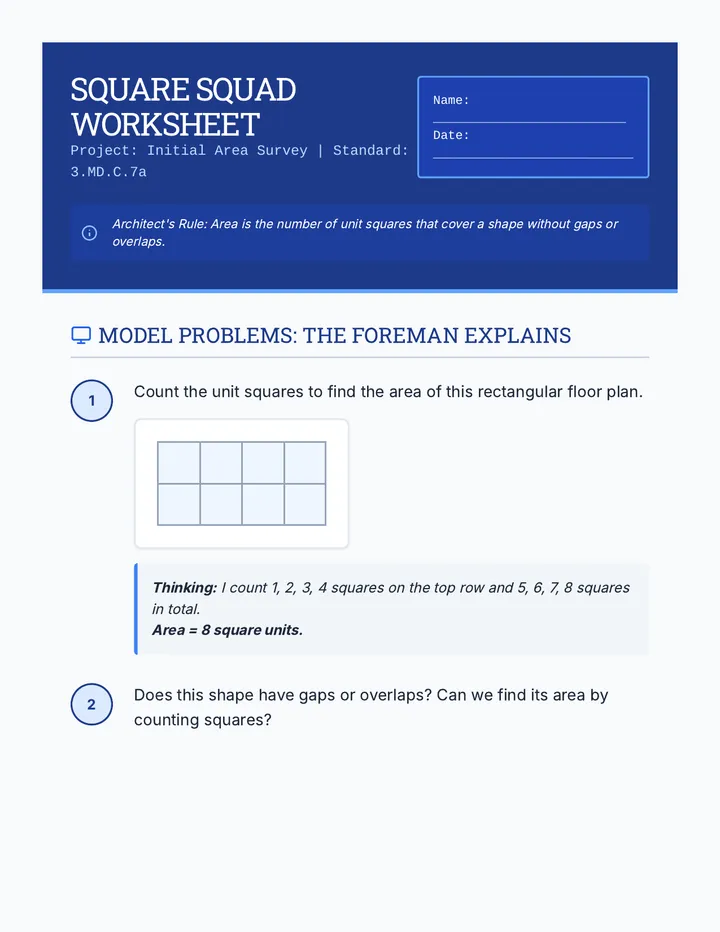
Square Squad Worksheet

Blueprint Builders

A 4-day unit on area measurement for 3rd grade students, covering tiling, the relationship between multiplication and addition, and decomposing rectilinear shapes. Designed with a 'Blueprint Builders' architectural theme.

TD

Taylor Doucet

10

Lessons

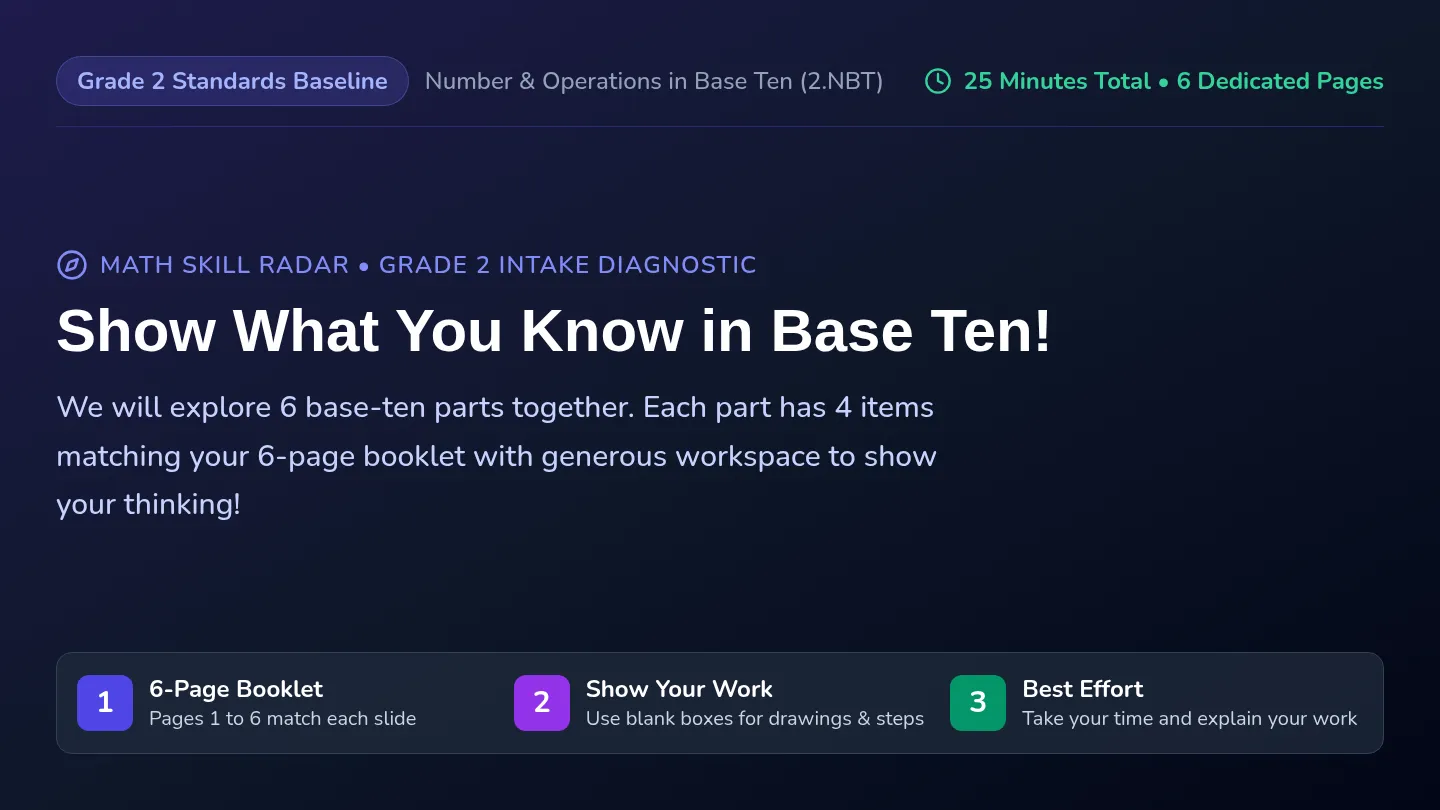
Math Radar Intake Slides

Math Skill Radar

A comprehensive baseline math diagnostic and intervention suite for special education spanning early numeracy through Grade 4. Features complete tiered intake assessments, practice packets, manipulative work mats, and master scoring keys for both 1st Grade Base Ten (1.NBT) and 2nd Grade Base Ten (2.NBT), alongside K-1 early number sense tools.

S

Sara

20
Mountain Mix Worksheet 6

Mountain Math Expedition

Two worksheets featuring a mix of three-digit addition and subtraction problems without regrouping. Each problem includes individual digit boxes and a functional number line for students to visualize their calculation strategies.

CN

Coleman Newell

14
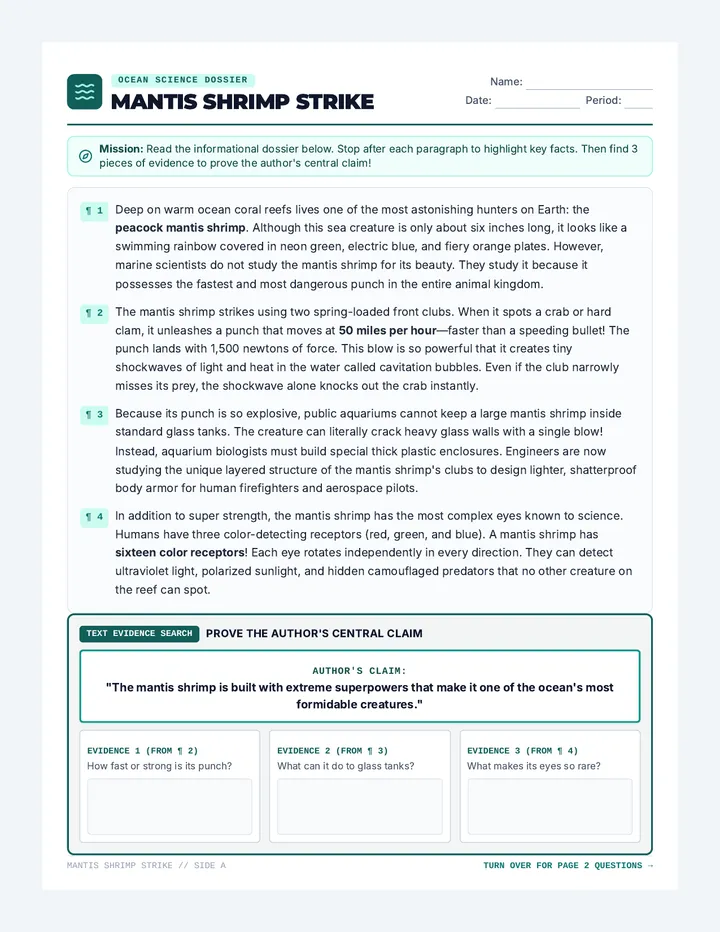
Mantis Shrimp Strike Evidence Worksheet

Sub Day Sleuths

An engaging third-grade substitute teacher lesson pack featuring an informational text evidence investigation and a word-problem-free math logic puzzle.

KS

Kathleen Suther

9
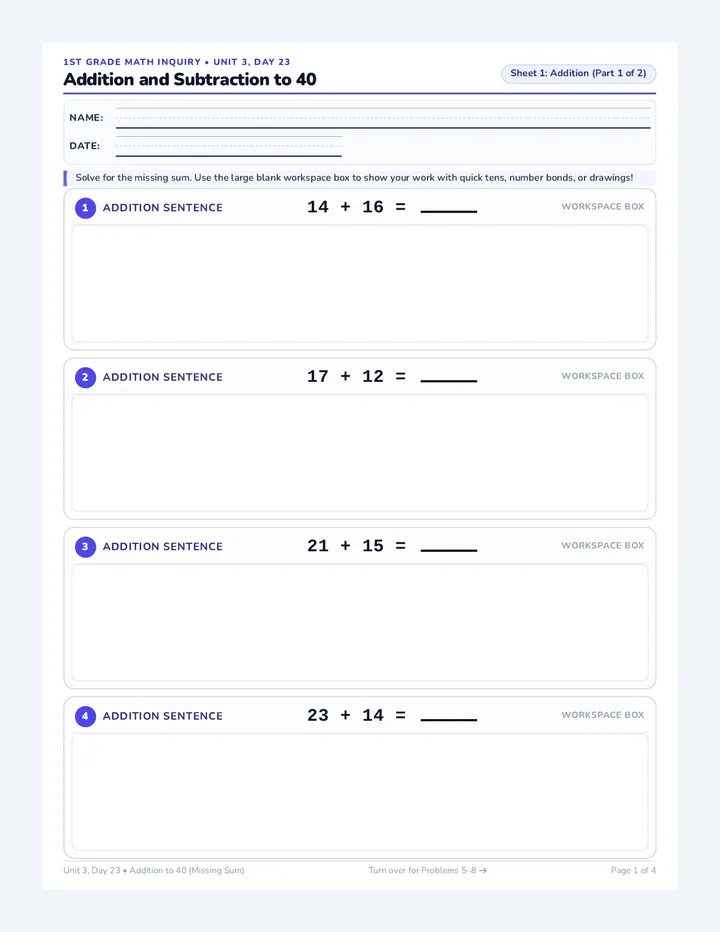
Operations Practice Worksheet

Operations Within Forty

A targeted primary mathematics lesson focused on mastering addition and subtraction number sentences within 40. Students demonstrate their mathematical thinking through dedicated visual workspaces and comparing challenge problems.

EB

Emily Brown

15
Ones Regrouping Diagram Practice

Regrouping Addition Adventures

A comprehensive multi-digit addition unit focusing on place-value regrouping with visual models. Includes structured practice packets for regrouping in the tens and hundreds places with dual algorithm and diagram workspaces.

TG

Tyonna Gunter

12
Blueprint Builders Slides

Blueprint Builders

A comprehensive lesson on adding and subtracting mixed numbers using visual area models and improper fraction conversions, themed around architectural blueprints and construction.

G

goodev

6