Lenny.com
Explore
Create
ActivitiesNewMathEnglish Language ArtsScience & EngineeringSocial StudiesGlobal LanguagesHealth & Physical EducationSpecial EducationCounseling & Life SkillsArts & CreativityESL
Lenny.com
Lenny.com
Explore
Create
ActivitiesNewMathEnglish Language ArtsScience & EngineeringSocial StudiesGlobal LanguagesHealth & Physical EducationSpecial EducationCounseling & Life SkillsArts & CreativityESL
Lenny.com
Lenny.com

Solutions

Lenny for EducatorsLenny for SchoolsLenny for Districts

Product

ExploreSign inCreateSupportAbout

Resources

Getting startedMTSS Acceleration Program

© 2026 Lenny Learning Inc.

TermsPrivacyAccessibility
LinkedInInstagramX
Lenny

Congruence and Similarity

Rigid transformations, scale factors, and proportional reasoning for identifying identical or scaled figures. Addresses triangle congruence criteria and similarity theorems for polygons.

MathNumbers & CountingCounting ObjectsNumber NamesComparing NumbersNumber OperationsCounting SequenceNumbers 0-10Place Value Understanding and SystemAdd and Subtract Within 20Addition and Subtraction ConceptsAddition and Subtraction EquationsAddition and Subtraction ProblemsFoundations for MultiplicationMultiplication and Division PropertiesMultiply and Divide Within 100Multiplication and Division ProblemsFactors and MultiplesProperties of OperationsPatterns and RelationshipsGenerate and Analyze PatternsMulti-Digit ArithmeticPlace Value OperationsMulti-Digit and Decimal OperationsNumerical ExpressionsFour Operations and PatternsFour Operations Problem SolvingMeasurement & DataMeasurable AttributesMeasuring LengthsMeasure and Estimate Lengths in Standard UnitsRelate Addition and Subtraction to LengthClassifying and Counting ObjectsTime and MoneyArea Concepts and MeasurementPerimeter and Area MeasuresAngle Concepts and MeasurementTime, Volume, and MassMeasurement Unit ConversionsGeometryIdentifying ShapesShapes and AttributesShape Attributes and ReasoningShapes and CompositionClassifying 2D FiguresGeometric Figures and RelationshipsLines, Angles, and ShapesAngle, Area, and VolumeGeometric MeasurementVolume of 3D ShapesCoordinate Plane ApplicationsTransformations in the PlaneCongruence and SimilarityUnderstand congruence in terms of rigid motionsSimilarity and TransformationsProve Theorems Involving SimilarityPythagorean TheoremTrigonometry for General TrianglesMake Geometric ConstructionsProve Geometric TheoremsTheorems About CirclesFind Arc Lengths And Areas of Sectors of CirclesVolume FormulasRelationships Between Two-Dimensional and Three-Dimensional ObjectsProve Simple Geometric Theorems AlgebraicallyTranslate Between Geometric Description and Equation for Conic SectionApply Geometric Concepts in Modeling SituationsFractions & DecimalsFractions as NumbersBuilding FractionsFraction Equivalence and OrderingAdding and Subtracting FractionsMultiplying and Dividing FractionsDividing FractionsDecimal FractionsMulti-Digit Computation and FactorsAdd, Subtract, Multiply, and Divide Rational NumbersRational Number SystemIrrational Numbers and ApproximationsRatiosRatios and ProportionsProportional RelationshipsUnit RateAlgebraAlgebraic ExpressionsGenerate Equivalent ExpressionsQuantitative RelationshipsProportional Relationships and Linear EquationsEquations and InequalitiesEquation Solving and ReasoningLinear Equations and SystemsGraph Equations and InequalitiesSystems of EquationsReal-World Algebraic ProblemsQuantitative Reasoning with UnitsExpression StructureEquivalent Expression FormsRadicals and Integer ExponentsRational ExponentsRational and Irrational NumbersPolynomial OperationsPolynomial IdentitiesPolynomial Zeros and FactorsRational ExpressionsComplex Number OperationsComplex Numbers in PolynomialsComplex Numbers on PlaneStatistics & ProbabilityRepresent and Interpret DataData DistributionsStatistical VariabilityProbability ModelsCompound Event ProbabilitiesStatistical SamplingInterpret Categorical and Quantitative DataBivariate Data PatternsInterpret Linear ModelsComparing Two PopulationsRandom Processes in StatisticsIndependence and Conditional ProbabilityExpected ValuesProbability-Based Decision MakingStatistical Inference and ConclusionsFunctionsFunction Concepts and NotationDefine and Compare FunctionsInterpret Functions in ContextAnalyze Function RepresentationsModel Relationships with FunctionsIdentify Linear vs Exponential GrowthDistinguish Between Function TypesCompare Growth RatesInterpret Function ExpressionsBuild Functions from RelationshipsConstruct and Model FunctionsTransform and Combine FunctionsModel Comparison and SelectionSolve Exponential EquationsTrigonometryTrigonometric Ratios Involving Right TrianglesTrigonometric Functions and Unit CircleModel with Trigonometric FunctionsTrigonometric IdentitiesVectors & MatricesIntroduction to Vectors and MatricesVector QuantitiesVector OperationsMatrix OperationsCalculusLimits and ContinuityDerivative Concepts and NotationDerivative Rules and TechniquesApplications of DerivativesOptimization ProblemsRelated RatesCurve Sketching and AnalysisIntegration Concepts and NotationAntiderivatives and Indefinite IntegralsDefinite Integrals and AreaFundamental Theorem of CalculusIntegration TechniquesApplications of IntegrationDifferential EquationsSequences and SeriesParametric and Polar FunctionsVector-Valued Functions

Videos

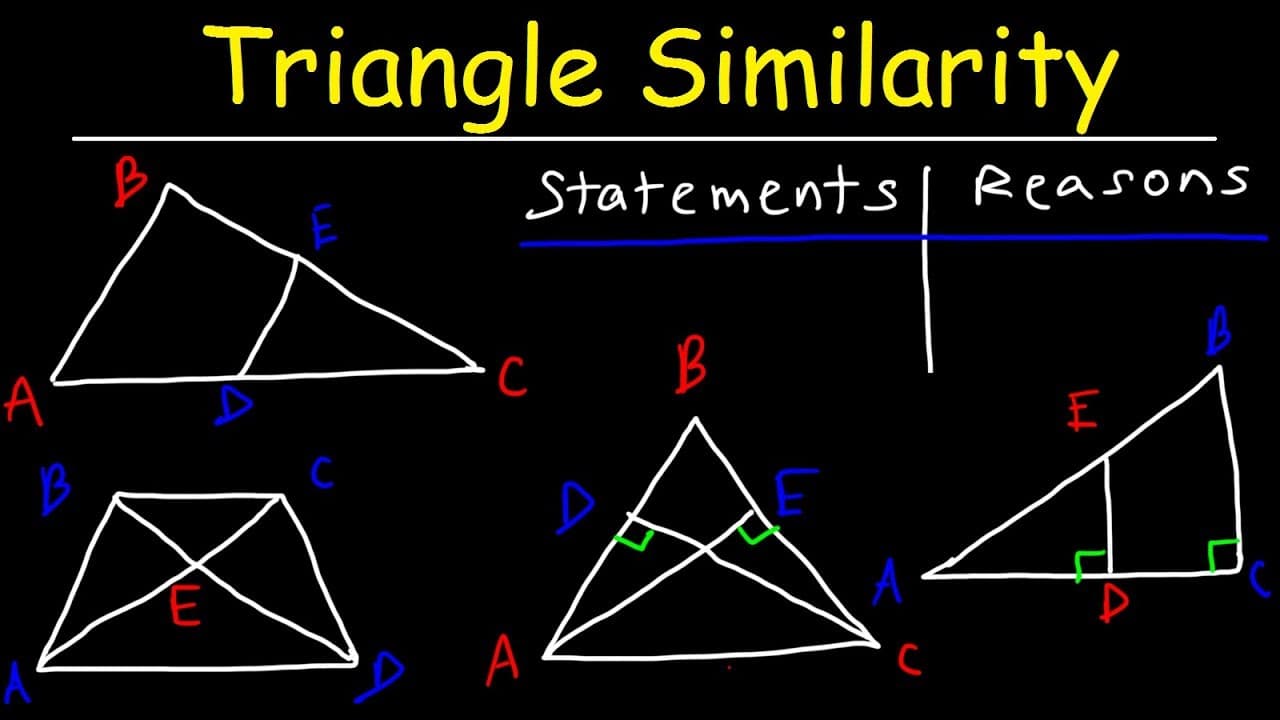
Mastering Similar Triangles: Postulates and Proofs

Mastering Similar Triangles: Postulates and Proofs

This comprehensive geometry tutorial provides a deep dive into proving triangle similarity, a fundamental concept in high school mathematics. The video begins by systematically explaining the four main methods for proving similarity: Angle-Angle-Angle (AAA), Angle-Angle (AA), Side-Side-Side (SSS), and Side-Angle-Side (SAS). It clearly distinguishes between these postulates and demonstrates how to identify them visually, explaining that while AAA exists, AA is the more commonly used and efficient method. The content transitions from theoretical definitions to practical application through numerical examples. Students are guided through problems where they must calculate ratios of corresponding sides to determine if triangles are similar using SSS and SAS. The video then advances to rigorous two-column geometric proofs. It walks viewers through complex scenarios involving isosceles trapezoids, parallel lines, alternate interior angles, and the reflexive property, modeling the logical step-by-step thinking required for formal geometric proofs. This resource is highly valuable for the classroom as it bridges the gap between basic computation and formal logic. It specifically addresses the challenging "Means-Extremes Product Theorem" (cross-multiplication in proofs), showing students how to work backwards from a product of segments to a similarity statement. The clear, slow-paced narration and visual markup of diagrams make it an excellent tool for introducing proofs or for remediation with struggling students.
The Organic Chemistry TutorThe Organic Chemistry Tutor

29mins 23s

Mastering Arithmetic and Geometric Means, Ratios, and Proportions

Mastering Arithmetic and Geometric Means, Ratios, and Proportions

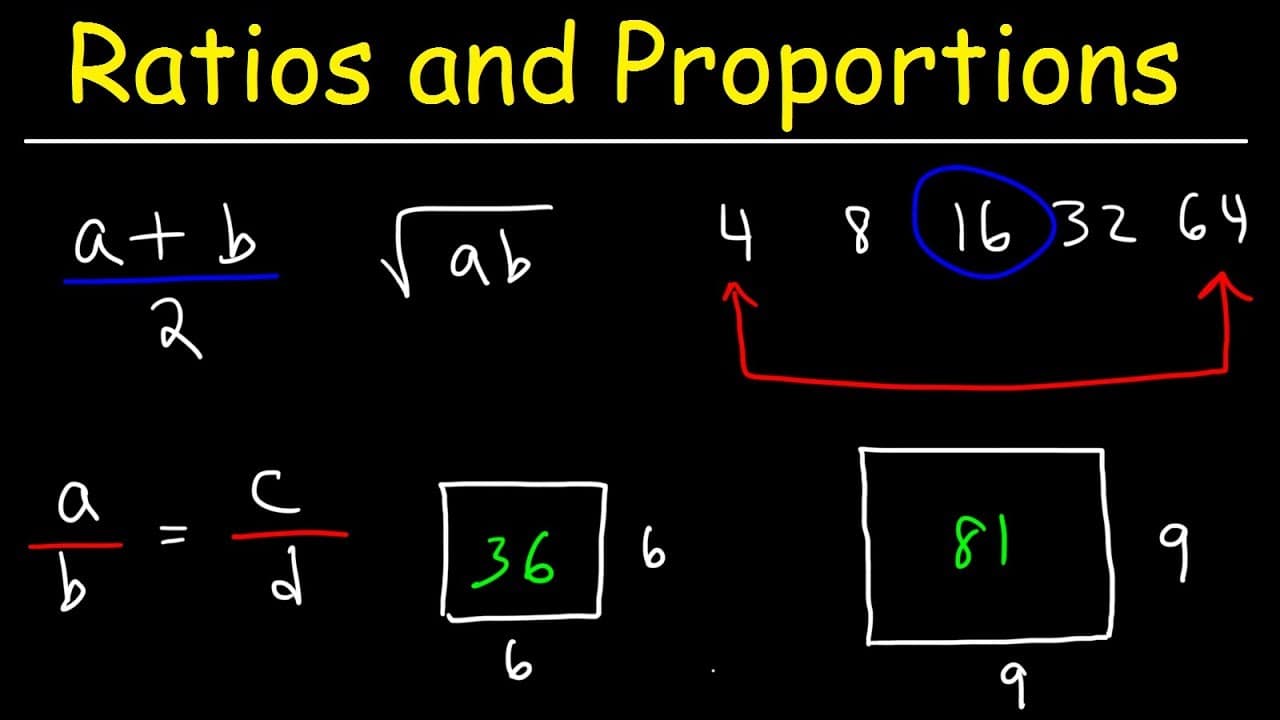
This comprehensive mathematics tutorial explores the fundamental differences between arithmetic and geometric means, followed by a series of practice problems involving ratios, proportions, and geometric applications. The video begins by conceptually defining arithmetic mean as the middle term of an arithmetic sequence and geometric mean as the middle term of a geometric sequence. It progresses through eight distinct problems ranging from basic mean calculations to complex word problems involving scale factors, geometric shapes, and algebraic manipulation.

The Organic Chemistry TutorThe Organic Chemistry Tutor

19mins 49s

Introduction to Sine, Cosine, and Tangent Ratios

Introduction to Sine, Cosine, and Tangent Ratios

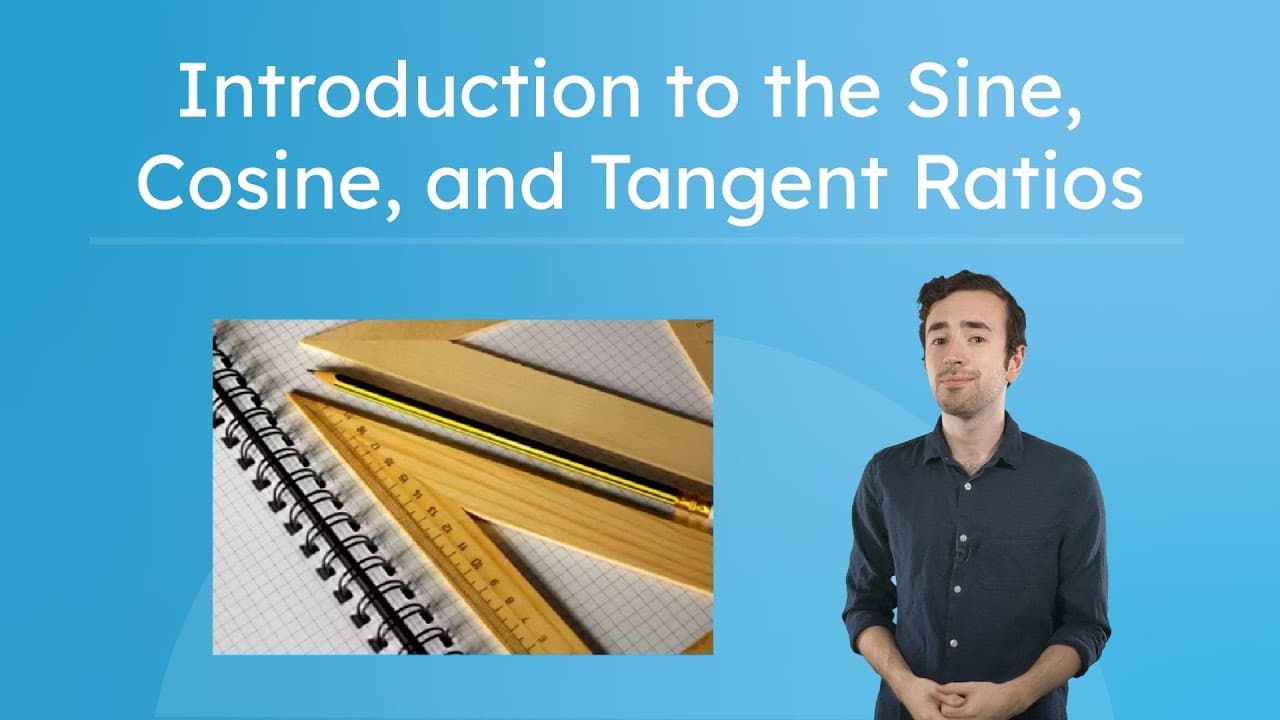
This educational video serves as a comprehensive introduction to the foundational concepts of trigonometry, specifically focusing on the sine, cosine, and tangent ratios within right triangles. The narrator guides viewers through the process of identifying the key components of a right triangle—the hypotenuse, opposite side, and adjacent side—and emphasizes how these labels change depending on which acute angle is being referenced. This distinction is critical for students beginning their study of trigonometry and is demonstrated clearly with visual animations. The video introduces the mnemonic "SOH CAH TOA" as a memory aid for the three primary trigonometric ratios. Step-by-step examples demonstrate how to calculate these ratios using specific side lengths (3-4-5 and 8-15-17 triangles). The content covers the definitions of sine (opposite/hypotenuse), cosine (adjacent/hypotenuse), and tangent (opposite/adjacent), and introduces the Greek letter theta as a symbol for an unknown angle. For educators, this video is an excellent resource for introducing high school geometry or trigonometry units. It addresses common student misconceptions about side labeling and provides structured practice opportunities where students can pause and test their understanding. The visual clarity of the animations helps demystify the abstract relationships between angles and sides, making it a valuable tool for flipped classrooms or review sessions.

Miacademy & MiaPrep Learning ChannelMiacademy & MiaPrep Learning Channel

5mins 27s

Identifying and Solving with Congruent and Similar Figures

Identifying and Solving with Congruent and Similar Figures

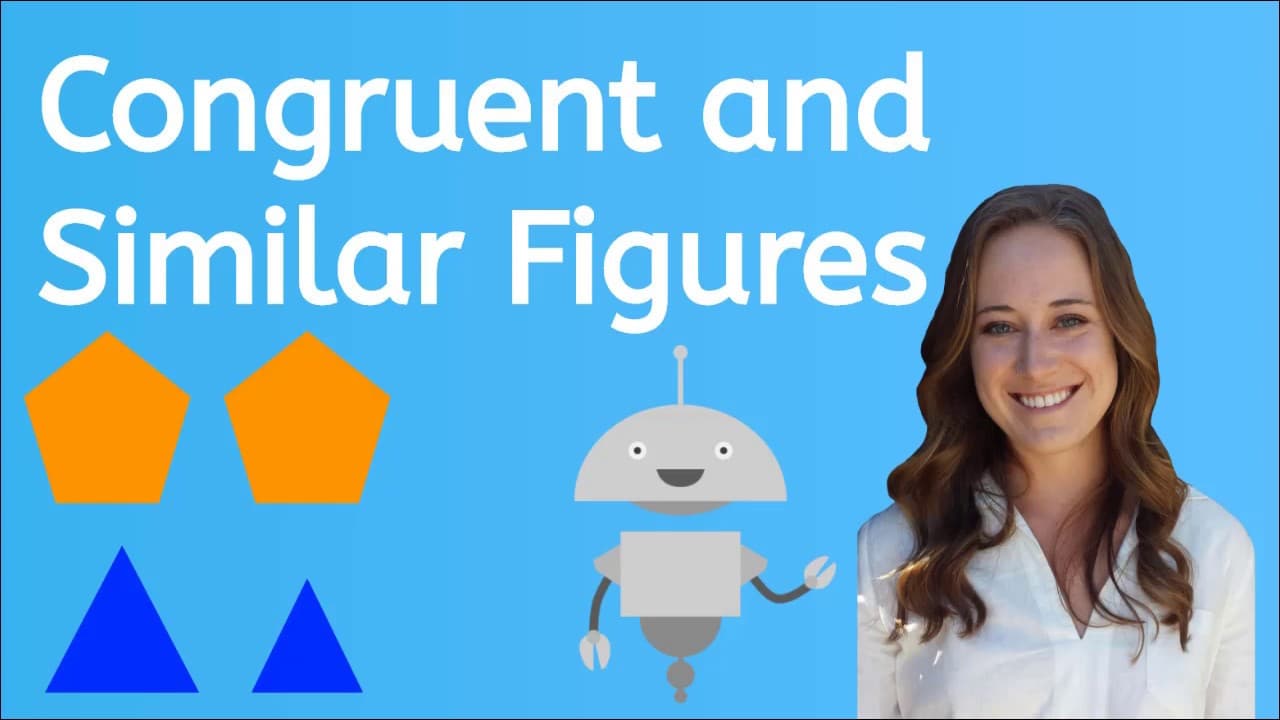
This comprehensive math video explores the core geometric concepts of congruent and similar figures. Narrator Kaylee guides students from basic visual identification of shapes to the more complex application of ratios and proportions. The video begins by defining congruence as figures with the exact same shape and size, regardless of orientation, before contrasting this with similar figures, which share the same shape but differ in size.

Miacademy & MiaPrep Learning ChannelMiacademy & MiaPrep Learning Channel

12mins 46s

How to Write Indirect Proofs for Triangle Congruence

How to Write Indirect Proofs for Triangle Congruence

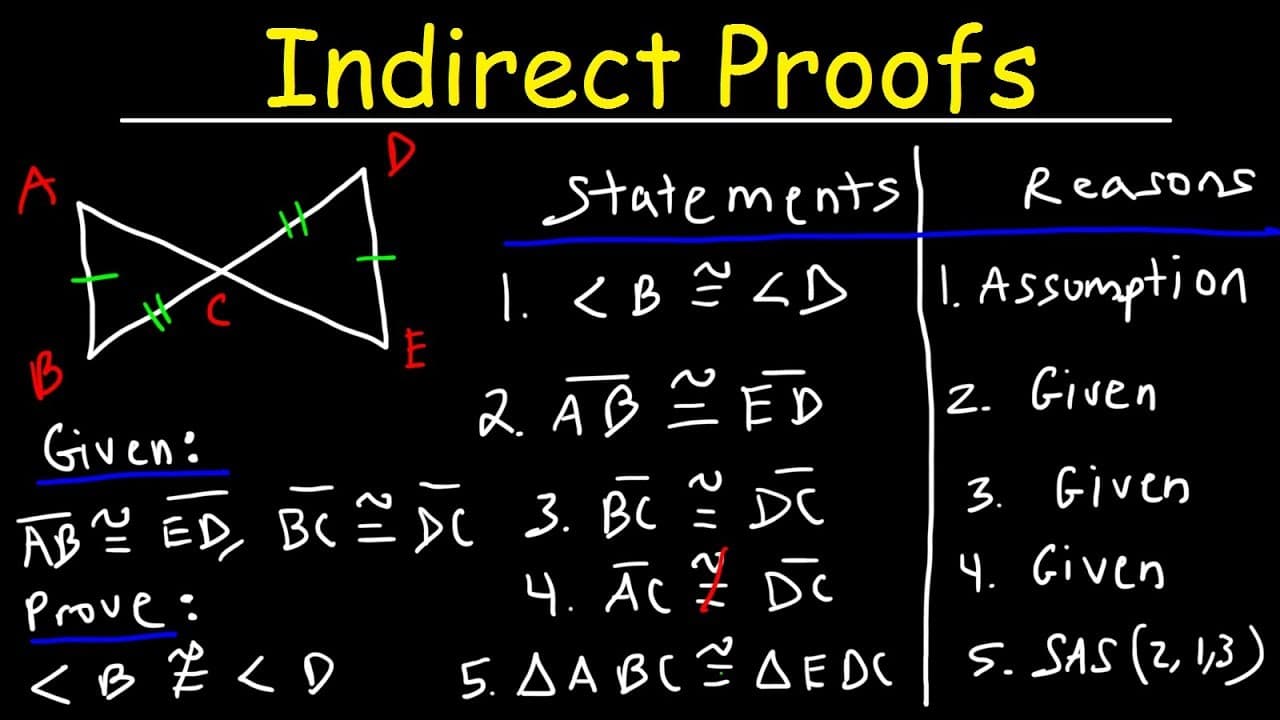
This educational video provides a clear, step-by-step tutorial on how to construct indirect proofs in geometry, specifically focusing on triangle congruence. The narrator uses a digital whiteboard to walk viewers through two distinct examples. The first example involves two separate triangles, while the second features two triangles sharing a vertex in a "bowtie" configuration. The video demonstrates the logic behind proof by contradiction, showing how to assume the opposite of the desired conclusion to eventually find a logical inconsistency.

The Organic Chemistry TutorThe Organic Chemistry Tutor

11mins 12s

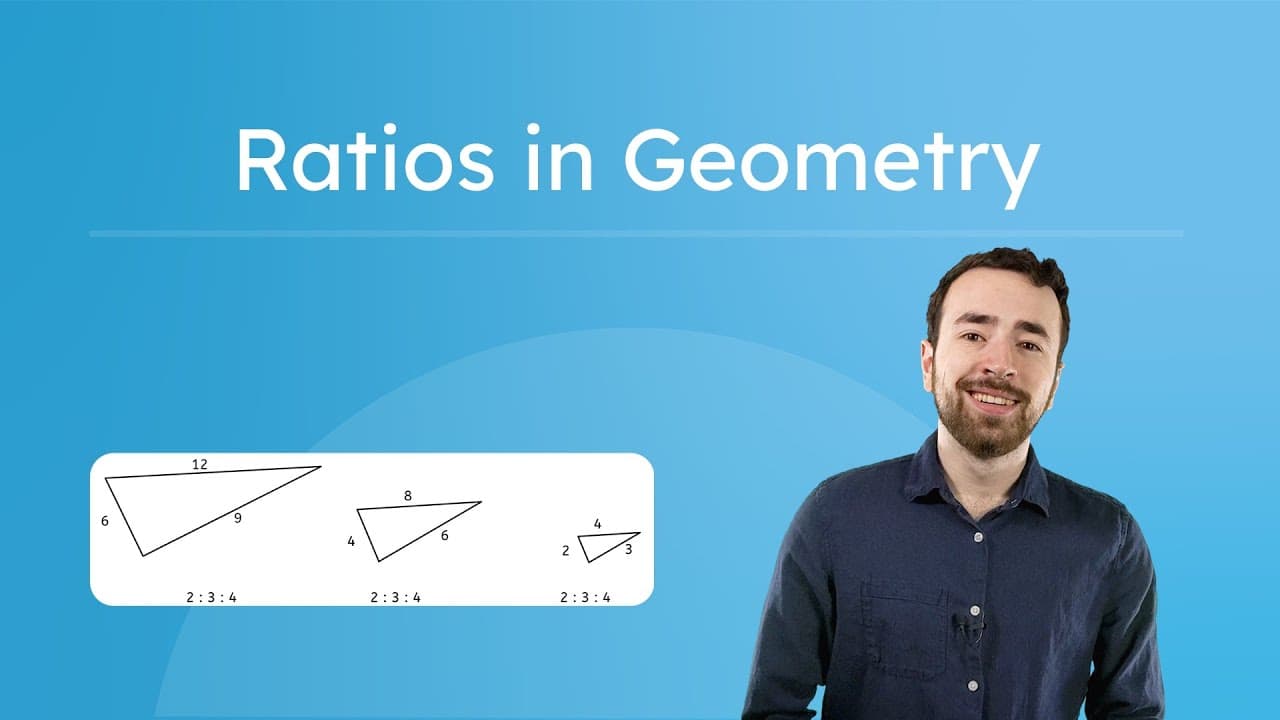
Simplifying and Applying Ratios in Geometry

Simplifying and Applying Ratios in Geometry

This educational video provides a clear and practical guide to understanding, simplifying, and applying ratios within the context of geometry. Hosted by Justin, the lesson bridges the gap between everyday ratios—using a dog food portion example—and geometric ratios used to compare side lengths and angles. The video progresses from basic definitions to complex multi-step problems involving algebra, demonstrating how to use variables to solve for unknown dimensions in rectangles and triangles. Key themes include the definition of a ratio as a comparison of amounts, the "grammar" of mathematics regarding whole numbers versus decimals in geometry, and the application of algebra to geometric theorems. The video explicitly covers how to simplify ratios using the Greatest Common Factor (GCF) and how to set up linear equations (e.g., 7x + 5x...) to solve for perimeter and interior angle sums. For educators, this video serves as an excellent bridge between pre-algebra and high school geometry. It helps students visualize why we attach an 'x' to ratio numbers when setting up equations (e.g., turning a 2:3:4 ratio into 2x + 3x + 4x = 180). The step-by-step walkthroughs of perimeter and triangle angle problems address common student errors, such as forgetting to include all four sides of a rectangle, making it a valuable tool for introducing or reviewing these essential standards.

Miacademy & MiaPrep Learning ChannelMiacademy & MiaPrep Learning Channel

12mins 17s

Materials

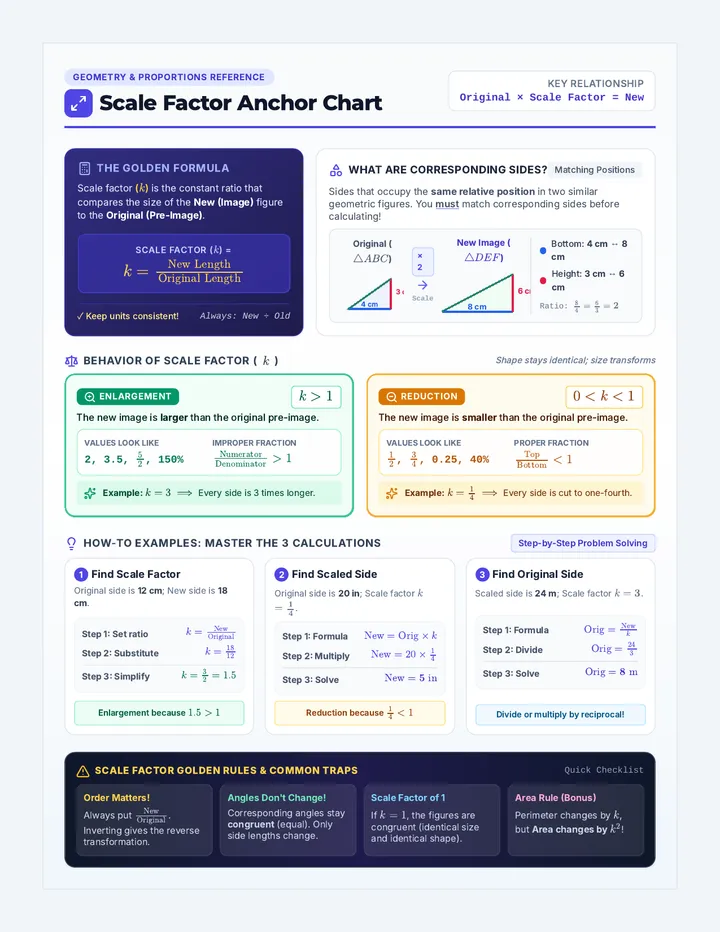
Scale Factor Anchor Chart

Scale Factor Anchor Chart

A comprehensive math anchor chart explaining scale factor, corresponding sides, enlargements versus reductions, and step-by-step examples for finding scale factors and missing original or scaled dimensions.

R

rgood

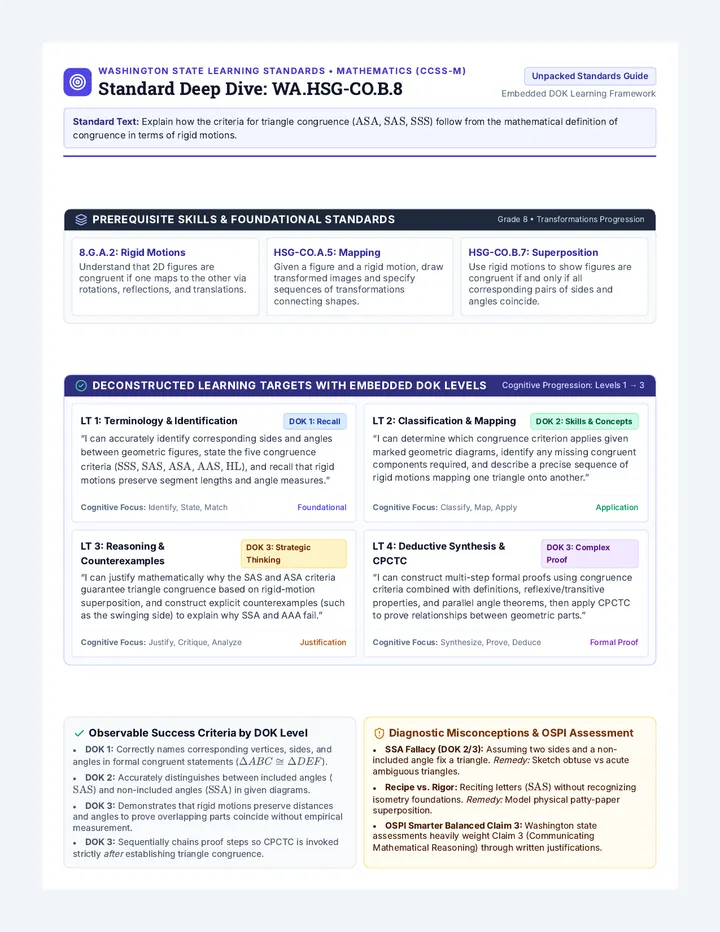
Geometry Proofs Reference Guide

Geometry Proofs Reference Guide

An instructional standards breakdown for Washington State high school geometry, featuring a full deconstruction of standard WA.HSG-CO.B.8 with Webb's DOK cognitive levels embedded directly into the progressive student learning targets, success criteria, and prerequisites.

MS

Melissa Super-Greene

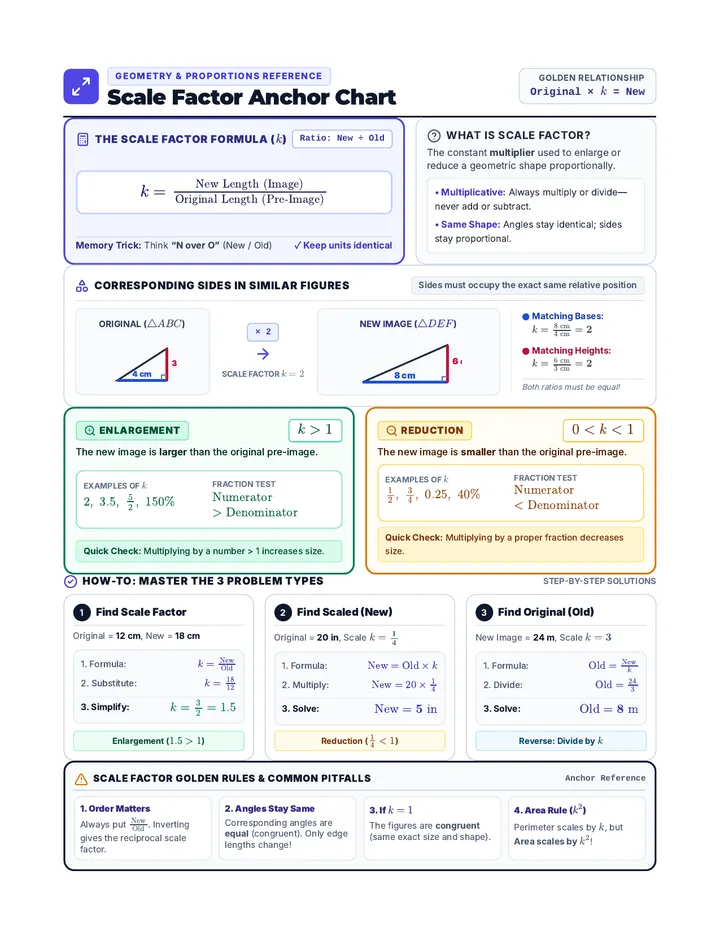
Scale Factor Anchor Chart

Scale Factor Anchor Chart

A printer-friendly, ink-conscious math anchor chart for scale factor featuring high-contrast typography, crisp geometric diagrams, core formulas, enlargement versus reduction comparisons, three step-by-step calculation methods, and key conceptual rules.

R

rgood

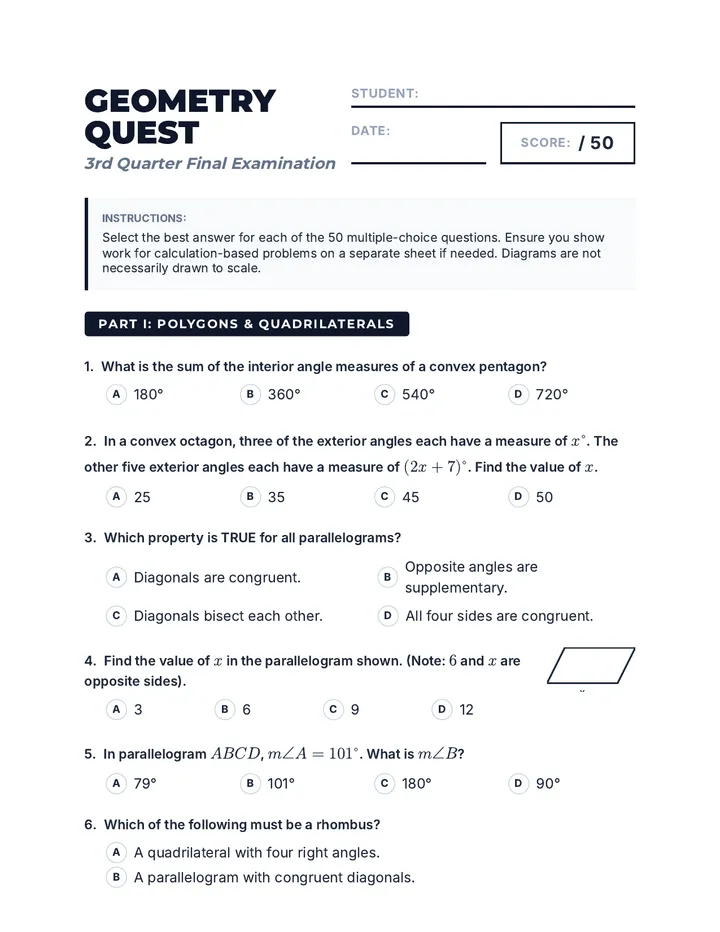
Geometry Quest Exam Worksheet

Geometry Quest Exam Worksheet

A comprehensive 50-question multiple-choice geometry exam condensed into 5 pages. The worksheet covers polygons, quadrilaterals, similarity, and proportion, including diagrams and algebra-based geometry problems with a clean, professional layout.

AC

Anjoe Calamba

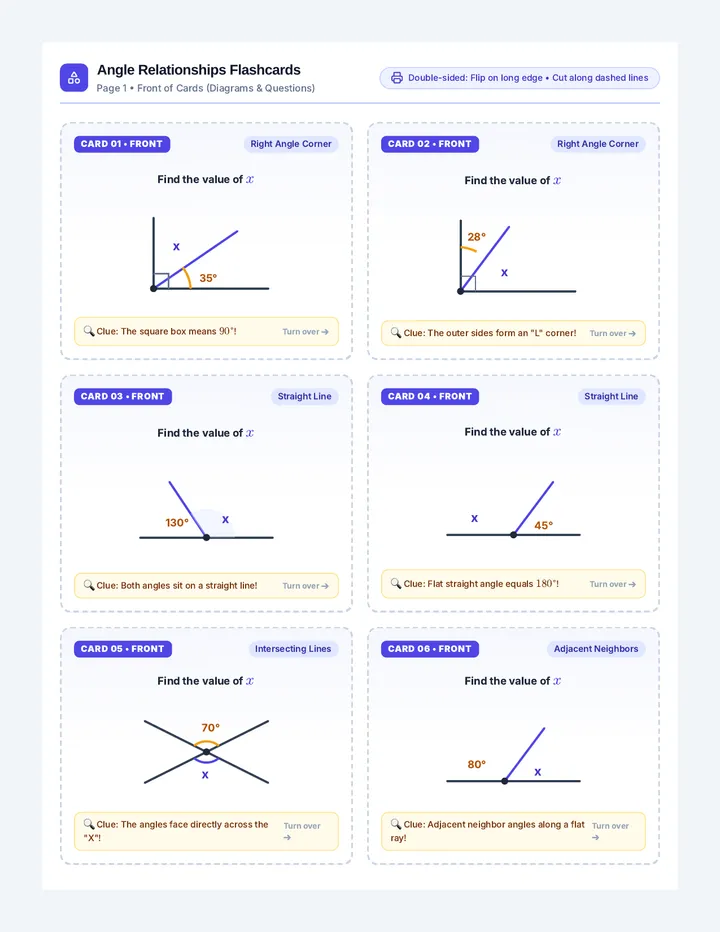
Angle & Geometry Flashcards

Angle & Geometry Flashcards

A 4-page double-sided printable flashcard set (16 cards total) for 8th-grade geometry review. Updates Card 6 Front so the 120° label is positioned to the right of the transversal in the top-right obtuse exterior angle, perfectly matching x in the alternate exterior pair.

L

Logan-Greene

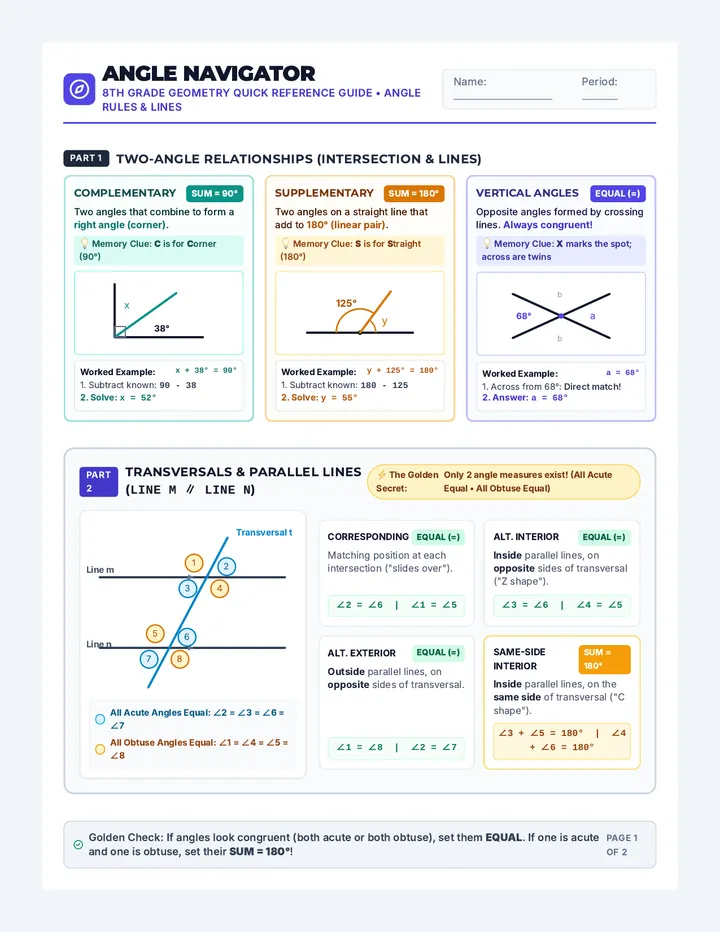
Angle Navigator Reference Sheet

Angle Navigator Reference Sheet

A comprehensive 2-page geometry reference sheet for 8th-grade students covering complementary, supplementary, and vertical angles, transversal angle pairs, triangle angle sum, exterior angle theorem, and AA triangle similarity with labeled diagrams and step-by-step worked examples.

L

Logan-Greene

Sequences

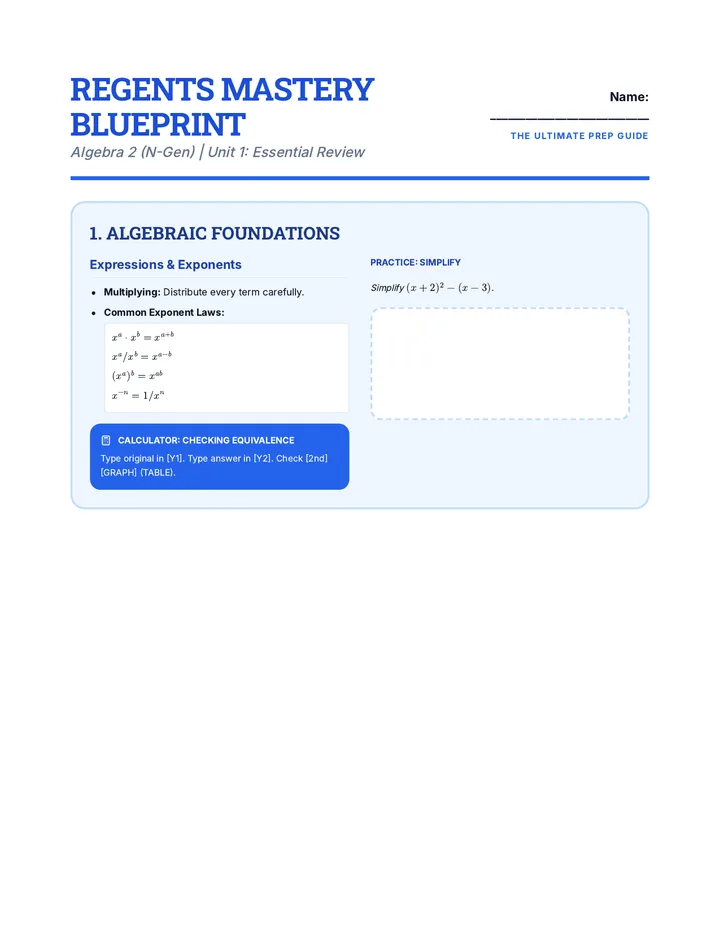
Regents Mastery Blueprint Study Guide

Regents Mastery Suite

A comprehensive review suite for the New York State Mathematics Regents exams, including Algebra 1, Geometry, and Algebra 2, featuring mastery blueprints, calculator strategies, and exam-taking tips.

KB

Kayla Borozny

15
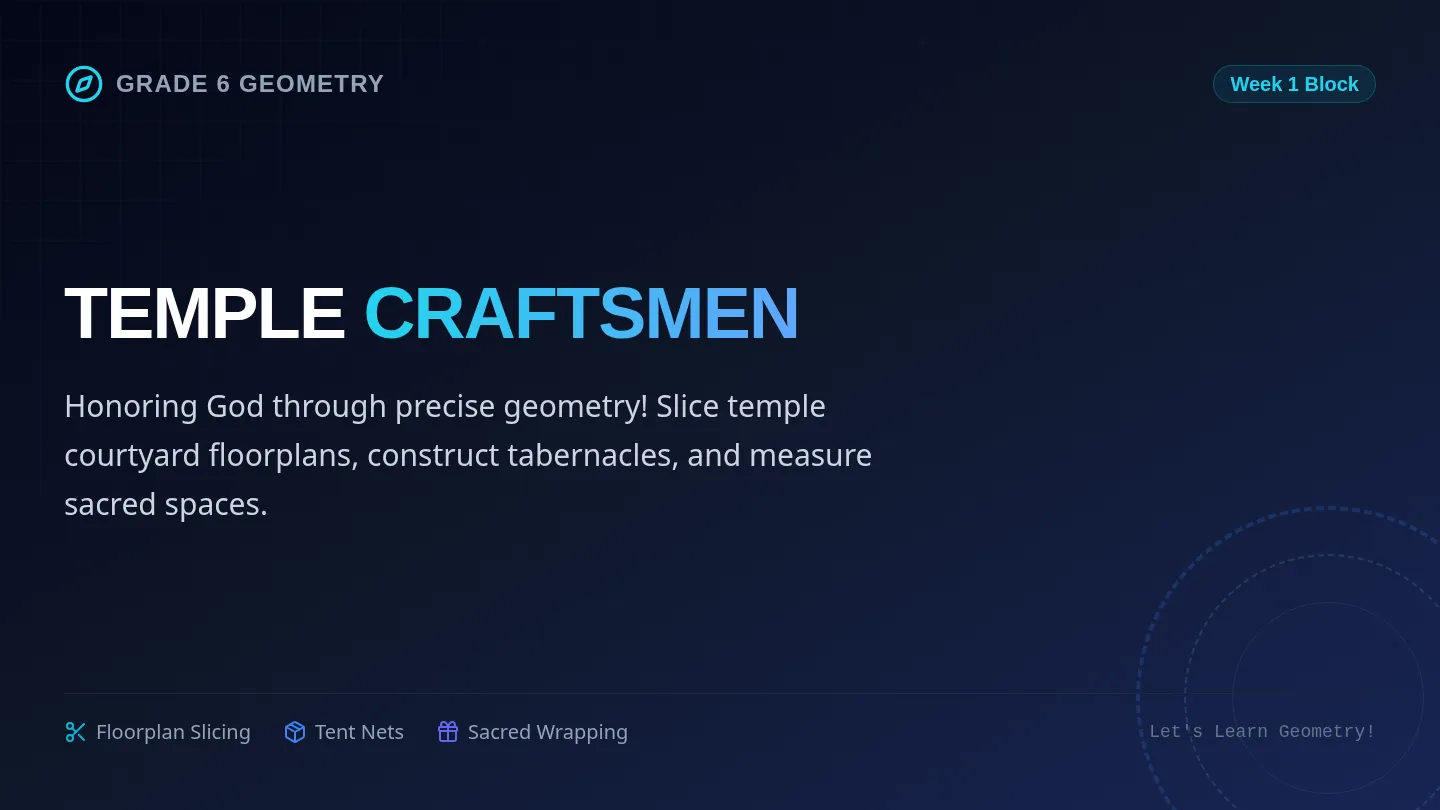
Temple Craftsmen Slides

Middle School Math Block

A multi-subject middle school mathematics block for Week 1, covering 6th Grade Geometry (Temple Craftsmen: polygon decomposition, nets, surface area) and 7th/8th Grade Math (Faithful Stewards: proportional relationships, linear equations, inequalities, transversals) from a Christian perspective.

JR

Jamens Ray II

59
Segment Postulates Guided Notes

Segment Geometry

A two-part sequence exploring segment addition, subtraction, and midpoint relationships through visual GCR deductive reasoning and algebraic modeling.

C

Courtney.Smiley

17
LMS Bulldog Clothing Company Teacher Guide

LMS Bulldog Clothing Company

A 4-week project-based learning sequence for middle school students, connecting mathematics, marketing data, apparel scaling, and budget formulas through the real-world challenge of launching a school merchandise brand.

LM

Lydia McCracken

4
Congruence Logic Quiz pocket edition

Congruence Chronicles

An exploration of geometric congruence, coordinate geometry, and the formal logic required for mathematical proofs.

SR

Saifel-Dein Raja

2
Le Bon Cadre Presentation

L'Atelier Photo

Une série de micro-leçons de 10 minutes centrée sur l'optimisation de l'espace papier. Les élèves apprennent à mettre à l'échelle une mise en page de 6 photos (format A4) vers le format Raisin (50x65 cm) en minimisant les chutes.

SB

saida bendaoud

11

Lessons

Slide Squad Teacher Guide

Slide Squad

A scaffolded lesson on geometric translations that simplifies complex vocabulary, breaks down coordinate rules into manageable steps, and provides clear visual anchors for students.

EE

Erin Esswein

6
Pivot Points Facilitation Guide

Pivot Points Rotation Lesson

A high-school Geometry lesson focused on performing rotations about points other than the origin, featuring a three-step translation method and NYS Regents practice.

KB

Kayla Borozny

5
Size Me Up Lesson Plan

Size Me Up

A 9th-grade geometry lesson where students master similar figures and proportions to solve real-world height problems through shadow reckoning and indirect measurement.

KC

Kris Coyne

6
Prism Lab Lesson Plan Guided Notes Teacher Resource

Mirror World Reflections

An introductory lesson on geometric reflections, covering lines of reflection, x and y-axis reflections, and the concept of congruence.

EE

Erin Esswein

8
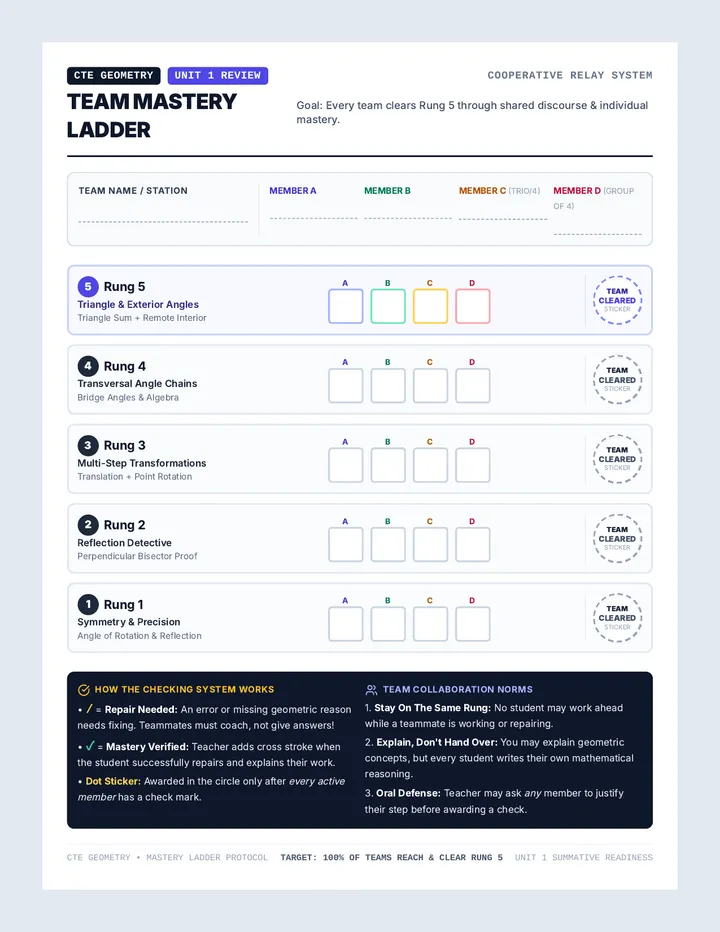
Mastery Ladder Tracking Sheet

Geometry Ladder Relay

Collaborative 5-rung mastery review activity for CTE Geometry Unit 1 covering symmetry, reflections, multi-step transformations, parallel transversal angle chains, and exterior angle theorems across four parallel student versions plus a Spanish edition.

MM

Matthew McIntyre

9
Similarity Secrets Anchor Charts

Similarity Squad

A comprehensive guide to understanding geometric similarity, covering ratios, proportions, and similarity criteria for polygons and triangles.

WM

Wilkzhie Maria Silva Moncada

19