Lenny.com
Explore
Create
ActivitiesNewMathEnglish Language ArtsScience & EngineeringSocial StudiesGlobal LanguagesHealth & Physical EducationSpecial EducationCounseling & Life SkillsArts & CreativityESL
Lenny.com
Lenny.com
Explore
Create
ActivitiesNewMathEnglish Language ArtsScience & EngineeringSocial StudiesGlobal LanguagesHealth & Physical EducationSpecial EducationCounseling & Life SkillsArts & CreativityESL
Lenny.com
Lenny.com

Solutions

Lenny for EducatorsLenny for SchoolsLenny for Districts

Product

ExploreSign inCreateSupportAbout

Resources

Getting startedMTSS Acceleration Program

© 2026 Lenny Learning Inc.

TermsPrivacyAccessibility
LinkedInInstagramX
Lenny

Transform and Combine Functions

Horizontal and vertical translations, reflections, and dilations of parent functions. Includes function arithmetic and composition to create complex mathematical models.

MathNumbers & CountingCounting ObjectsNumber NamesComparing NumbersNumber OperationsCounting SequenceNumbers 0-10Place Value Understanding and SystemAdd and Subtract Within 20Addition and Subtraction ConceptsAddition and Subtraction EquationsAddition and Subtraction ProblemsFoundations for MultiplicationMultiplication and Division PropertiesMultiply and Divide Within 100Multiplication and Division ProblemsFactors and MultiplesProperties of OperationsPatterns and RelationshipsGenerate and Analyze PatternsMulti-Digit ArithmeticPlace Value OperationsMulti-Digit and Decimal OperationsNumerical ExpressionsFour Operations and PatternsFour Operations Problem SolvingMeasurement & DataMeasurable AttributesMeasuring LengthsMeasure and Estimate Lengths in Standard UnitsRelate Addition and Subtraction to LengthClassifying and Counting ObjectsTime and MoneyArea Concepts and MeasurementPerimeter and Area MeasuresAngle Concepts and MeasurementTime, Volume, and MassMeasurement Unit ConversionsGeometryIdentifying ShapesShapes and AttributesShape Attributes and ReasoningShapes and CompositionClassifying 2D FiguresGeometric Figures and RelationshipsLines, Angles, and ShapesAngle, Area, and VolumeGeometric MeasurementVolume of 3D ShapesCoordinate Plane ApplicationsTransformations in the PlaneCongruence and SimilarityUnderstand congruence in terms of rigid motionsSimilarity and TransformationsProve Theorems Involving SimilarityPythagorean TheoremTrigonometry for General TrianglesMake Geometric ConstructionsProve Geometric TheoremsTheorems About CirclesFind Arc Lengths And Areas of Sectors of CirclesVolume FormulasRelationships Between Two-Dimensional and Three-Dimensional ObjectsProve Simple Geometric Theorems AlgebraicallyTranslate Between Geometric Description and Equation for Conic SectionApply Geometric Concepts in Modeling SituationsFractions & DecimalsFractions as NumbersBuilding FractionsFraction Equivalence and OrderingAdding and Subtracting FractionsMultiplying and Dividing FractionsDividing FractionsDecimal FractionsMulti-Digit Computation and FactorsAdd, Subtract, Multiply, and Divide Rational NumbersRational Number SystemIrrational Numbers and ApproximationsRatiosRatios and ProportionsProportional RelationshipsUnit RateAlgebraAlgebraic ExpressionsGenerate Equivalent ExpressionsQuantitative RelationshipsProportional Relationships and Linear EquationsEquations and InequalitiesEquation Solving and ReasoningLinear Equations and SystemsGraph Equations and InequalitiesSystems of EquationsReal-World Algebraic ProblemsQuantitative Reasoning with UnitsExpression StructureEquivalent Expression FormsRadicals and Integer ExponentsRational ExponentsRational and Irrational NumbersPolynomial OperationsPolynomial IdentitiesPolynomial Zeros and FactorsRational ExpressionsComplex Number OperationsComplex Numbers in PolynomialsComplex Numbers on PlaneStatistics & ProbabilityRepresent and Interpret DataData DistributionsStatistical VariabilityProbability ModelsCompound Event ProbabilitiesStatistical SamplingInterpret Categorical and Quantitative DataBivariate Data PatternsInterpret Linear ModelsComparing Two PopulationsRandom Processes in StatisticsIndependence and Conditional ProbabilityExpected ValuesProbability-Based Decision MakingStatistical Inference and ConclusionsFunctionsFunction Concepts and NotationDefine and Compare FunctionsInterpret Functions in ContextAnalyze Function RepresentationsModel Relationships with FunctionsIdentify Linear vs Exponential GrowthDistinguish Between Function TypesCompare Growth RatesInterpret Function ExpressionsBuild Functions from RelationshipsConstruct and Model FunctionsTransform and Combine FunctionsModel Comparison and SelectionSolve Exponential EquationsTrigonometryTrigonometric Ratios Involving Right TrianglesTrigonometric Functions and Unit CircleModel with Trigonometric FunctionsTrigonometric IdentitiesVectors & MatricesIntroduction to Vectors and MatricesVector QuantitiesVector OperationsMatrix OperationsCalculusLimits and ContinuityDerivative Concepts and NotationDerivative Rules and TechniquesApplications of DerivativesOptimization ProblemsRelated RatesCurve Sketching and AnalysisIntegration Concepts and NotationAntiderivatives and Indefinite IntegralsDefinite Integrals and AreaFundamental Theorem of CalculusIntegration TechniquesApplications of IntegrationDifferential EquationsSequences and SeriesParametric and Polar FunctionsVector-Valued Functions

Videos

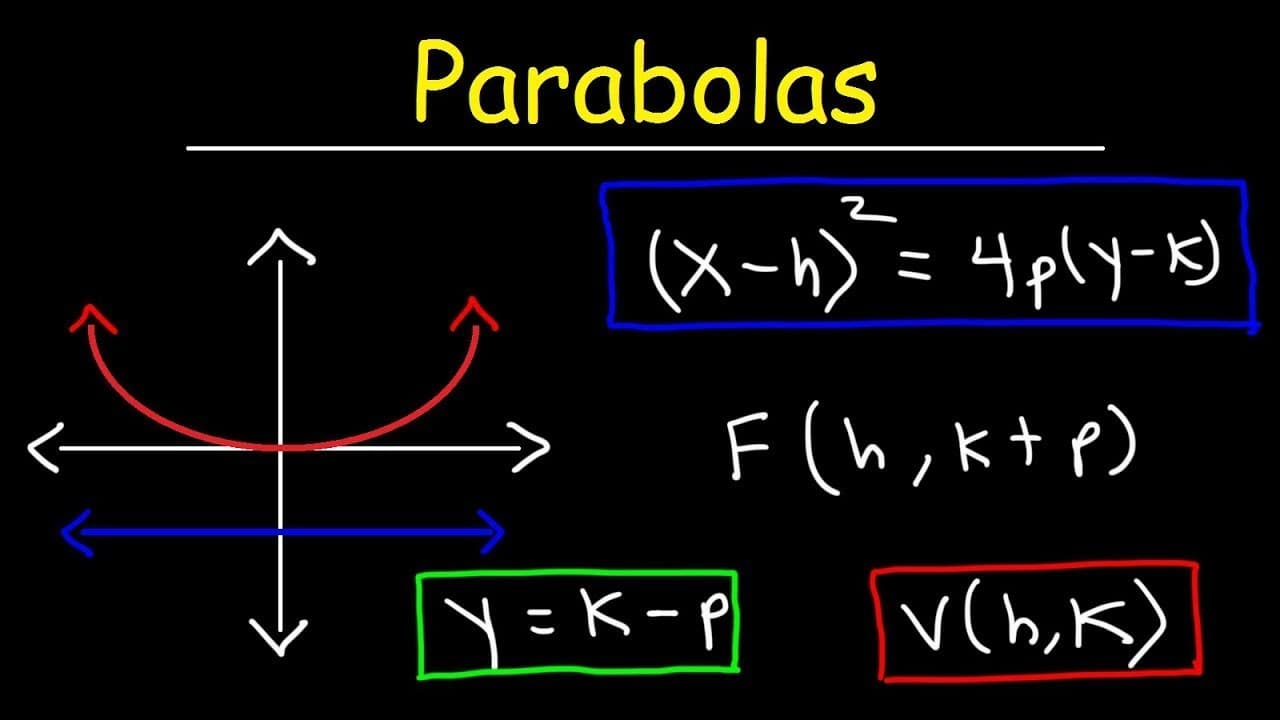
Mastering Parabolas: Equations, Graphs, And Geometric Properties

Mastering Parabolas: Equations, Graphs, And Geometric Properties

This comprehensive mathematics tutorial provides a deep dive into understanding, graphing, and analyzing parabolas as conic sections. The video begins by introducing the standard equations for parabolas centered at the origin, distinguishing between vertical ($x^2 = 4py$) and horizontal ($y^2 = 4px$) orientations. It thoroughly explains fundamental geometric properties including the vertex, focus, directrix, and latus rectum, defining $p$ as the distance from the vertex to the focus. Through a series of progressive examples, viewers learn how to determine the direction a parabola opens based on the variable squared and the sign of the coefficient. The video progresses to more complex problems involving parabolas shifted away from the origin. It demonstrates how to extract the vertex $(h, k)$ from standard form equations like $(y-k)^2 = 4p(x-h)$ and calculating the new coordinates for the focus and equations for the directrix. A key segment covers the algebraic technique of completing the square to convert general quadratic equations into standard form, a critical skill for upper-level algebra students. The tutorial also addresses calculating the length of the latus rectum to determine the width of the parabola and identifying the domain and range of the graphed functions. Ideally suited for Algebra 2, Pre-Calculus, and Trigonometry classrooms, this video serves as an excellent instructional tool for introducing or reviewing conic sections. Teachers can use the distinct problem types—matching equations to graphs, graphing from equations, deriving equations from geometric features, and algebraic manipulation—to structure a scaffolded lesson. The clear, step-by-step visual approach helps demystify the abstract connections between algebraic formulas and geometric shapes, supporting students in mastering the specific vocabulary and procedural fluency required for this topic.
The Organic Chemistry TutorThe Organic Chemistry Tutor

34mins 54s

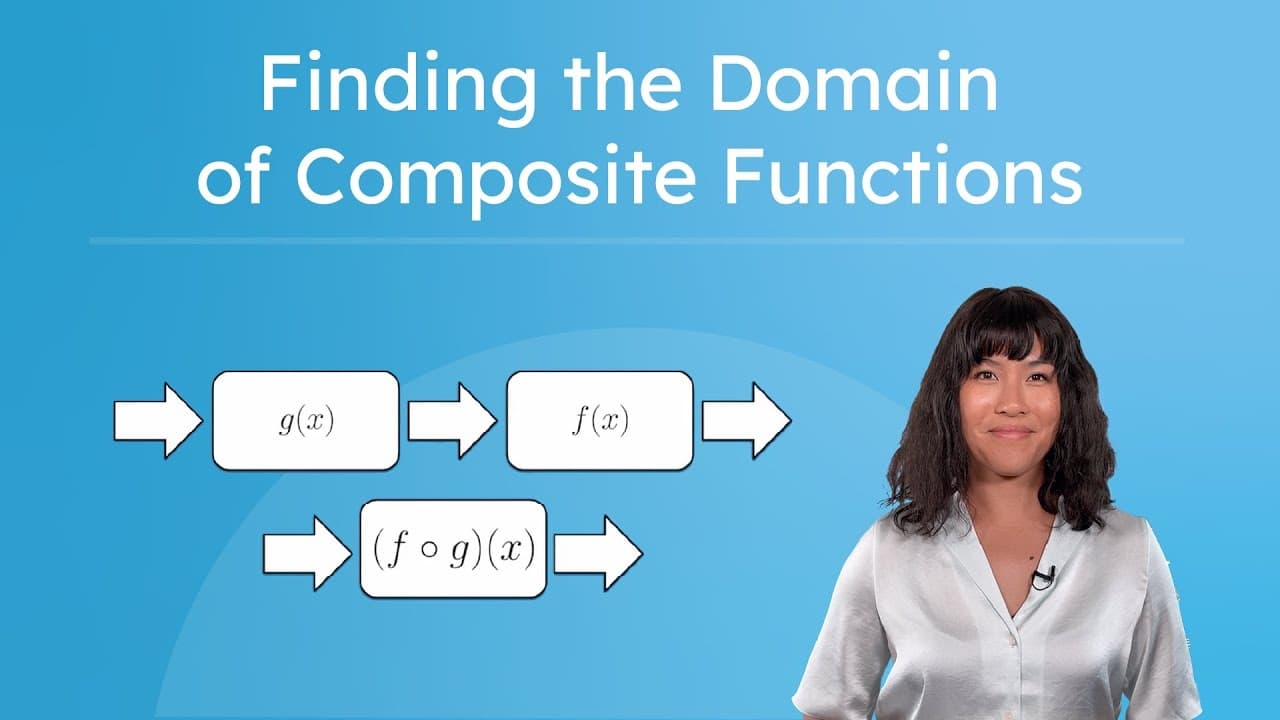
How to Find the Domain of Composite Functions

How to Find the Domain of Composite Functions

This educational video provides a clear, step-by-step guide on how to determine the domain of composite functions, a key concept in precalculus and algebra. Through the use of specific examples involving rational and radical functions, the narrator demonstrates that finding the domain isn't as simple as just looking at the final simplified equation. The video uses a logical "input-output" approach, comparing functions to a cooking process where inputs must be compatible with each stage of preparation. The content progresses from a numerical investigation using a table of values to an analytical algebraic method. It highlights the two main sources of domain restrictions: values excluded from the inner function, and values that cause the inner function to output a number that is undefined in the outer function. This dual-layer analysis is crucial for students who often miss the second type of restriction. Teachers can use this video to introduce or reinforce the complex topic of composite domains. It breaks down the process into four actionable steps: finding the inner domain, finding the outer domain, solving for x-values that violate the outer domain, and combining the results. The visual aids and pause points make it an excellent tool for interactive classroom learning or flipped classroom assignments.

Miacademy & MiaPrep Learning ChannelMiacademy & MiaPrep Learning Channel

8mins 44s

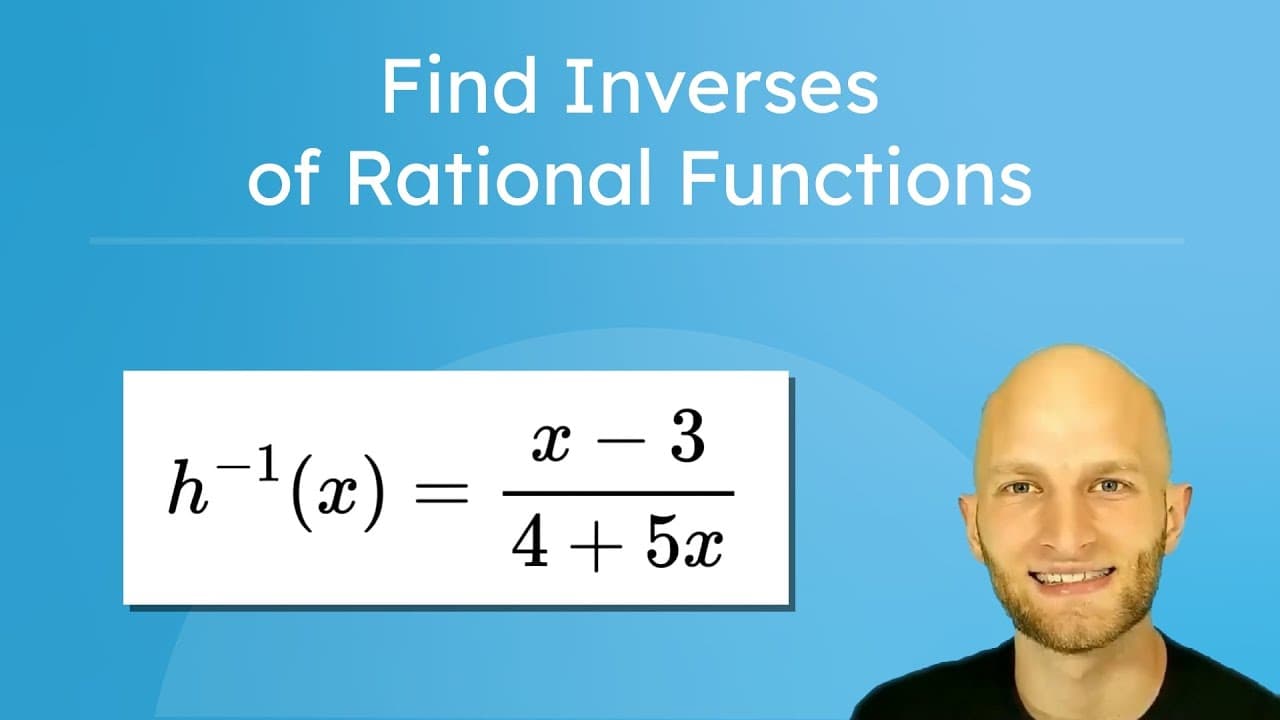
How to Find the Inverse of a Rational Function

How to Find the Inverse of a Rational Function

This educational video provides a clear, step-by-step guide on how to find the inverse of a rational function. Hosted by an instructor named Randy, the lesson begins by defining what an inverse function is conceptually—specifically, the swapping of x and y coordinates. It outlines a systematic three-step process for finding inverses algebraically: replacing function notation with 'y', switching 'x' and 'y' variables, and solving for the new 'y'. The video uses a specific example of a rational function to demonstrate these steps in real-time. The core of the video focuses on the algebraic manipulation required to solve for 'y' when it appears in both the numerator and denominator of a rational equation. This involves skills such as cross-multiplication, the distributive property, grouping variable terms on one side of the equation, and factoring. The narrator emphasizes common stumbling blocks, particularly the crucial step of factoring out 'y' to isolate the variable. The video concludes by connecting the algebraic result to a graphical representation, showing how the graphs of a function and its inverse are related through reflection. For educators, this video serves as an excellent instructional tool for Algebra II or Pre-Calculus units on functions. It addresses a specific skill gap—handling rational functions where the variable to be isolated appears twice—which is often challenging for students. The clear visual aids, explicit written steps, and side-by-side graphical comparison make it suitable for direct instruction, flipped classroom assignments, or as a review resource for students struggling with algebraic manipulation of complex functions.

Miacademy & MiaPrep Learning ChannelMiacademy & MiaPrep Learning Channel

8mins 59s

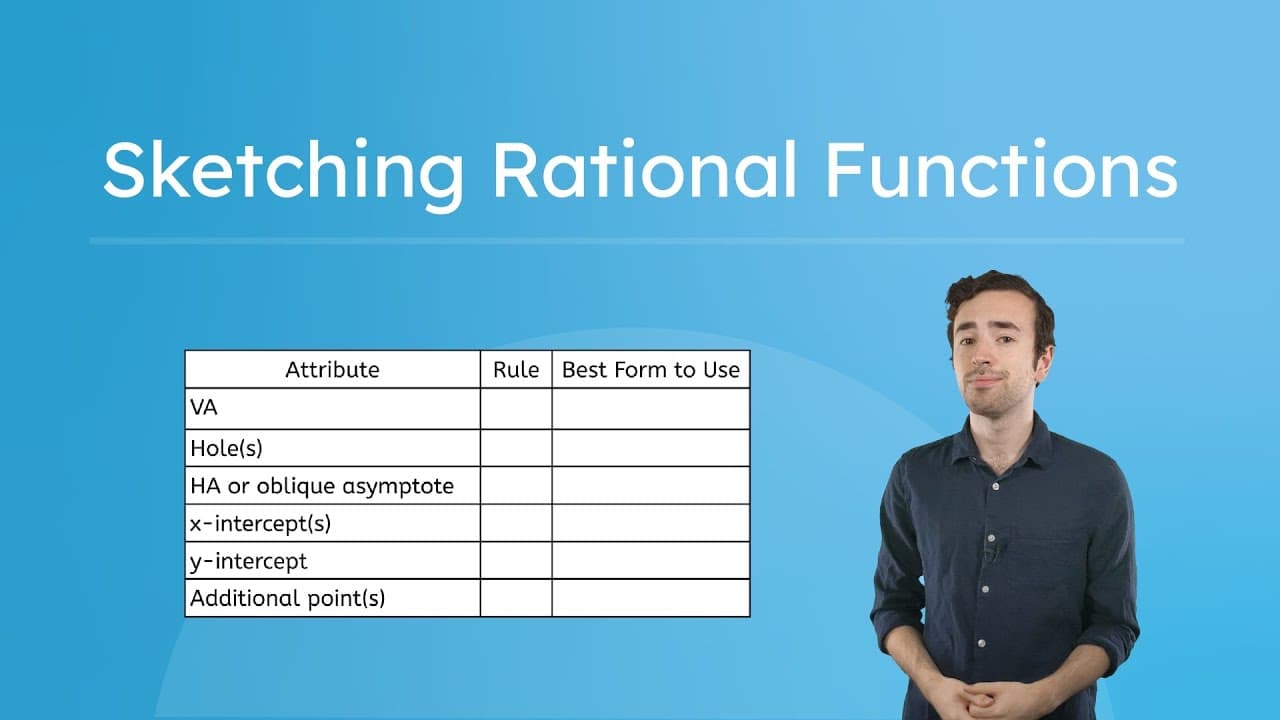
How to Sketch Graphs of Rational Functions

How to Sketch Graphs of Rational Functions

This educational video provides a comprehensive guide on how to sketch graphs of rational functions by synthesizing various algebraic concepts. The instructor, Justin, begins by constructing a summary table that serves as a "cheat sheet" for students, outlining the rules for finding vertical asymptotes, holes, horizontal or oblique asymptotes, and intercepts. The video emphasizes the importance of identifying which form of the equation (factored vs. unfactored) is best suited for finding specific attributes. The content explores key themes in advanced algebra and pre-calculus, specifically focusing on the behavior of rational functions. Detailed explanations cover how to handle discontinuities (holes), how to determine end behavior using degree comparisons for asymptotes, and the specific algebraic steps to find x and y-intercepts. The video addresses complex scenarios, such as functions with oblique (slant) asymptotes and removable discontinuities. For the classroom, this video is an excellent synthesis tool for the end of a unit on rational functions. It encourages active participation by prompting students to pause and attempt problems before seeing the solution. The structured approach of creating an attribute table helps students organize their thinking and provides a scaffolding method for tackling complex graphing problems, making it a valuable resource for Algebra II and Pre-Calculus curricula.

Miacademy & MiaPrep Learning ChannelMiacademy & MiaPrep Learning Channel

16mins 55s

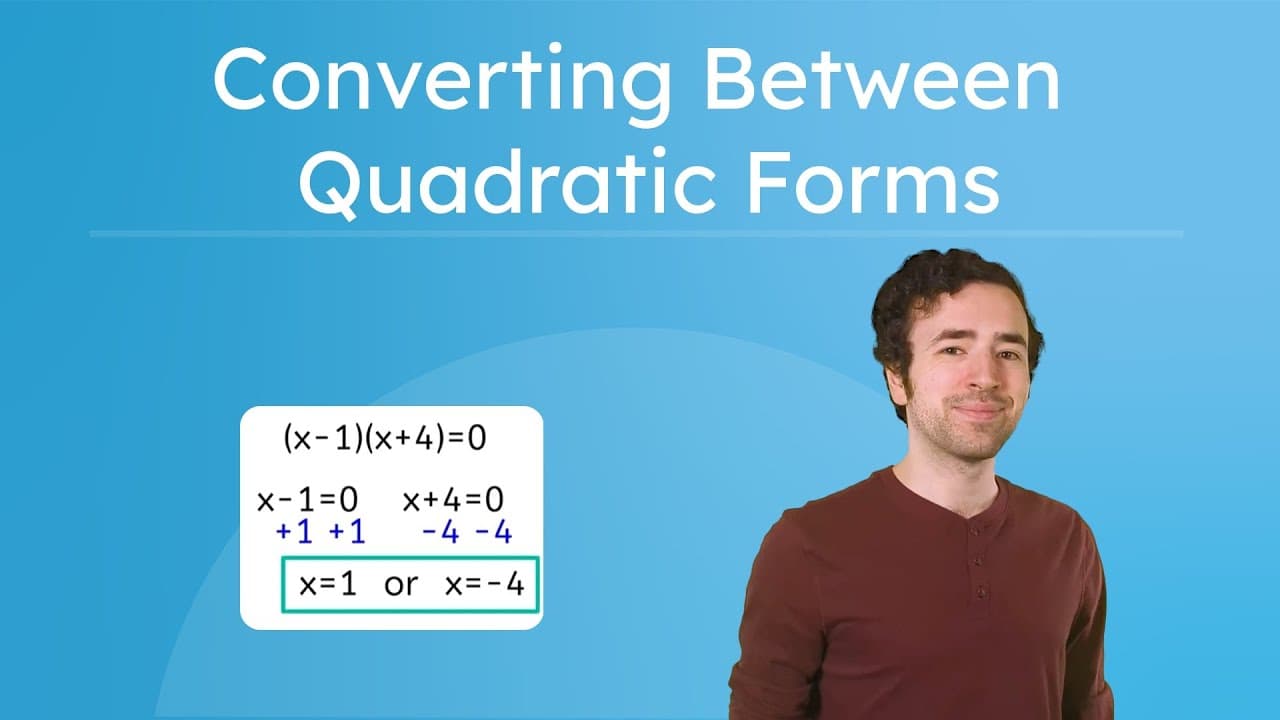
Converting Quadratic Forms: Standard and Vertex

Converting Quadratic Forms: Standard and Vertex

This short educational video introduces the concept of converting between two primary forms of quadratic equations: Standard Form and Vertex Form. Hosted by an enthusiastic presenter named Justin, the video serves as a lesson introduction that connects prior knowledge of graphing quadratics to the new skill of algebraic conversion. It emphasizes that mathematics offers flexibility, showing that different forms of an equation reveal different attributes of a function, such as the vertex or intercepts. The video utilizes engaging animations, including a robot character hitting a baseball and visualizing profit growth, to illustrate real-world applications of parabolic functions. It outlines a learning path for students that includes guided notes, an activity called 'Quadratic Quest,' and online practice. The content focuses on the 'why' and 'what' of the lesson, setting the stage for students to learn the specific algebraic mechanics of converting forms. For educators, this video acts as an excellent hook or engagement trigger at the start of a unit on quadratic algebraic manipulation or completing the square. It provides a clear rationale for why students need to learn these conversions—specifically, that choosing the right form makes solving specific problems easier. It helps transition students from simply identifying forms to actively manipulating them to suit their problem-solving needs.

Miacademy & MiaPrep Learning ChannelMiacademy & MiaPrep Learning Channel

1min 54s

Mastering Composite Functions and Their Domains

Mastering Composite Functions and Their Domains

This comprehensive mathematics tutorial provides a deep dive into composite functions, a fundamental concept in Algebra II and Pre-Calculus. The video systematically explains how to combine two functions, f(x) and g(x), to create a new composite function. Beyond simple substitution, it tackles the often-challenging topic of determining the domain of these composite functions, emphasizing the importance of considering restrictions from both the inner input function and the final simplified expression. The instructor uses clear, step-by-step examples involving rational and radical functions to illustrate these concepts using interval notation and number lines.

The Organic Chemistry TutorThe Organic Chemistry Tutor

30mins 2s

Materials

Rational Roots Reference Sheet

Rational Roots Reference Sheet

A two-page comprehensive reference sheet for Algebra. The first page features a graphic organizer for factoring (GCF, Trinomials, Difference of Squares), and the second page provides step-by-step guides and examples for multiplying, dividing, adding, and subtracting rational functions.

JD

Jonathan de la Fuente

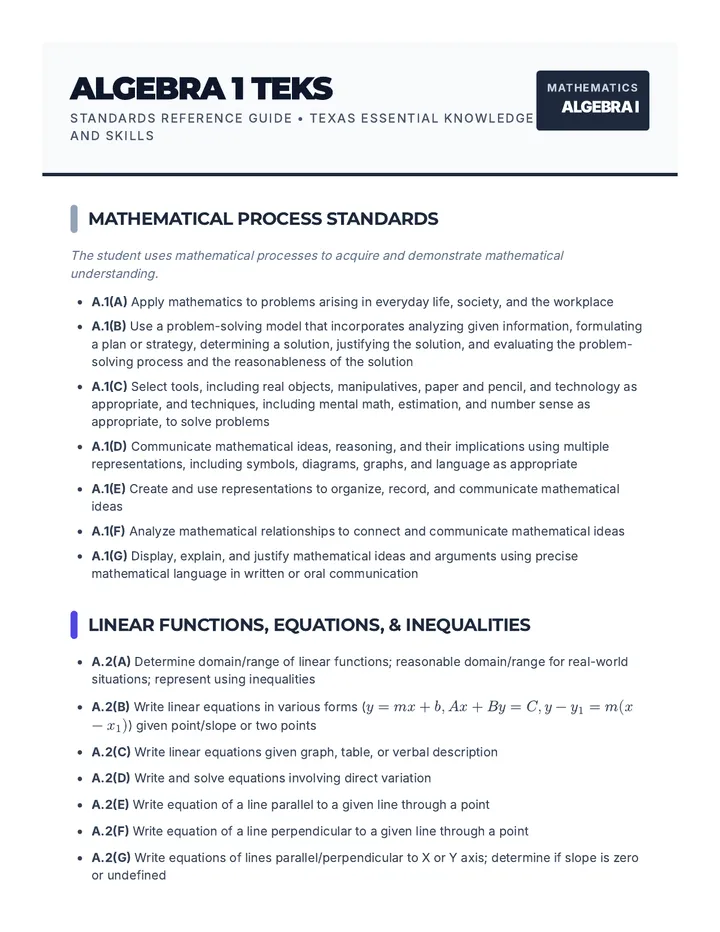
Algebra 1 TEKS Reference Guide

Algebra 1 TEKS Reference Guide

A comprehensive, formatted reference list of all Algebra 1 Texas Essential Knowledge and Skills (TEKS) organized by standard strands for teacher use. Includes Process Standards.

M

mbatey

Sequences

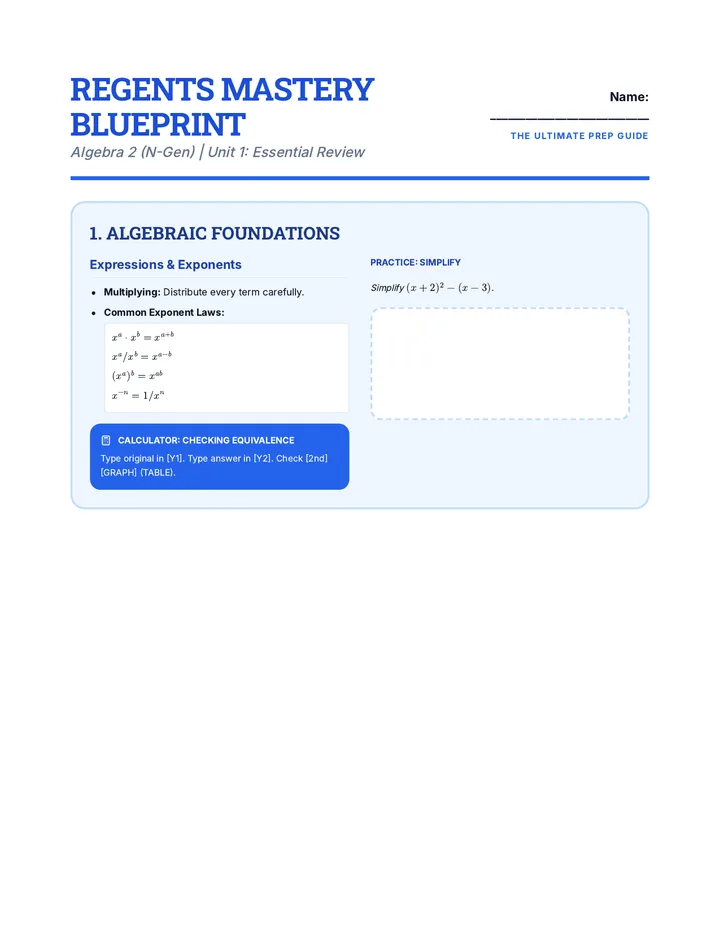
Regents Mastery Blueprint Study Guide

Regents Mastery Suite

A comprehensive review suite for the New York State Mathematics Regents exams, including Algebra 1, Geometry, and Algebra 2, featuring mastery blueprints, calculator strategies, and exam-taking tips.

KB

Kayla Borozny

15
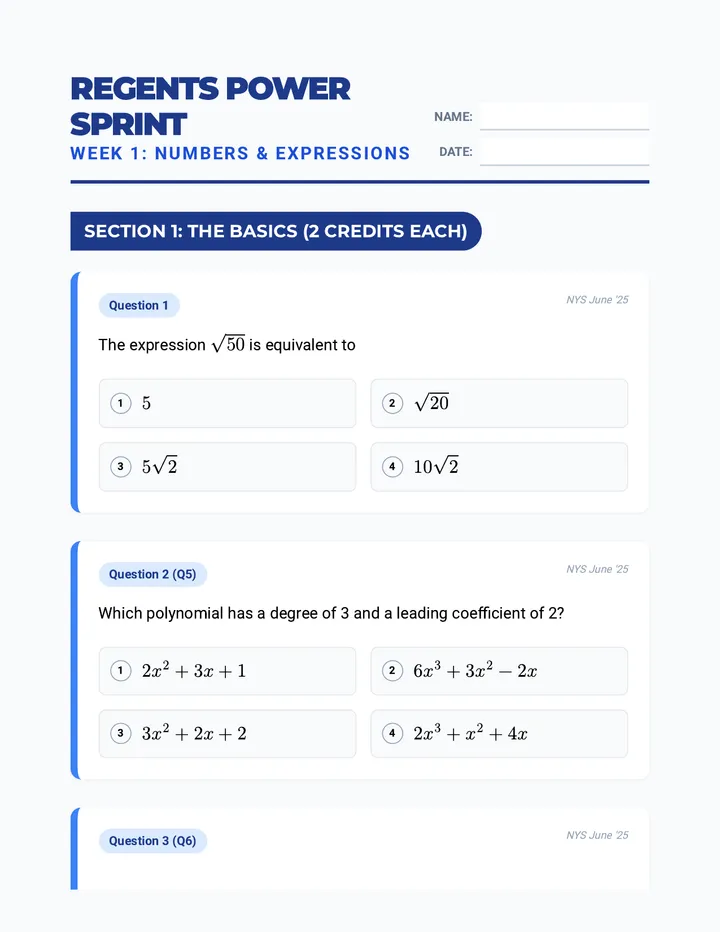
Week 1 Power Sprint Worksheet

Regents Road Map

A comprehensive 10-week preparation sequence designed to get students ready for the Algebra I Regents exam by May 15th, featuring bi-weekly 30-minute practice sessions and visual anchor charts.

L

laura.clar

31
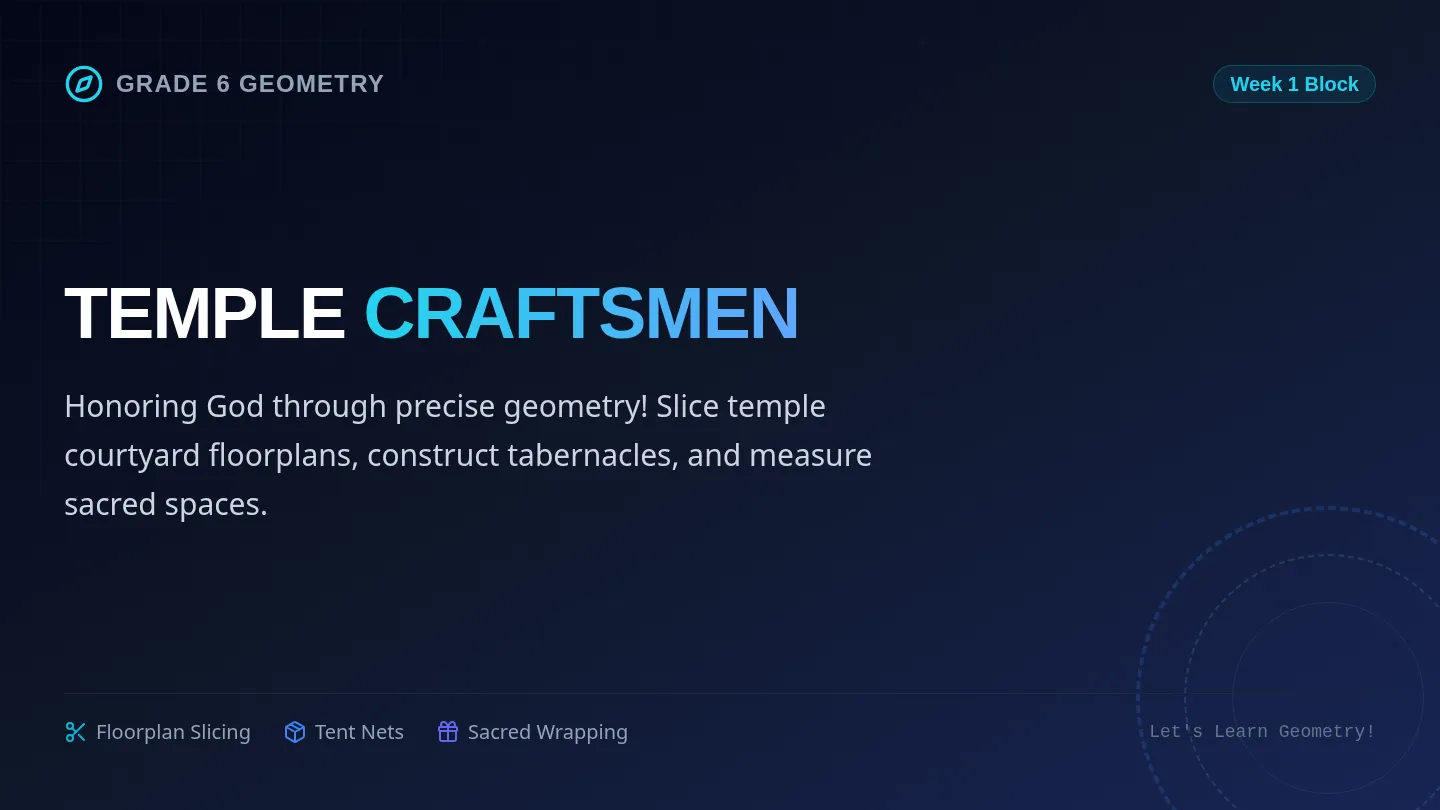
Temple Craftsmen Slides

Middle School Math Block

A multi-subject middle school mathematics block for Week 1, covering 6th Grade Geometry (Temple Craftsmen: polygon decomposition, nets, surface area) and 7th/8th Grade Math (Faithful Stewards: proportional relationships, linear equations, inequalities, transversals) from a Christian perspective.

JR

Jamens Ray II

59
Slope Stories Worksheet

EOC Blueprint

A comprehensive Algebra 1 EOC preparation series designed for AVID classrooms, focusing on inquiry-based learning and collaborative problem-solving across linear, quadratic, and exponential functions.

ES

Erin Sims

9
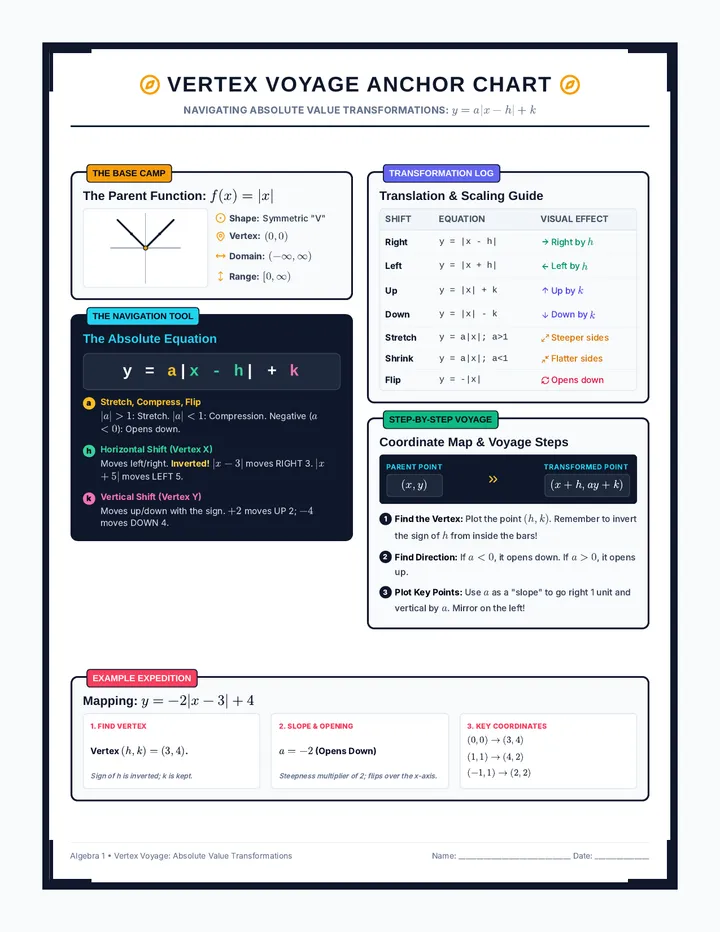
Vertex Voyage Anchor Chart

Algebraic Adventures

An algebraic exploration of key functions and their graphs, taking students on a visual voyage from linear equations to absolute value transformations.

M

Mike.Hale

4
Vital Vitals Project Booklet

Vital Vitals Healthcare Project

A 3-day healthcare-themed project for remedial precalculus students. It covers algebra 2 fundamentals, systems of equations, and introductory trigonometric transformations within clinical contexts.

KC

Kris Coyne

3

Lessons

Algebra II Final Exam Test

Algebra II Spring Final Exam

A comprehensive Algebra II final exam covering quadratics, function operations, inverses, exponent rules, and polynomial division.

BF

Ben Freitag

2
Algebra 1 Formula Sheet

Algebra 1 Assessment

A comprehensive final assessment for Algebra 1 covering linear equations, systems, exponents, polynomials, and quadratic functions. Includes free response and graphing sections to evaluate deep understanding.

JF

Jim Fusaro

3
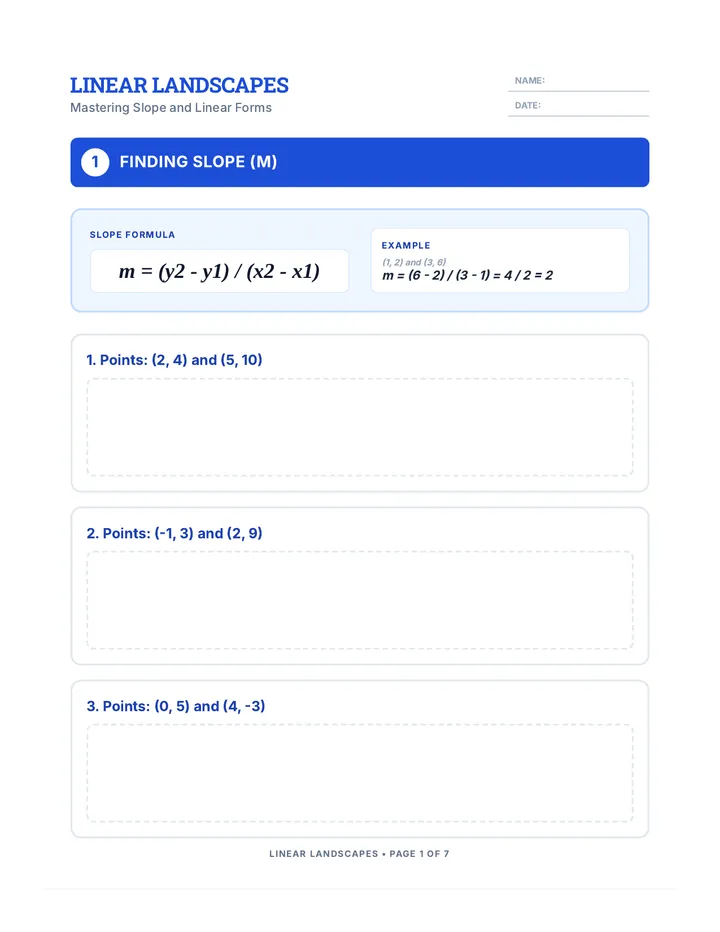
Linear Landscapes Practice Packet

Linear Landscapes Practice

A comprehensive practice module for high school Algebra 1 students focusing on slope, point-slope form, and slope-intercept form. Designed with scaffolding and visual aids specifically for special education support.

D

david.marques

2
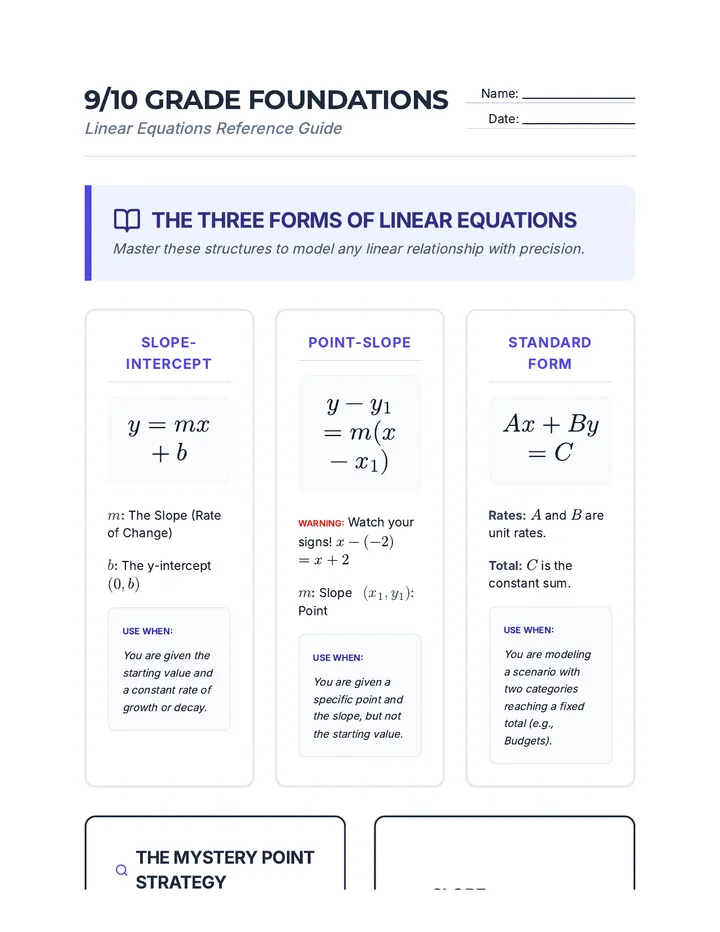
Foundations Reference Sheet

The Form Finder Challenge

An extra practice lesson focused on helping students strategically choose between slope-intercept and point-slope forms based on given mathematical information. Includes a comprehensive student packet with scaffolding and a detailed teacher answer key.

D

david.marques

3
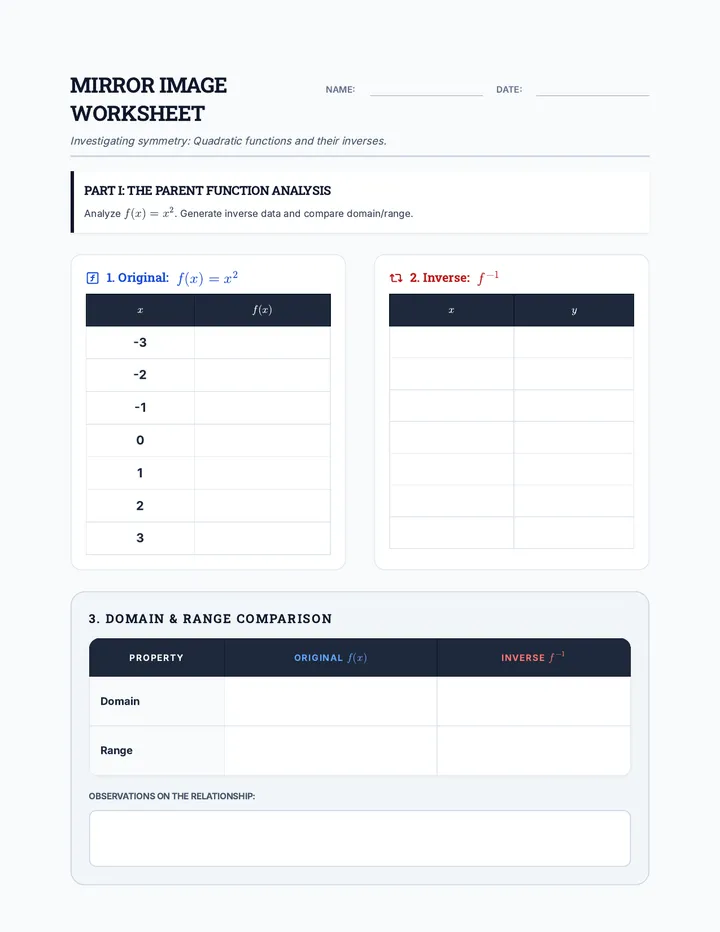
Mirror Image Worksheet

Inverse Intuition

Explore the relationship between a quadratic function and its inverse. Students will graph both, compare domain and range, and determine if the inverse is a function or a relation.

MR

Mahuya Roy Chowdhury

2
Inverse Mapping Worksheet

Inverse Mapping Mastery

A lesson focused on graphing and analyzing inverse relations for absolute value and quadratic functions. Students learn to reflect functions across y=x and evaluate if the resulting relation is a function.

MR

Mahuya Roy Chowdhury

5