| \( y \) |
|---|
| \( 12 \) | \( -1 \) |
| \( 7 \) | \( 0 \) |
| \( 4 \) | \( 1 \) |
| \( 3 \) | \( 2 \) |
| \( 4 \) | \( 3 \) |
| \( 7 \) | \( 4 \) |
| \( 12 \) | \( 5 \) |
| Property | Original \( g(x) \) | Inverse \( g^{-1} \) |
|---|---|---|
| Domain | \( (-\infty, \infty) \) | \( [3, \infty) \) |
| Range | \( [3, \infty) \) | \( (-\infty, \infty) \) |
Inverse Turning Point
\( (3, 2) \)
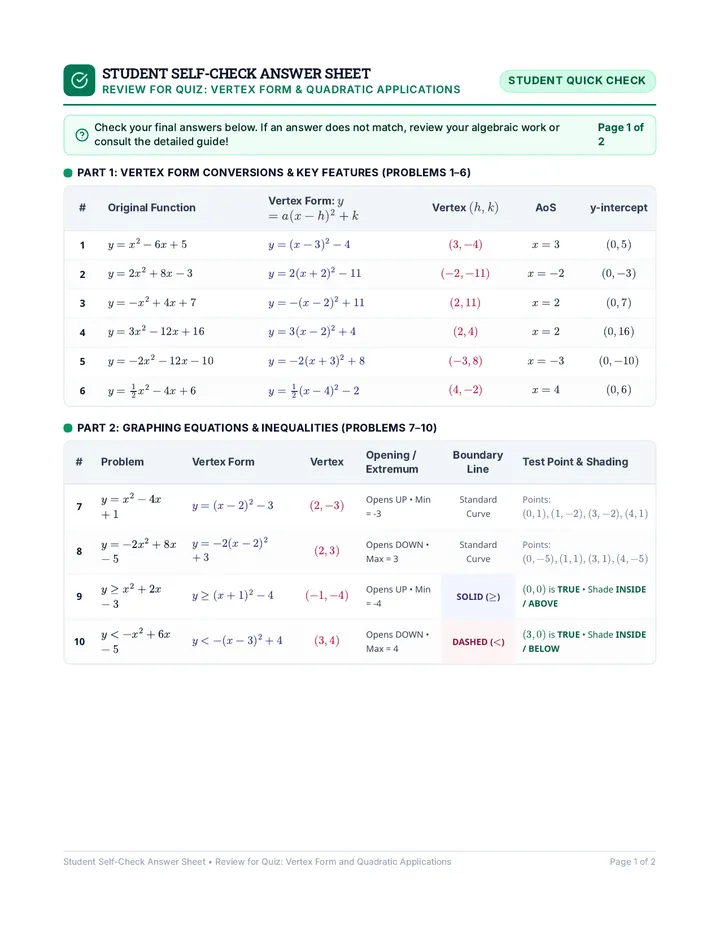
The vertex \( (h, k) \) of the quadratic always maps to \( (k, h) \) in its inverse relation.
Function Verdict
No
Even with a transformation, the graph is not one-to-one, so the inverse remains a relation (fails VLT).