Slope Stories Worksheet Slope Stories
Inquiry-Based Investigation // Algebra 1 EOC
Student:
Date:
ESSENTIAL QUESTION
How does the "rate of change" translate from a mathematical value into a real-world story?
PART 1
Scenario Analysis: The Data Plan
A mobile service provider, "Signal Strength," charges a monthly base fee plus a cost per gigabyte (GB) of data used. The total cost, C, is modeled by:
C = 12.50g + 35
Where g represents the number of gigabytes used.
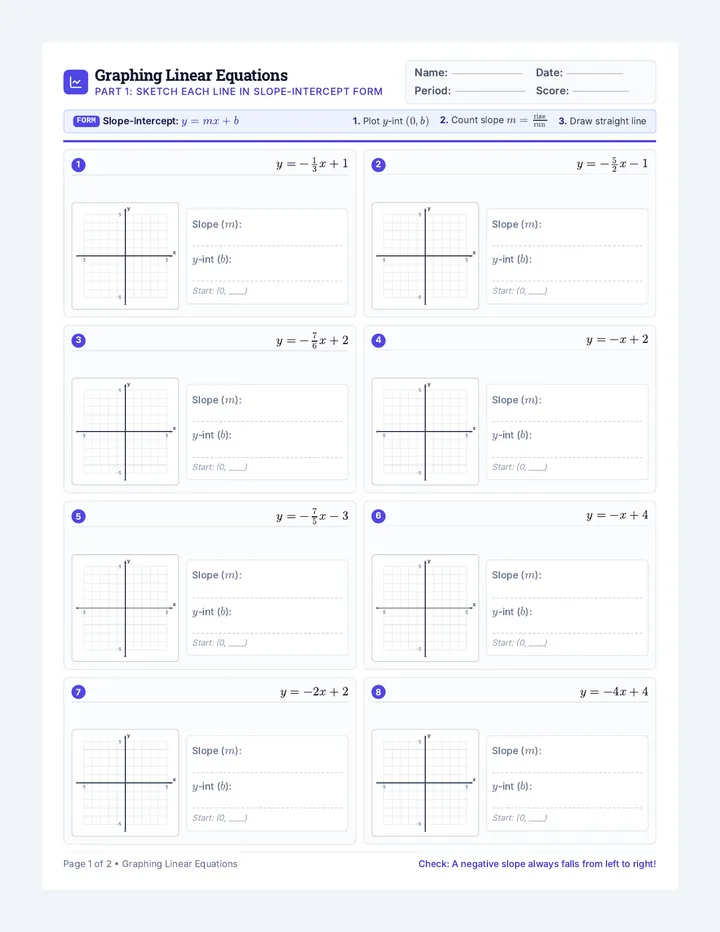
Identify the Slope (m)
What does this number represent in the context of a cell phone bill?
Identify the Y-Intercept (b)
What does this number represent in the context of a cell phone bill?
PART 2
The Multi-Step Challenge
Suppose Signal Strength changes their pricing. The base fee doubles , but the cost per gigabyte is reduced by $2.50 .
1. Write the new equation for the total cost (C).
2. If a customer uses 4GB, which plan is cheaper? Show the math.
3. Reflect: How did the slope change affect the "steepness" of the cost growth?
PART 3
EOC Style Multiple Choice
Analyzing Slope in Different Forms
1. A water tank is being drained. The volume of water (V) in gallons after t minutes is shown in the table below.
Time (min) Volume (gal) 0 450 5 400 10 350
Which statement correctly interprets the slope of this function?
A
The tank starts with 450 gallons of water.
B
The tank drains at a rate of 10 gallons per minute.
C
The tank drains at a rate of 50 gallons per minute.
D
It will take 10 minutes to drain the entire tank.
2. The graph of a linear function passes through the points (2, 5) and (4, 11). What is the rate of change of this function?
A) 3
B) 6
C) 1/3
D) 2
Slope Mastery Achieved
ALGEBRA 1 EOC // WICOR STRATEGIES
Slope Stories Slides Lesson 01
Slope Stories
Interpreting Linear Change in Real-World Scenarios
Collaboration
Inquiry
THE CASE OF THE
MYSTERY BILL
"Your phone bill was $65 this month. Last month, when you used half the data, it was $45."
Collaborative Inquiry:
Why didn't the bill double?
What stays the same every month?
What changes based on your use?
$20 diff
Anatomy of Change
Linear Functions
Slope-Intercept
y = mx + b
The Blueprint of a Line
m
Slope (Rate of Change)
"For every 1 unit of X, Y changes by..."
b
Y-Intercept (Starting Value)
"The value of Y when X is zero."
Check for Understanding
If a plumber charges $75 per hour plus a $100 service fee , which value is the slope?
A) 100
B) 75
Group Blueprint Challenge
The Problem:
"A drone at an altitude of 500 feet starts descending at a rate of 15 feet per second ."
1
Write the equation for height h.
2
Explain why the slope is negative.
3
When will the drone land (h=0)?
AVID STRATEGY
Collaborative Inquiry
Compare your equations. Does anyone have a different variable? Why?
Key EOC Takeaways
Visual Cues
Look for "per", "each", "every" for slope. Look for "start", "fee", "initial" for y-intercept.
Direction
Ascending = Positive Slope. Descending = Negative Slope.
Verification
Always plug in a value (like X=1) to see if the story makes sense.
ALGEBRA 1 EOC MASTER SERIES
Blueprint Series
Linear Landscapes Teacher Guide Teacher Facilitation Guide
Linear Landscapes
Answer Key & Instructional Support
Lesson 1 of 3
EOC Blueprint Series
AVID Strategy
This lesson utilizes Collaborative Inquiry . Encourage students to debate the meaning of "slope" as a story rather than just a number. Use the "Think-Pair-Share" model for the mystery case on Slide 2.
EOC Focus
Standard A.CED.A.1 : Creating and interpreting linear equations. Focus on multi-step transformations where the context dictates changes to the slope or intercept.
Pacing guide
Slides & Hook: 15 min
Investigation: 25 min
EOC Practice: 10 min
Debrief: 5 min
Worksheet Answer Key
Part 1: Scenario Analysis
Slope (m)
12.50
Meaning: The cost per gigabyte ($12.50/GB).
Y-Intercept (b)
35
Meaning: The monthly base fee (fixed cost) of $35.
Part 2: The Challenge
1. New Equation
C = 10g + 70
Base fee doubles (35 * 2 = 70), Rate drops (12.50 - 2.50 = 10).
2. 4GB Comparison
Plan 1: 12.50(4) + 35 = $85
Plan 2: 10(4) + 70 = $110
Plan 1 is cheaper by $25.
3. Reflection
The lower slope makes the cost grow more slowly, but the higher intercept means you start at a much higher price point.
Part 3: EOC Practice
Question 1
Answer: B
Rate = (400-450) / (5-0) = -50/5 = -10 gal/min.
Question 2
Answer: A
Rate = (11-5) / (4-2) = 6/2 = 3.
Collaborative Inquiry Prompts
Critical Thinking:
"What would happen to the graph if the service provider offered 'unlimited' data? How does the slope change?"
Misconception Alert:
Students often confuse the base fee (y-intercept) with the unit rate (slope) in word problems. Emphasize that the slope always depends on the independent variable.
Parabola Paths Worksheet Parabola Paths
Quadratics in Vertex Form // Algebra 1 EOC
Student:
Date:
ESSENTIAL QUESTION
How do changes in a quadratic's equation physically "shift" the path of the curve?
PART 1
The Base Model: \( f(x) = x^2 \)
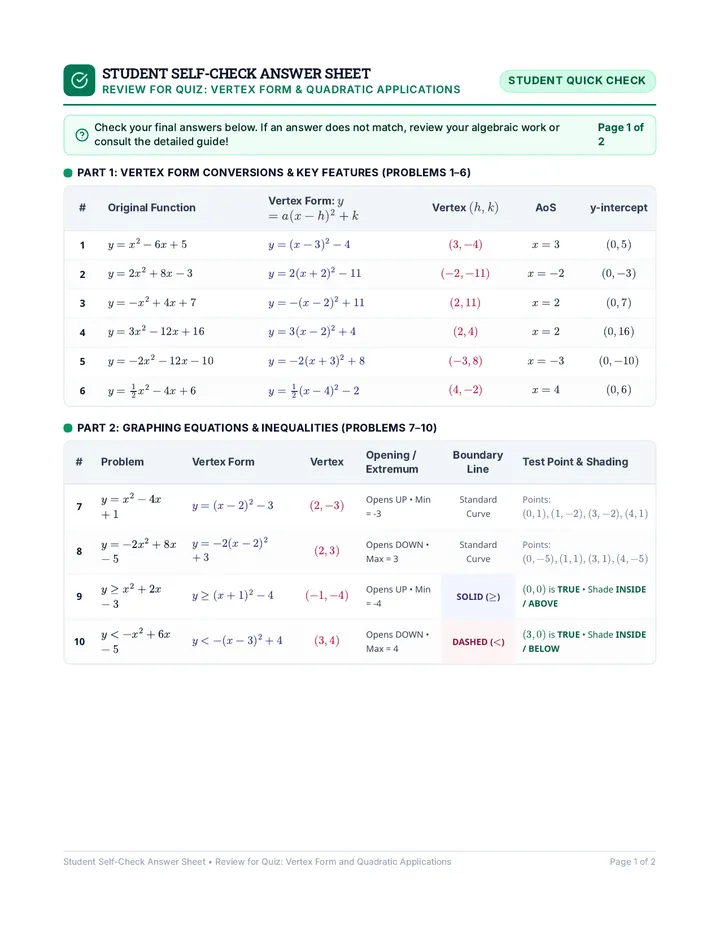
Equation 1: \( g(x) = (x - 3)^2 + 4 \)
Describe the shifts from the parent function:
Identify the Vertex (h, k):
Equation 2: \( h(x) = -(x + 2)^2 - 5 \)
Describe the shifts from the parent function:
Identify the Vertex (h, k):
PART 2
The Arch Blueprint
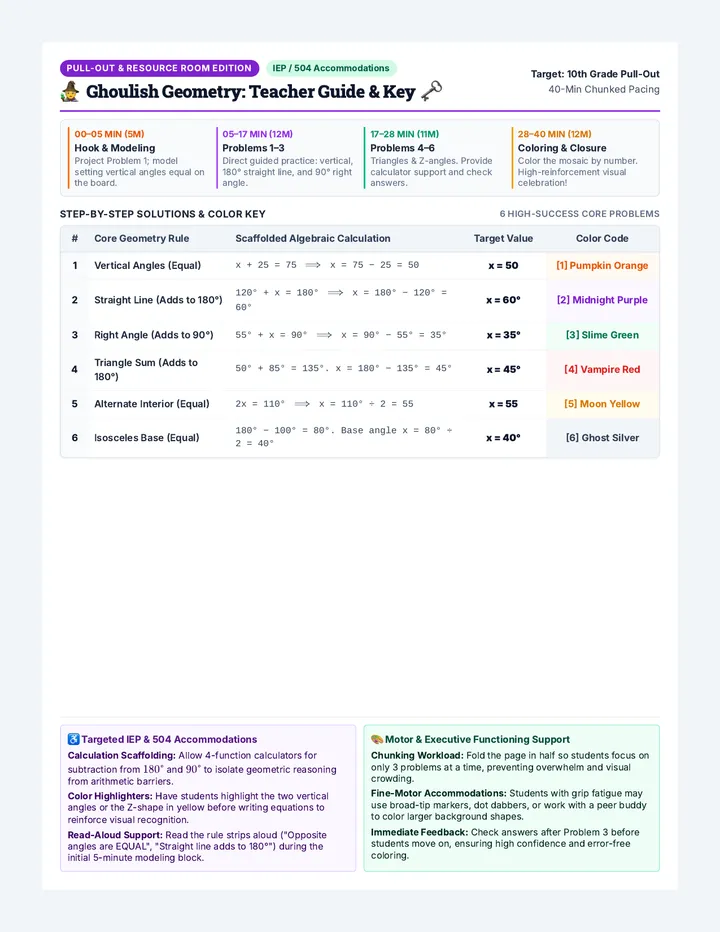
Engineers are designing a symmetrical archway. The vertex of the arch is at (0, 10) and it must pass through the point (2, 6) .
1. Use the vertex to write as much of the equation as possible in \( y = a(x - h)^2 + k \) form.
2. Solve for the value of "a" using the point (2, 6).
3. Reflect: Does the arch open up or down? How do you know?
PART 3
EOC Performance Task
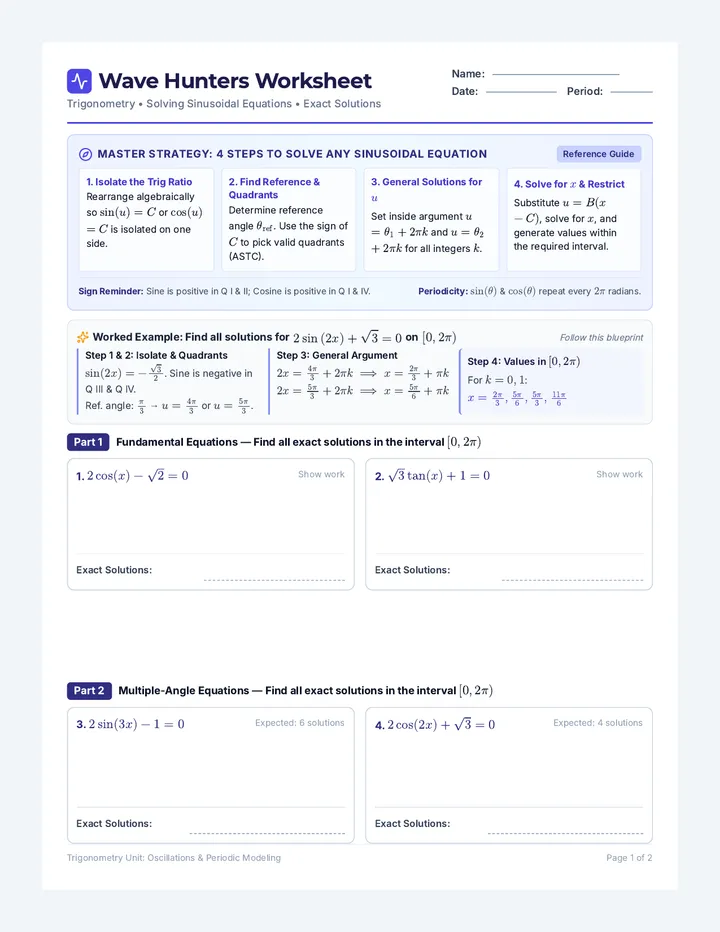
1. The function \( f(x) = x^2 \) is transformed to create \( g(x) = f(x + 4) - 2 \). Which of the following is the graph of \( g(x) \)?
[ Space for Graph Options ]
Describe where the vertex moved:
2. An object is thrown from a platform. Its height (h) in feet over time (t) in seconds is given by \( h(t) = -16(t - 1.5)^2 + 40 \).
A) What is the maximum height of the object?
B) How many seconds does it take to reach that height?
Parabola Precision
ALGEBRA 1 EOC // WICOR STRATEGIES
Parabola Paths Slides Lesson 02
Parabola Paths
Visualizing Transformations in Vertex Form
The Basketball Shot
"A basketball follows a curved path through the air. If you stand on a taller platform, does the 'shape' of the shot change, or just its 'starting point'?"
Collaborative Discussion:
What happens to the peak of the shot?
Which part of the equation models the height shift?
The Shift Controller
y = a(x - h)2 + k
a
Direction & Width
(+ Open Up / - Open Down)
h
Horizontal Shift
(Left / Right - Opposite Sign!)
k
Vertical Shift
(Up / Down)
Blueprint Detective Task
"A parabola with a vertex at (5, -2) is flipped upside down and shifted 3 units left ."
A
What is the new vertex?
B
Write the new equation.
Collaborative Strategy
Consensus Building
Discuss with your team: Why does the "(x - h)" part feel backwards when shifting left and right?
Quadratic Mastery
The Vertex Shortcut
The coordinates (h, k) are always your maximum or minimum point.
Transformation Logic
Inside the parentheses = Horizontal (X).
Parent Reflection
Compare every equation back to y = x2 to see what actually changed.
EOC Ready
Parabola Paths Teacher Guide Teacher Facilitation Guide
Parabola Paths
Answer Key & Instructional Support
Lesson 2 of 3
EOC Blueprint Series
WICOR Focus
Focus on Organization and Inquiry . Students must systematically identify h and k before describing transformations. The Arch Blueprint task requires Writing to explain mathematical reasoning.
EOC Focus
Standard A.SSE.B.3 : Identifying key features of a quadratic function (vertex, axis of symmetry) and explaining how transformations relate to the parent function.
Common Pitfalls
The sign of "h" inside the parentheses is the #1 student error. If students see \((x-3)\), they assume a left shift. Remind them: "X is a liar."
Worksheet Answer Key
Part 1: Transformation Investigation
Eq 1: \( g(x) = (x-3)^2 + 4 \)
Shifts: Right 3, Up 4.
Vertex: (3, 4)
Eq 2: \( h(x) = -(x+2)^2 - 5 \)
Shifts: Left 2, Down 5, Reflected (Opens Down).
Vertex: (-2, -5)
Part 2: The Arch Blueprint
1. Vertex Equation: \( y = a(x - 0)^2 + 10 \) or \( y = ax^2 + 10 \)
2. Solving for "a":
6 = a(2)^2 + 10
6 = 4a + 10
-4 = 4a → a = -1
3. Reflection:
Opens down because "a" is negative. This makes sense for an archway!
Part 3: Performance Task
Question 1
Vertex moves to (-4, -2) . (Left 4, Down 2).
Question 2
A) Max Height: 40 feet.
B) Time: 1.5 seconds.
Discussion Facilitation
Visual Debate:
"If I change 'a' from 1 to 10, does the parabola get 'bigger' or 'thinner'? Why is that term confusing?" (Hint: It gets narrower because it grows faster vertically).
Contextual Connection:
"In the object throw problem, what does the +40 represent physically? What if the platform was only 20 feet high?"
Growth Graphs Worksheet Growth Graphs
Exponential Modeling // Algebra 1 EOC
Student:
Date:
ESSENTIAL QUESTION
How can we distinguish between adding a constant amount and multiplying by a constant factor?
PART 1
Linear vs. Exponential
Scenario A: Bank Savings
You start with $100 and add $10 every month.
Month Total ($) 0 100 1 _____ 2 _____
Growth Pattern:
Scenario B: Viral Video
A video has 100 views and doubles every hour.
Hour Views 0 100 1 _____ 2 _____
Growth Pattern:
PART 2
Deciphering \( y = ab^x \)
Match the context clues to the variables a and b.
The Initial Value (a)
Example: "Started with...", "Initially..."
The Growth Factor (b)
Example: "Triples every...", "Reduced by half..."
PRACTICE CASE:
"A bacteria culture begins with 500 cells and increases by 20% each hour."
a =
b =
(Hint: 1 + r)
PART 3
EOC Problem Solving
1. A rare isotope decays at a rate of 15% per day. If the sample starts at 200 grams, which equation models the mass (M) remaining after t days?
M = 200(1.15)^t
M = 200(0.85)^t
M = 200 - 15t
Justify your choice (WICOR):
The Collaborative Challenge
A population of 50 birds doubles every year. After 5 years, how many birds are in the forest? Show your process.
Exponential Power
ALGEBRA 1 EOC // WICOR STRATEGIES
Growth Graphs Slides Lesson 03
Growth Graphs
Exponential Modeling & Reality
The Compound
Effect
"Would you rather have $1,000,000 right now, or a single penny that doubles in value every day for 30 days?"
Collaborative Vote:
Which option grows faster at the start? Which option wins at the end? Why?
$5.3M
Exponential Power
The Multiplier Logic
y = a(b)x
Growth
b > 1
Values are increasing . We add the rate to 1.
Decay
0 < b < 1
Values are decreasing . We subtract the rate from 1.
Team Blueprint Analysis
Case File:
"A computer loses 25% of its value every year. It was purchased for $1,200 ."
1
Is this growth or decay?
2
What is the "b" value? (1 - r)
3
What will it be worth in 4 years?
Inquiry Point
Why can the "b" value never be negative? What would happen to the graph if it was?
Exponential Mastery
Intercept
The value of 'a' is ALWAYS the y-intercept (when x = 0).
Percent
Always convert % to decimals (e.g., 5% = 0.05) before adding to 1.
Asymptote
Notice the graph never quite hits zero. It gets infinitely close!
BLUEPRINT SERIES FINALE
EOC Blueprint Series
Growth Graphs Teacher Guide Teacher Facilitation Guide
Growth Graphs
Answer Key & Instructional Support
Lesson 3 of 3
EOC Blueprint Series
Reading Focus
In this lesson, focus on Reading for context clues. Help students distinguish between linear "additive" language and exponential "multiplicative" language.
EOC Focus
Standard F.LE.A.2 : Constructing linear and exponential functions. Focus on modeling growth and decay from verbal descriptions and tables.
Socratic Prompt
Ask: "Why does the exponential graph start slower than the linear graph but end up much higher? Where is the 'pivot point'?"
Worksheet Answer Key
Part 1: Multiplier Mystery
Scenario A (Linear)
Month 1: $110 // Month 2: $120.
Pattern: +10 (Addition)
Scenario B (Exponential)
Hour 1: 200 // Hour 2: 400.
Pattern: *2 (Multiplication)
Part 2: Practice Case
500 cells, increases by 20%.
a = 500
Initial amount.
b = 1.20
1 + 0.20 = 1.20.
Part 3: EOC Modeling
Question 1
Answer: M = 200(0.85)^t
Decay = (1 - 0.15) = 0.85.
Question 2
50(2)^5 = 50 * 32 = 1,600 birds.
Collaborative Debrief
Misconception Alert:
Students often use 15% as 15.0 or just 15 in the equation. Remind them: "Percent means out of 100!" Use the WICOR strategy of Organization to convert rates before building equations.
Real World Connection:
Discuss social media trends or compound interest. "How does a video 'go viral'? What part of the equation is the share button?"