Lenny.com
Explore
Create
ActivitiesNewMathEnglish Language ArtsScience & EngineeringSocial StudiesGlobal LanguagesHealth & Physical EducationSpecial EducationCounseling & Life SkillsArts & CreativityESL
Lenny.com
Lenny.com
Explore
Create
ActivitiesNewMathEnglish Language ArtsScience & EngineeringSocial StudiesGlobal LanguagesHealth & Physical EducationSpecial EducationCounseling & Life SkillsArts & CreativityESL
Lenny.com
Lenny.com

Solutions

Lenny for EducatorsLenny for SchoolsLenny for Districts

Product

ExploreSign inCreateSupportAbout

Resources

Getting startedMTSS Acceleration Program

© 2026 Lenny Learning Inc.

TermsPrivacyAccessibility
LinkedInInstagramX
Lenny

Identify Linear vs Exponential Growth

Distinguishes between additive and multiplicative patterns in tables, graphs, and real-world contexts. Examines constant rates of change versus constant percentage growth to identify function types.

MathNumbers & CountingCounting ObjectsNumber NamesComparing NumbersNumber OperationsCounting SequenceNumbers 0-10Place Value Understanding and SystemAdd and Subtract Within 20Addition and Subtraction ConceptsAddition and Subtraction EquationsAddition and Subtraction ProblemsFoundations for MultiplicationMultiplication and Division PropertiesMultiply and Divide Within 100Multiplication and Division ProblemsFactors and MultiplesProperties of OperationsPatterns and RelationshipsGenerate and Analyze PatternsMulti-Digit ArithmeticPlace Value OperationsMulti-Digit and Decimal OperationsNumerical ExpressionsFour Operations and PatternsFour Operations Problem SolvingMeasurement & DataMeasurable AttributesMeasuring LengthsMeasure and Estimate Lengths in Standard UnitsRelate Addition and Subtraction to LengthClassifying and Counting ObjectsTime and MoneyArea Concepts and MeasurementPerimeter and Area MeasuresAngle Concepts and MeasurementTime, Volume, and MassMeasurement Unit ConversionsGeometryIdentifying ShapesShapes and AttributesShape Attributes and ReasoningShapes and CompositionClassifying 2D FiguresGeometric Figures and RelationshipsLines, Angles, and ShapesAngle, Area, and VolumeGeometric MeasurementVolume of 3D ShapesCoordinate Plane ApplicationsTransformations in the PlaneCongruence and SimilarityUnderstand congruence in terms of rigid motionsSimilarity and TransformationsProve Theorems Involving SimilarityPythagorean TheoremTrigonometry for General TrianglesMake Geometric ConstructionsProve Geometric TheoremsTheorems About CirclesFind Arc Lengths And Areas of Sectors of CirclesVolume FormulasRelationships Between Two-Dimensional and Three-Dimensional ObjectsProve Simple Geometric Theorems AlgebraicallyTranslate Between Geometric Description and Equation for Conic SectionApply Geometric Concepts in Modeling SituationsFractions & DecimalsFractions as NumbersBuilding FractionsFraction Equivalence and OrderingAdding and Subtracting FractionsMultiplying and Dividing FractionsDividing FractionsDecimal FractionsMulti-Digit Computation and FactorsAdd, Subtract, Multiply, and Divide Rational NumbersRational Number SystemIrrational Numbers and ApproximationsRatiosRatios and ProportionsProportional RelationshipsUnit RateAlgebraAlgebraic ExpressionsGenerate Equivalent ExpressionsQuantitative RelationshipsProportional Relationships and Linear EquationsEquations and InequalitiesEquation Solving and ReasoningLinear Equations and SystemsGraph Equations and InequalitiesSystems of EquationsReal-World Algebraic ProblemsQuantitative Reasoning with UnitsExpression StructureEquivalent Expression FormsRadicals and Integer ExponentsRational ExponentsRational and Irrational NumbersPolynomial OperationsPolynomial IdentitiesPolynomial Zeros and FactorsRational ExpressionsComplex Number OperationsComplex Numbers in PolynomialsComplex Numbers on PlaneStatistics & ProbabilityRepresent and Interpret DataData DistributionsStatistical VariabilityProbability ModelsCompound Event ProbabilitiesStatistical SamplingInterpret Categorical and Quantitative DataBivariate Data PatternsInterpret Linear ModelsComparing Two PopulationsRandom Processes in StatisticsIndependence and Conditional ProbabilityExpected ValuesProbability-Based Decision MakingStatistical Inference and ConclusionsFunctionsFunction Concepts and NotationDefine and Compare FunctionsInterpret Functions in ContextAnalyze Function RepresentationsModel Relationships with FunctionsIdentify Linear vs Exponential GrowthDistinguish Between Function TypesCompare Growth RatesInterpret Function ExpressionsBuild Functions from RelationshipsConstruct and Model FunctionsTransform and Combine FunctionsModel Comparison and SelectionSolve Exponential EquationsTrigonometryTrigonometric Ratios Involving Right TrianglesTrigonometric Functions and Unit CircleModel with Trigonometric FunctionsTrigonometric IdentitiesVectors & MatricesIntroduction to Vectors and MatricesVector QuantitiesVector OperationsMatrix OperationsCalculusLimits and ContinuityDerivative Concepts and NotationDerivative Rules and TechniquesApplications of DerivativesOptimization ProblemsRelated RatesCurve Sketching and AnalysisIntegration Concepts and NotationAntiderivatives and Indefinite IntegralsDefinite Integrals and AreaFundamental Theorem of CalculusIntegration TechniquesApplications of IntegrationDifferential EquationsSequences and SeriesParametric and Polar FunctionsVector-Valued Functions

Videos

Writing Exponential Functions from Data Tables

Writing Exponential Functions from Data Tables

This instructional video guides students through the process of writing exponential functions from data tables, building upon previous knowledge of reverse-engineering functions from graphs. The narrator, Justin, systematically demonstrates how to identify the initial value (a) and the growth or decay factor (b) to construct equations in the form f(x) = a tb^x. The video contrasts tables with graphs, highlighting that tables offer precise numerical values which can make function writing more accurate. The content progresses through three distinct examples of increasing complexity: (1) a basic table with consecutive integer inputs starting at zero; (2) a table with inputs increasing by intervals of three, introducing fractional exponents; and (3) a table where the initial value (x=0) is missing, requiring students to work backward. Key mathematical themes include calculating growth factors by dividing consecutive outputs, handling non-unit intervals using roots or fractional exponents, and extrapolating data to find unknown initial values. This resource is highly valuable for Algebra 1 and Algebra 2 classrooms as it directly addresses common student stumbling blocks, such as what to do when the y-intercept isn't explicitly given or when data points aren't consecutive. It provides clear, step-by-step procedural knowledge that allows teachers to scaffold learning from simple pattern recognition to more complex algebraic manipulation involving roots and exponents.

Miacademy & MiaPrep Learning ChannelMiacademy & MiaPrep Learning Channel

4mins 45s

How to Use Arithmetic Sequence Formulas and Calculate Partial Sums

How to Use Arithmetic Sequence Formulas and Calculate Partial Sums

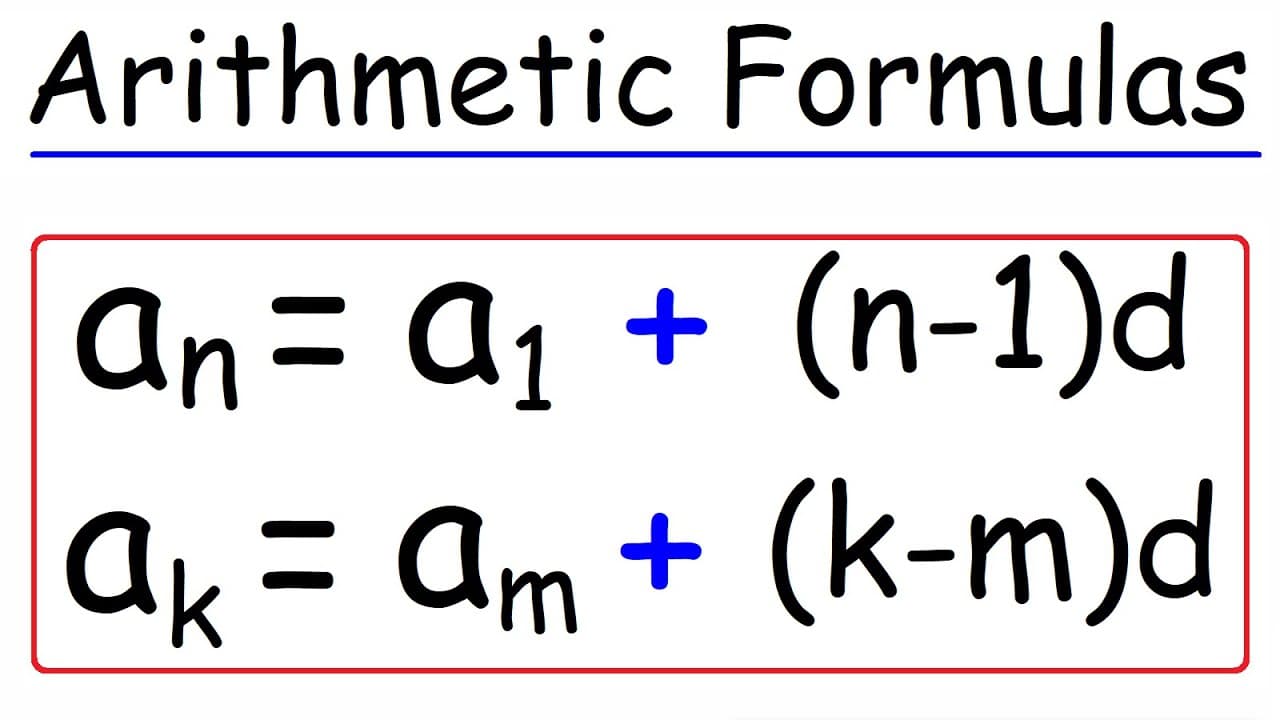
This educational video provides a comprehensive tutorial on the fundamental formulas associated with arithmetic sequences and series. The narrator begins by defining an arithmetic sequence as a list of numbers with a common difference and demonstrates how to identify patterns using specific examples. The video methodically breaks down the notation used in algebra, distinguishing between term position (n) and term value (a_n), and explains the concept of a common difference (d). The core of the video focuses on deriving and applying essential algebraic formulas. It introduces the standard nth term formula, explores variations that allow calculation from any starting term (not just the first), and explains the concept of the arithmetic mean (the average of terms). The latter part of the video shifts to arithmetic series, explaining the difference between sequences and series, and teaching how to calculate partial sums using both long-hand addition and the summation formula. This resource is highly valuable for high school algebra and pre-calculus classrooms. It clarifies common points of confusion, such as the difference between a term's value and the sum of a series up to that term. The step-by-step problem-solving approach makes it an excellent tool for introducing new concepts or reviewing for exams. Teachers can use this video to scaffold learning, moving from basic pattern recognition to complex summation notation (sigma).

The Organic Chemistry TutorThe Organic Chemistry Tutor

15mins 3s

Calculating Sums of Infinite Geometric Series

Calculating Sums of Infinite Geometric Series

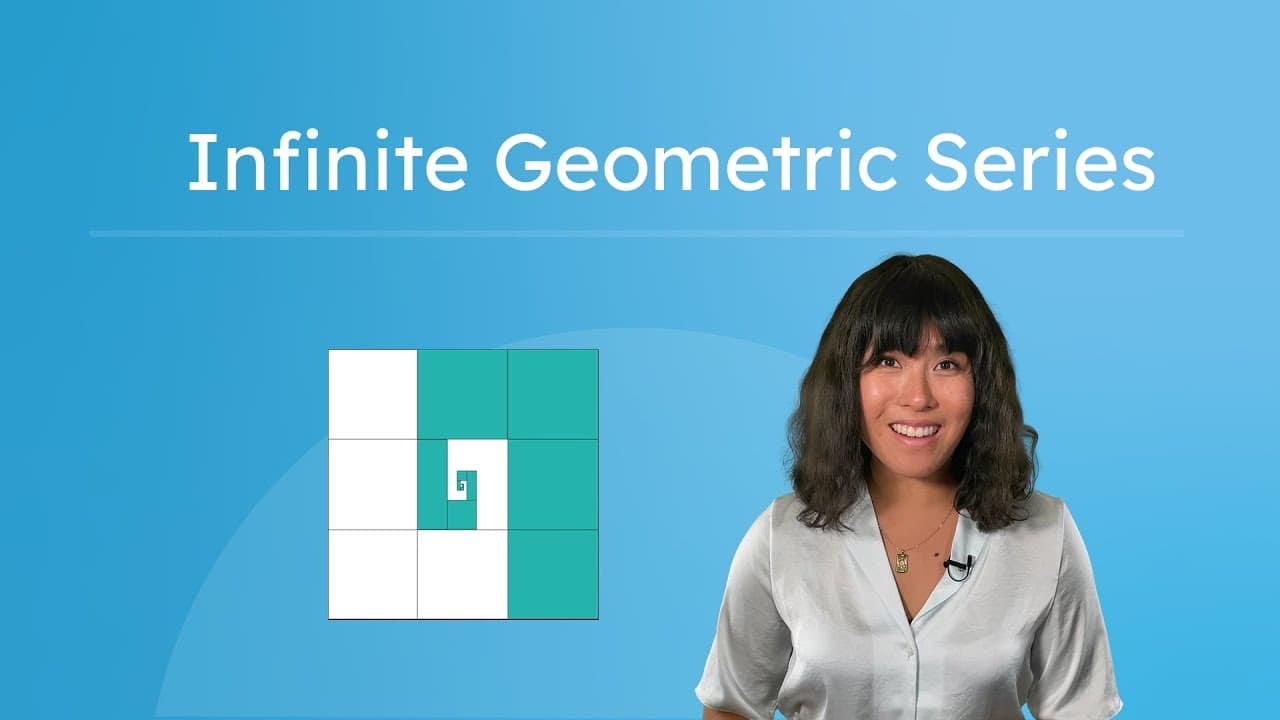
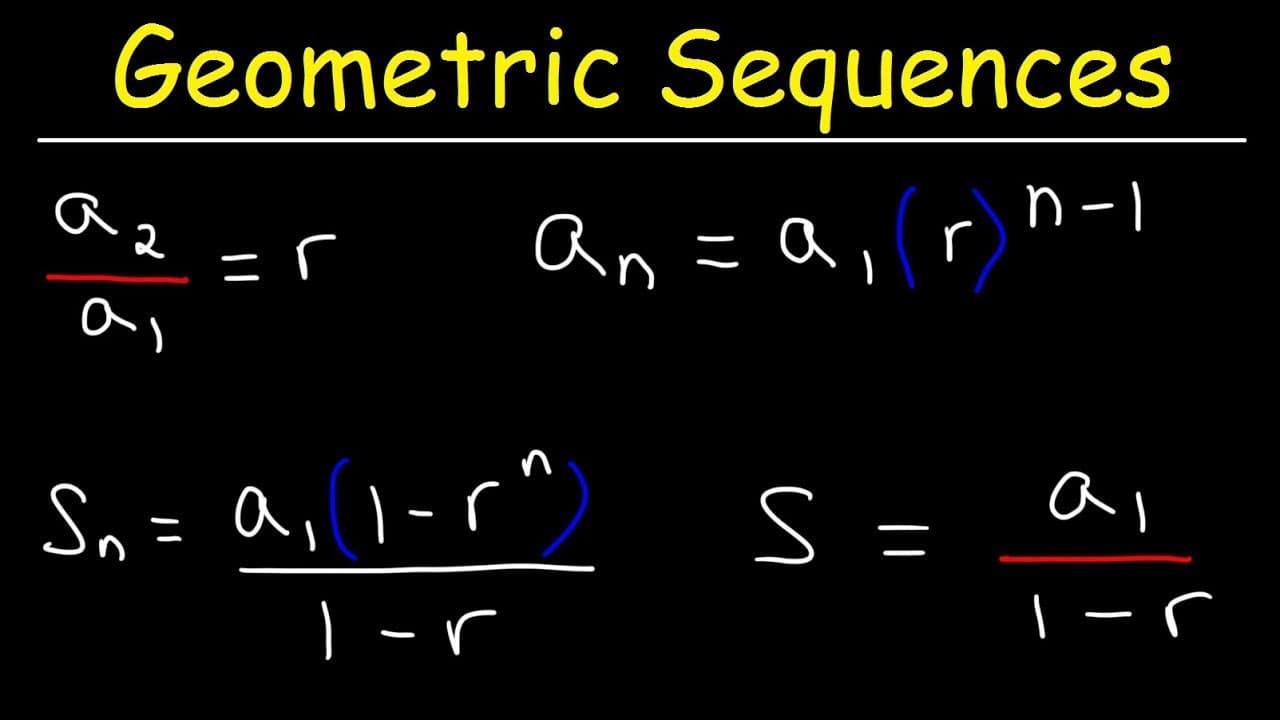
This video provides a comprehensive introduction to infinite geometric series, distinguishing between those that grow indefinitely and those that approach a specific limit. It guides students through the conceptual shift from calculating finite sums to analyzing infinite behavior, using both numerical examples and geometric visualizations to illustrate how adding infinite terms can result in a finite sum. The narration explains the critical role of the common ratio in determining the behavior of the series. The content covers key concepts including summation notation, the definitions of convergent and divergent series, and the specific conditions for the common ratio ($r$) that dictate these behaviors. It walks viewers through the derivation of the infinite geometric series formula ($S_\infty = \frac{a}{1-r}$) by applying limits to the finite series formula. The video specifically addresses the misconception that all infinite series can be summed, emphasizing the necessity of checking if the absolute value of $r$ is less than 1. For educators, this resource serves as an excellent bridge between Algebra II and Pre-Calculus concepts. It offers visual proofs of convergence using geometric shapes (fractal-like triangles and subdivided squares) which helps concrete thinkers grasp abstract limits. The included practice problems and "trap" questions—where students must identify a divergent series rather than blindly applying a formula—encourage critical thinking and procedural fluency.

Miacademy & MiaPrep Learning ChannelMiacademy & MiaPrep Learning Channel

12mins 5s

Interpreting Percent Rate of Change in Exponential Models

Interpreting Percent Rate of Change in Exponential Models

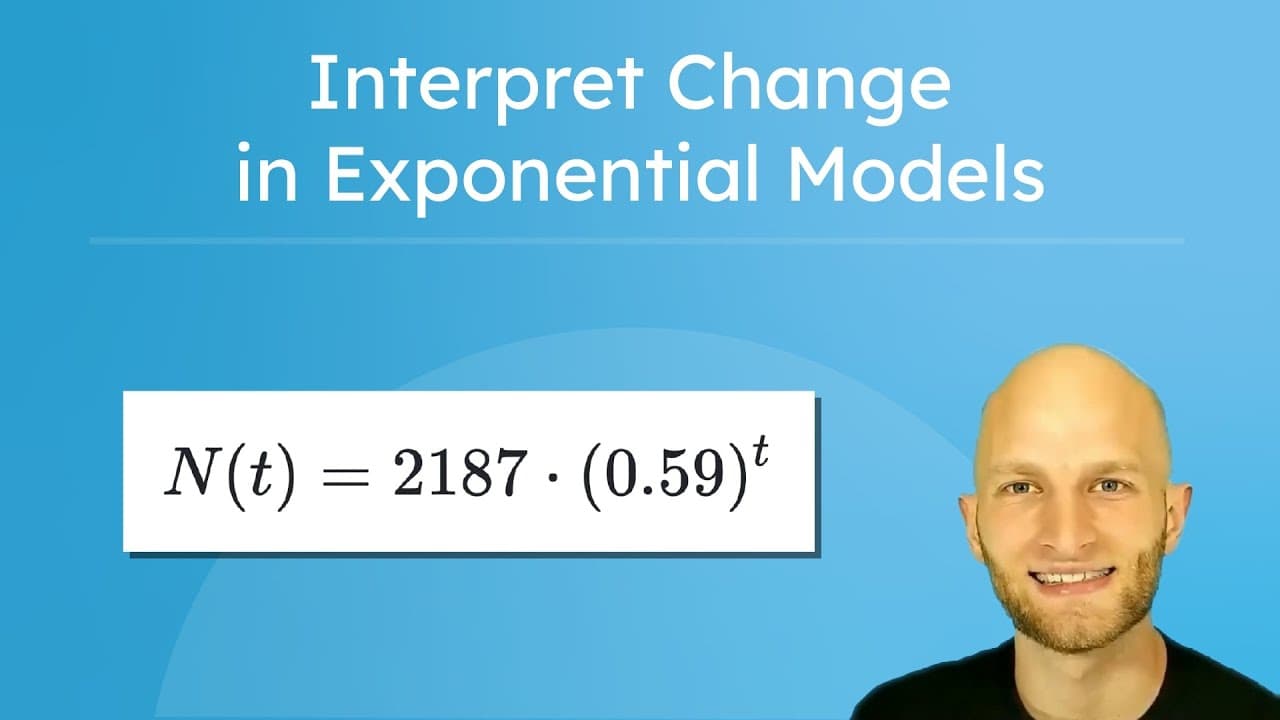
This instructional video guides students through the process of interpreting exponential models to determine percent rates of change. The presenter, Randy, breaks down two real-world scenarios—a ball's decreasing velocity and a tree's increasing branch count—to demonstrate how to extract growth and decay rates directly from exponential equations. By constructing tables of values and analyzing the mathematical patterns, the video demystifies the relationship between the base of an exponent and the percentage change it represents. The video explores key themes of exponential functions, specifically distinguishing between exponential growth and decay. It focuses heavily on understanding the base of the exponent as a factor and how it relates to the number 1 (representing 100%). Concepts covered include function notation, evaluating exponents, converting decimals to percentages, and interpreting mathematical models in practical contexts. For educators, this resource is an excellent tool for bridging the gap between abstract algebraic formulas and concrete understanding. It addresses the common student confusion between the decay factor (what remains) and the decay rate (what is lost). The step-by-step derivation of the "shortcut" method empowers students to quickly analyze equations without needing to perform repetitive calculations, making it valuable for Algebra I and Algebra II curriculums.

Miacademy & MiaPrep Learning ChannelMiacademy & MiaPrep Learning Channel

8mins 55s

How to Solve Exponential Growth Word Problems

How to Solve Exponential Growth Word Problems

This educational video serves as a practical guide to solving word problems using exponential expressions. Narrated by Justin, the lesson begins by reviewing the core components of an exponential expression—initial value, growth factor, and exponent—before diving into three distinct real-world scenarios. The video transitions from simple doubling patterns to more complex compound interest calculations and biological growth cycles, demonstrating how to construct and solve equations for each situation.

Miacademy & MiaPrep Learning ChannelMiacademy & MiaPrep Learning Channel

5mins 46s

Mastering Geometric Sequences and Series: Formulas and Examples

Mastering Geometric Sequences and Series: Formulas and Examples

This comprehensive mathematics tutorial provides a deep dive into geometric sequences and series, distinguishing them clearly from arithmetic progressions. The video systematically breaks down the core definitions, explaining how geometric sequences rely on a common ratio through multiplication or division, whereas arithmetic sequences use a common difference through addition or subtraction. It moves beyond basic identification to cover essential formulas for calculating the nth term, partial sums of finite series, and the converging sums of infinite series. A key feature of this resource is its detailed coverage of related concepts like the difference between arithmetic and geometric means, providing specific formulas and examples for calculating the 'middle term' in a sequence. The tutorial also explains how to write and interpret both explicit and recursive formulas, a common area of struggle for algebra students. The distinction between finite and infinite series is visualized, with clear rules provided for when an infinite series converges or diverges based on the absolute value of the common ratio. For educators, this video serves as an excellent instructional anchor or review tool for Algebra II and Pre-Calculus curriculums. It includes a robust set of practice problems that progress in difficulty, allowing students to apply formulas for finding specific terms, summing series, and identifying pattern types. The clear, high-contrast visual style with step-by-step narration makes it ideal for flipped classroom models, homework support, or test preparation, offering multiple natural pause points for checking student understanding.
The Organic Chemistry TutorThe Organic Chemistry Tutor

31mins 20s

Materials

Function Patterns Worksheet

Function Patterns Worksheet

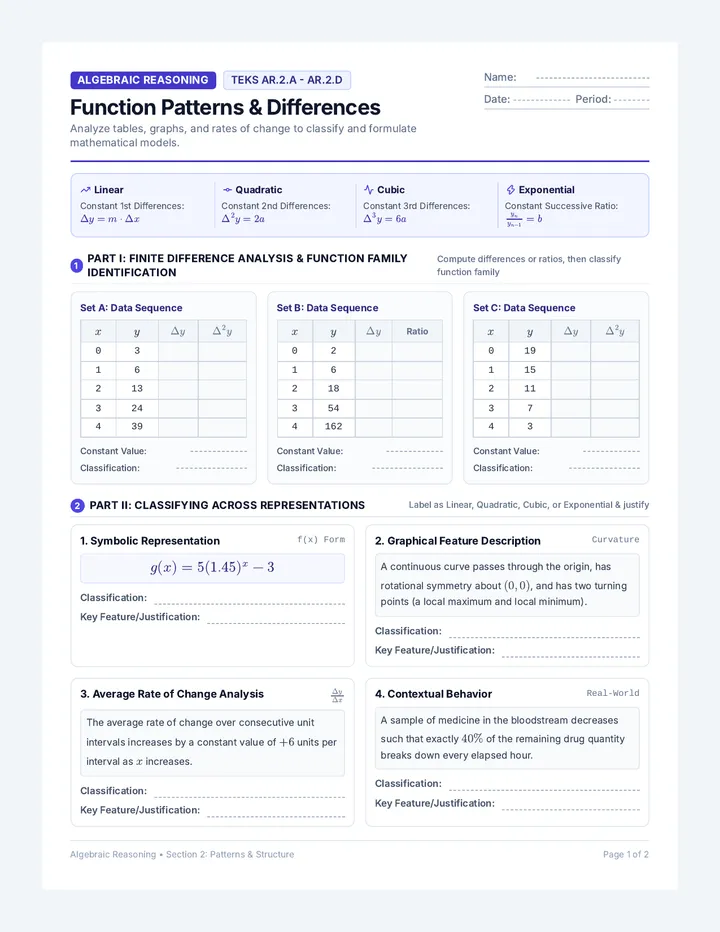
A two-page high school Algebraic Reasoning practice worksheet covering TEKS AR.2.A through AR.2.D. Includes table finite-difference calculations, function classification across representations, and step-by-step function modeling for linear, quadratic, cubic, and exponential relationships.

MR

Mahuya Roy Chowdhury

Bacteria Bloom Graphic Organizer

Bacteria Bloom Graphic Organizer

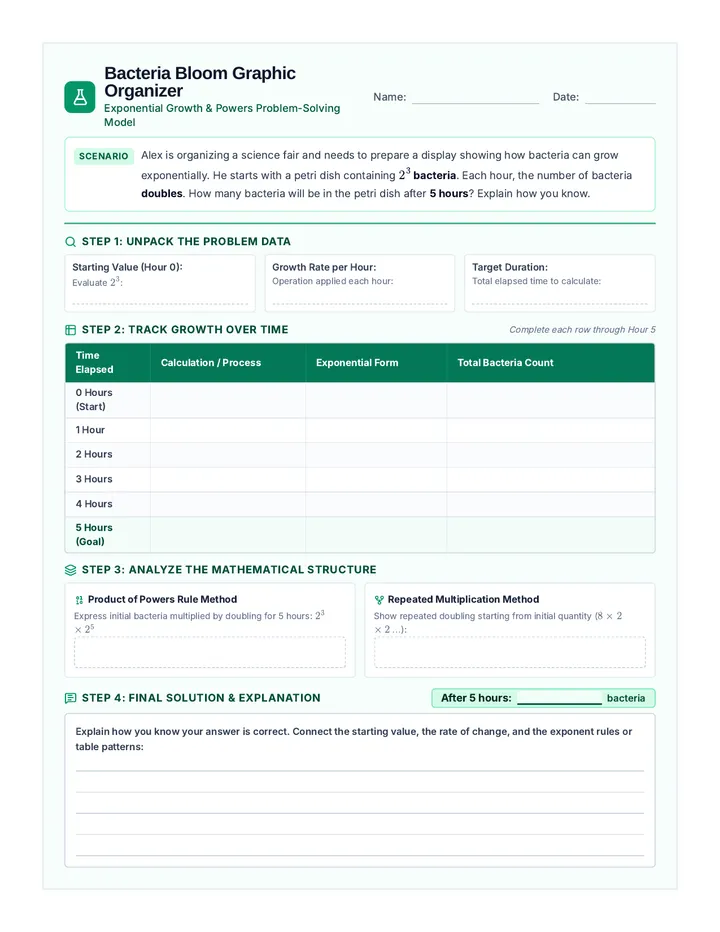
A guided graphic organizer designed to help students analyze and solve an exponential growth word problem involving doubling bacteria. Students deconstruct key information, complete a multi-step time-and-exponent tracking table from hour 0 to hour 5, explore exponent rules, and synthesize their reasoning in a structured explanation area.

CR

Candice Richardson

Pattern Power Anchor Chart

Pattern Power Anchor Chart

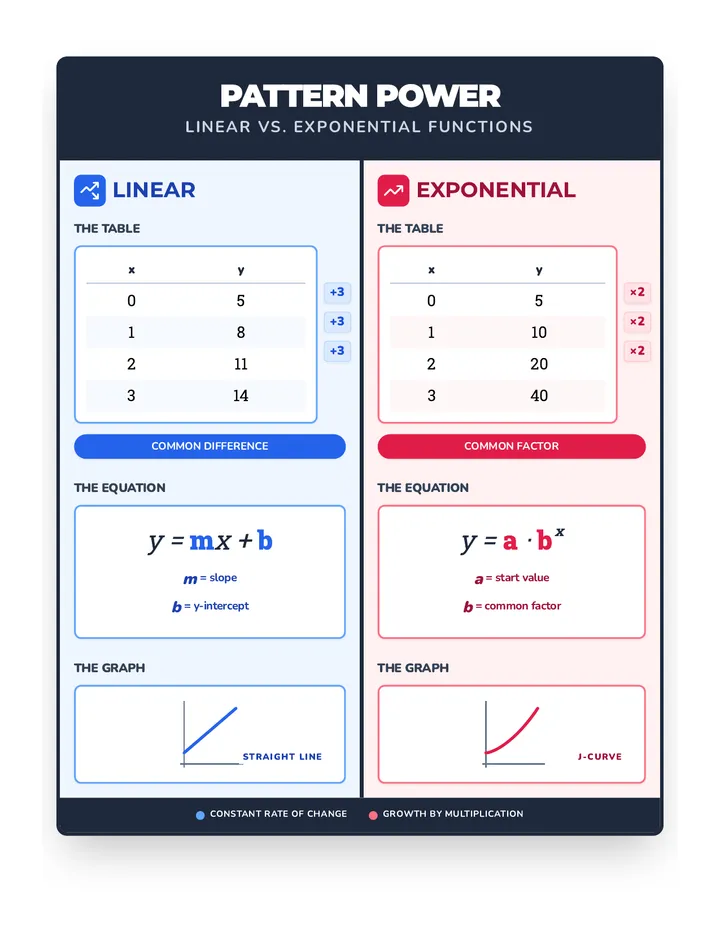
A high-contrast anchor chart comparing linear and exponential functions through annotated tables, equations, and graphs. Optimized for single-page printing as a wall poster. Updated equations to lowercase variables. Corrected graph y-intercepts to show y=5 at x=0 for both functions by using integrated SVG axes. Refined visual clarity for poster use.

Y

yucel

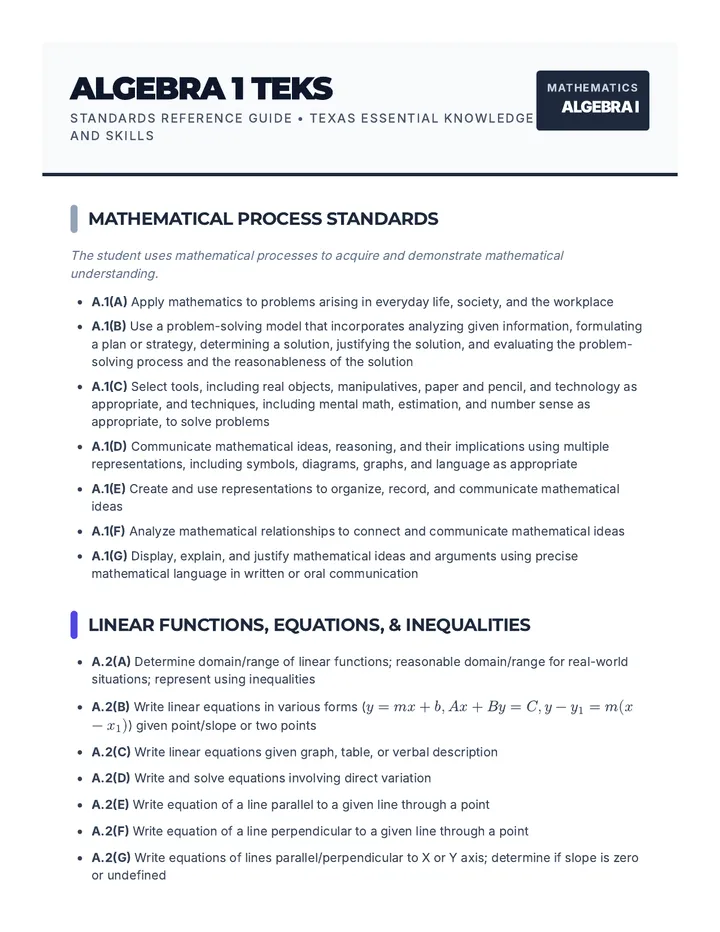
Algebra 1 TEKS Reference Guide

Algebra 1 TEKS Reference Guide

A comprehensive, formatted reference list of all Algebra 1 Texas Essential Knowledge and Skills (TEKS) organized by standard strands for teacher use. Includes Process Standards.

M

mbatey

Sequences

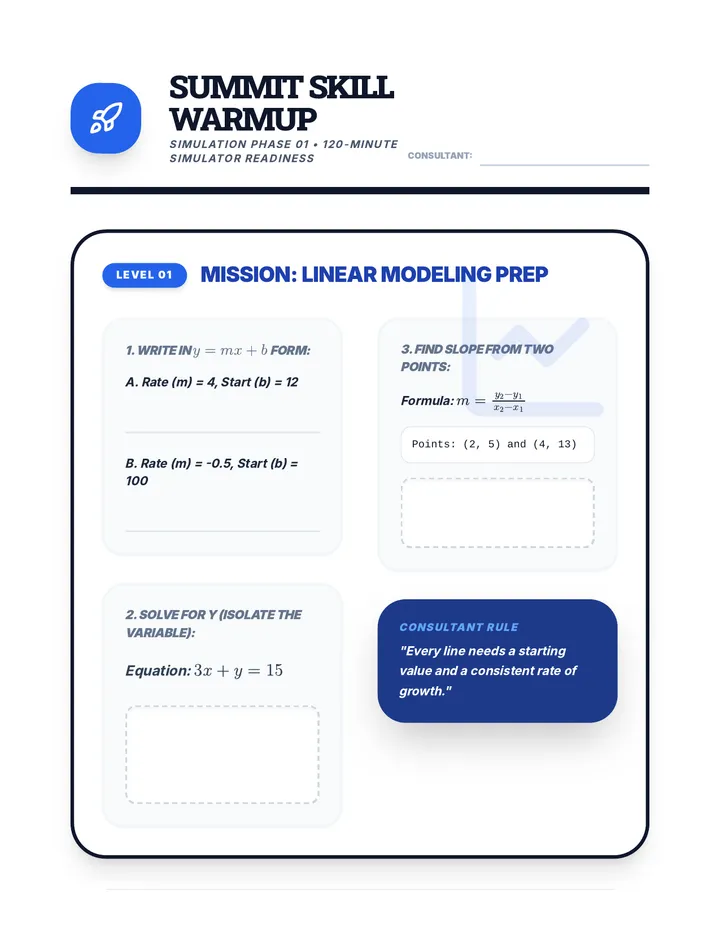
Foundation Missions Part 1 Final

Math in Motion: The 2-Hour Summit

A high-intensity, 120-minute math simulation. Students act as lead consultants, completing a high-speed skill warmup before selecting a professional sector (Music, Urban Planning, Rocket Science, or Sports Analytics) to solve a series of complex work orders.

EL

Elsa LaLone

102
Project Mission Slides Final

Math in Motion: The 2-Hour Summit

A high-intensity, 120-minute math simulation. Students act as lead consultants, completing a high-speed skill warmup before selecting a professional sector (Music, Urban Planning, Rocket Science, or Sports Analytics) to solve a series of complex work orders.

EL

Elsa LaLone

102
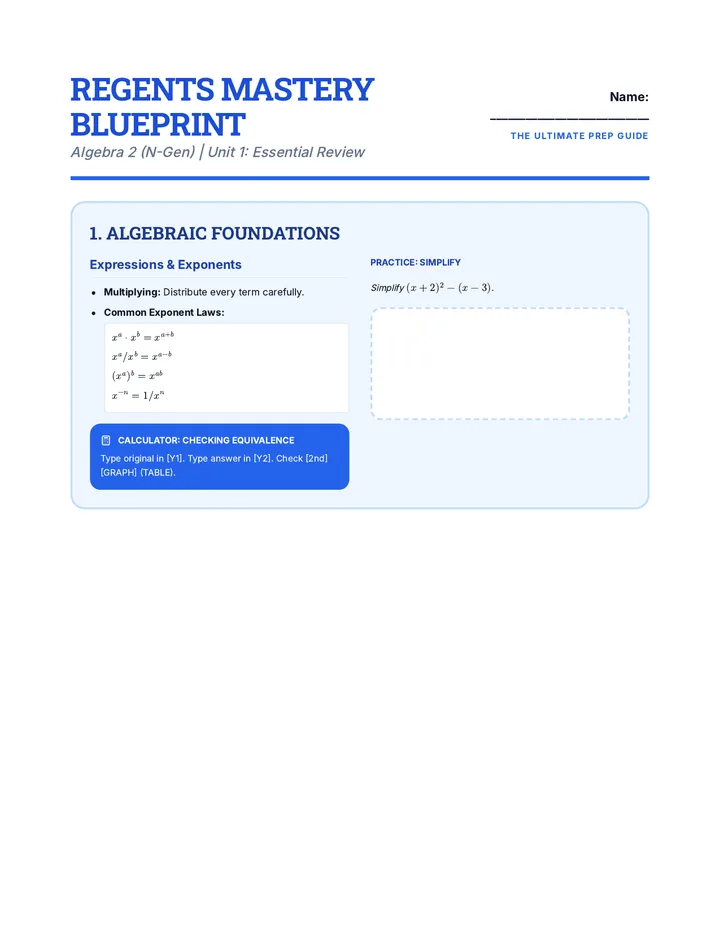
Regents Mastery Blueprint Study Guide

Regents Mastery Suite

A comprehensive review suite for the New York State Mathematics Regents exams, including Algebra 1, Geometry, and Algebra 2, featuring mastery blueprints, calculator strategies, and exam-taking tips.

KB

Kayla Borozny

15
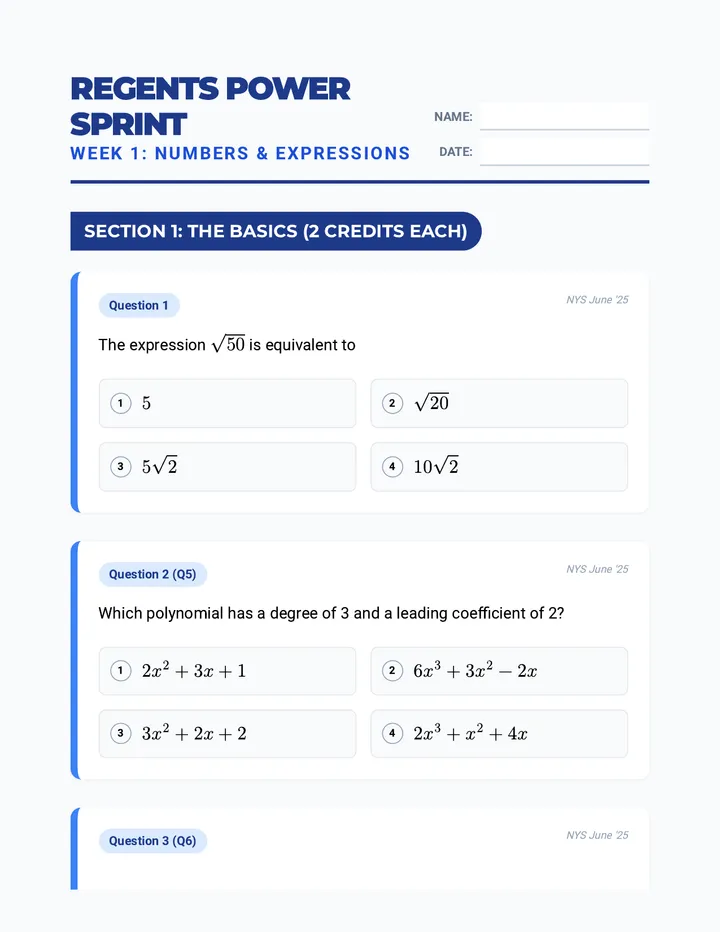
Week 1 Power Sprint Worksheet

Regents Road Map

A comprehensive 10-week preparation sequence designed to get students ready for the Algebra I Regents exam by May 15th, featuring bi-weekly 30-minute practice sessions and visual anchor charts.

L

laura.clar

31
Tile Architects Worksheet

Concept Lab Math

A specialized Tier 3 intervention sequence for 8th-grade students performing at a 5th-grade level, focusing on bridging foundational arithmetic to high school algebra concepts. This sequence uses concrete-representational-abstract (CRA) methods to explore area modeling, systems of equations, exponential patterns, and inequalities.

A

achurchill

6
Day 1 Grid Map Worksheet

Graphing Navigator

A comprehensive 5-day self-paced packet for remedial Algebra 1 students focusing on the fundamentals of graphing, from basic coordinate planes to finding slope.

KC

Kris Coyne

6

Lessons

Blueprint Lesson Plan

Shortcut to the Graph

A 65-minute lesson for 9th-grade students on graphing linear equations efficiently using slope-intercept form (y = mx + b). Students move from the tedious method of tables to the 'shortcut' of using the y-intercept and slope as a blueprint for their lines.

KC

Kris Coyne

5
Algebra 1 Formula Sheet

Algebra 1 Assessment

A comprehensive final assessment for Algebra 1 covering linear equations, systems, exponents, polynomials, and quadratic functions. Includes free response and graphing sections to evaluate deep understanding.

JF

Jim Fusaro

3
Interest Blueprint Notes

Interest Architect

A guided exploration of discrete and continuous compound interest formulas through visual organizers and structured notes.

CK

Cheydon Krysl

4
Project Choice Menu

Math Masterpieces Project

A creative end-of-year project where students choose between two paths to demonstrate mastery of transformations, linear equations, and patterns/sequences. Designed with scaffolded options for 8th-grade students.

JS

Jennifer Stevens

4
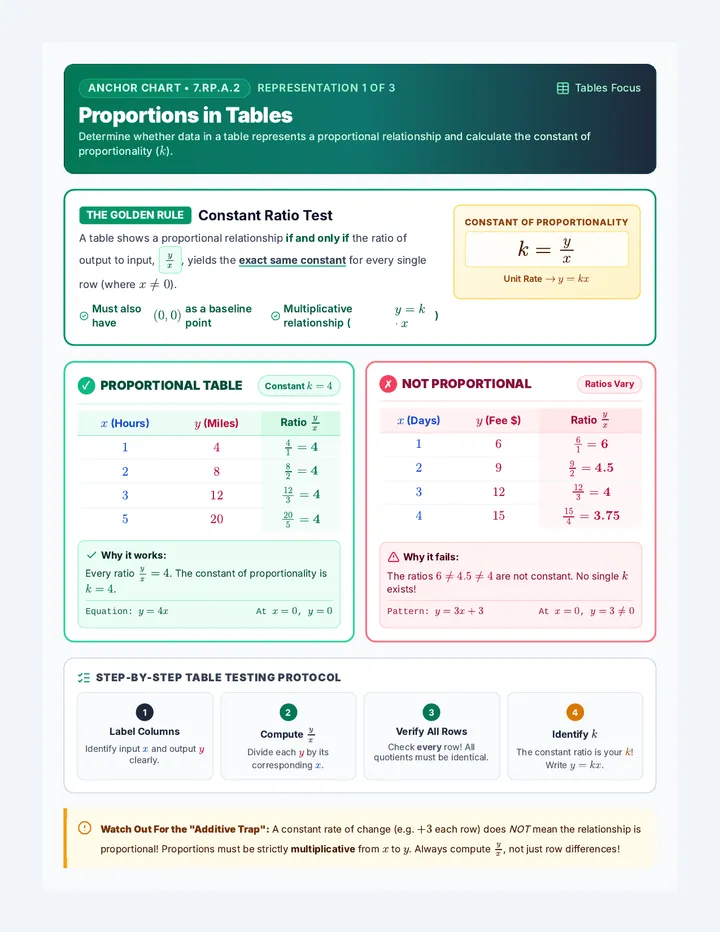
Table Proportions Anchor Chart

Proportion Playbook

A high-impact middle school math lesson focused on identifying proportional relationships across multiple representations. Students learn definitive tests and methods to extract the constant of proportionality from tables, graphs, and equations.

R

rgood

3
Growth Lab Notes Worksheet

Growth Lab

A lesson exploring the mathematics of exponential growth and decay through real-world scenarios, focusing on formula mastery and percentage-to-decimal conversion.

CK

Cheydon Krysl

2