Blueprint Lesson Plan Blueprint Lesson Plan
Shortcut to the Graph: Slope-Intercept Form
Subject: Algebra I
Grade: 9th
Duration: 65 Minutes
Learning Objectives
• Identify the slope (\(m\)) and y-intercept (\(b\)) from a linear equation in slope-intercept form (\(y = mx + b\)).
• Graph a linear equation by starting at the y-intercept and using the slope to plot subsequent points.
• Explain why \(y = mx + b\) is a more efficient graphing tool than a table of values.
Materials Needed
Blueprint Slide Deck
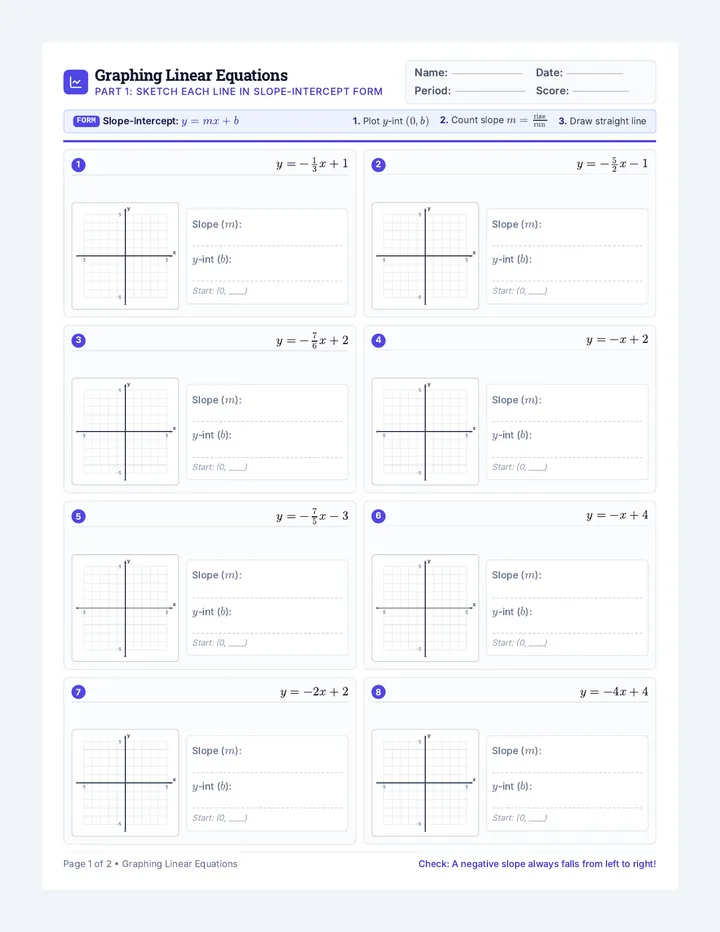
Graphing with \(y = mx + b\) Worksheet
Blueprint Art Activity (Colored Pencils/Rulers)
Exit Ticket
Instructional Timeline
00-05
Hook: The Long Way vs. The Shortcut
Challenge students to graph \(y = 2x - 3\) using a table of values. Time them for 60 seconds. Then, reveal that there's a 5-second method.
05-20
Direct Instruction: Decoding the Blueprint
Introduce \(y = mx + b\). Define \(b\) as the "Beginning" (y-intercept) and \(m\) as the "Movement" (slope). Demonstrate graphing 3 examples of increasing complexity.
20-35
Guided Practice: Construction Site
Students follow along on their worksheet as the teacher models finding the "Starting Point" and the "Path". Use the "Think-Pair-Share" method for the last two examples.
35-55
Independent Practice: Blueprint Art
Students complete the "Blueprint Art" activity, graphing multiple lines to create a geometric design. This reinforces precision and multiple slope types (positive, negative, whole number, fraction).
55-65
Wrap-up & Assessment
Discussion on why the "Shortcut" works and when a table might still be useful. Administer the Exit Ticket.
Key Teacher Moves
Checking for Understanding (CFU)
During direct instruction, ask: "If \(b\) is 5, where is my first dot exactly?" and "If the slope is \(-3\), do I go up or down? How many over?" Look for students who forget that whole numbers like 3 should be treated as \(\frac{3}{1}\).
Common Misconceptions
Mixing up \(x\) and \(y\): Students often plot the y-intercept on the x-axis. Emphasize "y-intercept lives on the y-axis."Slope as a point: Students might try to plot the slope as a coordinate (e.g., if \(m=2\), they plot \((2,2)\)). Use the "Move, don't land" analogy.Negative Sign Placement: Students may apply a negative to both rise and run. Remind them: "One negative means one change in direction (down OR left, usually down then right)."
Differentiation Strategies
Scaffolding (For Struggling Learners)
Provide a "Graphing GPS" sticky note for their desk:
Extension (For Advanced Learners)
Challenge students to graph equations not in slope-intercept form (e.g., \(2x + y = 5\)) by rearranging them first. Have them create a line that must pass through a specific "secret point" on the grid.
"Precision is the foundation of any great structure." - The Blueprint Method
Blueprint Graphing Worksheet v4.0 Blueprint Practice
Project: Graphing \(y = mx + b\)
Engineer:
Date:
The Formula
\(y = mx + b\)
Step 1: Beginning
b = Y-Intercept
Step 2: Movement
m = Rise / Run
Guided Practice: Building Together
1. \(y = 2x - 1\)
Whole Number
Beginning (\(b\)):
Movement (\(m\)):
2. \(y = \frac{1}{2}x + 3\)
Fractional
Beginning (\(b\)):
Movement (\(m\)):
Independent Practice: Site Inspection
3. \(y = -3x + 4\)
4. \(y = \frac{2}{3}x - 5\)
5. \(y = x + 2\)
Hint: What is the "invisible" slope?
6. \(y = -4x + 0\)
Challenge: Rearrange the Blueprint
Graph the equation \(2x + y = 3\) by solving for y first. Show your work in the drafting space provided.
Blueprint Art Activity v4.0 Blueprint Art
Project: Geometric Intersections
ENGINEER:
DATE:
The Mission
Graph each equation precisely on the grid. Extend your lines to the edges. Once finished, use colored pencils to shade the shapes created by the overlaps.
Construction List
1. \(y = \frac{1}{2}x + 4\)
2. \(y = -2x - 3\)
3. \(y = 3x - 6\)
4. \(y = -\frac{1}{3}x + 2\)
5. \(y = -5\)
6. \(y = -x + 8\)
Pro Tip: Use a ruler for perfectly straight intersections! Precision is key to a professional blueprint result.
x
y
COORDINATE RANGE: [-10, 10]
PRECISION DRAFTING METHOD v4.0
Blueprint Slides Project: Algebra I
Shortcut to
The Graph
"Why build the whole table when you have the blueprint?"
The "Old" Way
Graphing \(y = 2x - 3\)
Time: 60+ Seconds
The Shortcut
No tables.
Master Blueprint
y = m x + b
Slope
The MOVEMENT
Y-Intercept
The BEGINNING
STEP 01
Find the "Beginning"
The b value is your Y-Intercept.
"Where does the line cross the center vertical pole (Y-axis)?"
Start Here!
m = \(\frac{\text{Rise}}{\text{Run}}\)
Up / Down
Always Right
STEP 02
Make your "Move"
The m value tells you how to get to the next point.
"If slope is a whole number, put it over 1!"
Construction Example #1
\(y = 2x - 3\)
The Beginning
b = -3
Plot at (0, -3)
The Movement
m = \(\frac{2}{1}\)
Up 2, Right 1
The Result
Connect the dots
Pro Tip: Fractional Slopes
Fractions are actually easier because they already give you the Rise and Run!
\(y = \frac{1}{3}x + 2\)
Start at +2
Go Up 1, Right 3
Warning: Negative Slopes
When the slope is negative, you Fall instead of Rise.
\(y = -2x + 4\)
Down 2, Right 1
Line goes DOWN
Your Turn
Grab your "Blueprint Graphing Worksheet".
Blueprint Art Phase
1
Graph all 6 equations on your art template.
2
Use a ruler for perfectly straight edges.
3
Blueprint Exit Ticket v4.0 Exit Ticket: Blueprint Check
Project: Shortcut to the Graph
NAME: ______________________
DATE: _______________________
1. Analyze the Blueprint:
\(y = -\frac{2}{3}x + 1\)
Slope (m):
Y-Intercept (b):
2. Efficiency Reflection:
Why is using \(y = mx + b\) more efficient than building a table of values?
3. Execute the Graph:
Precision Drafting Space
Exit Ticket: Blueprint Check
Project: Shortcut to the Graph
NAME: ______________________
DATE: _______________________
1. Analyze the Blueprint:
\(y = -\frac{2}{3}x + 1\)
Slope (m):
Y-Intercept (b):
2. Efficiency Reflection:
Why is using \(y = mx + b\) more efficient than building a table of values?
3. Execute the Graph:
Precision Drafting Space