Lenny.com
Explore
Create
ActivitiesNewMathEnglish Language ArtsScience & EngineeringSocial StudiesGlobal LanguagesHealth & Physical EducationSpecial EducationCounseling & Life SkillsArts & CreativityESL
Lenny.com
Lenny.com
Explore
Create
ActivitiesNewMathEnglish Language ArtsScience & EngineeringSocial StudiesGlobal LanguagesHealth & Physical EducationSpecial EducationCounseling & Life SkillsArts & CreativityESL
Lenny.com
Lenny.com

Solutions

Lenny for EducatorsLenny for SchoolsLenny for Districts

Product

ExploreSign inCreateSupportAbout

Resources

Getting startedMTSS Acceleration Program

© 2026 Lenny Learning Inc.

TermsPrivacyAccessibility
LinkedInInstagramX
Lenny

Adding and Subtracting Fractions

Calculation methods for fractions with like and unlike denominators using least common multiples. Covers regrouping with mixed numbers and simplifying final sums and differences.

MathNumbers & CountingCounting ObjectsNumber NamesComparing NumbersNumber OperationsCounting SequenceNumbers 0-10Place Value Understanding and SystemAdd and Subtract Within 20Addition and Subtraction ConceptsAddition and Subtraction EquationsAddition and Subtraction ProblemsFoundations for MultiplicationMultiplication and Division PropertiesMultiply and Divide Within 100Multiplication and Division ProblemsFactors and MultiplesProperties of OperationsPatterns and RelationshipsGenerate and Analyze PatternsMulti-Digit ArithmeticPlace Value OperationsMulti-Digit and Decimal OperationsNumerical ExpressionsFour Operations and PatternsFour Operations Problem SolvingMeasurement & DataMeasurable AttributesMeasuring LengthsMeasure and Estimate Lengths in Standard UnitsRelate Addition and Subtraction to LengthClassifying and Counting ObjectsTime and MoneyArea Concepts and MeasurementPerimeter and Area MeasuresAngle Concepts and MeasurementTime, Volume, and MassMeasurement Unit ConversionsGeometryIdentifying ShapesShapes and AttributesShape Attributes and ReasoningShapes and CompositionClassifying 2D FiguresGeometric Figures and RelationshipsLines, Angles, and ShapesAngle, Area, and VolumeGeometric MeasurementVolume of 3D ShapesCoordinate Plane ApplicationsTransformations in the PlaneCongruence and SimilarityUnderstand congruence in terms of rigid motionsSimilarity and TransformationsProve Theorems Involving SimilarityPythagorean TheoremTrigonometry for General TrianglesMake Geometric ConstructionsProve Geometric TheoremsTheorems About CirclesFind Arc Lengths And Areas of Sectors of CirclesVolume FormulasRelationships Between Two-Dimensional and Three-Dimensional ObjectsProve Simple Geometric Theorems AlgebraicallyTranslate Between Geometric Description and Equation for Conic SectionApply Geometric Concepts in Modeling SituationsFractions & DecimalsFractions as NumbersBuilding FractionsFraction Equivalence and OrderingAdding and Subtracting FractionsMultiplying and Dividing FractionsDividing FractionsDecimal FractionsMulti-Digit Computation and FactorsAdd, Subtract, Multiply, and Divide Rational NumbersRational Number SystemIrrational Numbers and ApproximationsRatiosRatios and ProportionsProportional RelationshipsUnit RateAlgebraAlgebraic ExpressionsGenerate Equivalent ExpressionsQuantitative RelationshipsProportional Relationships and Linear EquationsEquations and InequalitiesEquation Solving and ReasoningLinear Equations and SystemsGraph Equations and InequalitiesSystems of EquationsReal-World Algebraic ProblemsQuantitative Reasoning with UnitsExpression StructureEquivalent Expression FormsRadicals and Integer ExponentsRational ExponentsRational and Irrational NumbersPolynomial OperationsPolynomial IdentitiesPolynomial Zeros and FactorsRational ExpressionsComplex Number OperationsComplex Numbers in PolynomialsComplex Numbers on PlaneStatistics & ProbabilityRepresent and Interpret DataData DistributionsStatistical VariabilityProbability ModelsCompound Event ProbabilitiesStatistical SamplingInterpret Categorical and Quantitative DataBivariate Data PatternsInterpret Linear ModelsComparing Two PopulationsRandom Processes in StatisticsIndependence and Conditional ProbabilityExpected ValuesProbability-Based Decision MakingStatistical Inference and ConclusionsFunctionsFunction Concepts and NotationDefine and Compare FunctionsInterpret Functions in ContextAnalyze Function RepresentationsModel Relationships with FunctionsIdentify Linear vs Exponential GrowthDistinguish Between Function TypesCompare Growth RatesInterpret Function ExpressionsBuild Functions from RelationshipsConstruct and Model FunctionsTransform and Combine FunctionsModel Comparison and SelectionSolve Exponential EquationsTrigonometryTrigonometric Ratios Involving Right TrianglesTrigonometric Functions and Unit CircleModel with Trigonometric FunctionsTrigonometric IdentitiesVectors & MatricesIntroduction to Vectors and MatricesVector QuantitiesVector OperationsMatrix OperationsCalculusLimits and ContinuityDerivative Concepts and NotationDerivative Rules and TechniquesApplications of DerivativesOptimization ProblemsRelated RatesCurve Sketching and AnalysisIntegration Concepts and NotationAntiderivatives and Indefinite IntegralsDefinite Integrals and AreaFundamental Theorem of CalculusIntegration TechniquesApplications of IntegrationDifferential EquationsSequences and SeriesParametric and Polar FunctionsVector-Valued Functions

Videos

Adding and Subtracting Fractions with Unlike Denominators

Adding and Subtracting Fractions with Unlike Denominators

This engaging animated music video teaches students the step-by-step process of adding and subtracting fractions with unlike denominators. Through a catchy hip-hop song set in "Tomorrow's Pizzeria," the video introduces key concepts such as finding the Least Common Multiple (LCM), creating equivalent fractions, and simplifying the final answer. The visual narrative uses pizza slices to represent fractional parts, making abstract numerical concepts concrete and relatable. The content specifically focuses on the procedural algorithm for solving fraction problems where denominators do not match. It demonstrates three distinct examples: subtraction (3/6 - 1/4), addition (2/4 + 1/5), and another subtraction problem (5/6 - 1/3). For each example, the video explicitly models listing multiples to find the LCM/LCD, converting the fractions, performing the operation on the numerators, and simplifying the result. This video is an excellent classroom resource for introducing or reviewing fraction operations. The musical format helps with memory retention of the steps ("Find the LCM, Make equivalent fractions, Add/Subtract, Simplify"). Teachers can use it to anchor a lesson on finding common denominators, as a remediation tool for struggling students, or as a fun transition activity that reinforces vocabulary like "numerator," "denominator," and "equivalent."
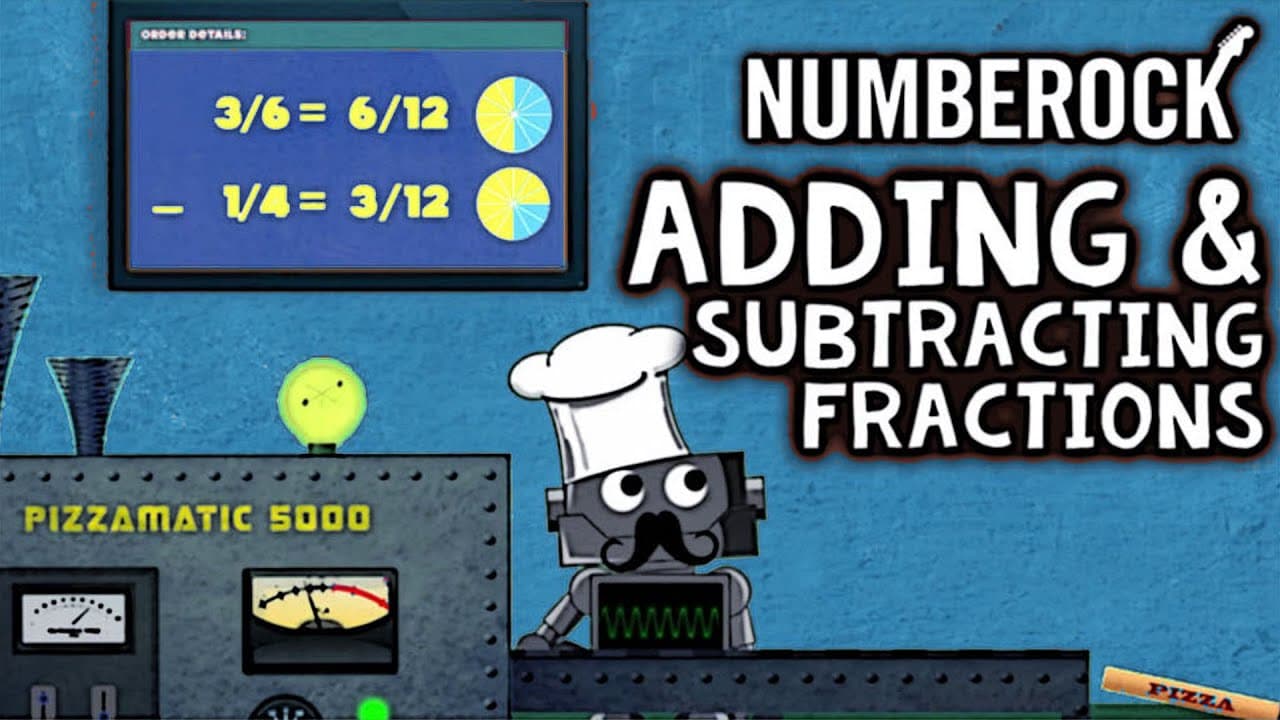
Math Songs by NUMBEROCKMath Songs by NUMBEROCK

2mins 39s

Solving Word Problems by Adding Fractions with Unlike Denominators

Solving Word Problems by Adding Fractions with Unlike Denominators

This instructional math video guides students through the process of solving word problems that require adding fractions with unlike denominators. Hosted by "Math with Mr. J," the video breaks down two distinct real-world scenarios: calculating spending habits and tracking reading progress. For each problem, the instructor demonstrates how to identify the correct operation, set up the equation, find a common denominator to rename fractions, and perform the addition to find the total amount.

Math with Mr. JMath with Mr. J

5mins 3s

How to Add and Subtract Fractions with Different Denominators

How to Add and Subtract Fractions with Different Denominators

This educational video provides a clear, step-by-step guide to adding and subtracting fractions with unlike denominators. Using a relatable visual analogy of sharing chocolate bars, the presenter demonstrates why fractions must have the same denominator before they can be combined. The video transitions from concrete visual models to the abstract mathematical procedure of finding equivalent fractions to create a common denominator. Key themes explored include the necessity of common denominators, the concept of equivalent fractions, and the mathematical property of identity (multiplying by 1). The video addresses the common misconception that numerators and denominators can simply be added straight across, explaining visually why this approach fails. It covers both addition and subtraction scenarios, offering a consistent method for solving both types of problems. For educators, this video serves as an excellent bridge between visual conceptualization and procedural fluency. It effectively answers the "why" behind the algorithm, making it a powerful tool for introducing the topic to 5th graders or reviewing it with 6th graders. The visual demonstration using area models helps students grasp the relative size of fractional parts, supporting deeper conceptual understanding before they move on to rote calculation.

Miacademy & MiaPrep Learning ChannelMiacademy & MiaPrep Learning Channel

4mins 17s

Mastering Fraction Operations: From Basics to Mixed Numbers

Mastering Fraction Operations: From Basics to Mixed Numbers

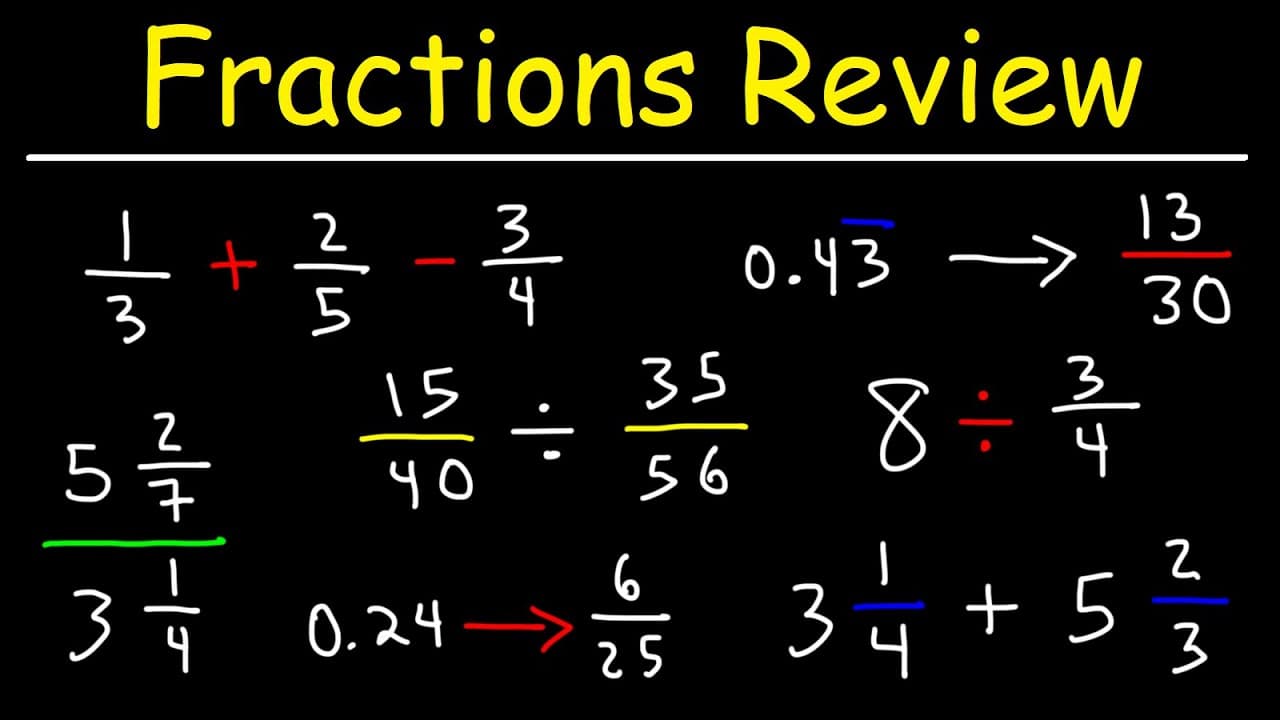
This comprehensive math tutorial provides a thorough review of fraction operations, covering everything from basic addition and subtraction to complex mixed number calculations. The video systematically progresses through concepts, starting with adding fractions with like denominators and moving to finding least common multiples for unlike denominators. It demonstrates key techniques such as simplifying fractions, cross-canceling during multiplication, and the "keep-change-flip" method for division. The tutorial also bridges the gap between different number forms, showing students how to convert between improper fractions and mixed numbers, as well as how to translate fractions into decimals and percentages. Special attention is given to more advanced topics like operations with mixed numbers requiring borrowing/regrouping and converting repeating decimals into fractions. Teachers can use this video as a modular resource, assigning specific segments to students based on their needs. It is excellent for introducing new concepts, providing remediation for struggling learners, or serving as a comprehensive review before standardized tests. The clear, step-by-step visual walkthroughs make complex arithmetic procedures accessible and easier to understand.

The Organic Chemistry TutorThe Organic Chemistry Tutor

11mins 53s

Adding Fractions with Sums Greater Than One

Adding Fractions with Sums Greater Than One

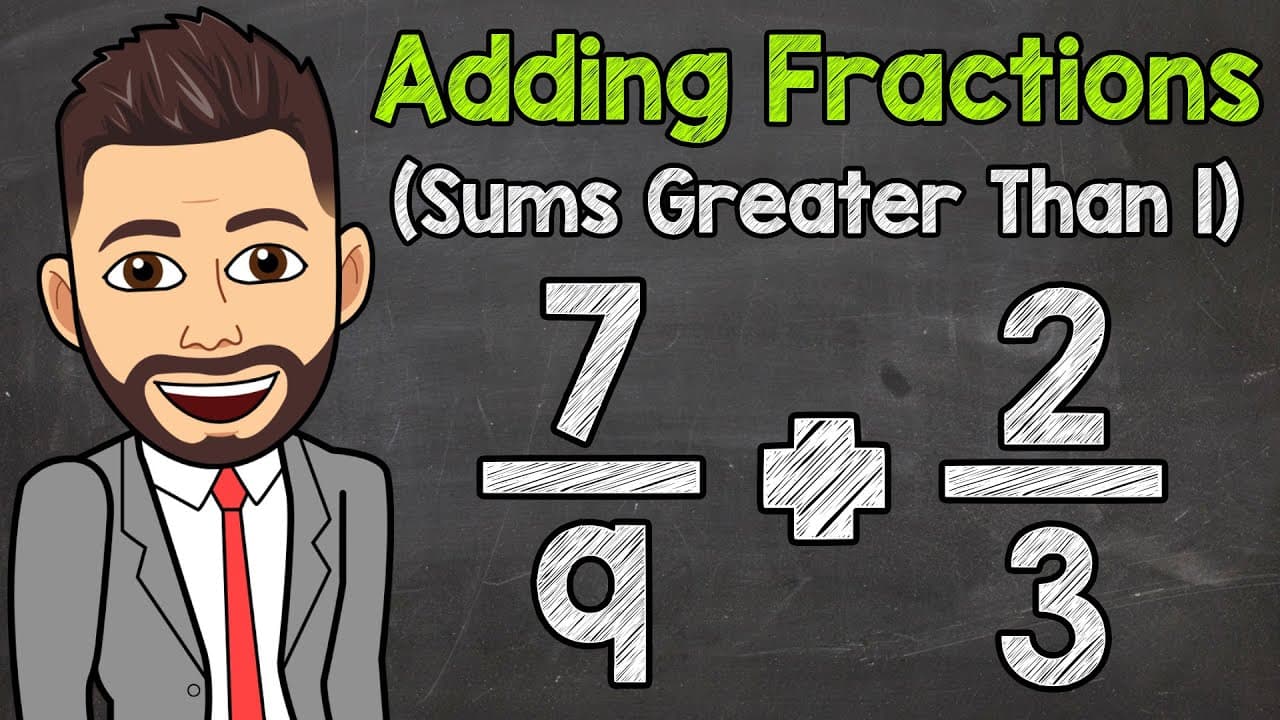
In this clear and methodical math tutorial, Mr. J demonstrates how to add fractions with unlike denominators that result in sums greater than one whole. The video addresses the specific scenario where adding fractions produces an improper fraction (where the numerator is larger than the denominator) and guides viewers through the necessary steps to convert that answer into a mixed number. The visual style simulates a chalkboard, making it easy for students to follow the step-by-step written calculations. The video explores several key mathematical themes, including finding the Least Common Denominator (LCD), renaming fractions to create equivalent fractions, adding numerators while keeping denominators constant, and converting improper fractions to mixed numbers using division. Mr. J works through two distinct examples—$7/9 + 2/3$ and $4/5 + 3/4$—providing a repetitive structure that reinforces the procedural algorithm required for solving these problems. This resource is highly valuable for 5th and 6th-grade classrooms as it explicitly models the entire workflow of fraction addition, from setup to simplification. It is excellent for introducing the concept of sums greater than one, reviewing prerequisite skills like finding equivalent fractions, or as a remediation tool for students struggling with the multi-step process. Teachers can use this video to scaffold instruction, allowing students to see the logic behind why we convert improper fractions and how division relates to that process.

Math with Mr. JMath with Mr. J

6mins 11s

How to Subtract Fractions with Different Denominators

How to Subtract Fractions with Different Denominators

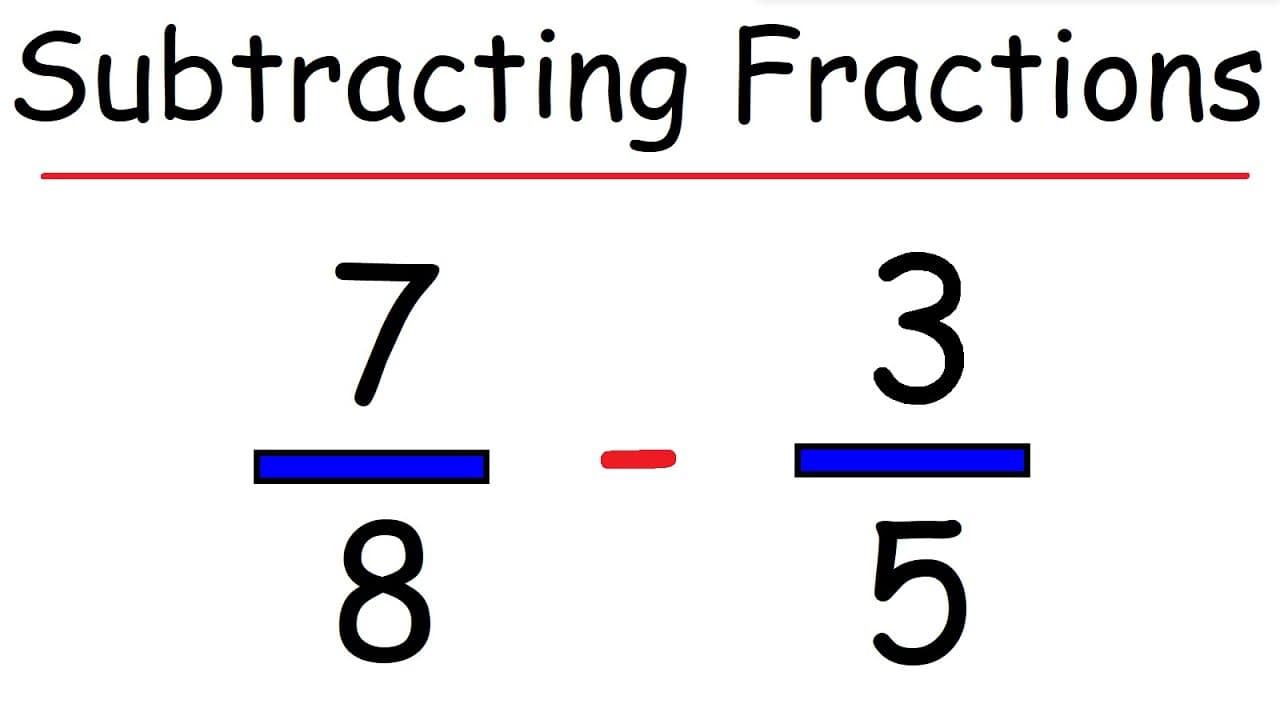
This instructional video provides a clear, step-by-step tutorial on how to subtract fractions with unlike denominators. The narrator demonstrates the process using two specific examples: 7/8 minus 3/5 and 4/9 minus 1/7. The core method taught involves finding a common denominator by multiplying the two existing denominators together, rather than searching for the Least Common Multiple (LCM), ensuring a straightforward algorithmic approach for students. The video explores key mathematical themes including finding common denominators, creating equivalent fractions, and performing subtraction with numerators. It visually emphasizes the mechanics of cross-multiplying to adjust the numerators while keeping the denominators consistent. The digital whiteboard format allows viewers to follow the handwriting in real-time, making the abstract steps concrete and followable. For educators, this video serves as an excellent direct instruction tool or a review resource for students struggling with fraction operations. It eliminates the initial hurdle of finding the LCM, allowing students to focus on the process of converting fractions and subtracting them. It is particularly useful for 5th and 6th-grade math classrooms where operations with rational numbers are a primary focus.

The Organic Chemistry TutorThe Organic Chemistry Tutor

2mins 23s

Materials

Rational Rules Reference Sheet

Rational Rules Reference Sheet

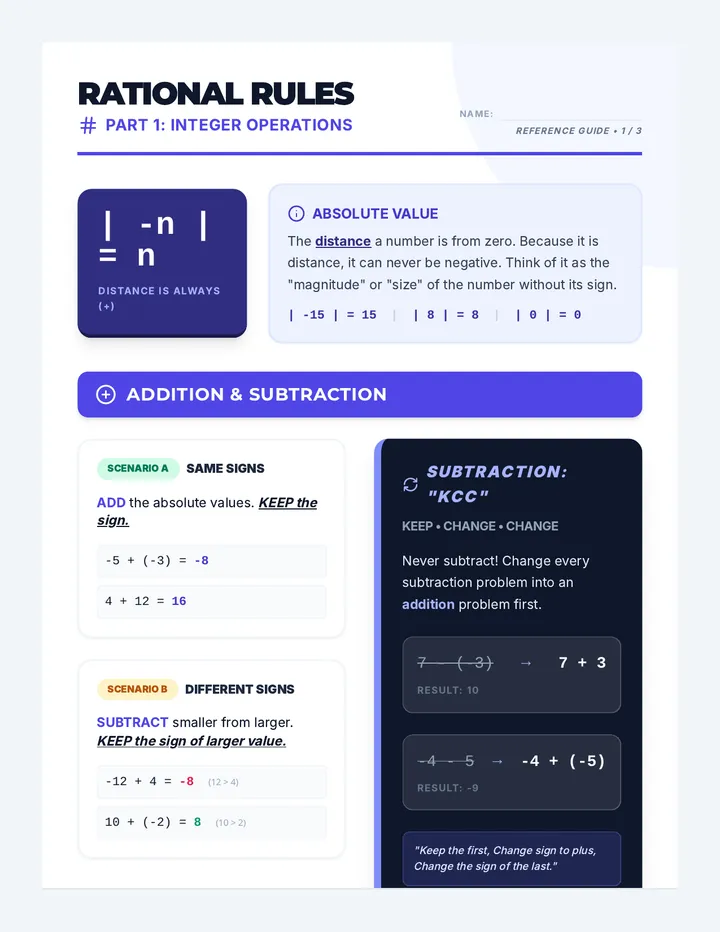
A redesigned three-page reference sheet for rational number operations. Page one focuses on integer rules with absolute value, addition, subtraction (KCC), and multiplication/division sign tricks. Page two covers decimals with detailed guides on lining up dots, counting places for multiplication, and the 'Top in the Box' method for division. Page three masters fractions with common denominators, the KCF method, mixed-to-improper conversion (MAD), and a table of common conversions, ending with a logical 'Reality Check' section.

WM

Will M

Grade 4 Math Priority Pacing Guide

Grade 4 Math Priority Pacing Guide

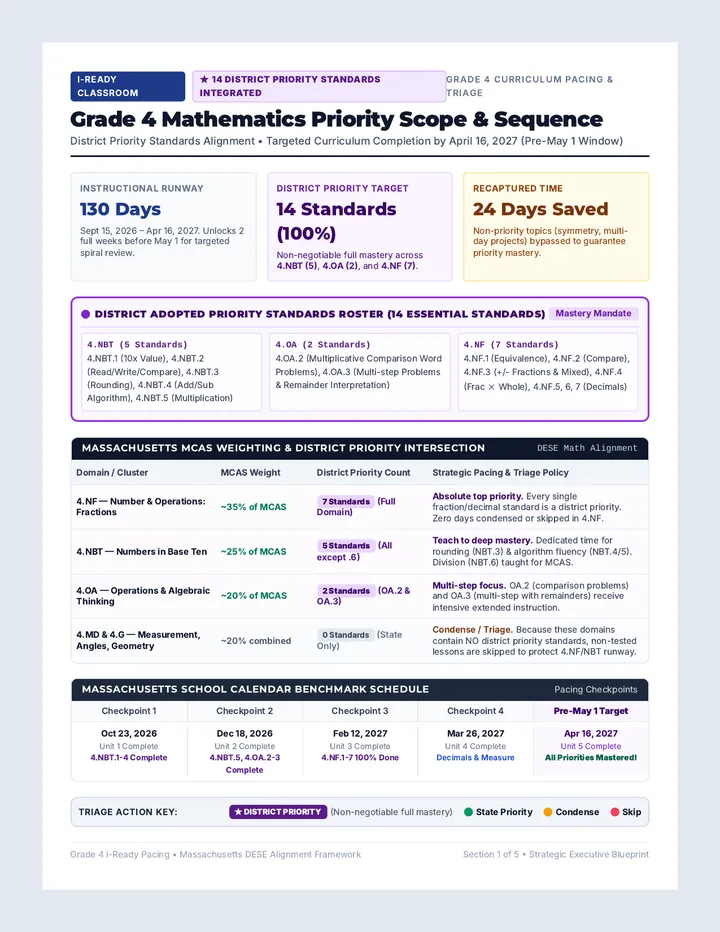
A comprehensive 5-page standards-aligned Grade 4 Mathematics curriculum pacing guide for i-Ready Classroom Mathematics, specifically incorporating the 14 designated District Priority Standards across 4.OA, 4.NBT, and 4.NF. Calibrated to the Massachusetts Curriculum Frameworks to guarantee 100% completion of all district priority standards before May 1, featuring explicit district priority badging, unit-by-unit pacing dates, strategic triage rationales for non-priority topics, and a Tier 2 prerequisite intervention bridge.

AS

Ashley Santiago

Problem Scale Visual Poster

Problem Scale Visual Poster

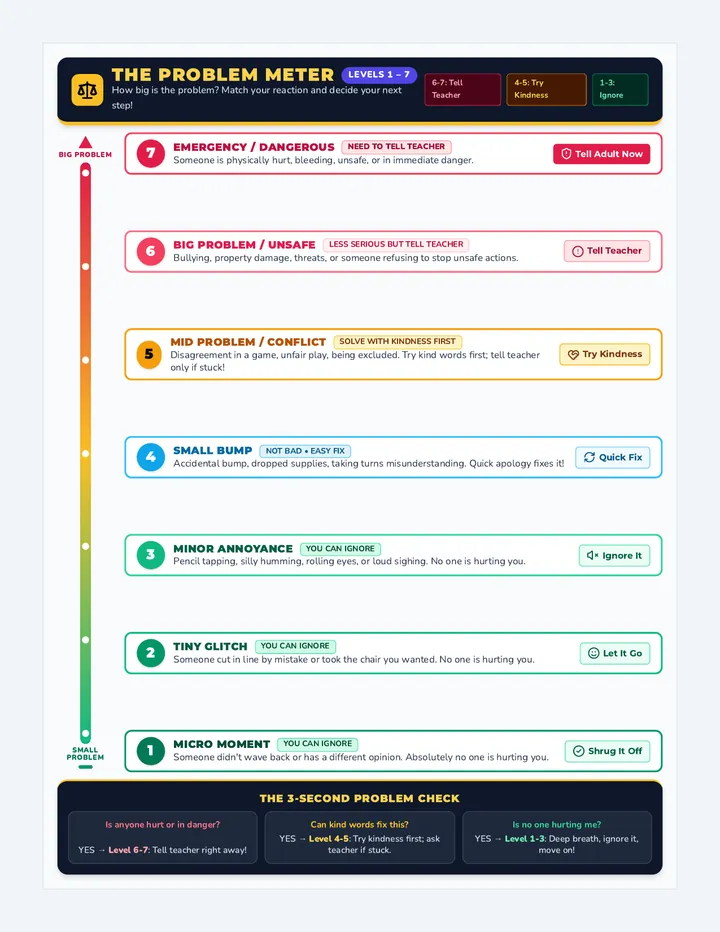
A clear 1-7 problem scale visual anchor chart for fourth graders, differentiating small versus big problems with an arrow scale showing when to ignore, solve with kindness, or tell a teacher.

MB

Michelle Bentley

Fraction Feast Station Handout

Fraction Feast Station Handout

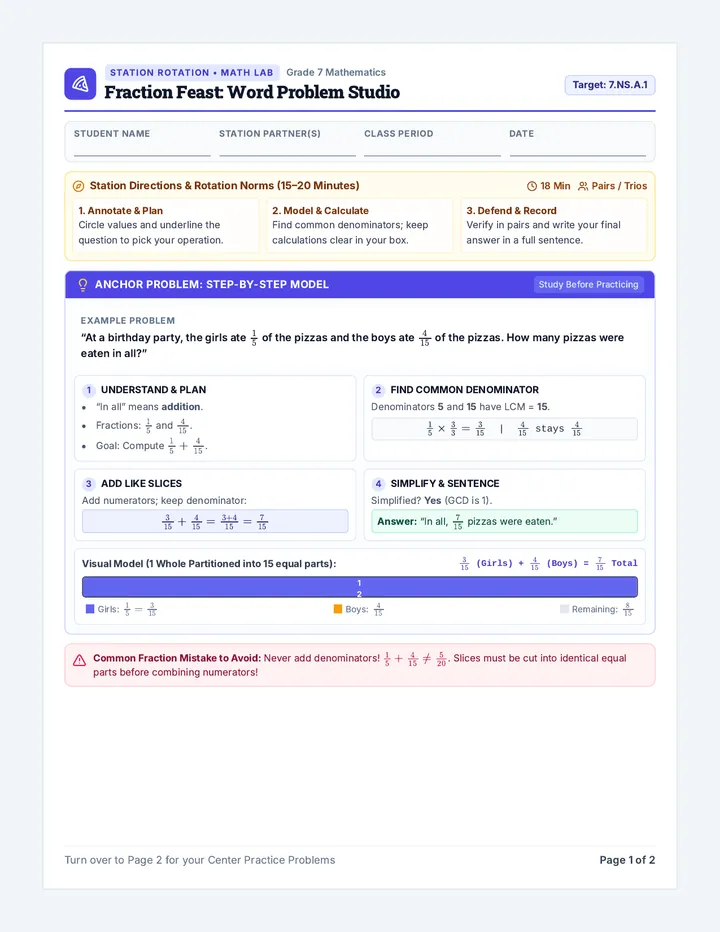
A two-page 7th-grade math centers rotation handout featuring clear station norms, an in-depth 4-step anchor model solving the birthday pizza fraction problem with visual representations, and three scaffolded rotation practice problems with dedicated workspace.

AP

Alexis Paolini

Math Radar Screener

Math Radar Screener

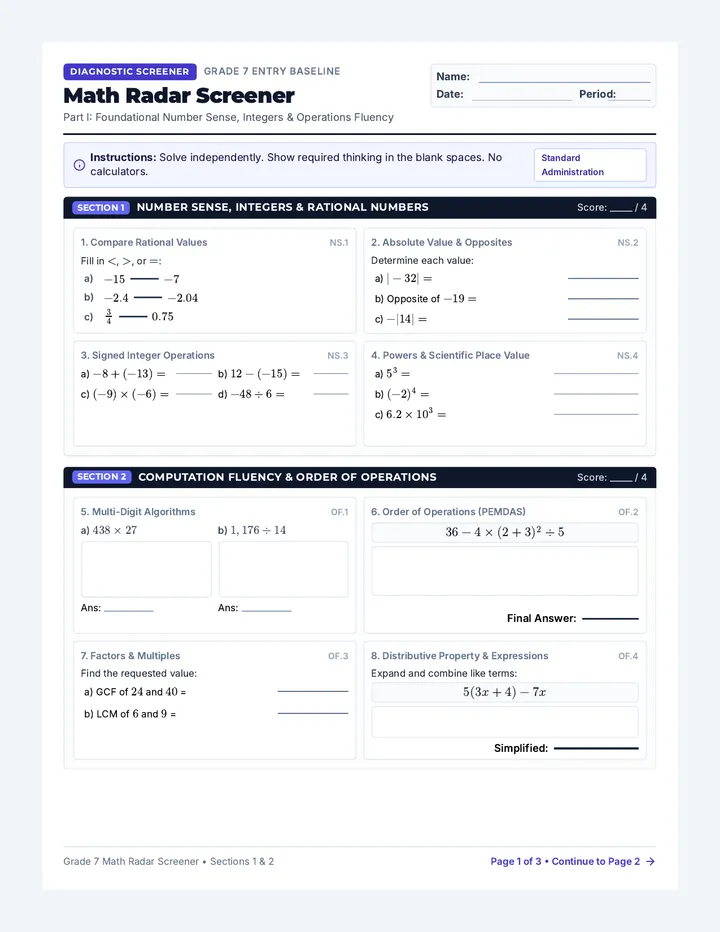
A comprehensive 3-page diagnostic math screener for entering 7th graders covering number sense, operations fluency, fractions, decimals, percents, and multi-step word problems. Includes a built-in teacher diagnostic rubric and tier intervention matrix.

BH

Beth Hellman

Fraction Mastery Practice Test

Fraction Mastery Practice Test

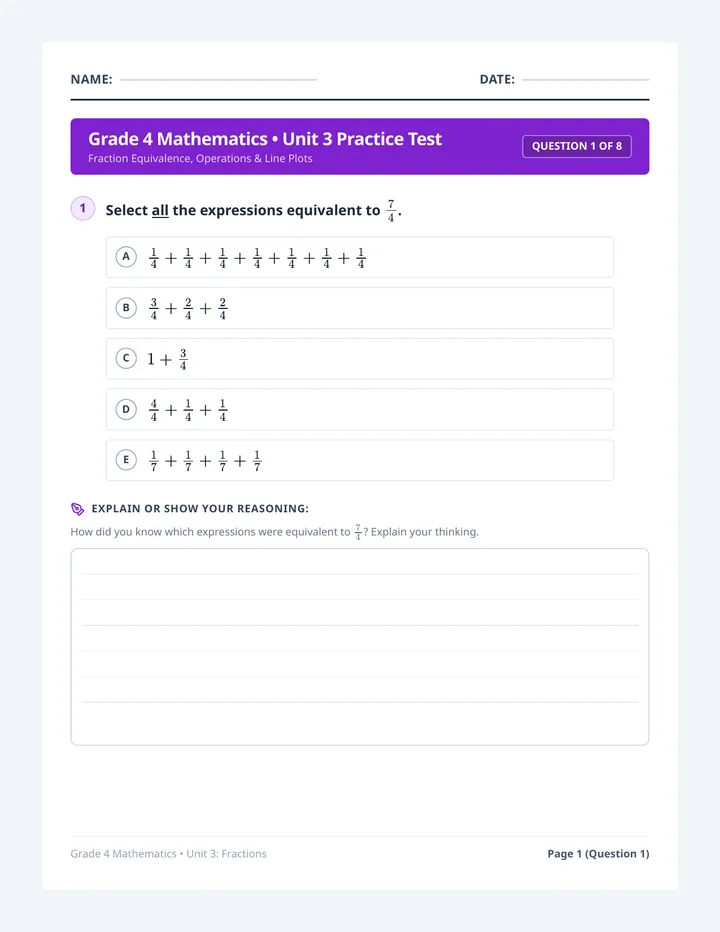
An 8-problem Grade 4 fraction practice test modeled after Illustrative Mathematics Unit 3. Question 5 features a fractional line plot marked in fourths with data points positioned between tick marks to represent eighths, accompanied by targeted questions on identifying, subtracting, comparing, and plotting eighths, followed by a comprehensive two-way solution guide.

N

nmack

Sequences

Math Blueprint Week 1 Booklet (Definitive)

Math Blueprint Spiral

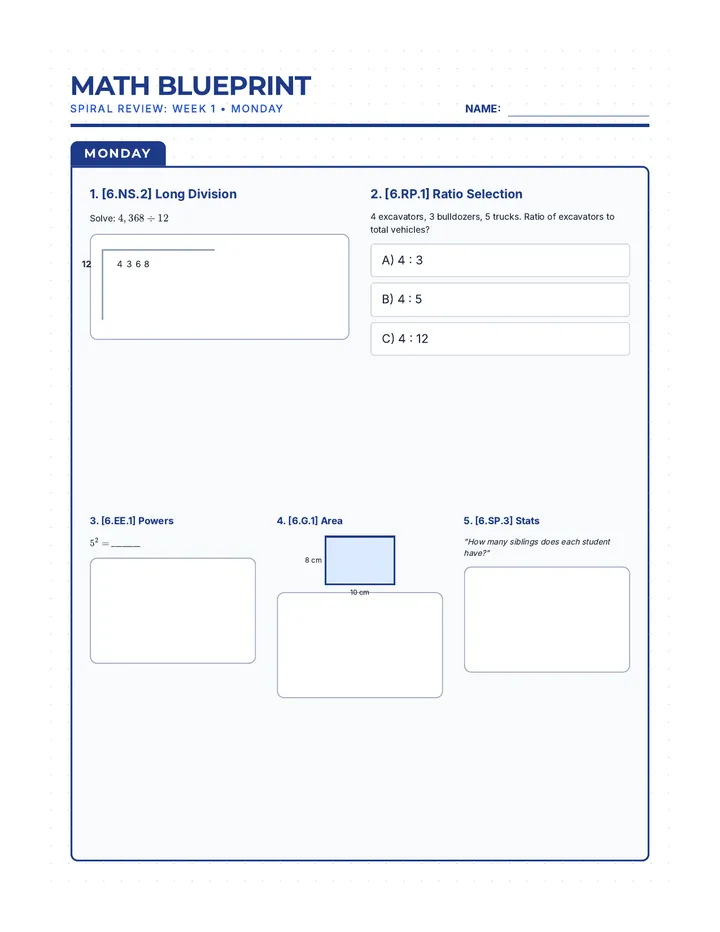
A 7-week comprehensive math review sequence designed to prepare 6th-grade students for North Carolina state testing, covering Number Systems, Ratios, Expressions, Geometry, and Statistics.

MK

Michell Kisler

27
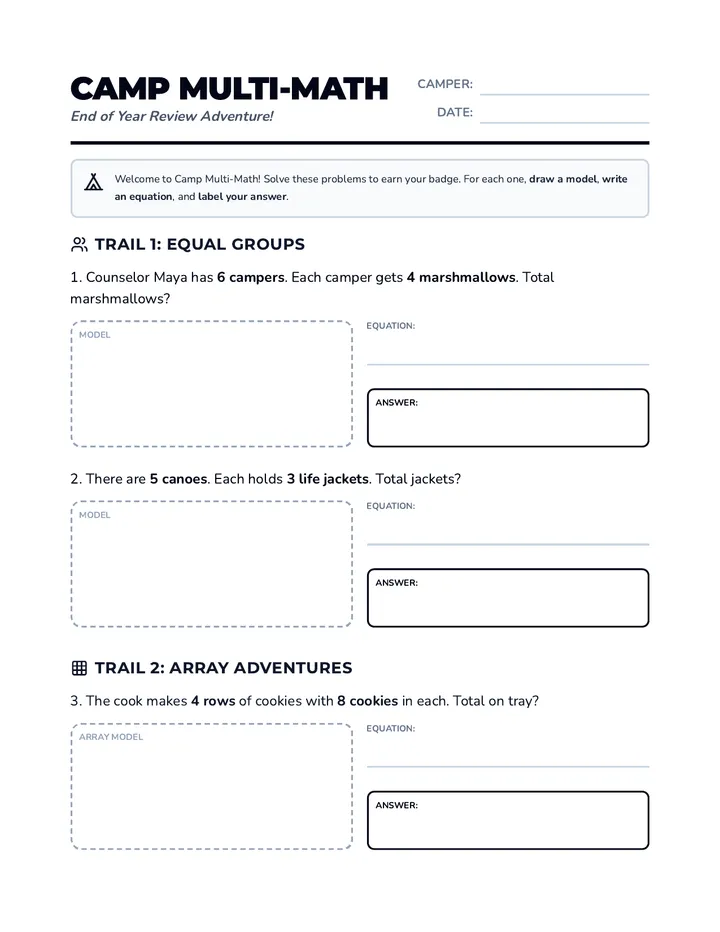
Camp Multi-Math Worksheet

Math Review Adventures

A collection of themed end-of-year math review adventures for different grade levels, focusing on spiraling key standards and problem-solving.

DB

Deborah Burton

21
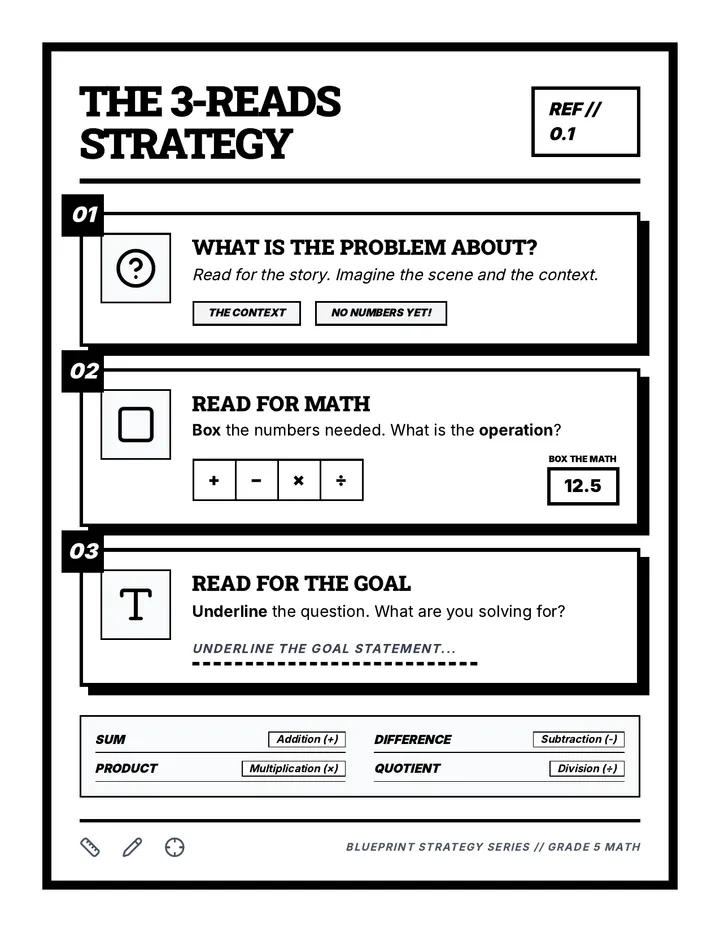
3 Reads Strategy Poster

Math Blueprints Grade 5

A comprehensive set of math supports for 5th-grade students in a co-taught environment. Each unit includes visual vocabulary, worked examples, cloze-style guided notes, and exit tickets featuring a 'Mistake of the Day' analysis.

HJ

Hope Joel

23
Fraction Fundamentals Slides

Fraction Factory

A comprehensive 3-week unit covering the full spectrum of fraction operations, from basic identification and equivalence to multiplication and division, themed as a precision engineering factory.

C

corteza

15
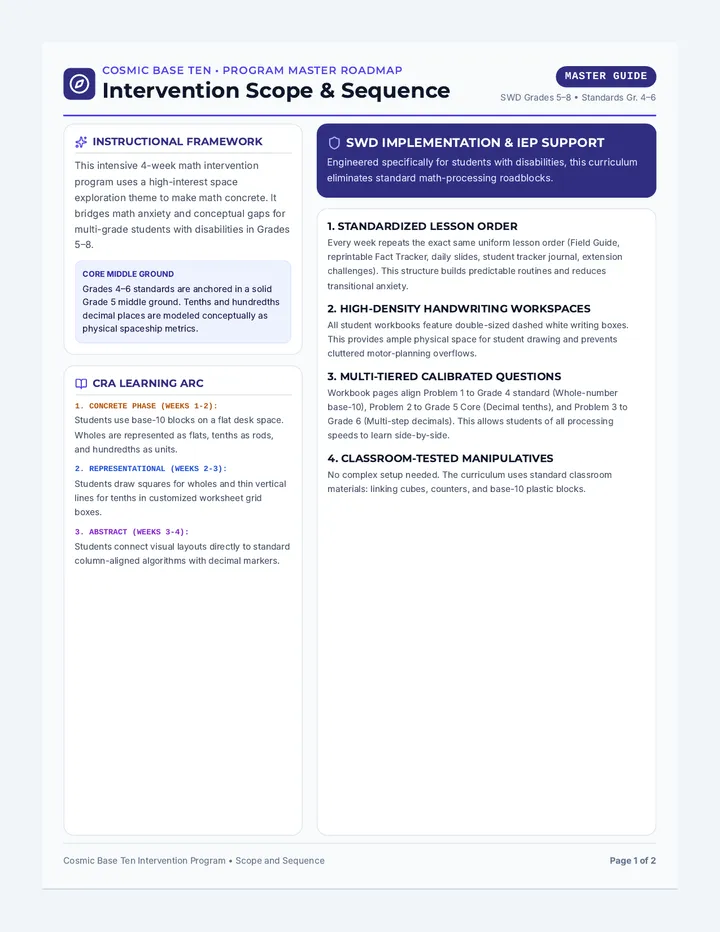
Cosmic Base Ten Scope Guide

Cosmic Base Ten

A 4-week intensive math intervention program set in a space exploration universe, designed for multi-grade students with disabilities in Grades 5–8. It covers additive thinking, place value, and decimal regrouping, anchored in Grades 4–6 standards with a Grade 5 core middle ground.

S

samantha.davis

37
Equivalent Essentials Plan

Fraction Frontiers

A comprehensive 12-lesson Tier 2 intervention sequence for 5th-grade fractions. Following ALN High Leverage Concepts and IM methods, this unit covers equivalent fractions, addition, subtraction, multiplication, and division of fractions using visual models and conceptual strategies.

D

dfredericks

36

Lessons

Blueprint Builders Slides

Blueprint Builders

A comprehensive lesson on adding and subtracting mixed numbers using visual area models and improper fraction conversions, themed around architectural blueprints and construction.

G

goodev

6
Bakery Blitz Worksheet

Whisk and Wonder Math

A collection of word problems centered around a bakery theme, focusing on mixed operations with whole numbers and addition/subtraction of fractions with like denominators.

DG

Danielle Gagnon

10
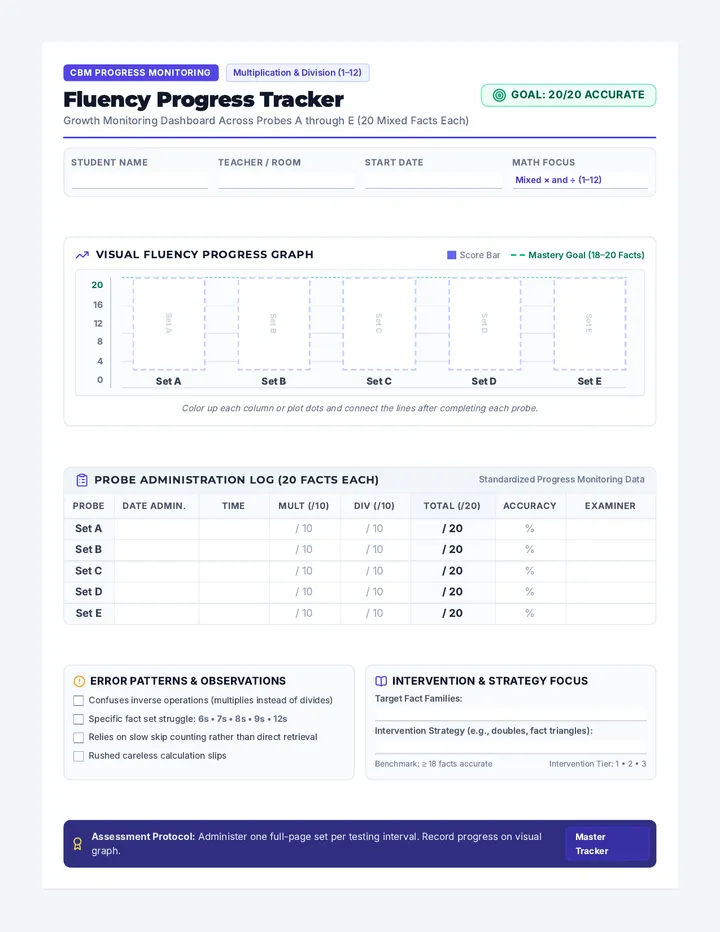
Fact Fluency Tracker Document

Fluency Progress Trackers

A comprehensive progress monitoring toolkit designed for elementary math intervention. Features standardized CBM fluency probes and multi-attempt tracking dashboards across essential computation skills.

AS

Annie Shields

6
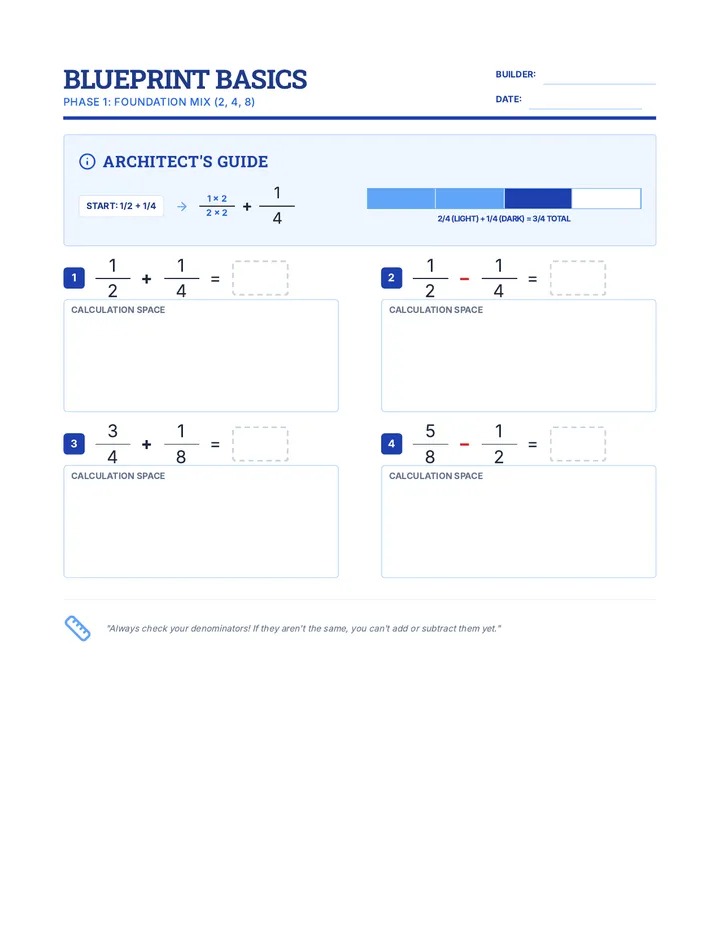
Blueprint Basics Worksheet

Fraction Blueprint Lesson

A series of 9 structured worksheets focusing on adding and subtracting fractions with simple denominators (2, 3, 4, 5, 6, 7, 8, 9, 10, 11) using a blueprint-inspired design. Includes step-by-step examples and visual scaffolds for students to master both like and unlike denominators.

TP

tiffany priest

13
Fraction Power Assessment

Fraction Power Checkup

A mini-assessment focused on NC.4.NF standards, including equivalent fractions, comparison, and operations with like denominators.

DG

Debra Golden

2
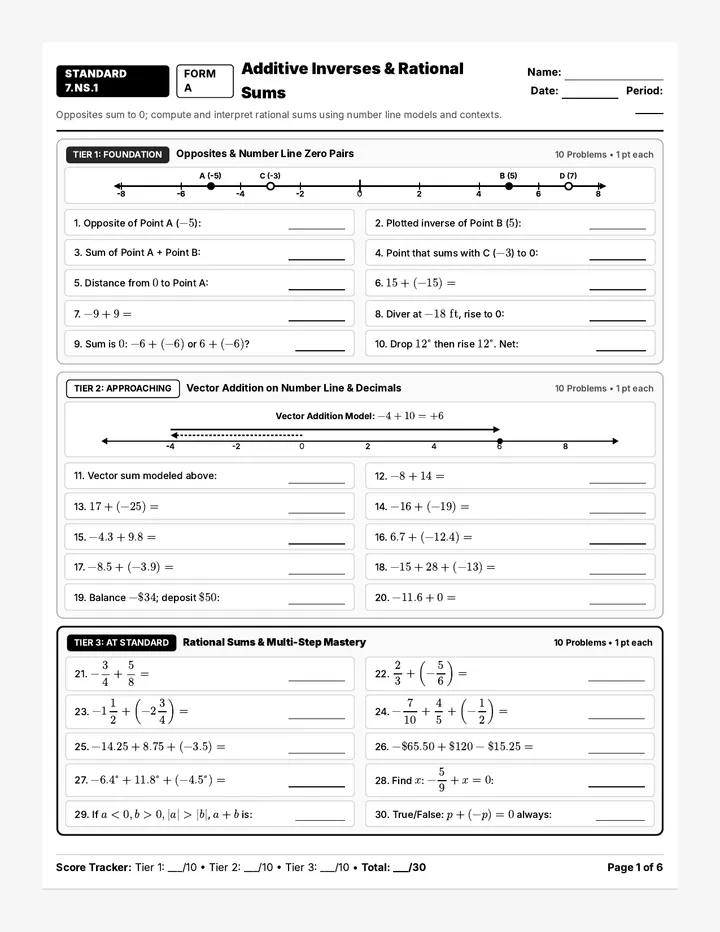
Number Sense Form A Workbook

Number Sense Progression

Grade 7 number sense progression series covering standards 7.NS.1 through 7.NS.6. Features four parallel assessment workbooks (Forms A, B, C, and the 4-tier Form D with Above Standard challenge), a master answer key, teacher facilitation guide, and tier quick notes.

CS

Chynna Smith

7