Lenny.com
Explore
Create
ActivitiesNewMathEnglish Language ArtsScience & EngineeringSocial StudiesGlobal LanguagesHealth & Physical EducationSpecial EducationCounseling & Life SkillsArts & CreativityESL
Lenny.com
Lenny.com
Explore
Create
ActivitiesNewMathEnglish Language ArtsScience & EngineeringSocial StudiesGlobal LanguagesHealth & Physical EducationSpecial EducationCounseling & Life SkillsArts & CreativityESL
Lenny.com
Lenny.com

Solutions

Lenny for EducatorsLenny for SchoolsLenny for Districts

Product

ExploreSign inCreateSupportAbout

Resources

Getting startedMTSS Acceleration Program

© 2026 Lenny Learning Inc.

TermsPrivacyAccessibility
LinkedInInstagramX
Lenny

Rational Exponents

Relationship between radical expressions and power notation using fractional exponents. Simplifies complex algebraic expressions by applying exponent properties to rational numbers.

MathNumbers & CountingCounting ObjectsNumber NamesComparing NumbersNumber OperationsCounting SequenceNumbers 0-10Place Value Understanding and SystemAdd and Subtract Within 20Addition and Subtraction ConceptsAddition and Subtraction EquationsAddition and Subtraction ProblemsFoundations for MultiplicationMultiplication and Division PropertiesMultiply and Divide Within 100Multiplication and Division ProblemsFactors and MultiplesProperties of OperationsPatterns and RelationshipsGenerate and Analyze PatternsMulti-Digit ArithmeticPlace Value OperationsMulti-Digit and Decimal OperationsNumerical ExpressionsFour Operations and PatternsFour Operations Problem SolvingMeasurement & DataMeasurable AttributesMeasuring LengthsMeasure and Estimate Lengths in Standard UnitsRelate Addition and Subtraction to LengthClassifying and Counting ObjectsTime and MoneyArea Concepts and MeasurementPerimeter and Area MeasuresAngle Concepts and MeasurementTime, Volume, and MassMeasurement Unit ConversionsGeometryIdentifying ShapesShapes and AttributesShape Attributes and ReasoningShapes and CompositionClassifying 2D FiguresGeometric Figures and RelationshipsLines, Angles, and ShapesAngle, Area, and VolumeGeometric MeasurementVolume of 3D ShapesCoordinate Plane ApplicationsTransformations in the PlaneCongruence and SimilarityUnderstand congruence in terms of rigid motionsSimilarity and TransformationsProve Theorems Involving SimilarityPythagorean TheoremTrigonometry for General TrianglesMake Geometric ConstructionsProve Geometric TheoremsTheorems About CirclesFind Arc Lengths And Areas of Sectors of CirclesVolume FormulasRelationships Between Two-Dimensional and Three-Dimensional ObjectsProve Simple Geometric Theorems AlgebraicallyTranslate Between Geometric Description and Equation for Conic SectionApply Geometric Concepts in Modeling SituationsFractions & DecimalsFractions as NumbersBuilding FractionsFraction Equivalence and OrderingAdding and Subtracting FractionsMultiplying and Dividing FractionsDividing FractionsDecimal FractionsMulti-Digit Computation and FactorsAdd, Subtract, Multiply, and Divide Rational NumbersRational Number SystemIrrational Numbers and ApproximationsRatiosRatios and ProportionsProportional RelationshipsUnit RateAlgebraAlgebraic ExpressionsGenerate Equivalent ExpressionsQuantitative RelationshipsProportional Relationships and Linear EquationsEquations and InequalitiesEquation Solving and ReasoningLinear Equations and SystemsGraph Equations and InequalitiesSystems of EquationsReal-World Algebraic ProblemsQuantitative Reasoning with UnitsExpression StructureEquivalent Expression FormsRadicals and Integer ExponentsRational ExponentsRational and Irrational NumbersPolynomial OperationsPolynomial IdentitiesPolynomial Zeros and FactorsRational ExpressionsComplex Number OperationsComplex Numbers in PolynomialsComplex Numbers on PlaneStatistics & ProbabilityRepresent and Interpret DataData DistributionsStatistical VariabilityProbability ModelsCompound Event ProbabilitiesStatistical SamplingInterpret Categorical and Quantitative DataBivariate Data PatternsInterpret Linear ModelsComparing Two PopulationsRandom Processes in StatisticsIndependence and Conditional ProbabilityExpected ValuesProbability-Based Decision MakingStatistical Inference and ConclusionsFunctionsFunction Concepts and NotationDefine and Compare FunctionsInterpret Functions in ContextAnalyze Function RepresentationsModel Relationships with FunctionsIdentify Linear vs Exponential GrowthDistinguish Between Function TypesCompare Growth RatesInterpret Function ExpressionsBuild Functions from RelationshipsConstruct and Model FunctionsTransform and Combine FunctionsModel Comparison and SelectionSolve Exponential EquationsTrigonometryTrigonometric Ratios Involving Right TrianglesTrigonometric Functions and Unit CircleModel with Trigonometric FunctionsTrigonometric IdentitiesVectors & MatricesIntroduction to Vectors and MatricesVector QuantitiesVector OperationsMatrix OperationsCalculusLimits and ContinuityDerivative Concepts and NotationDerivative Rules and TechniquesApplications of DerivativesOptimization ProblemsRelated RatesCurve Sketching and AnalysisIntegration Concepts and NotationAntiderivatives and Indefinite IntegralsDefinite Integrals and AreaFundamental Theorem of CalculusIntegration TechniquesApplications of IntegrationDifferential EquationsSequences and SeriesParametric and Polar FunctionsVector-Valued Functions

Videos

Evaluating Logarithms by Converting to Exponents

Evaluating Logarithms by Converting to Exponents

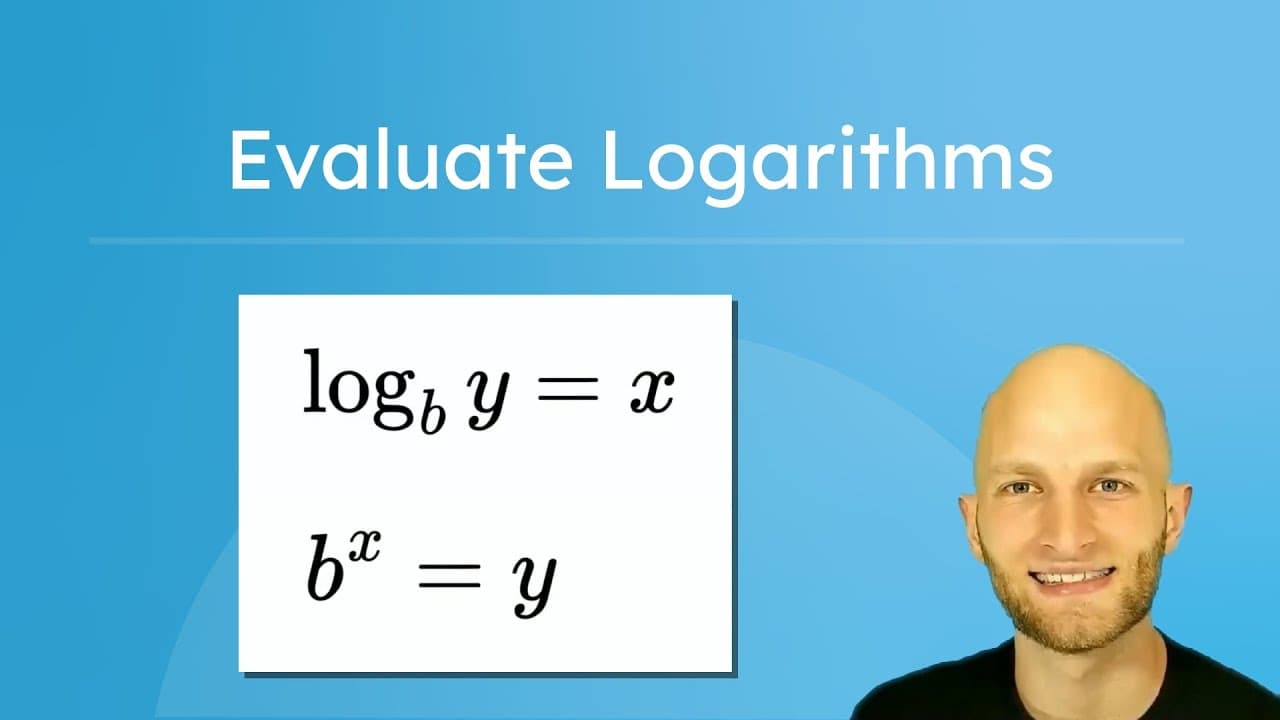
This concise mathematics video introduces students to the concept of evaluating logarithms by understanding their relationship with exponential equations. The host, Randy, demystifies the intimidating notation of logarithms by translating the mathematical expression into a simple spoken sentence: "Base to the power of what equals the result?" The video uses a digital whiteboard approach to visually map the components of a logarithmic equation to its exponential counterpart. The content covers the fundamental definition of a logarithm and walks through four distinct examples that increase in complexity. It begins with standard integer answers, demonstrating how to find missing exponents through mental math or multiplication. It then progresses to more advanced examples involving rational exponents (fractions), requiring students to recall the connection between roots (like square and cube roots) and fractional powers. This video is an excellent resource for Algebra II and Pre-Calculus classrooms as either an introduction to logarithms or a review of the connection between logarithmic and exponential forms. By focusing on the conceptual definition rather than calculator shortcuts, it helps build number sense. Teachers can use this video to scaffold learning, starting with integer logarithms before challenging students with rational exponents, directly addressing the common struggle students face when switching between radical and exponential notation.

Miacademy & MiaPrep Learning ChannelMiacademy & MiaPrep Learning Channel

6mins 45s

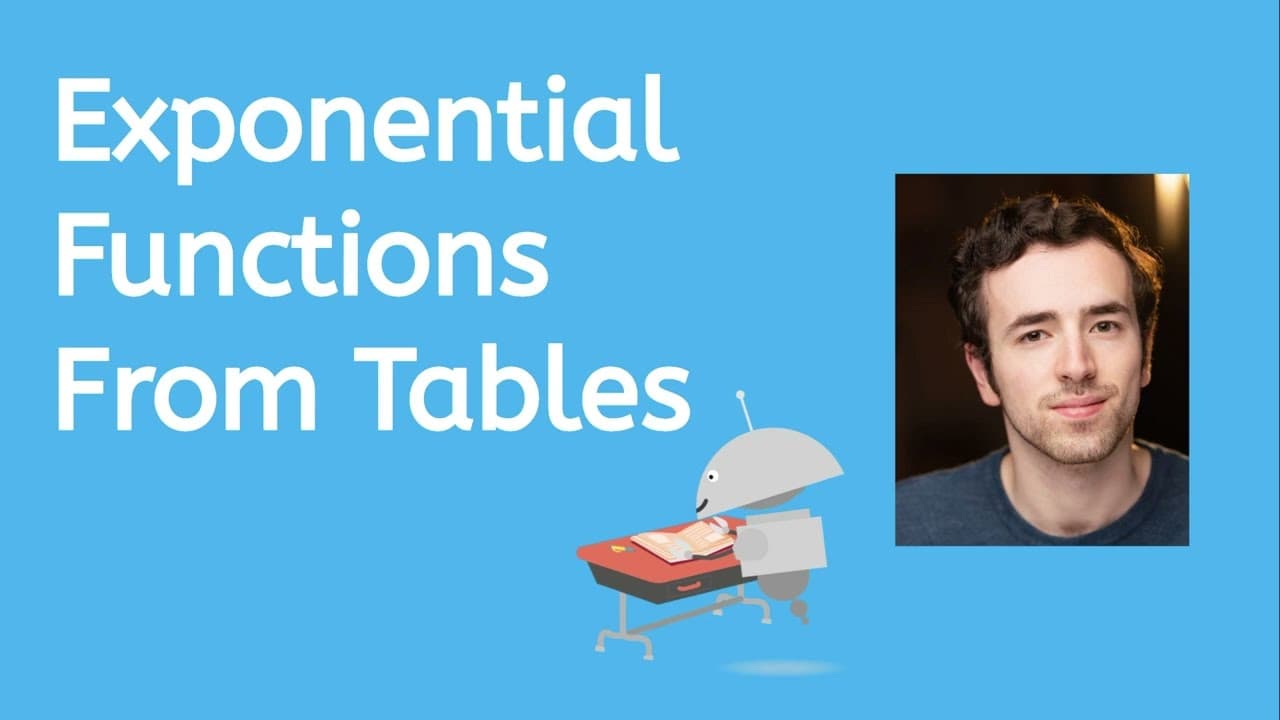
Writing Exponential Functions from Data Tables

Writing Exponential Functions from Data Tables

This instructional video guides students through the process of writing exponential functions from data tables, building upon previous knowledge of reverse-engineering functions from graphs. The narrator, Justin, systematically demonstrates how to identify the initial value (a) and the growth or decay factor (b) to construct equations in the form f(x) = a tb^x. The video contrasts tables with graphs, highlighting that tables offer precise numerical values which can make function writing more accurate. The content progresses through three distinct examples of increasing complexity: (1) a basic table with consecutive integer inputs starting at zero; (2) a table with inputs increasing by intervals of three, introducing fractional exponents; and (3) a table where the initial value (x=0) is missing, requiring students to work backward. Key mathematical themes include calculating growth factors by dividing consecutive outputs, handling non-unit intervals using roots or fractional exponents, and extrapolating data to find unknown initial values. This resource is highly valuable for Algebra 1 and Algebra 2 classrooms as it directly addresses common student stumbling blocks, such as what to do when the y-intercept isn't explicitly given or when data points aren't consecutive. It provides clear, step-by-step procedural knowledge that allows teachers to scaffold learning from simple pattern recognition to more complex algebraic manipulation involving roots and exponents.
Miacademy & MiaPrep Learning ChannelMiacademy & MiaPrep Learning Channel

4mins 45s

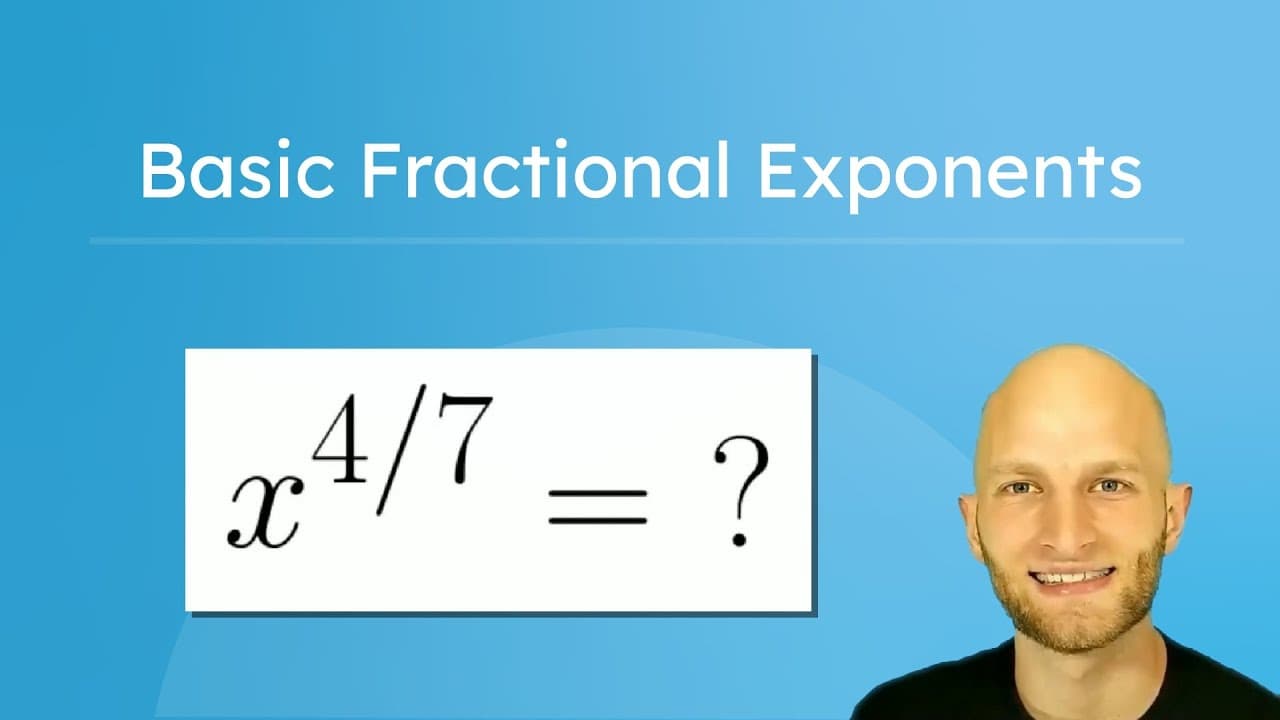
Converting Between Fractional Exponents and Radicals

Converting Between Fractional Exponents and Radicals

This concise mathematics tutorial guides students through the process of converting between exponential expressions with fractional exponents and radical expressions. Narrated by Randy from MiaPrep, the video breaks down the relationship between the numerator and denominator of a fractional exponent and their corresponding positions in a radical expression. It covers both directions of conversion: turning roots into powers and powers into roots, providing clear examples for each. The video explores key algebraic concepts including the specific roles of the index and the radicand. It delves into the properties of exponents, specifically the power of a power rule, to demonstrate why different notations (like the cube of a fifth root versus the fifth root of a cube) result in equivalent exponential expressions. Special attention is given to understanding implied numbers, such as the unwritten '2' in a square root and the unwritten '1' exponent. For educators, this video serves as an excellent direct instruction tool or review resource for Algebra 1 and Algebra 2 curriculums. It explicitly addresses common student errors, such as confusing the index of a root with a coefficient multiplier. The clear visual aids and step-by-step whiteboard derivations make abstract notation concrete, helping students master the syntax required for higher-level calculus and algebraic manipulation.

Miacademy & MiaPrep Learning ChannelMiacademy & MiaPrep Learning Channel

7mins 20s

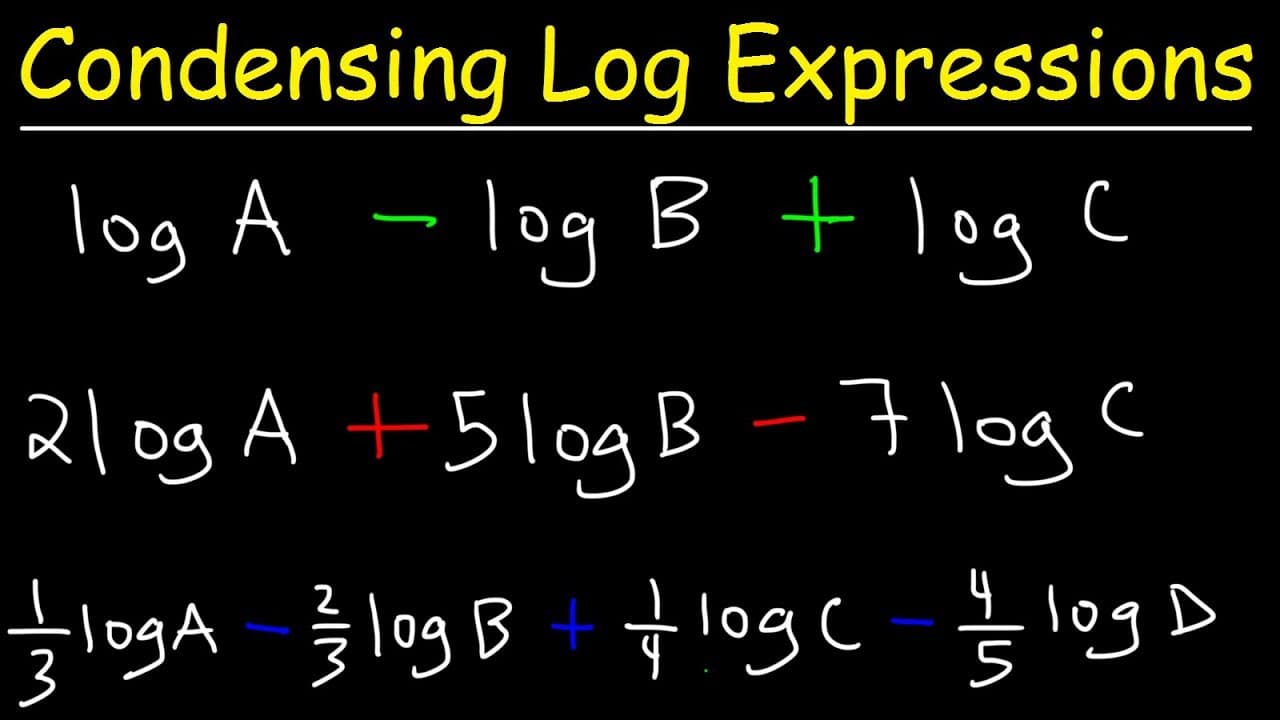
How to Condense Logarithmic Expressions

How to Condense Logarithmic Expressions

This mathematics tutorial provides a step-by-step guide on how to condense multiple logarithmic expressions into a single logarithm using the properties of logarithms. The video functions as the inverse to a previous lesson on expanding logarithms, focusing now on combining terms. It progresses from simple variable expressions to more complex problems involving integer coefficients and finally rational (fractional) coefficients. The content covers three main properties of logarithms: the Product Rule (addition becomes multiplication), the Quotient Rule (subtraction becomes division), and the Power Rule (coefficients become exponents). The instructor demonstrates these rules through three distinct examples, clearly showing how to handle positive and negative terms to determine their placement in the numerator or denominator of the final argument. This video is highly valuable for high school Algebra II and Pre-Calculus classrooms. It offers clear, procedural modeling for a skill that often confuses students—specifically the order of operations when condensing logs (dealing with coefficients first) and converting fractional exponents into radical form. It serves as an excellent resource for direct instruction, review, or remediation for students struggling with logarithmic properties.

The Organic Chemistry TutorThe Organic Chemistry Tutor

3mins 43s

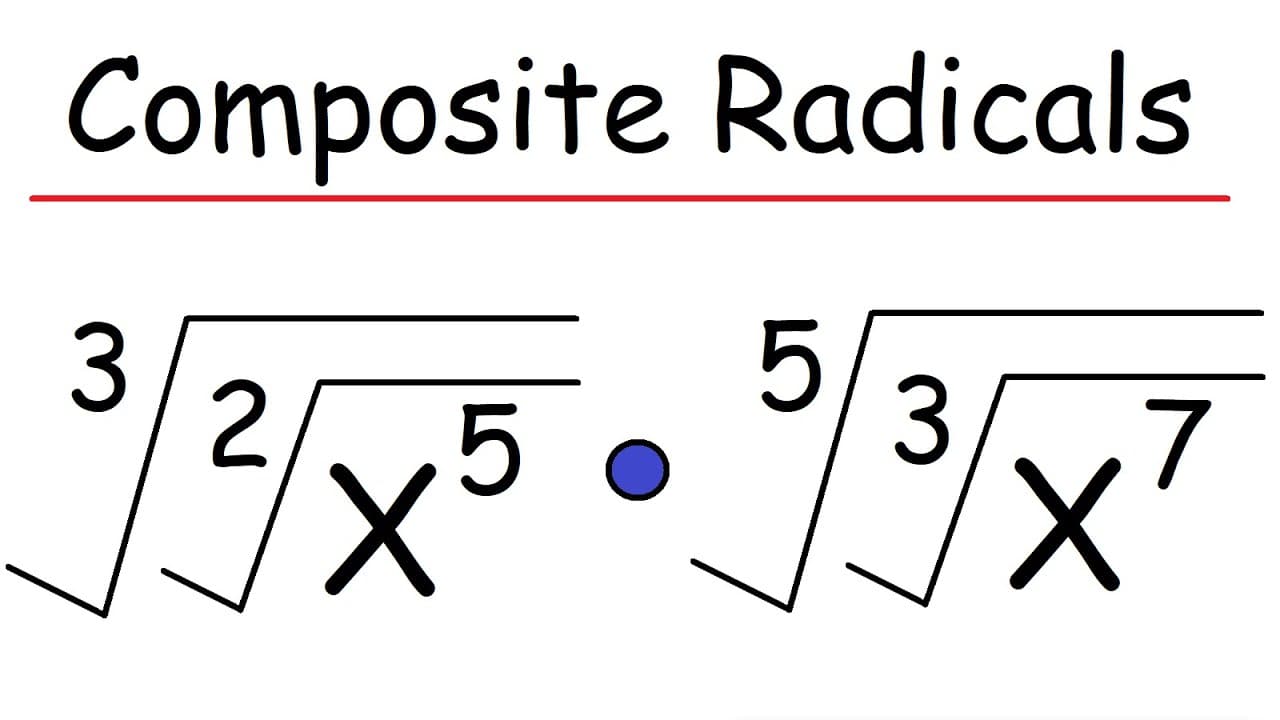
Simplifying Nested Radicals and Multiplying Roots with Different Indices

Simplifying Nested Radicals and Multiplying Roots with Different Indices

This math tutorial provides a comprehensive guide to simplifying composite (nested) radicals and multiplying radicals with different index numbers. The video introduces efficient formulas for handling radicals within radicals, such as converting the cube root of a fourth root into a single twelfth root. It also presents a specific shortcut method for multiplying radicals like the fourth root of x multiplied by the fifth root of x without needing to convert everything to fractional exponents first. The content covers theoretical derivations and practical applications. The narrator first explains the logic behind the formulas using rational exponents, demonstrating why multiplying indices works. Several practice problems are worked through step-by-step, including complex examples involving both nested radicals and multiplication simultaneously. The video concludes with a nuanced discussion on domain constraints, specifically addressing when to use absolute value symbols based on whether roots are even or odd and whether the variable could be negative. This video is highly valuable for high school Algebra 2 and Pre-Calculus classrooms. It addresses advanced algebraic manipulation skills that are often stumbling blocks for students. The dual approach of showing the "shortcut" formula alongside the standard exponential conversion method helps students build conceptual understanding while acquiring efficient problem-solving tools. The final section on absolute value corrections serves as an excellent case study for precision in mathematical definitions.

The Organic Chemistry TutorThe Organic Chemistry Tutor

14mins 37s

How to Solve Equations with Square Roots and Cube Roots

How to Solve Equations with Square Roots and Cube Roots

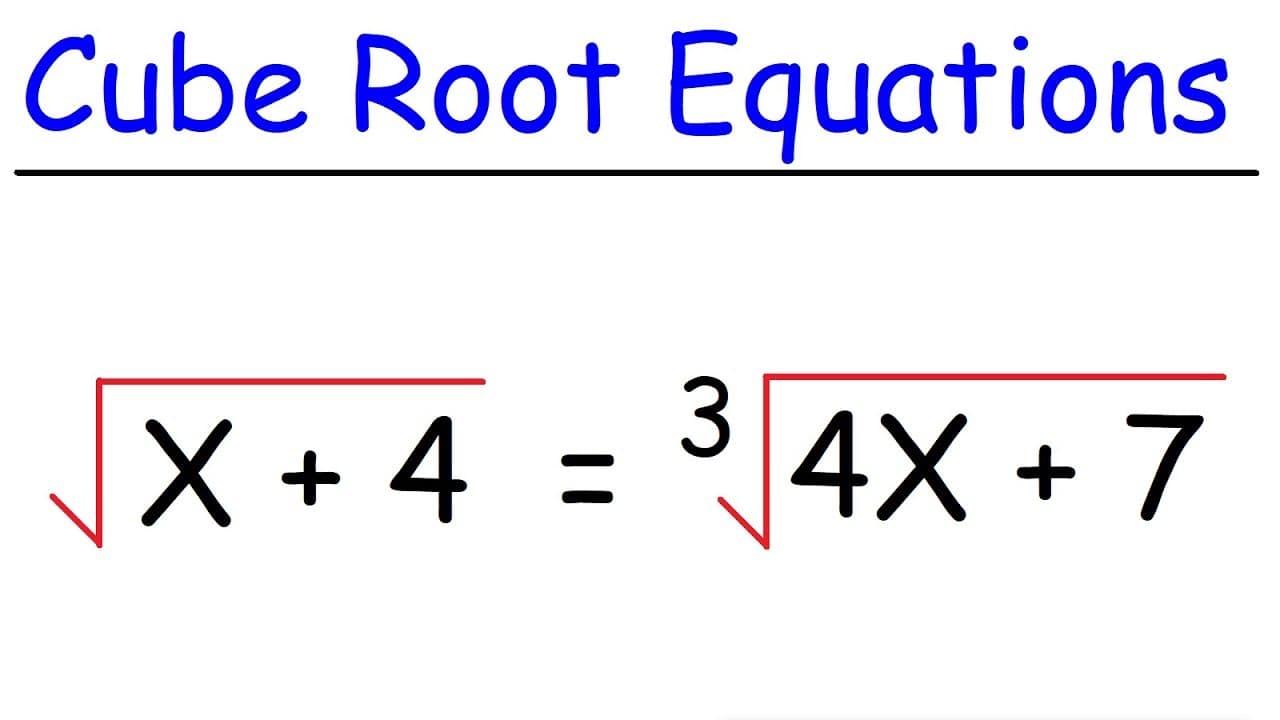
This comprehensive math tutorial guides viewers through the advanced algebraic process of solving a radical equation that contains both a square root and a cube root. The video breaks down a complex problem into manageable steps, demonstrating how to convert radicals to fractional exponents, eliminate roots by raising the equation to the least common multiple power, and expand the resulting binomials into a cubic polynomial.

The Organic Chemistry TutorThe Organic Chemistry Tutor

12mins 24s

Materials

Exponent Laws Reference Sheet

Exponent Laws Reference Sheet

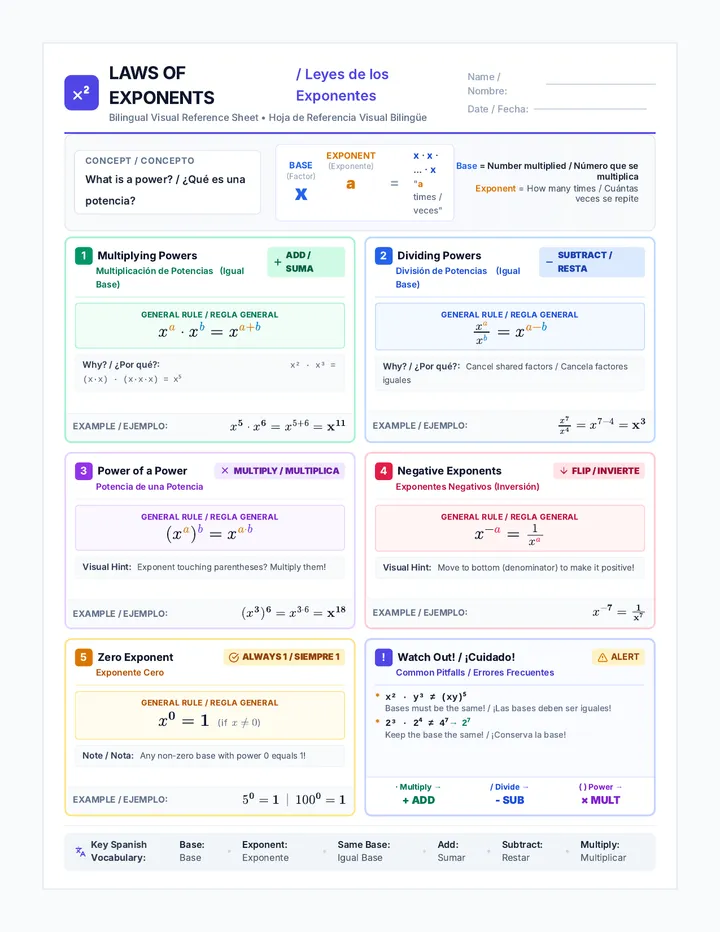
A comprehensive, visually rich bilingual reference sheet (English and Spanish) covering the five fundamental laws of exponents with labeled anatomy, color-coded rules, step-by-step examples, and common pitfalls for Level 1 Spanish speakers.

JD

Jenna Dzioba

Algebra Engine Reference Sheet

Algebra Engine Reference Sheet

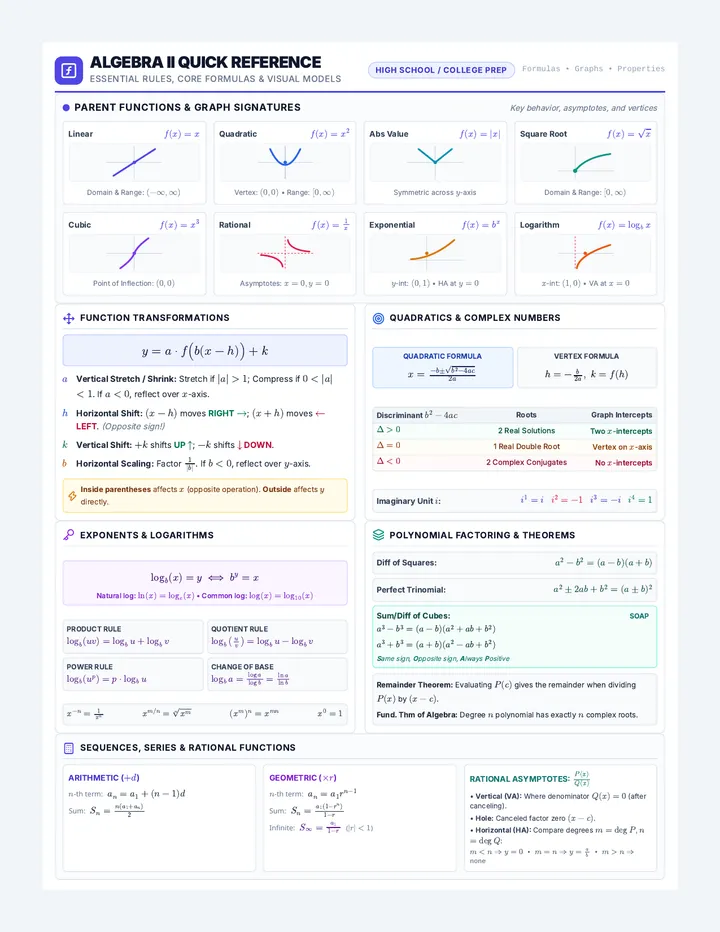
A comprehensive, one-page printable Algebra 2 reference sheet packed with visual parent function graphs, transformation guides, quadratic formulas, complex numbers, logarithmic rules, polynomial factoring shortcuts, and sequence formulas.

KL

Karen Lloyd

Sequences

Regents Mastery Blueprint Study Guide

Regents Mastery Suite

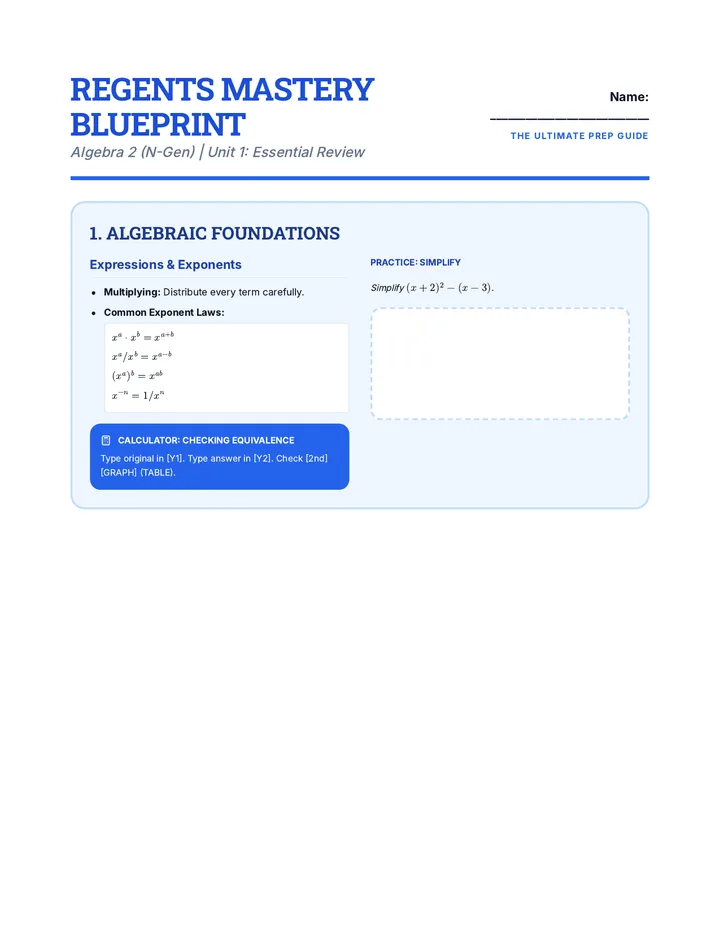
A comprehensive review suite for the New York State Mathematics Regents exams, including Algebra 1, Geometry, and Algebra 2, featuring mastery blueprints, calculator strategies, and exam-taking tips.

KB

Kayla Borozny

15
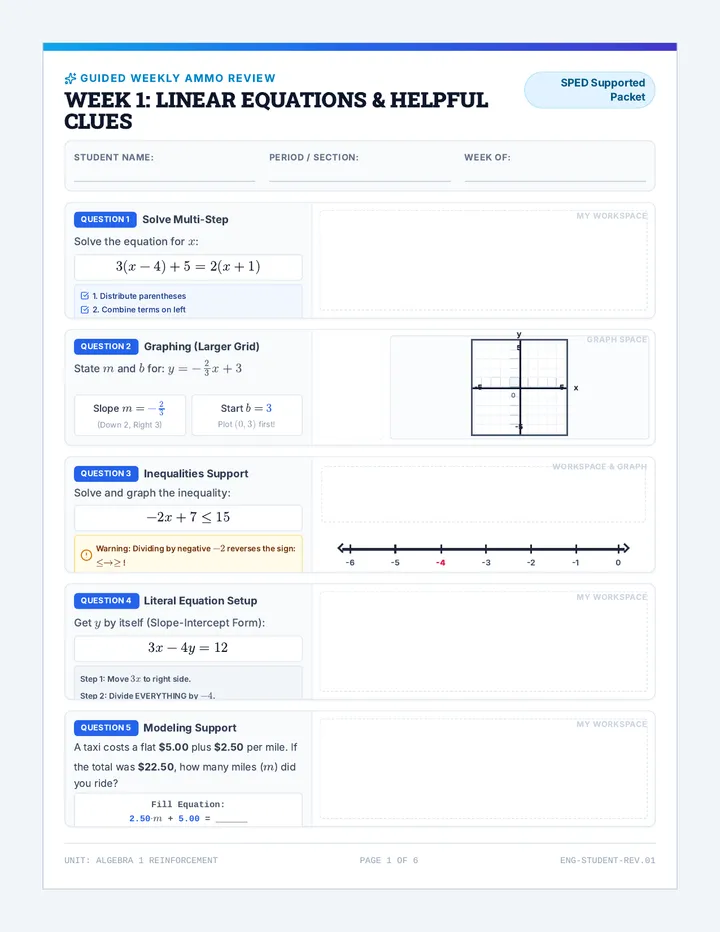
Algebra Ammo Student Booklet

Algebra Ammo Review Unit

A comprehensive 6-week Algebra 1 review unit comprising structured daily bellringers and a detailed teacher answer key with worked-out solutions and misconceptions.

T

timothy.nixon

2
Strategy Blueprint Slides

ACT Math Mastery

A comprehensive ACT Math preparation program focusing on essential strategies, high-yield Algebra and Geometry concepts, and realistic practice to boost scores.

AL

ava larumbe

26
Algebra Ammo Student Booklet

Algebra Ammo Review Unit

A comprehensive 6-week Algebra 1 review unit comprising structured daily bellringers and a detailed teacher answer key with worked-out solutions and misconceptions.

JD

Jenna Dzioba

2
Exponent Lab Slides

Conceptualizing Rational Exponents

A 5-lesson inquiry-based unit that guides 9th-grade algebra students from recognizing integer exponent patterns to fluently translating between radical and rational exponent notation. students will discover the conceptual meaning of fractional exponents through investigative tasks and symbolic manipulation.

15
Radical Blueprint Teacher Guide

Radical Rational Mastery

A Tier 2 intervention sequence focused on helping high school students master the conversion and simplification of expressions involving radicals and rational exponents, aligned with Colorado standard HS.N-RN.A.2.

4

Lessons

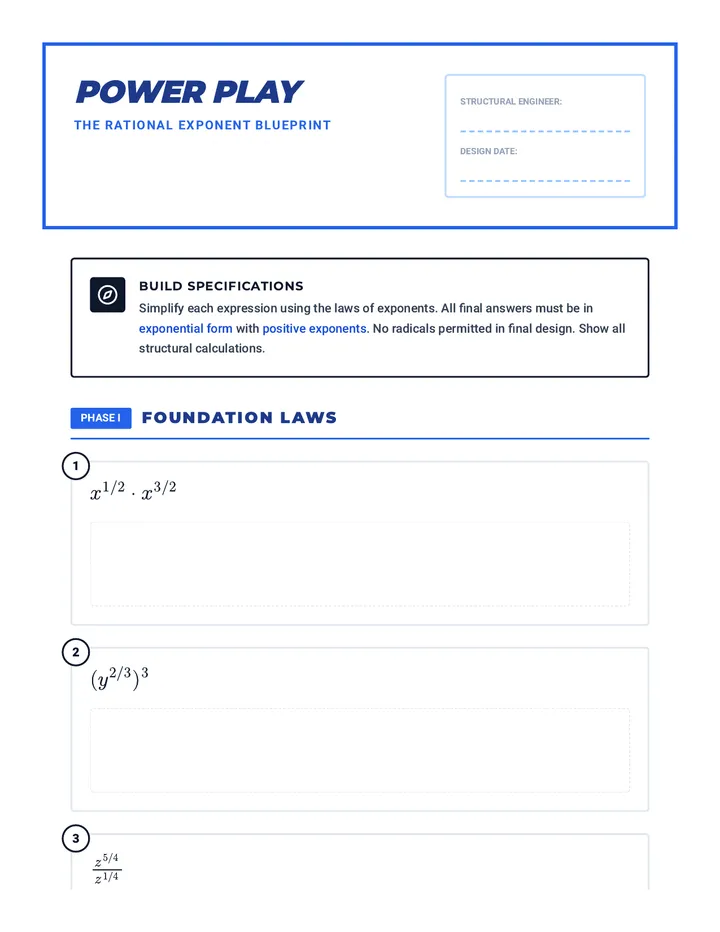
Power Play Worksheet

Power Play Masterclass

A lesson focused on mastering the laws of exponents with rational exponents, progressing from single-step applications to complex multi-step simplifications without using radical notation.

M

mastronardil

5
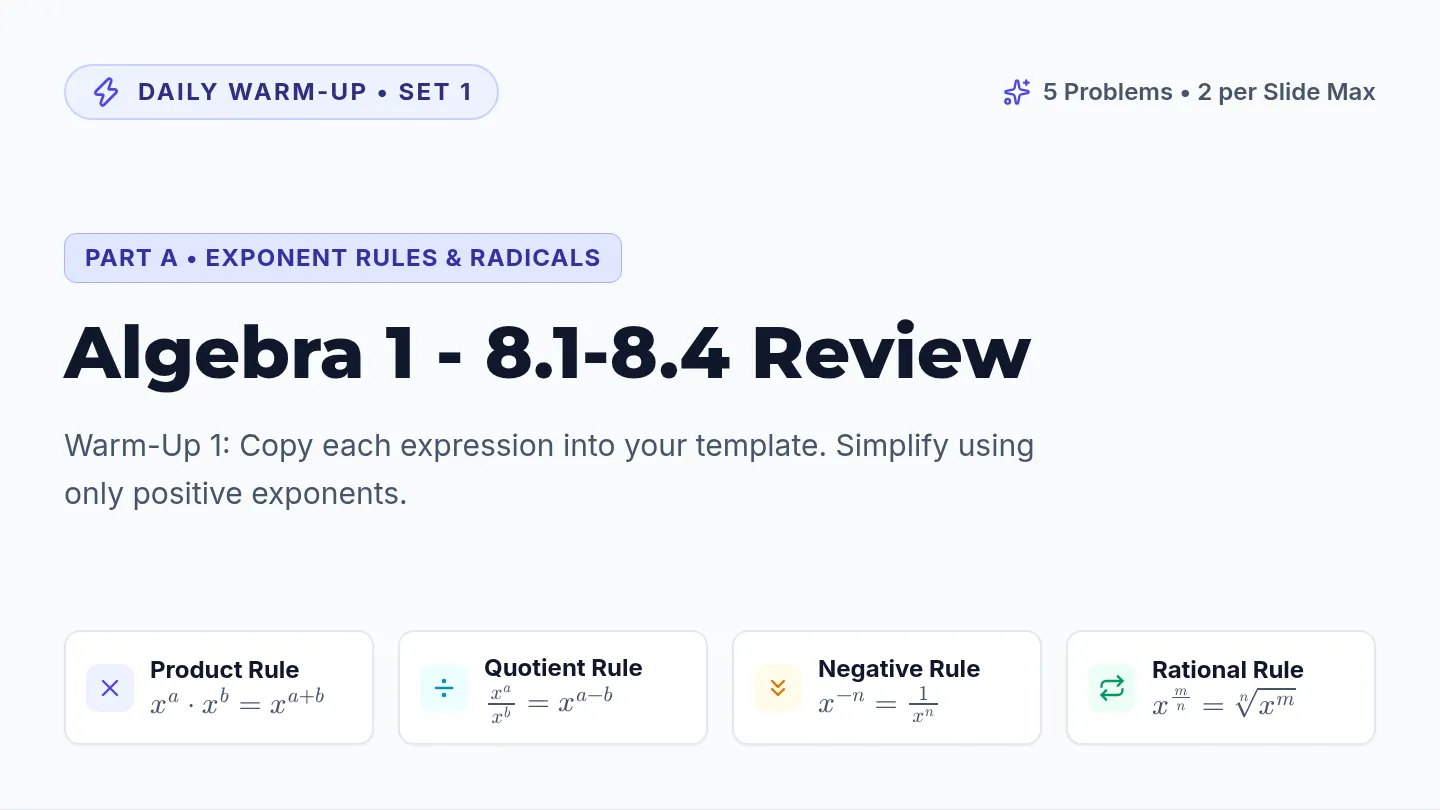
Warm Up One Slides

Exponent Power Review

A targeted warm-up and practice module reviewing Algebra 1 exponent rules, negative exponents, rational powers, and radical expressions. Includes visual presentation slides and a matching student work template.

J

jfrisk

3
CP Algebra Review Worksheet

CP Algebra Review

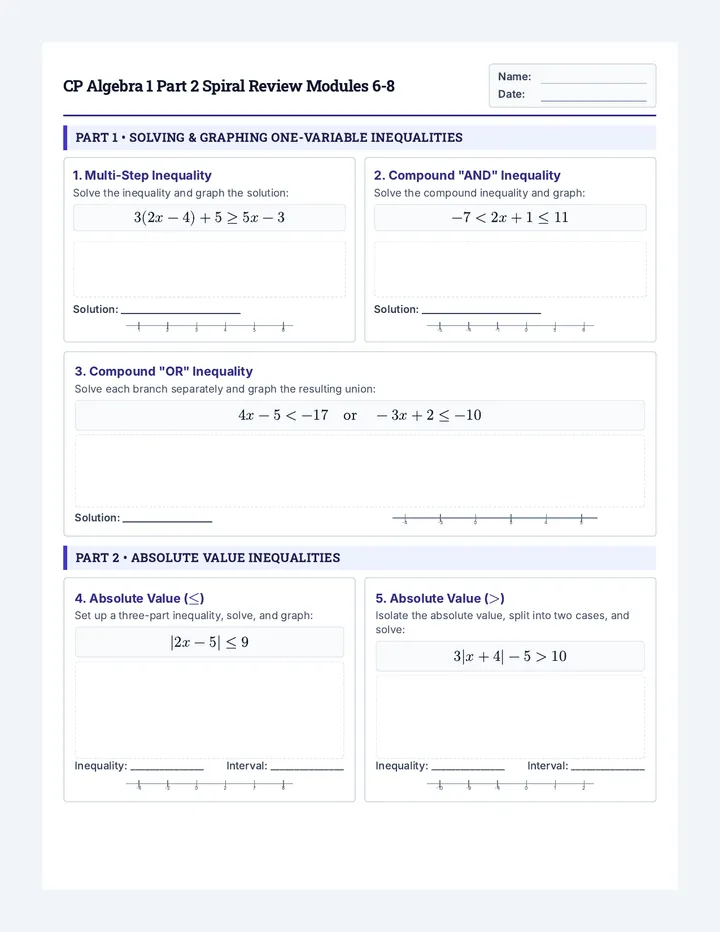
Comprehensive spiral review unit covering linear and absolute value inequalities, systems of linear equations and inequalities, laws of exponents, rational exponents, and exponential equations.

J

jfrisk

2
Cosmic Powers Worksheet

Power Play

A focused lesson on mastering rational exponents, covering conversion between forms, simplification using the Power of a Power rule, handling negative exponents, and solving radical equations.

BF

Ben Freitag

4
Power Play Handout

Power Play

A comprehensive guide to mastering exponent laws, from basic products to complex fractional roots. Includes a detailed reference sheet and scaffolded practice problems.

M

mastronardil

7
Algebra 2 Q3 Exam MCQ

Algebra 2 Q3 Exam

A comprehensive 50-question cumulative exam covering the third quarter of Algebra 2, focusing on radicals, rational exponents, and logarithmic and exponential functions.

AC

Anjoe Calamba

3