Lenny.com
Explore
Create
ActivitiesNewMathEnglish Language ArtsScience & EngineeringSocial StudiesGlobal LanguagesHealth & Physical EducationSpecial EducationCounseling & Life SkillsArts & CreativityESL
Lenny.com
Lenny.com
Explore
Create
ActivitiesNewMathEnglish Language ArtsScience & EngineeringSocial StudiesGlobal LanguagesHealth & Physical EducationSpecial EducationCounseling & Life SkillsArts & CreativityESL
Lenny.com
Lenny.com

Solutions

Lenny for EducatorsLenny for SchoolsLenny for Districts

Product

ExploreSign inCreateSupportAbout

Resources

Getting startedMTSS Acceleration Program

© 2026 Lenny Learning Inc.

TermsPrivacyAccessibility
LinkedInInstagramX
Lenny

Complex Number Operations

Arithmetic operations including addition, subtraction, multiplication, and division of imaginary numbers. Builds skills in simplifying expressions using the imaginary unit, conjugates, and powers of i.

MathNumbers & CountingCounting ObjectsNumber NamesComparing NumbersNumber OperationsCounting SequenceNumbers 0-10Place Value Understanding and SystemAdd and Subtract Within 20Addition and Subtraction ConceptsAddition and Subtraction EquationsAddition and Subtraction ProblemsFoundations for MultiplicationMultiplication and Division PropertiesMultiply and Divide Within 100Multiplication and Division ProblemsFactors and MultiplesProperties of OperationsPatterns and RelationshipsGenerate and Analyze PatternsMulti-Digit ArithmeticPlace Value OperationsMulti-Digit and Decimal OperationsNumerical ExpressionsFour Operations and PatternsFour Operations Problem SolvingMeasurement & DataMeasurable AttributesMeasuring LengthsMeasure and Estimate Lengths in Standard UnitsRelate Addition and Subtraction to LengthClassifying and Counting ObjectsTime and MoneyArea Concepts and MeasurementPerimeter and Area MeasuresAngle Concepts and MeasurementTime, Volume, and MassMeasurement Unit ConversionsGeometryIdentifying ShapesShapes and AttributesShape Attributes and ReasoningShapes and CompositionClassifying 2D FiguresGeometric Figures and RelationshipsLines, Angles, and ShapesAngle, Area, and VolumeGeometric MeasurementVolume of 3D ShapesCoordinate Plane ApplicationsTransformations in the PlaneCongruence and SimilarityUnderstand congruence in terms of rigid motionsSimilarity and TransformationsProve Theorems Involving SimilarityPythagorean TheoremTrigonometry for General TrianglesMake Geometric ConstructionsProve Geometric TheoremsTheorems About CirclesFind Arc Lengths And Areas of Sectors of CirclesVolume FormulasRelationships Between Two-Dimensional and Three-Dimensional ObjectsProve Simple Geometric Theorems AlgebraicallyTranslate Between Geometric Description and Equation for Conic SectionApply Geometric Concepts in Modeling SituationsFractions & DecimalsFractions as NumbersBuilding FractionsFraction Equivalence and OrderingAdding and Subtracting FractionsMultiplying and Dividing FractionsDividing FractionsDecimal FractionsMulti-Digit Computation and FactorsAdd, Subtract, Multiply, and Divide Rational NumbersRational Number SystemIrrational Numbers and ApproximationsRatiosRatios and ProportionsProportional RelationshipsUnit RateAlgebraAlgebraic ExpressionsGenerate Equivalent ExpressionsQuantitative RelationshipsProportional Relationships and Linear EquationsEquations and InequalitiesEquation Solving and ReasoningLinear Equations and SystemsGraph Equations and InequalitiesSystems of EquationsReal-World Algebraic ProblemsQuantitative Reasoning with UnitsExpression StructureEquivalent Expression FormsRadicals and Integer ExponentsRational ExponentsRational and Irrational NumbersPolynomial OperationsPolynomial IdentitiesPolynomial Zeros and FactorsRational ExpressionsComplex Number OperationsComplex Numbers in PolynomialsComplex Numbers on PlaneStatistics & ProbabilityRepresent and Interpret DataData DistributionsStatistical VariabilityProbability ModelsCompound Event ProbabilitiesStatistical SamplingInterpret Categorical and Quantitative DataBivariate Data PatternsInterpret Linear ModelsComparing Two PopulationsRandom Processes in StatisticsIndependence and Conditional ProbabilityExpected ValuesProbability-Based Decision MakingStatistical Inference and ConclusionsFunctionsFunction Concepts and NotationDefine and Compare FunctionsInterpret Functions in ContextAnalyze Function RepresentationsModel Relationships with FunctionsIdentify Linear vs Exponential GrowthDistinguish Between Function TypesCompare Growth RatesInterpret Function ExpressionsBuild Functions from RelationshipsConstruct and Model FunctionsTransform and Combine FunctionsModel Comparison and SelectionSolve Exponential EquationsTrigonometryTrigonometric Ratios Involving Right TrianglesTrigonometric Functions and Unit CircleModel with Trigonometric FunctionsTrigonometric IdentitiesVectors & MatricesIntroduction to Vectors and MatricesVector QuantitiesVector OperationsMatrix OperationsCalculusLimits and ContinuityDerivative Concepts and NotationDerivative Rules and TechniquesApplications of DerivativesOptimization ProblemsRelated RatesCurve Sketching and AnalysisIntegration Concepts and NotationAntiderivatives and Indefinite IntegralsDefinite Integrals and AreaFundamental Theorem of CalculusIntegration TechniquesApplications of IntegrationDifferential EquationsSequences and SeriesParametric and Polar FunctionsVector-Valued Functions

Videos

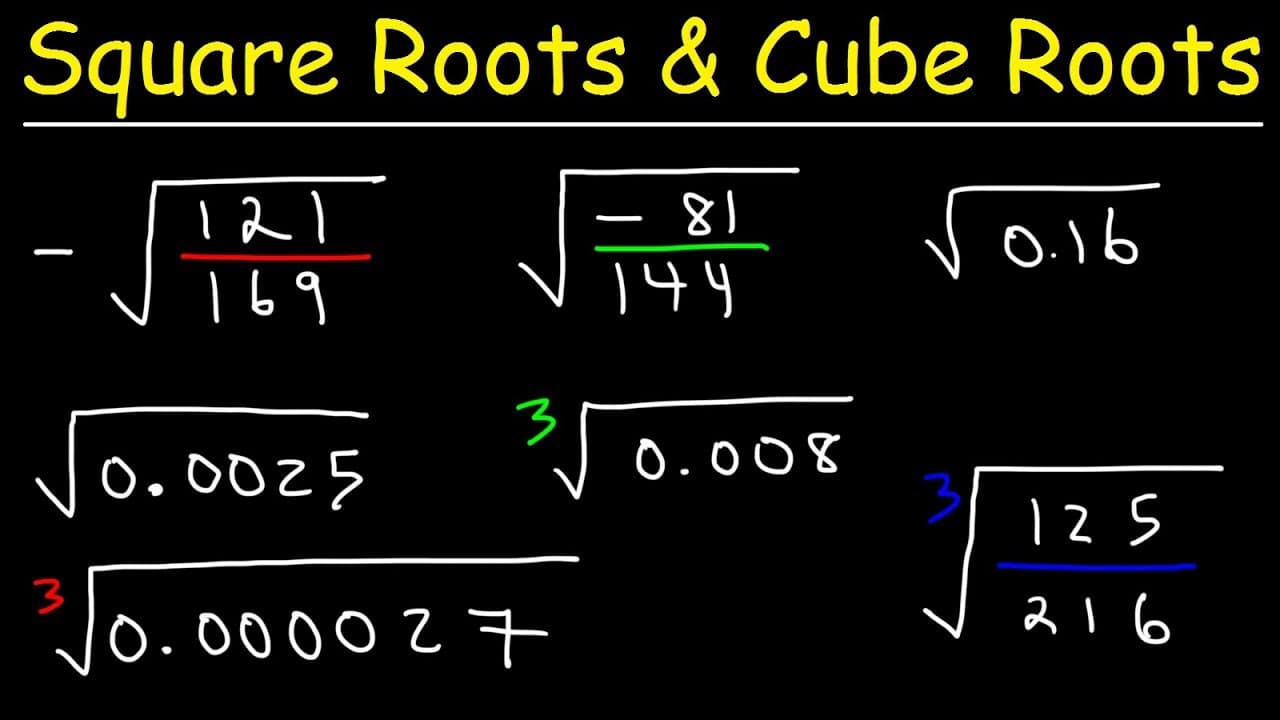
How to Calculate Square and Cube Roots of Fractions and Decimals

How to Calculate Square and Cube Roots of Fractions and Decimals

This educational math tutorial provides a comprehensive guide to evaluating square roots and cube roots involving integers, fractions, and decimal numbers. The video systematically progresses from basic perfect squares to more complex problems involving negative radicands (introducing imaginary numbers) and the specific rules for determining the placement of decimal points when calculating roots of decimal numbers. It utilizes a digital blackboard format where problems are handwritten and solved in real-time.

The Organic Chemistry TutorThe Organic Chemistry Tutor

6mins 51s

Solving Quadratic Equations and Graphing Parabolas

Solving Quadratic Equations and Graphing Parabolas

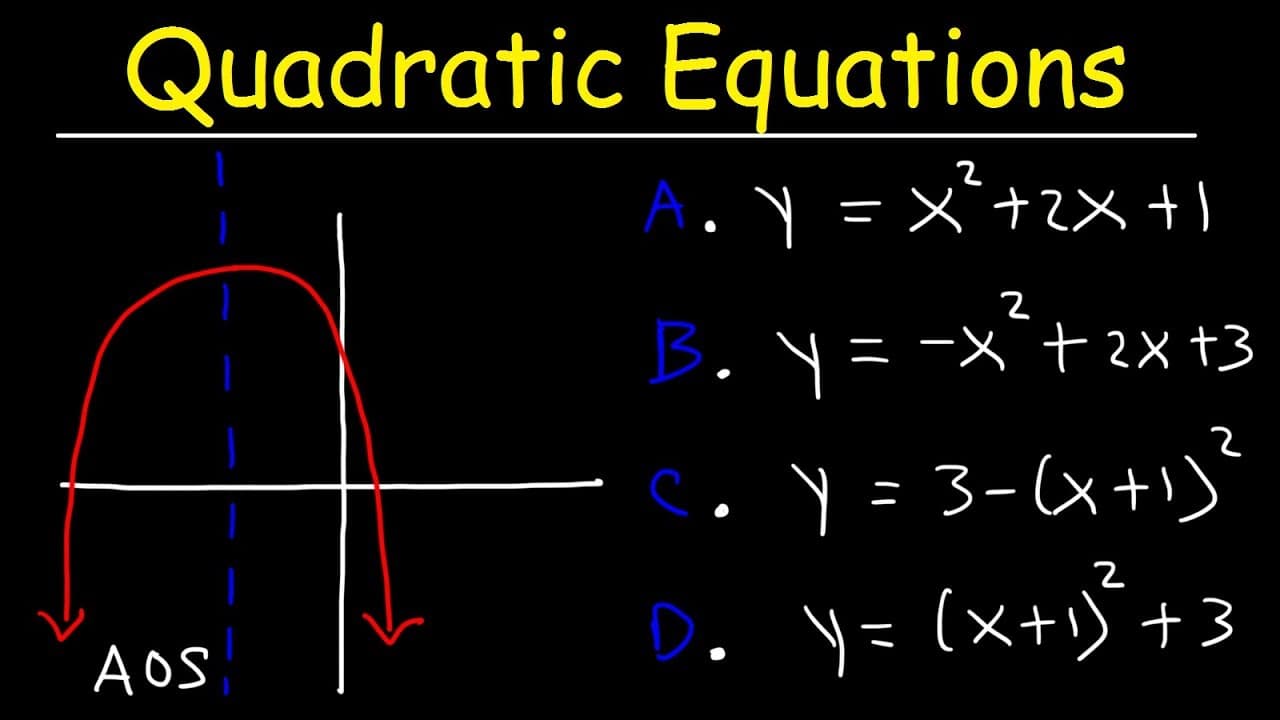
This comprehensive math tutorial guides students through a series of ten practice problems focused on quadratic equations and functions. The video adopts a 'quiz' format where viewers are encouraged to pause and solve each multiple-choice problem before watching the step-by-step solution. The narrator covers a wide range of essential skills, from visually matching equations to graphs to performing algebraic manipulations like factoring, completing the square, and using the quadratic formula. Key mathematical themes include identifying properties of parabolas (direction of opening, y-intercepts, vertices), solving for x-intercepts using factorization and the quadratic formula, finding the range and axis of symmetry, and converting between standard and vertex forms. The video also touches on more advanced topics such as finding equations from complex roots involving imaginary numbers and finding quadratic models given specific points. The video concludes with a real-world application problem involving revenue maximization, demonstrating the practical utility of finding the vertex of a parabola. This resource is highly valuable for Algebra I and II students preparing for exams, as it reinforces conceptual understanding while demonstrating efficient problem-solving strategies such as eliminating incorrect multiple-choice answers and checking work through substitution.

The Organic Chemistry TutorThe Organic Chemistry Tutor

16mins 57s

Algebra 1 Final Exam Review: From Arithmetic to Logarithms

Algebra 1 Final Exam Review: From Arithmetic to Logarithms

This comprehensive video serves as a rapid-fire review of core algebra concepts, ranging from basic arithmetic operations to advanced equation solving. It begins by establishing a foundation with number systems, including real, rational, and imaginary numbers, before moving into fundamental operations with integers, fractions, and decimals. The instructor demonstrates various techniques for arithmetic, such as the number line for integers and the 'keep-change-flip' method for dividing fractions, ensuring viewers have the prerequisite skills for algebra. The content progresses into key algebraic topics including exponents, radicals, and polynomial factoring. Viewers are guided through the laws of exponents, simplifying complex radical expressions, and converting between exponential and radical forms. A significant portion of the video is dedicated to solving different types of equations: linear equations involving fractions, quadratic equations using both factoring and the quadratic formula, and exponential and logarithmic equations. The instructor emphasizes checking for extraneous solutions, particularly with logarithmic and rational equations. This video is an invaluable resource for students preparing for an Algebra 1 final exam or an Algebra 2 placement test. Its modular structure allows teachers to use specific segments for targeted review or as a complete overview of the curriculum. The step-by-step problem-solving approach models mathematical thinking, making it ideal for classroom observation, homework support, or 'flipped classroom' assignments where students review the theory at home and solve problems in class.
The Organic Chemistry TutorThe Organic Chemistry Tutor

12mins 10s

Solving Complex Number Problems: Operations and Simplification

Solving Complex Number Problems: Operations and Simplification

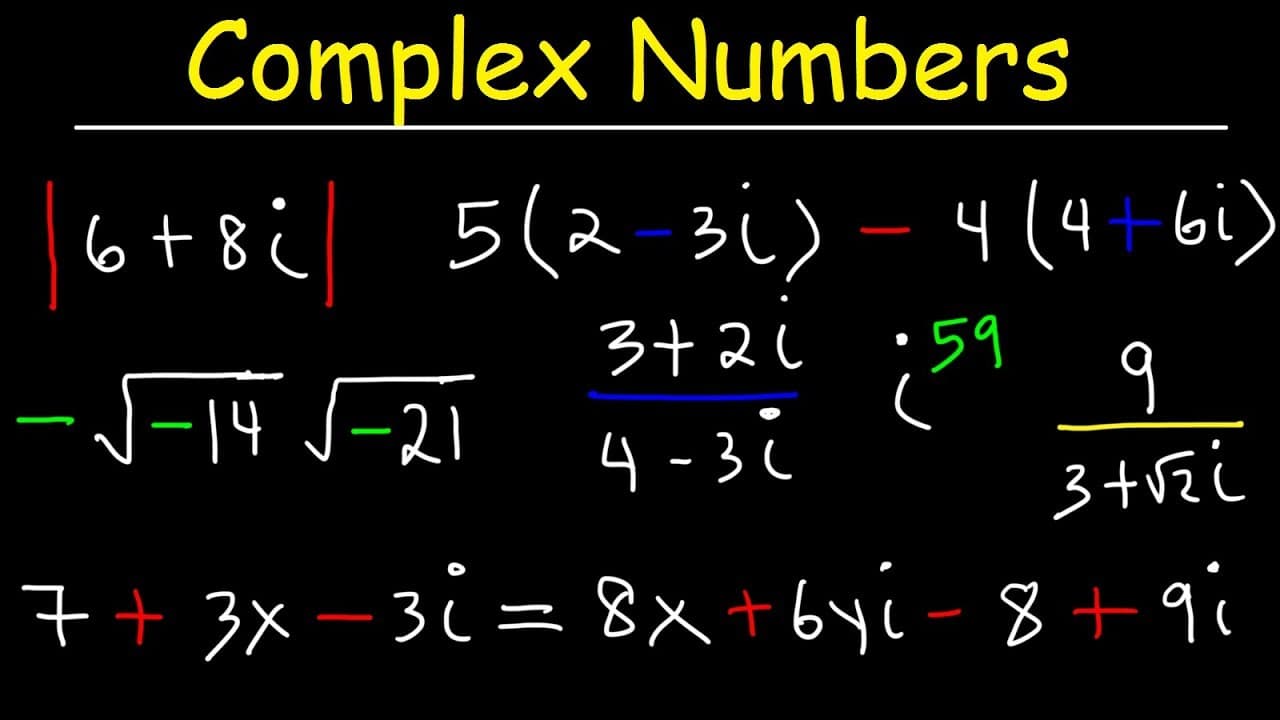
This comprehensive math tutorial guides students through ten specific practice problems involving complex numbers. The video utilizes a digital whiteboard format to demonstrate step-by-step solutions for a variety of operations, including finding absolute values, simplifying expressions through addition, subtraction, and multiplication, and handling exponents of the imaginary unit *i*. The narrator encourages viewer participation by suggesting they pause and attempt the problems before watching the solution. The content covers essential algebraic concepts applied to the complex number system. Key themes include the cyclic nature of powers of *i*, the use of complex conjugates to rationalize denominators, the expansion of binomials involving imaginary terms, and the technique of equating real and imaginary parts to solve for variables. A significant portion of the video focuses on the specific arithmetic rules that differ from real numbers, such as simplifying square roots of negative numbers and substituting -1 for *i* squared. For educators, this video serves as an excellent review module or independent practice resource for Algebra II or Pre-Calculus students. It reinforces procedural fluency by modeling best practices, such as distributing negative signs carefully and converting negative radicals to imaginary numbers before multiplication to avoid common errors. The multiple-choice format of the questions also makes it valuable for standardized test preparation.

The Organic Chemistry TutorThe Organic Chemistry Tutor

12mins 55s

Solving Simple Quadratic Equations by Taking Square Roots

Solving Simple Quadratic Equations by Taking Square Roots

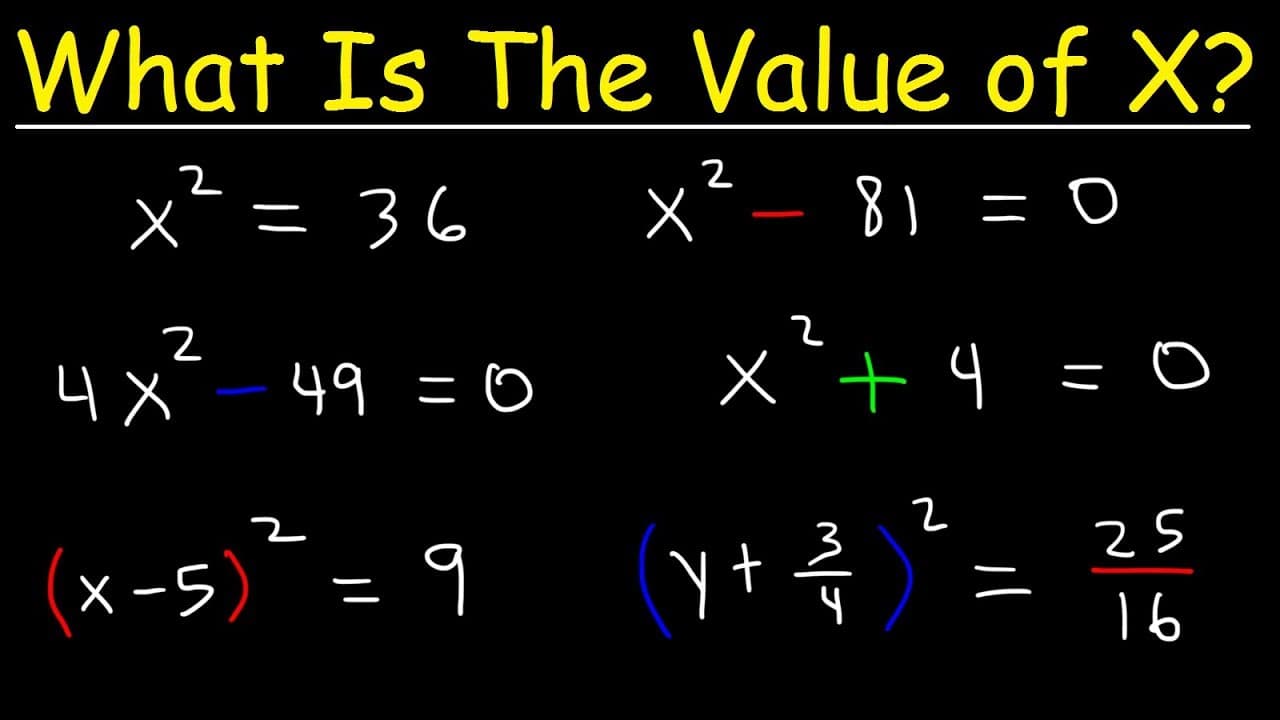
This math tutorial provides a step-by-step guide to solving simple quadratic equations using the square root method. The video progresses from basic integer problems to more complex variations involving zero-product rearrangement, coefficients, fractions, and imaginary numbers. The instructor demonstrates how to isolate the squared term and apply the square root property, emphasizing the importance of including both positive and negative solutions. The content covers key algebraic themes including inverse operations, properties of equality, and the introduction of complex numbers. A significant portion of the video is dedicated to handling arithmetic with fractions and binomial squares, helping students understand that the variable term can be an expression like (x-5) rather than just a single letter. The inclusion of an equation resulting in an imaginary solution (involving 'i') bridges the gap between Algebra I and Algebra II concepts. For educators, this video serves as an excellent direct instruction tool or review resource for units on quadratic equations. It effectively models procedural fluency, showing students exactly how to format their work and check their logic. The clear visual progression makes it useful for flipping the classroom or supporting students who struggle with the algorithmic steps of solving equations. The variety of examples allows for differentiation, challenging advanced students with fraction operations while supporting foundational learners with simple integer examples.

The Organic Chemistry TutorThe Organic Chemistry Tutor

5mins 23s

Finding Complex Solutions Using the Quadratic Formula

Finding Complex Solutions Using the Quadratic Formula

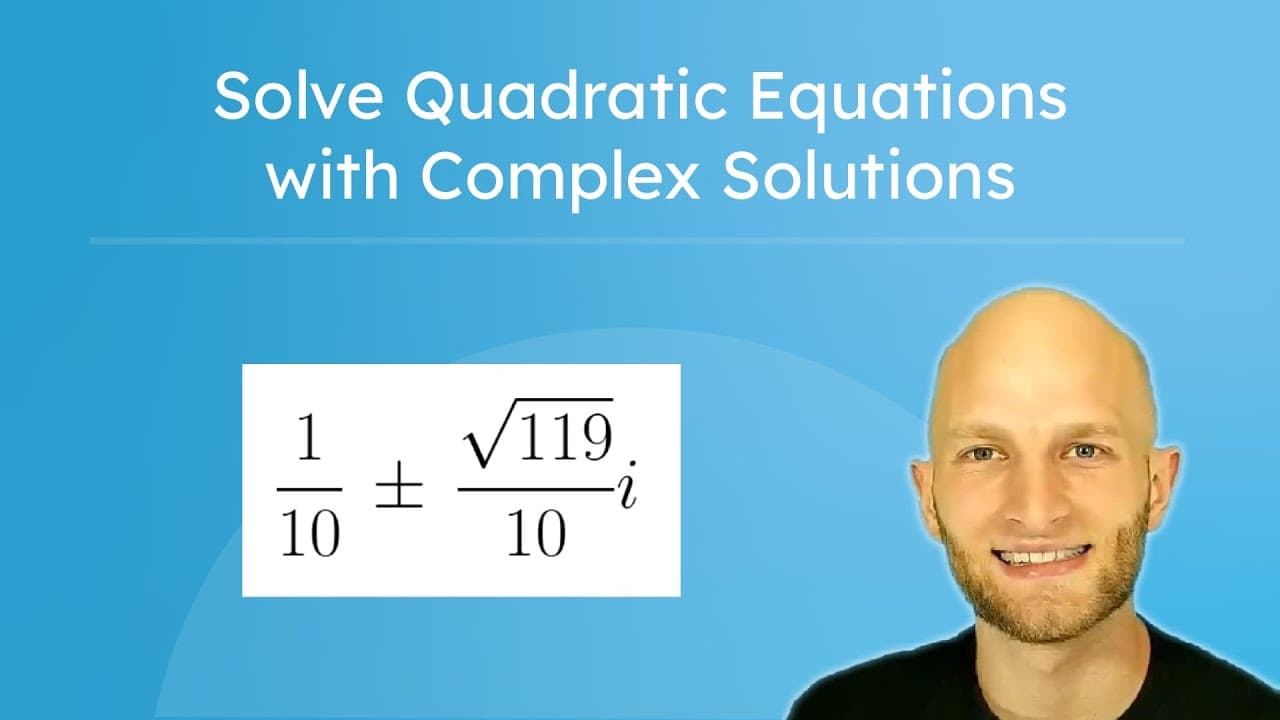
This educational math video guides students through the process of finding complex solutions to quadratic equations using the quadratic formula. The host, Randy, begins by presenting a specific equation, $5x^2 - x + 6 = 0$, and connects the algebraic problem to its visual representation. He demonstrates that because the parabola graphed from this equation never touches the x-axis, it has no real solutions, necessitating the use of complex numbers. The video covers key themes including identifying coefficients ($a, b, c$), substituting values into the quadratic formula, simplifying the discriminant, and handling negative square roots using the imaginary unit $i$. A significant portion of the video is dedicated to the arithmetic simplification process and the proper formatting of complex numbers in $a + bi$ form. For educators, this video serves as an excellent bridge between graphical interpretation and algebraic manipulation in Algebra II curricula. It visually reinforces the concept of the discriminant determining the nature of roots. The clear, step-by-step narration makes it a useful tool for introducing complex roots or for reviewing the procedural mechanics of the quadratic formula before tackling more advanced polynomial functions.

Miacademy & MiaPrep Learning ChannelMiacademy & MiaPrep Learning Channel

6mins 19s

Sequences

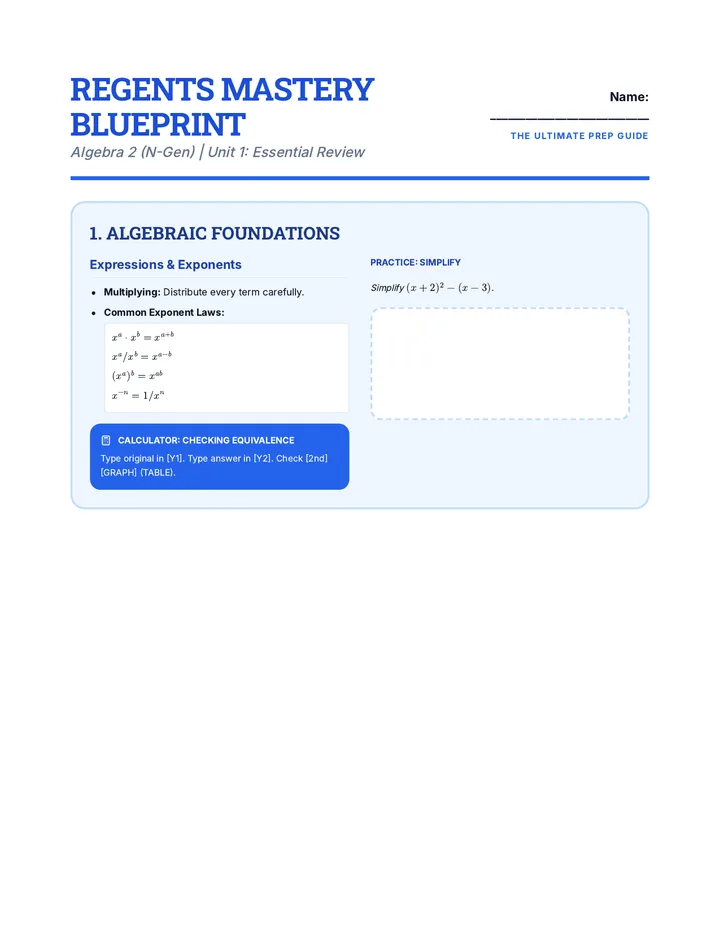
Regents Mastery Blueprint Study Guide

Regents Mastery Suite

A comprehensive review suite for the New York State Mathematics Regents exams, including Algebra 1, Geometry, and Algebra 2, featuring mastery blueprints, calculator strategies, and exam-taking tips.

KB

Kayla Borozny

15
Strategy Blueprint Slides

ACT Math Mastery

A comprehensive ACT Math preparation program focusing on essential strategies, high-yield Algebra and Geometry concepts, and realistic practice to boost scores.

AL

ava larumbe

26
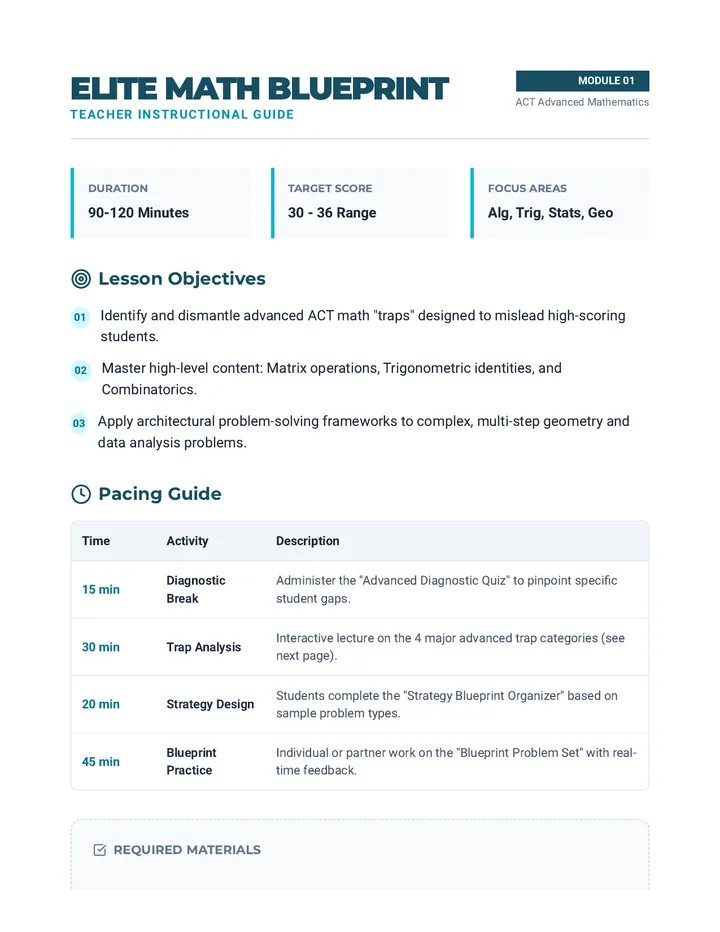
Elite Math Teacher Guide

Advanced ACT Mastery

A comprehensive prep sequence for the most challenging questions on the ACT Math and Science sections. It focuses on high-level conceptual blueprints for math topics like complex numbers and matrices, alongside speed-reading and data-interpretation strategies for the Science section.

AL

ava larumbe

29
Circuit Instruction Slides

Complex Circuits

A Tier 2 intervention sequence focused on mastering operations with complex numbers, specifically designed for small group instruction with visual scaffolding.

3
Complex Operations Slides

Complex Circuits Sequence

A targeted intervention sequence for Tier 2 high school students focusing on mastering arithmetic operations with complex numbers, emphasizing visual scaffolding and color-coded procedures.

4
Operation Intel Teacher Guide

Imaginary Intel

A targeted intervention sequence focusing on performing operations with complex numbers using fundamental algebraic properties and the identity i² = -1.

5

Lessons

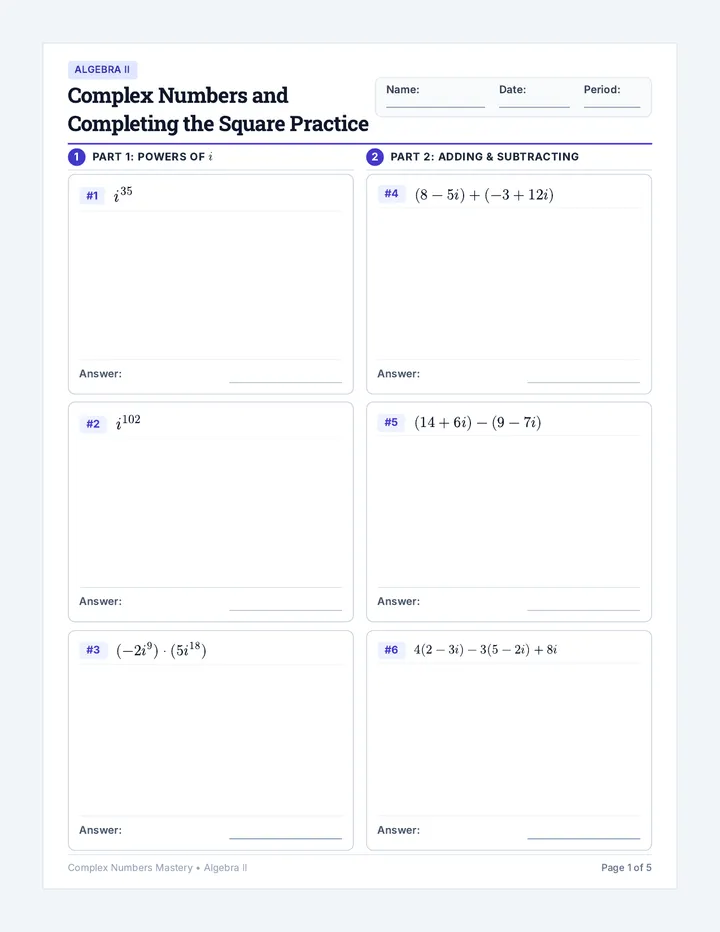
Complex Numbers and Complete Square Mastery Worksheet

Complex Numbers Mastery

A comprehensive 11th grade algebra lesson covering complex number operations, rationalization with conjugates, complex equations, and completing the square with complex roots.

AR

Angie Rice

3
Complex Sync Exit Ticket

Complex Circuits Assessment

A quick assessment lesson on adding complex numbers, focusing on combining like terms (real and imaginary components) and correcting common misconceptions.

LH

Lisa Holifield

7
Formula Blueprint Worksheet

Quadratic Blueprint

A technical, step-by-step guide and template for mastering the quadratic formula through visual color-coding. This lesson provides students with a structured 'blueprint' to decompose and solve quadratic equations with precision.

MQ

Melanie Quick

1
Vector Vision Exit Ticket

Polar Navigation

A series of focused assessments to verify student mastery of polar coordinate plotting, conversion, graphing special curves, and representing complex numbers in polar form.

S

SANDRA.MOORE

4
Semester 2 Mastery Answer Key

Semester 2 Mastery

A comprehensive final exam for Semester 2 of Algebra 2 Credit Recovery, covering radicals, factoring, quadratics, and rational functions.

MQ

Melanie Quick

2
Quantum Complex Exit Ticket

Quantum Complex Solutions

A quick assessment focusing on solving quadratic equations that result in complex solutions using the Quadratic Formula and Completing the Square.

SR

Saifel-Dein Raja

2