Weight Benchmark Lab Worksheet Weight Benchmark Lab
Grade 3 • Module 2 • Lesson 7 (Modified Practice)
Name: ______________________
Date: ____________
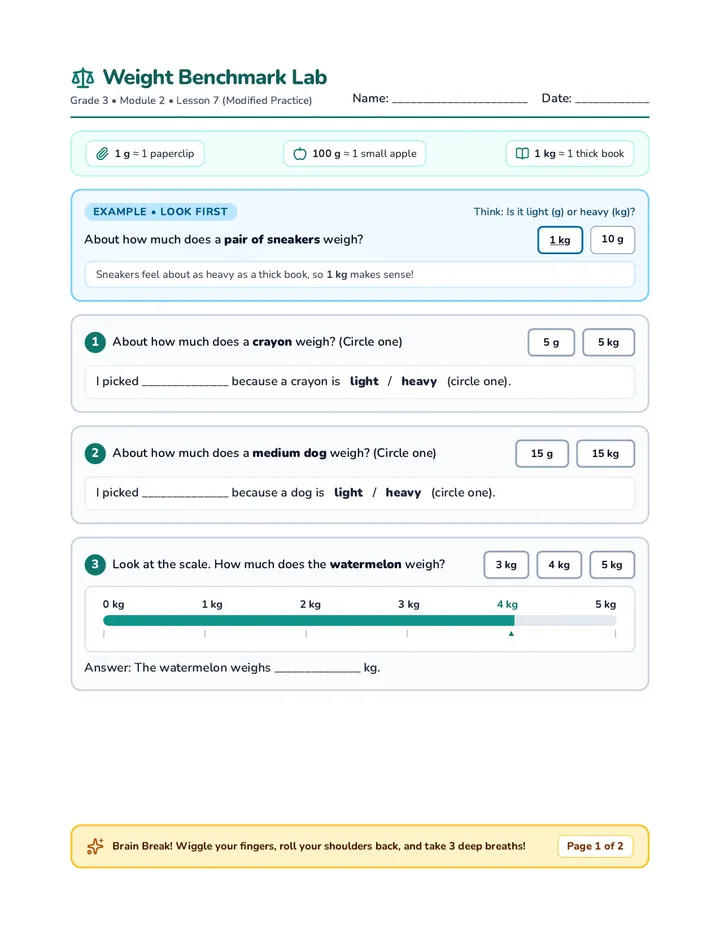
1 g ≈ 1 paperclip
100 g ≈ 1 small apple
1 kg ≈ 1 thick book
Example • Look First Think: Is it light (g) or heavy (kg)?
About how much does a pair of sneakers weigh?
1 kg 10 g
Sneakers feel about as heavy as a thick book, so 1 kg makes sense!
1
About how much does a crayon weigh? (Circle one)
5 g 5 kg
I picked ______________ because a crayon is light / heavy (circle one).
2
About how much does a medium dog weigh? (Circle one)
15 g 15 kg
I picked ______________ because a dog is light / heavy (circle one).
3
Look at the scale. How much does the watermelon weigh?
3 kg 4 kg 5 kg
0 kg 1 kg 2 kg 3 kg 4 kg 5 kg
||||▲|
Answer: The watermelon weighs ______________ kg.
Brain Break! Wiggle your fingers, roll your shoulders back, and take 3 deep breaths!
Page 1 of 2
Weight Benchmark Lab — Part 2
Remember: 1 kg = heavy • 1 g = light
4
Look at the scale. How much does the bag of grapes weigh?
200 g 300 g 400 g
0 g 100 g 200 g 300 g 400 g 500 g
|||▲||
Answer: The grapes weigh ______________ g.
5
A textbook weighs 2 kg . A feather weighs 1 g . Which is heavier ?
Textbook (2 kg)
Feather (1 g)
Answer: The ________________________ is heavier.
6
Draw or write one thing in our classroom that weighs about 1 kg .
How did this work feel? (Circle one)
😊 Easy for me
🙂 Good with help
🤔 Need more practice
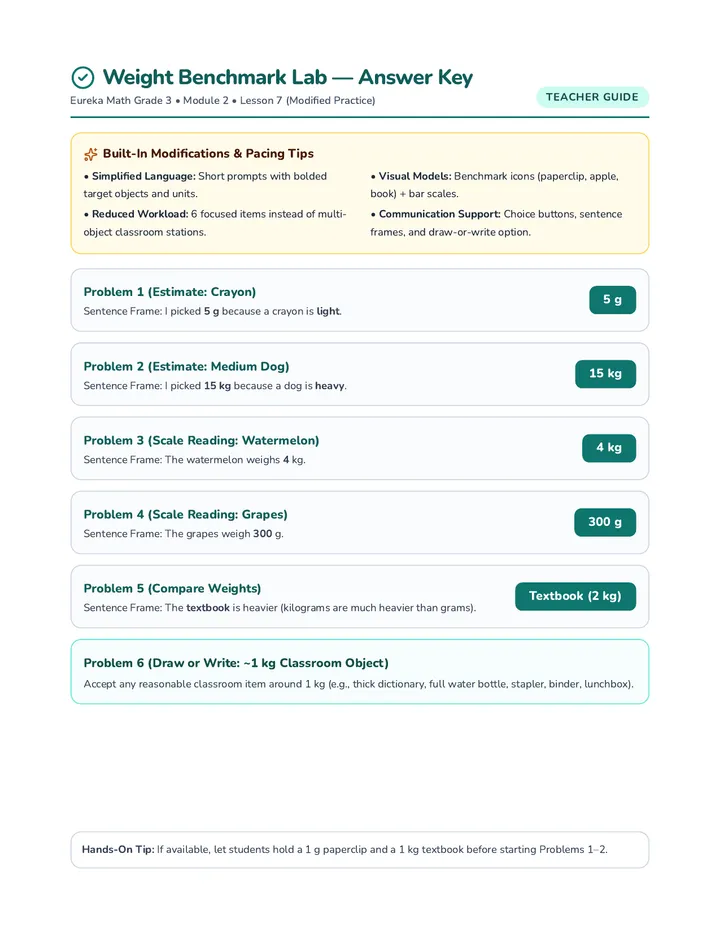
Weight Benchmark Lab Answer Key Weight Benchmark Lab — Answer Key
Eureka Math Grade 3 • Module 2 • Lesson 7 (Modified Practice)
Teacher Guide
Built-In Modifications & Pacing Tips
• Simplified Language: Short prompts with bolded target objects and units.
• Visual Models: Benchmark icons (paperclip, apple, book) + bar scales.
• Reduced Workload: 6 focused items instead of multi-object classroom stations.
• Communication Support: Choice buttons, sentence frames, and draw-or-write option.
Problem 1 (Estimate: Crayon)
Sentence Frame: I picked 5 g because a crayon is light .
5 g
Problem 2 (Estimate: Medium Dog)
Sentence Frame: I picked 15 kg because a dog is heavy .
15 kg
Problem 3 (Scale Reading: Watermelon)
Sentence Frame: The watermelon weighs 4 kg.
4 kg
Problem 4 (Scale Reading: Grapes)
Sentence Frame: The grapes weigh 300 g.
300 g
Problem 5 (Compare Weights)
Sentence Frame: The textbook is heavier (kilograms are much heavier than grams).
Textbook (2 kg)
Problem 6 (Draw or Write: ~1 kg Classroom Object)
Accept any reasonable classroom item around 1 kg (e.g., thick dictionary, full water bottle, stapler, binder, lunchbox).
Hands-On Tip: If available, let students hold a 1 g paperclip and a 1 kg textbook before starting Problems 1–2.
Metric Weight Quest Worksheet Metric Weight Quest
Grade 3 • Module 2 • Lesson 8 (Modified Practice)
Name: ______________________
Date: ____________
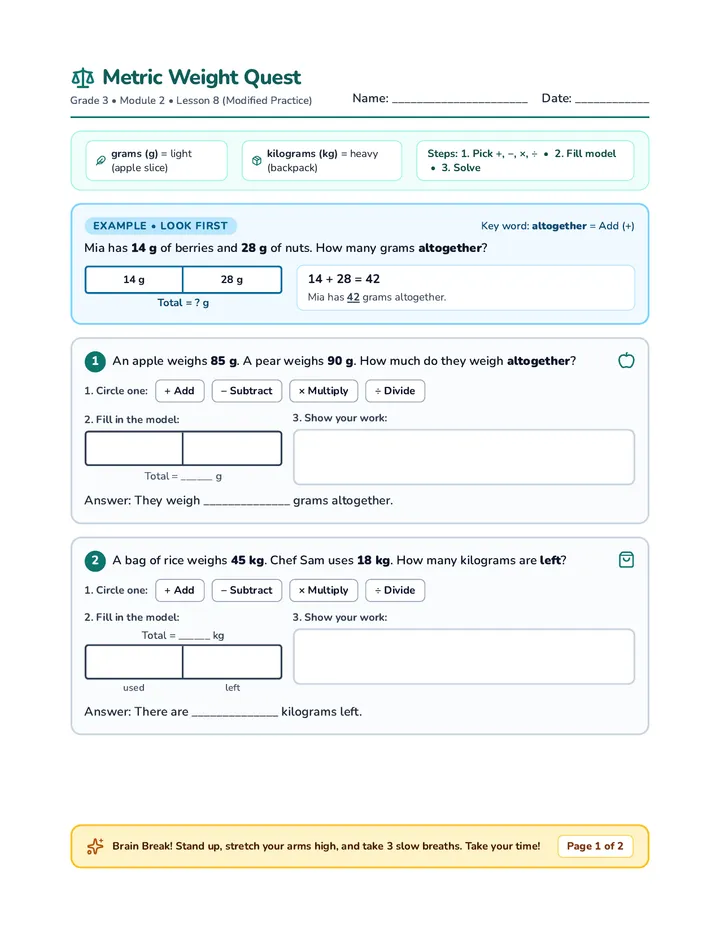
grams (g) = light (apple slice)
kilograms (kg) = heavy (backpack)
Steps: 1. Pick +, −, ×, ÷ • 2. Fill model • 3. Solve
Example • Look First Key word: altogether = Add (+)
Mia has 14 g of berries and 28 g of nuts. How many grams altogether ?
14 g
28 g
Total = ? g
14 + 28 = 42
Mia has 42 grams altogether.
1
An apple weighs 85 g . A pear weighs 90 g . How much do they weigh altogether ?
1. Circle one:
+ Add − Subtract × Multiply ÷ Divide
2. Fill in the model:
Total = ______ g
3. Show your work:
Answer: They weigh ______________ grams altogether.
2
A bag of rice weighs 45 kg . Chef Sam uses 18 kg . How many kilograms are left ?
1. Circle one:
+ Add − Subtract × Multiply ÷ Divide
2. Fill in the model:
Total = ______ kg
used
left
3. Show your work:
Answer: There are ______________ kilograms left.
Brain Break! Stand up, stretch your arms high, and take 3 slow breaths. Take your time!
Page 1 of 2
Metric Weight Quest — Part 2
Remember: Take your time and use the models!
3
One box of books weighs 6 kg . There are 4 boxes . How much do all the boxes weigh in all ?
1. Circle one:
+ Add − Subtract × Multiply ÷ Divide
2. Write the weight in each box:
Total = ______ kg
3. Show your work:
Answer: All the boxes weigh ______________ kilograms in all.
4
A baker has 35 g of sugar. She puts equal amounts into 5 bowls . How many grams go in each bowl?
1. Circle one:
+ Add − Subtract × Multiply ÷ Divide
2. Share the total into 5 bowls:
Total = 35 g
1 bowl = ______ g
3. Show your work:
Answer: ______________ grams go in each bowl.
5. Quick Estimate Check
A dog weighs 12 kg . Which number is 12 kg closer to?
10 kg
20 kg
How did this work feel? (Circle one)
😊 Easy for me
🙂 Good with help
🤔 Need more practice
Metric Weight Quest Answer Key Metric Weight Quest — Answer Key
Eureka Math Grade 3 • Module 2 • Lesson 8 (Modified Practice)
Teacher Guide
Built-In Modifications & Pacing Tips
• Simplified Language: Short sentences, bolded action/unit words, 3-step checklist.
• Visual Models: Worked example + pre-drawn tape diagrams on every problem.
• Reduced Workload: 4 core one-step problems (+, −, ×, ÷) + 1 estimate check; built-in Brain Break.
• Communication Support: Operation choices, sentence frames, and emoji self-check.
Problem 1 (Addition) + Add
85 g
90 g
Total = 175 g
85 + 90 = 175
Sentence Frame: They weigh 175 grams altogether.
Problem 2 (Subtraction) − Subtract
Total = 45 kg
18 kg (used)
27 kg (left)
45 − 18 = 27
Sentence Frame: There are 27 kilograms left.
Problem 3 (Multiplication) × Multiply
6 kg
6 kg
6 kg
6 kg
Total = 24 kg
4 × 6 = 24 (or 6 + 6 + 6 + 6 = 24)
Sentence Frame: All the boxes weigh 24 kilograms in all.
Problem 4 (Division) ÷ Divide
Total = 35 g
7 g
7 g
7 g
7 g
7 g
35 ÷ 5 = 7
Sentence Frame: 7 grams go in each bowl.
Problem 5 (Quick Estimate Check)
12 kg is 2 away from 10 kg and 8 away from 20 kg.
10 kg
Alternative Response Option: Students who struggle with handwriting may point to or circle the operation, fill in only the tape diagram numbers, and dictate their final sentence frame verbally.
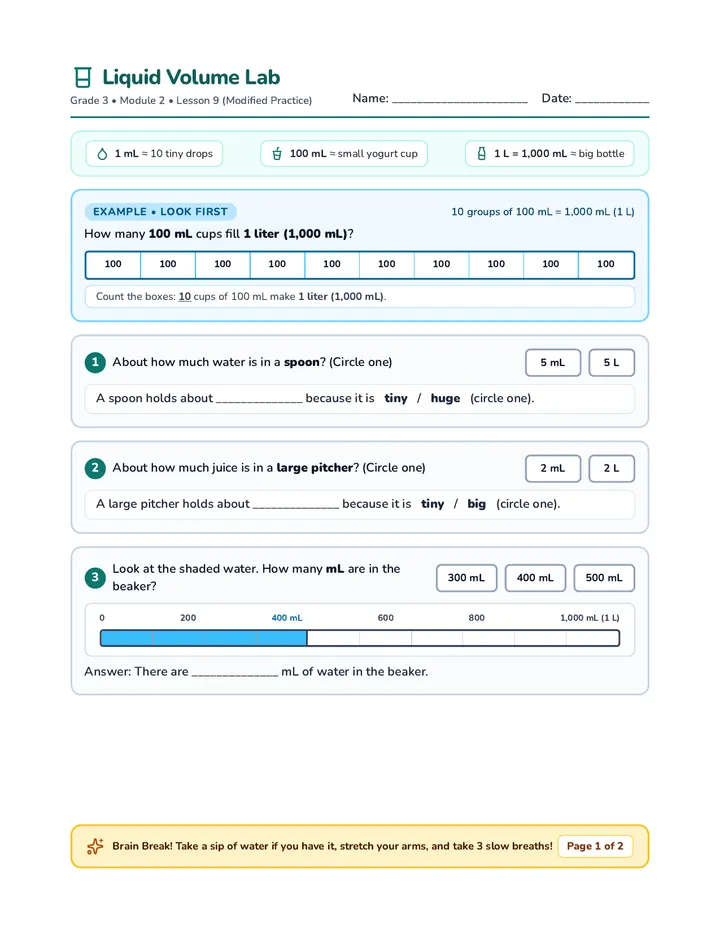
Liquid Volume Lab Worksheet Liquid Volume Lab
Grade 3 • Module 2 • Lesson 9 (Modified Practice)
Name: ______________________
Date: ____________
1 mL ≈ 10 tiny drops
100 mL ≈ small yogurt cup
1 L = 1,000 mL ≈ big bottle
Example • Look First 10 groups of 100 mL = 1,000 mL (1 L)
How many 100 mL cups fill 1 liter (1,000 mL) ?
100
100
100
100
100
100
100
100
100
100
Count the boxes: 10 cups of 100 mL make 1 liter (1,000 mL) .
1
About how much water is in a spoon ? (Circle one)
5 mL 5 L
A spoon holds about ______________ because it is tiny / huge (circle one).
2
About how much juice is in a large pitcher ? (Circle one)
2 mL 2 L
A large pitcher holds about ______________ because it is tiny / big (circle one).
3
Look at the shaded water. How many mL are in the beaker?
300 mL 400 mL 500 mL
0200400 mL6008001,000 mL (1 L)
Answer: There are ______________ mL of water in the beaker.
Brain Break! Take a sip of water if you have it, stretch your arms, and take 3 slow breaths!
Page 1 of 2
Liquid Volume Lab — Part 2
Remember: 1 liter (L) = 1,000 milliliters (mL)
4
A beaker has 600 mL of water. How many more mL do we need to make 1 liter (1,000 mL) ?
1 Liter = 1,000 mL
600 mL (water)
? mL (empty)
1. Circle one:
300 mL 400 mL 500 mL
2. Show your work (optional):
Answer: We need ______________ mL more to make 1 liter.
5
Count by 100 mL . Write the 3 missing numbers in the blank boxes.
100 mL
200 mL
400 mL
500 mL
700 mL
800 mL
1,000 mL
How did this work feel? (Circle one)
😊 Easy for me
🙂 Good with help
🤔 Need more practice
Liquid Volume Lab Answer Key Liquid Volume Lab — Answer Key
Eureka Math Grade 3 • Module 2 • Lesson 9 (Modified Practice)
Teacher Guide
Built-In Modifications & Pacing Tips
• Simplified Language: Short prompts with bolded units (mL, L).
• Visual Models: Benchmark icons, 10-part liter bar, and shaded beaker gauges.
• Reduced Workload: 5 core items focusing on benchmarks, reading, and 1,000 mL bonds.
• Communication Support: Choice buttons, sentence frames, and emoji self-check.
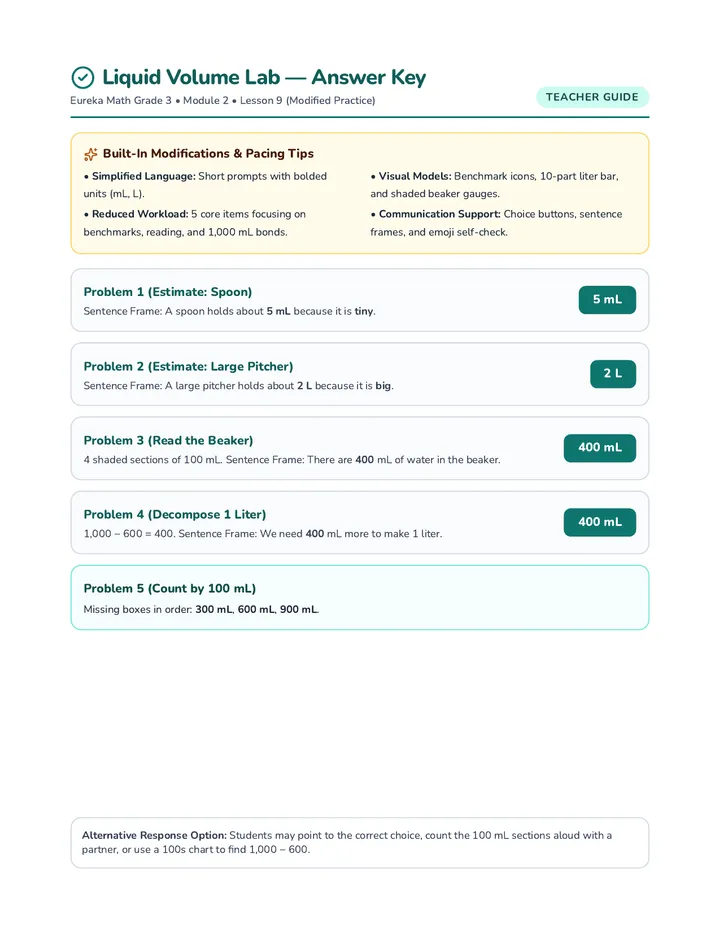
Problem 1 (Estimate: Spoon)
Sentence Frame: A spoon holds about 5 mL because it is tiny .
5 mL
Problem 2 (Estimate: Large Pitcher)
Sentence Frame: A large pitcher holds about 2 L because it is big .
2 L
Problem 3 (Read the Beaker)
4 shaded sections of 100 mL. Sentence Frame: There are 400 mL of water in the beaker.
400 mL
Problem 4 (Decompose 1 Liter)
1,000 − 600 = 400. Sentence Frame: We need 400 mL more to make 1 liter.
400 mL
Problem 5 (Count by 100 mL)
Missing boxes in order: 300 mL , 600 mL , 900 mL .
Alternative Response Option: Students may point to the correct choice, count the 100 mL sections aloud with a partner, or use a 100s chart to find 1,000 − 600.