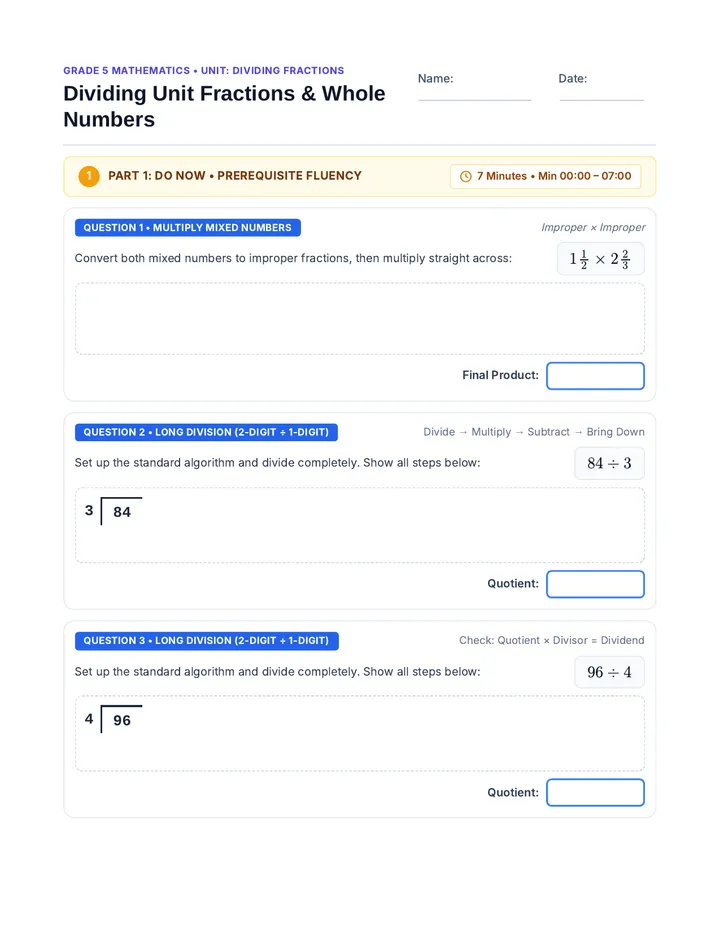
Unit Fraction Division WorksheetGrade 5 Mathematics • Unit: Dividing Fractions Dividing Unit Fractions & Whole Numbers Name: Date: 1 Part 1: Do Now • Prerequisite Fluency 7 Minutes • Min 00:00 – 07:00 Question 1 • Multiply Mixed Numbers Improper × Improper Convert both mixed numbers to improper fractions, then multiply straight across: \( 1\frac{1}{2} \times 2\frac{2}{3} \) Final Product: Question 2 • Long Division (2-Digit ÷ 1-Digit) Divide → Multiply → Subtract → Bring Down Set up the standard algorithm and divide completely. Show all steps below: \( 84 \div 3 \) 3 84 Quotient: Question 3 • Long Division (2-Digit ÷ 1-Digit) Check: Quotient × Divisor = Dividend Set up the standard algorithm and divide completely. Show all steps below: \( 96 \div 4 \) 4 96 Quotient: Heart of the Lesson • Conceptual Discovery Part 2: Guided Practice 15 Minutes • Min 07:00 – 22:00 Pattern Rule • Dividing a Unit Fraction by a Whole Number: \( \frac{1}{a} \div b = \frac{1}{a \times b} \) 1. Start with \( \frac{1}{a} \) Look at 1 whole split into \(a\) equal parts. Focus on one shaded \( \frac{1}{a} \) piece. 2. Split into \(b\) Groups Partition each \( \frac{1}{a} \) part into \(b\) equal groups to see the new total parts in 1 whole. 3. Spot the Pattern Total parts = \(a \times b\), so each part is \( \frac{1}{a \times b} \). More groups = smaller parts! Problem 1 • Teacher Model Evaluate: \( \frac{1}{2} \div 3 \) Tape Diagram (Split each \( \frac{1}{2} \) into 3 parts) \( \frac{1}{2} \) \( \frac{1}{2} \) 1 whole = 2 halves → split each into 3 equal groups Pattern & Reasoning Equation & Quotient Problem 2 • Guided Practice Evaluate: \( \frac{1}{3} \div 2 \) Tape Diagram (Split each \( \frac{1}{3} \) into 2 parts) \( \frac{1}{3} \) \( \frac{1}{3} \) \( \frac{1}{3} \) 1 whole = 3 thirds → split each into 2 equal groups Pattern & Reasoning Equation & Quotient Problem 3 • Partner Practice Evaluate: \( \frac{1}{4} \div 3 \) Tape Diagram (Split each \( \frac{1}{4} \) into 3 parts) \( \frac{1}{4} \) \( \frac{1}{4} \) \( \frac{1}{4} \) \( \frac{1}{4} \) 1 whole = 4 fourths → split each into 3 equal groups Pattern & Reasoning Equation & Quotient Solo Fluency Practice Part 3: Independent Practice 18 Minutes • Min 22:00 – 40:00 Directions: Solve each problem using the pattern \( \frac{1}{a} \div b = \frac{1}{a \times b} \). Partition the tape diagram or draw equal groups to justify your answer. Problem 1 • Model & Pattern Evaluate: \( \frac{1}{5} \div 2 \) Partition Each \( \frac{1}{5} \) into 2 Equal Groups \( \frac{1}{5} \) \( \frac{1}{5} \) \( \frac{1}{5} \) \( \frac{1}{5} \) \( \frac{1}{5} \) Show Work Final Quotient Problem 2 • Pattern Fluency Use \( \frac{1}{a} \div b = \frac{1}{a \times b} \) 2A. Evaluate: \( \frac{1}{6} \div 3 \) Quotient: 2B. Evaluate: \( \frac{1}{4} \div 5 \) Quotient: Problem 3 • Application Word Problem A baker has \( \frac{1}{3} \) pound of cinnamon. She splits it equally into 4 small jars. How many pounds of cinnamon are in each jar? Tape Diagram & Equation Cinnamon per Jar Problem 4 • Explain Why Use “equal groups” language Explain why \( \frac{1}{2} \div 5 \) results in a smaller piece than \( \frac{1}{2} \div 3 \). How does splitting into more equal groups affect the denominator? Final Formative Check Part 4: Exit Ticket 8 Minutes • Min 40:00 – 48:00 Complete all 3 questions independently to show your mastery of dividing unit fractions by whole numbers. Question 1 • Model & Evaluate Evaluate: \( \frac{1}{3} \div 4 \) Partition Each \( \frac{1}{3} \) into 4 Equal Parts \( \frac{1}{3} \) \( \frac{1}{3} \) \( \frac{1}{3} \) Show Pattern Final Quotient Question 2 • Apply the Pattern Evaluate: \( \frac{1}{8} \div 2 \) Show Your Thinking (Equation or Diagram) Final Quotient Question 3 • Error Analysis Core Rule Maya attempted to solve \( \frac{1}{4} \div 3 \) and wrote \( \frac{3}{4} \). Explain Maya’s mistake using “equal groups” language, and find the correct quotient. Correct Quotient: Self-Check: Can you divide a unit fraction by a whole number and explain why the denominator gets larger? Need Help Almost Got It!
Unit Fraction Division ExemplarGrade 5 Mathematics • Teacher Exemplar & Script Dividing Unit Fractions: Exemplar Key Teacher Copy Lesson Stamp & Key Understandings (IM 12.3) Core Takeaway: To divide a unit fraction by a whole number, the quotient is a unit fraction with a denominator that is the whole times the denominator: \( \frac{1}{a} \div b = \frac{1}{a \times b} \). We are splitting the unit fraction into equal groups, which increases the total number of parts across the whole—so the more equal groups we make, the smaller each part becomes. Facilitation Guardrail: Affirm when students notice “multiply the whole by the denominator,” but do NOT teach algorithms like Keep-Change-Flip. Students must justify why using “groups of” / equal-parts language. 1 Part 1: Do Now Exemplar (7 Min) Prerequisite Fluency Q1 • Multiply Mixed Numbers \( 1\frac{1}{2} \times 2\frac{2}{3} \) Step 1 (Improper Fractions): \( 1\frac{1}{2} = \frac{3}{2} \) and \( 2\frac{2}{3} = \frac{8}{3} \) Step 2 (Multiply Across): \( \frac{3}{2} \times \frac{8}{3} = \frac{3 \times 8}{2 \times 3} = \frac{24}{6} = 4 \) Final Product \( 4 \) Q2 • \( 84 \div 3 \) Quotient: 28 28 384 -6↓ 24 -24 0 Check: \( 28 \times 3 = 84 \) Q3 • \( 96 \div 4 \) Quotient: 24 24 496 -8↓ 16 -16 0 Check: \( 24 \times 4 = 96 \) Part 2: Guided Practice • Teacher Script & Exemplar Guided Practice Problems 1 & 2 15 Minutes • Min 07:00 – 22:00 Problem 1 • Teacher Model: \( \frac{1}{2} \div 3 = \frac{1}{6} \) I Do (5 min) Exemplar Tape Diagram (Each \( \frac{1}{2} \) split into 3 parts) \( \frac{1}{6} \) \( \frac{1}{6} \) \( \frac{1}{6} \) \( \frac{1}{6} \) \( \frac{1}{6} \) \( \frac{1}{6} \) Reasoning: Splitting each half into 3 equal groups makes \( 2 \times 3 = 6 \) total parts in 1 whole. Equation: \( \frac{1}{2} \div 3 = \frac{1}{2 \times 3} = \mathbf{\frac{1}{6}} \) Teacher Questions (Ask) “What does \( \frac{1}{2} \div 3 \) mean in this tape diagram?” “If we split this \( \frac{1}{2} \) into 3 equal groups, why must we also split the other \( \frac{1}{2} \) into 3 parts?” “How many total equal parts are in 1 whole now, and how can we find that using multiplication?” Expected Student Responses & Solve “We are sharing \( \frac{1}{2} \) into 3 equal groups.” “All parts in 1 whole must be equal-sized to name the fraction.” “There are 2 groups of 3, or \( 2 \times 3 = 6 \) parts in the whole, so 1 part is \( \frac{1}{6} \).” Problem 2 • Guided Practice: \( \frac{1}{3} \div 2 = \frac{1}{6} \) We Do (5 min) Exemplar Tape Diagram (Each \( \frac{1}{3} \) split into 2 parts) \( \frac{1}{6} \) \( \frac{1}{6} \) \( \frac{1}{6} \) \( \frac{1}{6} \) \( \frac{1}{6} \) \( \frac{1}{6} \) Reasoning: Splitting 3 thirds into 2 equal groups each creates 3 groups of 2 = 6 total parts in 1 whole. Equation: \( \frac{1}{3} \div 2 = \frac{1}{3 \times 2} = \mathbf{\frac{1}{6}} \) Teacher Questions (Ask) “How do we partition the shaded \( \frac{1}{3} \) to show \( \div 2 \)?” “Notice Problems 1 and 2 both equal \( \frac{1}{6} \)! Why do \( \frac{1}{2} \div 3 \) and \( \frac{1}{3} \div 2 \) give the same quotient?” “How does the size of one part compare to \( \frac{1}{3} \)?” Expected Student Responses & Review “Cut each third into 2 equal pieces, giving 3 groups of 2 = 6 pieces.” “Both \( 2 \times 3 \) and \( 3 \times 2 \) make 6 total equal parts in 1 whole.” “Each \( \frac{1}{6} \) is smaller than \( \frac{1}{3} \) because we split it into more equal groups.” Part 2: Guided Practice • Teacher Script & Review Guided Practice Problem 3 & Synthesis Partner Practice & Stamp Problem 3 • Partner Practice: \( \frac{1}{4} \div 3 = \frac{1}{12} \) You Do Together (5 min) Exemplar Tape Diagram (Each \( \frac{1}{4} \) split into 3 parts) \(\frac{1}{12}\) Reasoning: 4 fourths each split into 3 equal groups gives 4 groups of 3 = 12 total parts in 1 whole. Equation: \( \frac{1}{4} \div 3 = \frac{1}{4 \times 3} = \mathbf{\frac{1}{12}} \) Teacher Questions (Ask) “Before you draw, predict: will the quotient be larger or smaller than \( \frac{1}{4} \)? Why?” “How many groups of 3 are across the entire whole bar?” “Without drawing, how could you predict the denominator for \( \frac{1}{a} \div b \)?” Expected Student Responses “Smaller, because we are splitting \( \frac{1}{4} \) into 3 equal groups.” “There are 4 fourths, so 4 groups of 3 = 12 total parts in 1 whole.” “Multiply the denominator by the whole number: \( 4 \times 3 = 12 \), so \( \frac{1}{12} \).” How Will You Review Problems 1–3 & Stamp the Pattern? 1. Pattern Comparison Across Problems 1–3 Write all three equations on the board: \( \frac{1}{2} \div 3 = \frac{1}{6} \), \( \frac{1}{3} \div 2 = \frac{1}{6} \), and \( \frac{1}{4} \div 3 = \frac{1}{12} \). Ask: “What do you notice about the numerators and denominators?” Have students turn and talk to connect \( 2 \times 3 = 6 \), \( 3 \times 2 = 6 \), and \( 4 \times 3 = 12 \). 2. Watch For & Address Common Misconceptions If a student writes \( \frac{3}{4} \) for \( \frac{1}{4} \div 3 \) (multiplying the numerator), ask: “If you share \( \frac{1}{4} \) of a pan equally among 3 people, can each person get \( \frac{3}{4} \)—more than what you started with?” Redirect to the tape diagram to show splitting creates smaller pieces. 3. Final Conceptual Stamp (Before Independent Practice) Choral read: “To divide a unit fraction by a whole number, \( \frac{1}{a} \div b = \frac{1}{a \times b} \), because splitting each unit fraction into \( b \) equal groups makes \( a \times b \) total parts in the whole.” Parts 3 & 4 • Exemplar Key Independent Practice & Exit Ticket Exemplar Answer Key Part 3: Independent Practice Exemplar (18 Min) \( \frac{1}{a} \div b = \frac{1}{a \times b} \) Problem 1: \( \frac{1}{5} \div 2 \) Each \( \frac{1}{5} \) is split into 2 equal groups → \( 5 \times 2 = 10 \) total parts in 1 whole. \( \frac{1}{10} \) Problem 2A: \( \frac{1}{6} \div 3 \) \( \frac{1}{6 \times 3} = \frac{1}{18} \) \( \frac{1}{18} \) Problem 2B: \( \frac{1}{4} \div 5 \) \( \frac{1}{4 \times 5} = \frac{1}{20} \) \( \frac{1}{20} \) Problem 3 (Word Problem): \( \frac{1}{3} \text{ lb} \div 4 \text{ jars} \) Splitting \( \frac{1}{3} \) pound into 4 equal groups makes \( 3 \times 4 = 12 \) parts per whole pound. \( \frac{1}{12} \) lb Problem 4 (Explain Why): \( \frac{1}{2} \div 5 \) vs. \( \frac{1}{2} \div 3 \) Exemplar Response: Splitting \( \frac{1}{2} \) into 5 equal groups creates \( 2 \times 5 = 10 \) total parts in 1 whole (\( \frac{1}{10} \)), whereas splitting into 3 equal groups creates \( 2 \times 3 = 6 \) total parts (\( \frac{1}{6} \)). Making more equal groups increases the denominator and makes each part smaller. Part 4: Exit Ticket Exemplar (8 Min) Formative Mastery Check Question 1: \( \frac{1}{3} \div 4 \) Partition each \( \frac{1}{3} \) into 4 equal parts → \( 3 \times 4 = 12 \) total parts in 1 whole. \( \frac{1}{12} \) Question 2: \( \frac{1}{8} \div 2 \) \( \frac{1}{8 \times 2} = \frac{1}{16} \) (8 eighths split into 2 equal groups each = 16 parts in 1 whole). \( \frac{1}{16} \) Question 3 (Error Analysis): Maya wrote \( \frac{1}{4} \div 3 = \frac{3}{4} \) Exemplar Response: Maya multiplied the numerator by 3 instead of splitting \( \frac{1}{4} \) into 3 equal groups. Splitting each fourth into 3 equal groups makes \( 4 \times 3 = 12 \) total parts in 1 whole, so each part is \( \frac{1}{12} \) (much smaller than \( \frac{1}{4} \)). Correct \( \frac{1}{12} \)
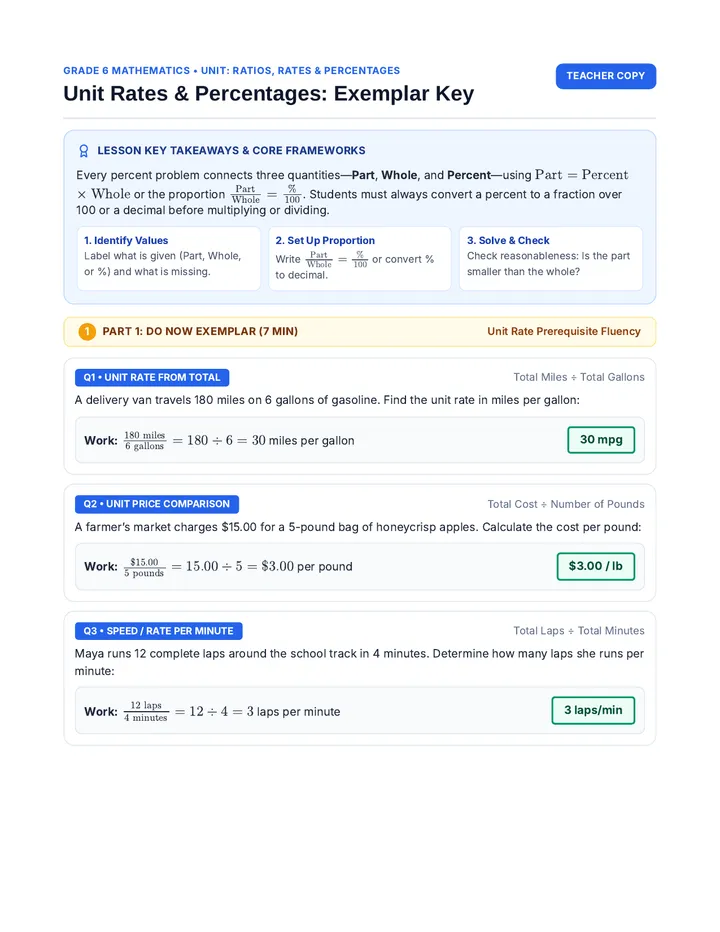
Unit Rates Percentages ExemplarGrade 6 Mathematics • Unit: Ratios, Rates & Percentages Unit Rates & Percentages: Exemplar Key Teacher Copy Lesson Key Takeaways & Core Frameworks Every percent problem connects three quantities—Part, Whole, and Percent—using \( \text{Part} = \text{Percent} \times \text{Whole} \) or the proportion \( \frac{\text{Part}}{\text{Whole}} = \frac{\%}{100} \). Students must always convert a percent to a fraction over 100 or a decimal before multiplying or dividing. 1. Identify Values Label what is given (Part, Whole, or %) and what is missing. 2. Set Up Proportion Write \( \frac{\text{Part}}{\text{Whole}} = \frac{\%}{100} \) or convert % to decimal. 3. Solve & Check Check reasonableness: Is the part smaller than the whole? 1 Part 1: Do Now Exemplar (7 Min) Unit Rate Prerequisite Fluency Q1 • Unit Rate from Total Total Miles ÷ Total Gallons A delivery van travels 180 miles on 6 gallons of gasoline. Find the unit rate in miles per gallon: Work: \( \frac{180\text{ miles}}{6\text{ gallons}} = 180 \div 6 = 30 \) miles per gallon 30 mpg Q2 • Unit Price Comparison Total Cost ÷ Number of Pounds A farmer’s market charges $15.00 for a 5-pound bag of honeycrisp apples. Calculate the cost per pound: Work: \( \frac{\$15.00}{5\text{ pounds}} = 15.00 \div 5 = \$3.00 \) per pound $3.00 / lb Q3 • Speed / Rate Per Minute Total Laps ÷ Total Minutes Maya runs 12 complete laps around the school track in 4 minutes. Determine how many laps she runs per minute: Work: \( \frac{12\text{ laps}}{4\text{ minutes}} = 12 \div 4 = 3 \) laps per minute 3 laps/min Part 2: Guided Practice • Teacher Script & Exemplar Guided Practice Problems 1 & 2 15 Minutes • Min 07:00 – 22:00 Problem 1 • Teacher Model: Calculate 25% of 28 Answer: b. 7 Step 1: Convert % \( 25\% = \frac{25}{100} = \frac{1}{4} \) or \( 0.25 \) Step 2: Multiply \( \frac{1}{4} \times 28 = 7 \) or \( 0.25 \times 28 = 7 \) Step 3: Choice & Check b. 7 (25% is 1/4 of 28) Teacher Questions (Model & Ask) “In ‘25% of 28,’ which number is the Whole and which is the Percent? What are we solving for?” “Why can’t we just multiply \( 25 \times 28 \)? What does ‘percent’ mean?” “Which benchmark fraction is equivalent to \( \frac{25}{100} \), and how does that make mental math easier?” Expected Student Responses & Solve “28 is the Whole, 25% is the Percent, and we are finding the Part.” “Percent means out of 100, so 25% is \( \frac{25}{100} \) or \( 0.25 \), not 25 wholes.” “\( \frac{25}{100} \) simplifies to \( \frac{1}{4} \), and \( \frac{1}{4} \times 28 = 28 \div 4 = 7 \).” Problem 2 • Guided Practice: Finding the Whole Answer: b. 50 miles Lin’s family has completed 70% of a trip. They have traveled 35 miles. How far is the trip? Step 1: Set Ratio \( \frac{35}{\text{Total}} = \frac{70}{100} \) Step 2: Solve Total \( 35 \div 0.70 = 50 \) (or \( 70 \div 2 = 35 \), so \( 100 \div 2 = 50 \)) Step 3: Choice & Check b. 50 miles (\( 50 > 35 \)) Teacher Questions (Ask) “Is 35 miles the Part or the Whole? How do you know?” “Should the total trip be greater than or less than 35 miles? Which answer choices can we eliminate right away?” “Using \( \frac{35}{\text{Total}} = \frac{70}{100} \), how can we scale or divide to find the Whole?” Expected Student Responses & Solve “35 miles is the Part because it’s only 70% of the trip, not 100%.” “Greater than 35 miles—so we eliminate (a) 24.5 miles immediately.” “\( 70 \div 2 = 35 \), so \( 100 \div 2 = 50 \) miles (or \( 35 \div 0.70 = 50 \)).” Part 2: Guided Practice • Teacher Script & Review Guided Practice Problem 3 & Review Script Partner Practice & Synthesis Problem 3 • Partner Practice: Finding the Percentage Answer: b. 40% There are 15 pieces of fruit in a bowl and 6 of them are apples. What percentage of the pieces of fruit in the bowl are apples? Step 1: Set Ratio \( \frac{\text{Part}}{\text{Whole}} = \frac{6}{15} \) Step 2: Convert to % \( \frac{6}{15} = \frac{2}{5} = \frac{40}{100} \) or \( 6 \div 15 = 0.40 \) Step 3: Choice & Check b. 40% (less than half of 15) Teacher Questions (Ask) “Which value is the Whole and which is the Part? How do we write that as a ratio?” “Is 6 more or less than half of 15? So should our percent be above or below 50%?” “How can we turn \( \frac{6}{15} \) into a fraction out of 100?” Expected Student Responses & Solve “15 is the Whole bowl of fruit, 6 is the Part that are apples: \( \frac{6}{15} \).” “Half of 15 is 7.5, so 6 is less than half—under 50%!” “Simplify \( \frac{6}{15} \) to \( \frac{2}{5} \), then multiply top and bottom by 20 to get \( \frac{40}{100} = 40\% \).” How Will You Review Problems 1–3 & Stamp the Key Takeaways? 1. Compare All Three Problem Types Side-by-Side Display all three proportions on the board: P1 (Find Part): \( \frac{x}{28} = \frac{25}{100} \), P2 (Find Whole): \( \frac{35}{x} = \frac{70}{100} \), P3 (Find %): \( \frac{6}{15} = \frac{x}{100} \). Ask: “How did the same structure \( \frac{\text{Part}}{\text{Whole}} = \frac{\%}{100} \) help us solve three different missing values?” 2. Watch For & Address Common Misconceptions Misconception (P2): Multiplying \( 35 \times 0.70 = 24.5 \) (choice a). Ask: “Can the whole trip be shorter than the 35 miles they already drove?” Misconception (P1): Multiplying by 25 instead of \( 0.25 \) or \( \frac{25}{100} \). 3. Final Stamp Before Independent Practice Have students repeat: “Step 1: Label Part, Whole, and Percent. Step 2: Convert % to a fraction over 100 or decimal. Step 3: Solve and check if the answer makes sense!” Parts 3 & 4 • Exemplar Key Independent Practice & Exit Ticket Exemplar Answer Key Part 3: Independent Practice Exemplar (18 Min) Solo Fluency Problem 1: What is 15% of 80? Step 1: \( 15\% = 0.15 \) (or \( \frac{15}{100} \)) • Step 2: \( 0.15 \times 80 = 12 \) b. 12 Problem 2: 36 is 60% of what number? Step 1: \( \frac{36}{\text{Whole}} = \frac{60}{100} \) • Step 2: \( 36 \div 0.60 = 60 \) (or \( \frac{6}{10} \times 6 = \frac{36}{60} \)) c. 60 Problem 3 (Word Problem): $50.00 backpack on sale for 30% off. How much do you save? Step 1: Discount = 30% of $50 • Step 2: \( 0.30 \times 50 = \$15.00 \) a. $15.00 Part 4: Exit Ticket Exemplar (8 Min) Final Formative Check Question 1: Calculate 75% of 48 Step 1: \( 75\% = \frac{3}{4} \) (or \( 0.75 \)) • Step 2: \( \frac{3}{4} \times 48 = 36 \) c. 36 Question 2: 18 is 30% of what total amount? Step 1: \( \frac{18}{\text{Total}} = \frac{30}{100} \) • Step 2: \( 18 \div 0.30 = 60 \) d. 60 Question 3 (Error Analysis): Sam calculated \( 20 \times 80 = 1,600 \) to find 20% of 80. Exemplar Response: Sam forgot to convert 20% into a fraction or decimal before multiplying—he treated 20% as 20 wholes. The correct first step is to convert \( 20\% = \frac{20}{100} = 0.20 \) (or \( \frac{1}{5} \)), and then multiply \( 0.20 \times 80 = 16 \). Correct 16