Odds Outcomes Guided Notes High School Finite Math Expected Value Applications
Lesson 4-4: Expected Value Notes
Name:
Date:
1. What Is Expected Value?
The expected value is the average result you would get if you played a game, made an investment, or repeated a situation many times.
How to Find Expected Value (3 Simple Steps)
\(\text{Expected Value} = (\text{Value}_1 \times \text{Prob}_1) + (\text{Value}_2 \times \text{Prob}_2) + \dots\)
Step 1: Find each Net Value (gain or loss).
Step 2: Multiply each value by its probability.
Step 3: Add all the products together.
Key Rule for Games & Investing: Always use Net Value : \(\text{Net Value} = \text{Winnings} - \) .
2. Example 1: Carnival Spinner (Game of Chance)
You pay $4 to spin a fair 4-equal-section spinner: Red (1/4) wins $10 , Blue (1/4) wins $4 , and Green or Yellow (2/4) wins $0 .
Outcome
Winnings
Net Value
Probability
Value × Probability
Red
$10
$10 − $4 =
0.25
Blue
$4
0.25
Green / Yellow
$0
0.50
Add the last column to find the Expected Value:
What does this mean? Should you play this game many times?
3. Example 2: Robotics Club Raffle (Positive Expected Value)
A robotics club sells 200 raffle tickets at $5 each. Because a local sponsor donated the prizes, the pool includes one $1,200 laptop and two $150 gift cards . Find the expected net value of buying one ticket.
Prize Tier
Net Value
Probability
Value × Probability
Grand Prize ($1,200)
\(1 / 200 = 0.005\)
Gift Card ($150)
\(2 / 200 = 0.010\)
No Prize ($0)
\(197 / 200 = 0.985\)
Calculate the Expected Value and state whether the ticket is a good deal:
4. Example 3: School Grades — Smart Guessing on a Quiz
On a 4-choice multiple-choice quiz question, a correct answer earns +4 points , and an incorrect answer receives a −1 point penalty.
a) Pure Random Guess (1 in 4 chance):
Chance right = 0.25, Chance wrong = 0.75
b) Eliminate 2 Wrong Choices (50/50 guess):
Chance right = 0.50, Chance wrong = 0.50
Takeaway: When is guessing a smart strategy for your grade?
Expected Value Practice Worksheet High School Finite Math Tip: Expected Value = Sum of (Net Value × Probability)
Lesson 4-4 Worksheet Assignment: Expected Value
Name:
Date:
1 Roll for Riches (Game of Chance)
A carnival booth charges $3 to roll a fair 6-sided die. Rolling a 6 wins $10 , rolling a 4 or 5 wins $2 , and rolling a 1, 2, or 3 wins $0 .
a) Complete the table for your net profit or loss:
Die Roll
Net Value
Probability
Value × Probability
6
4 or 5
1, 2, or 3
b) Add the last column to find the Expected Value. What would you expect to happen if you played 60 times?
2 Tech Startup Investment (Market Investing)
An investor puts $1,000 into a tech stock for one year. Market analysts estimate a 30% chance of a surge (+$1,500 net profit), a 50% chance of steady growth (+$300 net profit), and a 20% chance of a downturn (−$800 net loss).
Find the Expected Value of the net profit. Based on your answer, should the investor buy this stock?
3 Comparing Two Market Portfolios (Market Investing)
You are choosing between two 1-year investment portfolios:
Portfolio A (Steady Bond Fund): +$400 profit−$100 loss
Portfolio B (Volatile Crypto Fund): +$2,000 profit−$400 loss
Find the Expected Value for both portfolios. Which has the higher expected return, and why might someone still pick the other?
4 Exam Guessing Penalty (School Grades)
On a timed exam, each 5-choice question awards +2 points for a correct answer, −0.5 points for an incorrect answer, and 0 points if left blank.
a) Expected score for a random guess (1 of 5):
b) Expected score if you eliminate 2 wrong choices (1 of 3):
5 Final Exam Grade Forecast (School Grades)
Based on your practice tests in Finite Math, you estimate a 50% chance of scoring 88 on the final exam, a 35% chance of scoring 76 , and a 15% chance of scoring 64 . Calculate your expected final exam score.
Expected Value Answer Key Teacher Answer Key
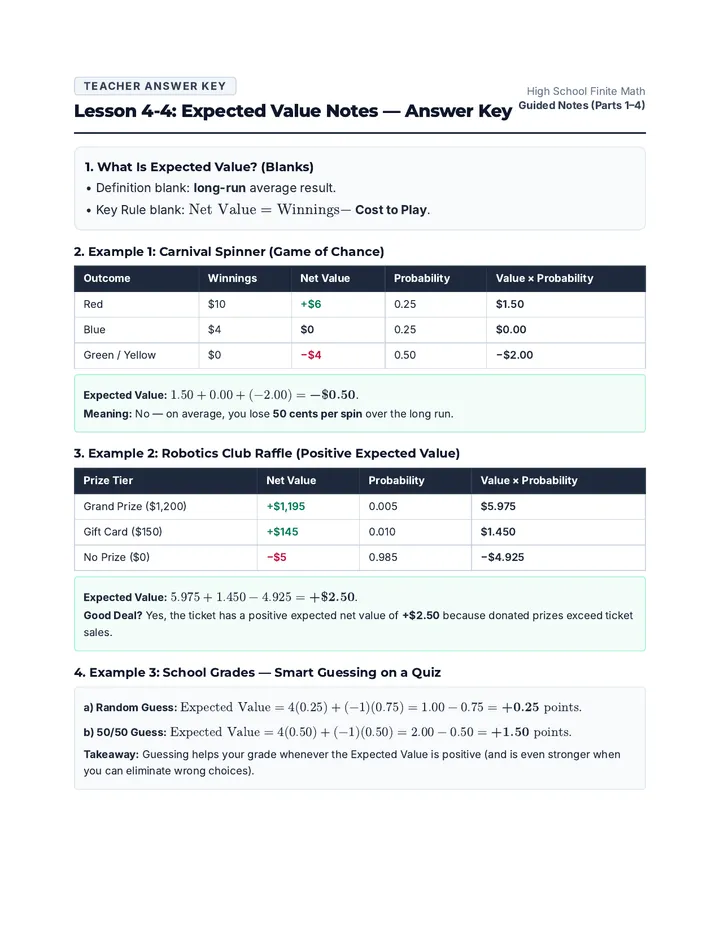
Lesson 4-4: Expected Value Notes — Answer Key
High School Finite MathGuided Notes (Parts 1–4)
1. What Is Expected Value? (Blanks)
• Definition blank: long-run average result.
• Key Rule blank: \(\text{Net Value} = \text{Winnings} - \) Cost to Play .
2. Example 1: Carnival Spinner (Game of Chance)
Outcome
Winnings
Net Value
Probability
Value × Probability
Red
$10
+$6
0.25
$1.50
Blue
$4
$0
0.25
$0.00
Green / Yellow
$0
−$4
0.50
−$2.00
Expected Value: \(1.50 + 0.00 + (-2.00) = \mathbf{-\$0.50}\).Meaning: No — on average, you lose 50 cents per spin over the long run.
3. Example 2: Robotics Club Raffle (Positive Expected Value)
Prize Tier
Net Value
Probability
Value × Probability
Grand Prize ($1,200)
+$1,195
0.005
$5.975
Gift Card ($150)
+$145
0.010
$1.450
No Prize ($0)
−$5
0.985
−$4.925
Expected Value: \(5.975 + 1.450 - 4.925 = \mathbf{+\$2.50}\).Good Deal? Yes, the ticket has a positive expected net value of +$2.50 because donated prizes exceed ticket sales.
4. Example 3: School Grades — Smart Guessing on a Quiz
a) Random Guess: \(\text{Expected Value} = 4(0.25) + (-1)(0.75) = 1.00 - 0.75 = \mathbf{+0.25\text{ points}}\).
b) 50/50 Guess: \(\text{Expected Value} = 4(0.50) + (-1)(0.50) = 2.00 - 0.50 = \mathbf{+1.50\text{ points}}\).
Takeaway: Guessing helps your grade whenever the Expected Value is positive (and is even stronger when you can eliminate wrong choices).
Expected Value Worksheet Key Teacher Answer Key
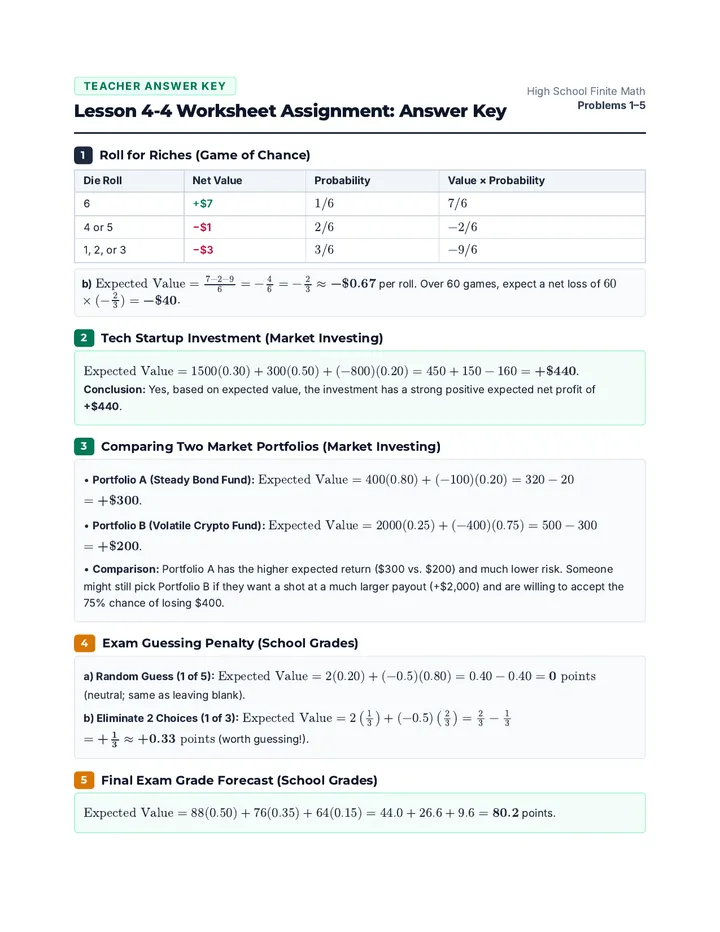
Lesson 4-4 Worksheet Assignment: Answer Key
High School Finite MathProblems 1–5
1 Roll for Riches (Game of Chance)
Die Roll
Net Value
Probability
Value × Probability
6
+$7
\(1/6\)
\(7/6\)
4 or 5
−$1
\(2/6\)
\(-2/6\)
1, 2, or 3
−$3
\(3/6\)
\(-9/6\)
b) \(\text{Expected Value} = \frac{7 - 2 - 9}{6} = -\frac{4}{6} = -\frac{2}{3} \approx \mathbf{-\$0.67}\) per roll. Over 60 games, expect a net loss of \(60 \times (-\frac{2}{3}) = \mathbf{-\$40}\).
2 Tech Startup Investment (Market Investing)
\(\text{Expected Value} = 1500(0.30) + 300(0.50) + (-800)(0.20) = 450 + 150 - 160 = \mathbf{+\$440}\).Conclusion: Yes, based on expected value, the investment has a strong positive expected net profit of +$440 .
3 Comparing Two Market Portfolios (Market Investing)
• Portfolio A (Steady Bond Fund): \(\text{Expected Value} = 400(0.80) + (-100)(0.20) = 320 - 20 = \mathbf{+\$300}\).
• Portfolio B (Volatile Crypto Fund): \(\text{Expected Value} = 2000(0.25) + (-400)(0.75) = 500 - 300 = \mathbf{+\$200}\).
• Comparison: Portfolio A has the higher expected return ($300 vs. $200) and much lower risk. Someone might still pick Portfolio B if they want a shot at a much larger payout (+$2,000) and are willing to accept the 75% chance of losing $400.
4 Exam Guessing Penalty (School Grades)
a) Random Guess (1 of 5): \(\text{Expected Value} = 2(0.20) + (-0.5)(0.80) = 0.40 - 0.40 = \mathbf{0\text{ points}}\) (neutral; same as leaving blank).
b) Eliminate 2 Choices (1 of 3): \(\text{Expected Value} = 2\left(\frac{1}{3}\right) + (-0.5)\left(\frac{2}{3}\right) = \frac{2}{3} - \frac{1}{3} = \mathbf{+\frac{1}{3} \approx +0.33\text{ points}}\) (worth guessing!).
5 Final Exam Grade Forecast (School Grades)
\(\text{Expected Value} = 88(0.50) + 76(0.35) + 64(0.15) = 44.0 + 26.6 + 9.6 = \mathbf{80.2}\) points.
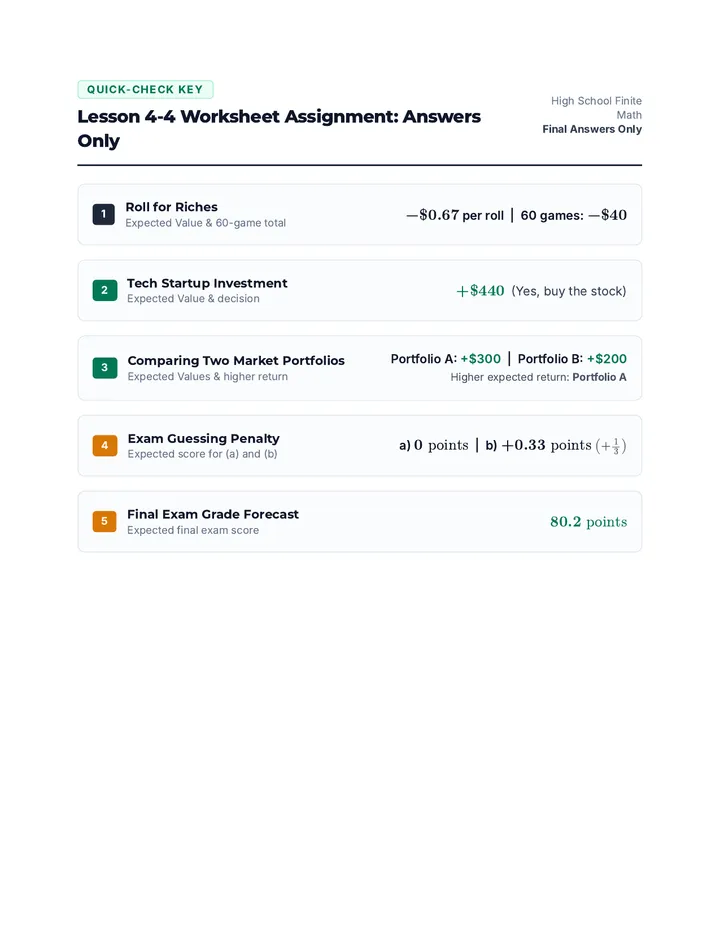
Expected Value Quick Key Quick-Check Key
Lesson 4-4 Worksheet Assignment: Answers Only
High School Finite MathFinal Answers Only
1
Roll for Riches
Expected Value & 60-game total
\(\mathbf{-\$0.67}\) per roll | 60 games: \(\mathbf{-\$40}\)
2
Tech Startup Investment
Expected Value & decision
\(\mathbf{+\$440}\) (Yes, buy the stock)
3
Comparing Two Market Portfolios
Expected Values & higher return
Portfolio A: +\$300 | Portfolio B: +\$200Portfolio A
4
Exam Guessing Penalty
Expected score for (a) and (b)
a) \(\mathbf{0\text{ points}}\) | b) \(\mathbf{+0.33\text{ points}}\) \(\left(+\frac{1}{3}\right)\)
5
Final Exam Grade Forecast
Expected final exam score
\(\mathbf{80.2\text{ points}}\)