Compliance Clock Slides Module 01
Mastering the
Compliance Clock
Navigating the legal milestones of Special Education from referral to results.
T-MINUS 60 DAYS
ANNUAL REVIEWS
The Broken Timeline
Look at the timeline on the wall. Pieces are missing. If we don't know the "Legal Speed Limit," what happens to the student?
SCENARIO A
Evaluation takes 120 days instead of 60.
SCENARIO B
The IEP meeting is held one day after the deadline.
SCENARIO C
Progress reports aren't sent for 2 quarters.
The 60-Day Evaluation Lifecycle
1
Consent Signed
The clock officially starts ticking.
2
Assessment
Observations, testing, and data collection.
3
Report Writing
Analyzing data and drafting the findings.
4
Eligibility
The meeting must happen by Day 60.
Pro Tip: Business days vs. Calendar days matter! (Check your state law).
Recurring Commitments
Annual Review
Must happen every 365 days.
Updates goals and services.
Includes progress monitoring.
Triennial Re-eval
Happens every 3 years.
Re-determines eligibility.
Deep dive into student needs.
Process Map Worksheet Process Map: The IEP Lifecycle
SEQUENCE: DEADLINE ARCHITECTS • LESSON 01
Name
Date
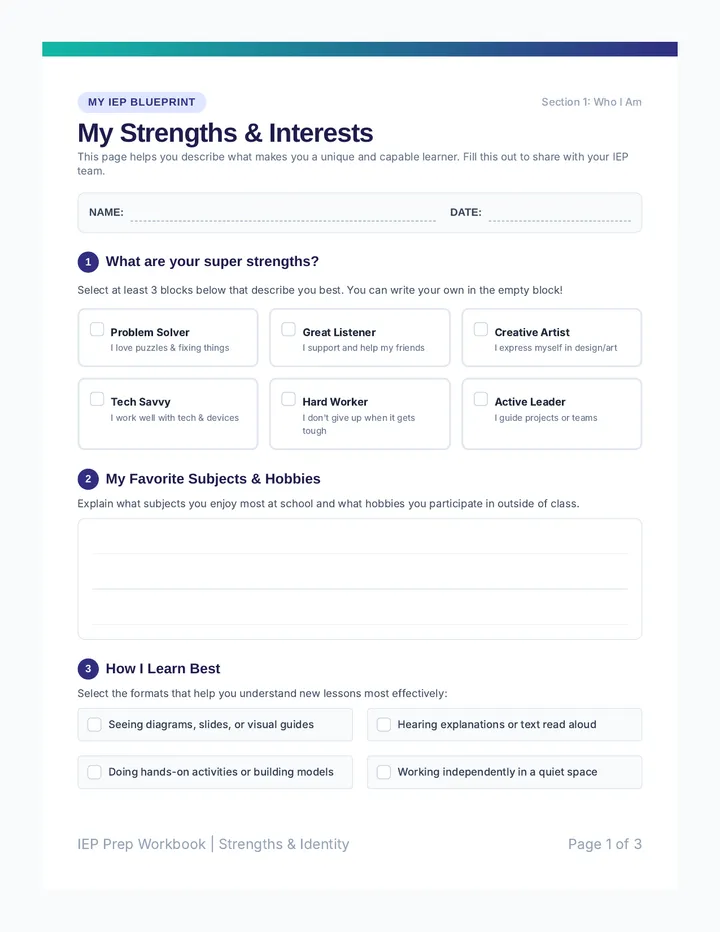
Part 1: The Legal Dictionary
Match the following terms to their definitions. Use the slide deck for reference.
A
Annual Review
B
Initial Consent
C
Evaluation Window
D
Draft IEP
The 60-day period where testing and data collection occur.
The legal document signed by parents to start the clock.
The document shared with parents before the formal meeting.
The yearly meeting required to update student goals.
Part 2: Visualizing the 60-Day Clock
Place the following events in the correct chronological order on the timeline below.
Meeting Invitation Sent Data Analysis & Scoring Testing/Observations Eligibility Meeting Parent Consent Signed
1
Day 0
2
Days 1-45
3
Days 45-50
4
Days 50-55
5
Day 60 (Deadline)
Part 3: Critical Thinking
Why is the 60-day deadline legally binding? What happens to the student's education if we miss it?
Timeline Master Teacher Guide Timeline Master
LESSON 01: TEACHER FACILITATION GUIDE
Learning Objective
Students will be able to identify and sequence the legal milestones of the Special Education compliance lifecycle, specifically focusing on the 60-day evaluation window and annual review requirements.
The "Hook" Setup
Preparation:
Tape a long strip of masking tape across one wall (marked 0 to 60 days).
Write key milestones (Consent, Testing, Report, Meeting) on index cards.
Hide or remove two cards before students enter.
The Prompt:
"Our compliance clock is broken. We have 60 days to decide if a student needs help. If these pieces are missing, how does the student's family feel? What does the judge say?"
At A Glance
Time
55 Minutes
Materials
Tape, index cards, Slide Deck, Process Map Worksheets.
Skills
Legal literacy, Process mapping, Time-estimation.
Instructional Flow
00-10
The Broken Clock (Hook)
Students attempt to place milestones on the wall. Facilitate a discussion on the "why" behind specific time gaps (e.g., why does testing take 45 days, but report writing only 5?).
10-25
Direct Instruction (Slides)
Use the Compliance Clock Slides. Focus on the legal implications of "Day 61." Mention that in some states, weekends count, and in others, only school days count.
25-45
Process Mapping (Worksheet)
Students work individually or in pairs to complete the Process Map. Monitor for common misconceptions (e.g., thinking the IEP is written *at* the meeting).
45-55
Closing & Reflection
Exit ticket: "What is one thing that could cause a delay in the 60-day clock?" (e.g., student illness, parent rescheduling, missing data).
Common Student Misconception
"Students often think the 'Clock' ends when testing is done. Emphasize that the legal deadline is the *Meeting Date*, where parents are present and decisions are finalized."
Reverse Engineering Slides Module 02
Reverse
Engineering Success
Why the smartest planners always start at the finish line.
Backwards Planning
The Surprise Party Fail
It's 2:00 PM on Saturday. The party starts at 6:00 PM.
You call the bakery to order the custom cake. They say: "That takes 4 days to make."
The Lesson:
The deadline is 6:00 PM Saturday, but the Action Deadline was Tuesday.
Tues: Order Cake (DONE?)
Wed: Confirm Guest List
Fri: Buy Decorations
SAT: PARTY STARTS
Milestones vs. Tasks
Milestones
The "What"
Draft IEP Completed
Data Collection Finished
IEP Meeting Held
Tasks
The "How"
Email Parent for Availability
Observe Student in Math Class
Print Signature Page
The "Tickler" System
Don't trust your brain to remember deadlines. A "Tickler" is a reminder set 3-5 days before the actual task is due.
Digital
Calendar alerts & automated emails.
Physical
Sticky notes on the monitor or planner.
Social
A check-in buddy or project lead.
Backwards Blueprint Template Backwards Blueprint
PROJECT TEMPLATE
Name
Date
01
The Compliance Scenario
"A student named Jordan had his evaluation consent signed on October 1st . Your legal deadline to hold the Eligibility Meeting is 60 days later: November 30th . You must have a draft report ready for the parents 5 days before the meeting."
02
Reverse the Clock
Target Date
Eligibility Meeting Held Nov 30
Minus 5 Days
Draft Report to Parents ________
Minus 10 Days
Final Data Analysis Complete ________
Minus 20 Days
Observations & Testing Finished ________
03
Safety Net Reminders
Choose two tasks from above and set a "Tickler" alert for them (3 days before they are due).
Tickler Alert 1
The Alert Says:
Set for Date:
Tickler Alert 2
The Alert Says:
Set for Date:
Data Collection Flow Slides Module 03
Data Collection Flow
Gathering evidence without stopping the class. Mastering the "Observation Window."
The Multi-Tasking Trap
"I'll just watch Jordan's behavior while I'm teaching the whole class long division."
Why this fails:
Data becomes biased or inaccurate.
You miss critical behavioral triggers.
Instructional quality drops for everyone.
Focus > Frenzy
Compliance requires High-Fidelity data. That needs scheduled time.
The Rotation Strategy
Micro-Windows
10-minute bursts of intensive data collection while students work independently.
Peer Check
Asking a co-teacher or para to monitor the class while you focus solely on one student.
The Batch
Dedicate every Tuesday morning for 3 weeks to specific student observations.
Simulation: The Data Dash
In a moment, you will receive a clipboard. You have 3 tasks to finish, but you MUST also record every time your partner touches their hair or adjusts their glasses.
Can you maintain accuracy for both?
Observe
Document
Teach
Data Dash Tracker Rotation Planner The Data Dash
SIMULATION RECORD & ROTATION PLANNER
NAME:
DATE:
Phase 1: Simulation Reflection
While completing your primary task (writing), you were asked to track a specific behavior. Record your findings below.
Behavior Tracked:
Number of Tally Marks:
Self-Rating (Data Accuracy):
1
Guesses
2
3
4
5
Perfect
Reflection: Did you miss any data points while you were writing? Why?
Phase 2: The 5-Student Rotation
Scenario: You have 5 students (A, B, C, D, E) whose data is due in 2 weeks. You have a 30-minute independent work block every day. Create a "Rotation Schedule" to ensure each student gets 20 minutes of dedicated, high-fidelity observation.
Day Observation Window 1 (15m) Observation Window 2 (15m) Monday Tuesday Wednesday Thursday Friday
Check Your Work:
Did every student (A-E) appear at least twice?
Is there a "Buffer Day" in case a student is absent?
Is the data being collected *during* a time when that student is usually active?
Stakeholder Sync Slides Module 04
Stakeholder
Sync
The art of professional coordination: Emailing, scheduling, and managing the human side of deadlines.
The Human Element
Compliance isn't just paperwork; it's people. Your deadline depends on:
Parents' work schedules
Teachers' prep periods
Student attendance
The Golden Rule of Scheduling:
"Give people 10 days of notice, but ask for 3 days of availability."
Anatomy of a "Sync" Email
New Message
To: Mrs. Smith (Parent)
Subject: Scheduling Jordan's IEP Meeting
[Warm Greeting] Good afternoon, Mrs. Smith!
[The Why] It’s time for Jordan’s annual IEP review to celebrate his growth.
[The Choice] We have space on Nov 12 (8:00 AM) or Nov 14 (3:30 PM).
[Call to Action] Please let me know which works best by Friday!
Roleplay: The Busy Parent
The parent works nights. The Gen Ed teacher is on a field trip on the only day you're free. The deadline is tomorrow.
How do you stay professional while solving the puzzle?
"I understand your schedule is tight. Can we try a Zoom meeting during your lunch break?"
Professional Communication Kit Communication Kit
STAKEHOLDER SYNC • LESSON 04
Name
Date
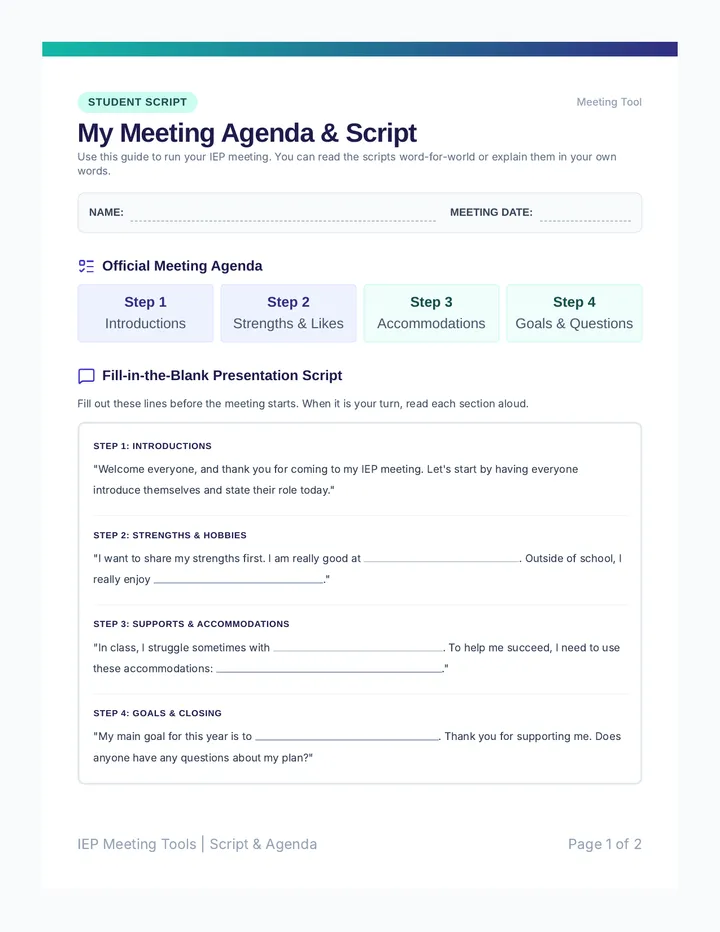
Part 1: The Email Blueprint
Fill in the blanks to create a professional meeting request for a general education teacher. Remember to be concise and offer specific times.
To: [General Education Teacher]
Subject: Jordan's IEP Meeting - Coordination
Hi ______________________,
I am writing to schedule Jordan’s annual IEP meeting. Your input as his ______________________ teacher is vital to our planning. The legal deadline for this meeting is ______________________.
I am looking at the following two times that might work with your prep period:
1. ______________________ at ______________________
2. ______________________ at ______________________
Please let me know if either of these work for you, or if you have a different time during that week. I’ll send the formal calendar invite once we confirm!
Best regards,
______________________
Part 2: Solving Scheduling Conflicts
The Scenario
The parent calls and says: "I can't do any of those times. I work from 8 AM to 5 PM every day, and I don't have a car." Your deadline is in 3 days.
Write your professional response:
Strategic Tips
01 Offer a phone or video conference option (if legally allowed).
02 Ask the parent if they have a preferred "window" (e.g., lunch break).
03 Explain the importance of their voice in the meeting.
04 Keep calm—empathy solves more than aggression.
Big Picture Slides Module 05: Capstone
The Big
Picture
Zooming out to manage a 10-month caseload without hitting the "May Meltdown."
The Bottleneck Phenomenon
"Why am I so stressed in May? Oh, right... half my caseload has birthdays in May."
Bottlenecks occur when:
Too many annual reviews happen in one month.
Testing windows overlap for 5 students at once.
Report cards and IEPs are due on the same Friday.
MAY
JORDAN IEP
SARAH RE-EVAL
MARCUS DATA
Leveling the Load
Strategy A: Front-Loading
If you know May is busy, hold Jordan’s April meeting in March. There is no penalty for being early!
Gains: Breathing room later.
Strategy B: The 10-Day Rule
Schedule every meeting exactly 10 days BEFORE the legal deadline. This creates a "Failure Buffer."
Gains: 100% Compliance.
Your Turn:
The Compliance Calendar
You have a caseload of 10 students. You have their due dates. You have a 10-month calendar.
Can you build a year where no student is late and no week is impossible?
Start Planning
Compliance Calendar Project Pack Year-Long Compliance Project
The Big Picture • Final Capstone
Due Date
Step 1: Your Fictional Caseload
Below are 6 students on your caseload. Their "Legal Deadline" is based on their last IEP date. You must schedule their Annual Review Meeting before this date.
Student Name Last IEP Date Legal Deadline (Due) Notes Jordan A. Oct 12 Oct 11 Very involved parents; need 2 weeks notice. Sarah B. Jan 15 Jan 14 Needs 3-year Re-eval (Triennial). Marcus C. May 05 May 04 May is a "Busy Season" month. Lila D. May 12 May 11 Bottleneck risk with Marcus. Xavier E. May 20 May 19 Heavy data collection required. Chloe F. Nov 02 Nov 01 Thanksgiving break falls in Nov.
Step 2: The Master Calendar (Partial)
Plot your Action Dates (meetings) below. Aim to hold meetings 10 days before the deadline. Solve the "May Bottleneck" by front-loading students into April.
OCTOBER
NOVEMBER
DECEMBER
Front-loading window?
JANUARY
FEBRUARY
MARCH
APRIL (Relief Month)
May (The Bottleneck)
Mastery Rubric
Compliance
All 6 students have a meeting scheduled *before* their legal deadline.
Load Balancing
No more than 2 meetings are scheduled in the month of May.
Buffer Zone
Meetings are scheduled at least 5-10 days before the absolute deadline.