Stand Tall Worksheet Stand Tall Together
Lesson 1: Direct Comparison
Scout Name
Expedition Date
1
The Partner Stand-Off
Find a partner and stand back-to-back. Use your "Scout Words" to describe what you see!
Comparison 1: Height
My partner is _________________ than me.
Taller
Shorter
Comparison 2: Arms
My arm is ________________ than my partner's arm.
Longer
Shorter
2
Supply Sorting
Look at the scout supplies below. Circle the correct word to finish the sentence.
A
B
Water Bottle B is _________________ than Water Bottle A.
TALLER SHORTER
X
Y
Walking Stick Y is _________________ than Walking Stick X.
LONGER SHORTER
3
Master Artist Challenge
Sketchbook Area
Draw two trees side-by-side.
One tree must be taller than the other tree.
Stand Tall Slides Size Scouts
Expedition 1: Standing Tall
Scout Vocabulary
Taller
Shorter
Longer
🦒 🐁
The Giraffe is taller than the Mouse.
The Mouse is shorter than the Giraffe.
Expedition Mission
1
Find a partner of similar height.
2
Stand back-to-back.
3
A third friend checks who is taller!
🙋♂️🙋♀️
The Partner
Stand-Off
The Secret Rule
Stop! Don't do this!
We can't tell which is taller if they don't start at the same line!
Perfect!
Line them up at the "start" line!
Stand Tall Teacher Guide Expedition Guide
Lesson 1: Direct Comparison
GRADE 1
Time Required
45-60 Minutes
Gear Needed
Classroom objects (bottles, books)
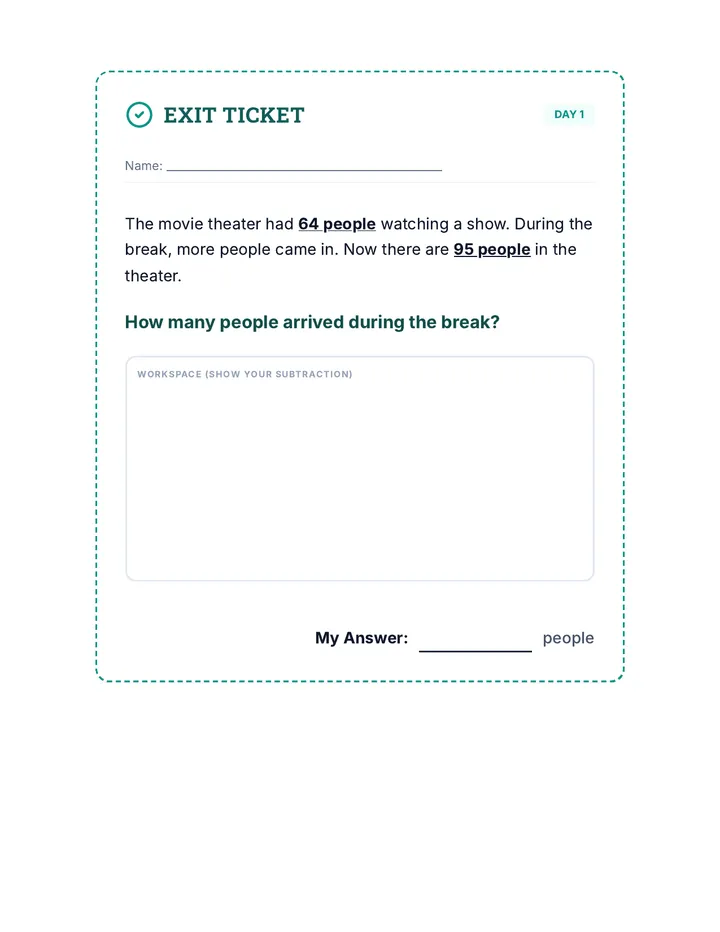
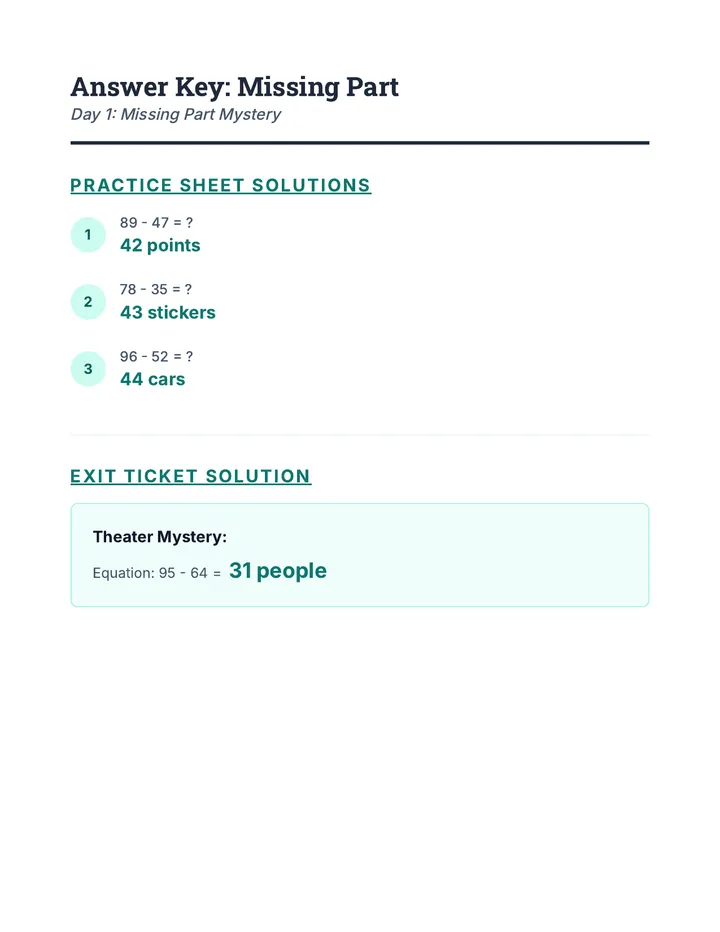
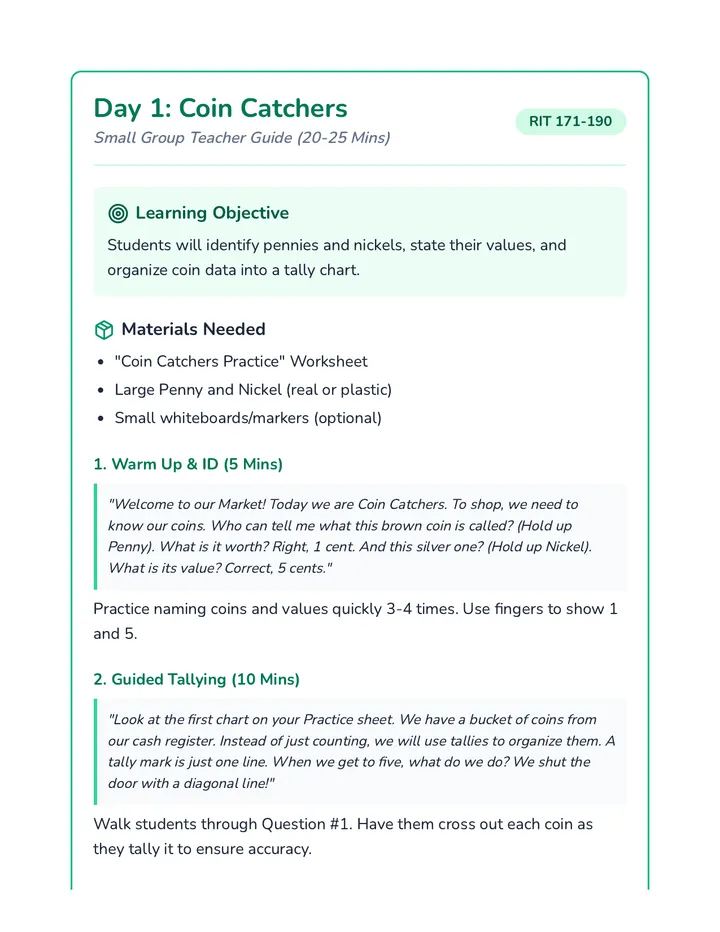
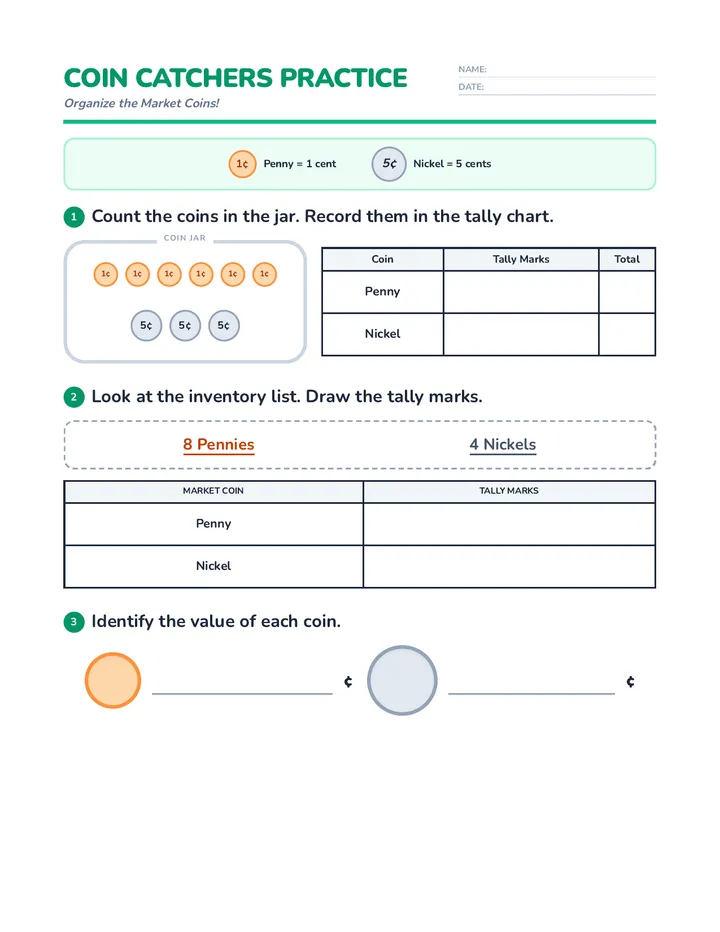
Stand Tall Worksheet
Anchor Chart paper
Markers
Scout Keywords
Taller Shorter Longer Equal to Baseline
The Hook (10 mins)
Ask for two student volunteers who are clearly different heights. Ask the class: "Who is taller?" Then, have the shorter student stand on a chair. Ask again: "Now who is taller?"
"Is he actually taller, or does it just look that way? What is the 'fair' way to measure height?" (Guide them to the concept of a shared baseline or floor level).
Guided Exploration (20 mins)
The Partner Stand-Off: Students pair up to compare height, arms, and feet.
Model the Language: Demonstrate using the sentence frame: "I am [taller/shorter] than my partner because [observation]."
The Three-Point Check: Teach students to check: (1) Toes even, (2) Backs straight, (3) Eyes forward.
Discussion Prompts
Check for Understanding
"If Maria is taller than Sam, is Sam taller or shorter than Maria?"
Critical Thinking
"What happens if two people have the exact same height? What word do we use?" (Equal to)
String Secret Slides Size Scouts
Expedition 2: The String Secret
The Stuck Problem
We want to know: Is the DOOR wider than the DESK?
"But the door is on the wall, and the desk is too heavy to move! What can we do?"
🚪
Door
🪑
Desk
The String Solution
String
How it works:
1. Measure the Desk with the string. Cut it!
2. Take that same string to the Door.
3. See if the string is longer or shorter than the door!
Scout Logic
Object A
String
Object B
If A is Longer than the string...
And the string is Longer than B...
Then A must be Longer than B!
String Secret Worksheet The String Secret
Lesson 2: Indirect Comparison
Scout Name
Team Code
Mission Objective
Use your Secret String to compare objects around the room that cannot move. Record your findings below!
Expedition A
First Object
The Door Width
Our Secret String is...
Longer
Shorter
Second Object
The Desk Width
So, the ________________ is longer than the ________________.
Expedition B
First Object
Our Secret String is...
Longer
Shorter
Second Object
So, the ________________ is longer than the ________________.
The Secret Logic
Why do we use the string? Why can't we just use our eyes to guess?
String Secret Teacher Guide Expedition Guide
Lesson 2: Indirect Comparison
TRANSITIVITY
Goal
Understand that if A > B and B > C, then A > C.
Gear Needed
Pre-cut pieces of yarn/string
Scissors
Tape
String Secret Worksheet
Scout Keywords
Indirect Intermediary Transitivity
The Problem (5 mins)
Point to two large objects in the room that are far apart (e.g., the teacher's desk and the doorway). Ask: "Which one is wider? I can't pick them up to put them side-by-side like yesterday. How can we be sure?"
The Discovery (20 mins)
Introduce the Secret String . Show how to hold the string against the first object and mark/cut the length.
Step-by-Step Modeling:
Place the end of the string at the left edge of the desk.
Pull it tight to the right edge.
Cut the string so it is the exact same width as the desk.
Walk the string over to the door. "If the door is wider than my string, is it wider than the desk?"
Independent Expedition
Students work in pairs. Each pair gets one "Secret String." They must find two objects in the room and use the string to determine which is longer.
Scout Tip:
Remind students that the string must be pulled tight. A floppy string gives a bad measurement!
Big Order Slides Size Scouts
Expedition 3: The Big Order
Level 1: Length
Smallest to Largest
1st
2nd
3rd
Start at the left and grow!
What is "Big"?
📏
Length
How long or tall something is.
🏋️♂️
Weight
How heavy or light something is.
Scout Mystery
🪶
Feather
🪨
Rock
The Feather is LONGER... but the Rock is HEAVIER!
Big Order Worksheet The Big Order
Lesson 3: Ordering by Size
Scout Name
1
The Height Hike
Number these trees in order from Shortest (1) to Tallest (3).
?
?
?
2
The Weight Watch
Circle the item in each pair that is HEAVIER. Remember, long doesn't always mean heavy!
🪶
A: Feather
vs
🪨
B: Rock
🎈
A: Balloon
vs
🍎
B: Apple
3
Scout's Choice
Drawing Zone
Draw 3 sticks in a row.
Order them from Longest to Shortest.
Big Order Teacher Guide Expedition Guide
Lesson 3: Ordering by Size
ATTRIBUTES
Goal
Order 3+ objects by a single attribute and distinguish between different attributes.
Gear Needed
3 different sized books
3 different length pencils
Collection of objects: Rock, Feather, Balloon, Apple
Big Order Worksheet
The Workshop (15 mins)
Gather the class. Display 3 pencils of clearly different lengths. Ask: "If I want to organize these from shortest to longest, where should I start?"
"When we order things, we don't just compare two at a time. We look at the whole group to find the smallest, then the middle, then the biggest."
The Attribute Twist (15 mins)
Hold up a long piece of yarn and a small heavy rock. Ask: "Which one is bigger?"
Challenge the Concept: Explain that "big" can mean tall, long, wide, or heavy.
Scout Language: Encourage students to be specific. Instead of "big," say "longer" or "heavier."
Expedition Mission:
Give each small group a "Bag of Objects." They must order them three times: once by height, once by weight (using hands as scales), and once by width.
Just Right Slides Size Scouts
Expedition 4: The Just Right Box
The Goal
📦
Too Big
Lots of empty space!
📦
Too Small
It won't fit inside!
🎁
Just Right
A perfect snug fit.
Estimation
Estimation means taking a Smart Guess using your eyes.
Ask yourself: "If I put the teddy bear next to the box, does the box look taller and wider?"
🧸
📦
Your Mission
Find one thing in the room that fits JUST RIGHT in your hand.
✋ 🍎 🧼 🎾
Test it out! Does it fall out? Is it too big to close your fingers?
Just Right Worksheet The Just Right Box
Lesson 4: Spatial Fitting
Scout Name
1
The Smart Guess
Look at the box on your teacher's desk. Find 3 objects in the room. Predict if they will fit.
Object Name Will it Fit? Actual Result Yes No
| |
| |
Yes No
| |
| |
Yes No
| |
2
The Perfect Match
Find an object that is TOO BIG for your pencil box.
Draw it here
Find an object that is JUST RIGHT for your hand.
Draw it here
Scout Reflection
"How did you know if an object was 'Just Right' before you even tried it?"
Just Right Teacher Guide Expedition Guide
Lesson 4: The Just Right Box
ESTIMATION
Goal
Develop estimation skills for spatial awareness and "fit."
Gear Needed
1 medium-sized cardboard box
A variety of classroom objects (blocks, books, balls)
Just Right Worksheet
The Simulation (10 mins)
Place a box in the center of the rug. Hold up a tiny paperclip. "Is this box 'just right' for this paperclip?" (No, too big). Hold up a giant chair. "Is this box 'just right' for the chair?" (No, too small).
"When we measure for a box, we aren't just looking at how tall it is. We have to look at how wide and deep it is too!"
The Smart Guess (15 mins)
Model the prediction process. Hold a book next to the box.
Visual Comparison: Teach students to hold the object right next to the container to compare heights and widths without putting it inside yet.
Estimation Language: Use "I think it will fit because..." or "I think it is too tall because..."
Teaching Tip:
If an object is only 1 inch shorter than the box, is it a good fit? Discuss the idea of "snug" vs "loose."
Clue Catchers Slides Size Scouts
Final Expedition: Clue Catchers
The Clue Rules
Listen for "Taller" or "Shorter"
Verify your guess with a test!
🕵️♂️
Case Files Open
Case #101
"I am TALLER than a glue stick, but SHORTER than the teacher's chair. What am I?"
📖
Book?
✏️
Pencil?
🗑️
Bin?
The Detective Test
1
Bring your guess to the Glue Stick.
2
Stand them back-to-back.
3
Verify! Is it actually taller?
No Guessing!
Just Testing!
Clue Catchers Log Clue Catchers Log
Lesson 5: Final Expedition
Detective Name
Riddle #1
"I am shorter than your chair, but taller than your shoe."
My Guess
Verification Test
Taller than Shoe?
Shorter than Chair?
Riddle #2
"I am longer than a crayon, but shorter than a desk."
My Guess
Verification Test
Longer than Crayon?
Shorter than Desk?
?
Master Detective Challenge
Write your own measurement riddle!
"I am _________________ than a ,"
"but I am _________________ than a ."
What am I?
Clue Catchers Teacher Guide Expedition Guide
Lesson 5: Measurement Detective
DEDUCTION
Final Goal
Apply all comparison skills to solve riddles and verify conclusions.
Riddle Key
Riddle 1: Bin, stool, lunchbox.
Riddle 2: Ruler, book, tablet.
The Briefing (10 mins)
Explain that as master Size Scouts, they must now use their eyes and their logic to solve mysteries. A riddle is like a map—it tells you where to go, but you have to find the treasure.
Verification Mode (20 mins)
The most important part of being a detective is Verification .
"I can't just say 'it's a book.' I have to physically put the book next to the chair and next to the shoe to prove I'm right. If it doesn't pass both tests, it's not the right answer!"
Closing Ceremony
Have students share their "Master Detective Challenge" riddles with the class. The class must guess the object and then the creator must show why it works using direct comparison.
Final Badge: Award each student a "Master Measurement Scout" sticker or paper badge!