Caseload Crunch Slides The Caseload Crunch
Service Minute Math & Caseload Weighting
Graduate Seminar: Instructional Logistics
The Essential Question
"How do we design instructional schedules that satisfy legal service mandates while maximizing pedagogical quality?"
The 30-Hour Math Problem
The Standard School Week
~1,800 Minutes Total
Deductions
• Lunch & Recess: 375 mins
• Transitions & Setup: 150 mins
• Prep & IEP Meetings: 225 mins
Remaining Instructional Window
1,050
Minutes per week
Does your caseload fit into 1,050 minutes?
Caseload Complexity: Beyond the Count
Acuity of Need
Weighting for behavior support, medical needs, or intensive 1:1 requirements.
Documentation Load
Frequency of progress monitoring and complexity of IEP reporting cycles.
Service Coordination
Time spent managing related services (OT, PT, SLP) and paraprofessionals.
The Advocacy Pivot
Administrator: "Your caseload is only 15 students. Why are you stressed?"
The Weighted Logic:
Student A (LRE 1) Weight: 1.0
Student B (LRE 2 + Behavior Plan) Weight: 1.8
Student C (Significant Medical Needs) Weight: 2.5
Total Weighted Units: 5.3
Versus the raw count of 3 students.
Minutes Matrix Worksheet The Minutes Matrix
Caseload Capacity Audit & Analysis
NAME:
DATE:
Step 1: Define Your Instructional Window
Determine how much "clean" instructional time is available in your week after non-instructional duties are removed.
A. Total Minutes in School Week (e.g., 1800)
B. Lunch & Recess (Total weekly)
C. Prep & Planning Time (Contractual)
D. Transitions/Arrival/Dismissal
E. Meetings & Admin Duties
TOTAL INSTRUCTIONAL MINUTES (A - B - C - D - E)
Step 2: The Mandate Audit
Student Initials IEP Service Minutes (Weekly) Setting (Push/Pull) Grouping Potential TOTAL MANDATED MINUTES:
Step 3: Gap Analysis & Reflection
Calculate the Efficiency Ratio:
Mandated Minutes
Instructional Window
=
*If > 1.0, individual service delivery is mathematically impossible without grouping or delivery model shifts.
1. Identify the 'Impossible' Point: At what point in your caseload did the math stop working? (e.g., student #12, Tuesday at 2 PM)
2. Grouping Opportunities: Based on goal similarity, which students can be served concurrently to reduce the minute drain?
3. Advocacy Statement: Draft a 2-sentence explanation for an administrator explaining why the current caseload exceeds available minutes, using your efficiency ratio.
Caseload Weighting Guide Caseload Weighting Guide
Professional Advocacy Reference
Why Weight Caseloads?
A simple student count (e.g., "Max 28 students") fails to account for the actual workload intensity. Weighting models assign numeric values to students based on the acuity of need and documentation requirements, providing a more accurate picture of a teacher's capacity.
The Standard Weighting Matrix (Sample)
Student Category Typical Indicators Weight Value LRE 1 / Consultation Primarily inclusion, accommodations tracking, quarterly monitoring. 1.0 LRE 2 / Academic Support Direct pull-out or push-in services (up to 20% of day), weekly monitoring. 1.5 Behavioral Intensity Active BIP, daily data collection, crisis intervention potential. +0.5 Complex Medical/Physical Feeding, toileting, equipment management, extensive coordination. 2.5 Transition/Post-Secondary Job coaching, agency coordination, community-based instruction. 2.0
The Efficiency Threshold
Districts often set a Total Weighted Capacity (e.g., 40 units).
Weighted Units / Total Students = Complexity Index
*A Complexity Index > 1.8 often signals the need for additional paraprofessional support or caseload redistribution.
Advocacy Tip
"Instead of saying 'I'm overwhelmed,' say 'My caseload complexity index is currently 2.1, which exceeds the departmental recommendation for a single FTE. Let's look at the weighting of my LRE 2 students.'"
Reflection for Practice
1
Does your current district use a formal weighting model? If not, what informal factors do they use to decide who gets which student?
2
How would you account for "Travel Time" in a weighting model for an itinerant teacher visiting multiple campuses?
Model Efficiency Slides Push-In or Pull-Out?
The Logistics of High-Impact Delivery
Lesson 2: Delivery Model Optimization
The Logistics Debate
"Is co-teaching a time-saver (by reducing transitions) or a time-sink (due to planning and shared space constraints) for the special educator?"
Team Efficiency
Team Planning
Model A: Push-In
Zero Transition Time: Students remain in their instructional environment.
Natural Scaffolding: Supports are context-specific to general ed curriculum.
The "Velcro" Risk: Teacher becomes a personal assistant rather than an educator.
Scheduling Reality:
Requires high synchronization with the General Ed schedule. If Gen Ed shifts, your whole day ripples.
Efficiency Factor: High for student, Variable for teacher.
Scheduling Reality:
Complete control over the environment and pacing. High intensity for short durations.
Efficiency Factor: High for intervention, Low for transitions.
Model B: Pull-Out
Intensive Intervention: Ability to use specific materials and high-repetition tasks.
Privacy: Safer space for students working significantly below grade level.
The Transition Drain: Losing 5-10 minutes per session to walking in hallways.
Decision-Making Criteria
Goal Complexity
Can this goal be met using the Gen Ed curriculum?
Student Density
Are there enough students in one room to justify push-in?
Intervention Type
Does it require "Tier 3" specialized equipment or silence?
Campus Geography
How long does it take to get from Room 101 to Room 405?
Delivery Model Debate Organizer The Logistics Debate
Evaluating Delivery Model Efficiency
REF: DELIVERY-LOGISTICS-L2
The Prompt
"Is co-teaching a time-saver by reducing transitions, or a time-sink due to co-planning requirements and shared space constraints? Evaluate this from a systemic efficiency perspective."
Arguments for Push-In
Instructional Continuity
Transition Math (Mins Saved)
Arguments for Pull-Out
Intervention Intensity
Planning Independence
The "Efficiency Pivot" Point
At what threshold (number of students, complexity of goals, or physical distance) does one model mathematically outperform the other for a specific caseload?
Final Position Statement
Collaborative Dialogue Notes
Model Selection Rubric Service Delivery Matrix
Decision-Making Rubric for IEP Teams
Use this rubric to evaluate the most efficient and effective delivery model for a student's specific IEP goals. Score each category from 1 to 4, then total the points to identify the recommended setting.
Criteria 1 - Strong Push-In 2 - Moderate Push-In 3 - Moderate Pull-Out 4 - Strong Pull-Out Goal Context Goal is fully aligned with Grade Level Standards. Goal requires modifications to Grade Level content. Goal targets foundational skills (2+ years below). Goal requires highly specialized pedagogy/tools. Peer Interaction Student requires peer modeling to meet goal. Student benefits from small group with peers. Student is easily distracted by peer activity. Student requires 1:1 or isolated environment. Logistical Density 5+ students with similar goals in same room. 3-4 students with similar goals in same room. Only 1-2 students with this goal in the room. Solo student; high travel time to classroom. Materials Needed Uses standard Gen Ed textbooks/digital tools. Uses standard tools with minor overlays. Requires specific manipulatives or software. Requires heavy equipment/sound-proofed area.
Total Score Guide:
4 - 7 Points: Recommended Model: Push-In
8 - 11 Points: Recommended Model: Hybrid
12 - 16 Points: Recommended Model: Pull-Out
Student Score
/ 16
Team Justification & Logistics Notes
Why did the team select this model? What are the transition implications?
Schedule Tetris Slides Schedule Tetris
Building Blocks of an Efficient Master Schedule
Lesson 3: Strategic Grouping & Scheduling
The Scheduling Challenge
The Puzzle Pieces
• 20 Students with varying needs
• 6 Academic Periods
• 3 Different Grade Levels
• Zero overlaps allowed for 1:1 sessions
"A bad schedule is the #1 cause of intervention failure."
The Logic of Cluster Grouping
Skill Clustering
Group by current skill level (e.g., Phonemic Awareness) regardless of grade, where permissible.
Goal Clustering
Group by IEP goal overlap (e.g., social-emotional coping skills) to maximize service impact.
Logistical Clustering
Group by classroom proximity to minimize your own travel time between sessions.
The Enemy: Fragmentation
The "Swiss Cheese" Schedule
Tiny gaps you can't use for prep or instruction.
The "Block" Schedule
Large blocks of protected instructional and prep time.
Technique: Scheduling Anchors
Start by scheduling your "immovables" (anchors) first, then build flexibility around them.
Primary Anchors
• Lunch/Recess (Fixed)
• Special Areas (Fixed)
• Core Literacy Block (Hard to move)
The Flex Points
• Independent Work Times
• Afternoon Intervention Gaps
• Content Areas (Social Studies/Science)
Master Schedule Blueprint Master Schedule Blueprint
Simulated Scheduling Workshop
DOC-ID: L3-SCHED-BPRINT
Step 1: Place Your Anchors
Identify the fixed times in the school day that you cannot change. Block these out on the grid first.
Lunch Block
Specials/Electives
Arrival/Dismissal
Core Math/Lit
Step 2: Build the Grid
Time Block Monday Tuesday Wednesday Thursday Friday 08:00 - 09:00 09:00 - 10:00 10:00 - 11:00 11:00 - 12:00 12:00 - 01:00 01:00 - 02:00 02:00 - 03:00
Scheduling Efficiency Reflection
1. Where are your largest contiguous blocks of time? What are they dedicated to?
2. How did you minimize "fragmentation" for students who require multiple services (e.g., SLP and Resource)?
Cluster Logic Guide Cluster Logic Guide
Strategic Grouping Patterns for Caseload Efficiency
Skill-Based Clusters
Group by instructional level rather than grade level to reduce the number of unique lesson preps.
Goal-Based Clusters
Group by specific IEP goal overlap (e.g., self-regulation) to streamline data collection.
Proximity Clusters
Group students by physical classroom location to minimize transition/travel dead-time.
The Grouping Logic Matrix
Pattern Logistical Win Pedagogical Win Efficiency Rating Cross-Grade Skill Group 1 prep for 6 students across 2nd/3rd grade. Peers are at the exact same reading level. ⭐⭐⭐ Inclusive Push-In "Station" Zero student transition; high student density. Contextualized support within Gen Ed flow. ⭐⭐ SEL Lunch Bunch Utilizes non-instructional window for service. Naturalistic setting for social goal practice. ⭐⭐⭐ 1:1 High-Acuity Slot Lowest efficiency; high scheduling "anchor". Necessary for intensive intervention/privacy. ⭐
The "Golden Rules" of Grouping
1
Avoid the "Mixed Bag": Do not group behavior students with students who need high focus unless skills align.
2
Limit Size: Keep Resource groups to 5 or fewer; Inclusion groups to 6-8 per station.
3
Protect Prep: If grouping creates a 1.2 ratio, use the efficiency to reclaim a 30-min block for data entry.
4
Compliance First: Ensure grouping never exceeds the maximum allowable student-teacher ratio in your state.
Data Flow Slides The Data Flow
Moving from "Testing" to "Tracking"
Lesson 4: Embedded Assessment Routines
The Data Drain
Traditional Assessment
"Stop what we're doing. Everyone sit quietly while I test one student for 10 minutes."
Logistical Cost: 200 mins/week
Embedded Data
"Instructional tasks are designed so that the work is the data."
Logistical Cost: 0 mins/week
"If you have to stop teaching to collect data, your system is broken."
Student Agency = Teacher Efficiency
When students track their own progress, they gain metacognitive awareness and you gain hours of administrative time.
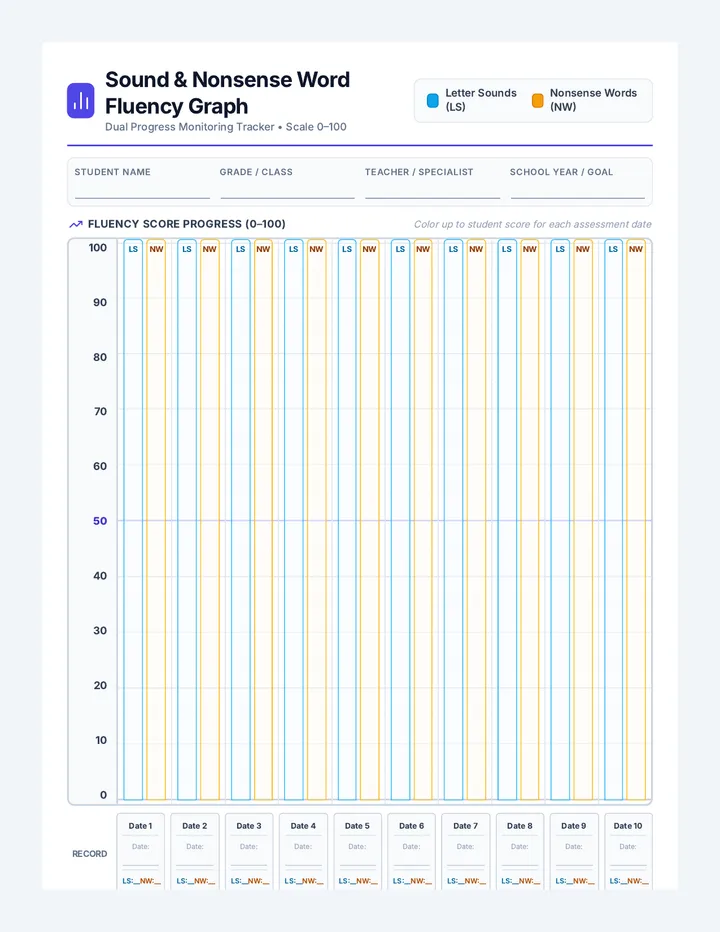
Fluency Graphs
Students plot their WCPM after cold reads.
Goal Check-ins
Self-rating on behavior goals at 15-min intervals.
Student Fluency Tracker
"I saved 3 hours of graphing per week."
Instructional Design Audit
The Input
The worksheet has exactly 10 questions for easy percentage calculation.
The Prompt
Multiple choice questions map directly to IEP sub-skills (e.g., Q1-3 are decoding, Q4-10 are comprehension).
The Output
A "Data Header" at the top of the page for the paraprofessional to quickly log accuracy.
Automating the Log
Google Forms
QR codes on student desks for behavior self-entry.
Auto-Dashboard
Data pipes directly into your quarterly progress report.
Self Graphing Student Tracker My Growth Tracker
NAME:
GOAL:
Instructions: After each session, record your score and color in the bar to see your growth over time!
100 80 60 40 20 0
Trial 1
Trial 2
Trial 3
Trial 4
Trial 5
Trial 6
Trial 7
Trial 8
Success Reflection
What did you do today that helped you grow?
Next Steps
What is one thing you want to try in the next session?
Implementation Note: Student-led data collection satisfies metacognitive standards while automating the graphing requirements of progress monitoring. This document serves as primary evidence for IEP data points.
Embedded Assessment Design Checklist Data Design Audit
Checklist for Embedded Assessment Efficiency
Instructional Task Design
Discrete Trial Mapping
The worksheet contains a specific number of opportunities (e.g., 5, 10, or 20) to make percentage calculation instantaneous.
Standardized Formatting
Every lesson follows a consistent structure so students know exactly where and how to record their scores.
Direct Alignment
Every task on the worksheet maps 1:1 to an IEP goal or objective. No "fluff" tasks are included during direct service time.
The Logistical Flow
Para-Friendly Headers
Worksheets include a "Staff Use Only" box at the top right for quick tallies (+ / -) by paraprofessionals.
Instant Digital Entry
Lessons conclude with a 2-minute "Digital Log" routine (e.g., QR code form or tablet entry) to eliminate paper trail management.
Self-Checking Mechanisms
Answer keys are provided for non-target skills so students can self-correct, freeing the teacher for direct observation of IEP targets.
Lesson Audit Challenge
Select one of your upcoming lesson plans. Answer the following:
1. What specific IEP goal data point does this lesson produce? (e.g., % accuracy on 2-digit subtraction)
2. How long does it take YOU to move that data from the worksheet to your master log? (Target: < 30 seconds)
3. What change could you make to the worksheet layout to make data entry faster?
Chaos Control Slides Chaos Control
Maintaining FAPE Amidst Schedule Disruptions
Lesson 5: Compliance & Contingency Planning
The "Snow Day" Scenario
"Three snow days in one month wiped out all your Friday service minutes. Now what?"
Legal Risk: Failure to provide FAPE.
Logistical Risk: Overcrowded makeup sessions.
Compensatory Thinking
It's not just about "making it up"—it's about documenting Good Faith Effort and Substantial Compliance.
Common Schedule Killers
School-Wide
• Assemblies
• Pep Rallies
• Fire Drills
• Testing Weeks
Personnel
• Teacher Absence (Sick)
• IEP Meetings (Staffing)
• Professional Development
• Field Trips
Environmental
• Snow Days
• Power Outages
• Lockdowns
• Room Relocation
The 3-Step Compliance Shield
01
Notification
Clearly document that service was missed and WHY (e.g., "Student absent" vs. "Teacher in IEP meeting").
02
Quantification
Track total minutes owed. Use a rolling ledger system so you never lose count.
03
Recovery
Schedule 'Make-Up' blocks. If service cannot be recovered in 30 days, notify administration of the FAPE gap.
Professional Integrity
"You are not a superhero. You cannot create more time. You can only document your systems for managing the time you have."
End of Sequence: Caseload Efficiency
Make-Up Service Protocol Make-Up Service Protocol
Regulatory Compliance & Recovery Log
Standard Operating Procedure
Phase 1: Documentation
Any service missed for non-student related reasons (e.g., teacher meeting, school assembly) must be logged immediately as "Recoverable Time."
Phase 2: Recovery
Attempt recovery within 10 school days. If recovery is not possible within a 30-day window, formal notification of a "Service Gap" must be sent to the LEA representative.
Service Recovery Ledger
TEMPLATE-ID: L5-COMPLIANCE-LOG
Date Missed Student(s) Minutes Owed Reason for Gap Recovery Date/Notes
Professional Notification Boilerplate
Copy/paste for email to Administration/LEA when recovery is not possible:
"This notice is to document that Student(s) [Name/Initial] did not receive mandated IEP services for the period of [Dates] due to [Reason]. To date, [X] minutes remain unrecovered despite a good-faith effort to utilize secondary scheduling blocks. I am requesting an administrative review of the current master schedule to ensure continued FAPE compliance."
Chaos Scenarios Case Studies Chaos Scenarios
Contingency Planning Workshop
L5-WORKSHOP-01
"Special education scheduling is not a static document; it is a living system. Below are three common 'Chaos Scenarios.' For each, determine your immediate compliance response and your long-term scheduling fix."
Scenario A: The Testing Vortex
State testing occupies the computer lab and all general education classrooms for 4 hours every morning for two weeks. Your Resource Room is being used as a small-group testing site for students not on your caseload.
Short-Term Compliance (Week 1-2)
Long-Term Schedule Fix
Scenario B: The Para-Shortage
One of your two paraprofessionals is out on medical leave for 3 weeks, and no substitute is available. This paraprofessional was responsible for three 30-minute inclusion blocks for students with high behavioral needs.
Immediate Coverage Shift
Documentation / Parent Notice
Scenario C: The Meeting Avalanche
Annual review season has arrived. You have 8 IEP meetings scheduled over the next three days, all during your morning instructional blocks. Your administrator says "do your best to see the kids after the meetings."
Advocacy for Subs/Coverage
Make-Up Logistics Plan